




Abstract
We used the Theory of Planned Behavior (TPB) to analyze the role of attitudes, subjective norms, and perceived behavioral control as predictors of intentions to obtain Human Papillomavirus (HPV) vaccinations or a Papanicolaou (Pap) smear in a sample of young Singaporean women. A further aim was to evaluate knowledge of cervical cancer and preventive measures as a possible additional predictor of intentions. A purpose-designed TPB and knowledge questionnaire was completed by 206 women aged 18 to 26 years living in Singapore. Descriptive analyses and structural equation modeling revealed subjective norm as the best predictor, while perceived behavioral control had moderate predictive power. Attitude and knowledge were not significant predictors of intentions. The findings suggest the importance of focusing on subjective norms, rather than factual knowledge, in educational and awareness campaigns that encourage HPV vaccination and Pap smear screening in Singapore.
In Singapore, cervical cancer is the fourth most frequent cancer among young women (15-44 years) with annual incidence rates of 11.5 per 100,000 women (Bruni et al., 2014). Despite the observed declining incidence of cervical cancer, the burden of the disease remains moderately high in Singapore, with 918 new cases and 354 deaths between 2007 and 2011 (H. P. Lee et al., 2011). In this study, the Theory of Planned Behavior (TPB) was used to explore young Singaporean women’s intentions regarding cervical cancer prevention.
Two preventive measures, the Human Papillomavirus (HPV) vaccination (since 2006) and Papanicolaou (Pap) smear screening (since 1964), have been made available to women in Singapore. HPV vaccination, which stimulates adaptive cellular immunity against the HPV pathogen, is recommended for Singaporean women from 9 to 26 years, prior to first sexual exposure (Bruni et al., 2014) and is administered on a three-cycle basis. A Pap smear test is recommended once every 3 years for Singaporean women who are above 25 years and sexually active (Health Promotions Board, 2014).
Socio-cultural influences in Singapore, such as Chinese ethnicity and lower educational level, are believed to contribute to increased risk of cervical cancer development (Bruni et al., 2014). In response to this increased risk, ongoing public education and social marketing programs in Singapore have introduced initiatives such as vaccination subsidies and free Pap smears for females aged 25 to 69 years. However, despite epidemiological evidence suggesting that organized screening is more effective than opportunistic screening in reducing mortality rates (Simonella & Canfell, 2013), in Singapore these prevention programs are opportunistic and thus utilization rates of both interventions are low. Only 3% of Singaporean women have been immunized (H. C. Lee, 2010), and only 52% of the target population attended for a Pap smear over the 3 years 2011 to 2013 (Health Promotions Board, 2014).
Useful guidelines to encourage prevention activities have been developed (Smith et al., 2013), which focus on removing barriers to prevention and increasing knowledge and availability of prevention initiatives. However, previous research also identifies psychological factors as being a strong influence on prevention behaviors. Across a range of samples, attitudes and self-efficacy perceptions have been associated with prevention intentions. For example, pain, embarrassment, and fear were reported as intrusive (Pitts et al., 2009; Steven et al., 2004), extenuated by negative perceptions of inconvenience and cost incurred by medical examinations (Kuitto, Pickel, Neumann, Jahn, & Metelmann, 2010; Tan, 2013). Perceptions of long-term health benefit have been associated with regular screening attendance (Reid, 2001). In terms of self-efficacy, women reported lack of accessibility to a regular family doctor (Bish, Sutton, & Golombok, 2000), time constraints due to work (Markovic, Kesic, Topic, & Matejic, 2005), and affordability concerns that limit their belief in their own ability to access prevention services (Taylor et al., 2002).
Opinions and actions of social referents may be associated with prevention intentions. For example, Singaporean women reported high compliance with parents and doctors who expressed negative concerns about sexual promiscuity and side effects (Chow et al., 2010). Asian women have also indicated need of relationship partner support (Yeoh, Chew, & Wang, 2006), peer approval, and endorsement by public figure (Tay, Ngan, Chu, Cheung, & Tay, 2008).
Knowledge of cervical cancer risks, HPV causality, and prevention measures is positively associated with women’s intentions to attend cervical cancer prevention measures in Western countries (Reid, 2001; Steven et al., 2004). Singaporean women, however, reportedly have lower knowledge levels compared with the worldwide average (Klug, Hukelmann, & Blettner, 2008), suggesting this may contribute to low uptake of preventive measures.
The TPB is widely used to examine the determinants of health-related intentions (Ajzen, 2002) and thus may be useful in explaining Singaporean young women’s cervical cancer prevention intentions. The TPB posits the volitional constructs of attitude; subjective norm with the non-volitional construct of perceived behavioral control combine to predict behavioral intentions (Ajzen, 2002). TPB emerged as a superior predictor of intentions when compared with traditional health models such as the Health Belief Model, Social Cognitive Theory, and Theory of Reasoned Action Model in cancer screening meta-analytic reviews and cervical cancer studies (Bish et al., 2000; Cooke & French, 2008).
Attitude is a measure of favorable or unfavorable beliefs toward obtaining a vaccination or Pap smear. The TPB model predicts that women have higher intentions to utilize cervical cancer prevention measures if they hold favorable attitudes (Jennings-Dozier, 1999; Linton, 2009; Teitelman et al., 2011). Studies have reported significant associations between cervical cancer prevention measures and attitudinal related-factors such as pain, embarrassment, and fear (Pitts et al., 2009; Steven et al., 2004), inconvenience and cost (Kuitto et al., 2010; Tan, 2013), and health benefits (Reid, 2001).
Subjective norm is the perception of whether important referents would consider it essential to obtain a vaccination or a Pap smear. The TPB model predicts that women have higher intentions to utilize cervical cancer prevention measures if they experience positive subjective norms (Teitelman et al., 2011). In the collectivistic Singapore society, heightened motivation to think consensually with significant others may increase the importance of subjective norms in determining intentions (Zou et al., 2009). Subjective norms may be separated into injunctive and descriptive norms (Hagger & Chatzisarantis, 2005). Injunctive norm is the approval or disapproval of vaccination or Pap smear by important social referent figures. For example, in South-East Asian countries, parents and doctors may express negative concerns about sexual promiscuity and side effects (Chow et al., 2010; Pitts et al., 2009). Women also seek the approval of their relationship partner (Yeoh et al., 2006). Descriptive norm is the self-identification with the referent who has attended a vaccination or a Pap smear. Significant associations exist between cervical cancer prevention measures and peer approval and the endorsement of public figures (Tay et al., 2008).
Perceived behavioral control is the perception of ability to perform a given behavior (Ajzen, 2002), in other words, the difficulty of obtaining Pap smear or vaccination depending on factors that may act as barriers or facilitators. The TPB model predicts that women have higher intentions to utilize cervical cancer prevention measures if they have significant perceived behavioral control (Askelson et al., 2010; Teitelman et al., 2011). Factors affecting perceived control may include accessibility to a family doctor (Bish et al., 2000), time (Markovic et al., 2005), and affordability of Pap smear and vaccination (Menvielle, Richard, Ringa, Dray-Spira, & Beck, 2014; Taylor et al., 2002). However, it is the perception of ease or difficulty that is important in determining intentions. Intention is an indication of a person’s readiness to perform a given behavior (i.e., readiness to participate in a full three-cycle HPV vaccination course or a regular Pap smear).
In addition to the constructs of the TPB, Knowledge levels may also influence individual cost–benefit calculations for undertaking prevention measures (Kuitto et al., 2010). TPB studies on cervical cancer prevention have commonly used knowledge as a supplementary measure when seeking to understand Pap smear intentions. For example, young women in Canada were observed to have moderate knowledge about Pap tests, but low understanding on HPV significance in cervical cancer (Duffett-Leger, Letourneau, & Croll, 2008) and Californian college women’s gaps in HPV-related knowledge were considered to contribute to incorrect beliefs influencing behavior regarding HPV vaccination (Ratanasiripong, Cheng, & Enriquez, 2013). To date, there are no studies of HPV prevention knowledge in Singaporean young women. Knowledge is hence proposed as an additional predictor to the TPB to improve predictive power and increase the ability to explain cervical cancer prevention intentions.
Figure 1 shows the constructs of the TPB model predicting intentions for vaccination (Figure 1a) and Pap screening (Figure 1b). Both models assess the strength of the three TPB predictors. Attitude is composed of six items, being pain, embarrassment, benefits, hassle, fear, and cost. Subjective norm is composed of two summed constructs of injunctive norm and descriptive norm. Perceived behavioral control is composed of items of accessibility to a doctor, time, and affordability. Intention is composed of two to three items that consist of either future, immediacy, regularity, or completion.
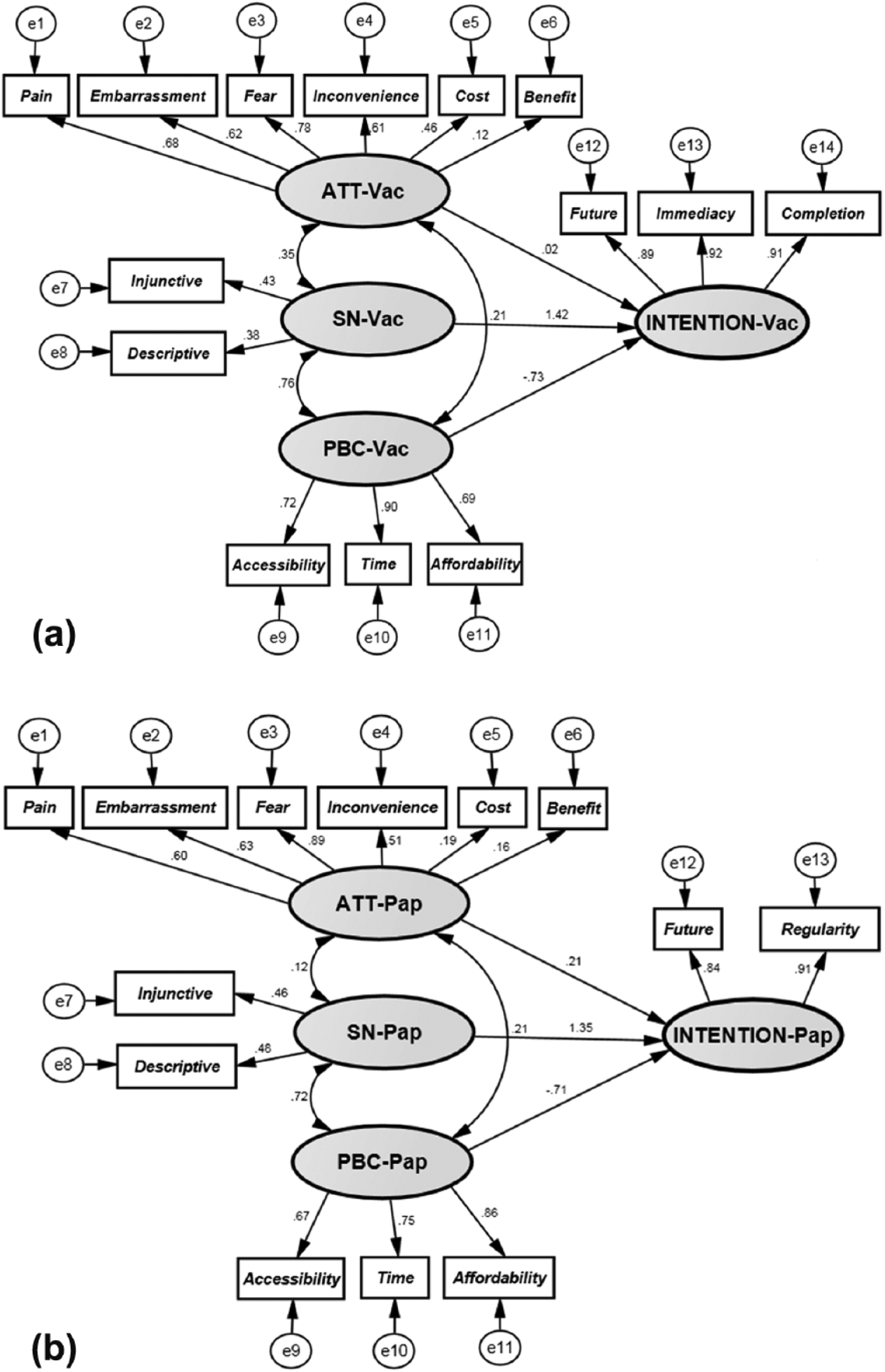
Vaccination model (a) and Pap screening model (b), which assess relative strength of the TPB predictors on HPV vaccination and Pap screening intentions.
The focus of this study was young Singaporean women between 18 and 26 years old, which is the recommended age for vaccination in Singapore. As the model predicts future intentions, all women in the stated age group were eligible to participate, regardless of previous risk or prevention behaviors. The aim of the current study was to assess the relative impact of the predictive factors of attitude, subjective norm, and perceived behavioral control under a single theoretical framework of TPB, as well as evaluating the impact of the addition of the knowledge construct to the TPB model. These constructs should predict intentions of young Singaporean women to utilize HPV vaccination and Pap smear preventive measures. Specifically, it was hypothesized that the constructs of attitude, subjective norm, and perceived behavioral control would predict HPV vaccination and Pap smear intentions in Singaporean young women and, further, that the addition of the knowledge construct would improve the ability of the overall TPB model to predict HPV vaccination and Pap smear intentions.
Method
Participants
Institutional Human Research Ethics Committee approval was obtained prior to any recruitment or data collection. The sample of 206 participants was recruited via snowball sampling from December 2012 to January 2013. The inclusion criteria were 18- to 26-year-old females who had resided in Singapore for 2 or more years. Women with a history of cervical cancer or hysterectomy procedure were excluded. A high response rate of 86% (206 responses out of 240 distributed questionnaires) was obtained. The ethnic mix of Chinese (75.7%), Malay (13.1%), Indian (3.9%), and others (6.3%) is representative of the ethnicity profile of Singapore, that is, Chinese (74.2%), Malay (13.3%), Indian (9.1%), and (3.3%) others (Singstats, 2013). Demographics, medical history, and awareness of public cervical cancer prevention campaigns are summarized in Table 1. More than half of the participants were sexually active (77.2%) and aware of HPV vaccination (55.3%) and Pap screening (66.5%). Uptakes were low for HPV vaccination (13.6%) and Pap smear (5.3%). Only 38.3% of the participants reported awareness of public cervical cancer prevention campaigns.
Demographic Profile, Risk Factors, and Awareness of Cervical Cancer.
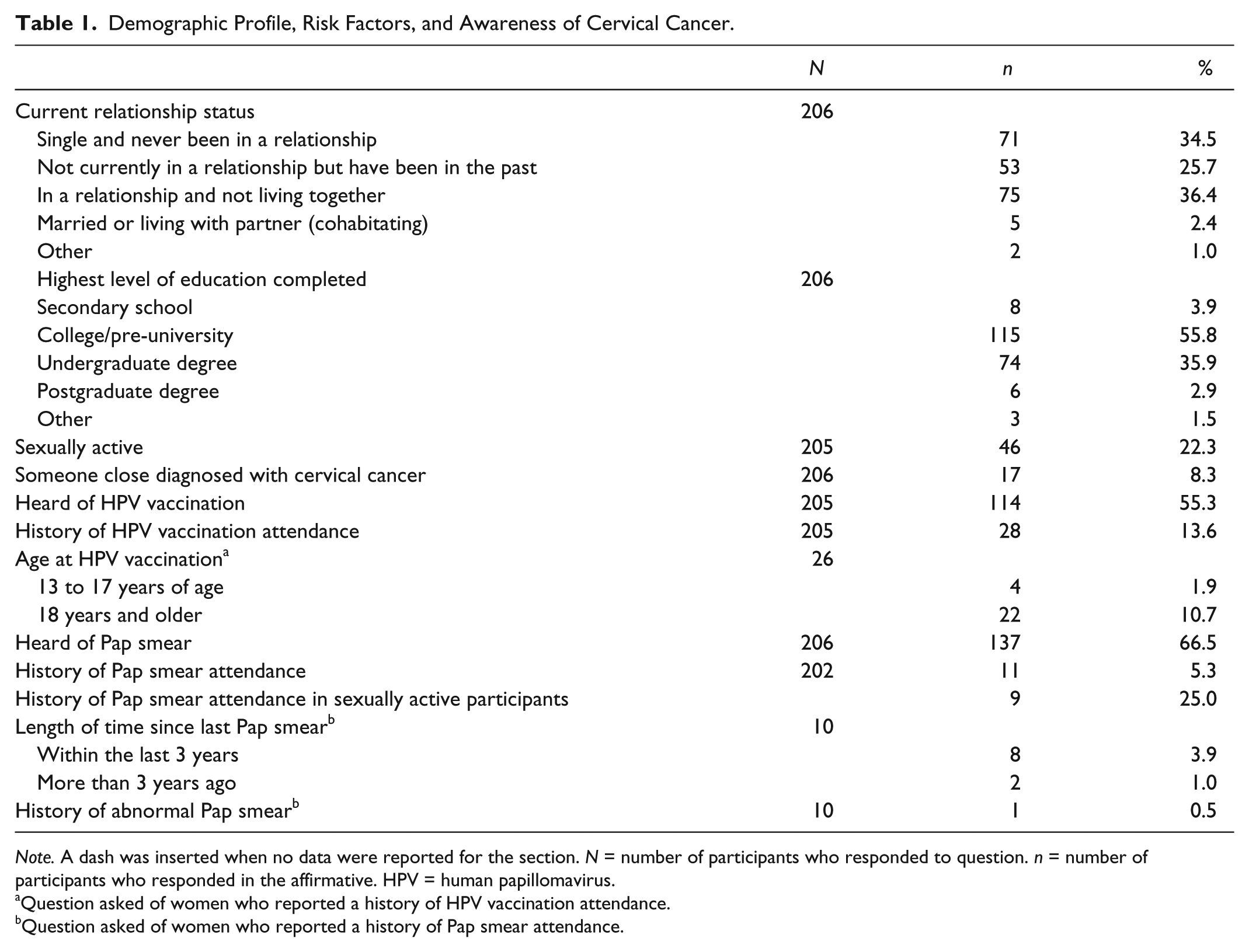
Note. A dash was inserted when no data were reported for the section. N = number of participants who responded to question. n = number of participants who responded in the affirmative. HPV = human papillomavirus.
Question asked of women who reported a history of HPV vaccination attendance.
Question asked of women who reported a history of Pap smear attendance.
Materials
A study-specific questionnaire was designed, measuring demographics, risk factors, cervical cancer knowledge, and the TPB constructs based on Ajzen’s TPB questionnaire construction recommendations (Ajzen, 2006). The Knowledge questionnaire was adapted from Shand, Burney, and Fletcher’s study in Australia (Shand, Burney, & Fletcher, 2010). Cronbach’s alpha reliability is not calculated for the whole questionnaire as it measures multiple constructs (Ajzen, 2006); however, individual construct alphas were adequate, ranging from .71 (attitude) to .93 (intentions), except for descriptive norms, which was .48.
Statistical Analysis
A priori power analyses for Structural Equation Modeling (SEM) using a root-mean-squared-error-of-approximation (RMSEA; Steiger, 1998) test of good fit (Kim, 2005), with alpha level of .05 and .8 power (Cohen, 1988), showed 179 participants were required. SEM was conducted using AMOS Version 20 evaluating the TPB predictors of HPV vaccination (vaccination model) and Pap screening intentions (Pap screening model). Knowledge was then added to both SEM models as a predictor.
Results
Data Screening
The missing data proportions were small (<5%), enabling listwise deletion. All four SEM models met the five SEM assumptions (McDonald & Ho, 2002). The endogenous dependent variable (Intention) was continuously distributed. All measurement models identified appropriate parameters of independently estimated regression weights. Scores for Knowledge and the TPB constructs are summarized in Table 2.
Participant Knowledge and TPB Constructs.

Note. M = mean; SD = standard deviation; TPB = theory of planned behavior.
Maximum possible score = 20. Knowledge scores incorporate both vaccination and Pap screening constructs.
Maximum possible score = 49. Subjective norm obtained by normative referent score of 7 multiplied by motivation to comply score of 7. Descriptive norm obtained by was normative referent score of 7 multiplied by identification of referent score of 7.
Maximum possible score = 7.
Assessment of Model Fit
All models had acceptable fit. The chi-square ratio indices were less than three and were statistically significant, p < .001 (Barrett, 2007). The comparative fit index (CFI; Bentler, 1990), goodness-of-fit index (GFI; Joreskog, 1973), and Tucker–Lewis index (TLI; Tucker & Lewis, 1973) were mostly above .90, suggesting an excellent fit. The RMSEA had values less than .08, which is an acceptable fit. Table 3 presents GFI for all four models. Figure 2 displays the respective standardized regression coefficients of the TPB constructs as predictors of vaccination (Figure 2a) and Pap screening (Figure 2b) intentions.
Goodness of Fit Indices for Four SEM Models.

Note. χ2/df = chi-square indices; Pap model = Pap screening model; Pap screening-knowledge model; Vac model = vaccination model; Vac-K model = vaccination-knowledge model. SEM = structural equation modeling; CFI = comparative fit index; GFI = goodness-of-fit index; TLI = Tucker–Lewis index; RMSEA = root mean squared error of approximation.
Criteria met for χ2 ratio indices.
Criteria met for goodness of fit indices.
p < .05.
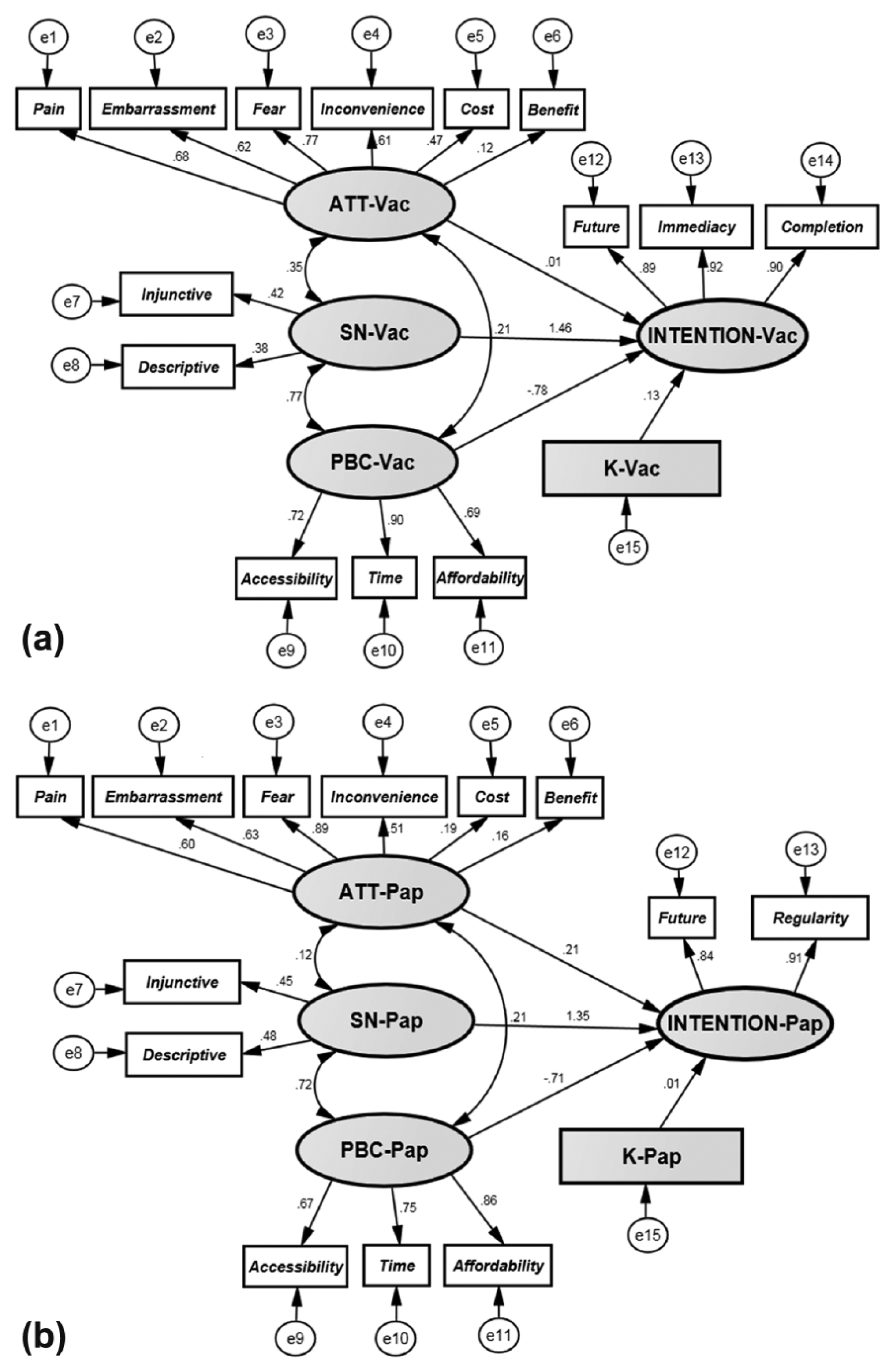
Vaccination-knowledge model (a) and Pap screening-knowledge model (b), which assess relative strength of knowledge as an additional predictor on HPV vaccination and Pap screening intentions.
Estimation of vaccination model
Higher levels of subjective norm (β = 1.42, p < .001) significantly predicted higher vaccination intentions. Higher levels of perceived behavioral control (β = −0.73, p = .014) significantly predicted lower vaccination intentions. Attitude was a non-significant predictor of vaccination intentions despite a positive beta weight (β = 0.02, p = .920).
The suppression phenomenon as proposed by Velicer (1978) may have caused the negative regression weight of perceived behavioral control. There was a high multicollinearity (r = .76) between perceived behavioral control and subjective norm. Subjective norm as a strong predictor (β = 1.42, p < .001) may have acted as a reciprocal negative suppressor of perceived behavioral control. To confirm the suppression effect, we conducted a partial correlation between perceived behavioral control and intention, controlling for subjective norm, and found a significant positive relationship (r = .20, p = .007).
Estimation of Pap screening model
High levels of subjective norm (β = 1.35, p < .001) significantly predicted high screening intentions. High levels of perceived behavioral control (β = −0.71, p = .004) significantly predicted low screening intentions, which may be again attributed to the suppression phenomenon (Velicer, 1978). Attitude was a non-significant predictor of screening intentions despite the positive beta weight (β = 0.215, p = .175). Figures 2a and 2b display the respective standardized regression coefficients of the models with knowledge as an additional predictor of intentions.
Estimation of vaccination-knowledge model
Knowledge was non-significant (β = 0.13, p = .057) and did not add to the predictive validity of the model. High levels of subjective norm (β = 1.46, p < .001) significantly predicted high vaccination intentions. High levels of perceived behavioral control (β = −0.78, p = .012) significantly predicted low vaccination intentions, which may be attributed to the suppression phenomenon (Velicer, 1978). Attitude was a non-significant predictor of vaccination intentions with a low beta weight (β = 0.01, p = .979).
Estimation of Pap screening-knowledge model
Knowledge was non-significant (β = 0.01, p = .911) and did not add to the predictive validity of the model. High levels of subjective norm (β = 1.35, p < .001) significantly predicted high screening intentions. High levels of perceived behavioral control (β = −0.71, p = 004) significantly predicted low screening intentions, again likely due to the suppression phenomenon (Velicer, 1978). Attitude was a non-significant predictor of vaccination intentions with a low beta weight (β = 0.22, p = .235).
Discussion
This study investigated the predictors of the intentions of young 18- to 26-year-old Singaporean women to utilize HPV vaccination and Pap smear preventive measures. Subjective norm was the strongest predictor of intentions, while perceived behavioral control had moderate predictive power. Attitude was not a significant predictor. In the second model, knowledge was added. However, this was not a significant predictor of intentions and did not add predictive power to the TPB model. These results are consistent with past research showing that subjective norms are the strongest predictor of prevention intentions for the uptake of both vaccination (Teitelman et al., 2011) and Pap smear (Duffett-Leger et al., 2008) in TPB studies of young women. The addition of second-order latent constructs of injunctive and descriptive norm may have further improved the predictive validity of first-order subjective norm in the current model, as compared with conventional TPB models (Hagger & Chatzisarantis, 2005). The importance of subjective norms may also reflect the conservative and collectivistic culture in Singapore, which encourages consensual thought and behavior in line with accepted social norms (Zou et al., 2009). Hence, young women’s prevention intentions may be strongly influenced by the opinions of social referents such as relationship partners (Yeoh et al., 2006) and peers (Tay et al., 2008).
Young women’s perceived behavioral control was moderately associated with intentions, which is consistent with Linton’s finding that 30% variance in cervical cancer prevention intentions is due to perceived control (Linton, 2009). Considering the low levels of exposure to Pap smear (5.3%) and HPV vaccination (13.6%) of our sample, screening decisions are unlikely to be habitual responses, thus accounting for lower perceptions of control. However, the regression weight was negative (β = −0.73 to −0.71), contrary to TPB prevention studies, which found significant positive regression weights (β = 0.27 to 0.61; Askelson et al., 2010; Teitelman et al., 2011). One study observed that women might have entertained novel cognitions (i.e., thoughts of getting a vaccination) during questionnaire completion (Ratanasiripong et al., 2013), which may raise barrier perception, such as lack of time (Markovic et al., 2005) and affordability (Taylor et al., 2002), thus implying low control. From an empirical perspective, the negative regression weights for perceived behavioral control are likely due to the suppression phenomenon (Velicer, 1978). Subjective norm was a very strong predictor (β = 1.35-1.42) and may have been a suppressor of effects of perceived behavioral control. Post hoc partial correlation analyses showed a significant positive correlation between these two predictors (r = .55). Thus, while there is overall support for the hypothesized TPB model fitting the data, the control component of the model may warrant further attention.
Young women’s attitudes were not a significant predictor of HPV vaccination and Pap screening intentions, with small to negligible associations. This contrasts with previous TPB studies which found that attitudes were the strongest predictor of intention regarding vaccination (Teitelman et al., 2011) and Pap smear uptake (Jennings-Dozier, 1999; Linton, 2009), accounting for 58% to 83% of the variance in intentions. The theoretical premise of the TPB states that attitudes develop into stable representations over time (Ajzen, 2011). Given that the majority of this sample had never had HPV vaccination (86%) or Pap smear (95%), it is possible that anticipatory anxiety of pain, embarrassment, and fear may not be as entrenched as the stabilized attitudes of older women who have experienced Pap smear or HPV vaccination. However, the finding that attitudes were a non-significant predictor raises some interesting questions. This challenges the conventional focal point in cervical cancer prevention campaigns, which predominantly target change in attitudes (Health Promotions Board, 2014; H. C. Lee, 2010). From a practical perspective, given that vaccination should occur by 26 years of age, all the unvaccinated participants in this sample should be forming intentions for or against vaccination, and these intentions about Pap smear may not yet be stable. Interestingly, however, the same pattern of results held for both vaccination and Pap smear. From a theoretical perspective, Ajzen and Fishbein (2004) argued that the relative importance of TPB constructs for the prediction of intentions is expected to vary in terms of target behavior and in different populations. Although the three TPB antecedents should be sufficient to predict intentions, only one or two, and in this case, specifically, subjective norm, may be necessary for effective application. Furthermore, the lack of predictive validity of attitudes may indicate that for cervical cancer prevention, attitudes may not be an important consideration in the Singapore population.
Young women’s knowledge was not a significant predictor of cervical cancer prevention intentions. Despite being aware of HPV vaccination (55%), Pap smear (67%), and cervical cancer prevention campaigns (38%), the young women in the current sample reported low utilization of HPV vaccination (14%) and Pap smears (5%). This apparent contradiction may be due to the constantly changing operationalization of knowledge in different contexts and time frames. Individuals are constantly presented with new health care research that updates or conflicts with prior knowledge or provides new options for diagnosis and treatment (Tiro, Meissner, Kobrin, & Chollette, 2007). Hence, subjective norms may come to play a stronger role than knowledge in determining intentions.
This may be the first study in which knowledge as a predictor has been incorporated into a theoretical TPB model. In past research, knowledge has been used as a supplementary measure (Duffett-Leger et al., 2008) or an indirect predictor (Ratanasiripong et al., 2013). Also, in the present study, SEM provides an overview of the relative importance of contributing variables and suggests that, contrary to extant research, promoting knowledge may not be the most effective way to increase the uptake of cervical cancer prevention strategies.
Some limitations of this study must be acknowledged. These include those of the TPB itself. The TPB assesses intentions and does not account for the likely gap between intention and behavior. As this was a cross-sectional study, the actual behavior of participants was not measured. Rather, information on Pap smear and vaccination history was obtained retrospectively. Future research should use a longitudinal design to assess actual behavior. Another limitation was the homogeneity of the study population, composed largely of highly educated Asian women. Previous research has typically studied more ethnically diverse or minority samples, who tend to have lower cervical screening rates and are medically uninsured (Teitelman et al., 2011). Furthermore, the limitations of convenience sampling and self-report methods must be acknowledged.
The study has implications for health care systems in Singapore, where health planners may increase participation rates of cervical cancer prevention by developing comprehensive services with consideration of the influence of subjective norms based on sexual conservatism and communality. Awareness campaigns, rather than focusing on knowledge per se, could encourage open dialogue on the risks and prevention of cervical cancer.
Overall, this study lends further support to the TPB as well as highlighting the importance of subjective norms, in contrast to the conventional predictors of attitudes and knowledge in determining intentions. This result could potentially lead to the emphasis of social influence in cervical cancer prevention campaigns designed to increase HPV vaccination and Pap smear uptake.
Footnotes
Declaration of Conflicting Interests
The author(s) declared no potential conflicts of interest with respect to the research, authorship, and/or publication of this article.
Funding
The author(s) received no financial support for the research and/or authorship of this article.