




Abstract
This study examined the utility of an adapted version of the Brief Resilience Scale (BRS) to measure Chinese undergraduates’ ability to bounce back from stress. The BRS together with measures tapping optimism, self-esteem, pessimism, and physical health were administered to 547 Hong Kong and 268 mainland Chinese undergraduates. The BRS was found to measure one single construct and exhibited convergent validity in both samples. Further analyses using a path analytic model showed that the BRS scores substantially mediated the link between the two positive traits (optimism and self-esteem) and physical health in the two samples. The results suggested that the BRS is a reliable and valid instrument for measuring Chinese undergraduates’ ability to bounce back from stress. The implications for further research related to resilience in Chinese people are discussed.
The last few decades have witnessed a proliferation of research related to the construct of resilience and its health implications in different populations (Norris, Tracy, & Galea, 2009). Resilience research has been extended from its original focus on successful adaptation among children exposed to adversities (Cowan, Cowan, & Schulz, 1996) to adult populations, and has more recently encompassed optimal functioning (Schetter & Dolbier, 2011). Despite the wealth of data demonstrating the health and adaptive benefits of resilience, issues related to the proper conceptualization of this construct have recently emerged. Resilience has been operationalized in at least two ways in the literature. First, it has referred to the possible trajectories (e.g., absence of symptoms or recovery) following exposure to a trauma (e.g., Bonanno, 2004; Bonanno, Galea, Bucciareli, & Vlahov, 2006; Carver, 1998; Norris et al., 2009). Second, it has been defined as the personal qualities and social resources that influence the aforementioned trajectories (e.g., Connor & Davidson, 2003; Friborg, Hjemdal, Martinussen, & Rosenvinge, 2009). In other words, the term resilience has been used to denote both an adaptive outcome and the antecedents/predictors of that outcome, which is conceptually confusing (Smith, Tooley, Christopher, & Kay, 2010; Smith et al., 2008). As resilience was originally conceptualized as a trajectory of possible outcomes after exposure to a traumatic event or as a recovery from adversity, it can only be operationalized in a longitudinal context in which a person’s psychological response to adversity is monitored over time. Individuals are considered to exhibit resilience if their psychological functioning or mental health status returns to its preexposure level after a traumatic encounter (e.g., Bonanno, 2004). Specific personal qualities and social resources may predict who exhibits resilience over time, but these qualities and resources are not identical to outcomes. Smith et al. (2008) suggested that it would be more appropriate to consider these qualities and resources as “resilience resources.” However, most existing measures of resilience have been developed exclusively to assess resilience resources rather than outcomes.
The Brief Resilience Scale (BRS) was developed to measure an individual’s ability to bounce back or recover from stress (Smith et al., 2010; Smith et al., 2008), and is considered to relate more closely to the original meaning of resilience. The ability to bounce back from stress, or “resilience,” is conceptually different from “resilience resources.” “Resilience” is oriented toward stress (Smith et al., 2010), whereas “resilience resources” such as optimism and self-esteem have broader effects because their influences are not restricted to the domain of stress or negative events (Smith & Zautra, 2008). Smith et al. (2010) emphasized that although the BRS is a measure of a person’s belief in how well he or she can bounce back rather than his or her success in doing so, this belief may serve as a prerequisite of the individual’s actual ability to bounce back. As such, the effect of the BRS can be considered as analogous to that of self-efficacy measures, which involve an individual’s beliefs about how well he or she can do something rather than his or her actual performance.
The six-item BRS has been shown to be a reliable and valid measure of one’s ability to bounce back from stress (Smith et al., 2010; Smith et al., 2008). The construct identified by the BRS is not the same as that measured by established scales such as the Connor–Davidson Resilience Scale (CD-RISC) and the Ego Resilience Scale, with which it is only moderately correlated (Smith et al., 2008). The BRS reliably predicts both affective and physical health measures when the effects of other resilience resources are controlled (Smith et al., 2010). Moreover, the effect of the BRS is more consistent across different health outcomes compared with resilience resource measures. In a study conducted by Smith et al. (2009), higher scores on the BRS were shown to predict quicker habituation to heat and cold pain in women, providing additional support for the validity of the scale.
Research related to resilience in Chinese populations has emerged only recently. The construct has been operationalized as a composite of optimism, self-esteem, and perceived control, and has been shown to predict a better response to rehabilitation in Chinese cardiac patients (Chan, Lai, & Wong, 2006) and more adaptive health outcomes in nurses (Chan, 2006), and to moderate the effect of daily problems on the positive well-being of Chinese undergraduates (Lai & Mak, 2009). Although this operationalization has been shown to apply to both Western (e.g., Taylor & Brown, 1988; Taylor, Kemeny, Reed, Bower, & Grunenewald, 2000; Wanberg & Banas, 2000) and Chinese populations (e.g., Chan et al., 2006), it tends to obscure the differential contributions of the three positive qualities, and is not immune to the problem identified by Smith et al. (2008).
Resilience in Chinese people has also been studied using an adapted version of the CD-RISC developed by Connor and Davidson (2003; Yu & Zhang, 2007). However, similar to other resilience measures, the CD-RISC was devised to identify the resilience resources that predict a person’s adaptive outcomes rather than his or her ability to bounce back. Further research on resilience in Chinese people would be hampered without a reliable and valid measure of the construct. The present study addresses this issue by validating the BRS among Chinese undergraduate participants from Hong Kong and Nanjing, China. Comparable Chinese samples were recruited to ensure compatibility. Nanjing University was selected for three reasons: (a) both Hong Kong and Nanjing are key metropolitan cities in China; (b) the City University of Hong Kong and Nanjing University are comparable in terms of their rankings among Asian universities, with the City University of Hong Kong ranking 19th and Nanjing University ranking 28th according to the Quacquarelli Symonds (QS) ranking of Asian universities in 2013/2014; and (c) the two universities are located in the center of the city and have similarly sized student populations.
One’s ability to bounce back is different from the resilience qualities identified by the conventional measures of resilience. Although Smith et al. (2008; Smith et al., 2010) empirically demonstrated this observation, studies have not yet addressed the issue of how such a personal quality is conceptually related to resilience resources. As the BRS is supposed to measure one’s ability to bounce back from stress, which is thought to be affected by resilience resources (Smith et al., 2008), one of the most reasonable hypotheses is that the ability to bounce back can be treated as a mediator of the link between resilience resources and health outcomes. This formulation is also compatible with the core feature of psychological resilience suggested by cognitive adaptation theory (Taylor & Brown, 1988), that is, the mobilization and augmentation of personal qualities including optimism, self-esteem, and perceived control in response to adversities. The augmentation of these resilience resources potentiates an individual’s ability to cope and increases the likelihood that the individual will bounce back from stress. In other words, resilience resources lead to resilience (the ability to recover from stress) in the individual, which, in turn, predicts his or her health outcomes. The present study tests this conjecture using path analysis. Verification of the following hypotheses would lend strong support to the validity of the construct measured by the BRS.
The BRS items measure one single construct. This is tested using exploratory factor analytic procedures.
In terms of convergent validity, the BRS is positively correlated with measures of optimism, self-esteem, and physical health, and negatively correlated with measures of pessimism.
In terms of incremental utility, BRS scores are able to predict a significant proportion of physical health variance beyond that explained by other resilience-related qualities.
BRS scores mediate the link between resilience resources and physical health. In the present study, a path model is used to delineate the effects of resilience resources and a person’s ability to bounce back on his or her physical health. As depicted in Figure 1, the ability to bounce back as indexed by the BRS scores mediates the effect of the two resilience resources (optimism and self-esteem) on an individual’s physical health. These two attributes are considered because studies have found their reactive augmentation and that associated with perceived control to be crucial for successful adaptation to adversity (Taylor & Brown, 1988; Taylor et al., 2000). Moreover, they form the core components of positive psychological capital (e.g., Luthans, Avolio, Avey, & Norman, 2007). The latter has been shown to predict a number of positive organizational outcomes (e.g., Luthans, Youssef, & Avolio, 2007).

Hypothesized path model: Resilience traits, resilience, and physical health.
Although research conducted under the rubric of resilience has focused on the mental health effects of the construct, the present study uses physical health as its outcome measure for the following reasons. First, the physical health benefits of specific resilience resources have been well documented in the literature (e.g., optimism, Rasmussen, Scheier, & Greenhouse, 2009; and positive emotions, Tugade, Fredrickson, & Barrett, 2004). Resilience resources have been shown to have a smaller effect on physical health than on mental health, but the effect is consistent and significant across studies (e.g., Rasmussen et al., 2009). The exclusive focus of the resilience research on mental health outcomes is not justified and has created a large knowledge gap, one that the present study attempts to fill by focusing on physical health outcomes. Second, recent evidence has shown that resilience resources are associated with a number of physiological benefits that may explain the better physical health of resilient individuals. These include a stronger vagal tone (Smeets, 2010), faster cardiovascular recovery from laboratory stressors (Tugade & Fredrickson, 2004), and lower salivary cortisol levels in the morning (Lai et al., 2010; Lai et al., 2005). This study’s focus on physical health addresses an issue of growing importance and thus makes a significant contribution to the literature.
Method
Participants
Hong Kong sample
The Hong Kong sample comprised 198 male and 349 female undergraduates recruited from a university in Hong Kong. The mean age of the sample was 21.26 years (SD = 1.84 years). The mean age of the male participants was 21.35 years (SD = 1.92) and that of the female participants was 21.22 years (SD = 1.80). All of the participants were ethnic Chinese and took part in the study anonymously. The participants were given cash shopping coupons of HKD50 each for contributing their time and effort to the study.
Mainland sample
The mainland sample consisted of 268 undergraduates (149 men and 119 women) recruited from Nanjing University in China. The mean age of the sample was 20.58 years (SD = 1.63). The mean age of the male participants was 20.39 years (SD = 1.48) and that of the female participants was 20.82 years (SD = 1.78). Like those in the Hong Kong sample, they took part in the study voluntarily and anonymously. However, they were given course credits instead of cash coupons in return for their contribution.
Procedure
Email advertisements were sent to undergraduate students enrolled in psychology courses at a Hong Kong university during the fall semester of 2009. The experimenter contacted students who showed interest in taking part in the study and briefed them about its nature and requirements. As a result, 547 students were recruited and subsequently tested in groups of 5 to 20 throughout the semester. The procedure used to recruit the Hong Kong sample was also adopted to recruit participants in Nanjing. Recruitment was conducted and completed in spring 2011, with 268 students volunteering to take part.
The participants in both samples were asked to complete a set of questionnaires consisting of the following scales written in Chinese: (a) the revised Life Orientation Test (Lai, 2009), (b) the Physical Health Questionnaire (PHQ; Ng, 2007), (c) the Rosenberg Self-Esteem Scale (SES; Cheng & Hamid, 1995), (d) the Chinese Hopelessness Scale (C-HOPE; Lai & Yue, 2000), and (e) an adapted version of the BRS.
These tests were administered to the two samples in a standardized manner. The experimenter taught the participants how to fill out the scales to ensure correct completion during each test session. It took each participant an average of 20 min to complete the questionnaire. At the end of the session, the participants were debriefed about the nature and aims of the study and given a chance to ask questions about the tests they had just completed and the research in general. They were then given a shopping coupon of HKD50 (Hong Kong sample) or course credits (mainland sample) for their participation.
Measures
Resilience
The participants’ resilience was measured using an adaptation of the BRS developed by Smith et al. (2008). The original English BRS consisted of six items identifying one’s ability to bounce back from stress. As the BRS had never been translated into Chinese, a back-translation procedure was adopted to translate the six items into Chinese. The experimenter translated the items into Chinese, and a postgraduate psychology student then back-translated them into English. The Chinese translations were modified until each item could be properly back-translated into English. To complete the scale, the participants were asked to indicate the extent to which they agreed with each of the six items according to a 5-point rating scale (1 = strongly disagree; 5 = strongly agree). The BRS was scored by reverse-coding Items 2, 4, and 6 and calculating the sum of all six items. The scale exhibited acceptable internal consistency in both samples, with Cronbach’s α values equal to .76 and .72 in the Hong Kong and mainland samples, respectively.
Optimism
Optimism was measured by a Chinese version of the revised Life Orientation Test (CLOT-R) adapted by Lai (2003) and subsequently validated by Lai et al. (2005), Lai (2009), Lai and Mak (2009), and Chan et al. (2006) using different Hong Kong Chinese samples. The six-item CLOT-R is based on the English version of the revised LOT (Scheier, Carver, & Bridges, 1994), with half of the items worded positively and the other half worded negatively. All of the items of the adapted scale were back-translated versions of their corresponding items in the revised English LOT except for the second item, which was developed by Lai (2003) to more precisely reflect a non-expectancy of positive outcomes (“Looking into the future, I do not see any positive scenarios”). Studies have shown the scale to be internally consistent for Hong Kong Chinese samples, with Cronbach’s α values ranging from .72 to .78 (Chan et al., 2006; Lai, 2009; Lai et al., 2005; Lai & Mak, 2009).
The respondents rated the extent to which they agreed or disagreed with each of the six items according to a 5-point scale (1 = strongly disagree, 5 = strongly agree). Filler items were not included in the test. The participants were assigned optimism scores, which were calculated by adding the ratings of the positively worded items to the reversed ratings of the negatively worded items. The Cronbach’s α values were .81 for the Hong Kong Chinese undergraduate sample and .64 for the mainland sample, which were comparable with the values reported in past studies (Chan et al., 2006; Lai, 2009; Lai et al., 2005; Lai & Mak, 2009).
Self-esteem
Self-esteem was measured using a nine-item revised Chinese version of the Rosenberg SES. One of the negatively worded items, “I wish I could have more respect for myself,” was syntactically problematic in Chinese, and the actual meaning was lost due to the differences in syntax after the item was back-translated (Cheng & Hamid, 1995). Moreover, this problematic item was the only one that raised the α coefficient when omitted from the calculation, and it was thus excluded. The scale showed a high internal consistency. Cronbach’s α values of .89 and .86 were obtained for the Hong Kong and mainland samples, respectively, which were comparable with those reported in recent studies involving Chinese cardiac patients (Chan et al., 2006; Cronbach’s α = .82) and Chinese undergraduates (Lai & Mak, 2009, Cronbach’s α = .85).
Pessimism
Pessimism was measured according to the C-HOPE, adapted by Shek (1995) from the original version developed by Beck, Weissman, Lester, and Trexler (1974) to measure each participant’s expectations about himself or herself and his or her future life. The scale consists of 11 items negatively worded items and 9 positively worded items. The respondents were asked to indicate the extent to which each item applied to them according to a 6-point scale (1 = strongly disagree; 6 = strongly agree). The scale was scored in the pessimistic or hopeless direction. It exhibited acceptable internal consistency with past studies involving Hong Kong Chinese people (e.g., Cronbach’s α values = .88 and .83; Lai & Yue, 2000). In this case, Cronbach’s α values of .87 and .85 were obtained in the Hong Kong and mainland samples, respectively.
Physical health
Physical health was measured using a Chinese version of the PHQ (Schat, Kelloway, & Desmarais, 2005), which was translated from the English version via a back-translation procedure used by Ng (2007). The scale consists of 14 items (e.g., “How often have you experienced headaches?”) that measure four distinct dimensions of somatic symptoms, including sleep disturbances, headaches, gastrointestinal problems, and respiratory illness. The respondents were asked to rate the frequency with which they experienced the symptoms on a 7-point frequency scale ran (1 = not at all; 7 = all the time) in the past month. Except for Item 4 (“How often has your sleep been peaceful and undisturbed?”), the endorsement of which indicated an absence of symptoms, the scores for the other 13 items, the endorsement of which indicated the presence of symptoms, were reversed before scoring. A total PHQ score was calculated by adding the Item 4 rating to the ratings of the remaining 13 items. Higher scores generally reflected better physical health. Studies have demonstrated the PHQ to have an acceptable internal consistency (Cronbach’s α = .79; Schat et al., 2005). The Cronbach’s α values of the PHQ in the Hong Kong and mainland samples were .85 and .78, respectively.
Schat et al. (2005) showed that the PHQ can measure four factors that correspond to the different aspects of somatic symptoms, including headaches, sleep disturbances, respiratory infections, and gastrointestinal problems. However, their study also showed that these four factors are subsumed under a single higher order dimension of physical health (Schat et al., 2005). In the present study, ratings of the 14 items were used to calculate an overall index of somatic health, and the PHQ was used as a criterion for validating the BRS rather than examining the different aspects of physical health.
Results
Table 1 summarizes the means, the standard deviations, and Cronbach’s α values of the scales measuring the two resilience qualities (optimism, self-esteem), pessimism, resilience, and physical health. The missing values were replaced with the mean values of the actual items. For the Hong Kong sample, 22 mean values were attributed to 22 participants (CLOT-R = 2, C-HOPE = 7, BRS = 2, SES = 1, PHQ = 10). For the Nanjing sample, 28 mean values were attributed to 25 participants (CLOT-R = 7, C-HOPE = 7, BRS = 2, SES = 2, PHQ = 10). In view of the small percentage of imputed data, their effect on test statistics and standard errors was expected to be minimal. Cronbach’s α values ranged from .64 to .89 in the two samples, indicating internal consistency among the scales.
Means, Standard Deviations, and Cronbach’s Alphas of Scales Administered to the Hong Kong (N = 547) and Nanjing (N = 268) Samples.

Note. Data of the Nanjing sample are in bold type. CLOT-R = Chinese Revised Life Orientation Test; SES = Self-Esteem Scale; BRS = Brief Resilience Scale; C-HOPE = Chinese Hopelessness Scale; PHQ = Physical Health Questionnaire.
Cronbach’s α values of the BRS in the two samples were .76 and .72, respectively, which were comparable with those reported by Smith et al. (2008). Table 2 inspects the sample correlations and indicates that the BRS scores were significantly correlated with each of the two resilience resources (rs = .311-.539, ps < .001), pessimism (rs = −.35 and −.537, ps < .001), and the PHQ scores (rs = .306 and .362, ps < .001) in the predicted directions. This correlation pattern provided modest support for the convergent validity of the BRS in the two undergraduate samples.
Correlation Coefficients Among the Five Scales Administered to the Hong Kong (n = 547) and Nanjing (n = 268) Samples.
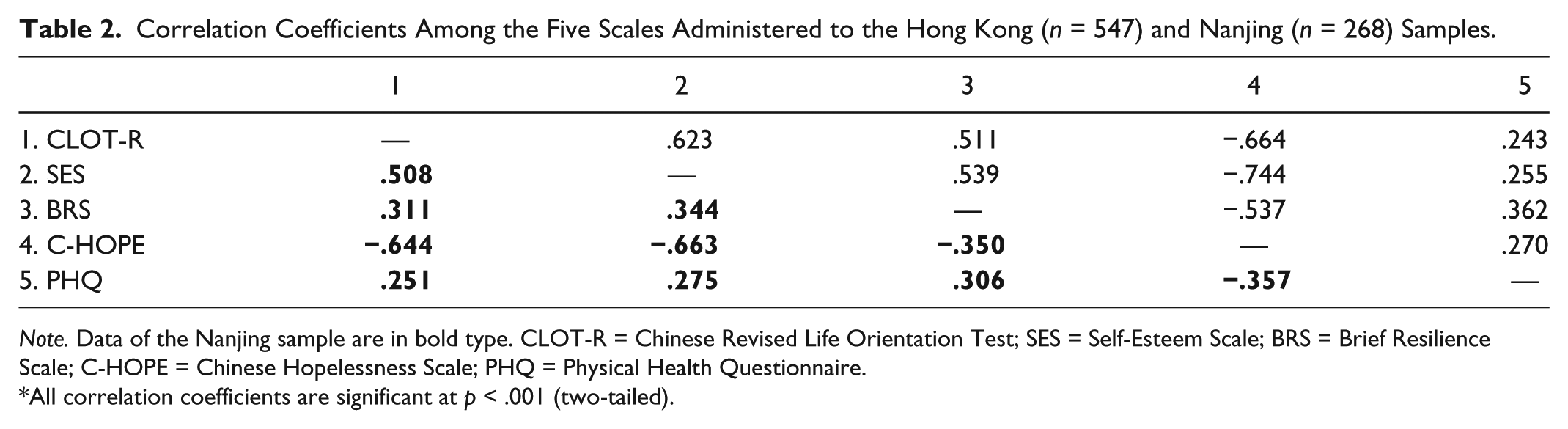
Note. Data of the Nanjing sample are in bold type. CLOT-R = Chinese Revised Life Orientation Test; SES = Self-Esteem Scale; BRS = Brief Resilience Scale; C-HOPE = Chinese Hopelessness Scale; PHQ = Physical Health Questionnaire.
All correlation coefficients are significant at p < .001 (two-tailed).
Factor Structure and Construct Validity
Principal component analysis (PCA) was conducted for the responses to the six items of the BRS in each of the two samples. For the Hong Kong sample, a single factor (eigenvalue = 2.80) that explained 46.73% of the total variance was extracted. Inspection of the scree plot also suggested a one-factor solution (initial eigenvalues = 2.80, .94, .76, .56, .52, and .42). The Kaiser–Meyer–Olkin (KMO) measure (.82) and Bartlett’s test, χ2(15) = 766.54, p < .0001, clearly showed that the correlations among the BRS items were strong enough for factor analysis. A similar pattern of results was observed in the Nanjing sample, from which a single factor (eigenvalue = 2.53) that explained 42.18% of the total variance was extracted. A scree plot of the eigenvalues also supported a one-factor interpretation (initial eigenvalues = 2.53, .89, .86, .76, .49, and .47). The KMO (.76) and Bartlett’s test, χ2(15) = 282.60, p < .0001, also suggested the adequacy of the correlation matrix for factor analysis. Table 3 shows the PCA loadings of the BRS items for the two Chinese undergraduate samples.
Factor Loadings of the Items of the Brief Resilience Scale in the Hong Kong and Nanjing Samples.

Note. R = reverse-coded items.
Hierarchical multiple regression analysis was used to examine the incremental utility of the BRS in predicting PHQ scores, while controlling for the effects of the two resilience resources. This was also done to show that the BRS measured a construct that could not be reduced to the two resilience resources. The results clearly showed that the BRS scores were able to explain a significant portion of the variance in PHQ scores after the effects of gender, age, and the two resilience resources were controlled for (Table 4).
Multiple Regression Analyses Predicting Physical Health From Optimism, Self-Esteem, and Resilience.
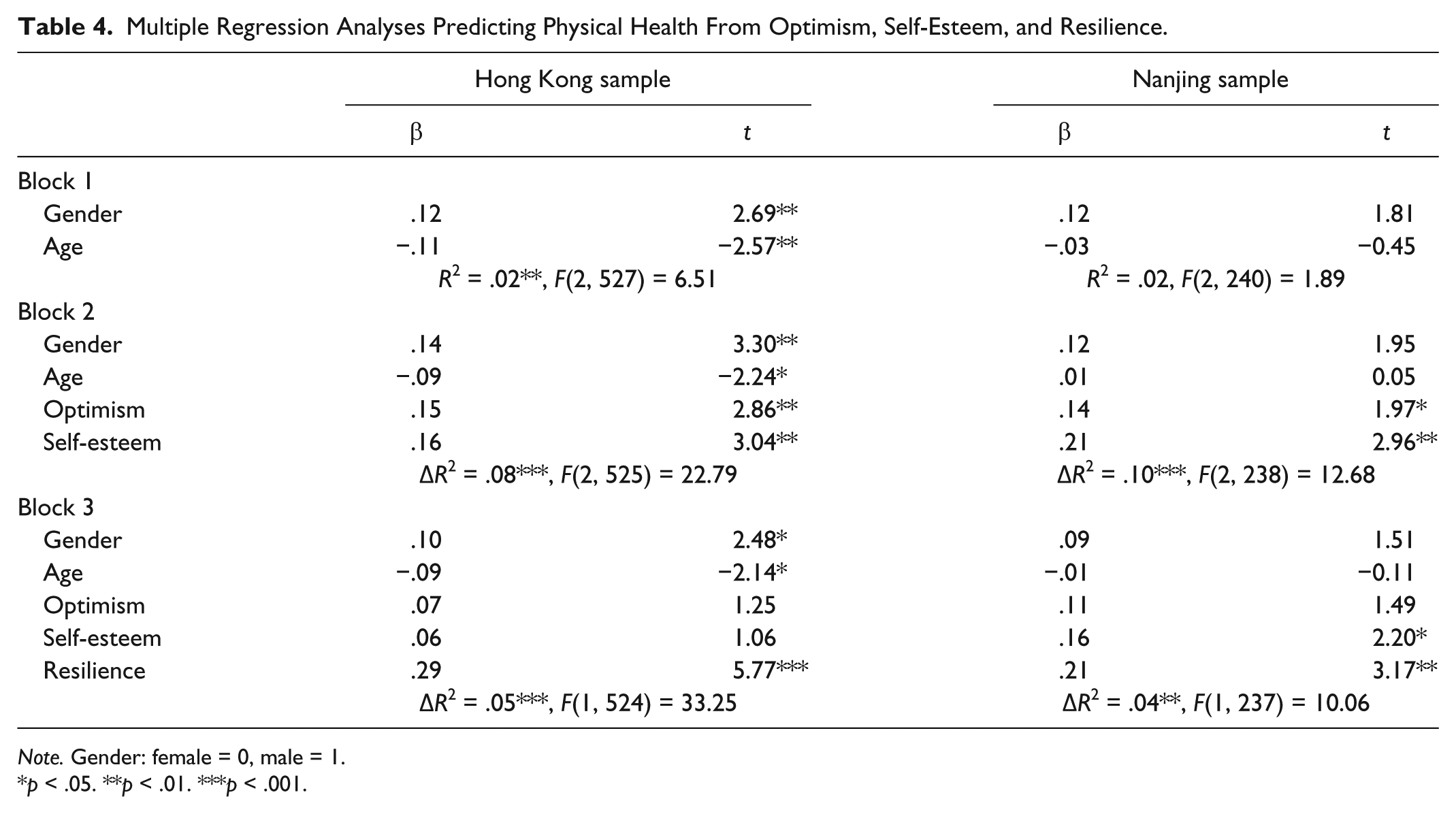
Note. Gender: female = 0, male = 1.
p < .05. **p < .01. ***p < .001.
For the Hong Kong sample, ΔR2 = .054, F(1, 524) = 33.25, and p < .001. Similar results were found for the Nanjing sample, ΔR2 = .036, F(1, 237) = 10.06, and p < .005. In the present study, the predictive power of the BRS as indexed by the portion of the explained physical health variance (5.4% and 3.6% in the Hong Kong and Nanjing samples, respectively) was comparable with that reported in prior studies (Nygren et al., 2005; Smith et al., 2008).
Gender and age also explained a significant percentage of the variance in the Hong Kong sample. However, this was not observed for the Nanjing undergraduates. In particular, male and younger Hong Kong students tended to score higher on the PHQ.
Path Models
To test whether the BRS scores or resilience (one’s ability to bounce back) mediated the link between resilience resources and physical health, the hypothesized path model was tested separately in the Hong Kong and Nanjing samples using path analysis (IBM AMOS 19). First, the model depicted in Figure 1 was tested in the Hong Kong sample. Using a maximum likelihood estimation, the model fit was determined to be adequate: χ2(2) = 4.12, p = .13, comparative fit index (CFI) = 0.996, root mean square error of approximation (RMSEA) = 0.04 (Figure 2). As hypothesized, both optimism and self-esteem were positively associated with resilience, which was, in turn, positively associated with physical health. These results clearly pointed to an indirect-only mediation and suggested that resilience or the ability to bounce back was the most crucial factor translating the two resilience qualities into better physical health (Zhao, Lynch, & Chen, 2010).

Final path model with standardized coefficients for the Hong Kong sample.
A similar analysis was conducted for the Nanjing data, using the model delineated in Figure 1. However, an adequate fit was not observed: χ2(2) = 11.60, p < .01; CFI = 0.934, RMSEA = 0.13. An inspection of the results summarized in Table 4 indicated that the effect of self-esteem on physical health in the Nanjing sample was greater than that in the Hong Kong sample, such that the linear relationship remained significant in the Nanjing sample after resilience was entered into the regression equation. The path model for the Nanjing sample was then revised by adding a path between self-esteem and physical health. The sample was then tested again (Figure 3), with an adequate fit resulting: χ2(1) = 2.30, p = 1.29, CFI = 0.991, RMSEA = 0.07. The complementary mediation observed suggested that the relationship between self-esteem and physical health in the Nanjing sample might have been more complex than that in the Hong Kong sample because resilience was not the only mediator of the relationship (Zhao et al., 2010).

Path model with standardized coefficients for the Nanjing sample.
Discussion
The findings of the present study constitute the first set of data demonstrating the validity of the BRS for Hong Kong and mainland Chinese undergraduates. The adapted scale was shown to be a reliable and valid measure for assessing one’s ability to bounce back from stress in two samples of Chinese undergraduates. The scale items loaded substantially on one single factor, implying that the scale measured the same construct of resilience in the two samples. Moreover, consistent with resilience theories, the ability to bounce back mediated the effect of resilience resources such as optimism and self-esteem on physical health in the two samples. These findings have two implications. First, the availability of the BRS facilitates studies of resilience in Chinese people. Due to its brevity and ability to mediate the effect of resilience resources on health, the adapted BRS should be more suitable for research or screening purposes than either the Chinese version of CD-RISC (Yu & Zhang, 2007) or a composite of resilience qualities (e.g., Chan et al., 2006; Lai & Mak, 2009). Second, this study pinpointed the mechanisms in which resilience resources are translated into better health outcomes. This has not been reported previously, and should advance the general understanding of resilience. In support of the argument that one’s ability to bounce back from stress is conceptually distinct from other definitions of resilience (Smith et al., 2010), the findings of this study clearly show that the construct measured by the BRS, one’s ability to bounce back from stress, cannot be reduced to resilience resources or positive traits. Rather, it is more appropriately conceived as a separate construct that mediates the effect of resilience resources on physical health. Moreover, as this study found one’s ability to bounce back from stress to be more predictive of physical health, it may be a more important target for interventions than other positive characteristics.
Resilience research has focused on mental rather than physical health outcomes, with only a handful of studies examining both the mental and physical health outcomes of resilience factors. However, resilience factors have been shown to explain a smaller percentage of variance in physical health outcomes than mental health outcomes (e.g., 4.7% vs. 19.2%, Nygren et al., 2005; 5.2% vs. 14.4%, Smith et al., 2008). As suggested by Scheier and Carver (1987), the small effect of resilience resources on physical health could be attributed to the relatively large number of factors that could determine self-reports of physical health but might not have been controlled in most studies. These investigators have also pointed out that self-reports of physical symptomatology may not be perfect measures of the underlying physiological events or symptoms actually experienced. Due to the small portion of explained variance in physical health observed in our study, we would never claim that the two resilience resources and the ability to bounce back from stress are the sole determinants of physical health, only that these qualities contribute reliably to the explanation of self-reports of physical health, as shown clearly by the results of our study.
Although in the present study the BRS explained only a small portion of the variance in physical health, this study makes contributions that compensate for this limitation. First, it is one of the few studies to extend the health-related effects of psychological resilience to the physical realm. Findings have clearly shown that resilience is a crucial variable in explaining the influence of positive psychological attributes on physical health. Second, it is the first study to examine the validity of the BRS in Chinese populations. Although studies have examined the applicability of other resilience measures to Chinese populations (e.g., Wang, Shi, Zhang, & Zhang, 2010; Yu & Zhang, 2007), none has critically evaluated the conceptual basis of psychological resilience, as the present study does.
The difference in the mediating effect of an ability to bounce back from stress between the Hong Kong and Nanjing samples is worthy of further discussion. Using the typology proposed by Zhao et al. (2010), the former is an instance of “indirect-only mediation,” and the latter is a form of “complementary mediation” (p. 200). This raises the possibility that the centrality of self-esteem in determining physical health might have varied between the two samples. This study’s findings contradict recent evidence of the supremacy of self-esteem in determining physical and mental health in Hong Kong (Li, Chan, Chung, & Chui, 2010) and mainland (Ye, Yu, & Li, 2012) Chinese individuals, and suggest that the health-promoting effects of interventions that focus on enhancing self-esteem may be greater in mainland undergraduates than in Hong Kong Chinese undergraduates. For the latter, the ability to bounce back from stress is the more appropriate target of intervention.
Despite the significance of this study’s findings, a number of limitations may moderate their effects. First, as only optimism and self-esteem were examined in relation to the BRS in this study, it is possible that one’s ability to bounce back from stress could have been reduced to other unconsidered positive constructs. Although no Chinese sample data were available to evaluate the validity of this conjecture, Smith et al. (2010) showed that BRS scores remained predictive of different health outcomes when the effects of a number of positive characteristics including optimism, social support, mood clarity, spirituality, and purpose in life were controlled. To further establish the importance of resilience in research involving Chinese populations, future studies must include a wider range of positive characteristics and multiple health outcome measures. Second, as all of the variables in the present study were measured at the same time, the causal relationships between the positive traits and health outcomes were not convincingly demonstrated. Third, as the Hong Kong and Nanjing samples were recruited from a single university in each of the two cities, the representativeness of the two samples might have been limited. Fourth, this study’s exclusive focus on undergraduates makes it difficult to extend its findings to other age groups or populations with health problems. To further advance the general understanding of resilience in the Chinese people, future research must take the aforementioned limitations into account and examine resilience in relation to a wider range of variables in different populations with a longitudinal design.
Footnotes
Acknowledgements
Thanks are due to Mr. Jack Tsui for his assistance with the data collection and fieldwork.
Authors’ Note
Some of this study’s findings were presented at the second China International Conference on Positive Psychology in Beijing, China, in November 2012.
Declaration of Conflicting Interests
The author(s) declared no potential conflicts of interest with respect to the research, authorship, and/or publication of this article.
Funding
The author(s) disclosed receipt of the following financial support for the research and/or authorship of this article: The work described in this article was fully supported by a grant from the Research Grants Council of the Hong Kong Special Administrative Region, China (Project No. 144009).