




Abstract
This article uses analytical hierarchy process (AHP) to find prioritization of functional strategies (manufacturing, marketing, human resource, and financial management) by small and medium enterprises (SMEs) operating in auto parts manufacturing sector of Pakistan. SMEs are major part of the industrial structure and have significant contribution toward generating jobs in Pakistan. These enterprises are generally family-owned businesses, and this study provides concrete insights into the mind-set of owners toward different functional strategies. The AHP implementation steps are performed using commercially available software “Expert Choice®.” Marketing strategy is considered to be the most important strategy, while manufacturing management strategy is the second most important strategy. There is little emphasis on the financial and human resource management which is a serious cause of concern. The study would help policy makers to understand the business behaviors of this sector and consequently formulate policies to enhance their performance.
Introduction
In most developing and developed countries, small and medium enterprises (SMEs) are a major part of any industrial structure (Ruiz Duran, 2010). The share of economic contribution by SMEs in terms of employment is more in developing countries as compared to the developed countries (Javalgi & Todd, 2011). The literature focusing on small firms has increased substantially in the last three decades. Various studies have been conducted to examine the dynamics, contributions, constraints and opportunities for SMEs of developing countries (MacGillivray & Raynard, 2006; Mead & Liedholm, 1998; Nichter & Goldmark, 2009; Tambunan, 2005). In Pakistan, SME is defined as an enterprise with employment size up to 250 employees and paid up capital of Rs. 25 million according to SME policy 2007, and nearly 90% of all private enterprises in the industrial sector are SMEs contributing over 30% to the Gross Domestic Product (GDP; Afaqi & Seth, 2007). Most of the research related to SMEs in Pakistan deals with prospects, constraints, and impediments faced by these firms (Afaqi & Seth, 2007; Bari, Cheema, & ul Haque, 2005; Burki et al., 2011; Dasanayaka & Sardana, 2010; Lall & Weiss, 2003; Seth, 2010). SMEs, due to limited tangible and intangible resources coupled with the business environment in country, have unique posture of prioritizing and implementing the functional strategies. Similarly, in a developing country like Pakistan, SMEs accord prioritization to functional strategies on the basis of industrial structure, business environment, and culture (Ahmad, Pirzada, & Khan, 2013). Automotive sector, comprising of automotive assemblers and automotive parts manufacturers, is considered to be one of the most important sectors of any country in which SMEs, without exception, play major role. There is high number of SMEs (more than 1,200) operating in organized and unorganized auto parts manufacturing sector in Pakistan (Pakistan association of auto parts accessories manufacturers [PAAPAM], 2010), out of which about 95% are self-financed (SMEs development authority [SMEDA], 2006). The owners of the firms in organized sector are mostly qualified and possess a formal technical education, whereas owners of firms in unorganized sector have less formal qualification but noticeable knowledge about materials, machinery, and products (Afaqi, 2009). With a population of more than 160 million citizens, the car ownership rate per 1,000 stands at 16 vehicles in Pakistan whereas it stands at 54 for China and 74 for Thailand (World Bank, 2014). However, during the recent past years, automotive industry in Pakistan has progressed with new automotive assemblers mostly two wheelers (about 2.2 million two-wheel vehicles were produced in 2012) as well as auto parts manufacturing units mostly SMEs to take advantage of the market situation due to increased demand of vehicles. These SMEs provide auto parts to existing/new automotive assemblers as well as replacement market. But still there is huge potential and opportunities available for investments and startups in this sector.
Although the domestic market is reasonably well protected under the tariff-based system (TBS), yet no significant industry-specific measures and support is provided to the auto parts manufacturers (Competitiveness Support Fund [CSF], 2006). This medium volume and low variety industry (Jahanzaib, 2008) is currently facing a number of problems including improper government import and tariff policies, energy crises, global competition, law and order situation, competition from Chinese products, and rupee depreciation (Ahmad et al., 2013). All these factors have profound impact on SMEs and in their struggle to survive and make profit. The main objectives of the research are as follows:
To find out the functional strategies valued by auto parts manufacturing SMEs in Pakistan.
To determine the prioritization of the functional strategies by auto parts manufacturing SMEs in Pakistan using multi-criteria decision-making (MCDM) technique.
MCDM Techniques
MCDM refers to making decisions in the presence of multiple, usually conflicting, criteria. The main purpose of MCDM approach is to provide help in making decisions. It has different features, ranging from problem formulation to ranking the alternatives (Xu & Yang, 2001; Zardari, 2008). Since the 1960s, many MCDM methods have been used to solve multi-criteria problems in many fields, the summary of important methods is available in Zardari (2008). Choosing one MCDM method out of all the existing methods is itself a multi-criterion as there is no specific method for every problem due to uniqueness of each problem. In this study, the researcher has used precise criteria to select a suitable MCDM method for determining the priority ranking of the functional strategies of SMEs. These criteria include
The selected MCDM method should be easy to understand and use by the people involved in the decision process (e.g., SMEs’ owners).
A user friendly computer software package may be available to implement the selected MCDM method.
The MCDM method should be flexible so that the decision makers may easily indicate their preferences over different evaluation criteria.
The selected MCDM method should be suitable to the situation where lesser number of alternatives and criteria are to be considered.
Out of all the available methods, the current study uses analytical hierarchy process (AHP), which is considered to be an effective technique determining the relative importance of a set of attributes or criteria. The method is explained in detail along with its advantages and disadvantages in the next section.
AHP Methodology
The AHP introduced by Saaty (1980, 1990, 2008) has gained its popularity as an effective MCDM approach. The main advantage of this method is its mathematical properties and ease of obtaining required input data, and because of this, many researchers have shown interest in its use (Triantaphyllou & Mann, 1995). Although the AHP technique was originally developed for solving MCDM problems, its practicality and flexibility has allowed it to be widely applied in many different areas including ranking of projects and making choices (Al-Harbi, 2001; Palcic & Lalic, 2009; Zahedi, 1986). Moreover, AHP is based on the natural human capability to make comprehensive judgments about small problems (Bayazit, 2005) in which problem is broken down to the smaller level in a hierarchal manner to facilitate the simple paired comparison judgments (Al-Harbi, 2001). Pair-wise comparisons are quantified using a scale also defined by Saaty (1990). Such a scale helps the decision maker to give discrete numbers to the choices available to signify the importance of choices. AHP helps capture both subjective and objective assessment measures of the alternative options available, thus reducing bias in decision making (Dalalah, Al-Oqla, & Hayajneh, 2010). AHP has also been criticized due to certain concerns by many researchers (Belton & Gear, 1983; Dyer, 1990; Watson, 1982). According to Belton and Gear (1983), a rank reversal problem can occur in case a near copy of an existing option is added to the set of the alternatives. In case of problem with many criteria and sub-criteria, large number of pair-wise comparisons make the task lengthy and cumbersome (Macharis, Springael, De Brucker, & Verbeke, 2004). The method was also criticized for lack of firm theoretical basis by Belton and Gear (1983). However, Harker and Vargas (1987) and Saaty (1990) discussed the criticisms on AHP method in detail and verified the firm foundation of the method. Due to viability of AHP based on above-mentioned criteria and limited number of criteria and alternates, the method is considered suitable for use in the study. The scale proposed by Saaty is shown in Table 1. The pair-wise comparisons are made between the elements of each element in the hierarchy, and psychological experiments have shown that it is very difficult for individuals to simultaneously compare more than seven objects (Miller, 1956). The AHP is normally implemented in conjunction with the use of Expert Choice® with its application in variety of decisions and planning projects in nearly 20 countries (Saaty, 1990), and this method is now one of the most frequently used method for making decisions. Generally, the following steps are undertaken to apply the AHP (Saaty, 1980, 1990):
Saaty’s Scale of Importance.

Defining the problem and the main goal.
Structuring the hierarchy from the top starting with the objective/goal through criteria, sub-criteria (if any), and finally the alternatives.
Constructing a set of pair-wise comparison matrices (size n × n) for each of the lower levels with a matrix for each element in the level immediately above using the scale as given in Table 1. The pair-wise comparisons are carried out by comparing one element with the other. The exceptional or absolute importance of one element over the other is assessed at 9 and if both elements are equal in importance then number 1 is used to denote this equality. Reciprocals are also used in each pair-wise comparison based on the values determined by the decision maker. Thus the numbers in matrices may vary from 1/9 to 9.
Total of n × (n − 1) / 2 comparisons are required to develop the set of matrices for the pair-wise comparisons as mentioned in above step.
Hierarchical synthesis is carried out to find the weightage of eigenvectors by the weights of the criteria and then sum of all weighted eigenvector entries corresponding to those in the next lower level of the hierarchy is calculated to find the overall priority.
After carrying out pair-wise comparisons, the consistency is found by using the eigenvalue, λmax. The consistency index (CI) is calculated using the formula involving matrix size n: CI = (λmax − n) / (n − 1). Judgment consistency is calculated by consistency ratio (CR) using the value of random index (RI) as per Table 2 (CR = CI / RI). The CR value below 0.10 is acceptable otherwise the judgment matrix is inconsistent which is required to be reviewed and improved.
Steps c-f, mentioned above, are performed for all levels in the hierarchy.
The Reference Values of RI.
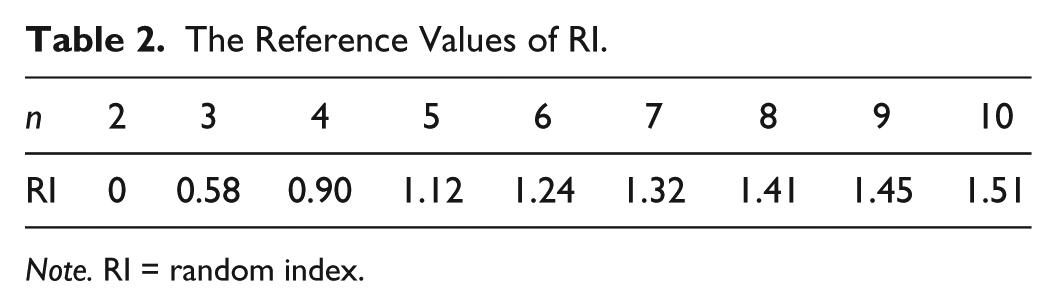
Note. RI = random index.
Different methods are also used for the approximate solution of the comparison matrices. Two methods are generally recommended (Palcic & Lalic, 2009):
All cells in an individual column of the pair-wise comparison matrix are divided with the sum of the cells of the given column, then these values are added in row and the resultant sum is divided with the mean values of cells in a row. The vector achieved in such manner is called a vector of criteria priority. .
The values in each row of n × n pair-wise comparison matrices are multiplied to calculate the geometric mean, and the resultant vector is normalized to achieve the priority vector.
Application of the AHP in Prioritization of Functional Strategies
In this article, prioritization of functional strategies (manufacturing, marketing, HR, and financial management, selection criteria of which will be explained later) by SMEs operating in auto parts manufacturing industry of Pakistan is carried out using AHP. There are numerous kinds of functional areas in an organization which require proper management including manufacturing, operations, marketing, human resource, research and development, information, technology, and finance. There is a requirement for organizations whether large or small (like SMEs) to manage these functions by following variety of strategies. These strategies help SMEs to accomplish their objectives and ensure their existence in the market. SMEs value different functional strategies differently based on different factors like size, nature of business, scope of operations, and resources (Kraus, Reiche, & Reschke, 2007). In Pakistan, where majority of small businesses are concentrated in few major cities (Karachi, Lahore, Sialkot, Faisalabad, Peshawar, Gujranwala, etc.) with minimum resources (HR and financial), SMEs’ preferences are different as compared to developed countries. This study is aimed to find out the priorities given by auto parts manufacturing SMEs for selected functional strategies. The hierarchal framework for AHP will be discussed in the subsequent section.
Conceptual Framework of the Study
The study utilizes the AHP methodology for the ranking of functional strategies. The hierarchy is composed of different levels in AHP with the objective of the study at first level. Based on the objective of the study, the first level of AHP hierarchal model is set to be the prioritizing/ranking of the functional strategies of SMEs operating in auto parts manufacturing sector of Pakistan. Through review of related literature and qualitative research using interviews (unstructured and semi-structured) of CEOs and managers (middle and floor), planned and unplanned visits of SMEs, different criteria for Level 2 were identified. The criteria selected for this study are significant even for large firms operating in manufacturing sector, and their significance can easily be understood by the competitive nature of business in automotive industry. By following the AHP procedure described above, the hierarchy of the problem is shown in the Figure 1. SMEs operating in auto parts manufacturing sector are concerned with profit, growth market share, and certifications to compete in the market. Later on for third level of hierarchy, list of functional strategies considered of significant value to SMEs were made through review of literature (Alam, 2010; D. Barnes, 2002; J. Barnes, Bessant, Dunne, & Morris, 2001; Chang, Yang, Cheng, & Sheu, 2003; Dangayach & Deshmukh, 2003; Hayton, 2003; Hill, 2001; Javalgi & Todd, 2011; Karpak & Topcu, 2010; Peel & Bridge, 1998; Saini & Budhwar, 2008). The Delphi method is used to select important functional strategies for the SMEs in auto parts manufacturing industry of Pakistan. The researcher carried out several steps in Delphi method as identified by Brooks (1979). In the beginning, panels of experts were identified for participation in the study. The group consisted of a total of eight participants comprising four SME owners, two academicians, and two managers of SMEDA (established in October 1998 under Ministry of Industries, Government of Pakistan). The selection of group member was made in consultation with PAAPAM and SMEDA. PAAPAM was formed in 1988 to represent the auto parts industry and provide technical/managerial support to its members. The willingness of the experts was achieved through personal meetings/telephone calls. The panel was asked regarding the functional strategies considered to be important with some rationale. The data were compiled and shared with the panel regarding the top five functional strategies. The panel was asked to rank these important functional strategies. In the final step, the data regarding the ranked functional strategies were again shared with the panel to give their final viewpoint. The panel was asked to give their brief comments if someone differs from the categorization of functional strategies. Thus, the consensus on important functional strategies was achieved by a group of experts. The functional strategies considered important for SMEs operating in developing countries in the literature and subsequently confirmed by Delphi method are manufacturing, marketing, HR, and financial management strategies. This study helps in finding out the preferences of these dimensions by SMEs working in auto parts manufacturing sector.

Hierarchal structure of problem.
Data Collection
Questionnaire Design
To get the information of SMEs involved in the study and comparison of elements in the hierarchical structure at different levels, a survey questionnaire was designed. The questionnaire was prepared in two languages: English and Urdu (national language of Pakistan). The translation of the questionnaire was validated by four linguist experts before conduct of pilot test of instrument. The first section contains personal information of the respondents including company’s name, experience, and major manufacturing products. The respondents were given the option of not writing their own or company name for the sake of anonymity. The second section consisted of six pair-wise comparison items for evaluation of criteria considered to be important for success of SMEs in auto parts manufacturing sector. To minimize interpretation bias, definition of each dimension was shared with respondents. Moreover, the respondents were encouraged to clarify any doubt and seek the clarification during personal administration of the questionnaire. The judgments were based using the values of importance as per Table 1. The third section of the questionnaire (corresponding to the third level of the hierarchy) consisted of six questions to evaluate the functional strategies with respect to the four dimensions. Before the administration of the survey instrument, a pilot study was conducted with 10 SMEs managers with whom unstructured interviews were already conducted. The pilot study enhances the reliability and validity of the data to be collected through the questionnaire. These managers were initially briefed about the research and their participation in the pilot study. These managers were selected on the basis of their experience (minimum of 15 years) in the auto parts manufacturing sector. During administration of questionnaire, managers were asked to identify the ambiguous or difficult to understand phrases in each section. The pilot study was conducted to ensure that managers had no problem in understanding and answering the questions. This exercise enabled the researcher to ensure that the questions are meaningful, clear, and understandable. The questions were also checked for comprehension of questionnaire by the less educated managers. The pilot study also allowed assessing the clarity of instructions and estimating the time to complete the questionnaire. Moreover, the pilot test also assured that the questions are capable to provide the required information for the research objectives. In the study, the questionnaire reliability was measured by Alpha-Cronbach test and all the calculated values were within the acceptable range.
Sample
Over a 4 months’ period, the questionnaire was personally administered to 25 and sent through mail to 80 randomly selected SMEs, out of which, only 34 questionnaires were received. There was no evidence of non-response bias (checked using the earliest and the latest received questionnaires). The selected SMEs were written formal letter introducing the purpose of the study and method to answer the questionnaires. The actual questionnaire also contained an example for better understanding of the respondents to use the relational scale as per Table 1. SMEs to whom the questionnaires were sent through postal mail, contact number of the corresponding researcher was also shared to provide clarification at any stage of filling of questionnaire. A total of nine questionnaires were rejected due to inconsistencies (more than 10%), thus a total of 50 valid questionnaires were available for data analysis.
Data Analysis
The respondents’ weights and scores were computed using Expert Choice®. The elements in each level were compared with each other using the values as per Table 1. Synthesis of the pair-wise comparisons is done. For each criterion (profit, market share, growth, and certifications), pair-wise comparisons are made for alternatives, that is, four selected functional strategies. One such comparison for the criterion of profit is shown in Table 3.
Pair-Wise Comparison Matrix of Functional Strategies With Respect to Profit.

The priority vectors are calculated for each alternative with respect to all criteria. Table 4 shows priority vector as calculated after synthesis operation with respect to profit with the inconsistency calculated to be 0.08 (in the acceptable range). The values in Table 4 show that respondents prefer manufacturing strategy over the other three functional strategies as far as profit is concerned. Similarly, the priority vectors for the other criteria can also be calculated for all the criteria.
Priority Vector for Functional Strategies With Respect to Profit (Inconsistency = 0.08).

In addition to the pair-wise comparison for the alternatives (functional strategies), the pair-wise comparisons of all four criteria in terms of their importance to contribute toward goal are also conducted. Similarly, the priority vectors for these four criteria are calculated. There are two modes of synthesis generally used: ideal and distributive, guideline for their use is given in Millet and Saaty (2000). In the distributive mode, alternative’s scores under each criterion are normalized to get the sum equal to one. In the ideal mode, the score of each alternative is divided by the score of the best alternative under each criterion. The choice to use any mode of the synthesis depends on the nature of the problem (Bahurmoz, 2006). The final outcome of the synthesis for criteria using the distributive mode as produced by Expert Choice® is given in Table 5.
Priorities of Criteria With Respect to Goal (Inconsistency = 0.08).

Results and Discussions
Criteria Results
Table 5 represents the average relative weights vector of each criterion with respect to the goal. Profit is considered to be the most important dimension for the SMEs operating in auto parts manufacturing sector with 43.5% whereas market share is considered to be the second most important dimension slightly lagging behind with 40.3%. Growth is not considered at par with the first two dimension, that is, profit and market share. SMEs prefer to increase their profit and market share without much consideration to their growth and certifications. With respect to the certifications, owners/managers of SMEs show very little preference to this factor because of their orientation toward the domestic market with non-stringent quality standards. Most of the SMEs visited by the researchers either do not have quality certifications (like International Standard Organization (ISO)-9000, Technical Specification (TS)-16949) or their certifications have expired. It also shows that local automotive assemblers do not impose strict quality certifications’ criteria for vendors to follow.
Prioritization of Functional Strategies
The priority vectors for all the criteria are then calculated similar to the example shown in Table 4 for profit from synthesis of all pair-wise comparison matrices. The calculations are done with the help of Expert Choice® to come up with the priority vectors. The priority vectors for profit, market share, growth, and certifications are given in Table 6.
Priority Vectors for All the Criteria and Alternatives.

Now the overall prioritization of the functional strategies is found by multiplying the weights of the criteria with the priorities of each functional strategies and then adding for each strategy. The final priority vectors as calculated by Expert Choice® using distributive and ideal modes are given in Table 7. It is important to note that there is no significant difference between the priority vectors, thus, ranking of strategies remains unaffected. The marketing strategy is considered to be the most important strategy for owners/managers of SMEs to be managed effectively to earn profit and increasing the market share of products. This is important because of the intense competition among the SMEs competing for the limited domestic market. The manufacturing strategy is considered to be the second most important strategy valued by owners/managers of SMEs. There is not much difference between the final values of the priority vectors for marketing and manufacturing strategies showing that SMEs value the management of these functions almost equally. The strategies ranked as third and fourth in the priority are HR and financial strategies with considerable low final values showing their non-importance for owners/managers of SMEs.
Overall Ranking of Functional Strategies.

Sensitivity Analysis
To expand our understanding of the issue, sensitivity analysis is performed. This kind of analysis is helpful in understanding the effect of changes in weights of criteria on the overall ranking of the functional strategies. The implementation of AHP through Expert Choice® provides four graphical sensitivity analysis modes: dynamic, performance, gradient, and two-dimensional analysis (Expert Choice, 1995). The sensitivity analyses of the result are done in the current study using three modes dynamic.
Dynamic Sensitivity Analysis
This analysis has been carried out to observe the change of weights of the criteria on the overall weights of functional strategies and their ranking. Through this kind of analysis, it is easy to graphically analyze the effect of changing the criteria over the ranking of functional strategies. Through analysis of data, we have the overall weights of criteria and functional strategies (alternatives) as shown in the Tables 6 and 7. Now changing the profit to approximately 54% (53.8% to be precise), the manufacturing and marketing strategies gain the same priority of approximately 37% (37.4% to be precise), and as we increase the weight of profit beyond 54%, manufacturing strategy gains the top priority with marginally higher percent as compared with marketing strategy. But as we increase the weight of market share, marketing strategy remains as the number one functional strategy valued by SMEs. The margin is considerably higher as compared with manufacturing strategy. The bar graph to show this type of sensitivity made by Expert Choice® is shown in Figure 2.

Dynamic sensitivity graph.
Performance Sensitivity Analysis
The performance sensitivity graph exhibits the impact of each criterion on the functional strategies using the line graph. It shows how the functional strategies are prioritized relative to each other with respect to each criterion. The weight of each criterion is shown with the help of a bar with its length equivalent to the weight. The y-axis on left-hand side of graph shows weights of criterion, while the y-axis on right-hand side shows the weight of alternatives with respect to each criterion as well as the overall weight of each alternative. The advantage of this type of sensitivity analysis is that it clearly represents weights of each functional strategy with respect to each criterion and the strategies performing better as compared with each other. From the graph, it is evident that SMEs value certification for manufacturing strategy and even for HR management, whereas marketing and financial strategies are not valued with respect to certifications. Marketing strategy gains more weightage for increasing the market share as compared with manufacturing strategy. Financial strategy is graded the lowest in all of the four criteria as shown in Figure 3.

Performance sensitivity analysis graph.
Gradient Sensitivity Analysis
This kind of analysis helps to demonstrate the weights of functional strategies with respect to one criterion at a time. The x-axis shows the weight of the criterion while the overall weights of the functional strategies are depicted on y-axis. Using this analysis, sensitiveness of overall ranking with respect to the change of the criterion weight can be observed. In Figure 4, the profit is represented on the x-axis, and change of ranking for the manufacturing and marketing strategy can occur as the weight of the criterion is changed from present value of 43.5% to 53.8% and above. In this case, manufacturing strategy surpasses the marketing strategy. Similar analysis can also be carried out for all the criteria and to find out the ranking of the functional strategies with different weightages of criteria. Figures 5, 6, and 7 show the change in functional strategies with the criteria (market share, growth, and certifications).

Gradient sensitivity analysis graph—Profit.
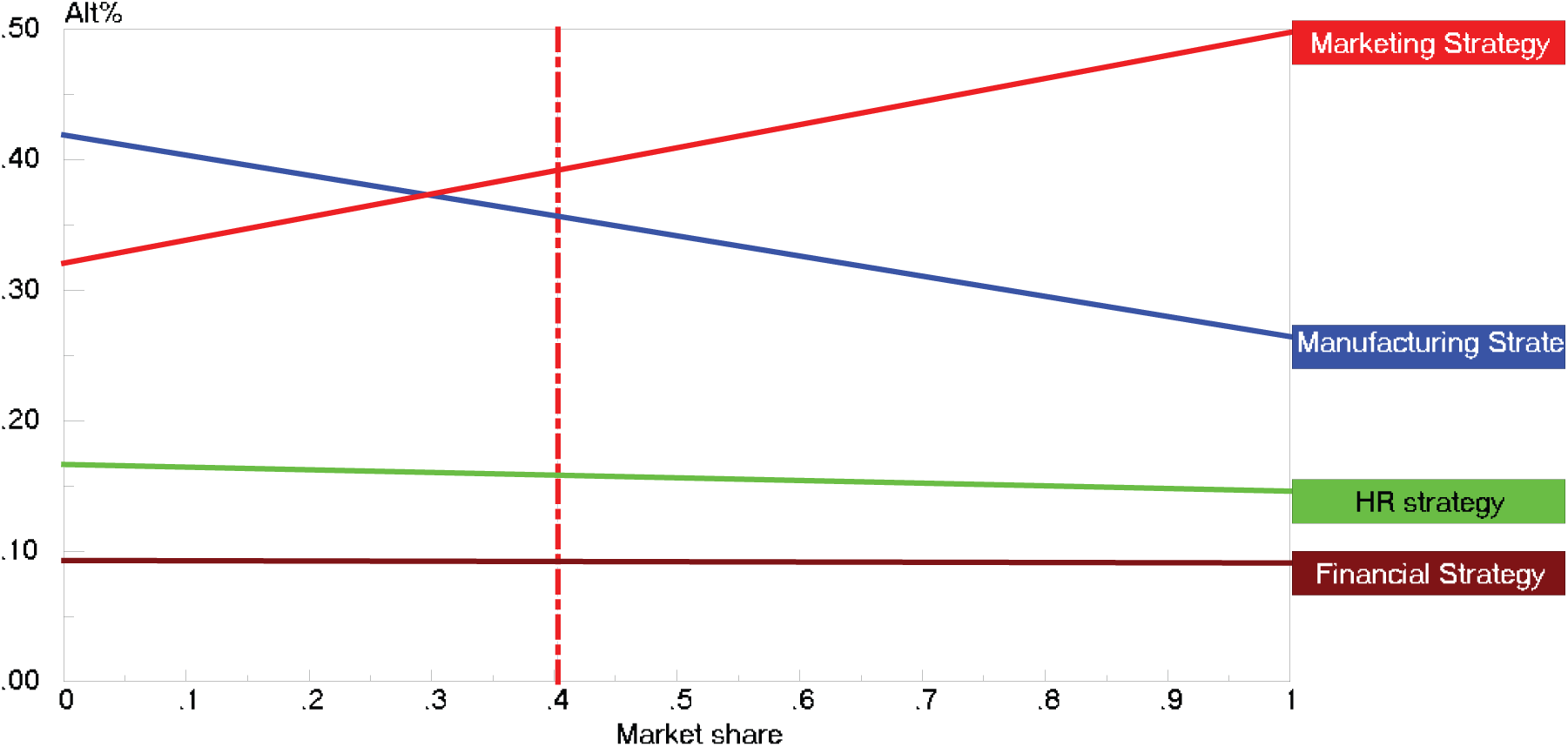
Gradient sensitivity analysis graph—Market share.

Gradient sensitivity analysis graph—Growth.
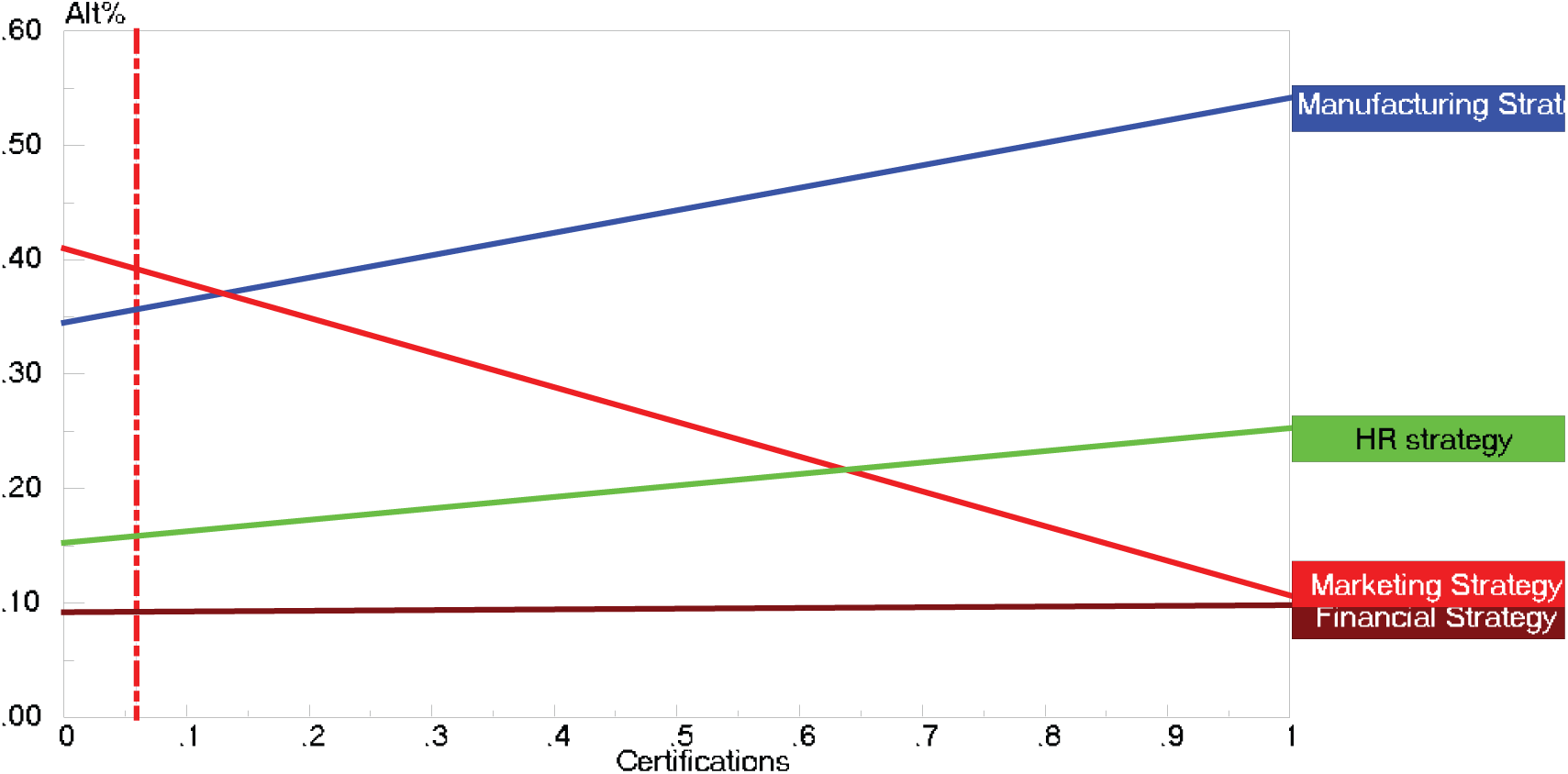
Gradient sensitivity analysis graph—Certifications.
The trend in Figure 5 shows that beyond 33% of market share, marketing strategy remains the first choice for the SMEs and switching to manufacturing strategy can only occur below this level.
The trend in Figure 6 shows that growth (10.3%) has been valued by SMEs operating in auto parts manufacturing sector lower than the profit and market share with more impact on the marketing strategy, that is, in case of increased weightage of growth in future as a result of increased export orientation, marketing management will have more profound effect as compared with other functional strategies.
The Figure 7 shows certifications criterion, although with least weightage, increase in weightage will make the manufacturing strategy as the first choice followed by HR management.
In all the four figures of gradient sensitivity analysis, it is obvious that the increase in weightage of all the criteria has not affected the rank of financial management, and it remains the area of the least priority for the SMEs in auto parts manufacturing sector.
Conclusion
The AHP process is nowadays used in various decision making and prioritization situations. In this study, AHP is used to prioritize functional strategies for SMEs manufacturing auto parts in Pakistan. Critical factors that are valued by SMEs have also been identified. This is first of its kind of studies conducted for SMEs in the auto parts manufacturing sector of Pakistan which will be helpful in understanding the business styles of SMEs. As expected, SMEs prefer profit and also recognize the importance of marketing strategy, but the low ranking of financial strategy by the SMEs despite having limited financial resources seems out of place. This perhaps is due to the mind-set of SMEs’ owners who do not consider the requirement of having a formalized financial management strategy in managing the limited capital resources. Human resource management is also considered to be unimportant and researchers have found most of the SMEs without HR department. With domestic market orientation of the SMEs, certifications are also considered to be just waste of money and effort. The use of AHP has helped to understand the idiosyncrasies of auto parts manufacturing SMEs qualitatively as well as quantitatively. The sensitivity analyses carried out by Expert Choice® provide valuable information that how the ranking may be changed by changing the weightages of the criteria.
Future Research
AHP has been utilized to find the ranking of the functional strategies by SMEs operating in auto parts manufacturing sector. Similar type of research can be conducted in other engineering sectors to find the differences in the approaches of the SMEs’ owners toward different functional strategies. Moreover, the reasons behind the specific behavior of SMEs can also be explored and AHP can be utilized for such purpose by building a hierarchical framework. The study of this kind will further enhance our understanding of the context of business strategies and priorities of SMEs operating in developing countries.
Footnotes
Declaration of Conflicting Interests
The author(s) declared no potential conflicts of interest with respect to the research, authorship, and/or publication of this article.
Funding
The author(s) received no financial support for the research and/or authorship of this article.