




Abstract
The article presents the General Fractal Model of Transit (GFMT) designed to apply modeling in the sociopolitical disciplines. For the purposes of conducting computer experiments with the model, a “Modernofractal 5.1” program was created. Constructing procedures for algebraic fractals enables to simulate social evolutions in the phase space, mainly their starting and end points. The GFMT formula iteration simulated interaction of a series of abstract governing factors, which may be treated as the most significant for different social systems under the stage of transformation. The GFMT has the potential “tuned,” made more specific, for studying various social phenomena. The authors examined the heuristic opportunities of this analysis tool as applied to the fields of historical and political science research (the object of study was rapid modernization of institutions with informal “game rules”). The article contains descriptions of several GFMT computer experiments demonstrating the analysis tools and interpretability of outcome data.
Keywords
Introduction
Fractal geometry provides effective tools for study of not only physical but also social systems. The purpose of this article is, first, to describe the analytical tools that fractal modeling offers in the sociopolitical subject area and, second, to examine the heuristic opportunities they bring. In particular, we present results of the developed model’s approbation as applied to the modernization of sociopolitical institutions.
The development of fractal models is part of the general methodological trend aimed at the application of advances in synergetics, chaos theory (Alekseev et al., 2007; Borodkin, 2005; Guastello, 2013), and system approach (Gharajedaghi, 2006) to the study of complex and dynamic social systems.
Fractal models of social phenomena are used in economics, and in studies of spatial dynamics (Cirnu, 2014; De Florio, Bakhouya, Coronato, & Di Marzo, 2013; Tannier, Vuidel, Houot, & Frankhauser, 2012; Triantakonstantis & Mountrakis, 2012). Economic applications of fractal modeling may even be found in classical works on fractal geometry (Feder, 1988; Frame & Mandelbrot, 2002; Mandelbrot, 1982). A lot of fractal structures have been found in nature. In addition, it has been found that the evolution of many systems (including social systems) is fractal in nature, that is, a pink noise. It is a self-similar process in which events of all sizes coincide: small bursts, average waves, tremendous tsunamis. The theory of self-organized criticality—the sibling of fractal geometry—offers a universal explanation of the pink noise origin (Bak, 1996). It has been found that many different processes have fractal characteristics (e.g., the electrical activity of the human brain, freshets, changes in quasar brightness, the dynamics of market prices, the intensity of social conflicts, the frequency of traffic jams). In theoretical and review papers (Andergassen, Nardini, & Ricottilli, 2006; Buchanan, 2000; Guastello, 2013; Mathews, White, & Long, 1999; Pinto, Mendes Lopes, & Machado, 2012; Turcotte & Rundle, 2002), numerous allegations can be found that social reality also has the characteristic of self-organized criticality. There are researches specifically dedicated to fractal pink noise in social processes (Biggs, 2005; Brunk, 2001, 2002a, 2002b; Cederman, 2003; Kron & Grund, 2009; Picoli, del Castillo-Mussot, Ribeiro, Lenzi, & Mendes, 2014; Roberts & Turcotte, 1998; Shimada & Koyama, 2015).
However, to carry fractal geometry over to large-scale social phenomena, there is a need for some sort of interdisciplinary dialogue, which we attempt to conduct here. For our analysis, we chose the important social problem of transformation of traditional informal institutions (TIIs). In their pathological form, TIIs are regarded by researchers as the main obstacle to social progress. This is a key idea in fundamental theoretical writings (Knight, 1992; North, 1990), in analytical summaries on this subject (Helmke & Levitsky, 2004; Merkel & Croissant, 2000), in concrete political science studies (Lauth, 2000; Pejovich, 1999; Polyakov, 2011; Seltser, 2009), and in practice-oriented expert recommendations (Boesen, 2007).
We used fractal models to study quite a wide range of objects—modernization of sociopolitical institutions, demographic strategies of the traditional society, human pressure on the environment in history, evolution of territorial administration in empires of the Modern period, and so forth (e.g., Zhukov, Kanishchev, & Lyamin, 2013a, 2013b; Zhukov & Lyamin, 2010). Fractal models are able to discover and simulate nonlinear effects that appear in social systems (Borodkin, 2012). We believe, therein lies the heuristic value of this tool. The building of fractal models and computer experiments with them do not actually provide empirical facts at the historian’s, political scientist’s, or sociologist’s disposal. But models may be seen as a “heuristic machine” of its own kind that helps formulate hypotheses and discovers potentials and alternative developments (Axelrod, 2005; Badham, 2010; Epstein, 2008; Frigg & Reiss, 2009; Kuppers, Neslenhard, & Shinn, 2006). Russell Ackoff viewed virtual experiments with models as a substitute for the real ones that are near impossible to be carried out with regard to social objects:
In a sense the researcher into the operations of many social systems is in a situation similar to that of the early astronomers; the system they studied also seemed to be infinitely complex and yet incapable of being subjected to experimentation. However, astronomers eventually developed mathematical representations (models) of the systems, and analyzed or conducted experiments on these models. (Ackoff & Emery, 2009, p. 230)
Why Are Fractal Geometry Tools Applicable for Simulating Real Social Systems?
Fractal geometry emerged after Benois Mandelbrot’s book Les Objets Fractals: Forme, Hasard et Dimension, which was published in 1975. The revised version of the monograph, “The Fractal Geometry of Nature,” is now a seminal work on fractal geometry. A fractal is defined as a special type of geometric figure, and the adjective “fractal” is the characteristic of a structure, phenomenon, or process possessing properties of the fractal. Mandelbrot (1982) himself defined fractal as a structure whose parts “in some sense” are like the whole. Therefore, one of the fractal’s attributes is self-similarity (scale invariance): Whichever approximation we look at the fractal, we always see the same or, in any case, something similar. In Figure 1, some scales of the Sierpinski Sieve fractal (Mandelbrot, 1982) are presented to illustrate the scale invariance.

The Sierpinski Sieve.
Fractal’s self-similarity may be nonabsolute. Figure 2 demonstrates fragments of the best known fractal—the Mandelbrot (1982) set. In this case, the self-similarity is transformed at different scales, but at every level of complexity (at every scale), there appears a fusion of the individual characteristics of an element and the general ones of the whole system.

The Mandelbrot set.
Mandelbrot (1982) suggested that in nature, a fractal way of self-organization was essential, because algorithms of fractal building had a relatively simple “genetic code” (a basic principle of building), yet at the same time they could produce supercomplex objects or processes.
Subsequent to natural sciences, principles and tools of fractal geometry are mastered in humanities. In the monograph “Fractals, Graphics and Mathematical Education,” Mandelbrot quite remarkably, reflects on history and fractal geometry:
Let me at this point confess to you the envy I experienced as a young man, when watching the hold on minds that is the privilege of psychology and sociology, and of my youthful dreams of seeing some part of hard science somehow succeed in achieving a similar hold. Until a few decades ago, the nature of science made this an idle dream. Human beings (not all, to be sure, but enough of them) view history, psychology, and sociology as alive . . . Astronomy is not viewed as alive; the Sun and the Moon are superhuman because of their regularity, therefore gods. [ . . . ] In recent years the sharp contrast between astronomy and history has collapsed. We witness the coming together, not of a new species of science; nor even (to continue in taxonomic terms) a new genus or family, but a much more profound change. [ . . . ] It is only since the 1960s that the study of true disorder and complexity has come onto the scene. Two key words are chaos and fractals, but I shall keep to fractals. Again and again my work has revealed cases where simplicity breeds a complication that seems incredibly lifelike. [ . . . ] Astronomy described simple rules and simple effects, while history described complicated rules and complicated effects. Fractal geometry has revealed simple rules and complicated effects. (Frame & Mandelbrot, 2002, pp. 25-26)
Fractal models allow the discovery of patterns and strict ordering in such systems where, seemingly, absolute chaos of multidirectional human aspirations and diverse empirical facts dominate. The consistency of the basic pattern does not contradict the diversity of facts under study. Fractal geometry unites them, but at the same time it does not lay them down to the Procrustean bed of simple schemes.
The most “ancient” type of fractals is geometrical fractals. They are a convenient heuristic metaphor for describing self-similar social and political structures, as well as logics of their development. Geometrical fractals are figures that emerge as a result of repetition of one and the same graphic element (a so-called “fractal generator”) for an infinite number of times at a constantly reducing scale. Examples of such figures are the Sierpinski Sieve (Figure 1) or the Koch Snowflake (Mandelbrot, 1982; Figure 3) fractals.

Initial stages of building the Koch Snowflake.
Fractals of another type—algebraic—emerge in a complex numbers space as a result of iterations of a particular formula. Algebraic fractal building may be seen as a study of the system’s behavior in the phase space. That is the principle implemented in General Fractal Model of Transit (GFMT).
How GFMT and Modernofractal 5.1 Fractal-Builder Work
For the purposes of computer modeling in social and political disciplines, we offered the GFMT. The mathematical apparatus of the model is based on procedures described by Mandelbrot (1982). These classical methods were modified to solve issues of simulating specific studied objects. The GFMT is a mathematical and logic matrix of a class of theories, which describe transformation, transition of social systems from one state to another. Here, we demonstrated the GFMT application to studying problems of institutional modernization, but there are also successful outcomes from using the model for other processes-related research.
In GFMT, various states of the system in any moment are depicted by means of an image point (complex number Z) in the two-dimensional phase space. This point’s position corresponds to values of key system characteristics plotted along phase space axes. State transition (transformation) of the system at any time is represented by the sequence of points—namely a certain trajectory in the phase space.
To conduct computer experiments with GFMT, Julia Movchko designed the Modernofractal 5.1 computer program that performs algebraic fractal-building procedures. 1
Fractal geometry reveals the mechanisms by which complex and diverse structures can be generated on the basis of very simple rules. The same is true of software that models real processes. The fractal generating programs are mostly rather simple. They use very simple algorithms—repetition of basic computational operations. Because of this, there are a lot of fractal generators, but none of them is quite a versatile enough program for modeling. Therefore, we needed a special program that could resolve the specific research problem.
The mathematical apparatus of the model contains an iterated formula (1) and two mathematical conditions (the so-called С-symmetry rule, А-symmetry rule), that allow us to equate the geometrical sense of complex numbers operations with the results of nuclear interactions of a model’s factors.

where A is a real number, Z (dzn; kzn) and С (dc; kc) are complex numbers.
The iterated formula generates a sequence of numbers that are taken as coordinates and, therefore, set an image point trajectory in the complex plane (the very same, two-dimensional phase space of the model).
Why and how can iteration simulate the evolution of the social system? Let us compare the iterative process in a fractal model with procedures of agent-based modeling. There are similarities and differences.
In agent-based modeling, individual agents interact with each other, guided by simple rules and conditions. The result is a new, complex, and sometimes paradoxical behavior of the whole artificial society—the entire set of agents. Thus, the agents’ basic interactions at the microlevel generate system microdynamics.
In fractal modeling, the system is not broken down into individual components or agents; rather, it is the system’s whole dynamics that are broken down into individual situations. Each situation is a short-term and basic change of the whole system under the influence of controlling factors. The formula (1) governs the interaction of controlling factors and their influence upon the system in the simplest situation. Each change in the system is manifested in the iteration. The position of the image point in the phase space changes as a result of the iteration. A series of iterations simulates a series of changes. During a single iteration or a small number of iterations, the system’s behavior tends to be very simple. However, the set of iterations can create a nontrivial trajectory. Thus, the elementary behavior of the system in short periods of time generates a long-term system dynamics.
A researcher has the opportunity to observe point trajectories tracing starting points (creation states of the system) and finishing stable points (if any)—attractors of the system evolution. The fractal-builder computer program can, therefore, generate images of system attractors (we will call them “perspectives’ space” for our purposes) and basins (“potentials’ space”). If we consider the complex plane as a two-dimensional phase space, the movement of the image point may be identified as the system evolution. The basins (the whole complex of starting points from which the system gets into one or another attractor) highlight possibilities for evolution. Attractors shed light on the most likely and comfortable outcomes of the system development under the influence of model factors.
The attractor is heuristically a very productive concept of synergetics. Configuration of each specific trajectory may depend on many fluctuations, but it does not eliminate the final outcome and does not change the attractor’s “location.” However, the system may have several attractors, and the choice between them is made in a bifurcation point and may be dependent on fluctuations. After passing a bifurcation point, only a correction of the attractor-approaching trajectory may take place within the system, not the choice of the attractor itself; in the attractor the system stabilizes. Discovering attractors allows us to effectively forecast the future of the object of study, because eventually specific trajectories (viz., any future scenarios) demonstrate a distinct convergence to the attractor.
In many cases, the choice of the attractor depends heavily on initial conditions, that is, the system’s starting positions. Every attractor corresponds to a certain area of initial states/points, starting from which a system (if it “depends on initial conditions”) will definitely come to this attractor. As a metaphor for such phenomena, we can use a river’s basin.
Quite often the images of basins and, less frequently, those of attractors, generated in the way mentioned above, are fractals.
The quadratic model simulates the effect of a factor on itself. This allows consideration of the presence of feedback loops in the system. It is known that the presence of such loops is a necessary condition for the model to demonstrate some nonlinear effects. This is well illustrated in the agent-based (Schelling, 2006) and system-dynamic (Meadows, 2008) modeling. Therefore, if we want to teach the model to simulate nonlinear effects, the most direct way to do this is to put into the model one or more feedback loops.
However, there are more fundamental considerations forcing us to use the quadratic model to simulate the development of social systems in particular. Among other things, the system dynamics depends on its properties. A key feature of any social system is reflexivity. Self-reflection, reflection of its own state, is the attribute of the individual consciousness as well as collective social phenomena. Our individual and group ideas and behavioral strategies are under the direct and strong influence of reflection on our current and past states. Reflexivity is realized in a vast number of feedback loops in society and, of course, in our minds. Reflexivity requires considering the social system as a control factor for the reconstruction of the social-system dynamics. The easiest way to do this is to use the quadratic model.
According to the models’ conditions, different areas of the phase space may have a qualitative meaning. In GFMT, a system is regarded in the context of transition from one ideal state (zero pole) to another (infinity pole). As applied to real systems, in most cases this transition starts, continues, and finishes somewhere between these two poles (see Figure 1). An image point in the considered plate may be represented as a certain qualitative state of the system that emerged from a combination of particular values of two key system characteristics—Hx and Hy. The conventional border of the GFMT working space is a square (Figure 4). Each of the two characteristics (generally speaking) has two gradations: weak (from 0 to 1, from 0 to −1) and strong (from 1 to 2, from −1 to −2). These gradations may be treated as two essentially (qualitatively) different ranges of the respective characteristics. The combination of two gradations of two characteristics provides four types of system states, conditionally designated as Т, О, М, Н (ТОМН)—Figure 4.

GFMT phase space marking.
Modernofractal 5.1 generates images of attractors and basins (fractal ones, as a rule) of the studied system depending on governing factors—Figure 5.

Modernofractal 5.1 program.
The user sets values of А, dc, and kc (i.e., force of governing factors) as constants; the user also pinpoints the direction of how dc and kc factors influence the system (this may be inward or outward directed—to the zero point or to the periphery, at infinity). In compliance with the preset mesh step, the program tests a set of complex plane points in the TOMH area or in any other area that is defined by the user at random. Coordinates of each tested point are carried to the iterated formula as a Z1 initial value. Furthermore, the program performs a number of iterations, defined by the user, and analyzes the final outcome. Generally, 300 to 400 iterations are sufficient to establish whether a generated numerical sequence ends at infinity or tends to a certain attractor in some space (in the TOMH area).
С-symmetry rule enforces that in each iteration, signs before dc and kc are marked not depending on signs obtained in the previous iteration, but depending on the user’s settings and signs before parts of the complex number F (df; kf) in the current iteration (Table 1).

С-Symmetry Rule.

A-symmetry rule simulates the use in calculations of the equal amount of negative and positive A-values taken in random order, that lead to the distribution of attractors symmetrically about all axes. This rule may be applied by the user if there is a qualitative sense of A irrespective of a sign.
Due to A- and C-symmetry rules, the imagery is symmetrical about the x- and y-axes. That is why a qualitative meaning of imagery is enclosed in any one quarter of the working space limited by semiaxes.
What Qualitative Senses Could Be Correlated With GFMT Elements?
GFMT is designed for simulating and forecasting real social processes. But the ability to simulate, as a minimum, suggests certain qualitative senses of a model’s procedures and mathematical apparatus. How does transition (or nontransition) of the system from one state to another actually take place in GFMT scenarios? Or, if we ask this question another way—why does GFMT describe various transformations of different systems with only one mathematical and logical structure of representation? What are the common qualitative senses for different systems that underlie the mathematical apparatus of the model?
A social system’s transition from one state to another occurs under the influence of the three multicomponent factors:
Any system tends to reproduce itself, to save itself, to secure its identity as a minimum and strengthen its key characteristics as a maximum, and so forth. Under the impact of such inner intension for self-development, social structures tend not to move rectilinearly and uniformly. And, it is the operation of squaring a complex number Zn that definitely reflects this attribute of social systems. First, inner factors of the system’s self-reproduction and self-protection may lead the process of transition to empirically described “turbulences” (rollbacks, jerks, slips, etc.)—multiple nonlinear effects so common in real life. Second, the closer a system is to “poles” (ideal states), the stronger its intention is to strengthen key characteristics.
In GFMT, a user sets the full range of environmental impacts on the system by means of two constants—parts of the complex number С (dc; kc). They are two generalized groups of “external impulses.” Each of them is in effect predominantly along the respective axis, that is to say, each of them makes an impact on one of the key characteristics. But using complex numbers in calculations leads to paradoxical outcomes. External influences may both encourage the strengthening of a given characteristic as well as its weakening. That is the reason why a user is allowed not only to set a dc and kc value (“force”) but also for direction (“inward” or “outward”). We can easily speculate on directions of external factors’ influence (as though we are in a one-dimensional world) because we only deal with the theory of transition from one state to another. And, it is the very paradigm of transition studies that makes us establish a clear transition direction—forward or backward (a third is not given).
The А-factor is an inner factor of the system closely related with the character of its interactions with the environment. This factor weakens or strengthens the ability of the system for self-development following its internal logic. This factor makes the system more or less stable toward the environment. To provide linearity of its impact, the A-factor is introduced as a real number. As С (dc; kc), the A-factor may be treated as a generalized combination of factors.
Because complex numbers are used for building algebraic fractals, questions arise: What is the “ontological” status of complex numbers in social studies, and what kind of social and political phenomena can be described by means of complex numbers? Our proposal is to correlate real and imaginary parts of a complex number with some binary notions a system is characterized with. These may be contradictory or, conversely, complementary notions. Discovering two basic system characteristics, which are two parts of its dialectical development, is quite a routine method for studying systems. The GFMT-applied mathematical apparatus allows us to simulate a system’s behavior exactly as dynamics of a correlation between two basic characteristics—Hх and Hу.
But why are there two characteristics? Why is correlation between them crucial? Why may a system’s trajectory/evolution in such coordinates be considered a tool to study different (and sometimes quite dissimilar) social systems at all? An application of a four-part marking-out of the phase space in GFMT (Figure 4) is a widespread practice. It is heuristically productive, because the phase space marked out this way may be considered a visualization of a two-dimensional (based on two criteria) typology.
A good survey of this toolkit is presented by Russell Ackoff’s student and disciple, Jamshid Gharajedaghi (2006), in System Thinking: Managing Chaos and Complexity. Gharajedaghi suggests taking several system characteristics in aggregate, moreover, in inseparable aggregate:
The principle of multidimensionality maintains that the opposing tendencies not only coexist and interact, but also form a complementary relationship. (Gharajedaghi, 2006, p. 39)
Technologically it is easier to work with the two-phase space, where each characteristic is represented by a single dimension. In this dimension, each characteristic may be “strong” or “weak” (or, for example, “low” or “high”). This procedure allows us (in a first, rough approximation) to distinguish four types of systems (or their states):
[This results] in a multidimensional scheme where a low/low and a high/high, in addition to low/high and high/low, are strong possibilities. This is a non-zero-sum formulation, in which a loss for one side is not necessarily a gain for the other. On the contrary, both opposing tendencies can increase or decrease simultaneously. Using a multidimensional representation, one can see how the tendencies previously considered as dichotomies can interact and be integrated into something quite new. [ . . . ] In this context, the point of distinction between low and high is not arbitrary. It signifies the level at which the behavior of the dependent system is qualitatively affected. (Gharajedaghi, 2006, pp. 39-41)
A point mentioned by Gharajedaghi (2006) is the so-called “unit line” in GFMT (Figure 4, red line), that may be considered as a border between two (along each axis) qualitatively different values of a respective characteristic. Such a feature of the unit line is determined by the very point of GFMT, intended to trace qualitative transitions in the process of system evolution. As an example, here we demonstrate markings used in our two recent research projects for studying demographic strategies and interactions of traditional (pre-industrial) society with the environment (Figures 6 and 7).

Types of demographic strategies of traditional (pre-industrial) society: An example of GFMT space marking.

Types of traditional (pre-industrial) society’s strategies of interaction with the environment: An example of GFMT space marking.
In a GFMT space marked “by default,” other various additional geometric constructions may be added—for example, a homeostasis line along which basic system parameters are balanced, and so forth. This makes the model heuristically productive, because the image point moves (the system evolves) through space endowed with a number of complex qualitative meanings. There are known cases when methods of studying system trajectories in the phase space were successfully applied in researching not only physical but also social phenomena. But how are these trajectories generated? We suppose that procedures of algebraic fractal build-up allow simulation of various social evolutions, mainly their initial and end points.
As we found, GFMT may be applied for simulation of a broad range of social phenomena with typical phase transitions, a disproportion of causes and consequences, and other counter-intuitive effects classic linear models cannot grasp. Of course, it matters whether the development of these phenomena may be simulated by formula (1) iteration. This operation simulates interaction of several governing factors, and moreover, these factors in their abstract formulation may be considered to be the most significant for many social systems. This fact, as well as the simplicity of the formula coupled with the great variety and complexity of results it produces, makes the model completely functional. GFMT may be “tuned,” made more specific for studying different objects. To do so, one should just redefine the characteristics, the governing factors, and make a new phase space marking.
What Phenomena Can We Observe in GFMT and How Can We Interpret Them?
Any model results should be, as a minimum, interpretable. The qualitative interpretation of images produced by GFMT depends on both the character of these images and the statement of initial conditions: Exactly what kind of physical (qualitative) meanings are attributed to the basic characteristics and governing factors of the model, and how different areas of TOMH working space are marked. Methods of qualitative interpretation of the resulting images are based on an analysis of the image point’s movement through “marked” phase space, with different areas and additional constructions within the latter having their respective physical meanings.
In GFMT, main objects and events of the chaos theory are generated. We shall consider possible interpretations of several (by no means all) events in the GFMT space without reference to a specific subject.
If the simulating process has an attractor in visible range and not in eternity, the point trajectory, as a rule, has a shape of an intertwined spiral. Such a trajectory signifies damped oscillation processes. It has a profound meaning with regard to social and political systems, because such mechanisms are instruments to achieve homeostasis and, besides, are often a part of open “reactive” systems, developing in a series of calls and responses (and counter-responses) to them. Homeostasis maintenance suggests not only the freezing of certain system parameters (in such a case it would lose its ability to respond to external calls, that is, its adaptation potential disappearing). In practice, homeostasis maintenance means several oscillations around system optima. These oscillations allow the system to find, by trial and error, the best parameters. In this case, homeostasis is not a product of the processes’ stopping, but an outcome of the dynamic balance of multidirectional processes. The latter creates significant advantages if the system comes out of the homeostatic condition under the influence of external impulses, because it leaves possibilities for system self-development.
Another most important event in the model is a disproportion of causes and consequences. A minor change of one factor may cause a qualitative adjustment of attractors’ and basins’ outlines. Of course, these macro-consequences of micro-causes are not always possible, only under a certain combination of factors. A reverse situation may also occur: In some cases, major changes of governing factors have few or no effect on outcomes.
In GFMT, a phase transition occurs as an “explosion of attractors.” For illustrative purposes, we present images from a series of experiments carried out for a research project on demographic strategies of traditional society (Figure 8; Zhukov et al., 2013a). Initially concentrated in one point, attractors fly apart to form several groups—they “explode” and leave a “shell.” After the first “explosion,” one can see a new “secondary” system stabilization, when attractors, though not in one point as before, nevertheless form a compact cloud. This means that separate social communities retain a certain degree of “social fate” commonality and evolve together in some way. However, if governing factors keep on changing in a definite way, the second “explosion” happens, and so forth. Eventually, a series of “explosions” leads to a slide toward true chaos (attractors and basins disappear from the working area).

“Explosion of attractors,” example.
Only within the last two decades has the idea of phase transitions being extremely widespread in history been established in social sciences. Overnight “loyal advocates” can turn into “blood-thirsty Jacobins,” “monarch-loving peasants” into “regicides,” and “communist leaders” into “bankers.” An inexperienced observer may conclude that all these social and political metamorphoses are so radical and fast moving that they are undoubtedly caused by supernatural forces or inspired by influence agents from abroad. That is wrong. Phase transitions are quite common phenomena even in daily life.
Diversification, distinction, and sophistication of different attractors’ basin contours may be interpreted as increased varieties of the system’s ways of development, the emergence of situations of social choice. Such a diversification generates complementarity of social elements in the first instance, and then a collapse, if it deepens pathologically. On the threshold of chaos—after a second or third “explosion”—even a very insignificant change in initial conditions can trigger the attractor’s change. In real life, this means that every decision becomes crucial for further development. Attractors do not just deconsolidate and diffuse, but “fly apart” to typologically distinct areas of the phase space. In such a situation, a coexistence of institutions with markedly different prospects takes place. System development is poorly predicted in this case. A community cannot exist following this pattern for long.
“Explosions” are accompanied by a narrowing of the “space of survival” (sum of all attractors), because in this case, a system sometimes cannot get into an attractor lying within a physically possible range. In other words, conditions emerge that push a system into infinity. After each “explosion of attractors,” the visible attractors keep on existing within an even narrower range of governing factors.
This is quite typical for understanding the modernization common for historical and political science studies, where it supposes acceleration of development rates, an increase in catastrophe risks, and an essential expansion of possible prospects. We assume that all modernized contemporary societies may be considered as ones of “secondary stability.” Homeostasis of a modernized society is based on the balance of fast processes and the balance of strong factors. Such balances need to be fine-tuned and are more sensitive to minor alterations in environmental conditions. Modernization institutions are solid within a narrow range of governing factors, because they are more fragile. On the contrary, traditional society is based on slow processes and maintains homeostasis due to the conservation of processes and the reduction of factors.
How Can Models of Particular Social Systems Be Created on the Basis of GFMT and How Can One Experiment With These Models?
We would like to demonstrate the GFMT heuristic potential in research practice, namely, in studies of social and political institutions’ modernization. We can create a model of the particular object—rapid institutional modernization—on the basis of the abstract GFMT. We call it “Modernofractal.” But first of all, we should formulate the initial conditions by describing the research situation.
It is known that spontaneous (natural, organic) modernization is now impossible—it is consigned to history. Possible formats for modernization are partial (in post-colonial countries) or rapid (in countries of catching-up development or, in other words, “of second echelon,” e.g., BRICS—Brazil, Russia, India, China, South Africa). We are concerned with forced modernization—a process enhanced and accelerated by impulses from a certain interior modernization driver.
Institutions are the key phenomenon in many social theories. Douglas North, an institutionalism theoretician, understood institutions, among other things, as a body of rules for human conduct (“game rules”; North, 1990). Institutions may be formal and informal, modernized and traditional. Modernization must be accompanied by the growing formalization of rules and mechanisms of social and political interaction. The reverse process, deformalization of rules, is generally a social malady in reality (Merkel & Croissant, 2000). The term “traditional informal institution” is applied to the enormous number of phenomena, which are mostly highly negative—personal ties networks and corruption, clientelism, paternalism, clans and mafia, nepotism, and so forth (Helmke & Levitsky, 2004). It is known that in the process of rapid modernization TIIs continue to exist for various reasons, as a rule, related to the high speed of modernization transformations. We shall focus our attention primarily on the correlation and interaction between TIIs and modernized formal ones (such as public law and the State administration).
By means of Modernofractal we carried out 19 series of experiments. Here, we could imagine (very generally) the final results.
To formalize initial data, we used indicators calculated on the basis of expert evaluations. Therefore, in this study, modeling should be considered solely as a means to produce hypotheses, to create a number of possible prospects. It was important for us, because along with historical content, the “Modernofractal” project incorporated a political research component. Within this component, the issues we addressed were an analysis of alternative scenarios and a forecasting of certain outcomes of various hypothetical controlling actions. We used data on Russia, but at a high level of abstraction, Russian processes are very similar to those in other countries of catching-up development.
In Modernofractal, standard scaling and calibration methods were applied. A model was verified by comparing the outcomes of computer experiments with values of governing factors and the final results of the studied processes known from historical sources and academic literature.
Modernofractal phase space marking for simulating institutional dynamics is a remarkably modified typology of institutions, offered by Helmke and Levitsky (2004; Table 2, Figures 9 and 10). The essence of this modification is an assumption that ineffectiveness of formal institutions increases in a direct ratio to the distinction in prominent characteristics between formal and informal institutions in a peculiar social milieu.
Typology of Institutions by Helmke and Levitsky (2004, p. 728).


Typology of institutions and GFMT space marking for institutional dynamics simulation.

Typology of institutions and GFMT space marking for institutional dynamics simulation, detailing.
We offer the following meanings for governing factors: Z2 is an intention of the system (institution) for self-development. Impulse С (dc; kc) signifies external impact on the system: dc—modernizing or traditionalizing activity of the State as a key creator and reformer of institutions; kc—the degree a system is influenced by public consciousness (a sum of attitudes and active stands aimed to maintain the system in its present form and/or its transformation toward modernization or traditionalization). The А-factor designates objective modernization/traditionalistic demands and opportunities inherent in the institution’s social milieu.
Essentially, the process of simulation modeling in GFMT consists of three stages: formalization of sociohumanitarian (politological in this case) discourse, imaging of attractors and basins in the fractal builder, and interpretation of graphic and numerical results in sociohumanitarian qualitative terms, and comparison of these interpretations with known facts.
Lacking the possibility to present all the experiments carried out in the “Modernofractal” project, we mention (very briefly) a number of experiments from “00 series.” Here, we focus not on their substantial outcomes, but on the methods of their obtaining and on demonstration of outcome data interpretability.
What are incoming data of a “zero” simulating situation? First, there is strong modernization pressure from the State (dc) upon a certain hypothetical institution (or a number of institutions). Second, a public consciousness attitude (kc) toward transformation of the institute is not clearly expressed and may change significantly. Recent historical experience shows that whereas some social strata have high modernization expectations, the dominance of traditionalist thinking is evident among enormous masses of the population not willing to adapt to the innovations associated with modernization. After all, these innovations often bring (as side effects) the necessity to master new formal practices, gain more modern knowledge of law and economics, and give up social parasitism in favor of social activism.
Third, values of modernization opportunities and social milieu demands (A-factor) used in the “zero” series may seem low at first sight (0.2-0.3 points on a scale 0-2). In the simplest case, it could mean, for example, that modernization supporters represent 10% to 15% of the social milieu of this institute. This is a not small number.
Let us consider the outcome of experiment 00_001 (Figure 11). Attractors are far from the convergence line and close to the competitive institutions area and to the pole of the State ineffectiveness. Generally speaking, this situation may be interpreted as an accentuation of an etatist and directive character of modernization. This is a situation where institutions of accommodating type are substituted by those of a competitive type. It leads to the decline of the State effectiveness and to the open confrontation of formal and informal institutions.
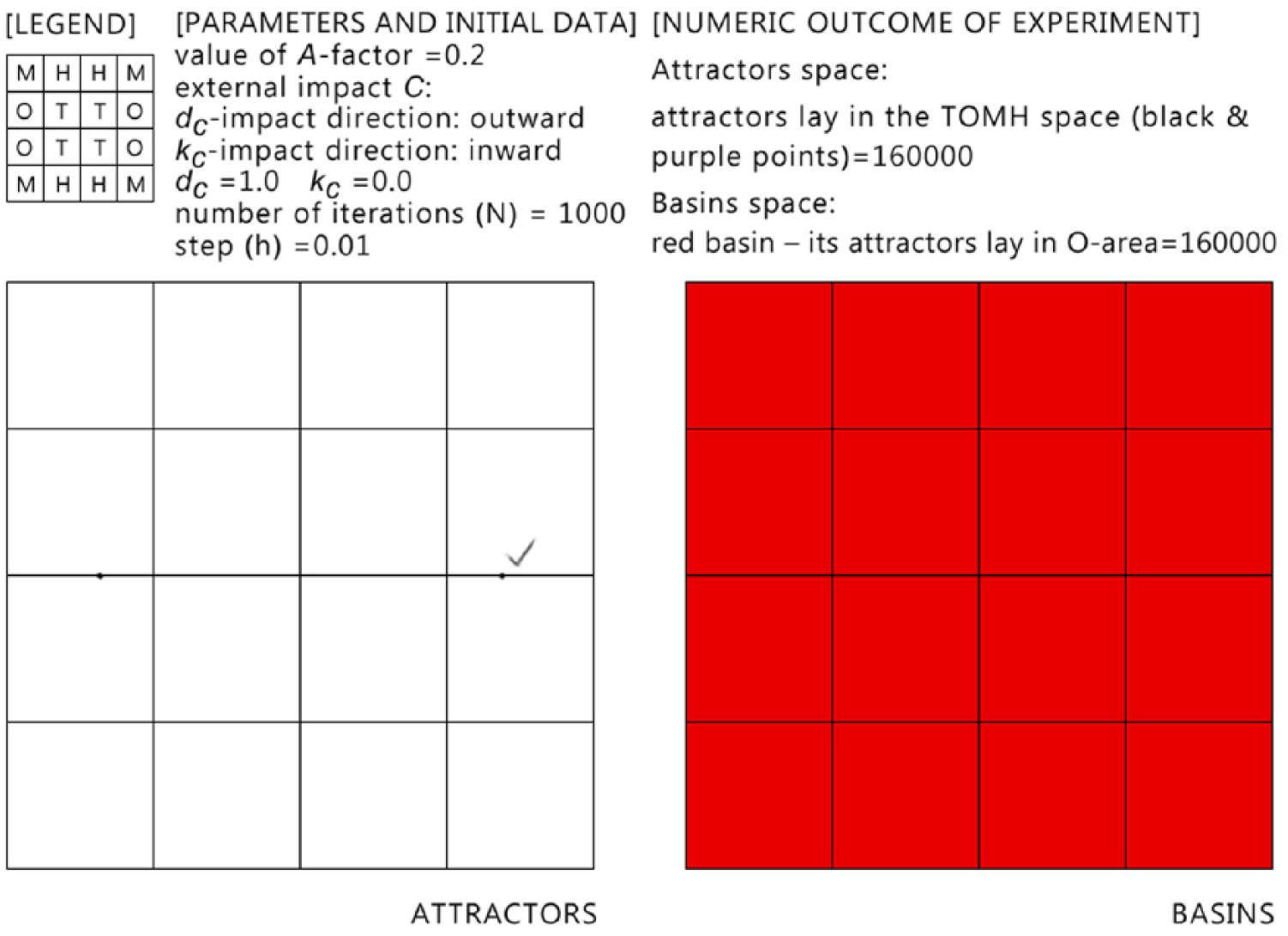
Experiment 00_001.
In many other experiments, the presence of modernization pressing as a major factor of institutional development is almost always necessary for the implementation of desirable scenarios. In the meantime, if the State efforts for modernization are the only driver of this process, they are canceled out by the counter-intuitive behavior of the social system.
Experiment 00_012 (Figure 12) is a good demonstration of a scenario where modernization efforts of the State are supported by the public consciousness. The outcome is positive: Attractors are steadily located in modernization areas near the convergence line. This observation is easily interpreted by itself. If some level of modernization of public consciousness does not exist, external modernization impact throws the actors out “in a vacuum”: The old institutional structure is deteriorated but not substituted with a new one.

Experiment 00_012.
Experiment 00_013а (Figure 13) demonstrates a scenario where modernization opportunities dominate (high A-factor) and the State impact is traditionalistic. This is quite an artificial situation hardly imaginable in real contemporary life, but of course, history knows such examples. At each level, we see a deeply dissected, polarized society where every unit has development prospects distinct from those of the next unit and, in its turn, consists of different-type parts.
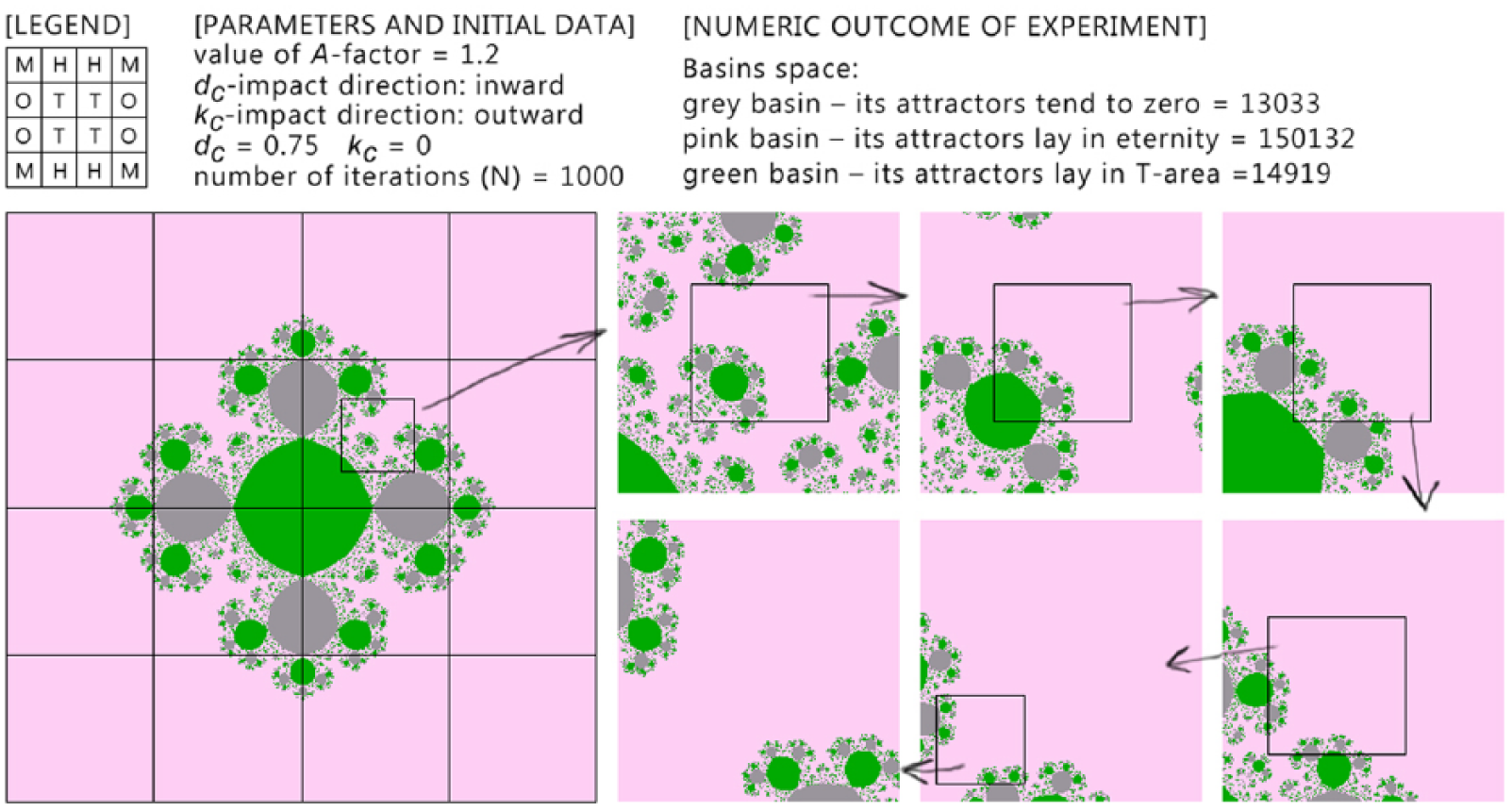
Experiment 00_013а, basins.
What Are the Results of the Institutional Modernization Simulation?
We present some most interesting qualitative interpretations from the series of experiments. Generally, nonlinear effects known from literature were verified (under a certain combination of factors), and new effects and/or conditions of their origin were discovered. We used a metaphor “turbulent” rapid modernization to describe the whole complex of these effects.
Such a modernization is not uniform, it variously affects different institutions, strata, and spaces that should seem to lead to contradictions or even clashes between them. The turbulent modernization is characterized with phase transitions—leaps, “breakthroughs”—that may break the proportion of causes and consequences. Leonid Borodkin (2005), a Russian specialist in social-system modeling, notes
According to the [synergetic] paradigm, development is thought of as a sequence of long periods of the stable states of the system, interrupted by short periods of chaotic behavior, after which a transition to the next stable state (attractor) takes place. (p. 5)
In terms of institutionalism, a phase transition may be described as follows: In the beginning, an institutional structure exists (game rules) with informal institutions inside it. There is also consensus among actors regarding this structure, as well as some kind of equilibrium (this implies, among other matters, a balance between actors’ advantages from the existing structure and disadvantages from its collapse). At the same time, a latent institutional structure exists (alternative, known-but-not-used game rules) that does not include TIIs. But transition to the new game rules, even though old ones are archaic and ineffective, faces at least two obstacles. First, actors are afraid to incur unacceptable costs as a result of abandoning the previous equilibrium. Second, scattered attractors do not possess the instruments to compromise on removing old game rules and accepting new ones. In many cases, tackling of these two obstacles does not need considerable resource spending (namely, it has a low-energy, “weak” impact on the system), but it may have far-reaching implications.
During modernization, archaic norms, social structures, and administrative and political institutions do not die off, but adapt, accustom into new ones, both transforming modernization innovations and being transformed by them. This is how “the sedimentary society” 2 emerges, where old “game rules” are conserved but not isolated. A sedimentary structure (or traditional institutional legacy), having lost its former functional role, obtains pathological forms. “Communal consciousness” justifies criminal clans. “Mutual supportiveness” gives rise to “mutual cover-up,” conspiracies of silence, and illegal relations between the State officials and the business community. “Patriarchalism” creates nepotism, domestic violence, and so forth. This is how an effect that may be called a “ptomaine of traditionalism” emerges.
“Backflows” are inherent in turbulent modernization. In some areas and institutions, which are not fully integrated into modernization processes, there is an emergence of a kind of cyst that evolves in the opposite direction—toward archaism. Under a number of favorable (nondiscriminatory) conditions, these sectors grow intensively. The appearance of pseudo-morphoses allows archaic institutions to be steadily embedded into modernized formal structures and substitute modernized “game rules” (the essence of institutions) while preserving exterior forms. Archaic institutions seek to adapt to a new modernized milieu in a way that is inherent to human beings and not plants: If the latter change themselves, the former change the environment. For example, in response to the primacy of personal ties, openness to violence, formal and legal nihilism in traditional societies, modernized structures have to adjust to them and obtain their features. These phenomena alone are widely known and constitute one of the most debated topics in social sciences.
Even if “backflows” occupy quite a small social space, nevertheless, the very presence of them drastically enhances the unforeseen negative effects of the modernization strategy. In many cases, the collapse of traditionalist segments proceeds quite painfully: Both in experiments and reality, we see that such efforts may result in the disintegration of the institutional structure, and the abrupt narrowing of the system’s space of survival. But the “flawed stability” scenario is very dangerous as well. It implies the dislocation of attractors to the area of competitive institutions and to the pole of the State ineffectiveness; it may even cause an open struggle between institutions of different types. While placing modernization demands on institutions, the State in the meantime makes concessions to the traditional social forces in exchange for stability. Such dissonant behavior leads to the sheer falsification of institutions: Behind the exterior formally modernized façade, informal archaic institutions—mafia-clannish, senior-vassal, tribal, and so forth—are developing.
A series of experiments also makes evident the effect of “necrosis”: In the process of modernization, a number of institutions are neither modernized nor traditionalized, neither adapt nor isolate themselves, they just disappear in the social and, consequently, physical sense. It is interesting that in our experiments “necrosis” started in the poles of divergence, where formal game rules were too weak and gave place to almighty informal institutions. These are spaces where society/state public authority ends and the supremacy of tribal and ethnic factions, criminal gangs, or quasi-capitalist corporations starts. One can see this effect as a humanitarian catastrophe, an accumulation of socially dangerous groups or “inflammable material,” and so forth.
Modernization pressure may be accompanied with the growth of “volatility” and variability of modernization measures (and likewise, reactions to them): Some of them may be stronger and super strong, others less strong and insignificant. Historians are familiar with the “frog effect,” an interchange of institutions’ and societies’ super-passivity with leap-ahead super-reactions to sometimes minor external impulses. Besides, the institution’s fragility grows significantly against the background of rapid modernization.
Conclusion
Following natural and hard sciences, social disciplines master methods and concepts of fractal geometry. Large-scale invariability, system’s ability to self-assembling, complex consequences of simple causes, fractal limits—these and many other phenomena are hard to describe and generalize within traditional models of social processes. Meanwhile, political scientists, historians, and sociologists often deal with these phenomena. The ability of virtual computer fractals to simulate real objects and processes in living and nonliving worlds makes fractal geometry a heuristically productive instrument not only for modeling physical but also for social reality.
Footnotes
Acknowledgements
The authors are particularly grateful to Julia Movchko for creating Modernofractal 5.1 program.
Declaration of Conflicting Interests
The author(s) declared no potential conflicts of interest with respect to the research, authorship, and/or publication of this article.
Funding
The author(s) disclosed receipt of the following financial support for the research and/or authorship of this article: This work was supported by Russian Foundation for Basic Research (Grant 14-06-00093a) and the Ministry of Education and Science of Russia (Grant 33.956.2014/K).