




Abstract
The purpose of this qualitative study was to describe motivational factors that increased open distance learning (ODL) students’ capacity to successfully graduate with master’s and doctoral credentials. Study background revealed that Zimbabwe Open University (ZOU) persistently experiences increased levels of student dropout and competition from conventional universities that introduce ODL through “block-release” programs. We used a descriptive qualitative research approach to collect and analyze data—hence, data collection through audio-recorded open-ended semi-structured interviews helped to maintain accurate accounts of data. We presented data through themed reporting enhanced by direct quotes from participants. Our research broadly concluded that once participants registered to study, perceived attention from various social angles created immense motivational factors ranging from institution motivators, personal factors, and social-generated motivators such as fear of what society would think of them all motivated them to persist and graduate with proposed credentials.
Background to the Study
Since 1980, the current Zimbabwe administration made the goal of achieving access to college a central theme of its education policy as it relates to adult students across demographic groups. In the last two decades, The Zimbabwe Ministry of Education policy focused on what literature refers to as “more on college access and college completion” (Kelly, Schneider, & Carey, 2010, p. 32). The late Minister of Higher Education Dr. Stan Mudenge extended the content of the Zimbabwe Higher Education Policy to include college access by increasing the number of colleges, universities, and students who enroll for college education. Available data reveal that in some areas around Zimbabwe, due to previous education policies and uneven cultural tendencies “raising the college completion rates of poor students [may be] critical to achieving that goal” (Kelly et al., 2010, p. i). In general, experts in the field of higher education and open distance learning (ODL) in particular consistently agree that college education may best be achieved by improving the quality of education through effective instruction and allowing as many students as possible access to higher education levels (Brookfield, 2005; Kelly et al., 2010).
For many years, there has been interest in the field of adult education in teacher quality, effective instruction, and the impact of these on learner success. The offices of adult education . . . in the . . . Department of Higher Education . . . play[ed] a leadership role in providing resources to enhance teacher quality and guide the improvement of adult education programs. (Center for Adult Language Acquisition Network, 2010, p. 1)
This quote emphasizes important issues that may be related to educating adult students in Zimbabwe:
Accepting that adult education forms an important link between high school education and the workforce.
Adult educators, especially ODL should develop deeper understanding of how adult students learn.
Adult educators across Zimbabwe should focus on developing instructional models for increasing numbers and quality of graduates from universities, so that they produce quality teachers and educational administrators primary and secondary education leading achievement of true spirit of college access and college success for all Zimbabweans.
The current Zimbabwean policy position and approach to higher education has set the tone for continuous reshaping of instructional strategies to continuously improve. The call for improved instructional strategies is also supported by research findings recommending that during an era of heightened accountability for education programs, teachers, and students, and with the connection between teacher preparation and student outcomes well established in primary to university education field should be able to demonstrate that the teaching workforce is qualified, competent, and able to meet the learning needs of a diverse group of learners. The university teaching field must therefore achieve a consensus on strategies for creating enabling learning environments for students. (Smith, 2006, p. 165)
As university education plays a collaborative role with, and supports a number of other social and educational arenas—workforce training, correctional education, civic education, high school education, and social services—policy related to higher education should influence how university resources and capabilities are developed and managed (Smith, 2006). So, from this standpoint, understanding struggles related to acquiring a university qualification from among ODL students should be viewed as a critical component for achieving excellence and the intended collaborative role between and among institutions. However, achieving this goal may depend on how players in ODL education understand and conceptualize tutoring in adult education. Literature points to a common hypothesis that ODL students exhibit learning behaviors that tutors should understand to achieve improved influence on student learning (Goldrick, 2009; Richardson, 2002). Knowledge of how adult ODL students adjust to learning demands “is the means by which educators acquire or enhance their skills . . . attitudes, and beliefs necessary to create high levels of learning for all students” (National Staff Development Council [NSDC], 2001, p. 2). This implies that tutoring approaches in ODL should be guided by “high quality, sustained, intensive, and student focused [instructional approaches] in order to have a positive and lasting impact on . . . students’ performance” (Lowden, 2005, p. 2).
Theoretical Frameworks Guiding ODL and Tutoring
We are not inventing the wheel anew—This study builds and rests on the base of theories that guide adult education. In this article, authors view and understand ODL from a number of well researched and established theoretical frameworks on andragogy including Knowles, (1980a), Knowles (1980b), Bodrova and Leong (2004), and Brookfield (2005). Our study is grounded in two such frameworks including the critical theory (CT) and the constructivist theories. First, we discuss how the critical theoretical frameworks relate to adult education, influencing student persistence and success.
Critical Theoretical Framework Shaping Adult Learning
The first of such overarching theoretical framework is CT, which includes the coalition pedagogy as an extension of CT (Brookfield, 2005; Freire, 1980). As Brookfield (2005) posits, critical ideology comprises the set of broadly accepted beliefs and practices that frame how people make sense of their experiences and live their lives. When it works effectively, it [CT] ensures that an unequal, racist, and sexist society is able to reproduce itself with minimal opposition. (Brookfield, 2005, p. viii)
CT accepts that education is the best vehicle for individuals’ understanding of how their current situation is shaped by dominant society and culture (Brookfield, 2005; Vygotsky, 1978). Therefore, it is important to help adults to understand that it is possible to identify personal levels of oppression and when necessary—to challenge the status quo in world democracies (Brookfield, 1987). In this study, oppression, as a CT concept, should be understood as that state of mind during which individual adult students experience a barrier between achieving a desired goal and not achieving it. The barrier, according to CT, is a gap caused by lack of skills and knowledge to achieve that desired goal. CT, therefore, accepts the notion that instructional approaches should be used to bridge that gap. When not resolved, the lack of skills and knowledge may be used as a tool for continuously reproducing highly unequal societies in which racism, class discrimination, and economic inequalities of the dominant society are accepted as normal, natural, and inevitable. When applied in the context of ODL, CT can help tutors to provide students with skills that help them change their statuses and help arm them with the skills to recognize discourses oppressing them and improve the social order (Delgado & Stefancic, 2001).
As a framework for shaping the way ODL tutors respond to their students’ needs, critical theorists advocate for tutors who are capable of providing ODL students with the knowledge, skills and develop attitudes that help the ODL students succeed in democratic, collectivist environments (Freire & Macebo, 1995). It is this lack of knowledge about how to achieve something that critical theorists define as an individual’s feeling of some level of oppression (Freire, 1994). Therefore, when tutors succeed in helping such students discover the how tos of students become liberated from that level of “oppression.” Literature identifies various strengths of how CT may help the formulation of tutoring, counseling, and advising strategies to empower ODL students to enroll in and succeed in higher education institutions.
CT starts from the premise that knowledge is always in motion, hence tutoring approaches that are shaped through principles of CT help lecturers to understand the concept of dialectical process—that is, because knowledge is always in motion, ODL adult students will always return to college to seek specific higher education skills (Brookfield, 2005). Providing students with adequate and appropriate skills, knowledge, and attitudes to meet those needs emancipates them from the false appearance of an oppressive realty (Peca, 2000). It is through this process of emancipation that adult students may realize the gains of attaining higher education and hence the motivation to learn. To emancipate them, ODL students need to continuously engage in critical thinking at all three levels, including self-critiquing, critiquing the current situation and critiquing historical factors related to that oppression (Brookfield, 2005). According to Brookfield (1987), central to critical thinking is placing one’s own situation in a broader context, so that aspects of one’s problems are seen as connected to broader social forces. Helping people explore the often contradictory and ambiguous nexus where private troubles and public issues meet often entails making clear the connection to social action. (p. 62)
According to CT literature, results from all forms of critiquing may lead to a new knowledge which must lead to change. That change, according to CT of education, refers to a cognitive movement of the individual from one level of knowing to a higher level of knowing (Brookfield, 1987). It is this new level of knowing that CTs in education refer to as removing oppression—which happens as a result of the individual’s ability to transform their self-consciousness so that they are able to ascertain best responses they need to make to bring themselves to the same level with the rest of the society (Brookfield, 2005).
One specific question that this study investigated was how do Zimbabwe Open University (ZOU) graduate students view the factors that ODL graduate programs demonstrate to persevere and succeed? CT accepts that reality is created when individuals purposely seek new knowledge by continuously reflecting on an ideal concept to discover what is beyond that current reality (Brookfield, 2005). Therefore, for critical theorists, in ODL the goal is to increase the levels of knowledge to practitioners about their students—who are they, what characteristics do they have now, what has been their historical context, what are they trying to become, what is in it for them, how will they look like—attitudes, behaviors, skills, and knowledge soon after learning from these professionals? These questions are best answered through a critical thinking process. From a critical thinking perspective, coalition pedagogy invites ODL tutors to ask themselves the following nine questions central to how adult students learn: [1] How do adults learn forms of reasoning that challenge dominant ideology and question social, cultural, and political forms that ideology justifies? [2] How do adults learn to interpret their experiences in ways that emphasize their connectedness to others and lead them to see the need for solidarity and collective organization? [3] How do adults learn to unmask flow of power in their lives and communities? [4] How do adults learn of the existence of hegemony—the process whereby people learn to embrace ideas, practices, and institutions that actually work against their own interests—and their own complicity in its continued existence? [5] Once they are aware of it, how do they contest its all-pervasive effects? [6] How do adults learn to defend the life-world (the set of understandings and assumptions that frame how people live with each other) and civil society (the relationships, associations, and institutions not directly under state control within which people form relationships and develop identities)? [7] How do adults learn to think critically by recognizing when an embrace of alternative views is actually supporting the status quo it appears to be challenging? [8] How do adults learn to recognize, accept, and exercise whatever freedom they have to change the world? [9] How do adults learn the practice of democracy with all its contradictions and disciplines? (Brookfield, 2005, p. 31)
Connecting Constructivist Theoretical Frameworks to ODL
The second broad theoretical framework that addresses the needs of ODL students is the constructivist theory, which consists of two complementary theories—social constructivism and the psychological constructivism. Constructivist theories guide understanding of how learning among adults takes place, first within a social context and then from an individual context (Phillips, 2000). According to constructivism, ODL students can make sense of a situation as individuals and in groups (Bodrova & Leong, 2004). When linked to adult students, the history of constructivism reveals that there are still some unanswered questions in the constructivist theory literature such as how may constructivism be applied to ODL tutoring and/or administration? However, as a theory guiding instruction, constructivism reveals a close relationship between characteristics of how adult students learn and how they should be taught (Richardson, 2003).
Constructivism as a theory explains how learning occurs among adults, and accepts that individual students “create their own new understandings on the basis of an interaction between what they already know and believe and ideas and knowledge with which they come into contact” (Richardson, 2003, p. 1624). Similar to this study, the broad questions that constructivists aim to answer are why do adult students seek education? How do adult students especially those in ODL persist and succeed? Two interdependent approaches to the constructivist theory include the social aspects of the classroom, which Phillips (2000) calls the social constructionist or social constructivism, and another, directly related to how adult students learn—the psychological aspects of the classroom—or the psychological constructivism. Both frameworks have a bearing on how ODL tutors should view instruction of adult students.
Social Constructivism
This accepts that any form of knowledge or discipline that adult students may possess are constructed on the basis that include “politics, ideologies, values, the exertion of power and the preservation of status, religious beliefs, and economic self-interest” (Phillips, 2000, p. 6). As a philosophical framework that may be used to guide tutoring strategies, the social constructivism approach describes ways in which power, the economy of a country, political, and/or social factors may influence ways through which individuals understand and make sense of the social and economic contexts in which they live (Richardson, 2003). The social constructivism framework encourages ODL tutors to engage students, so that they continuously view their own contexts in relation to that of the other students, and then seek to continuously improve themselves in relation to others, because they will always see new reality in the context of others. The role of the ODL tutors should be to foster collaborative learning communities to motivate students to learn through reflection of their ideas in the context of how others view similar ideas (Vygotsky, 1978).
Psychological Constructivism
A constructivist perspective related to learning views knowledge construction in relation to the developmental learning theory which says that individual learners actively construct the meaning around phenomena, and that these constructions are idiosyncratic [personal], depending in part on the learner’s background knowledge. The development of meaning may take place within a social group that affords its individual members the opportunity to share and provide warrant for these meanings. If the individuals with the group come to an agreement about the nature and warrant of a description of a phenomenon or its relationship to others, these meanings become formal knowledge. (Richardson, 2003, p. 1625)
Both the psychological and social theories agree that when tutors facilitate learning among students, they should base their mentorship on the understanding that adult students create meaning through active contact with other students on the basis of their background knowledge (Bodrova & Leong, 2004). This psychological context suggests that tutors develop deeper understanding of grouping students according to diverse understandings of issues, paying attention to individual needs of ODL students. The implication for this research project is that for ODL tutors to guide their students in a constructivist manner, they should move away from the model of teaching to the model of facilitating learning (Richardson, 2003). Five specific constructivist practitioner characteristics that define successful facilitating approaches include the following:
Creating student centered facilitation for individual learners including respecting adult students’ backgrounds, values, and beliefs.
Facilitating group dialogue. Grouping helps students to explore their own ideas in relation to what others know, leading to creation of shared meaning.
Providing students with opportunities for questioning adds new ideas by engaging people around them—through critical questioning.
Developing metacognitive awareness—helps students to understand how they learn.
Making reference to resources where students can find more information—groups, websites, reference books, and experts.
The frameworks advocate for tutors to understand students’ learning needs and characteristics of ODL students and to modify their andragogic strategies to help students succeed. Both frameworks suggest that there should be a tutor–apprentice/expert–learner relationship between the tutor and ODL student. The constructivist theory extends this notion by adding that ODL tutors should understand the diversity and cultures of their students because ODL students participate in adult educational programs for specific reasons and are motivated by a need to pick up skills that help them become employable again. In this context, tutors of adult students should focus on developing deeper knowledge of ODL students’ characteristics and needs to effectively guide their responses to learning needs (Knowles, 1980b).
Characteristics of Adult Education Students
Adult students exhibit characteristics that tutors should understand to succeed with them during tutoring (Knowles, 1980b). For example, regarding their development, adults and children differ in global learning processes. In particular, unlike children, adults participate voluntarily in education, have specific reasons for enrolling in classes, and are often self directed learners . . . Differences between adults and children suggest that even educators who are highly experienced in teaching children to read and write need special training. (Perin, 1999, p. 611)
A summary of some of these characteristics as they relate to how ODL adult students learn as discussed by Knowles (1980b) includes the following:
They Are Self-Directed Learners
Most adult students enroll in classes for specific reasons and they possess the potential to make decisions that affect them. During learning, adult students may independently complete certain scholastic assignments, but in some situations they need to collaborate with others.
They Acquired a Range of Life Experiences
Generally, adult students possess wide-ranging experiences related to how they process information, understand issues, and respond to learning situations and how they carry out tasks. Their past experiences and challenges, including successes that students previously experienced, shape how they respond to instruction. Because the aggregate effect of these experiences constitutes the building blocks of new knowledge, adult students use them to influence their abilities and willingness to take risks, try new strategies and move their ways of knowing to higher levels (Dembo & Seli, 2008). The question that remains unanswered from literature is how do ODL students who graduate with a master’s and/or doctorate credential describe the factors that encourage them to persist and finally graduate?
They Acquired a Fully Developed Vocabulary
Literature reveals that adult students demonstrate fully developed and functional oral vocabulary that allows them to communicate efficiently with tutors and other students (Knowles, 1980b). Therefore, adult ODL students are capable of functioning reflexively—using past experiences to communicate their opinions on current topics during learning. One clear implication for this characteristic to ODL tutors is ODL tutors should demonstrate deeper understanding of how their students use past knowledge to solve problems, share ideas; and on that basis, foster collaborative learning contexts that promote continuity.
Continuously Experience Ongoing Developmental Changes
Adult students continuously progress through developmental stages throughout their adult years, including but not limited to (a) changes in vision and hearing around ages 35 to 40, (b) females experiencing reduced levels of physical energy and menopause, (c) experiencing general health problems, and (d) experiencing signs of memory gaps (Knowles, 1980b).
Learn Better by Solving Problems
Andragogy and other models of adult learning theories view adult students’ experiences as resources and stimulus for learning. Constructivism extends this understanding, suggesting that adult students learn better during interaction with learning materials that address their lived experiences as they relate to learning topics. Adult students try to keep abreast with current events; they prefer learning situations that encourage responsibility for fixing things that go wrong, locating missing information, and solving the problems and dilemmas of daily existence.
Their Past Experiences Shape Learning Attitudes
Adult students observe, make decisions, and respond to assignments or events occurring around them using past experiences related to successes, but they avoid using past experiences references associated with failure (Vella, 2002).
Purpose of the Study and Research Question
The purpose of this study was to identify and describe factors that influence ODL students persist and succeed to graduate with higher degrees credentials. The study was guided by the question: How do ZOU doctoral and master’s graduate students describe the factors that encouraged them to persist and succeed in their studies?
Significance of the Study
Published findings from this study have potential to influence tutoring approaches for ODL students. Students who seek education through ODL will benefit from improved tutorship approaches. Policy on student recruitment and part-time tutor recruitment will be shaped by responsive needs of ODL students. This study has a huge potential to influence quality of ZOU graduates once tutors embrace use of responsive approaches to meet learning needs of students.
Participants
Volunteering participants—including five doctoral and six master’s graduates from around the 10 political regions of Zimbabwe—informed this study. The six (6) master’s degree holder participants included four female and two male graduates. There was one female and three male PhD graduate participants. All participants were invited to volunteer through e-mail invitation by one co-researcher who works at the central office of ZOU.
Research Methods
Guided by the interpretative and grounded theory approaches, we focused on data analysis approaches from the perspectives of the participants’ view of making sense of the data. We triangulated data analysis approaches by grounding our research questions on how the respondents grounded their understanding of the phenomenon under investigation. Therefore, for this study we embraced the discovery approach to understanding the similarities of experiences based on the notion that when grounded in the views of the participants, we as researchers needed to triangulate data analysis approaches by asking participants to provide their views on why certain behaviors and beliefs are important to their success. To discover the reasons for persistence, we asked participants the interpretive questions encouraging them to describe to us why certain strategies were viewed as a key to their success, and how they used the strategies to unlock the challenges they encountered throughout their studies. We also wanted to know how participants knew that in the absence of those strategies they felt they would not have succeeded. The interpretative approach as a qualitative approach to research suggests that when conducting research, researchers should strategically aim to “understand what things mean, how they happen, and the different ways in which the world [of the participants] may be understood” (Madhlangobe & Gordon, 2012, p. 181).
Data Collection Instruments-Interviews
Research literature commonly identifies interviews as critical instruments for collecting data that clearly describe the phenomenon being studied. We interviewed only individuals who enrolled and successfully completed higher degrees credentials with ZOU—an ODL institution in Zimbabwe. We also followed up leads of any other sources that were mentioned as motivators during the interviews.
Archival Data
In this study, we also collected historical artifacts and stories of the participants, and after reviewing them, followed up with personalized interviews. We requested participants to provide written narratives of the persistent power and motivational force of any artifact mentioned for their successful graduation.
Data Capturing, Analysis, and Interpretation
We recorded data from interviews using MP3 voice recorders and then transcribed data into word documents. Next, we read through, combed and coded all data for themes and categories that describe the factors encouraging students’ persistence. To make sense of data from the artifacts, we interpreted the data during the interviews with the participants by asking them a standard follow-up question: How did that help you to persist and succeed?
Ethical Considerations
We used pseudonyms to identify participants. However, there is a possibility that ZOU doctoral students may be identifiable to people since very few graduated with ZOU PhDs.
Findings and Discussion
The purpose of this qualitative study was to identify and describe factors that motivated master’s and graduate students to enroll, persist, and successfully graduate with master’s and doctoral credentials from an ODL institution. Results revealed that successful ZOU doctoral and master’s candidates do more than just study to graduate. In this context, ZOU ODL graduates who participated in this study revealed that they had to deal with hurdles that include time management, socioeconomic hurdles, stress factors, confusion, lack of resources, family, and other social responsibilities that bring a number of anxieties and stressors with the potential to cause students to fail or dropout. Similarly, findings from our study reveal that students who succeeded under these conditions experienced a number of motivators and used a number of persistent strategies that helped them to persevere and prevail under similar institutional conditions that caused other students to dropout or fail. Factors described during the interviews fell into three broad categories, including (a) individual student characteristics, (b) institutional-related characteristics, and (c) other external factors. Specific themes running through all three categories include personal need/actualization, family culture of persisting during studying, feeling of belonging to academic cohort created by ZOU, students’ ability to integrate into the academic community, interpersonal relationships, perceptions and expectations from family/community, fear of failure, personal accountability toward own family, favorable conditions for study (study groups, availability of modules and personal space), and perceived new status.
Individual Student Characteristics
The Relationship Between Student Engagement and Family Background
Some students’ characteristics and family backgrounds helped ensure participants’ persistence and graduation with credentials. One finding for this category regards female graduate participants. Reflections from one interview with the only doctoral female graduate revealed among many others that she was a single-female parent who had issues to juggle with in addition to her studies. Family emerged as a key motivator that ensured that in addition to supporting children, the female student maintained close relationships with ODL study groups. The graduate mentioned persistent sickness related to age that sometimes confined her to her bed. However, colleagues would team up and go to her house to conduct their study group sessions from her bedside.
This reflection is very significant to this study, because it reveals that both she and her male counterparts understood that success is achieved through study groups, driven by a high sense of belonging and need for participation. The result also indicates that cultural gender role-challenges that affect females vary significantly when compared with those that affect male students. However, this finding requires further research that examines cultural gender role differences and how they affect student persistence and matriculation within cultures.
Student Personal Motivation Factors, Characteristics, and Family Background Factors
Health-related factors
Consistent with other findings from reviewed literature (Trockel, Barnes, & Egget, 2000), our research findings reveal that health contributes to students’ academic performance by affecting students’ participation levels in ODL-related activities that determine students’ graduation outcomes and course grades obtained by adult students. This finding adds to existing literature in that available research literature was carried out in first world countries and reveals that exercising is important for adult students, while ODL students in Zimbabwe deal with some of their health issues only by consulting doctors and persisting under the cultural beliefs that regardless of health, community, and family members view health issues as a weak excuse for dropping out or failing. One participant summarized his belief in the following way:
Congruent to this finding, Trockel et al. (2000) found that in conventional universities, adult “students who exercised 7 or more hours a week obtained significantly lower grades than students who exercised 6 or fewer hours weekly or not at all . . . ” (p. 126). The difference between our current research findings and those from the Trockel et al. research is that earlier findings were delimited to Western cultural contexts that used a sample from a conventional setting. Our study extends existing literature relating to (a) results in the Zimbabwean ODL contexts, (b) findings describe mature adult learners who succeed in ODL settings, and (c) that students in our context deal with issues similar to those in western countries in addition to shortage of recent literature and limited access to technology.
Personal need or convenience
One motivating variable for participants’ high levels of success was their intrinsic need to benefit from contact hours with tutors or supervisors of research projects. Students reported fulfilling most scheduled tutor–student contact hours despite job-related responsibilities, age-related health issues, and expected parental roles that normally affect participation levels. For example, as students at times had to make choices between conflicting religious and academic-related interests. Participants reported having to alternate attending weekend-church and weekend school. Agreeing with most participants, one participant summarized views in this category:
One doctoral graduate extended this theme: You have to have a contract with yourself first, if you want to succeed. I rewarded myself for achieving certain milestones throughout the entire program. For example, I would go out to mix with friends [as a reward] only when I was sure I had covered or surpassed planned doctoral activities for the day. Coffee with friends or even going out to church . . .
Persistence, from this context, was viewed as the participants’ abilities to substitute fear of the unknown . . . with dedication for personal improvement. Such students reported taking risks that include avoiding listening to the outside world regarding their changes or emergence of new social behaviors that would be regarded as negative due to participation in the ODL programs.
Ability to Set Achievable Personal Goals
Personal commitment to achievable goals
Participants commonly held the belief that to successfully complete their studies, graduate students should demonstrate higher motivation and commitment to manageable milestones in their studies. Unlike master’s degree programs, ODL doctoral degrees require extended student commitment to complete. Lengthy studies require students to work both long- and short-term hours. Therefore, the participants’ approaches and perceptions toward coping to achieve an academic credential have a direct relationship with motivation levels and commitment demonstrated. The following quote from the one participant summarizes this finding:
When doctoral students work on their dissertations, some set insurmountable goals by attempting to solve world problems with just that one research. According to findings from this study, successful ODL doctoral candidates received assistance from their research supervisors who helped them quickly identify realistic research designs for their research questions/problems. Assistance from supervisors helped candidates to stay focused and motivated, to “continuously challenge ourselves in order to successfully complete our studies” (
Using Student Self-Control and Effective Personal Organizational Skills
Self-deprivation and self-regulatory persistent factors
Our findings revealed that ODL participants’ persistence levels related to clear focus on specific goals that indicated steps toward achieving graduation. Participants defined self-control as their “ability to forgo pleasure and non-planned emergent activities—except funerals in order to attend to master’s and doctoral work demands” (female participant). Some participants reported that they experienced short-sleep hours due to fear of failure. Culturally, in Zimbabwe, while people may not find plausible excuses for not attending funerals of close relatives, friends/neighbor, participants still ensured that they carried something to read and write at such events.
Additional information this reflection adds to the literature as it relates to student success is, to persist effectively; candidates need to ensure buy-in support from spouses or families. Second, one demonstration of persistence may be viewed through behaviors that at times may be regarded as morally and culturally wrong, especially at funerals and weddings. We concluded that (a) success in ODL requires candidates who take cultural risks, (b) students should avoid unproductive but tempting pass-time activities, and (c) they exhibit effective collaborative family financial management. From the overall responses to interviews, Figure 1 uses the descriptive vocabulary from participants’ responses to create a model we refer to as Self-Regulatory Persistence Factors for success. The figure may help during students’ orientation days to prepare them for behavior self-monitoring for success.

Decision factors related to student-self regulatory behaviors.
Students’ Ability to Source, Utilize, and Manage Resources
Results from one follow-up question indicated that participants grappled with resources management including time, material, technology, and finance to ensure persistence and success. For example, one participant whose reflection seamlessly agreed with and summarized most participants’ persistent principles and personal organizational skills suggested that one factor that ensured persistence and success was that doctoral and master’s students clearly have to work with a plan that summarizes all events for each particular day to always keep track of those doctoral tasks that have been accomplished and those that need accomplishment to be able to say yes, zvirikuita . . . [this is it . . . ] I am progressing with the doctoral work. For example, when I get to the end of each day, I ask myself, what have I done today to add something to my dissertation? If I find nothing specific to point at, I knew for sure that I was not persisting . . . I would tell myself my studies are in danger of folding up . . . Hatifaniri kutamba nenguva yatisina—nguva inokosha! [We don’t have to waste any little time available to us—time is a valuable resource!].
One common theme that we consistently heard throughout the interviews and observed from review of artifacts was that sometimes, data analysis overwhelmed candidates because they did not take pre-data analysis courses to prepare them. This involves reading, identifying themes and categories, and including writing the actual thesis. According to the participants, students who succeed persistently consulted tutors and project supervisors for help to overcome challenges. For example, graduates who intended to use SPSS abandoned the design because the university itself did not have the software. Although some students sourced the software, tutors did not know how to use it. One doctoral candidate said, “I wanted to use a quantitative research design for my dissertation, but my supervisor could not help me use SPSS although I had sourced it from my sister who is in UK.”
Timely Payment of Tuition
Students’ persistence was also linked to participants’ ability to fund their studies. Costs associated with studying for a master’s or doctorate degrees especially through ODL are significant, primarily because ODL higher degrees require the students to invest financial resources that ensure completion of the courses, including huge investment of required time and travel during data collection. According to findings of this study, for master’s and doctoral candidates, only those employed by ZOU had access to fellowships. External candidates had to pay tuition through applying for bank-loans and sometimes borrowing from local loan-sharks. In addition to bringing life threats to family, interests from loan-sharks are considerably high once loan-sharks perceive students’ inability to repay loans. This reflection from one doctoral participant summarizes this theme: It’s not one of those experiences I would like to go through again—but I did, and neither would I wish another person to experience it. In my case I had to endure that humiliation outside my two children’s view, but the good news is . . . Yes, I managed to payback but most important I was able to graduate . . . there is my graduation photo, my gown and all that goes with it . . .
This reflection reveals that participants were motivated to persist for self-actualization reasons and when they look at their graduation regalia and certificates they find satisfaction. Participants viewed money as a secondary goal for their participation.
Attending tutorials grounded on personal-timetable
Another critical persistence-related factor that was viewed by participants as an indicator of success in post-grad related to attendance of (a) weekend and face-to-face tutorials with research supervisors and (b) completing coursework assignments and dissertations. Participants were adult students who had children and some were married. The only female doctoral participant a widowed and single parent agreed with other participants that regularly they found themselves having to prefer to arrive late for weekend school to help their children with planned weekend school activities. Similar to our findings, volumes of research spanning decades also reveal that there is a positive correlation between attendance and student achievement (Bodrova & Leong, 2004; V. Richardson, 2003). We concluded that students who have experienced success previously are inclined to work hard to maintain that record especially when studying at higher levels. Participants’ reflections revealed that in addition to their children’s needs, they had to find time at night to catch up.
While sleep is considered important, participants confirmed that they sacrificed and worked deep into the nights to catch up. This appears to reject findings from literature that says there is always a need for students to maintain a strict 8-hr sleep regime before the next learning activity. This study reveals that certain cultural beliefs act as motivators including local music that acts as scholastic-anthems reminding candidates to recoup lost time and persist.
Student’s Ability to Ensure Focus/Persistence
In full-time institutional programs, it may take average students 5 years to complete their degrees, while ODL doctoral candidates will take several more years if they do not use effective persistence strategies. In some cases, students may drop out and never return because the road to get to their goal may appear endless and bumpy. Certain student characteristics may contribute to success or failure; hence, it requires a certain type of student to personality enroll in, persist and complete ODL higher degrees. The persistent question that arose from the gaps that we discovered during literature review is what persistence strategies do successful master’s and doctoral graduates use to complete their degrees?
Students face numerous distracters such as attending parties, watching television especially with the proliferation of satellite TV stations, sleep and drinking. Excessive participation in such activities may reduce positive gains toward goals of completing respective study programs. Participants reported that their ability to postpone joy and to resist temptations of investing time in non-productive activities helped them succeed. The following quote from one participant reveals persistence practices leading to attainment of a higher degree credential:
ZOU Institutional Factors
Results reveal that there are some institutional factors that help participants to succeed including (a) supervisor–doctoral candidate relationships, (b) availability of qualified lecturers who foster and model persistent attitudes, (c) receiving expert assistance from library staff, (d) interlibrary relationships with the University of Zimbabwe (UZ), and (e) advice on how to use electronic sources for research.
Research Supervisor–Doctoral Candidate Relationships
Relationships between graduate candidates and their research supervisors played crucial roles in building persistence energies among graduates. According to the data gathered from the interviews, student’s who succeeded to graduate with their respective credentials valued their relationships with the tutors.
According to this reflection, intrinsic motivation is viewed as a pre-condition for starting, persisting, and succeeding; and it is fostered by the general university academic atmosphere that ignites the students’ will to go all the way. For this research, we concluded that while students may be fully motivated to engage in a degree, if the university climate is not deliberately structured to match that inbuilt level of academic enthusiasm in the student, the student may not register but drop out at the earliest plausible opportunity. When students’ motivation is directly connected to a positive university environment, it helps to ensure persistence related to all aspects of the university. These include the culture of success, culture of supportive relationships in the faculty, and the intrinsic sense for belonging. Congruent to the literature, Siebert (2005) findings that “successful people work to achieve personal goals; [and] . . . are not motivated to achieve social indicators of success. Success, for them, is a feeling they enjoy when they reach their self-chosen goals . . . ” (p. 120), our findings reveal that from previous experiences with focused persistence, participants were able to avoid focusing on social indicators that may not help them arrive at self-selected academic goals.
Throughout all the interviews, one theme emerged related to how participants valued the institutional climate and relationships that they commonly qualified as very important, valuable, priceless, helpful, and motivating. The cordial relationships that exist in ZOU, participants found positive energy to continuously create opportunities to work with tutors on assignments and research projects. This was particularly important for ZOU as an institution that offers doctoral degrees through research.
ZOU Tutors Who Go an Extra Mile for Students
One factor that encouraged participants’ persistence was that research supervisors “take time to assist students in the development of manageable course of study; and were always accessible to provide ongoing feedback throughout the research” (Participant). In the case of master’s students, it covers the entire program. In the process, students who experienced ZOU student–tutor relationships valued the relationships as comfortable relationships that went an extra step providing consistent encouragement. Participants described advisor–student relationship as “beneficial to both the student and the supervisor,” meaning that both the supervisor and student get satisfaction when students make progress. However, according to the participants, such relationships should be structured to provide sources of encouragement, direction, and ensuring that students obtain advantages and opportunities to learn from supervisor expertise in their field of study. The following response to interview questions under this theme reveals how expert–apprentice factor ensured students persisted till graduation with chosen credentials:
Tutors who foster and model persistent attitudes
When adult students enroll in fields of study of their choice, one reason is because they identified potential gains related to completion of that course, in addition to quality of lecturers to provide support and guidance for success. Participants reported being able to persist because their tutors exhibited valuable experience and research interests that helped students to meet study targets. One student who experienced the ability to publish under the mentorship from his faculty reflected:
Expert assistance from library staff
According to participants in this study, successful students who graduate from a university receive effective supports from the library staff. They described that library staff helped them to persist through the following sub-themes: (a) helping to locate relevant books and explaining how to use the library—In general, graduates were encouraged when they experienced elements of success in locating information that supported their responses to assignment and related research; (b) permission to use UZ library—ZOU brings university education to the door step of aspiring students. Once students register, participation is assured through availability of ZOU libraries throughout the country and at their regional centers. During the interviews, participants confirmed experiencing a feeling of belonging to a wider academic community when they allowed to use the UZ library—a conventional institution. As a motivational factor, they were able to continue to study regardless of which province they were visiting; (c) advice on electronic sources usage for research—Most participants described their experience with computers as, brand-new and distressing, but for most, ZOU and UZ library staff helped them to develop skills for accessing online journal articles. As one participant puts it, her ability to access electronic files proved “that the research project could be done even from the click of a computer keyboard. Long back we thought computers were only for use by our secretaries, but things have changed.” However, participants also suggested that ZOU needed to subscribe to diverse international journals to benefit future students in all university faculties.
Other Factors that Promoted Persistence
Data from the interviews and follow-up questions revealed that there were other factors that motivated participants to persist and to graduate with their selected academic credentials. These include (a) employment conditions and responsibilities, (b) social supports, and (c) ability to override stressors
Employment conditions and responsibilities
One consistent factor that emerged from our interviews and e-mail exchanges with some participants was that there were demands for new skills at the workplaces. Therefore, some participants made crucial decisions to go back to university in the face of clear possibilities of losing out on their employment delayed promotions. In certain contexts, the participants were offered paid study leave that had conditions attached including that they had to show timely progress toward the credential they were studying for. This factor by itself ensured that participants who were on conditional study leave scored higher than other average students. The sample of participants in our study revealed that they obtained supports from the university, including one-on-one tutorship from lecturers, modules that were written by ODL lectures who understood their contexts. Such forms of support helped the students to perfect superior study strategies that fitted their way of understanding.
Social supports
Studies reveal that levels of social support from university and outside contributors such as family, friends, and mentors are central to the levels of persistence and perseverance that students demonstrate (Dlugosh & Madhlangobe, 2012; Trockel et al., 2000). For example, Dlugosh and Madhlangobe (2012) concluded that students who succeed include those who have powerful social supports such as family, community, and other institutional supports. Findings from this study add new knowledge to the current body of research by further involving participants specifically from ODL contexts. In Zimbabwe, where student loans and direct government supports are no longer available, the time that students spend studying for a university credential may be a stressful and life-changing experience; some of which may cause students to drop out.
For example, one big finding this study made is that doctoral candidates who work are motivated by comments from co-workers and such comments were likely to ensure that they worked hard at their studies more than those who did not receive similar comments. One participant said,
The social context plays a positive role in how master’s and doctoral students value their university careers especially when some individuals in senior positions at work demonstrate interest in what they are studying and how they are succeeding. According to the participants, similar attention from the community causes doctoral and master’s candidates to fulfill certain comments they make in response to some of the casual morning talks that emerge when people meet. For example, one PhD student experienced ridicule from one fellow social commentator who addressed him about his studies at a funeral:
We asked our standard follow-up question: How did these comments help them to persist and succeed? According to participants, comments like these caused them stress although they had positive influences on them. The comments provided fortitude to ensure persistence so the benefits would be evident through tangible results or promotion at work. One participant added, “You have no business vocalizing how you will benefit, what if it does not go that way, and how will you speak next?” (Doctoral graduate). Success strategies may also be found in how tutors influence their graduate students to form coalitions, which are commonly known as weekend study groups in ZOU. Responses from participants revealed that ZOU tutors foster the following behaviors that we used to create a model that may be used to promote perseverance, persistence, and success at ZOU (Figure 2).
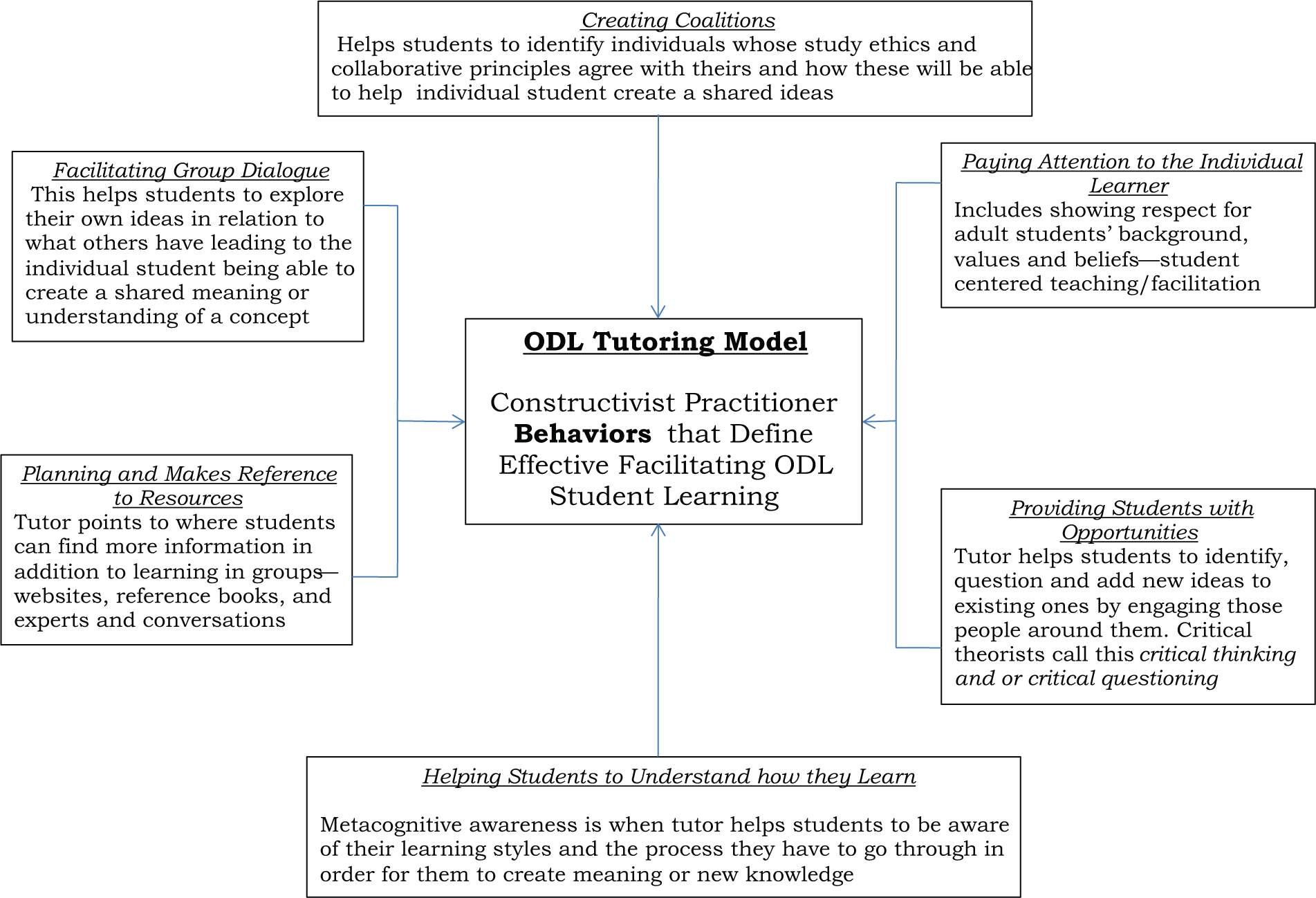
PSM for ODL student–tutor relationships.
One student summarized the importance of coalitions this way:
With too many stress factors present and limited resources of time and energy, a student could easily become overwhelmed. When tutors help to create coalitions, such contexts help students understand how they learn—metacognition, providing useful resources and creating group conversations on important topics. There is power in collaborative teamwork.
Outstanding Issues Needing to be Addressed
Some of the problems that participants feel were not fully addressed by ZOU during their studies include outdated textbooks considered too old when cited in literature review sections of the research projects; lack of a common language and uniform understanding of how to create references in American Psychological Association (APA) format; in-text citation using the APA style; ideas on how to cite literature from journals when compared with books; and following a standard agreed format for presentation of final research projects. Each semester, there is a need for a clear calendar of due dates and important dates including dissertation defense dates. Finally, graduates feel that the university website should create a database for current research and proposals registered by students and professors. This will help motivate current candidates to persist.
Conclusion
Findings from this study allowed us to make the following broad conclusions related to the factors that helped participants to register, persist, and graduate with master’s and doctoral credentials:
Graduates from Zimbabwean ODL institutions take cultural, financial, and social risks that lead to being labeled erroneously. Some of the risks that students take include self-initiated exile from friends, depriving themselves of sleep and putting theirs and family lives in danger through unconventional borrowings of money from loan-sharks.
Fear of the failure label causes adult students to ensure that the label itself does not attach itself to how their children are viewed in the society—“children of parents who fail to complete what they started.” Fear of failure is related more to the cultural backgrounds of the Zimbabwean graduates that we studied. Culturally, in Zimbabwe, adults who participate in adult educational programs and demonstrate failure are viewed as bad examples for the community and such labels may affect them and their children for life.
Team power is an important variable that ensures registered students keep their efforts fully focused on their graduation goals. The concept of collaborations includes the degree to which graduate students involve family and friends in their plans
Footnotes
Declaration of Conflicting Interests
The author(s) declared no potential conflicts of interest with respect to the research, authorship, and/or publication of this article.
Funding
The author(s) received no financial support for the research and/or authorship of this article.