




Abstract
An-Najah National University (ANNU) is a Palestinian university that was established more than 35 years ago. The objective of this study was to do a bibliometric assessment of research output, which describes the growth, contribution, and impact of research carried out by the faculty members, researchers, or students of ANNU in the past 35 years. The data used for this study were retrieved from Scopus database. Bibliometric analysis was used to identify the pattern of publication, relative growth rate, authorship pattern, collaborative measures, author’s productivity, most prolific authors, and most prolific journals. A total of 791 published documents were retrieved for ANNU. Seventeen documents (2.1%) were published in Acta Crystallographica Section E Structure Reports Online, whereas 16 (2.0%) were published in Journal of Environmental Science and Health, Part A: Environmental Science and Engineering, and 10 (1.3%) were published in International Journal of Clinical Pharmacology and Therapeutics. Six hundred one (76%) documents were published in journals listed in Web of Knowledge. The total number of citations for documents published from ANNU, at the time of data analysis (November 19, 2013), was 4,553, with an average of 5.8 citations per document. The study identified 384 (25.8%) documents with 59 countries as ANNU–foreign collaborators. Research output from ANNU showed steady growth over the past 35 years. Research output was high from certain scientific disciplines, whereas was lagging from others. Future emphasis on joint research, international collaboration, and publishing in indexed journals is needed.
Introduction
State of Palestine is a small geographical area in the Middle East located between the Jordan River and Mediterranean Sea. Palestine has undergone continuous political, religious, and military conflict since 1920. In 1947, the General Assembly of the United Nation adopted a resolution (U.N. resolution number 181) that partitioned Palestine into an Arab Palestinian state and a Jewish Israeli state (Smith, 2007). However, the conflict and fight continued between the Palestinians and Israelis over Palestine. During the Six-Day war in 1967, Israel captured all the Arab Palestinian territories located between Jordan River and the Mediterranean Sea (Pappe, 2004). The international community denied the Israeli occupation of the Arab Palestinian areas and used the term “Occupied Palestinian Territories” (OPT) to describe these areas. In 1993 and following the Oslo peace accords between Israel and the Palestinian Liberation Organization, the Palestinian National Authority (PNA) was established and became responsible for most parts of OPT located in West-Bank of Jordan River and Gaza Strip (Brown, 2003).
Higher education in OPT is relatively recent. According to the latest publications and statistics of the Palestinian Ministry of Higher Education (MOHE), there are 53 higher education institutes. These institutes are as follows: 14 traditional universities, 1 open university, 20 community colleges, and 18 university-level colleges (Ministry of Education & Higher Education, 2013). Of particular interest are institutions that offer university degrees and are involved in research and graduate studies. Universities in West-Bank include An-Najah National University (ANNU), BirZeit University, Al-Quds University, Bethlehem University, Hebron University, Palestine Polytechnic University, Arab American University, and Palestine Technical University, whereas those in Gaza Strip include Al-Azhar University–Gaza, Al-Aqsa University, and Islamic University of Gaza. Most of these universities started more than 40 years ago as 2-year college institutions and then were developed to provide university-level education. Currently, many of the universities in West-Bank and Gaza Strip offer graduate programs in various scientific disciplines including engineering, health, basic science, economics, humanities, and other fields (Ministry of Education & Higher Education, 2013).
ANNU is the largest university in terms of number of students enrolled. ANNU was founded in Nablus city more than 30 years ago. ANNU offers education in various disciplines (http://www.najah.edu/). Recently, ANNU has established a state-of-the-art teaching hospital to aid students in medical specialties. Since 2009, ANNU ranked first in Palestine and 1 of the top 10 universities in the Arab world based on Webometrics Ranking of World Universities (Webometrics, 2014). ANNU has recently set new guidelines for tenure and promotion for faculty members to maintain the momentum of research output and therefore reserve an advanced rank among Arab universities.
Research activity is one of the most important functions for universities and the backbone of university ranking criteria (Lukman, Krajnc, & Glavič, 2010; P. Taylor & Braddock, 2007). Recently, the Palestinian MOHE has established scientific research council to support research in Palestinian higher education institutions to reflect positively on Palestinian university research activities. Research activity and research excellence is one of the most important indicators used by international agencies for funding and financial support (Auranen & Nieminen, 2010; Geuna & Martin, 2003; Gulbrandsen & Smeby, 2005). Furthermore, research activity and research productivity reflect positively on the institution and on the individual faculty members (Volkwein & Sweitzer, 2006). Research productivity is a key element in tenure and promotion for faculty members and a key element in academic reputation of universities (Long, Allison, & McGinnis, 1993; Tien, 2007). Actually, research productivity has been used to compare excellence among different faculties in the same university or across universities or across different countries (Bissar-Tadmouri & Tadmouri, 2009; Deleu, Northway, & Hanssens, 2001; Ho, 1998; Man, Weinkauf, Tsang, & Sin, 2004; Moin, Mahmoudi, & Rezaei, 2005; Nederhof & Van Raan, 1993; Tadmouri & Bissar-Tadmouri, 2003). The quality and quantity of research output can be assessed using bibliometric methods (King, 1987; Van Raan, 1999, 2003). It is commonly agreed that the term “bibliometric” was first coined by Pritchard (1969) who defined bibliometrics as the application of mathematical and statistical methods to published literature.
This study focuses on ANNU as a leading university in Palestine and in Arab world. Assessment of research productivity of ANNU using bibliometric methods will shed light on points of strength and points of weakness in the research activity of ANNU. The study and its expected finding are very important for universities in general and for those in developing countries in particular. Universities in developing countries have to implement policies to achieve academic and scholar success despite limited funding and scarce resources. Furthermore, senior administrators in universities in Palestine and other developing countries have to have a clear picture of the status of research activity to set a future vision for the institution to promote its advancement in world university ranking. Therefore, this study was carried out to assess (a) the growth rate of research productivity from ANNU, (b) the quality of research productivity from ANNU, and (c) the pattern of collaboration between authors at ANNU and authors from other countries. To the best of author’s knowledge, this study is the first study to assess research output and productivity of a Palestinian university under occupation. Similar studies have been carried out in other parts of the world but none from the Arab world (And & Kumaravel, 2012; Baskaran, 2013; Jeevan & Gupta, 2002; Kumbar, Gupta, & Dhawan, 2008; Maharana & Sethi, 2013). Studies about research productivity from the Arab countries focused on medical faculty members or on biomedical research output (Abu-Zidan, 2001; Alghanim & Alhamali, 2011; Benamer & Bakoush, 2009; Dakik, Kaidbey, & Sabra, 2006; Mazboudi & Ben Abdelaziz, 2010; Sweileh et al., 2013). However, no studies have been published from the Arab countries that assessed institutional research productivity. It is known that universities that are involved in research can provide better services to the public. Therefore, most universities in the world do periodical assessment and measurement of their research productivity as an indicator for their creation of new transferable knowledge to the community (Quimbo & Sulabo, 2013).
Method
The data used in this study were based on the Scopus online database. A comprehensive online search was performed using SciVerse, Scopus, which is one of the world’s largest databases of peer-reviewed literature. Scopus covers nearly 18,000 titles from 5,000 publishers worldwide, and contains 41 million records and provides 100% MEDLINE coverage (Scopus, 2013). The Scopus database was developed by Elsevier, combining the characteristics of both Web of Science and PubMed. These characteristics allow for enhanced service for educational and academic needs, and medical literature research and bibliometric analysis. Scopus offers a basic search or an advanced search. In the basic search, the results for the chosen keywords can be limited by the date of publication, by subject area, and by document type (Falagas, Pitsouni, Malietzis, & Pappas, 2008). The search output from Scopus can be presented as a list of 20 to 200 items per page, and extracted documents can be exported to Microsoft Office Excel®. The results can be refined by document type, author name, source title, publications per year, and/or subject area, and a new search can be initiated within the results (Falagas et al., 2008).
Different authors use different ways of writing the English name of ANNU in their affiliation. Therefore, to avoid any mistake, all potential English names of ANNU were used to retrieve the documents. These terms were entered in Scopus search engine to achieve the objectives of this study. These terms were as follows: “Najah,” “Alnajah,” and “Annajah” as “Affiliation Name.” All subject areas were selected for this research: health sciences, social sciences, life sciences, and physical sciences during all year to present (November 19, 2013). The resultant search was as follows: Your query: Your query: (AFFILORG (najah) OR AFFILORG (annajah) OR AFFILORG (alnajah)) AND (EXCLUDE (DOCTYPE, “er”)). We excluded documents that published as erratum. We also excluded those documents in which the affiliation was not related to ANNU. Scientific output was evaluated based on a methodology developed and used in other bibliometric studies (Zyoud, Al-Jabi, & Sweileh, 2014a, 2014b; Zyoud, Al-Jabi, Sweileh, & Awang, 2014a, 2014b, 2014c). The collated data were used to generate the following information: (a) total and trends of ANNU contributions in research during the time, (b) authorship patterns and research productivity, (c) countries collaborations with ANNU, (d) the citations received by the publications, and (f) areas of interest for published papers.
Statistical Analysis
Data from Scopus were exported to Microsoft Office Excel® and then transferred to the Statistical Package for Social Sciences (SPSS; SPSS Inc., Chicago, IL, United States) program version 15 for analysis. Variables that are not normally distributed are expressed as median (Q1-Q3: interquartile range) and categorical data are expressed as numbers with percentages. The h-index for the data collected from Scopus is presented. The h-index represents the number of citations received for each of the documents in descending order, whereas the h-graph measures the impact of a set of documents and displays the number of citations per document. The journal’s impact factors (IFs) were evaluated using the Journal Citation Report (JCR; Web of Knowledge) 2012 science edition by Thomson Reuters (New York, United States).
Results
Using the methodology stated above, 791 documents were retrieved for ANNU. When a similar methodology was applied to other Palestinian universities, the following number of documents was retrieved: Al-Quds University (754), Birzeit University (735), Islamic University Gaza (543), Al-Azhar University of Gaza (510), Al-Aqsa University (228), Arab American University (164), Bethlehem University (121), Palestine Polytechnic University (117), Hebron University (78), Al-Quds Open University (41), and Palestine Technical University (39).
Of the 791 documents retrieved for ANNU, 693 (87.6%) were original journal articles, 56 (7.1%) were proceeding articles, 13 (1.6%) were review articles, and 29 (3.7%) were other types of publications. The annual number of documents published in the past three decades (1983-2013) indicated that research output from ANNU was low in the first two decades but showed an obvious increase in the last decade (Table 1). Furthermore, ANNU research productivity during the last decade was low in the first years but showed an obvious increase after 2008. The first article published from ANNU was published by Salim R. in Water Research in 1983 (Salim, 1983). Around 13% of publications were published in 2013; however, the number of scientific research productivity in this year may be increasing because it is still open for new journal issues.
Number of Documents Published From An-Najah National University by Publication Years.

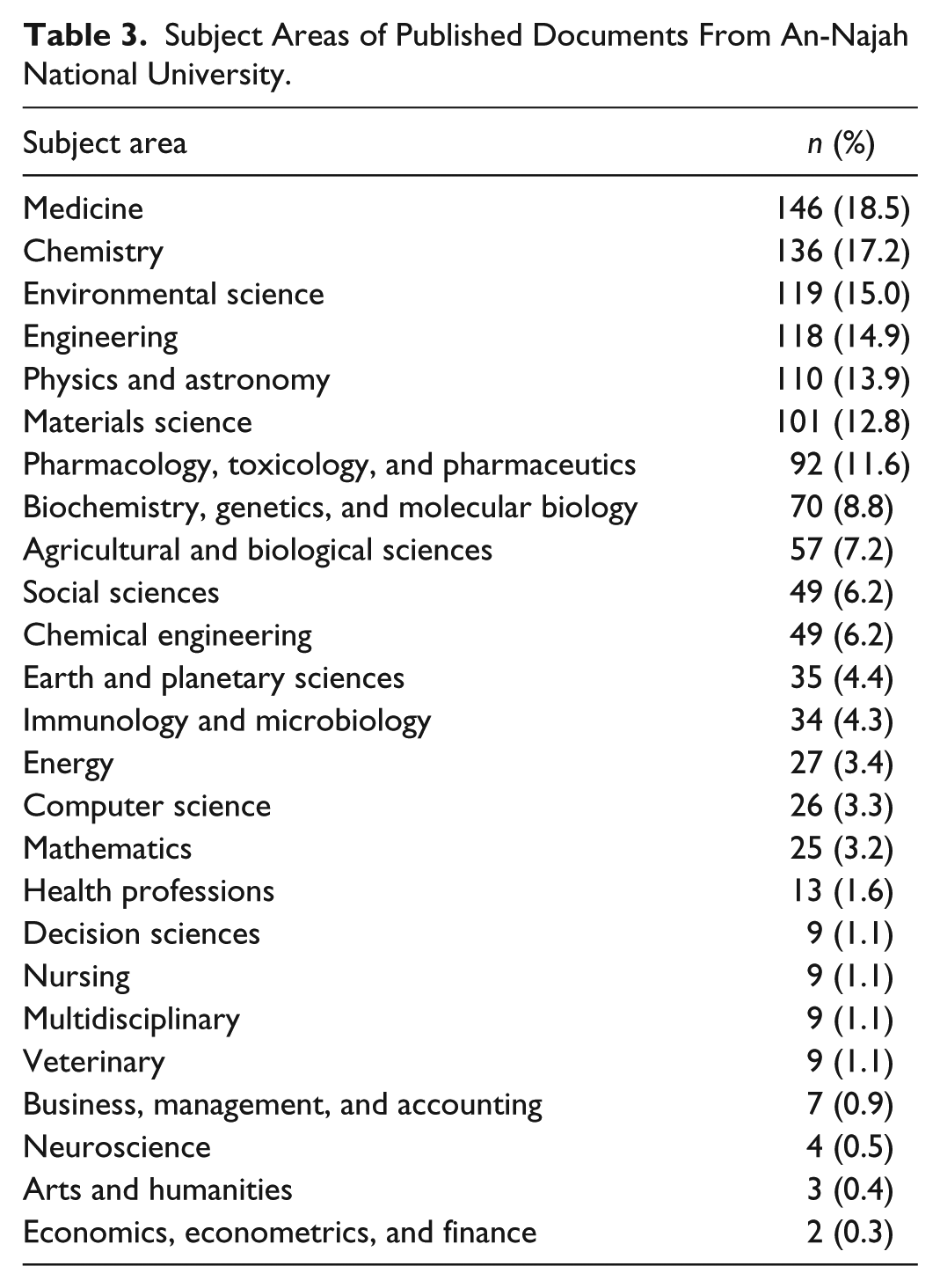
Table 2 shows the top journals in which ANNU articles were published. Seventeen documents (2.1%) were published in Acta Crystallographica Section E Structure Reports Online, whereas 16 (2.0%) were published in Journal of Environmental Science and Health, Part A: Environmental Science and Engineering, and 10 (1.3%) were published in International Journal of Clinical Pharmacology and Therapeutics. Three journals from the top 20 ranking journal titles had no official IF and not listed in the JCR 2012. In all, 601 (76%) documents were published in journals listed in Web of Knowledge. Table 3 presents the subject areas of published papers by ANNU.
Ranking Top Journals in Which Documents From An-Najah National University Were Published With Their Impact Factors.

Note. SCR = Standard Competition Ranking; IF = impact factor; NA = not available.
Equal journals have the same ranking number, and then a gap is left in the ranking numbers.
The impact factor was reported according to Institute for Scientific Information (ISI) journal citation reports (JCR) 2012.
Subject Areas of Published Documents From An-Najah National University.
The total number of citations, at the time of data analysis (November 19, 2013), was 4,553, with an average of 5.8 citations per each document and median (interquartile range) of 2 (0-6). Table 4 presents a list of the 20 most cited articles originating from ANNU. Of the 791 documents considered for the h-index, 29 articles had been cited at least 29 times at the time of data analysis.
Ranking Top 20 Cited Articles From An-Najah National University in Scopus.

Note. SCR = standard competition ranking.
Equal articles have the same ranking number, and then a gap is left in the ranking numbers.
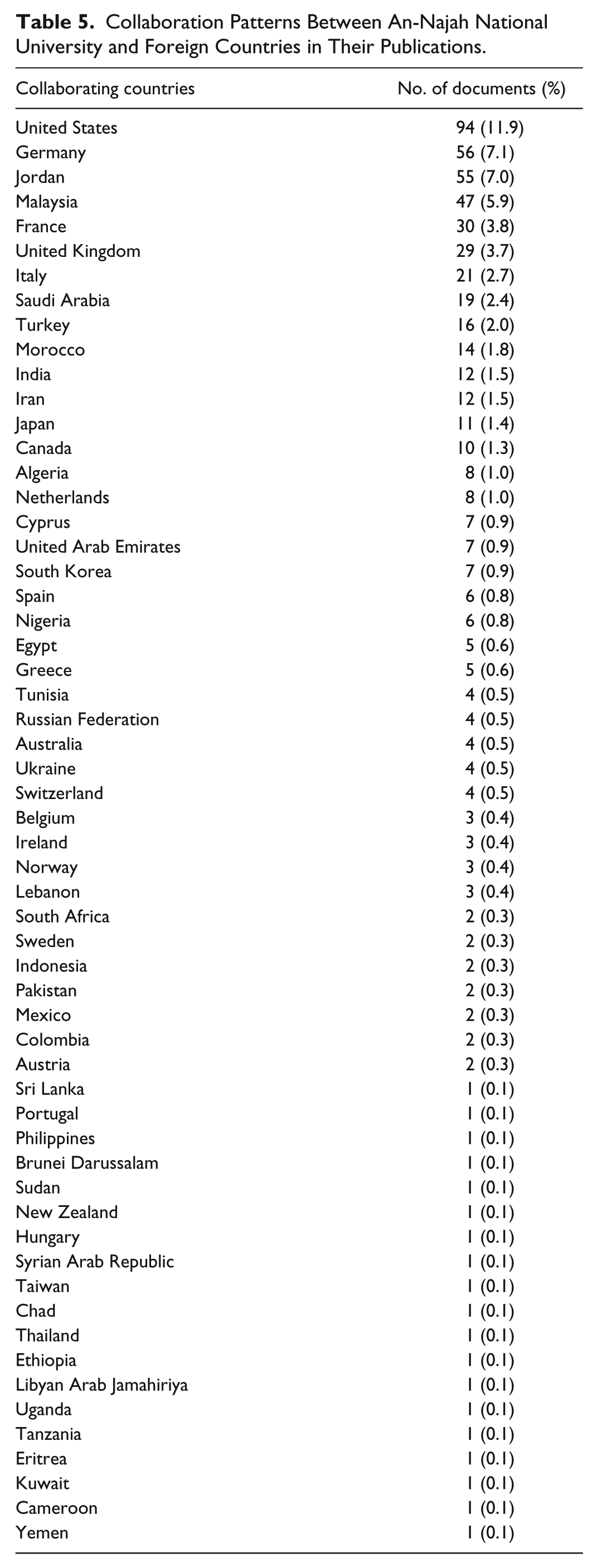
The study identified 384 (25.8%) documents with 59 countries as ANNU–foreign collaborations. ANNU actively collaborated with authors from the United States; (n = 94; highest number recorded), followed by Germany (n = 56), Jordan (n = 55), and Malaysian (n = 47; Table 5). Table 6 presents a list of the 20 most productive authors from ANNU, who have published at least 14 articles during the period of study.
Collaboration Patterns Between An-Najah National University and Foreign Countries in Their Publications.
Ranking of the Top 20 Prolific Authors From An-Najah National University With Their Affiliations.

Note. SCR = standard competition ranking.
Equal authors have the same ranking number, and then a gap is left in the ranking numbers.
Percentage of publications for each author by the total number of documents.
Discussion
This study was carried out to do a bibliometric assessment of research output, which describes the growth, contribution, and impact of research carried out by the faculty members, researchers, or students of ANNU in the past 35 years. The results of our study show that ANNU had the largest number of publications compared with other universities in West-Bank and Gaza Strip. This does not mean that ANNU has the highest total impact or the best quality research or the best academic reputation compared with other universities. Further analysis is needed to give honest comparison regarding research quality of various Palestinian universities. The relatively high research output from ANNU compared with other Palestinian universities could be attributed to the large faculty and diverse educational disciplines at the university. The administration at ANNU and that at other Palestinian universities should be accredited for encouraging research through financial and academic incentives. Administrations at Palestinian universities are becoming more interested in Webometrics, ResearchGate, and other international databases that rank universities. However, financial crisis, restrictions imposed by Israeli occupation, and difficulty in recruiting high-quality researchers remain the main challenge for universities in Palestine to improve research quantity and quality.
Our results showed that research output from ANNU had witnessed a steady increase during the past 30 years. Undoubtedly, the introduction of medical education at ANNU in the past 15 years has significantly contributed to the growth of research activity at ANNU. It was noteworthy that the medical discipline ranked first and dominated other disciplines in its contribution to research output despite that medical education is relatively recent at ANNU. It was not surprising that chemistry, environmental sciences, and engineering disciplines came next to medical discipline in contribution to research output at ANNU. These disciplines were established at ANNU more than 30 years ago and had recruited many scientists and researchers during its developmental history. Furthermore, the presence of graduate programs in these disciplines has encouraged research activity. Disciplines such as management, economics, accounting, law, humanities, and fine arts ranked low in their contribution to research output from ANNU despite their early establishment. One possible explanation for this is the lack of peer-reviewed local and regional journals that are indexed in Scopus or Pubmed. Actually, database from ANNU showed that research output from economics, management, accounting, humanities, and fine arts is very high, but mostly in un-indexed local or regional journals. If such journals were indexed in Scopus, the results obtained in this study will look different. Therefore, universities and research institution in Arab countries should work toward indexing these journals because this will reflect positively on individual researchers and on university ranking.
International collaboration in research output from ANNU was evident. Research collaboration is an important mechanism to improve quality and quantity of research at the university level. A study has found that there is a positive correlation between research productivity, funding, public impact, and international and domestic collaboration at the author level (Bordons, Gomez, Fernandez, Zulueta, & Mendez, 1996; Bozeman & Corley, 2004; Wagner, 2005). A study has found that at article level, both within-university collaboration and international collaboration are positively related to an article’s quality and that, at scientist-year level, only international collaboration is positively related to a scientist’s future research output (He, Geng, & Campbell-Hunt, 2009). Other studies indicated that international collaboration can increase the visibility of scientific publication from a particular country (Basu & Kumar, 2000). Furthermore, international collaboration in research helps capacity building in developing countries and makes national problems of developing countries more observable (Nauen, 2008). Therefore, Palestinian universities should encourage researchers to build bridges with other local, regional, and international researchers. This will improve the research capacity of researchers and will reflect positively on Palestinian university ranking. It is noteworthy that University of BirZeit had made a great success story in international collaboration that led to many publications in the Lancet (Husseini et al., 2009; Rahim et al., 2009).
It was observed that the top 20 prolific authors from ANNU belong to three major disciplines: medicine, science, and engineering. This skewed result in research activity means that research output from ANNU relies on and confined to a selected group of researchers. An interesting and new phenomenon regarding the top prolific authors at ANNU is the presence of research groups particular in pharmacology/pharmacy discipline. This has been shown in many recent publications (Abu-Taha & Sweileh, 2011; Sweileh et al., 2011; Sweileh et al., 2013; Zyoud et al., 2013). Studies have shown that the strategy of research group is an effective strategy to improve research productivity (Andrews, Aichholzer, & Bonmariage, 1979; Payne, 1990). There are several factors that could explain variation in research output from researchers. Such factors include gender, age, marital status, workload, ethnicity, and university of graduation (Bellas & Toutkoushian, 1999; Joshi et al., 2013; Sax, Hagedorn, Arredondo, & Dicrisi Iii, 2002; M. S. Taylor, Locke, Lee, & Gist, 1984; Xie & Shauman, 1998). It has been argued by some academicians that time allocated and the load specified for teaching and administrative tasks overshadow research activity in many Palestinian universities. University administration needs to decrease academic and teaching burden, so that university faculty members can allocate time for research activity. A meta-analysis study regarding relationship between research and teaching has concluded that there is no doubt that potential synergies exist between faculty research and undergraduate teaching, and that faculty research improves students’ educational experience (Prince, Felder, & Brent, 2007). Enhancing commitment of academicians to research requires a change in the mentality of higher education in PNA, such that research activity must be parallel to teaching activity for each faculty member. Understanding the individual and institutional factors and barriers affecting research productivity is the first step for PNA and university administration to draw future plans that can promote research productivity. A study has shown that good research incentives is well appreciated by faculty members and can stimulate research productivity (Cadez & Dimovski, 2011; Schroen, Thielen, Turrentine, Kron, & Slingluff, 2012).
The results of this study showed that the mostly cited articles published from ANNU were mainly those in the field of ethnopharmacology, microbiology, chemistry, engineering, and environmental sciences. It was very striking that 9 of the top 20 cited articles published from ANNU were articles whose first and/or corresponding author was not a faculty member at ANNU. These 9 articles were published from international institutions and a faculty member from ANNU was part of their research team. Furthermore, most of the remaining 11 top cited articles were published with international cooperation. A study analyzing the characteristics of highly cited articles showed that highly cited articles are very different from “ordinary” cited articles and that highly cited articles are usually authored by a large number of scientists and often involving international collaboration (Aksnes, 2003). Highly cited articles positively contribute to the h-index of the individual author and to the institution and country (Aksnes, 2006; Aksnes & Sivertsen, 2004; Fowler & Aksnes, 2007; Plomp, 1994). The citation is a key indicator of research quality and researchers need to be aware of mechanisms that might enhance citation of published articles like self-citation whenever possible (Vinkler, 2007).
The results of the study showed that Acta Crystallographica Section E Structure Reports Online Journal has the largest share from ANNU publication. This journal is in the field of chemistry and has no official IF. The second most common journal was the Journal of Environmental Science and Health, Part A: Environmental Science and Engineering, which is indexed in ISI Web of knowledge and has an official IF. The third common journal is the International Journal of Clinical Pharmacology and Therapeutics, which is also indexed in ISI Web of knowledge and has an official IF. There is a lot of debate lately on where should researchers publish their work and what journals they should select for their publications (Thompson, 2007). There are many factors that affect the researcher’s choice of a journal for manuscript submission. Factors such as open access, IF, specialty, publication fee, and editorial and revision time; all affect author’s choice of a particular journal. A study has shown that the majority of surgeons held the overall reputation of the journal as the most important factor, followed by the IF when submitting a manuscript (Søreide & Winter, 2009). An article published in British Medical Journal (BMJ) had shown that authors value free access to research articles and consider this an important factor in deciding whether to submit to the BMJ. And that closing access to research articles would have a negative effect on authors’ perceptions of the journal and their likeliness to submit (Schroter, 2006).
Finally, our study has few limitations. As Scopus search engine was used to retrieve published data for Najah University, data published in journals that were not indexed in Scopus will not be retrieved and counted. Therefore, almost all literature published from Najah University in Arabic languages was excluded. Unfortunately, there is no updated and full research database for An-Najah University faculty members for comparison with that obtained through Scopus. The University has made tremendous effort to create personal blogs for all university faculty members, but such efforts were not completely successful. Another limitation in our study is the collaboration with Israeli researchers. In our study, collaboration with Israeli researchers was excluded from the results because most Palestinian research output in the past was affiliated with Israel because Palestine was not internationally recognized as a state. Finally, it should be noted that research output for certain researchers could have been under-estimated because of writing their English names differently in different articles. Therefore, such authors might have two or more author profiles in Scopus because their names were written differently in different articles.
Conclusion and Recommendation
The finding of this study is an actual presentation of “Publish or Perish” strategy in the world of academia. This study showed that there is a steady progress in research output from ANNU and showed departmental variation in research productivity. The bulk of research output from ANNU indexed in “Scopus” has been made by the contribution of limited number of authors. This study showed that the major universities in Palestine are neck to neck in research output with a slight edge for ANNU. The university administrators need to take into consideration the following points when pushing research activity: (a) all faculty members need to be engaged in research as a parallel activity to teaching; (b) authors need to be encouraged to publish in journals that are indexed by ISI or Scopus; (c) authors need to be encouraged to do joint research and build international cooperation in research activity and publication; (d) university administration needs to be aware of parameters used in bibliometric and implement these parameters in annual evaluation of faculty members; (e) academics need to understand and be aware of the criteria used in university and college ranking systems; (f) university administration needs to invest more resources into research in medical colleges as research output from these colleges is very promising.
Finally, university administration, particularly those in developing countries, is responsible for introducing and creating a culture that appreciates research and understands the parameters and indicators, like citations, used in assessing quality of research. Authors of highly cited articles are those who created an impact on their research fields and are supposed to be influential on their student’s future career. Furthermore, those with highly cited articles are supposed to have the highest h-index.
Footnotes
Acknowledgements
The authors would like to thank An-Najah National University and Health InterNetwork Access to Research Initiative (HINARI) for giving the opportunities to access most recent information sources such as Scopus database.
Declaration of Conflicting Interests
The author(s) declared no potential conflicts of interest with respect to the research, authorship, and/or publication of this article.
Funding
The author(s) received no financial support for the research and/or authorship of this article.