




Abstract
Prior research on disagreement has mainly focused on its negative impact, suggesting that disagreement should be avoided in communication. Consequently, disagreement is rarely studied in computer-mediated communication, particularly in the Chinese context. Adopting the interactional approach, this project pioneers the investigation of disagreement strategies on online forums in Hong Kong and mainland China, in hopes of providing insights into a better understanding of disagreement in the Chinese online context and shedding light on politeness theory in intercultural communication among Chinese people. Two threads on a similar topic were selected, from which 400 comments were collected and annotated for further analysis. Our results showed that, instead of being a face-threatening act, disagreement maintained and enhanced the interlocutors’ face and advanced the communication of information within each thread. Moreover, although the distribution of the five disagreement strategies was similar in the two sites, there were notably more disagreement tokens and negative comments on the Hong Kong forum. The observed divergence has been attributed to the different degrees of collectivism–individualism in the two regions, the internet censorship in mainland China and the nature of the two forums selected, which remain to be confirmed in future studies.
Keywords
Introduction
With the development of technology, computer-mediated communication (CMC) has become more popular and received increasing attention in communication literature (Herring, 2001; Thorne, 2008). Regarded as a negative speech act, however, disagreement is rarely studied in CMC. Adopting the interactional approach, this article pioneers to investigate how disagreement strategies were employed on online forums of Hong Kong and mainland China, in hopes of providing insights into a better understanding of disagreement in the Chinese online context and shedding light on politeness theory in intercultural communication.
This section begins with a brief review of relevant issues concerning the research background of the paper and then proposes three research questions based on the gaps in the field. The methodology of the study will be described in the next section, and the main findings will be presented in the section “Results”, followed by the elaboration and interpretation of the results. Limitations and concluding remarks of the study will appear in the final two sections.
CMC
CMC is the text-based interaction of human beings mediated by networked computers (Herring, 2007). The texts in the definition are broadly defined to include any information in the forms of texts, signs, images, audios, videos, and so on, while computers generally refer to any digital communication devices (Herring & Androutsopoulos, 2015; Wu et al., 2016). The scope of CMC thus covers many domains of information transaction, consisting of text messaging, email, online forums, and social network services. Anonymity, synchronicity, message format, persistence of transcript and quoting are identified as medium factors associated with disagreement in the CMC context (Bolander, 2013), but as will be shown below, studies on disagreement in CMC are scarce, which motivates us to investigate how disagreement strategies are implemented on Chinese online forums.
Studies on Disagreement
Disagreement refers to the expression of a different view from that of a previous interlocutor (Sifianou, 2012). Prior research on disagreement has mainly focused on its negative impact and consequently suggested that disagreement should be avoided in communication. For instance, disagreement violates the agreement maxim of the classic Politeness Principle (Leech, 1983), which advocates that one should minimize the expression of disagreement between oneself and others. Similarly, when Brown and Levinson (1987) proposed their politeness theory, disagreement was also counted as one of the positive face-threatening acts.
Moreover, disagreement has been associated with conflict by some scholars (e.g., Kennedy and Pronin (2008)) and was even regarded as “a form of conflict” (Waldron & Applegate, 1994, p. 4). Yet no consensus has been reached as to how we should define conflict and how we can relate disagreement to conflict (Sifianou, 2019). In this article, we borrow the definition from Ting-Toomey and Oetzel (2001) and describe conflict as “the experience of emotional frustration in conjunction with perceived incompatibility of values, norms, face orientations, goals, scarce resources, processes, and/or outcomes” between or among interlocutors (Ting-Toomey & Oetzel, 2001, p. 17). As disagreement does not necessarily lead to such emotional frustration, we would like to distinguish the two notions; only disagreement cases that meet the criteria above will be counted as conflicts here (Angouri, 2012; Barki & Hartwick, 2004).
Meanwhile, a growing number of enquiries have provided new perspectives on disagreement. In the analysis of conversational data, Schiffrin (1984) identified sustained disagreement as one main feature of the Jewish speakers where they often contradicted or denied the utterances of previous speakers. Such sociable arguments were found to have displayed the informants’ solidarity and protected their intimacy. Harrison (2000) studied how politeness strategies were used in an email conversation group and found that the use of compliments immediately before disagreements had created a more positive atmosphere. In a study on opposition strategies in Greek-speaking communities, Kakava (2002) even proposed that disagreement actually served as a ritualized form of opposition and may be pervasive and preferred in Modern Greek discourse. Cheng and Tsui (2009) compared the management of disagreement in the conversations between Hong Kong people and native English speakers from the United Kingdom, the United States, and Australia. The Hong Kong people were found to disagree at an equal rate with the English speakers, but they adopted redressive language and mitigating devices more often than the English speakers. More recently, W. Zhu (2014) examined the use of strong disagreement by Mandarin speakers in everyday practice. Results showed that most of the strong disagreements were face maintaining or enhancing. The rare cases of face-threatening were also found to function as relationship maintaining.
When it comes to the context of CMC, however, very limited studies have addressed the issue of disagreement, although it is suggested that, as anonymity in CMC settings influences the civility and politeness of users’ behavior, disagreement should be more likely to happen online (Santana, 2014). With a focus on language use and power, Bolander (2012, 2013) looked into agreement and disagreement tokens in the comments of eight blogs and found that agreement and disagreement were central moves in her data. More relevant to this study, two studies (Lee & Shum, 2017; Shum & Lee, 2013) worked on disagreement in the CMC of Hong Kong, where Cantonese is the dominant language. Combining both interactional and discursive approaches, Shum and Lee (2013) first identified the instances of disagreement on two online forums and invited forum browsers to rate typical examples from each disagreement strategy in three aspects: politeness, appropriateness, and positiveness. They also conducted a follow-up interview with some of the browsers. Eleven disagreement strategies were used by the commenters and were generally perceived as polite, appropriate, and positive by the browsers. In their 2017 work, Lee and Shum (2017) further investigated how Chinese traditional values were incorporated into disagreement and concluded that the traditional values and norms “empower the interlocutors disagreement and intensify the force of the speech act” (Lee & Shum, 2017, p. 222).
The East-West Debate on Politeness and the Chinese Societies
In recent decades, there has been an ongoing debate on whether the postulates of politeness theory which were originally based on the Western world also hold true for the Eastern world, namely, whether East and West are essentially similar or fundamentally different (Chen, 2010; Gu, 1990; Haugh, 2005; Hwang, 2012; Ide, 1989; Leech, 2007; Leech & Larina, 2014; Mao, 1994; Matsumoto, 1988; Spencer-Oatey & Kádár, 2016; M. Zhang & Wu, 2018). The majority of the literature supports the different end of the continuum (see Chen (2010) for a review), while there are some studies that discover the convergence between East and West (e.g., M. Zhang & Wu, 2018). A thorough review of the debate would be beyond the scope of this article. In what follows, we will briefly compare the societies of Hong Kong and mainland China, with a focus on the language use as well as the notions of collectivism and individualism.
Hong Kong and mainland China are closely related Chinese societies, but they differ from each other in several aspects. First, in terms of language use, Cantonese and Mandarin are the dominant languages of daily communication in each society. Although the same writing system (the logographic writing system of Chinese, where Chinese characters are the basic writing units; traditional and simplified Chinese characters are used in Hong Kong and mainland China respectively, but this distinction is irrelevant to our study) is adopted in Hong Kong and mainland China, the users of Hong Kong CMC usually communicate in written Cantonese, which is quite different from standard written Chinese (Snow, 2004). In fact, similar to the unintelligible situation of spoken Cantonese and spoken Mandarin (X. Zhang, 1998), a Mandarin-speaking web browser without prior knowledge of Cantonese does not understand written Cantonese. Second, although Chinese people are found to be more collectivistic and less individualistic than people from other cultures (Oyserman et al., 2002), it is argued that as a highly internationalized region, Hong Kong exhibits the features of both individualism and collectivism (Ip et al., 2018; Wu & Hui, 1997). Collectivistic values are associated with indirect ways of communication (Morris et al., 1998), which presumably would avoid disagreement. If Hong Kong and mainland China differ in their degrees of collectivism, we can hypothesize that there should be some observable divergence in the use of disagreement in the CMC communities of Hong Kong and mainland China, as there is always an interplay between cultural diversity and language practice (H. Zhu, 2019).
The Current Study
As reviewed above, the CMC features such as anonymity are regarded as relevant to disagreement by scholars, but only a few studies have explored the use of disagreement in the CMC context. More research is needed in this area for a better understanding of how disagreement is expressed by CMC users, which will contribute to the development of politeness theory in intercultural communication in the New Media Age.
This project attempted to investigate how disagreement strategies are realized in Chinese CMC communities. Specifically, it aimed to analyze the data extracted from online forums in Hong Kong and mainland China. No previous research has worked on disagreement in Mandarin-speaking CMC discourse. So, our study is the first investigation into disagreement in the Mandarin-speaking CMC discourse. We also investigate how disagreement is expressed in the Cantonese-speaking CMC discourse and compare the disagreement strategies adopted in Hong Kong and mainland China, given the cultural differences between the two Chinese regions.
This study addresses the following research questions:
How is disagreement expressed in online communities in Hong Kong?
How is disagreement expressed in online communities in mainland China?
What are the similarities and differences in the disagreement strategies of forum users from Hong Kong and mainland China?
Methodology
As has been reviewed above, the classic Gricean approach to politeness fails to address the issue of disagreement appropriately. We thus explored the nature of disagreement from the interactional approach (Haugh, 2007). We first extracted top forum threads with similar topics from forums in Hong Kong and mainland China and then identified the disagreement strategies manually. Both qualitative and quantitative methods were adopted in the analysis.
Data Collection
Two online forums (one from each region) were selected from the top sites ranking of Alexa internet (Alexa, 2018). With seven million average visits per day, Hong Kong Golden Forum (hereinafter “Site HK”) is among the most famous online forums in Hong Kong. Douban (hereinafter “Site CN”) is a Chinese social network service website providing different services, the online forum of which is also very popular.
When selecting the threads, we consulted the criteria by Shum and Lee (2013) and made some adjustment. Our criteria for thread selection include the following: (a) they should be top threads with more than 200 comments, which would allow us to examine the interactions among the users; (b) they should address a similar topic, which would make further comparison possible; and (c) the topic(s) should be controversial, which would increase the chance of disagreement instances among users. We found two threads with almost the same arguable topic: destinations for migration. As both threads were created in 2018, we can study what current online interactions are like in these two sites. The thread from Site HK attracted more than 600 comments and the one from Site CN had over 300 comments. At the current stage, we collected the first 200 comments from each thread for our analysis.
Data Annotation
Previous research on disagreement proposed different frameworks for data annotation from various aspects (Netz, 2014). Traditional studies tended to classify disagreement on levels of mitigation and aggravation (Blum-Kulka et al., 2002; Goodwin, 1983; Rees-Miller, 2000). For example, the taxonomy in Rees-Miller (2000) listed three types of disagreement: softerned disagreement, disagreement not softened or strengthened, and aggravated disagreement.
Alternatively, some scholars created their frameworks based on the strategies of disagreement (Bousfield, 2008; Culpeper, 1996; Locher, 2004; Shum & Lee, 2013), which we think could allow for a better interpretation of the process of interactions. A full list of disagreement strategies presented in these frameworks is provided in the Appendix. Yet, the framkeworks put forward by these scholars cannot be directly borrowed to our study and still need further considerations. First, some of these schemes were designed for the study of oral communication, so strategies such as “interruptions” in Bousfield (2008) are not applicable to our data and were excluded. Besides, the scope of some strategies may be too narrow and should be amended. For example, Locher (2004) suggests the stragegy of “rhetorical questions”, but we think it is reasonable to take all types of questions into account and have formulated a strategy of “raising questions”. We will provide an example of a polar question in the next section. Finally, Shum and Lee (2013) identify 11 strategies in their work, which are complex and redundant, and there are also overlaps of strategies (such as “Giving negative comments”, “Using short vulgar phrases” and “Cursing”). To ensure the soundness of our data analysis, an updated annotation framework is called for.
After data collection, we started with open coding and examined each comment to identify whether there were instances of disagreement. If there were instances of disagreement, we labeled them with one or more strategies. In order to fit our data, we also consulted strategies in the aforementioned frameworks and prepared a list of potential strategies. Based on the strategies identified from our own data and the modified strategies from previous studies, we formulated our framework for data annotation, with the definition of each strategy presented in Table 1. Examples of each strategy from the two forums will be introduced in the next section.
Annotation Framework of Disagreement Strategies.
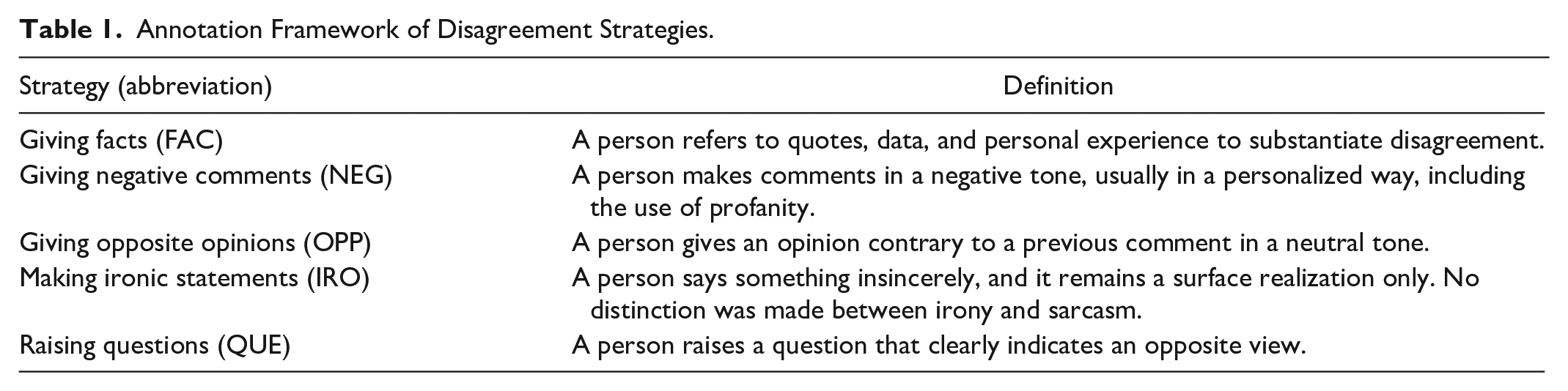
This framework is valid for our data for the following reasons: (a) the strategies proposed in this framework are rooted in our data from open coding and have also been compared with strategies in previous works; (b) during the coding process, the annotators were encouraged to bring up new strategies if they encountered any strategy that was not included in the framework and could be categorized as a new strategy, although there was no such case; (c) the proposed strategies are appropriate for the texted-based CMC context, as in our case, online forum communication; and (d) the author and two annotators (one annotator for each forum) coded the data separately, and the initial agreement rates between the author and the annotators were very high (95.92% for Site HK and 100% for Site CN).
Data Analysis
For the qualitative analysis, the author first annotated the comments of disagreement from the selected threads to code their corresponding strategies according to our framework in Table 1. Two native speakers (one for Cantonese and another for Mandarin) were then invited to code the data separately, and in case of any inconsistency, the author went over each case with them and attempted to reach a mutual agreement of the annotation. This procedure helped to ensure coder reliability (Révész, 2012). Double counting was allowed as some instances may have applied more than one strategy. Each comment was labeled with a unique code. In addition, to protect the confidentiality of the forum users, each user was also assigned a code which will be used to present in the examples.
Besides the qualitative approach to analyze the collected comments based on the framework presented in Table 1, we also adopted a quantitative approach for the token counts. More specifically, we labeled each token of disagreement as “1” and the tokens not showing disagreement as “0.” In the next section, we first presented the percentage of each disagreement strategy in Site HK and Site CN, respectively, and then performed further statistical analyses when comparing the use of disagreement strategies in the two sites. The chi-square test of independence was adopted to compare the tokens of disagreement in the two sites and also to compare the specific disagreement strategies used in the two sites. The data analyses were conducted in R (R Core Team, 2018; RStudio Team, 2016).
Results
Disagreement Strategies in Site HK
Of the 200 comments we collected from Site HK, 32 instances of disagreement were identified. As we allowed double counting, there were 49 counts of disagreement strategies in total, the distribution of which can be found in Figure 1. It is obvious that “giving facts” was the most frequently adopted strategy, followed by “raising questions”. The remaining three strategies were also used by forum users and were evenly distributed. Examples of each strategy will be given below for illustration. The format of the example presentation includes the following: (a) the user codes are used for each user before the comments, and comment codes are provided after the translation in parentheses; (b) original texts are provided and are kept as authentic as possible (including any nonstandard spelling or grammar), which are followed by equivalent English translation. Country names and other identifiable information are left anonymous; and (c) traditional Chinese characters are used in Site HK and simplified Chinese characters are used in Site CN. We keep the original written form when presenting examples in this article.
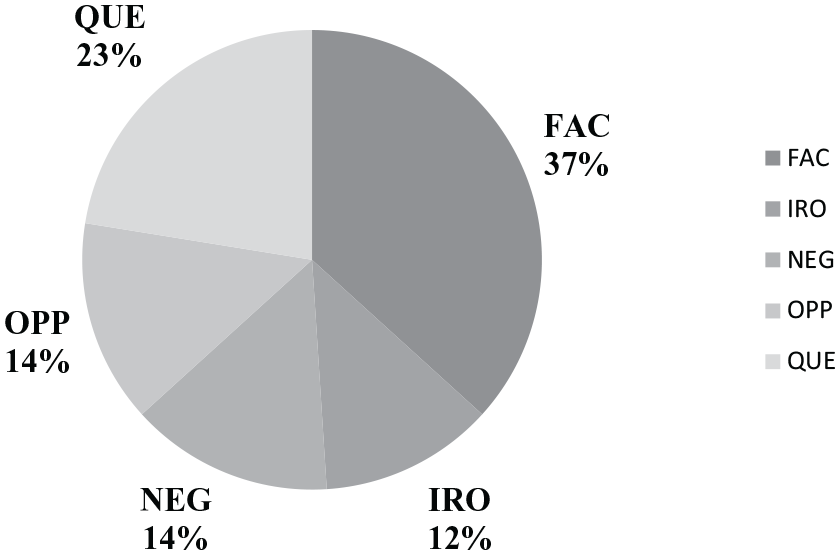
Distribution of disagreement strategies from Site HK.
The strategy “giving facts” makes use of quotes, data, and personal experiences as evidence against what has been proposed previously. This is the politest way of expressing disagreement within our framework because the interlocutor merely presents the facts to show his or her opinion without being aggressive or negative, which helps to maintain each other’s face. In Example 1, User HR79 showed reluctance to remain apart from family and friends due to migration. User HR77 disagreed with this idea by stating the fact that telecommunication is already highly developed nowadays. In this way, User HR77 conveyed the disagreement politely but also strongly with supporting evidence.
Example 1: Giving facts (37%).

Most of the time, it is also polite to express disagreement by raising a question. This works particularly well with a rhetorical question, which does not expect any answers from others and conveys the disagreement with a neutral tone. In Example 2, when User HR1 mentioned a country, User HR8 asked a rhetorical question, which literally means that it is impossible for people to move to a country that is even worse than Hong Kong.
Example 2: Raising questions (23%).

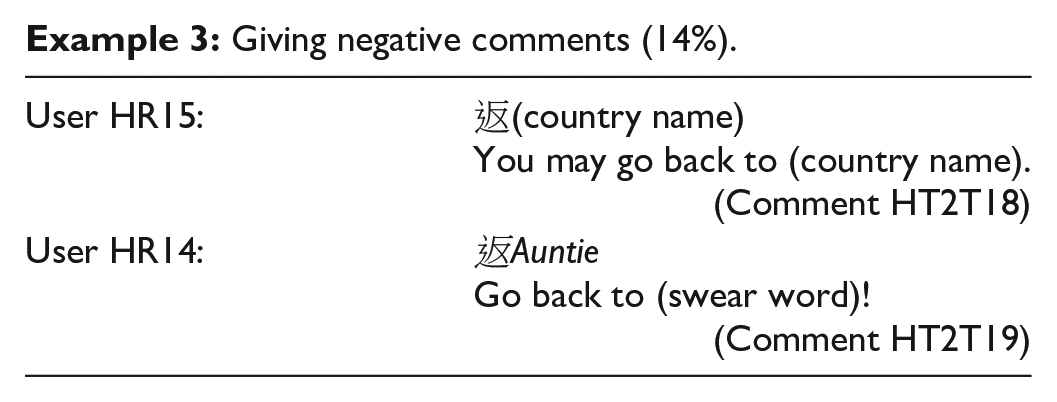
We observed a considerable amount of negative comments that revealed extremely strong personal emotions. These comments were sometimes made in a personalized way using obscene languages. There were also expressions that were created by users of Site HK and were used exclusively in Site HK; thus, non-Site HK users would have no idea when they encounter such expressions. For example, User HR14 used the expression “Auntie” to show disagreement without any mitigation. This is a swear word unique to Site HK and is not used by Hong Kong people in daily communication. However, User HR15 did not further respond to Comment HT2T19, so we could not tell whether there was any case of conflict. We will come back to the issue of conflict in the next subsection when we present the data from Site CN.
Example 3: Giving negative comments (14%).
Similar to “giving negative comments”, the strategy “giving opposite opinions” disagrees directly, but it focuses on the issue of concern in a more neutral tone. Thus, it also maintains the interlocutors’ face. In Example 4, User HR3 disagreed with the idea of User HR1 by first stating the fact and then saying that he or she would never move to the proposed country.
Example 4: Giving opposite opinions (14%).

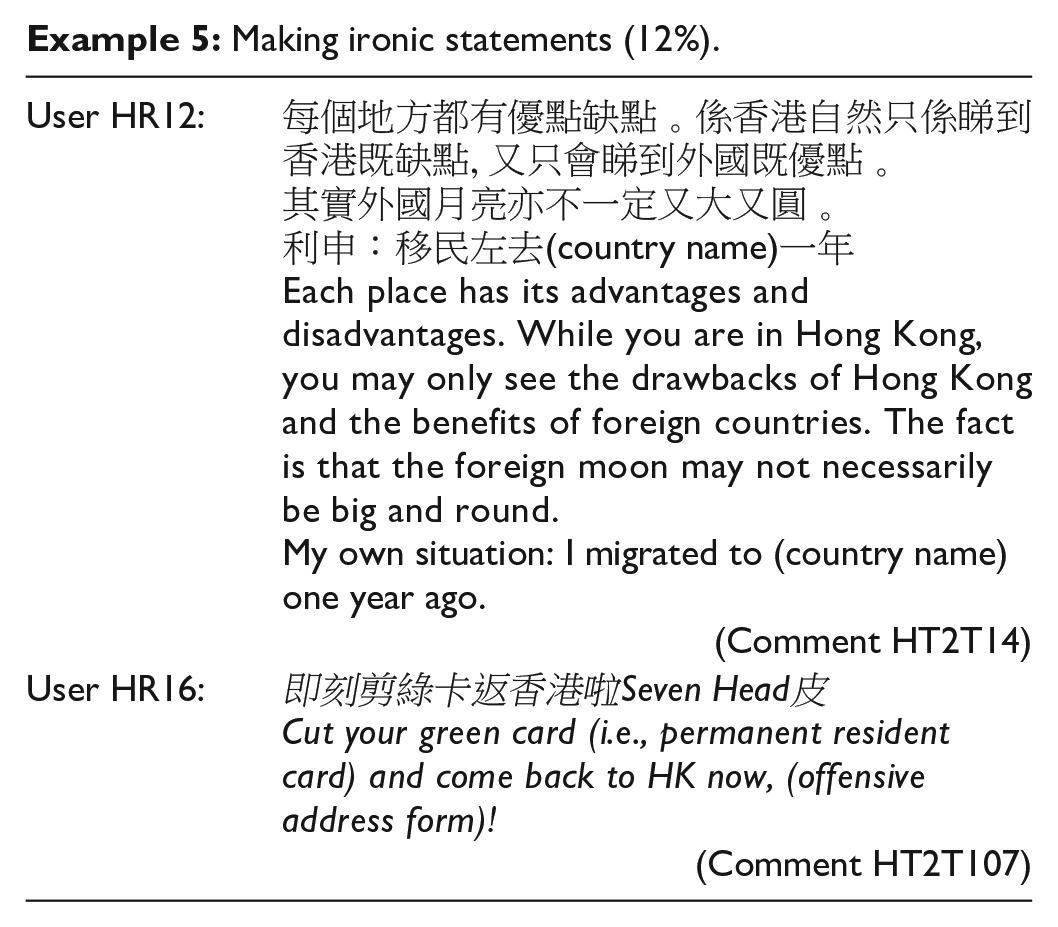
Irony and sarcasm can be defined as making statement in an implicit way, which “allows the hearer to arrive at the offensive point of your remark indirectly” (Leech, 1983, p. 82). In Example 5, User HR12 articulated the points that there are advantages and disadvantages in Hong Kong and foreign countries and that living abroad might not be the optimal choice. User HR12 also introduced that he or she had moved to a foreign country. User HR16 obviously did not agree with such claims and expressed the disagreement with an ironic statement, asking user HR12 to cut the permanent resident card and come back to Hong Kong. Again, an offensive address form which is unique to Site HK was used by User HR16.
Example 5: Making ironic statements (12%).
Disagreement Strategies in Site CN
For the 200 comments we collected from Site CN, only 16 instances of disagreement were identified, and there were 25 counts of disagreement strategies, as shown in Figure 2. Similar to data from Site HK, “giving facts” was the most frequently adopted strategy, accounting for almost half of all the strategies. “Giving opposite opinions” was used for around one third of the time. The strategies “making ironic statements” and “raising questions” shared the same frequency of 12%. The strategy “giving negative comments” was rarely used, and only one instance was found in the data. Again, examples of each strategy will be given below for illustration.

Distribution of disagreement strategies from Site CN.
The strategy “giving facts” was used very frequently by Site CN users, constituting almost half of the disagreement strategies from Site CN. In Example 6, User CR19 opposed the act of migration. Instead of disagreeing directly, CR176 stated the fact that all his or her migrated friends think they have made the right decision of migration at an earlier time.
Example 6: Giving facts (48%).

Likewise, the use of opposite opinion is a polite way of showing disagreement. In Example 7, User CR61 disagreed with User CR2 by saying that the named country was very anti-Chinese. In this case, we can observe the combination of two strategies (FAC and OPP) in one comment.
Example 7: Giving opposite opinions (24%).

As we have discussed earlier in the previous section, rhetorical questions are not the only type of questions people may raise to show disagreement. Example 8 is an illustration of our point. User CR21 introduced a migration program of a European country and recommended other users to check the details about it. Instead of rejecting the previous statement, User CR76 asked a polar question, indicating the current economic condition of this country (bankruptcy and external debt). In this example, disagreement was given in a very indirect way, but any users would get the point of User CR76 when they read this question.
Example 8: Raising questions (12%).
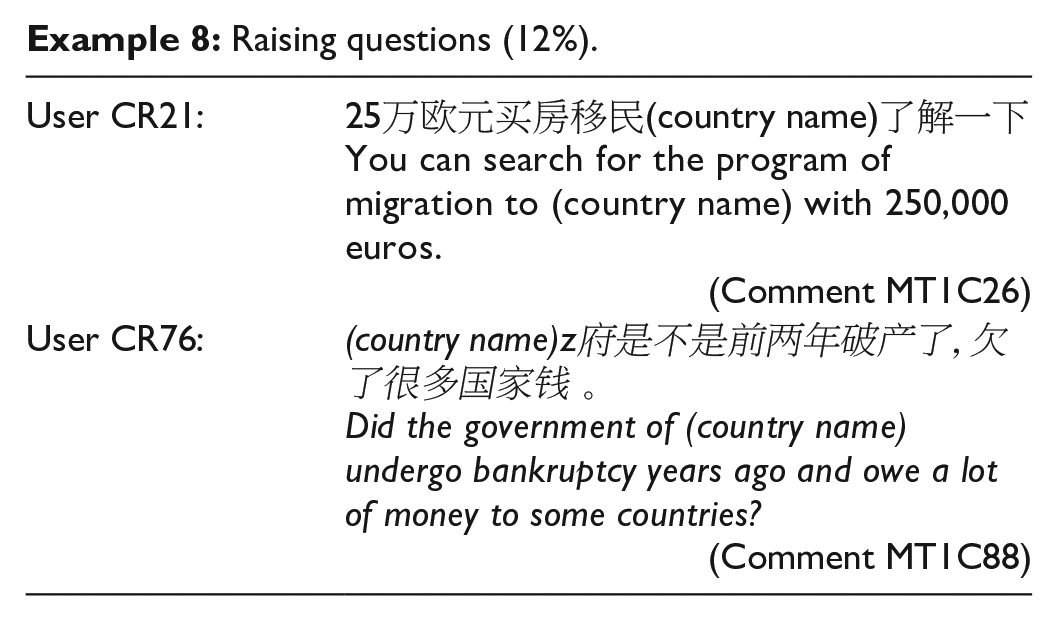
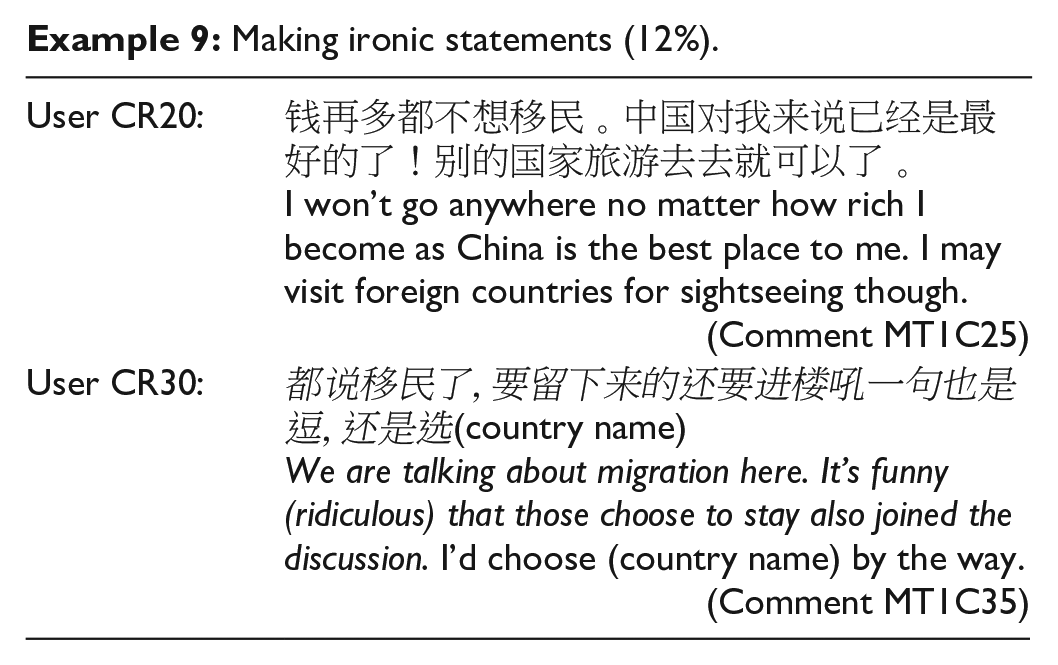
Example 9 is a case of making an ironic statement. User CR20 claimed that China is the best place in the world and would never consider migrating abroad. User CR30 used an ironic statement to disagree with this comment and further pointed out the country he or she would choose.
Example 9: Making ironic statements (12%).
Finally, there was only one case of a negative comment in Site CN (Comment MT1C57), where User CR46 showed a negative tone when disagreeing with Comment MT1C56 by User CA. User CA was the author of the thread and was allowed to delete any comments in the thread. When User CR46 was apparently replying in an unfriendly way in Comment MT1C57, User CA did not exhibit any emotional frustration; rather, the author patiently explained what he or she intended to express and ended the reply with “thanks” in Comment MT1C59. User CR46 was again not very polite in Comment MT1C67, but User CA continued to show his or her sincerity and responsibility as a thread author in Comment MT1C69. From Example 10, it is clear that, although User CR46 used a negative comment to disagree with User CA, their dialogue did not result in a conflict between the interlocutors.
Example 10: Giving negative comments (4%).

Comparison of Disagreement Strategies in the Two Sites
To compare the disagreement tokens in the two sites, we first employed a chi-square test of independence, with “Site” (HK/CN) and “Occurrence of disagreement” (Yes/No) as the tested variables. The relation between the two variables was significant (χ2(1, N = 400) = 6.061, p = .014), providing statistical evidence that whether a forum user tends to disagree or not is dependent on the site the user is from. Specifically, disagreement tokens are more likely to occur in Site HK than in Site CN.
Next, we compared the percentage of disagreement strategies used in the two sites, and the data are shown in Figure 3. We then performed a chi-square test with “Site” (HK/CN) and “Type of strategy” (FAC/IRO/NEG/OPP/QUE) as two variables. The result revealed a very weak association between site and type of strategy (χ2(4) = 3.984, p = .408), which indicated that, although Site HK had considerably more tokens than Site CN, the distributions of disagreement strategies in the two sites were not fundamentally different. For example, “giving facts” was always the favored strategy when forum users expressed their disagreement. It is also a persuasive and polite strategy as it provides evidence to support the opposing opinion in a neutral way. However, we did find a notable difference in the occurrence of the “giving negative comments” strategy. As a productive strategy in Site HK, it occurred equally frequent with “making ironic statements” and “giving opposite opinions” (around 14%), but it was rarely used in Site CN (around 4%). Only one instance was observed in the Site CN data. Further explanations to this observed divergence will be made in the discussion.

Comparison of disagreement strategies in the two sites.
Discussion
This study explored the use of disagreement strategies in Site HK and Site CN. Considerably more disagreement tokens were observed in Site HK, although the distribution patterns of disagreement strategies were similar in the two sites. A striking difference of the two sites was the occurrence of negative comments, which was common in Site HK but was very unusual in Site CN. The issues worth further elaboration will be discussed in this section.
Disagreement as an Effective Way of Communication
Disagreement has long been associated with conflict and discord in the literature, and it has been suggested that disagreement should be avoided in order to be polite and to maintain the interlocutors’ face (Brown & Levinson, 1987; Goffman, 1967; Leech, 1983). However, as shown in our data from Site HK and Site CN, disagreement did not generate conflicts at all; instead, it seemed to be a way of enhancing the communication of various opinions.
First of all, the topics of whether to migrate and destinations for migration are controversial; thus, in our case, the forum users were prone to disagree with each other’s opinions. In contexts such as decision-making and problem-solving, it is tolerated and even expected to express disagreement in conversations, and this would also contribute more information to the discussion and make the communication more effective (Locher, 2004; Schiffrin, 1984). For instance, in Example 2, User HR1 proposed a migration program of a country for others’ consideration (Comment HT2T2). Obviously, User HR8 did not like this idea. Instead of leaving negative comments, User HR8 raised a rhetorical question to express his or her disagreement, which did not bring any conflict; rather, he or she successfully conveyed the idea and maintained each other’s face at the same time. Second, we agree with Sifianou (2012) in that disagreement is actually a highly complex phenomenon and should not only be treated as a face-threatening act. Apart from the content of disagreement, it is necessary to consider the form of disagreement, namely, how disagreement is expressed. We adopted this approach and identified five disagreement strategies, among which only the “giving negative comments” is potentially face-threatening. As has been illustrated, even those negative comments did not cause conflicts in the discussion when we took the local contexts into account. Our data thus support the claim that disagreement can be face-maintaining and face-enhancing in communication (W. Zhu, 2014). Moreover, the features of anonymity and synchronicity make CMC communication distinct from face-to-face interaction, as disagreement is a dispreferred option in cases such as classroom teaching (Lopez-Ozieblo, 2018). As an increasing number of people interact with each other in the CMC environments, our expectations toward politeness have begun to shift (Graham & Hardaker, 2017); therefore, disagreement is more likely to occur in CMC than in face-to-face contexts, although further cross-modal investigations are required to test this point of view.
Interpreting the Divergence
Despite the similar distribution patterns of the disagreement strategies in these two sites, their differences are noteworthy. Notably more disagreement tokens and more negative comments were found in Site HK. Possible explanations are proposed in this subsection.
Rooted in Confucianism, Chinese societies are labeled as highly collectivism oriented (Wu & Lin, 2017), but the case of Hong Kong is more complicated. Hong Kong was a British colony from 1841 to 1941 and from 1945 to 1997, during which it has become a center for international trade (Tsang, 2003). As a result, Hong Kong exhibits both Chinese collectivism and western individualism, corresponding to “concern for others” and “concern for self” respectively (Angouri & Locher, 2012). It is plausible that, when people care more about themselves, they would express their disagreements more explicitly and frequently, while when people are aware of others’ face, they may not disagree overtly with others, as shown in the two sites. The first explanation is that disagreement is more preferred in a more individualized society like Hong Kong.
In addition, the internet censorship in mainland China may play a role here. The Great Firewall of China has blocked access to several foreign websites including Site HK, and there are also internet police officers and other official observers who would delete any online information considered noncompliant (Liang & Lu, 2010). This is why forum users in mainland China should have good manners and be more careful when proposing disagreements. Furthermore, the author of a thread in Site CN has the right to delete any comments, as shown in Example 10, where User CR46 was arguing with the author about his or her previous comment having been deleted. It is also possible that some disagreement comments had been deleted by the observer or the author before we collected the data. Still, we need to compare disagreement strategies in face-to-face communication of people from Hong Kong and mainland China to confirm whether the internet censorship contributes to the divergence.
Finally, the observed divergence might be attributed to the different cultures of Site HK and Site CN. It is suggested that each online community has its own norms of politeness and that the norms may differ strikingly from community to community (Angouri & Tseliga, 2010; Graham, 2007). Site HK and Site CN are fundamentally different in terms of community norms. Site HK is famous for its freedom, and conflicts and confrontations are very common (Xu, 2011). As a productive and creative platform for linguistic communication, the users of Site HK even produced a list of foul languages used exclusively among Site HK users, as shown in Examples 3 and 5. Meanwhile, the users of Site CN belong to the well-educated minority, who may not favor conflicts and arguments, as Site CN was originally a site for sharing reviews of books, movies, and music (Li, 2011). It is not surprising that more disagreements and negative comments appeared in Site HK. Further research including forums with diverse norms would certainly provide more persuasive results.
Limitations
There are some limitations of this study. First, the sample size of this study is relatively small, as there were only 200 comments collected from each thread. Also, the sample may be biased for three reasons: (a) only one forum was chosen for each region; (b) the scope of the thread topic was limited to destinations for migration; and (c) both threads were created and commented in the year 2018, which prevented us from examining any chronological development in the use of disagreement strategies. Future studies should explore a wider range of controversial topics from more diverse forums over a longer period of time to see whether the distribution patterns of disagreement strategies will be influenced by the selection of thread topics, the characteristics of forums and the created year of the threads.
Second, this project has investigated the disagreement strategies of two sites from the interactional approach, and the identification of strategies was made by the author and two trained annotators. To capture a fuller picture, the discursive approach can be included in follow-up studies. For example, we may invite user of the two sites to evaluate selected disagreement strategies regarding politeness, appropriateness, and positiveness (Shum & Lee, 2013). Another direction is to invite the users of the disagreement comments for an in-depth interview about their opinions, which would provide more convincing evidence. Alternatively, it is also worthwhile to design some discourse completion tasks (such as those reported by Wijayanto et al. (2017)) and see how participants would respond with various disagreement strategies.
Concluding Remarks
This article investigated how Chinese people from different regions (Hong Kong and mainland China) employed disagreement strategies in the CMC context and reported the similarities and differences in the use of disagreement strategies on two online forums from the interactional approach. It has been shown that, instead of being a face-threatening act, disagreement actually maintained and enhanced the interlocutors’ face and advanced the communication of information. As an effective way of communication, disagreement facilitates the collection of ample information from interlocutors, especially for controversial topics. It is crucial to shift our attitude toward disagreement and more research is needed to explore how disagreement could benefit our communication.
Although the distribution patterns of the five strategies of disagreement were similar in the two sites, notably more disagreement tokens and more negative comments occurred in Site HK. This divergence has been interpreted as resulting from the different degrees of collectivism–individualism in the two regions, the internet censorship in mainland China, and the nature of the two forums selected. Whether these interpretations hold true remains to be examined in the future.
Footnotes
Appendix
A Full List of Disagreement Strategies From Previous Frameworks.

| Bousfield (2008): 1. Snub, 2. Disassociate from the other, 3. Be uninterested, unconcerned, unsympathetic, 4. Use inappropriate identity markers, 5. Seek disagreement/avoid agreement, 6. Use taboo words, 7. Threaten/Frighten, 8. Condescend, scorn, or ridicule, 9. ‘Explicitly’ associate the other with a negative aspect. |
| Culpeper (1996): 1. Ignore, snub the other, 2. Exclude the other from an activity, 3. Disassociate from the other, 4. Be disinterested, unconcerned, unsympathetic, 5. Use inappropriate identity markers, 6. Use obscure or secretive language, 7. Seek disagreement, 8. Make the other feel uncomfortable, 9. Use taboo words, 10. Call the other names, 11. Frighten, 12. Condescend, scorn or ridicule, 13. Invade the other’s space, 14. Explicitly associate the other with a negative aspect, 15. Put the other’s indebtedness on record. |
| Locher (2004): 1. Hedges, 2. Giving personal or emotional reasons for disagreeing, 3. Modal auxililaries, 4. Shifting responsibility, 5. Objections in the form of a question, 6. The use of but, 7. Repetition of an utterance by a next or the same speaker, 8. Unmitigated disagreement. |
| Shum and Lee (2013): 1. Giving negative comments, 2. Using short vulgar phrases, 3. Raising rhetorical questions, 4. Making a personal stance, 5. Making an ironic statement, 6. Cursing, 7. Giving opposite opinions, 8. Rewording, 9. Giving personal experience, 10. Giving facts, 11. Reprimanding. |
Acknowledgements
The author would like to thank Doreen Wu, Gerald Stell and three anonymous reviewers for their constructive feedback on earlier versions of this paper. We are also indebted to Longxing Li and Carmen Wu for their contribution to the data annotation.
Author’s Note

Declaration of Conflicting Interests
The author declared no potential conflicts of interest with respect to the research, authorship, and/or publication of this article.
Funding
The author received no financial support for the research, authorship, and/or publication of this article.