




Abstract
Of the three formal dispute resolution procedures provided by the Individuals With Disabilities Education Act of 2004(IDEA), due process hearings are the most costly in terms of time, fiscal resources, and impact on relationships between school personnel and parents. This study examined 258 due process hearings held over the past 8 years in Massachusetts to examine the characteristics of students at the center of these disputes, the issues that were addressed in the hearings, and the representation utilized by parents and school districts. The findings from this study indicated that (a) Massachusetts school districts utilized attorney representation and won due process hearings at notably higher levels than parents, and (b) the most frequently addressed issues at due process hearings were Individualized Education Program (IEP) development/implementation and educational program placement, which are issues that represent the core mandate of IDEA to provide a free appropriate public education in the least restrictive environment (34 C.F.R. §300.300, 300.550). The authors present recommendations for policy actions and areas for future research.
Keywords
The Individuals With Disabilities Education Act of 2004 (IDEA) establishes that all children identified as eligible to receive special education services are entitled to receive a free appropriate public education in the least restrictive environment (IDEA, 2004a,). As part of the process for ensuring that children with disabilities receive this level of educational service, IDEA outlines both procedural and substantive requirements that must be met by school districts (Drasgow, Yell, & Robinson, 2001). Procedural requirements include processes such as including parents in decision-making processes and adhering to timelines for evaluation and program development. Substantive requirements address issues of quality and appropriateness, including the content of each eligible child’s Individualized Education Program (IEP), the types of special education and related services provided, and the selection of the educational environment(s) at which services are provided.
Research has demonstrated that school districts often struggle to meet the procedural and substantive requirements of special education law (Drasgow et al., 2001), including the provision that stipulates that parents should be included as participants in the educational decision-making process (Fish, 2008; Garriott, Wandry, & Snyder, 2000; Lo, 2008; Salas, 2004; Wagner, Newman, Cameto, Javitz, & Valdes, 2012; Zeitlin & Curcic, 2014). In instances in which conflicts arise between parents and school personnel regarding the development of IEPs or the implementation of education services, IDEA (2004) outlines a process for dispute resolution. There are three formal procedures for resolving special education disputes: mediation, resolution meetings, and due process hearings. Mediation is the least adversarial and most pro-active of these options (Mueller, 2009; Zirkel & McGuire, 2010). In mediation, both sides utilize an impartial mediator to resolve their differences and reach a mutually acceptable agreement. Mediation is a voluntary process, and any agreements resulting from this process are developed through cooperation and compromise between the parties.
The other two formal resolution procedures identified in IDEA are resolution meetings and due process hearings. Resolution meetings are a relatively recent addition, having been included in IDEA during the 2004 reauthorization in an attempt to introduce less adversarial mechanisms for dispute resolution (Mueller, 2009). Resolution meetings are mandatory if a parent has filed for due process and any agreements reached are binding (IDEA, 2004b). If the resolution meeting is not successful in solving the existing dispute, then the third formal resolution procedure outlined in IDEA is enacted. Due process hearings include all of the formal elements of dispute resolution, including review of evidence, written and/or oral testimony, and the frequent use of attorney representation (Mueller, 2009; Zirkel & McGuire, 2010). The final judgment comes from a hearing officer, and the results are legally binding.
Of the three formal dispute resolution procedures provided by IDEA (2004), due process hearings are the most costly in terms of time, fiscal resources, and impact on relationships between school personnel and parents (Cope-Kasten, 2013; Mueller, 2009). The financial costs may run as high as US$50,000 per hearing, with an average cost running between US$8,000 and US$12,000 (Daggett, 2004; Mueller, 2009). Despite these considerable costs, the number of due process hearings across the nation rose steadily in the 1990s (Ahearn, 2002; General Accounting Office, 2003) and has remained at a high level of over 2,000 hearings annually during the 2000s (Zirkel & Gischlar, 2008; Zirkel & Scala, 2010). The number of hearings is not evenly distributed across all 50 states and the District of Columbia. In the most recent state-by-state analysis, Zirkel and Scala (2010) found that nine states and the District of Columbia accounted for 91% of the total due process hearings held during 2008 through 2009. The nine states were New York, Connecticut, New Jersey, Pennsylvania, Maryland, Hawaii, Texas, Massachusetts, and Illinois.
Given the high volume of due process hearings, their significant financial costs, and the negative impact on parent–school relationships, it is important to further examine the existing research on this IDEA dispute resolution procedure. Over the past 15 years, research on due process hearings has addressed the disability characteristics of children at the center of the disputes, the issues addressed during the hearings, the prevailing parties, and the extent to which legal and lay representation was utilized by the disputing parties. Regarding the characteristics of children involved in due process hearings, Mueller and Carranza (2011) reported that students with specific learning disabilities and students with autism spectrum disorders were at issue in just under half of 575 due process hearings held in 41 states. Students categorized as having other health impairments, emotional disturbance, or intellectual disabilities were the next most frequently occurring groups in the hearings. This finding was consistent with a previous study (Newcomer & Zirkel, 1999) that identified students with learning disabilities as the largest disability group represented in due process hearings. The Newcomer and Zirkel (1999) study had an unexpected finding in that students with multiple disabilities were involved in 17% of the hearings in their sample, as compared with these students representing only 1.9% of the overall population of students receiving special education services. This finding was not supported by the Mueller and Carranza (2011) study.
Previous research on special education due process hearings has consistently found that the most frequent issues at dispute involve educational placement, IEPs, assessment/evaluation, and service delivery (Cope-Kasten, 2013; Mueller & Carranza, 2011; Newcomer & Zirkel, 1999; Rickey, 2003). In a 41-state sample, Mueller and Carranza (2011) reported that placement (25%) and IEP (24%) together represented almost half of the due process hearings examined. Cope-Kasten (2013) analyzed 210 due process hearings from Minnesota and Wisconsin over a 12-year period, and similarly found that IEP (47%) and placement (35%) were frequently occurring issues. The author also reported that service provision (42%) and evaluation (38%) were common issues addressed in due process. Rickey (2003) examined 50 due process hearings in Iowa over a 12-year period. The most frequently occurring issues were placement (46%) and evaluation (30%).
Research that has examined the prevailing parties in due process hearings has yielded inconsistent results. Two earlier studies (McKinney & Schultz, 1996; Sultana, 1997) indicated that parents prevailed on a majority of issues addressed at hearings. However, subsequent research (Cope-Kasten, 2013; Mueller & Carranza, 2011; Newcomer & Zirkel, 1999; Rickey, 2003) has demonstrated that school districts prevail on the largest portion of issues in due process hearings. Furthermore, Cope-Kasten (2013) examined the parties’ successes by type of representation. The author found that in cases where parents did not have attorney representation, school districts prevailed in 98% of the hearings. When parents did have attorney representation, school districts prevailed in 64% of the hearings. In an earlier study on representation, Kuriloff and Goldberg (1997) reported that parents perceived that they had more relative power in the dispute than parents who used a lay advocate or represented themselves. Ahearn (2002) found that many states did not collect on data on representation at due process hearings, and that those that did collect data reported that there were issues with securing affordable attorneys for parents.
Purpose and Research Questions
Given the continued high volume of due process hearings conducted annually in the United States and the relatively limited amount of research conducted in this area (Reiman et al., 2007), additional research on due process hearings can potentially benefit a wide range of stakeholders. These stakeholders include children with disabilities, their parents, educators, advocates, attorneys, researchers, and policy makers. Particularly with another reauthorization of IDEA on the horizon, continued research in this area is timely and important. The authors wanted to build on the previous research by conducting a longitudinal study of due process hearings within a state that continues to have consistently high volumes of hearings each year. It was hoped that by engaging in an in-depth study of due process hearings within a state that consistently has a high number of due process hearings, information can be uncovered that would shed light on potential ways to effectively resolve conflicts sooner and at a lower fiscal and relationship cost than occurs during due process hearings.
After consulting the existing research on the number of due process hearings held in each state (Zirkel & Gischlar, 2008; Zirkel & Scala, 2010), the authors selected Massachusetts as the target state. Massachusetts ranked in the top 10 states nationally in the number of hearings held annually and ranked 12th nationally in the number of hearings held per capita (Zirkel & Gischlar, 2008). The authors also had a more personal reason for selecting Massachusetts as the focus of this study. Both authors had previously worked in special education service provision and disability advocacy in Massachusetts at the local and state levels. Although the authors no longer work within the state, there remains a vested interest in trying to uncover information that may lead to more collaborative dispute resolution, as well as improved procedures and services for students that can prevent disputes from arising in the first place. Having worked in multiple states, the authors felt that the results from a study on due process hearings in Massachusetts could also inform and benefit stakeholders in other jurisdictions.
With the considerable costs of special education litigation (Daggett, 2004) and the findings from previous research that indicated school districts win a notable majority of due process hearings (Cope-Kasten, 2013; Lupini & Zirkel, 2003; Newcomer & Zirkel, 1999; Rickey, 2003), the authors felt it was important to examine the extent to which parents obtain legal and lay representation, and to determine if there were any patterns in the frequency of use of representation over time. The authors were also interested in examining a high volume of due process hearings over a number of years to determine if there were any trends in the types of issues that were brought to due process hearings and the characteristics of students who were the subject of these hearings. The following research questions were developed to guide the study:
Student characteristics: What were the characteristics of students who were the focus of due process hearings, including disability categories, grade levels, and educational placements? Were there trends in these characteristics over time?
Issues: What were the issues addressed in due process hearings? Were there trends in these issues over time? How often did parents and school districts prevail on each of these issues?
Representation: How often do parents and school districts utilize legal and lay representation at due process hearings? Were there trends in types of representation over time? How often did parents and school districts with different types of representation prevail in due process hearings?
Method
Data Source
The data set for this study was all written due process hearing decisions issued by the Massachusetts Bureau of Special Education Appeals (BSEA; n.d.) from July 1, 2005 through June 30, 2013. The authors felt that selecting a starting point of July 1, 2005 provided data that would primarily include disputes arising since the most recent reauthorization of IDEA in 2004. Data collection was straightforward as all hearing decisions in Massachusetts are available to the public via the BSEA’s website. Each written decision file was downloaded and an Excel database was created to manage data entry, coding, and analysis. A total of 258 hearing decisions were identified and included in the analysis. There were an additional 23 hearing decisions that were excluded from the study because they only addressed disputes between school districts related to financial responsibility for students’ special education programs.
Coding and Analysis
After identifying the 258 due process hearing decisions, each hearing file was logged in the project database. The information logged for each case included the case number, fiscal year (based on a July 1 to June 30 schedule), hearing officer who issued the decision, and the school district name. Each written hearing decision was then read and coded. The initial code set was informed by previous published research on due process hearings and judicial outcomes (Cope-Kasten, 2013; Mueller & Carranza, 2011; Newcomer & Zirkel, 1999; Rickey, 2003) as well as on the authors’ prior knowledge and experience with special education dispute resolution. The initial definitions for the codes were refined and additional codes were identified during the establishment of intercoder reliability and during ongoing conversations between the two principal investigators. The final code set was as follows:
Legal representation—The type of representation used by each party (attorney, pro se with advocate/consultant support, pro se).
School level—School level of the student at question in the dispute at the time of the due process hearing (preschool, elementary, middle school, high school, post–high school).
Primary disability category—Primary disability of the student as stated in the written hearing decision. In cases in which the student presented with multiple disabilities, the code “multiple” was used. For purposes of this study, the terminology for the disability categories used was taken from the Massachusetts special education regulations.
Educational program placement—The educational environment for the student at the time of the hearing request.
Prevailing party—The prevailing party for each issue (district, parent, mixed). An example of a mixed decision was a due process hearing in which related services were an issue. In this instance, the parent won the portion of the issue focused on physical therapy services, and the school district won the portion of the issue focused on occupational therapy services.
Issues—The identified issue(s) in dispute. Each separate issue addressed within a due process hearing was coded. The subcodes for issues were as follows. Evaluation—Evaluation process and procedures for determining areas of need and potential services, including independent education evaluations and the selection/qualifications of evaluators. Extended school year services—Special education and related services provided to eligible students beyond the typical 10-month academic year. Identification—Eligibility determination for special education services. IEP—Components and development of the IEP, commonly examined to determine the extent to which the IEP was calculated to provide a free appropriate public education in the least restrictive environment. Placement—Location of special education services for a student, including services provided in general education settings and specialized settings that will provide the student access to the general education environment to the appropriate extent; includes unilateral placement of student by parent. Procedural safeguards—Procedural protections afforded to students, parents, and schools through federal and state special education laws and regulations; included timelines, parental consent, and written notices. Related services—Developmental, rehabilitative, corrective, and supportive services that are necessary to assist a student in accessing and benefiting from special and general education services; included specialized transportation, occupational therapy, physical therapy, and orientation and mobility services. Suspension/expulsion—Removal of a student from the agreed-upon placement due to disciplinary actions; included both in-school and out-of-school suspensions. Transition—Practices and procedures related to transition planning for secondary students to assist in developing the knowledge, skills, and strategies for accessing and benefiting from post-secondary opportunities such a college, employment, independent living, and community participation.
There were a limited number of instances in which a variable could not be assigned a code because the information was not provided in the written decision. For these instances, the data was recorded as “not indicated.”
The two authors were equally responsible for all of the data collection, coding, and analysis. To refine codes and to establish intercoder reliability, an initial set of 20 hearings was randomly selected and coded by both authors. After meeting to compare codes and refine the code book, the authors then re-coded these 20 hearing decisions plus an additional 32 hearing decisions (for a total of 20% of the sample). Intercoder reliability was calculated based on these 52 hearing decisions using a formula recommended by Miles and Huberman (1994): Reliability = (Number of agreements) / (Total number of agreements plus disagreements). The final intercoder reliability calculation was 98.1%. Throughout the entire coding and analysis process, the authors frequently discussed any questions regarding codes and often examined portions of hearings together to ensure that an agreed-upon code was assigned. All data were recorded in a master database to better facilitate analysis and reporting. As the purpose of this study was to present and describe population data from due process hearings over time, descriptive statistics were deemed most appropriate for the analyses (Vogt, 2006).
Findings
Characteristics of Students in Due Process Hearings
The 258 special education due process hearings were analyzed to determine the characteristics of students at the center of these disputes, including their primary disability categories, grade levels, and educational program placements at the time of the hearing request. These data are presented in Table 1.
Characteristics of Students in Due Process Hearings (n = 258 hearings).

Note. Percentages are calculated within columns. Percentages may not total to 100 due to rounding.
Over the 8-year period of this study, the most common disability categories were multiple disabilities (29.1%), followed by specific learning disabilities (23.6%), autism (14.3%), and emotional/behavioral impairment (14.0%). All other disability categories were present in less than 50% of the hearings. Regarding trends in disability categories over time, there were three notable items. The percentage of students with multiple disabilities were markedly higher from fiscal year (FY)10 to FY13 than in earlier years, with percentages of 35.9% in FY10, 34.4% in FY11, 44.1% in FY12, and 55.6% in FY13. The percentage of students with specific learning disabilities declined steadily from FY07 to FY13. The percentage was 44.7% in FY07, and then moved to 24.3% in FY09, 15.6% in FY11, and finally 3.7% in FY13. The third notable item was the decline in the percentage of students with emotional/behavioral impairments in due process hearings. The percentage was 28.0% in FY06, moved to 19.9% in FY09, and was 3.7% in FY13.
The grade levels of students at the center of due process hearings were relatively evenly distributed. There were 27.1% of students at the preschool/elementary level, 29.1% at the middle school level, 36.0% at the high school level, and 5.4% at the post–high school level (e.g., students ages 19-21 in transition programs). Trend analysis indicated that students at the post–high school grade levels were represented in due process hearings at a high point of 13.5% (5 hearings) in FY09, and then have declined to being involved in no hearings in either FY12 or FY13. No other potential trends were identified in these data.
The students’ educational program placements at the time of the hearing request were also examined. The most frequent placements were general education classrooms with inclusive and/or resource room support services (44.2%), followed by separate public or private day schools (18.6%), substantially separate special education classrooms within the public school (17.4%), and residential/hospital programs (11.6%). Longitudinal analyses indicated a potential trend in the type of educational program placement for students involved in due process hearings. From FY11 to FY13, there were declines in the percentages of students placed in general education classrooms with inclusive/resource supports (43.8% in FY11 to 22.2% in FY13) and in the percentages of students placed in substantially separate classrooms with public schools (21.9% in FY11 to 11.1% in FY13). Over this same period, there was an increase in the percentages of students placed in public/private day schools (18.8% in FY11 to 29.6% in FY13) and residential/hospital programs (6.3% in FY11 to 22.2% in FY13). Further analysis indicated that students had been unilaterally placed by the parents into either a separate public/private day school or a residential/hospital program in 11 out of the 38 disputes involving students in these placements from FY11 to FY13.
Issues Addressed in Due Process Hearings
There were a total of 496 issues addressed in the 258 due process hearings held from FY06 through FY13, which resulted in an average of almost 2 issues per hearing. There were 89 hearings that addressed 1 issue, 114 hearings that addressed 2 issues, and 55 hearings that addressed 3 or more issues. The number of issues addressed annually peaked in 2007 (83 issues), and showed a steady decrease in recent years (75 issues in FY10, 60 issues in FY11, 56 issues in FY12, and 49 issues in FY13). The data on issues addressed in due process hearings is presented in Table 2.
Issues Addressed in Due Process Hearings (n = 496 issues).

Note. Percentages are calculated within columns. Percentages may not total to 100 due to rounding. IEP = Individualized Education Program.
The most frequently addressed issues in due process hearings were related to the development and content of IEPs (34.3% of all issues) and student placement (30.4%). These two areas were the most common issues in each of the 8 years examined. IEP and student placement were also frequently addressed in the same hearings. The two were identified as issues in 119 out of 258 due process hearings (46.1%). The next most frequently addressed issues were procedural safeguards (10.3%), evaluation (8.5%), and related services (7.7%). There were no trends in these areas over the 8 years, but it should be noted that evaluation had a 1-year spike in FY10 (16.0% of all issues that year). The issues of identification, extended school year services, suspension/expulsion, and transition were all under 3.0% of the total issues addressed. The only change over time in these areas was with extended school year services. Since FY10, only 1 due process hearing has addressed this area as an issue. Of the 9 transition-related issues, 5 of these were presented in hearings during FY09. No other year had more than one transition issue addressed at a due process hearing.
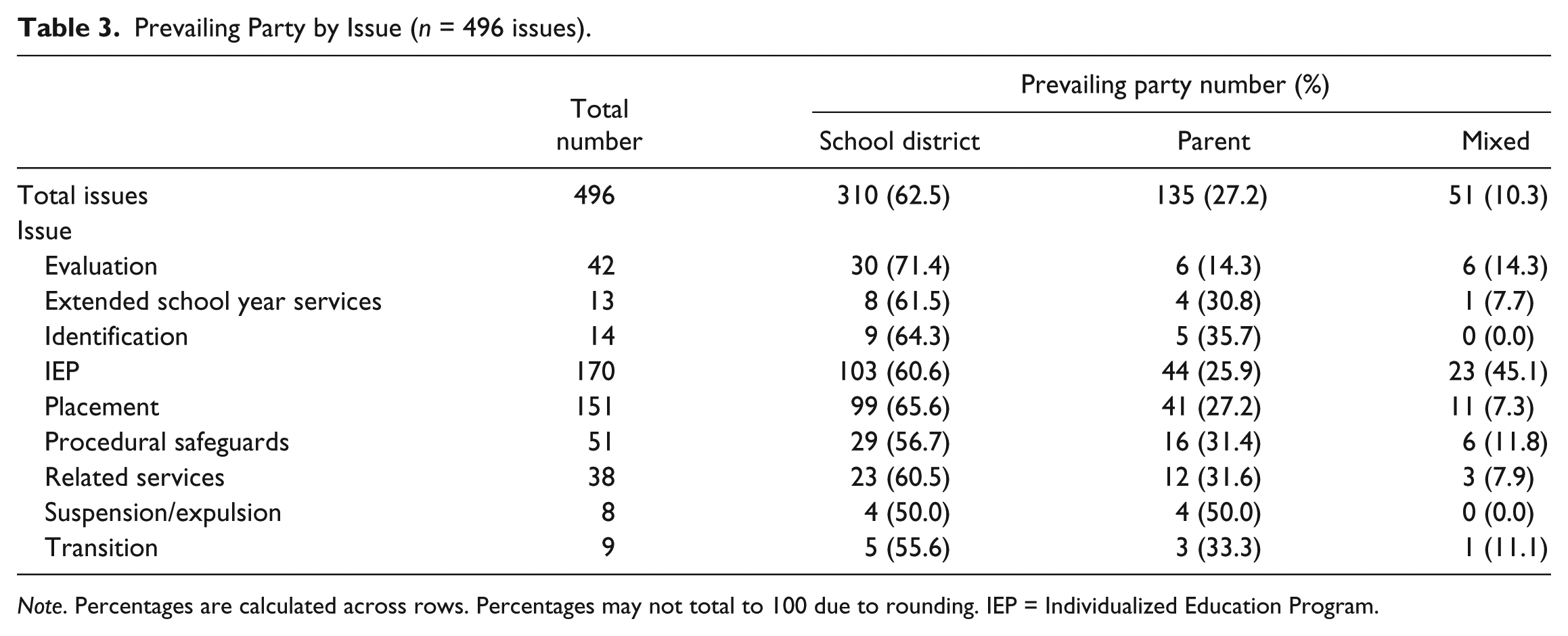
The due process hearings were also examined to determine the prevailing parties on each issue. While one of either the school district or parent typically prevailed on an issue, there were some instances in which the hearing officer presented a mixed decision in which both parties prevailed on various aspects of the same issue. The data on prevailing parties were analyzed in the aggregate for the 8-year period of this study, as the majority of the issue cells had n-sizes that were too small to be usefully examined by individual fiscal year. Table 3 presents the data on prevailing party by issue.
Prevailing Party by Issue (n = 496 issues).
Note. Percentages are calculated across rows. Percentages may not total to 100 due to rounding. IEP = Individualized Education Program.
Overall, school districts prevailed on 62.5% of all issues, parents prevailed on 27.2% of issues, and a mixed decision was issued on 10.3% of the issues. When examined by issue, the range of issues on which school districts prevailed extended from 50.0% of issues involving suspension/expulsion to 71.4% of issues involving evaluation. The percentage of issues in which parents prevailed ranged from 14.3% of issues involving evaluation to 50.0% of issues involving suspension/expulsion. Besides evaluation and suspension/expulsion, there were no issues in which it appeared one party prevailed out of proportion to the overall rate of success on all issues combined. The issue of placement was further examined to determine the outcomes of these issues when parents had unilaterally placed the student prior to the due process hearing. In the 48 hearings in which this situation was evident, districts prevailed on 27 issues related to unilateral placement by the parent (56.3%), parents prevailed on 15 issues (31.2%), and a mixed decision was presented on 6 unilateral placement issues (12.5%). These percentages were consistent with the overall success rate of these parties on other issues related to placement.
Representation of Parties in Due Process Hearings
Each of the 258 due process hearings were examined to determine how often parents and school districts utilized legal and lay representation. In all 258 hearings (100%) from FY06 to FY13, school districts utilized attorney representation. Over this same time period, parents had attorney representation in 40.3% of due process hearings, represented themselves pro se in 103 hearings (39.9%) and utilized advocate support in an additional 39 hearings (15.1%). In 12 hearings (4.7%), parents did not participate. Table 4 presents data on parent representation at due process hearings.
Parent Representation at Due Process Hearings (n = 258 hearings).

Note. Percentages are calculated within columns. Percentages may not total to 100 due to rounding.
Regarding trend analysis, parents utilized attorney representation more frequently from FY06 to FY08 (44.0%, 57.9%, and 42.3%, respectively, in those years). Beginning with FY09, parents did not enlist attorney representation more than 40.6% (FY11) in any given year. The two lowest years for parent use of attorney representation were in FY13 (29.6%) and in FY09 (32.4%). In every fiscal year beginning with FY08, parents represented themselves pro se with or without advocate support in over 50.0% of the due process hearings. In the final 2 years of this study, parents were pro se with or without advocate support in 61.8% (FY12) and 66.7% (FY 12) of due process hearings.
The due process hearings were also analyzed to determine how often the parties won with different types of representation. As the n-sizes for parent representation cells were small in most years, these data were analyzed in the aggregate of the 8 years of the study. For purposes of this analysis, a party was deemed to have won a due process hearing if that party prevailed on all issues. If both parties prevailed on separate issues within a hearing, then the outcome was coded as “mixed.” The data on prevailing party by type of representation is presented in Table 5.
Prevailing Party by Type of Representation (n = 258 hearings).

Note. Percentages are calculated across rows. Percentages may not total to 100 due to rounding.
School districts had attorney representation in all 258 due process hearings, and won 55.0% of these hearings. School districts lost 20.5% of the hearings and had a mixed decision in 24.4%. Parents had lower success rates, regardless of representation type. Parents with attorney representation won 30.8% of hearings, lost 39.4%, and had mixed decisions in 29.8%. Parents who represented themselves pro se without advocate support won 10.7% of the hearings, lost 68.9%, and had mixed decisions in 20.4%. Parents who were pro se with advocate support fared better, winning 20.5% of the hearings, losing 51.3%, and having mixed decisions in 28.2%. Parents who did not participate in the due process hearing won 16.7% and lost 83.3% of the hearings.
Discussion
Limitations
Before engaging in a discussion of the findings, it is important to recognize the limitations to this study. First, this study was restricted to one state, Massachusetts. Although the authors believe that the findings from this study can inform and benefit stakeholders in other states, the fact remains that this research is embedded within the context of a single state jurisdiction. Another limitation relates to inconsistencies in the level of detail provided in the written hearing decisions over the 8 years of this study. A total of 10 hearing officers issued written hearing decisions, and each officer utilized a slightly different format and sometimes marked differences in the level of descriptiveness. In other instances, the same hearing officer provided a high level of detail in one hearing but a lesser level of detail in another. The authors of this study particularly found it difficult to identify and code the primary disability category of students. Decisions issued in more recent years provided less straightforward statements of the primary disability category indicated on the student’s IEP, and instead provided greater levels of descriptiveness regarding evaluation report findings, witness testimony, and areas of student need. When it was not clear that one disability category was primary, these data were coded as “multiple disabilities.” The potential impact of this issue on the data set is addressed below in a discussion of the findings related to student disability categories.
Implications and Areas for Future Research
The disproportionate percentage of issues and hearings on which Massachusetts school districts prevail is an area for concern. Over the 8 years of this study, school districts prevailed in 55.0% of hearings and received a mixed decision in an additional 24.4%. When disaggregated to the level of specific issues addressed in hearings, school districts prevailed on 62.5% of all issues and received a mixed decision in an additional 10.3%. This finding is consistent with research from four other studies conducted in the past 15 years in other jurisdictions (Cope-Kasten, 2013; Mueller & Carranza, 2011; Newcomer & Zirkel, 1999; Rickey, 2003).
The authors of this study theorize that the unbalanced results in outcomes could be the result of unequal access to professional legal advice and representation. This can affect the outcome of special education disputes in two ways. First, there is the possibility that inadequate information and legal advice is available to parents when making decisions on whether to take a dispute to due process hearing. The findings in this study indicated that parents were more likely to represent themselves with or without advocate support than they were to enlist attorney representation. When parents did represent themselves, they frequently did not win, prevailing in only 10.7% of hearings in which they represented themselves pro se and 20.5% of hearings in which they were pro se with advocate support. In this case, we are seeing high volumes of parents with access to limited information choosing to take issues into a very costly and time-consuming process in which they will often not prevail. Another possibility is that school districts have greater access to professional expertise and legal representation that provide effective supports for determining which issues to take to due process and for presenting evidence and arguments at the hearings. In this study, school districts utilized attorney representation in 100% of the due process hearings and prevailed in the majority of hearings and on the majority of issues.
Based on these findings, the authors agree with Cope-Kasten (2013) and Johnson (2005) that due process hearings may not represent a fair means of resolving special education disputes. At the most fundamental level, it appears that parents are not able and/or willing to access the same level of professional legal expertise that school districts access. A major factor in this issue is likely due to the real or perceived costs of attorney representation. State government initiatives to create programs that provide pro bono attorney representation for parents could be one possibility for alleviating this issue. A potential area for future research is to examine available programs across states to determine the extent to which affordable attorney representation is provided for parents. This research could be an important update to earlier research from Ahearn (2002) that found that states that did collect data on attorney representation reported issues with securing affordable representation for families.
A stated goal of this study was to uncover information from due process hearings that could shed light on potential ways to effectively resolve conflicts sooner and at a lower fiscal and relationship cost than occurs during due process hearings. As Mueller (2009) has suggested, the use of alternative dispute resolution strategies such as IEP facilitation, parent-to-parent assistance, and third-party consultation are mechanisms that are less reliant on legal expertise and financial resources, and could reduce the considerable advantage that school districts appear to have when taking issues to due process hearings. However, the authors of this study found very limited information available in the written hearing decisions regarding the extent to which alternative dispute resolution procedures had been attempted or the types of procedures that had been utilized. This is an area for future research, both within Massachusetts and across other jurisdictions. Additional research in this area could potentially help make the case that the next reauthorization of IDEA should include provisions that require school personnel and parents to demonstrate that they have attempted multiple alternative dispute resolution strategies prior to any case moving forward to a due process hearing. Although the resolution meeting requirement that was added in 2004 was a move in the right direction, further steps likely need to be taken that address potential disagreements much earlier in the process.
The findings from this study indicate that many of the issues addressed during due process hearings in Massachusetts are related to IEP development/implementation and educational program placement. This finding is consistent with previous studies in other locations from Cope-Kasten (2013), Mueller and Carranza (2011), Newcomer and Zirkel (1999), and Rickey (2003). This is an important issue to address as it directly relates to the IDEA mandate of providing eligible students with a free appropriate public education in the least restrictive environment (IDEA, 2004b, 2004c). It is possible that there is a need to reconsider the effectiveness of the process for developing IEPs and determining the educational environment for students receiving special education services. Research on the development and quality of IEPs has consistently demonstrated that (a) schools struggle to meet the procedural requirements associated with IEP development, (b) IEPs are often not individualized to meet the unique needs of each child, and (c) parents are often not meaningful participants in the program development process (see Blackwell & Rossetti, 2014, for a review of literature on IEP development). The previous research on education placement has presented a picture of legal, programmatic, and philosophical challenges related to determining the least restrictive environment for students (Kavale & Forness, 2000). Future research across multiple states could focus more directly on issues related to IEP development/implementation and educational program placement within the context of due process hearings. The research could potentially enable state policy makers and authors of the next IDEA reauthorization to find ways to promote more collaborative models for student program development.
The findings related to student characteristics presented a few potentially noteworthy issues. First, the data indicated that there has been an increase in recent years in the percentage of disputes involving students in outside placements such as public and private day schools, residential schools, and hospital settings. The authors feel that this is not surprising, and it is likely that more disputes would arise involving the placement of students in higher cost settings. Future research could focus on this issue in other state contexts to determine if a larger pattern is emerging.
Second, the data indicated that there were a high percentage of students with multiple disabilities (29.1%), with a marked increase over the past 4 years. This finding was consistent with earlier research in other jurisdictions from Newcomer and Zirkel (1999), but was not supported by later research from Mueller and Carranza (2011). As discussed in the limitations section, there were inconsistencies and a general lack of clarity in the ways that disability information was described in the written hearing decisions. As a result of this lack of consistency and clarity, the authors may have used the “multiple disabilities” code during analysis more frequently than IEP teams would typically use this category during eligibility determination processes. However, even with this caution in mind, the authors believe that it stands to reason that there could be increased disagreement on the methods and approaches for educating students with more complex educational support needs, such as those students identified as having multiple disabilities. As the amount of research continues to expand on human cognition and development, the amount of available information and theories on how best to respond to this information also expands. This scenario could result in an increase in competing theories on educational supports for students with multiple, complex disabilities. Additional research is needed on this issue. A multi-state study that more closely examines due process hearings involving students with multiple disabilities could shed further light onto this issue.
Finally, the data indicated that there has been a steady decline in the percentage of due process hearings that involved students with specific learning disabilities (44.7% in FY07, 24.3% in FY09, 15.6% in FY11, and 3.7% in FY13) and students with emotional/behavioral impairments (28.0% in FY06, 19.9% in FY09, and 3.7% in FY13). The authors hypothesize that there could be two potential explanations for these apparent trends. One possibility is that school district personnel and parents are utilizing the increasing amount of research available on how to best educate and support students with specific learning disabilities and students with emotional/behavioral impairments. As the available knowledge base is increasing and becoming more widely available, parties are better able to make effective programmatic and placement decisions, thereby reducing the number of potential disagreements that could result in due process hearings. The other possibility is that the challenges with coding the primary disability category during the analysis phase of this study may explain the apparent decrease in the percentage of students with emotional/behavioral disabilities and specific learning disabilities involved in due process hearings. In re-checking the disability codes used from FY09 to FY13, the authors noted that the due process hearing decisions written in these years frequently provided detailed descriptions of both the academic and emotional/behavioral challenges faced by students, but often did not include a clear statement of the primary disability category. The authors coded these cases as “multiple disabilities,” when it could be the case that the student IEP identified one specific primary disability category. Additional research is needed before any reasonable conclusions can be reached regarding the prevalence of students with specific learning disabilities and students with emotional/behavioral disabilities involved in due process hearings.
Conclusion
Of the three formal dispute resolution procedures provided by IDEA (2004), due process hearings are the most costly in terms of time, fiscal resources, and impact on relationships between school personnel and parents (Cope-Kasten, 2013; Mueller, 2009). The findings from this study indicated that Massachusetts school districts utilized attorney representation and won due process hearings at notably higher levels than parents. The findings also indicated that the most frequently addressed issues at due process hearings were IEP development/implementation and educational program placement, which are issues that represent the core mandate of IDEA to provide a free appropriate public education in the least restrictive environment (IDEA, 2004b, 2004c). It is hoped that the findings and discussion presented in this article can help inform practices in Massachusetts and other state settings so that special education disputes are addressed sooner and more effectively, thereby resulting in more equitable dispute outcomes for parents and school districts.
Footnotes
Declaration of Conflicting Interests
The author(s) declared no potential conflicts of interest with respect to the research, authorship, and/or publication of this article.
Funding
The author(s) received no financial support for the research and/or authorship of this article.