




Abstract
The term foreigners is often used in prejudice research to analyze prejudice toward immigrants, but it is not specified which groups respondents have in mind. In the present study, we analyzed the content of the term foreigner and its impact on prejudice toward foreigners in a German national probability sample (N = 1,763). Results indicated that most respondents think of people with a Turkish migration background, but regional differences between East and West Germany occurred. In addition, the different individual meanings connected with the term foreigner go along with different levels of prejudice against foreigners: Differences in prejudice toward foreigners between East and West Germany are partially due to different groups associated with the term foreigner. Theoretical and practical implications for quantitative prejudice research are discussed.
Migration is a prevalent phenomenon. Never in human history so many people have lived outside their place of birth than nowadays (Esses, Deaux, Lalonde, & Brown, 2010). Immigrants are often perceived as foreigners by the host nation’s population. This perception elicits various problems, that is, intergroup tension, discrimination, and even intergroup violence (Esses et al., 2010). Hence, the social sciences try to understand the sociological and psychological mechanisms behind such negative intergroup relations, often applying quantitative survey methods. A common operationalization is asking the autochthonous population about their attitudes toward foreigners immigrating to their country, without any further specification of the foreigner group (e.g., Bauer, Lofstrom, & Zimmermann, 2000; Decker & Brähler, 2006; Fertig & Schmidt, 2011; Gang & Rivera-Batiz, 1994; Heitmeyer, 2009; Mau & Burkhardt, 2009; Pettigrew, 2009; Raijman, Semyonov, & Schmidt, 2003; Scheepers, Gijsberts, & Coenders, 2002; Zick, Küpper, & Hövermann, 2011; Zick et al., 2008).
Foreigners, or immigrants, are no homogeneous group. Every host nation has its own immigration history with specific immigrant groups. For example, immigrants to the United States are mainly from Mexico, China, or the Philippines (Grieco & Trevelyan, 2010) and immigration to Great Britain is mostly composed of people of Indian, Pakistani, Polish, and Irish descent (Office for National Statistics, 2011). Thus, on one hand, asking about attitudes toward foreigners in a country means asking about a heterogeneously composed group, which might fall short of the complexity of this category. On the other hand, foreigners might generally be perceived as a threat, no matter where their origins are, because the presence of foreigners challenges ethno-national definitions of society (Raijman et al., 2003). Recently, Braun, Behr, and Kaczmirek (2013) analyzed the cross-national equivalence of the meaning of the term immigrants as a target group in surveys. They analyzed data from autochthonous respondents from six European and North American countries and found that the perception of immigrants is determined by a general representation of immigrants as well as a representation by the most dominant ethnic minority group, which differs from country to country. Regarding prejudice toward foreigners, some researchers showed that most respondents are similarly prejudiced toward various foreign groups (Gorodzeisky, 2011; Gorodzeisky & Semyonov, 2009), while others indicated that people expressed more negative attitudes toward foreigners the more they were culturally different from the ingroup (e.g., Dustmann & Preston, 2007; Hagendoorn, 1995).
The Perception of Foreigners
The term foreigner is a social category that implies immigration and difference from Germans. In countries like Germany, which have historically developed a national group membership driven by the idea of heritage (the so-called jus sanguinis) immigrants are often perceived as foreigners even after their naturalization (Mazza, 1998). In the public perception, foreigners or immigrants are, for example, linked to high crime rates (Fitzgerald, Curtis, & Corlis, 2012). The question is whether the perception of foreigners and the associated stereotypes are driven by the specific outgroup individually associated with the term foreigners. Exemplar-based theories of social representation (e.g., Smith & Zárate, 1992) argue that people memorize specific representations of category members rather than abstract knowledge about a category’s features. Broad categories, like the category of foreigners, can therefore be represented by a very specific subgroup of this category, like Turks, Russian immigrants, and so on. Learning experiences from direct and indirect encounters are likely to influence the meaning an individual associates with the term foreigner. In addition, one can assume that immigrant groups that are highly visible due to their mere population size are more likely to represent the superordinate category foreigners than very small groups (see also Braun et al., 2013). Moreover, media coverage might also influence the perception of foreigners. Research indicates that foreigners generally receive rather negative media attention in Germany and other European countries (Galliker, 1996; ter Wal, d’Haenens, & Koeman, 2005). Recently, Schlueter and Davidov (2013) showed that this in fact influences recipients’ feelings of threat associated with immigrants. We therefore argue that the perception of foreigners is strongly influenced by the salience of specific groups. We hypothesize that most people think of the major immigrant group in a given region when they think of foreigners.
Attitudes Toward Foreigners
Prejudice and discrimination against foreigners and immigrants constitute a major social problem (Esses et al., 2010). As Dustmann and Preston (2007) showed, people are more prejudiced toward culturally different foreigners than toward more similar immigrant groups. This is likely due to the perception that culturally different foreigners pose both a competitive and cultural threat (e.g., Duckitt & Sibley, 2010; Thomsen, Green, & Sidanius, 2008). In their analysis of measures of xenophobia in six countries, Braun et al. (2013) found that immigrants are most strongly rejected if respondents think of immigrants from Islamic countries. In addition to analyzing what people have in mind when talking about foreigners in Germany, we aimed at testing whether prejudice varies with the content of the individual meaning of the category foreigners. According to Dustmann and Preston (2007) as well as Braun et al. (2013), we should expect variation. In contrast, Gorodzeisky (2011; Gorodzeisky & Semyonov, 2009) reports that most people express negative attitudes toward foreigners in general. We will analyze this question in an exploratory manner.
Foreigners in Germany
We tested our hypotheses in a German national probability sample. Germany has been a country of immigration for more than 50 years. Today, there are 6.2 million foreigners legally living in Germany (people without German citizenship), representing 7.7% of the population. In total, 16.3 million people in Germany have a migration background, that is, these people or their forefathers immigrated after 1949. Statistically, the largest groups of people with migration background are immigrants from Turkey (3.0 million), Poland (1.5 million), Russia (1.2 million), and Italy (0.8 million; Statistisches Bundesamt, 2012).
Germany is a good country for our analyses, because of its naturalization laws and its immigration history. For decades, naturalization in Germany was determined by having German ancestors (jus sanguinis). Even though this principle has lost relevance over the past years, public perception is still dominated by an ethno-national conceptualization of German society (Raijman et al., 2003). Consequently, even after naturalization and years of living in Germany, immigrants are often considered as foreigners.
Germany’s immigration history needs to be differentiated for the two formerly separated German states. During more than 40 years (1949-1990) of political division into the western Federal Republic of Germany and the eastern German Democratic Republic, the two states followed different immigration policies. West Germany primarily attracted people from Turkey, Italy, and other Southern European countries who came to work in Germany in the 1960s and 1970s, the so-called guest-workers (Gastarbeiter). A substantial portion of the guest-workers remained in Germany and brought their relatives (Bade & Oltmer, 2004). Many immigrants have now lived in Germany for decades, the largest group being from Turkey (Anil, 2007). Work migration into the German Democratic Republic concentrated on immigrants from other socialist countries and was very strict about the immigrants leaving Germany again after 5 years (Bade & Oltmer, 2004). Consequently, in 1989, the year of the fall of the Berlin Wall, only about 200,000 immigrants lived in the German Democratic Republic. Fifty-nine percent of them were from Vietnam and Poland (Bade & Oltmer, 2004).
Since the dissolution of the Eastern Bloc and the German reunification in 1990, two further groups of foreigners have been given public attention (Dietz, 1999; Oberwittler & Höfer, 2005). One is constituted by the so-called resettlers (Spätaussiedler) who are descendants of German emigrants to Eastern Europe. Between 1990 and 2008, approximately 2.5 million resettlers moved to Germany (Bundesministerium des Inneren, 2010). Even though these resettlers are Germans by law, they are often perceived as foreigners or Russians (Oberwittler & Höfer, 2005). The other group of foreigners is refugees or asylum seekers. Depending on economic and political conflicts in different parts of the world and restrictions in the German law of asylum, their number has varied significantly over time. In 1993, the number of refugees and asylum seekers who crossed the German border was more than 500,000 (Bundesamt für Migration und Flüchtlinge, 2011). In the early 1990s, asylum seekers were so prevalent that this issue dominated the political agenda, leading to a change in the constitution concerning stricter immigration laws in 1993. Subsequently, the number of asylum seekers coming to Germany constantly decreased to less than 50,000 in 2010 (Bundesamt für Migration und Flüchtlinge, 2011). Recently, this number has been increasing again (127.000 in 2013).
The differences in migration history also caused differences in size of the migrant population in East (2.5% of the population) and West Germany (9% of the population) as well as its composition. For example, only 21,000 Turkish immigrants live in East Germany (about 0.002% of the East German population; Statistisches Bundesamt, 2012).
Various researchers have shown that the rejection of foreigners is stronger in East Germany than in the West (e.g., Decker & Brähler, 2006; Heitmeyer, 2009; Wagner, van Dick, Pettigrew, & Christ, 2003). This has been considered a consequence of educational differences between the systems of the German Democratic Republic and the Federal Republic of Germany (Ewald, 1993) or of stronger feelings of disintegration in East Germany (Babka von Gostomski, Küpper, & Heitmeyer, 2007), that is, less integration into social institutions and communities, lower social recognition, and less personal integrity (Heitmeyer & Anhut, 2008).
Wagner et al. (2003) utilized intergroup contact theory (Pettigrew & Tropp, 2011) and showed that the difference in prejudice ascribes to the numbers of foreigners living in East and West Germany. People in West Germany have much more opportunities for intergroup contact and thus have a chance to reduce prejudice contingent on such contacts (cf. Wagner, Christ, Pettigrew, Stellmacher, & Wolf, 2006).
We raise another possible explanation for the differences in prejudice between the autochthonous population in East and West Germany. Can the difference in prejudice be ascribed to differences in content of the category foreigners? We assume that people in East and West Germany have different groups in mind when they think of foreigners, because of the differences in migrant population size (see also Braun et al., 2013). Moreover, we will test if these differences are associated with differences in prejudice, that is, if people in East Germany are especially prejudiced toward specific groups of foreigners.
Overview of Hypotheses
Method
Participants
Data for this study were obtained from a probability survey of the German adult (16 years of age and older) population without migration background (neither parents nor grandparents have a migration background). A survey company obtained data from a total of N = 1,763 respondents via computer-assisted telephone interviews in 2008 (731 men, 1,126 interviewees from West Germany, M age 47 years, SD = 16.59). Data were collected as part of the project Group-Focused Enmity (Heitmeyer, 2009; Zick et al., 2008).
Measures
Prejudice toward foreigners was measured with four items, which had to be answered on 4-point Likert-type scales from 1 (fully disagree) to 4 (fully agree): “Too many foreigners live in Germany” (Es leben zu viele Ausländer in Deutschland), “Foreigners should be sent back to their home country if jobs become scarce” (Wenn Arbeitsplätze knapp werden, sollte man die in Deutschland lebenden Ausländer wieder in ihre Heimat zurückschicken), “Foreigners living in Germany are a burden to the social welfare system” (Die in Deutschland lebenden Ausländer sind eine Belastung für das soziale Netz), and “The large amount of foreign children in schools prevents children in Germany from getting a proper education” (Die vielen Ausländerkinder in der Schule verhindern eine gute Ausbildung der Kinder in Deutschland). The items have been successfully used as indicators for prejudice in previous studies (e.g., Christ et al., 2010; Wagner, Christ, & Pettigrew, 2008; Zick et al., 2008). Consequently, we also averaged the items to a scale for prejudice toward foreigners (M = 2.25, SD = 0.77; Cronbach’s α = .83). There were less than 2% missing data in any prejudice item.
To assess the content of the term foreigners, respondents answered the following question immediately after the prejudice items: “When you think about foreigners in Germany, which group are you thinking of?” Participants were allowed to list as many groups as they liked. Whereas 93.8% of all participants nominated at least one group, only 50.7% of the respondents specified a second one. Moreover, research on the ease of retrieval and availability biases indicates that people rely in their judgments on that information they can easily retrieve due to strong associative networks (e.g., Schwarz, 1998; Schwarz et al., 1991). For the purpose of the present study, we therefore only analyzed the first group mentioned by the participants, which should reflect the most accessible and therefore most representative meaning of the category foreigner (Schwarz, 1998). The answers were categorized and coded on two levels: The first-level coding constructed specific content-categories, that is, answers with identical content (e.g., “people from Turkey” or “Turks”) fell into the same category. This created more than 100 categories (e.g., Turks, Italian, the Spanish, and Russians). The second-level coding summarized the first-level coding into 18 classes of similar content. This led, for example, to a differentiation of the categories Turks and Muslims, which have some overlap. However, Muslims were the only religious category named by a substantial amount of respondents, which is why this category seemed important enough to be categorized separately. The second-level data were also coded by a second rater to control for inter-rater reliability. Results indicate a nearly perfect agreement between the two coders (Cohen’s κ = .97; see Landis & Koch, 1977). Level 2 classes were taken as basis for further analyses.
Results
The coded subjective content of the term foreigner is shown in Table 1. The table displays only those groups that were named by at least 6% of either the East or West German subsample. As expected, most respondents thought of people with a Turkish migration background (58% of the total sample), followed by Eastern Europeans (12.5%; for example, people from Russia, Poland, Romania), Muslims (6.2%), Southern Europeans (5.6%; for example, Italy, Greece, Spain), and Vietnamese (2.9%). In line with our first hypothesis, this data pattern supports the assumption that the most accessible group for the category foreigners for most people in Germany is people of Turkish descent.
Percentage of Reported Groups When Thinking of “Foreigners” for Total, West, and East Germany.
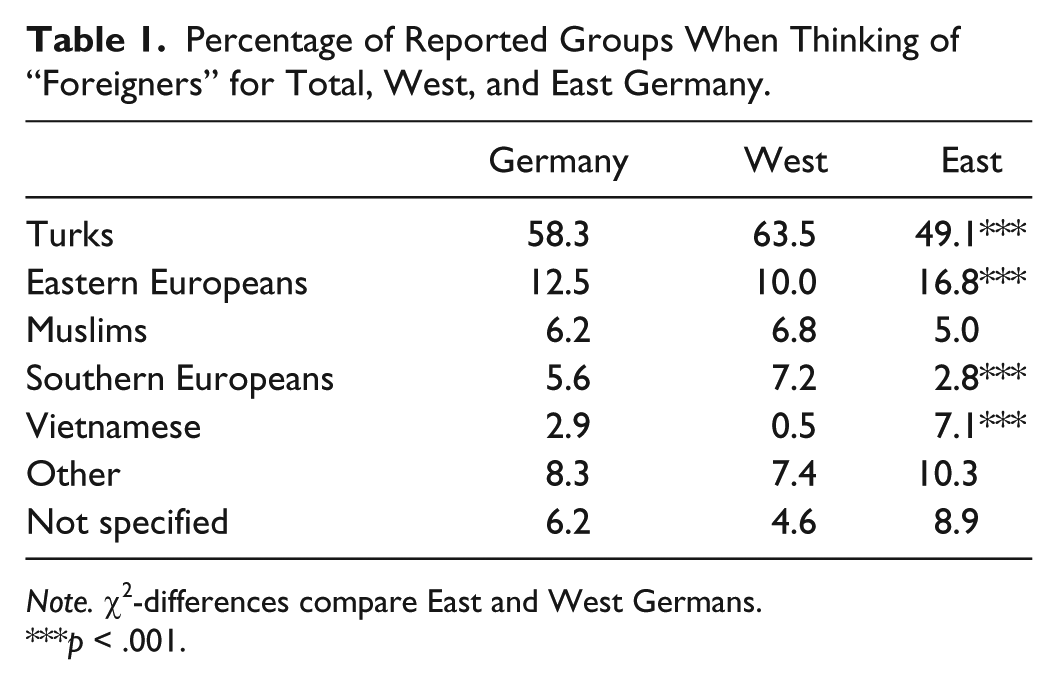
Note. χ2-differences compare East and West Germans.
p < .001.
As hypothesized, Table 1 also indicates differences between the associations connected with foreigners for people from East and West Germany: Even though people in both parts of Germany mostly thought of Turks as foreigners, West Germans (63.5%) did this more often than East Germans (49.1%), χ2(1) = 34.52, p < .001. In addition, West Germans thought of Southern Europeans more frequently (7.2% vs. 2.8%), χ2(1) = 14.65, p < .001, while East Germans thought of Eastern Europeans (16.8% vs. 10.0%), χ2(1) = 17.03, p < .001, and Vietnamese more often (7.1% vs. 0.5%), χ2(1) = 61.78, p < .001. These results mirror the differences in migration history between both parts of Germany. We found no differences regarding Muslims (West Germans: 6.8%, East Germans 5.0%), χ2(1) = 2.31, p = .13.
Next, we tested whether people in East Germany showed more prejudice toward foreigners than people in West Germany and whether this possible effect was due to differences in the specific content of the term foreigners. For sufficient subsample sizes, we differentiated between respondents associating Turks and respondents connecting one of the other main foreigners groups with foreigner (Eastern Europeans, Muslims, Southern Europeans, and Vietnamese). We conducted a 2 (representation: Turks vs. other groups) × 2 (origin of respondents: East vs. West Germany) ANOVA with both factors varying between participants and with prejudice toward foreigners as the dependent variable. In accord with our third hypothesis, we found a main effect for origin, F(1, 1503) = 36.12, p < .001. As expected, people in West Germany (M = 2.15, SE = .03) showed less prejudice than people in the East (M = 2.41, SE = .03). We also revealed a main effect for representation, F(1, 1503) = 9.74, p = .002, indicating that respondents showed more prejudice if their associations included Turks (M = 2.34, SE = .03) compared with other groups (M = 2.21, SE = .04). These main effects, however, were qualified by a significant interaction, F(1, 1503) = 6.75, p = .009. Subsequent analyses of the simple main effects revealed that East Germans who thought of Turks (M = 2.53, SE = .04) showed more prejudice than West Germans who had Turks in mind (M = 2.16, SE = .03), F(1, 1503) = 53.96, p < .001, Cohen’s d = .51, as shown in Figure 1. There was also a significant difference when West Germans (M = 2.14, SE = .05) and East Germans (M = 2.28, SE = .05) had other groups in mind, F(1, 1503) = 4.43, p = .04, d = .19. However, as the effect sizes show, the latter difference is very small compared with the medium effect (Cohen, 1988) for the representation of foreigners as Turks. This indicates that the difference in prejudice between East and West Germany is primarily due to the East German respondents who think of foreigners as Turks. If people have other groups in mind, there is only a small difference in prejudice between East and West Germany.

Estimated marginal means for prejudice toward foreigners for the representation of foreigners as Turks versus other groups (Eastern Europeans, Muslims, Southern Europeans, and Vietnamese) in East and West Germany.
Discussion
In the present article, we aimed at shedding some light on the heterogeneous category foreigners in quantitative survey research. Research often relies on operationalizations for prejudice that measure attitudes toward foreigners without any further specification of the group of foreigners (e.g., Bauer et al., 2000; Decker & Brähler, 2006; Fertig & Schmidt, 2011; Heitmeyer, 2009; Mau & Burkhardt, 2009; Pettigrew, 2009; Raijman et al., 2003; Zick et al., 2008). In the present study, we analyzed the content of the term foreigner for respondents in a German national probability sample and its relation to prejudice toward foreigners. In line with recent research by Braun et al. (2013), our results indicated that most Germans (nearly 60%) have Turks (the largest ethnic minority group) in mind when they think of foreigners. However, this proportion is larger in West Germany than in East Germany. In East Germany, more people think of foreigners from Eastern Europe and Vietnam than in West Germany. This variation reflects the differences in migration history between the Federal Republic of Germany and the German Democratic Republic until 1990 and the related differences in migrant population sizes and compositions.
In addition, we showed that prejudice toward foreigners varies with the content of the term foreigners: Respondents in our study were more prejudiced when they thought of Turks than when they thought of other groups. This reflects the perception of a hierarchy between ethnic groups (Hagendoorn, 1995), with Turks being perceived as a threat to cultural values and socio-economic status. Thus, the data go along with previous research (Braun et al., 2013; Dustmann & Preston, 2007; Snellman & Ekehammar, 2005; Verkuyten, Hagendoorn, & Masson, 1996) reporting more prejudice toward foreigners perceived as culturally dissimilar than toward more similar foreigners. However, this perception was mostly due to respondents in East Germany. In an exploratory fashion, we tested whether the well-documented finding that people in East Germany show more prejudice toward foreigners than people in West Germany (e.g., Decker & Brähler, 2006; Heitmeyer, 2009; Wagner et al., 2003) could be traced back to differences in the subjective meaning of the term foreigner. We showed that the difference of prejudice toward foreigners between West and East Germany was stronger when people had Turks in mind than when they thought of other groups.
Our findings provide several valuable insights for intergroup relations between migrants and the host country population as well as the perception of foreigners. In accordance with their actual number, people from Turkey are the prototype of foreigners in Germany. They also seem to constitute this prototype for people in East Germany, even though the mere size of the Turkish migrant population is substantially smaller than that in West Germany. We therefore assume that this disproportional prominence of Turks as prototypical foreigners in East Germany is the consequence of other factors than the presence of Turks in everyday life. One possible explanation is the public and published agenda concerning immigration, which is often connected to foreigners with a background in Turkey (cf. Anil, 2007).
Respondents from East Germany not only think of Turks as representatives of foreigners disproportionally often (compared with the small number of residents with a Turkish origin in East Germany), they also judge foreigners especially negatively when they think of Turks. This finding adds to previous explanations of the difference in prejudice between East and West Germany (e.g., Babka von Gostomski et al., 2007; Ewald, 1993). Media coverage of immigrants is mostly negative (Galliker, 1996; ter Wal et al., 2005) and might be one of the rare sources of information about this foreign group for people living in East Germany. In contrast, people in West Germany have frequent contact opportunities with Turks, due to the higher percentage of Turks living in West Germany (Wagner et al., 2003). Thus, West Germans can compensate any media-induced bias by intergroup contact (Pettigrew & Tropp, 2006, 2011). For the autochthonous East German population, this option seems to be restricted, so that these people are bleakly exposed to the negative public image of Turkish immigrants in Germany. This, of course, is post factum speculation, but it is in accordance with recent findings by Schlueter and Davidov (2013) that the impact of negative immigration-related news reports on perceived group threat is amplified in regions with a smaller immigrant group size.
Our results also provide arguments against the claim that foreigners are too heterogeneous to be used as a research category. The current image of foreigners is mostly shaped by the highly visible and publicly discussed group of Turkish immigrants. Other, less visible groups such as people from Austria, the Netherlands, or other Western countries were hardly mentioned and ostensibly not connected psychologically to the category foreigners. Moreover, the category foreigners seems to be flexible over time. For example, asylum seekers, a group that was highly visible in the German media in the early 1990s, were listed by very few respondents (less than 0.5%) only and consequently subsumed in the category other. Most likely, this might change in the future with increasing numbers of asylum seekers in Germany.
Proclaiming that it is primarily Turks that German respondents have in mind when being asked about their attitudes to foreigners in Germany does not imply that the high overlap between the two categories is inevitable. Societal and individual salience of specific immigrant groups varies with prevailing media coverage, such as reports about deaths of immigrants to Europe in the Mediterranean Sea or about supposedly increased numbers of immigrating Roma people to Germany. Nevertheless, it can be assumed that beyond such temporary variation, immigrants from Turkey are the prototype of subjective images of foreigners in Germany. This claim, however, needs further empirical data in form of replications of this study.
Another fruitful avenue for future research might be a closer look at the individual content of the cognitive representation of foreigners. Beyond the mere group people have in mind, this might give some further insight into the stereotype behind prejudice toward specific groups. For example, are Turks perceived as a stronger threat than Eastern Europeans? Are these groups perceived as low in status or as competitive? Which subjective stereotypes do respondents have in mind when associating a specific group with foreigners?
The Category Foreigners in Survey Research
Even though we analyzed data in a German national probability sample, we argue that our results are important for others countries as well. Various surveys ask for attitudes toward foreigners or immigrants without any further specification of the target group. To our knowledge, the present study is among the first to indicate that most people think of the most salient foreigners group when they express their attitudes by a comprehensive content analysis in a national probability sample (see also Braun et al., 2013). This is an important finding: Obviously, researchers do not have to specify the target outgroup any further if they are interested in attitudes toward the most prominent ethnic minority in a given country. This is a strong argument for the application of general foreigners—or immigrants-items in cross-cultural comparisons of attitudes toward immigrants (e.g., Gorodzeisky, 2011; Raijman et al., 2003; Scheepers et al., 2002; Zick et al., 2011). However, our data also indicate that researchers should be aware of the group their respondents might have in mind. There are individual differences in the associations connected with the term foreigner, which might vary systematically with regional differences. Therefore, researchers are well advised to carefully examine their population of interest and also apply cognitive interviews for their items. Cognitive interviews (Faulbaum, Prüfer, & Rexroth, 2009) provide information about respondents’ reception of the item and allow researchers to verify whether the respondents receive the item as intended. For example, Porst and Jers (2007) documented the development of new items for prejudice toward foreigners in the ALLBUS after the formerly used term guest worker was perceived as inappropriate during the beginning of the 1990s (see also Blank & Schwarzer, 1994). Such improvements of research instruments can only be made by extensive cognitive pretesting. Researchers planning survey studies should be aware of this and not simply rely on so-called “established” measures for their studies.
Footnotes
Declaration of Conflicting Interests
The author(s) declared no potential conflicts of interest with respect to the research, authorship, and/or publication of this article.
Funding
The author(s) disclosed receipt of the following financial support for the research, authorship, and/or publication of this article: This work was supported by grants from the Deutsche Forschungsgemeinschaft (GRK 884, Frank Asbrock, Gunnar Lemmer, Julia C. Becker), the Volkswagen Stiftung and the Freudenberg Stiftung (data collection; Wilhelm Heitmeyer, University of Bielefeld).