




Abstract
We conducted a survey of the winners of University of California (UC) Berkeley’s Library Prize for Undergraduate Research (2003-2016) to learn about the long-term impact of undergraduate research projects on students, find out what winners gained from the experience, and compare their careers post-graduation with other students. Seventy-four winners responded and reported increased academic engagement during their undergraduate experience, and demonstrated greater than average academic achievement post-graduation. The winners became more confident of their research skills and their aptitude for post-graduate work as a result of winning. More than 3 times as many prize winners went on to graduate school as the typical UC graduate. We also examined usage statistics of winning papers that had been posted to UC’s open access publishing platform and observed that papers continue to be accessed by the general public years after students graduate.
For many academic librarians, the most rewarding work with students is often during course-integrated library instruction or one-on-one reference sessions. Yet, librarians rarely see the finished research projects, or learn how students use the resources and concepts they have been introduced to by librarians. Library prize programs for undergraduate research provide librarians with unusual opportunities to see the finished products of student research. Berkeley’s Library Prize for Undergraduate Research, 1 launched in 2003, provides a treasury of information for the library—14 years’ worth of research projects, application essays, and recipients’ contact information. With this unique set of data, we embarked on a study of winners to learn about the long-term effects of undergraduate research at the highest level of performance, find out what they gained from the experience, and most delightfully, satisfy an intense curiosity about where those students are now.
Research Questions
This study has multiple goals. Our assumption was that winners of the Library Prize would be high achieving in other areas and our study sought to discover more information on those achievements, if any. For instance, we were curious about whether students who won the prize differed in some noteworthy ways from the “average” Berkeley student. And, we wanted to elicit their personal reflections on how formal recognition influenced them. We also wondered about their lives post-graduation. We wanted to learn what graduates would remember about the impact of library support on them as undergraduate researchers. Would they see any connection between the research skills they used as undergraduates and their later lives? Would there be any long-term learning we could identify?
Literature Review
The impact of awards on human behavior is studied primarily by psychologists and economists, focusing mainly on workplace recognition programs to motivate employees. In their article, “Awards: A View From Psychological Economics,” Frey and Neckermann summarize a number of psychological and sociological mechanisms by which awards influence human behavior. For one thing, winning an award effects the self-esteem of recipients, making them feel good about themselves irrespective of monetary or status consequences; although awards have an impact without others knowing about it, the social prestige and recognition from peers do have a benefit beyond increased self-esteem; approval from the award-granting organization is generally valued by the applicant; awards are often set up as contests, and many people enjoy competing; monetary compensation or other material or immaterial benefits have obvious benefits; and, awards can induce loyalty to the award-granting organization.
Awards also have an impact on others in the organization. By creating and establishing role models, they communicate information about successful and desirable behaviors. For nonwinners, however, there is the potential for disappointment and even decreased performance effort (Frey & Neckermann, 2008).
The field of education is concerned primarily with academic awards as incentives for disadvantaged or low-achieving students. However, an article on the impact of earning dean’s list on undergraduates (Seaver, 1973) asserted the reinforcing effect of public recognition on successful students. “Students who received dean’s list recognition earned significantly more grade points and higher grade point average in subsequent terms than expected by extrapolation from the performance of non-dean’s-list students.” In researching the benefits associated with a university-issued student leadership award, Adams found that “award winners benefited more intrinsically than extrinsically from winning the award,” but that the effects fade over time (Adams, 2012).
Also of interest is the literature exploring the impact of undergraduate research assignments on academic engagement and success. Douglass and Zhao conducted a study of the “culture of undergraduate research” promoted in American universities and colleges after the 1998 Boyer Report. They discovered a strong correlation between research engagement and self-reported learning gains. In particular, participating in a research course was more effective for undergraduates than serving as a faculty research assistant in terms of positive learning outcomes and “enhanced satisfaction with educational experience” (Douglass & Zhao, 2013). An earlier survey of undergraduates who participated in undergraduate research (Hathaway, Nagda, & Gregerman, 2002) found that those who participated in research were much more likely to pursue graduate school.
In 2010, the Association of College and Research Libraries (ACRL) created the Value of Academic Libraries initiative with the aim of helping librarians, library administrators, and provosts “identify resources to support them in demonstrating the value of academic libraries in clear, measurable ways” (Oakleaf, 2010, p. 8). Oakleaf’s comprehensive report provides many recommendations including the need to study the link between library outcomes and institutional outcomes in the areas of student success, achievement, and learning.
Indeed, many librarians believe that library services such as reference and information literacy programs benefit student learning and, in studying that link, libraries must ask themselves how these services have made a difference to the students and their institution. ACRL recently conducted a 3-year study called Assessment in Action that demonstrates “compelling assessment findings that tell a strong story about the multiple ways that academic libraries are contributing to student learning and success” (Brown & Malenfant, 2017, p. 1). In a study of the impact of library usage on undergraduates, Soria et al. found “statistically significant differences in cumulative GPA between first year students who used at least one library service compared with students who did not use any library services” (p. 154). They also discovered that specific types of library research were correlated with increased grade point average [GPA], including “using the library workstations (indicating physical presence in the libraries), accessing online databases, accessing electronic journals, and checking out books” (Soria, Fransen, & Nackerud, 2013, p. 160). A paper on the relationship between an institution’s academic library resources and services and undergraduates’ learning outcomes found that students who wrote more term papers “reported greater gains in critical thinking” (Whitmire, 2002, p. 121). The literature suggests that very few, if any, large-scale assessments of information literacy programs have been undertaken in academic libraries (Oakleaf, 2011) with most assessment programs being of the “micro-level” variety (Streatfield & Markless, 2008).
Method
Survey
Perhaps one of the main reasons to engage in this study in the first place was the existence of a discrete list of Library Prize winners. 2 Since the prize was established in 2003, there have been 120 winners. By searching the University of California (UC), Berkeley, alumni database and LinkedIn, along with some general Internet sleuthing, we located email addresses for 100 past winners. We emailed a link to a Google form (see the appendix, Survey 1) with an initial set of survey questions to those addresses. The response rate of 74 was impressively high, especially considering that many of the people on the contact list had graduated as many as 14 years earlier. One possible explanation for this high response rate, we speculated, was loyalty and goodwill engendered from having won the prize. This speculation is supported by Frey and Neckerman who described awards as, among other things, inducing loyalty to the award-granting organizations (Frey & Neckermann, 2008). To get more detailed information, the initial survey asked respondents whether they would be willing to be contacted with follow-up questions. Forty-one responded to a second survey (see the appendix, Survey 2).
Methodological Issues
This article uses statistics provided by UC along with information collected in our surveys, to compare winners with other UC students. The information available from the university is not exactly comparable, with respect to the years available and questions asked, but it is useful to give some notion of the “typical” UC student. Responses to the open-ended questions were coded to draw out common themes and patterns. The survey methodology used is descriptive rather than theoretical. We are cautious of seeming to suggest causal relationships between winning the Library Prize and any future or past experiences of the winners. However, when winners themselves suggested a connection, we are comfortable mentioning it.
Who Responded to the Survey
We sent messages to 100 individuals and received 74 responses: 58 won in the upper division category and 14 in the lower division category. This ratio slightly overrepresents the proportion of upper division to lower division prizes awarded (3:1).
Berkeley’s winning projects are skewed toward the social sciences, with fewer winners coming from the arts and humanities, and still fewer from the science, technology, engineering, and mathematics (STEM) fields. A total of 39 undergraduate majors were represented (24 students had a double major). Respondents’ majors mirrored that distribution: 53% majored in the social sciences, 34% in a humanities field, and 13% in a STEM field (see Figure 1). (Although some respondents did, in fact, major in an STEM field, their prize-winning paper may actually have been written in a non-STEM class.) This is not surprising, as the prize criteria tends to favor those who have written long, research-based papers that are more commonly expected in the humanities and social sciences. The department of history alone accounted for 32% of the winning papers, but only between 1% and 2% of undergraduates during the years since 2003.

Shows the academic major of survey respondents.
A follow-up survey collected additional demographic information, unfortunately, reaching a subset of just 41 students. Six of them were transfer students (14%); eight were first-generation college students (19%). These percentages approximate the number of transfer students and first-generation college students in the general Berkeley undergraduate population (Office of Planning & Analysis, Office of the Chief Financial Officer, 2015).
Other Awards and Honors Won
The winners of the Library Prize are a prize-winning group, who generally earned multiple other honors and awards during their Berkeley careers (see Figure 2). Berkeley offers three levels of honors degrees, comparable with cum laude, magna cum laude, and summa cum laude: distinction (3.724 GPA), high distinction (3.844 GPA), and highest distinction (3.944 GPA). In addition, each major offers honors, high honors, or highest honors, based on GPA for classes within the major, and/or completion of an honors thesis.

Awards and multiple other honors received by library prize winners.
More than 60% of winners graduated with departmental honors, and more than a quarter earned a degree with distinction. More than one third earned a citation or prize within one or more departments, often based on a specific project, and 16% earned a campus-level prize or award, such as a competitive merit-based fellowship or scholarship. And, these students outperform their peers at other research universities as well. More than a quarter of prize winners were invited to join Phi Beta Kappa, almost 3 times as many as the “normal” percentage of expected invitees. (The Phi Beta Kappa website claims that only about 10% of arts and sciences graduates from participating universities are invited to join.)
Results
Meeting With a Librarian
Most prize winners met with a librarian while attending Berkeley (see Figure 3). This is more significant than one might suppose, because Berkeley does not offer a first-year experience class, or require all students to have a library orientation at any time during their academic careers. A likely reason for the large percentage of librarian meetings among winners is that library liaisons often arrange in-class instruction for thesis classes, which may be where these winners met librarians. Also, during these in-class instruction sessions, librarians very likely promoted the Prize as part of ongoing outreach efforts. The fact that 10 of the winners never met with a librarian also demonstrates the initiative shown by the others (providing support for the impression that prize winners as a group represent the most outstanding students overall).
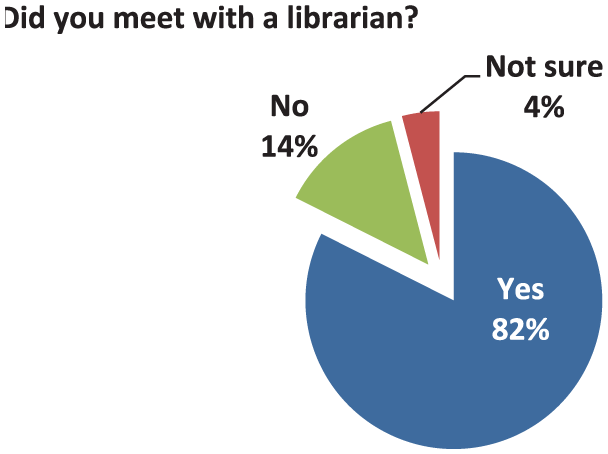
Illustrates that most prize winners met with a librarian while attending Berkeley.
In the follow-up survey, respondents answered more questions about the help they may or may not have received from librarians during their research experience and whether their library experience was positive or negative. Most respondents (85%) had a positive experience and, even several years after the completion of their projects, were able to call out the names of individual librarians who assisted them. With more than 27,000 undergraduates (Office of Planning & Analysis, Office of the Chief Financial Officer, 2015), UC Berkeley is a large campus in which students can often get lost in the bureaucracy, so it was of particular interest how the library experience compared with other campus departments. Many responses were of an emotional nature and commented on the librarians’ “support and enthusiasm” and how meeting with a librarian “gave me a lot of confidence.” One respondent, in particular, described the librarians as “kind, generous and patient,” further observing that the “library assistance differed dramatically from the kind of assistance that I received from other campus departments.” Another described the librarians as “very helpful and supportive—certainly more than other Cal departments.”
Ability to Evaluate Sources
The responses to this question were particularly gratifying, with former students citing many valid ways of evaluating the quality of information from a variety of sources. They appear to have successfully transitioned away from a simple reliance on peer review as an indicator of reliability to a more sophisticated understanding of the role of argument, source/context, and corroboration in evaluating information (see Figure 4). Several remarked on the importance of evaluation of sources as one of the outcomes of a good undergraduate education.

Lists some of the criteria, as described by respondents, for evaluating sources.
I consider the context of production (where/when/why it was made/compiled), who the intended audience was, references or citations in the “text,” and whether or not this information conflicts with or corroborates other information I have encountered. . . . I always ask where the information comes from, who is presenting it, why they are presenting it, and how they are presenting it. I’m pretty convinced that one of the principal aims—if not THE principle aim—of a liberal education is to teach people to ask these questions. the factors i learned through my training as a historian! the author, context in which the information was produced and the audience it was produced for, its intended purpose, its form.
Impact of Winning the Prize as a Lower Division Student
Previous research claimed that “Those students who do undertake original research during the initial years of college feel more comfortable with it later on and are likely able to achieve more sophisticated results” (Jones, 2009, p. 341). When respondents who had won the prize as a lower division student were asked whether winning had any impact on their undergraduate experience, most claimed it did. They frequently mentioned gaining self-confidence as a scholar and student, followed closely by increased academic engagement. In some cases, winning helped a student choose a major (for more, see Figure 5).
The award gave me the confidence to pursue other competitive projects, including the Haas Scholars Program. The honor of winning the library prize showed me early on that I had the abilities necessary to write rigorous, academic articles . . . Winning the Library Prize encouraged me to pursue other research opportunities as an undergraduate student . . . After curating an exhibit in Doe Library for my paper, I made connections with members of the Tule Lake Committee, an organization dedicated to preservation of and education around the Tule Lake Segregation Center, and will be meeting with members of the Committee and other young women researchers doing work on Japanese-American incarceration during WWII later this fall. I am also in the process of planning a presentation/film screening with one of the committee members and [a librarian from the] Ethnic Studies Library.
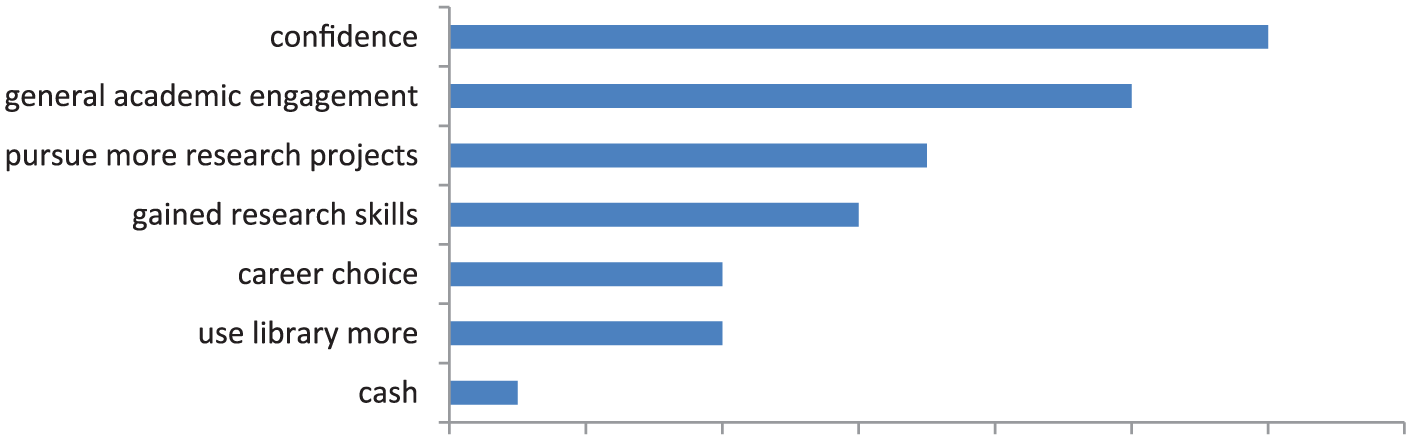
Lists ways that winning the prize as a lower division student had an impact on the undergraduate experience.
Some students mentioned that winning the prize made them use the library more than in the past. No doubt, learning to do the research for their papers made using the library more comfortable for them. “It made me excited about research and using the library . . .” As one student commented, “I learned how to use the library system, which opened up an entirely new world for me at Cal.” Lower division winners represent a small subset (22 students) of the whole group, because no more than two lower division prizes are awarded each year, so the response is most interesting as qualitative data.
Post-Graduation Impact of Prize Winning
Some of the same themes mentioned in the question about the impact of prize winning on the undergraduate years showed up in the post graduation question (see Figure 6). It may be a stretch to make a direct link between winning the prize and future success, but the increased confidence that results from external validation of one’s work was reported by several respondents.
As an undergraduate, Berkeley can feel deeply impersonal. It’s a bit like working in a vacuum; It’s hard to know if you are on the right track. Winning the library prize helped me establish connections and gave me the confidence to apply to competitive PhD programs upon graduation. I’m not sure I had ever received that level of recognition for something I had written, so it gave me great confidence to continue.

Lists the impact of prize wining post-graduation.
Clearly, even high-achieving students at a competitive research university such as Berkeley need encouragement that their work is excellent.
Many mentioned using their research skills in subsequent work or academic ventures.
It had a big impact for me. I went on to do a PhD in Spanish literature and continued to work with manuscripts. I was approached to present the work at a conference and to assist with a book adjacent to the topic of my paper. I also used excerpts of the paper in applications to graduate school. I felt that the tools that I had learned at Berkeley had real-world application and brought the research skills to bear in my work.
Although the possibility of a cash prize (US$1,000 for upper division winners and US$750 for lower division winners) may be a motivating factor for students to apply for the Prize, cash was rarely cited by the respondents as having a memorable impact. Only two respondents specifically commented on the prize money, with one stating that “I really appreciated the financial component of the prize,” a third respondent, regrettably, observed that the cash prize actually caused them to exceed their financial aid eligibility and, thus, generated a bill for them to pay.
Advanced Degrees or Professional Education
As a group of high-achieving students recognized for their academic success, it was not surprising to learn that of the 74, 60 (81%) have pursued a graduate or professional education (see Figure 7). Of those who answered “no” to the question, some were still, at the time of the survey, undergraduates or in the process of applying to graduate schools. By far, the largest percentage (45%) of respondents were pursuing or had completed a PhD, 33% were pursuing (or had completed) a terminal masters (MA or MPhil), with one respondent having completed three master’s degrees. Seven respondents had law degrees and others had a master of business administration (MBA) or other professional degree such as nursing or librarianship. This high level of graduate school enrollment is consistent with the findings of the 2010 Student Experience in the Research University (SERU) undergraduate survey, in which the authors noted that “student aspiration to go to graduate school seems to be connected to their research engagement patterns.” The experience of engaging in a research project, they go on to note, “leads students not only to gain various analytical skills but expands their knowledge of and interest in future endeavors” (Douglass & Zhao, 2013, p. 8). It is instructive to compare Library Prize winners with the larger UC population of graduates. Although 81% of those who responded to the survey pursued a graduate degree, according to the UC Accountability Report, “more than a quarter of bachelor’s degree recipients have enrolled in graduate or professional programs” 4 years post graduation (UC, Office of the President, 2015). Although there is a slight apples and oranges factor to this comparison, it is clear that Library Prize winners are much more likely to enroll in graduate programs than the average UC graduate. Although it was not a great surprise to see that prize winners had gone on to pursue more education, the numbers relative to the UC graduate population, in general, was quite unanticipated.

Eighty-one percent pursed advanced degrees (PhD, Masters, JD, MD, MBA, etc.) after graduation.
Where Are They Now?
Much of the original motivation for engaging in this study was curiosity about where prize winners ended up (See Figure 8). What we learned from the respondents was that half of them remained in education in one capacity or another, with the greatest number (38) currently in academia (PhD programs, post-docs, or research assistantships) or in the process of applying to a graduate program. It is noteworthy that those currently in graduate school often attend elite institutions. Among those mentioned in the responses were Stanford; Yale; Penn; Harvard; Northwestern; University of California, Los Angeles (UCLA); and UC, Berkeley. Of those who continue to work in higher education, two are professors. These professors will, no doubt, be joined by their fellow prize winners as they complete their PhDs and enter the academic job market. According to data compiled by UC’s Office of Institutional Research and Academic Planning, about 6% of UC graduates work in higher education. These data, however, do not provide a direct comparison with our survey results as UC examined a large set of graduates (with a wide range of years post-graduation) and, also look at all UC undergrads (UC, Office of the President, 2015). Nonetheless, it does appear that Library Prize winners are much more likely to end up in higher education than the average UC graduate. Outside of education, seven prize winners are currently in the legal field, working as district attorneys or clerking in the Court of Appeals, and medicine (physician, nurse practitioner, biotech researchers). In the private sector category, prize winners are currently working in fields as varied as architecture, publishing, and advertising. Two out of six of those in the “other” category are writing fiction or nonfiction—in both cases, delightfully, their writing is based on the topics of their prize-winning papers.

Lists responses to the question “What are you doing now? (professionally, educationally, or other).”
In response to the question about whether or not they continued to work in the area about which they wrote their paper, 33 out of the 74 respondents replied no. However, a couple of the “nos” expressed wistfulness and stated that “I wish I did” and “the desire to learn stayed with me.” That 44 respondents who continue—to some extent—to work in the area was heartwarming and demonstrates the lifelong impact of their undergraduate research experience in general and the Library Prize in particular. Some noteworthy responses to this question are as follows: My original paper focused on coalitional civil rights efforts in the UK. Today, I still work on and research coalition-based social movements in “developed” countries, but I focus on inter-community organizing for resources like clean/safe water, housing, jobs, and infrastructure. Since graduation I have been working on a biography with the research I collected as an undergraduate, and my book is now being published by an academic publisher (SUNY Press)!
Online Publication of Papers
As of 2010, winning papers have been posted on eScholarship, UC’s open access online publishing platform. Fifty-two papers have been posted as part of the Charlene Conrad Liebau Library Prize for Undergraduate Research series since that time. Although the first survey did not ask whether respondents had heard from any readers as a result of their paper being published online, the follow-up survey did. Six respondents indicated that they had been contacted, and shared some of the comments they received from readers: A U.S. State Department employee found my paper useful for policy purposes, and contacted me via email. They told me they loved my paper and applauded that I was writing on a topic that has not been written on much before. . . . a woman also researching the artist I wrote about contacted me for information on possible resources and books.
The eScholarship platform generates detailed usage reports with data that show Library Prize papers are, in fact, frequently accessed online. As of May 2017, the total number of online requests (defined as either online views or downloads) for Library Prize papers is a remarkable 21,808 with each paper averaging about 11 hits per month. Most requests came from general web searches (eScholarship is crawled by Google). Publishing the prize winner papers on eScholarship provides an enduring, digital record of the winners’ scholarship. That their papers continue to be accessed long after they graduate further affirms—both for the prize-winning author and the library—the potential far-reaching impact of this research.
The 10 most popular papers, based on the highest number of average hits per month online, are listed below, along with the year of publication and the total number of accesses:

Discussion
As librarians, we rarely engage with students after providing research support through classes or one-on-one reference assistance. Using an existing cache of information—a list of names representing 14 years of winners of this highly competitive prize—we were able to follow up and get a sense of the long-term impact of a successful undergraduate research experience. The survey, which was a micro level examination of a small set of students, albeit over the course of 14 years, demonstrated that undergraduate research engagement, as well as recognition for their effort, has a positive effect on a students’ self-confidence as scholars and academic engagement in general. External validation can make a difference in the short term (in terms of the cash award) and generate the confidence to continue in academia through graduate or professional school. Not surprisingly prize-winning students are high achieving in other academic areas as well.
Writing a major research paper can be a life-changing experience for undergraduates. Although the process of researching and writing is fraught with anxiety and doubt, successful completion compensates with high levels of satisfaction and pride. It may be one of the few academic experiences to remain fresh in students’ memory years after graduation. And, it may even direct the course of a student’s life and career after graduation.
Still, the question may be asked, why should an academic library offer research prizes? Our research demonstrates, through the high response rate to the survey and through the positive comments of winners, the enduring goodwill winners feel toward the library. Prize winners provide a rich source of information about a subset of alumni, and their experience with the library. Much more could be learned from the winners and other applicants about their library and research experiences, including deeper analysis of the research essays they submit with their prize applications.
Given the overall positive effect that undergraduate research can have on the success of a student, a library prize is an excellent way of recognizing and encouraging research engagement. A library prize program also reminds us about the value of the library’s mission and its effectiveness. As researchers at the University of Maryland, College Park, observed, a library prize program “increases the perceived value of library services . . . [and] promotes librarians’ expertise as educators and instructors” (Tchangalova & Cossard, 2015, p. 17). It demonstrates the library’s commitment to, and librarians’ essential role in enabling good scholarship. And, it brings together students, faculty, and campus partners to celebrate excellent student research. That is worth a lot.
Footnotes
Appendix
Declaration of Conflicting Interests
The author(s) declared no potential conflicts of interest with respect to the research, authorship, and/or publication of this article.
Funding
The author(s) received no financial support for the research, authorship, and/or publication of this article.
