




Abstract
The participatory model of management for natural resources, particularly water, rapidly became a global phenomenon in the early part of the 21st century. In many developing and transition countries, such as South Africa, expectations from it were disproportionately ambitious, despite little evidence that better results in the form of sustainable outcomes would follow. There is an urgent need for evaluations that assess what can and cannot be expected from participation. Empirically based processes and outcome-orientated evaluations are likely to prove more balanced, although they are challenging and thus rarely attempted. This article proposes an evaluative framework that allows for comparison, and differentiates between processes and participatory governance and sustainable outcomes. Four South African vignettes of participatory initiatives, operating at different scales with varying degrees of stakeholder heterogeneity, are measured against the framework, and broader lessons learnt about both participation and attempts to evaluate it.
By the close of the 20th century, the dominant top-down expert-driven management of natural resources was deemed to have failed. A new, conceptually attractive participatory model replaced it, promising better decisions and more sustainable outcomes. The participatory paradigm appeals to all political persuasions: left-wing radicals looking for grassroots empowerment, and right-wing neoliberals for ways of circumventing perceived ineffectual central governments (Mohan & Stokke, 2000). Ultimately, participation “means different things to different people” (Eversole, 2003, p. 782).
There are examples of successful participation in the literature (Abernethy & Sally, 2000; Chambers, 1997; Cook et al., 2013; D. A. Crook & Jones, 1999; Ostrom, 2005). However, they tend to operate at the local scale, with clearly defined and manageable goals—often with a focus on environmental protection or managing an irrigation scheme, and where the stakeholders are relatively homogeneous in terms of power relations and levels of education. They are also often in areas with resource abundance, for example, plenty of water (Cook et al., 2013). Thus, any lessons learnt may not be transferable to other contexts.
Despite this, participation was embraced with precipitate haste, scaled up and embedded into many developing countries’ national policies with massive transformatory and environmental protection expectations (Holmes & Scoones, 2000). One of the most ambitious applications was in newly democratic South Africa, with its challenging history, extreme heterogeneity, and relative water scarcity (Muller, 2009). There is scant evidence, however, that the participatory paradigm will deliver the ambitious goals of many heterogeneous developing countries in reasonable time frames, and they may not be transferable to contexts of scarcity.
The participatory model was embraced very much as an act of faith and “in opposition to previously dominant models of development” (Hickey & Mohan, 2004, p. 4). There is therefore a strong case to be made for evaluating participatory approaches, and what has been achieved vis-à-vis top-down non-participatory models, especially in view of the expenditure and expectation vested in it. The World Bank only acknowledged in 2005 a severe lack of research that evaluated its participatory programs (25% of its total portfolio; World Bank, 2005).
Conley and Moote (2003) suggest that evaluations of the right sort are urgently needed, but those that have been undertaken are largely unsatisfactory for a number of reasons: There are those produced by enthusiasts of participation (Beierle & Cayford, 2002; Innes & Booher, 1999), or conversely, by critics of the approach (Coglianese, 1999; Cooke & Kothari, 2001) to justify their position. The frameworks that these academics have used for their evaluations, and their measures of success, are radically different. There is not a uniformly agreed framework for undertaking evaluations, and moreover, evaluations may not be objective (Robson, 2002).
What is needed is a balanced and rigorous type of evaluation, useful across different scales and contexts and empirically grounded. To date, there is a dearth of evaluations that assess what can and cannot be expected from participatory approaches (Conley & Moote, 2003; Hickey & Mohan, 2004; Rowe & Frewer, 2000).
This article first proceeds with a review of the relevant literature on evaluations and then offers a framework devised for evaluating participatory initiatives. A series of four vignettes from the Inkomati region of north east South Africa are set out and assessed against the evaluative framework. Lessons learnt about the nature of participation and attempts to evaluate it conclude the article.
A Framework for Evaluating Participatory Processes and Outcomes
The purpose of an evaluation is to show whether a new initiative is working toward the stated goals of the program (Robson, 2002). Clarity over the objective is crucial: Without it, measuring success is compromised. Baseline data must be collected to gauge whether a program is having an impact; this is often something that has been neglected with the rolling out of participatory efforts (World Bank, 2005).
Of huge significance is the context in which a particular initiative is being undertaken: the scale, availability of the resource, economic status, and heterogeneity of stakeholders (Bellamy, McDonald, Syme, & Butterworth, 1999). Context is inextricably linked to the goals of many initiatives, for in the literature it is clear that in developed countries, the emphasis of participatory efforts in natural resource management tends to be conflict resolution and environmental protection (Cook et al., 2013), whereas in developing countries, social, economic, and environmental sustainability are sought, a far more ambitious undertaking (Muller, 2009). There are also important differences in the level of citizen control being advocated in developed and developing countries: In the former, it tends to be collaborative management, in the latter, participation is often coupled with devolution (the highest level of Arnstein, 1969 ladder). It is rarely, in evaluating participatory programs in developed and developing contexts, that like can be compared with like.
It is the business of evaluators to look at both the processes in setting up a participatory program and the outcomes that are the result. Processes need to be considered fair, open, inclusive, and accountable to engender support for the decisions and potential products and outcomes that stem from them (Parkins & Mitchell, 2005). It is also crucial that they are linked to real decision making and substantive changes on the ground, that is, sustainable development outcomes. Otherwise, interest in participatory processes may be lost, and they may be seen as a mere “talking shop” (Tewdwr-Jones & Allmendinger, 1998, p. 183). A major problem has been that evaluators tend to focus on either processes or outcomes, with a particular bias to the former (Conley & Moote, 2003). To understand this, it is necessary to look at the motivations for undertaking an evaluation and the perspective of evaluators. Deliberative democrats, heavily influenced by the Habermasian (1984) ideal speech, view participation and deliberative processes as an end in itself (Healey, 2003; Innes, 1996). This is largely at variance with the natural resource management literature (Bellamy, Walker, McDonald, & Syme, 2001; Blaikie, 2006). There has also been a trend for participatory evaluations, that is, asking participants what they thought of the process, often favored by those who value processes and deliberation (Carr & Halvorsen, 2001; Charnley & Engelbert, 2005). A second explanation is that focusing on processes is easier than outcomes: The indicators (discussed shortly) are relatively straightforward to assess, often more practical and certainly less tortuous. However, it is unsatisfactory to give undue weight to processes only—because it ignores whether improvements in livelihoods or the environment are being delivered. Focusing on outcomes only could mean that processes become a “black box” (Robson, 2002, p. 209)—studying the intervening processes may determine the variables that have affected the outcome and their causal links. There is therefore a strong case for an evaluative methodology that looks at both processes and outcomes of participatory initiatives: a “daunting task that is rarely undertaken” (Conley & Moote, 2003, p. 374).
Before moving on to the proposed process and outcomes evaluative framework, which in the second half of the article is applied to four participatory initiatives in South Africa, it is helpful to differentiate between processes, products of processes (interchangeable with outputs), and overall outcomes because these distinctions are not always clear in the literature. Figure 1 illustrates the stages based on South Africa’s plans to establish participatory Catchment Management Agencies (CMA) charged with the planning and management of water resources. Some clarification is required in the process and product category where the interpretation of success or failure may be challenged. An output may be “tangible,” such as a new representative institution (a CMA) or an agreement, or it may be “intangible,” such as enhanced social and intellectual capital and increased trust that may be difficult to measure (Bellamy et al., 2001; Charnley & Englebert, 2005). The tangible category conventionally is regarded as a success, but as Innes and Booher (1999), deliberative democrats, put it, “Conventional ideas . . . may lead one to see failure where there is success and vice versa” (p. 415). An agreement may lack durability, so is ultimately a failure; on the other hand, in the context of South Africa’s history, processes that work on capacity building may prove to be important to the long-term success and durability of participatory efforts. In sum, a lack of tangible products should not necessarily be viewed as failure. Another area of blurring of framework categories, again stemming from different academic backgrounds and perspectives, is where intangible process outputs and social sustainability outcomes become indistinguishable. Innes and Booher and Mog (2004) would categorize the former as social sustainability outcomes, whereas this author would argue that social sustainability is a reduction in inequalities. Thus, even deciding on what is a process and what is an outcome is not straightforward. It is argued that outcomes should be sub-divided into mid-term outcome—participatory governance—and the ultimate outcome—which is the result of this governance—sustainable management of the resource.

Evaluative framework differentiating between processes, products, and outcomes.
It is generally agreed that evaluative criteria—indicators against which to measure progress in an initiative—are of crucial importance (Conley & Moote, 2003; Fraser, Dougill, Mabee, Reed, & McAlpine, 2006; Robson, 2002). There is a vast and confusing body of literature that warns that too many indicators can become unwieldy (Bell & Morse, 2003; Kenny, 1999). All indicator lists are normative, but not all indicators themselves are subjective: for example, the number of members in an organization. Furthermore, what is deemed a success or failure is a value judgment and therefore subjective: thus, “developing truly objective means of evaluating collaborative efforts is impossible” (Conley & Moote, 2003, p. 382). Thus, it is important that evaluators declare their position and potential bias.
Process Evaluation
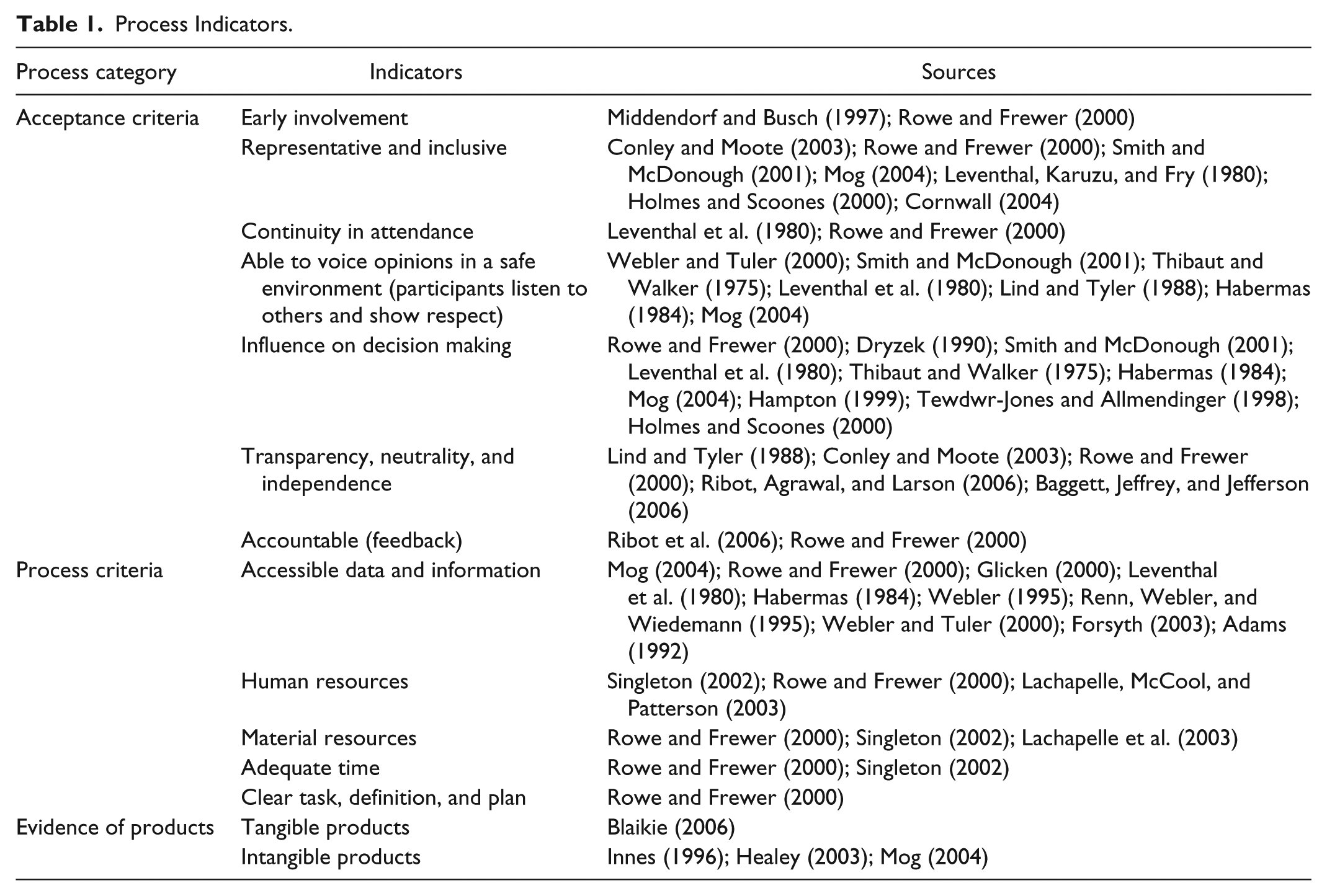
Three broad categories of process indicators are identified in Table 1. The first category of indicators is “acceptance criteria,” and is linked to the legitimacy and trust in the process (Lind & Tyler, 1988; Rowe & Frewer, 2000). The second category, “process criteria,” is related to more practical considerations. The final category of indicator is products: Did the process result in desired “tangible” and “intangible” products? These process indicators are fully explored and they are applied to the case studies presented in the fourth part of the article.
Process Indicators.
Participatory Governance Outcome Evaluation
This is a category that the literature tends to overlook but it is important and discrete, and proposed indicators are presented in Table 2.
Participatory Governance Outcome Indicators.

Sustainable Development Outcome Evaluation
What is the evidence that participatory and devolutionary processes have resulted in sustainable outcomes? There are no universally agreed on set of sustainability indicators, and although indicators have been developed (Fraser et al., 2006; Mog, 2004), they are for a specific purpose and context, frequently weighted toward environmental sustainability and are not applicable for the present study. This takes us back to the original three pillars of sustainability: economic, environmental, and social (Baker, 2006). Within each aspect, a choice of indicators is needed. Economic indicators could include a growing economy and gross domestic product (GDP) that is relatively straightforward to assess. Potential environmental sustainability indicators would include the maintenance and enhancement of ecological integrity, which would require adequate technical capacity to determine and measure. Social sustainability may be the most subjective criterion: This researcher argues strongly that redress and reduction in inequalities are important indicators, particularly given South Africa’s history of White minority rule. As Conley and Moote (2003) point out, documenting “outcomes is easiest when they are readily quantified, and where there is sufficient baseline information to allow reliable comparisons” (p. 379), which goes some way to justify Mog’s (2004) assessment of sustainability evaluations as being an “intellectual quagmire.”
Participatory Initiatives in South Africa: Four Vignettes
Democratic South Africa is regarded as being at the forefront of enshrining participation into laws and policies. For example, its 1998 National Water Act aims to radically transform the management of water through the establishment of participatory CMAs and at the sub-catchment scale through the transformation of White-dominated irrigation boards into more inclusive Water User Associations (WUA; Republic of South Africa, 1998). Participation of stakeholders is also now a legal requirement for all industrial proposals that require Environmental Impact Assessments (EIA) following the 1997 Environment Conservation Act (Republic of South Africa, 1997).
There now follow four vignettes of participatory initiatives drawn from the Inkomati Water Management Area: The first is the establishment of South Africa’s first CMA, the second looks at attempts to establish WUAs in the Inkomati, the third explores the creation of the deliberative Crocodile Forum, and the final vignette investigates public participation in the EIA for Sappi Kraft paper mill’s proposed expansion plans. The case studies exist at different scales: some are legal requirements, others are voluntary initiatives; they encompass different levels of heterogeneity of stakeholders, and they were each established for different purposes.
The water-stressed Inkomati (deficit of 12% of total requirement) constitutes three catchments, from north to south: Sabie/Sand, Crocodile, and the Komati, and includes portions of three different former Black homelands (see Figure 2). Covering an area of 28,383 km2 with an estimated population of 1.4 million in 1995, the dominant users are still White-controlled commercial agriculture (57% total requirement), followed by commercial forestry and industry (Department of Water Affairs [DWA], 2004).

Map of Inkomati water management area, South Africa.
Method
Much of the data for the case studies come from primary interview material generated from three visits to South Africa between November 2003 and March 2005. One hundred and one interviews were conducted with the main stakeholder groups both in the Inkomati and Pretoria, not all of whom were participants in the participatory processes. Interviewees were asked questions about their awareness of participatory initiatives, their involvement in these initiatives (if at all), and reflections on the processes. Meetings of the Crocodile Forum and CMA Advisory Committee were observed. Government reports and other studies were also consulted.
At this stage, it is important to declare that this researcher has a tendency to weight outcomes over processes: Are participatory efforts resulting in real changes on the ground, most notably in terms of redress for the rural Black population?
Vignette 1: Inkomati CMA
A zealous Mpumalanga regional DWA official initiated participatory efforts in July 1997 to develop CMA proposals in what is now the Inkomati Water Management Area prior to the finalization of the 1998 Act and before the Water Management Areas were determined—in 1999, by government-appointed consultants. There was difficulty in identifying and engaging Black interests, not traditionally organized around water, but eventually Black representatives joined already established steering committees. Meetings were held in English. There was a lack of continuity in attendance, and poor relaying of information to their communities was an obstacle throughout. A single Inkomati Reference Group emerged from the committees, whose final proposal for a CMA Governing Board, submitted in October 2000, was along geographical rather than sectoral lines, the result of exhaustive participatory endeavors. Lack of transparent water use figures by the agricultural sector hindered proceedings and clouded the implications of the proposal. In effect, the Governing Board could have been dominated by existing users, and DWA Pretoria officials recognized this. The proposal was put aside for 18 months pending efforts to garner stakeholder feedback. A period of inactivity followed during which the forums disintegrated and the regional champion relocated. This was also a period of growing tensions between DWA Pretoria and DWA Mpumalanga who did not maintain the forums, despite pressure from DWA Pretoria.
Fresh impetus came from impending elections in 2004 before which the Minister wanted one CMA in place, and this resulted in a rushed public relations (PR) exercise. In line with the Act, he appointed a committee to advice on the structure of the CMA Governing Board. Observation of an Advisory Committee meeting (March 2004) in a high-end hotel in Nelspruit emphasized knowledge asymmetries between Black and White attendees, and it was apparent that the DWA-hired facilitator was actually leading the committee to pre-determined recommendations. The original 2000 proposal was discarded and sectoral representation adopted, with a heavy slant toward Black interests. There were issues of participant continuity—some Black representatives were replaced in the afternoon session, and the late arrival of two highly vocal and educated White female NGO representatives caused some disruption (although they were supportive of the facilitator’s position). The Black nominal Chairman of the Advisory Committee conceded in March 2005 that he felt “uncomfortable” and “lost” during the process. At a later meeting, a 14-seat Governing Board was recommended, in effect sidelining commercial farmers, the single largest water user, and only granting forestry its own seat after lobbying the Minister. Unsurprisingly, commercial farmers were unhappy at the outcome and in protest were withholding payment on the Water Resource Management Charge on which the functioning on the CMA was to rest.
The formal launch of the CMA was in March 2004, to coincide with Water Week, but difficulty finding nominees for Historically Disadvantaged Groups held up proceedings until September 2005. Nominations were put up for each seat and the DWA Minister made the final choice of members. The differential education, skills, and experience of the Governing Board members was highlighted by Brown (2011).
The Governing Board of the CMA is only “nominally functional” (Merrey, 2011, p. 253), and this is one of the most advanced in South Africa. It is now focusing its efforts on a Catchment Management Strategy (Quinn, 2012). There was high turnover of Governing Board members, and the CEO position remained vacant for some time. The decision to designate the Inkomati as an area for Compulsory Licensing effectively removes the power to reallocate water away from the CMA to the center, thus stifling the potential to achieve redress through a devolved and participatory institution.
Following a review by DWA (2012) to reduce the number of Water Management Areas, and thus potential CMAs, from 19 to 9, DWA plans to enlarge the Inkomati to incorporate the adjacent the Mlhatuze-Usuthu Water Management Area. This may compromise the future manageability of the CMA in the interests of supposed efficiency.
Vignette 2: The Transformation of Irrigation Boards Into WUA
The irrigation boards in the Inkomati, developed by the White commercial farming sector in former White-only South Africa, are an example of sustainable participatory institutions managing water at the sub-catchment scale, although they were not racially representative. Members are homogeneous with a shared vision of managing the river, dam, or canal to their benefit. They also enjoyed a high level of autonomy, particularly in the lower Komati subcatchment, designated a Government Water Control Area, making membership of irrigation boards mandatory for all irrigators. The membership composition of the Komati and Lomati irrigation boards was by the mid-1990s unique because the Government Water Control Area was expanded to include Black small-scale farmers in the former homeland areas. These were the recipients of a sugarcane development program and were incorporated into the existing irrigation boards. Discussions with Komati irrigation board Black representatives in February 2004, whose travel expenses were paid for, suggested that they do not participate in discussions and were merely passive listeners. The attendance of Black representatives was thus not necessarily out of interest and could only be guaranteed if their expenses were paid.
The 1998 Act stipulated that all irrigation boards were to transform into more inclusive and representative WUAs within 6 months. The transformation proposals of all 27 irrigation boards were rejected by DWA on the grounds that they were not satisfied that the processes had been inclusive and participatory. Even the racially representative Komati and Lomati irrigation boards had their proposals rejected because they failed to incorporate non-farming interests. Local municipal representatives felt the proposal they were presented with a fait accompli, and they felt that they were given minimal time to consider it.
By 2005, only two WUAs had been established—one was the transformation of the Elands Valley irrigation board, and this was only on the fourth attempt in March 2005, after the Elands Valley irrigation board chairman (retired farmer) had invested considerable time and effort in consultation and ensured the proposal met the increasingly strict representation criteria for race and gender set by DWA. The other WUA (Upper Komati, north of Sawziland) was established in October 2004, in an area that never had irrigation boards. This was therefore a new institution. As with the Elands Valley irrigation board, its formation was the result of personal efforts by a retired and reform-orientated former White councilor. Again, he reported the frustration of meeting DWA representation criteria: “The goals kept shifting.” After 1,400 hours, and 20,000 km of travel out of his own finances, he was able to demonstrate to DWA a representative WUA committee. Establishing a WUA was no guarantee that it would function, and regional DWA officials reported in March 2005 that the fledgling Upper Komati WUA was already “struggling.”
Unhappy with their treatment and what they saw as unrealistic expectations of DWA for the composition of WUAs, many irrigation boards had drawn back from transforming, resulting in a standoff with DWA.
Vignette 3: Crocodile Catchment Forum
The Crocodile Forum constitutes an attempt to establish a multi-sectoral deliberative forum to promote collaborative management of the lower Crocodile catchment. This is the sort of endeavor encouraged by DWA Pretoria and it is in line with those who believed that forums developed to address locally important issues are likely to be more durable than those formed for a specific task whose raison d’être disappears when the project is completed.
Low levels of water entering the Kruger National Park (KNP) were adversely affecting wildlife in this ecologically important area, and relations between the KNP and commercial farmers, the main water user, had soured on ecological grounds over the halting of a proposed barrage across the river by the KNP. A new KNP Water Manager was appointed in September 2003, a Ghanaian PhD with participatory experience in another South African catchment. He took steps to reconcile opposing sides concerning the barrage and succeeded in easing long-standing tensions. Building on this progress, he took the initiative to establish a forum uniting local stakeholders: Transvaal Suiker Beperk (TSB) sugar miller and White commercial sugar farmers, tourist representatives, municipal officials, elected Black councilors, and tribal authorities (representing the rural Black population) were to discuss water management issues. These efforts were supported but not led by DWA regional officials (interviewed February 2005) who thought it a “good thing” that the initiative came from an affected party (KNP), giving it more legitimacy and credibility: “it is a people’s forum.”
The KNP Water Manager’s time and personal effort galvanized support, and the inaugural meeting in a high-end lodge on the February 3, 2004, saw good attendance but was unrepresentative racially, to the extent that a Representivity Task Group was set up to investigate the racial skews. A February 2005 meeting was attended by this researcher, at a four star resort, with 35 to 40 attendees, but no Black representatives were present due to local animosities between elected councilors and tribal authorities. It seemed that the farming and sugar sectors were present to keep abreast of water reforms, elicit information about the CMA process, and voice concerns in general.
The local private water company (Greater Nelspruit Utility Company [GNUC]) supported the initiative for a year, but by 2005 indicated it was a waste of time because “it has no teeth,” that is, it has no regulatory powers. It was clear that without the leadership of the KNP Water Manager, the forum would struggle. His efforts have been recognized as he was, in March 2013, appointed the Inkomati CMA CEO.
Vignette 4: Sappi Kraft Paper Mill, Ngodwana—Proposed Expansion and the Environmental Response
Two participatory initiatives can be identified in this case study: first, the Sappi Forest Liaison Forum that was established in 2000 and second, participation in the EIA, required by law (Republic of South Africa, 1997), concerning Sappi Kraft’s proposed expansion to its Ngodwana mill. The Sappi group—Sappi Forest is the supplier of raw materials for the mill’s operations—is a multi-national company and an important source of local employment.
The concerns of stakeholders now have to be factored into decision making, and the perceptions of local groups have assumed a much more important role. Under the 1997 Act, a full EIA can be avoided if the delegated authority—in this case, the provincial government’s Environment Department, to whom decision-making power has been entrusted—is satisfied that “sufficient information” was presented during the Scoping Phase of the EIA. This is what Sappi Kraft hoped for (Golder and Associates, 2003).
To this end, Sappi set up the Forestry Liaison Forum to try to dispel misconceptions about its environmental record and about the stream reduction impact of eucalyptus. Behind all this was the desire to pave the way for the impending EIA. This “public relations exercise,” as it was perceived by committed local environmentalists (interviewed March 2005), was instrumental in bringing together aggrieved, highly vocal “nature-loving” individuals and local conservancy groups and national NGOs—Geasphere, Environmental Action Link, and Wildlife and Environment Society of South Africa. An alliance was thus formed with professional environmental scientists who provided strong technical understanding and discredited Sappi’s environmental record. Nobel and Spoor of Nelspruit and the Legal Resources Centre, Pretoria, provided legal expertise.
The areas of discontent broadened from specific issues such as irrigating adjacent fields with chlorinated effluent from the mills’ activities and river and air contamination, to a more fundamental conflict over land use being played out over the extensive and growing use of alien plantation species (Golder and Associates, 2003). The well-organized, technically aware, and legally astute environmental lobby used the EIA process to convince the delegated authority (regional Environment Department) to demand a full EIA, which had considerable time and cost implications for Sappi (Golder and Associates, 2006a, 2006b). This can be seen as a victory for voluntary environmental groups over powerful industrial interests.
Central Government concern over the implications for the economy, however, led to new EIA regulations (announced in April 2005 by the National Department of Environmental Affairs and Tourism) and criticism of current public participation processes as lacking “proper guidance and often abused.” Compulsory time frames aimed to speed up the processes, reduce costs, and “facilitate out Accelerated and Shared Growth Initiative,” indicating that economic growth may take precedence over environmental concerns. This proved to be the case. The final decision in favor of the expansion was granted on February 22, 2008.
Application of the Evaluative Framework
This section now looks to evaluate the identified initiatives against indicators set out previously, as summarized in Figure 3.
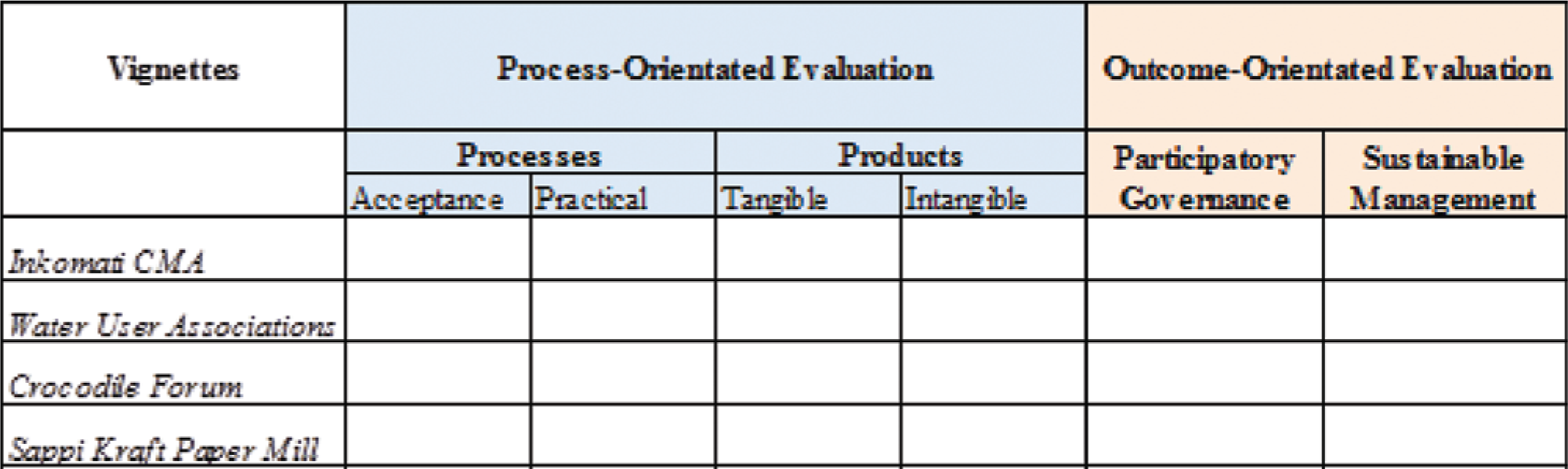
Summary of evaluative framework and South African vignettes.
Process-Orientated Evaluation
Acceptance criteria
Indicators under acceptance criteria (refer to Table 1) have to do with procedural trust (Webler, 1995) and are by their nature subjective.
Early involvement
The consensus is participants should be involved early on and in the creation of options—otherwise, they may be viewed as rubber stamping exercises and a form of manipulation in Arnstein’s (1969) ladder (Middendorf & Busch, 1997). This criterion is actually quite subjective: For example, participation can start too early, that is, before clarification over the scope of the initiative (Chakraborty & Stratton, 1993).
In the CMA case study, involvement was begun before the 1998 Act was passed or the boundaries of the Water Management Areas clarified: Participants initially assumed, mistakenly, that there would be three separate CMAs, one for each of the catchments. Overall, the CMA proposal process failed to engage representatives of all groups together at an early stage—which affects feelings of ownership and legitimacy. Black representation was an issue from the outset and it was found to be necessary to convene special homeland meetings in local languages before Black representatives could join already formed steering committees 6 months late. Already disadvantaged, they would feel handicapped vis-à-vis longer standing members. Late involvement does not automatically disadvantage: At the CMA Advisory Committee meeting, the White NGO latecomers were actually able to shape the direction of proceedings along with the facilitator.
All 27 Inkomati irrigation boards had their WUA proposals rejected on the grounds of inclusiveness. This meant widening their coverage that necessitated bringing in people at a later stage. Municipal representatives, for example, felt they were presented with a fait accompli so they were reluctant to engage.
In the case of the Crocodile Forum, extensive personal engagement with a range of stakeholders, including tribal authorities and Black councilors, still did not result in attendance and thus involvement of any kind. Invitations do not guarantee attendance: Local animosities, travel expenses, and intimidating venues are all factors that determine whether or not an invited person will in fact attend. With the Sappi Forest Forum, early engagement happened without recourse to special measures, as did the later EIA process.
Representative and inclusive
There are differences between deliberative democrats who emphasize “inclusiveness,” that is, everyone involved, and the natural resource management literature that stresses “representation” of users (Blaikie, 2006). Because everyone is a user of water, and given the scale of the Inkomati, representation was a practical solution to the CMA proposal process. However, in view of South Africa’s recent history, if significant groups are excluded, then the legitimacy of such a process is threatened.
In the CMA proposal process, as noted, Black representation was a problem and the DWA local champion encountered great difficulty in identifying and engaging groups outside recognizable organizations (easily contactable). Early involvement of all sectors was a challenge. An interpretation of DWA’s sidelining of the 2000 CMA proposal was that there could have been an Inkomati Governing Board that reinforced the dominance of existing users and was unrepresentative of the wider population.
The CMA Advisory Committee was inclusive and representative, both in terms of race and gender, but was engineered by DWA Pretoria. Black representation in the CMA process overall may have been greater than appeared because White NGOs and reform-orientated DWA officials upheld their interests. Without such intervention and representation, the interest of a large and poor rural population could be rendered silent. However, in the long term, it may perpetuate Black dependency.
The irrigation boards, failing representivity criteria of DWA for WUAs, had their proposals rejected and were asked to enlarge their area of remit to incorporate non-agricultural users. Consulted irrigation board representatives (six) felt the shared vision of their current members (for example, to manage a canal) that made them sustainable would become lost as a result, hence, the reluctance of many irrigation boards to engage with the process following their initial rejection by DWA. It took the Elands Valley irrigation board 7 years to finally achieve the level of representation that satisfied DWA. It is noteworthy that in the Komati and Lomati irrigation boards, the White commercial farmers represented themselves individually (about 80 on the Komati irrigation board) whereas the Black farmers sent irrigation scheme representatives and thus appeared a small presence at meetings, although in fact they outnumbered the commercial farmers 5 to 1. It has been suggested that Black representatives tended to be the elderly rather than the most dynamic, a reflection of a largely patriarchal system.
On the Crocodile Forum, despite the exertions of the KNP Water Manager, attendance was not racially representative but it would most likely increase with successful land claims in the area, as irrigated agriculture was at that time not practiced by the Black population in the lower Crocodile.
The Forestry Forum was open to the public, but the Sappi Environmental Manager thought the meetings were dominated by a “vocal minority” not representative of the wider Inkomati population. Similarly, the EIA Scoping Report exercise was disproportionately influenced by environmentalists. Evolving decision making to the local level and encouraging local representation may, as in this instance, give greater “voice” to minority positions.
Continuity in attendance
Ideally, the same representatives should attend meetings to maximize the process, sustain dialogue (Leventhal, Karuzu, & Fry, 1980), and avoid time-wasting recaps. Lack of continuity by Black representatives was an issue in the CMA proposal process, and observations of the CMA Advisory Committee illustrated how disruptive and patchy attendance proved to be with different attendees in the morning and afternoon. This erratic attendance affects the quality of later feedback and accountability.
With the Crocodile Forum, there was less onus to attend when the purpose was not decision making but learning and improved relations. Interest was beginning to wane among some attendees, which also may affect later continuity. The White commercial farmers, in a potentially tenuous position in new South Africa, felt the need to keep abreast of developments that may affect them, and thus regularly attended. Participation involves people’s time, and loss of earnings and travel expenses may affect willingness to attend. Paid officials are in a different position altogether, and for the relatively wealthy farmers, meetings may represent a social event.
Able to voice opinions in a safe environment
Although legitimacy for a process may be increased by the assurance of a respectful hearing (Smith & McDonough, 2001; Webler & Tuler, 2000), ground rules to prevent offensive statements or behavior can have a negative/tyrannical aspect (Kelly, 2004). The construction of a safe environment can hinder open and honest discussion, and multi-racial encounters may have a falseness about them, with a suppression of private views by both Black and White speakers, thus inadvertently frustrating a process of real change. The Komati irrigation board chairman (February 2004) made it clear that anyone could contribute to meetings, but those “seeking to derail processes would be excluded.”
People can be made uncomfortable by the choice of venue: High-end tourist lodges and hotels were used by the CMA Advisory Committee and Crocodile Forum meetings. Participants can be deterred from voicing opinions in larger meetings, the lingua franca (English) is often no one’s first language, and the very technical topics under discussion can overawe attendees. In the early stages of the CMA process, the DWA champion held meetings in local languages in the former homeland areas to encourage willingness to talk. Black attendees felt less comfortable on joining the larger “invited” CMA spaces. In the Sappi EIA Scoping Report, written submissions were encouraged, and this practice favors the highly educated. Clearly, voice is relational to place and context.
Influence on decision making
It is recognized that legitimacy is lessened for participatory processes not linked more directly to policy making, and participants can be made to feel they were used to give an appearance of participation if they do not contribute to decision making: “tokenism” in Arnstein’s (1969) ladder. Even Dryzek (1990), a deliberative democrat, recognizes that there has to be a link to decisions—without which they risk being labeled “talking shops.”
The White commercial farming sector took an active part in the CMA process and had some say in the 2000 proposal, although they felt “bulldozed” by the CMA champion, and were not totally happy with it. However, they had no impact in the direction the Advisory Committee followed nor in how it was set up. This was engineered and manipulated with a DWA appointed facilitator in control. It is suggested that DWA intervened to make the process more legitimate in the eyes of marginal groups, fearing that the commercial farmers had altogether too much influence at the local level. In view of the outcome of the CMA, many from the commercial farming sector felt that the whole process was delegitimized once they realized they, the largest water user, had only one seat, which may have colored their reflections on earlier processes.
Regarding the transformation of irrigation boards, DWA became increasingly prescriptive in adjusting representation requirements. The efforts and expense of the irrigation boards resulted in little influence on decisions—an exclusion acutely felt by those members who were expected to fund the WUAs’ and CMAs’ operations. The forestry sector felt similarly aggrieved as it struggled for a CMA seat despite paying water use charges and attending CMA proposal meetings.
The Crocodile Forum was never about decision making but was more about improved management through better understanding, but “having no teeth” resulted in loss of interest by the water service provider and Mbombela municipality. Similarly, the Forestry Liaison Forum saw interest decline once the major issues had been covered. With the Sappi EIA, legislation guaranteed response to concerns, and influence on decision making at a local level was a strong motivator to environmental groups.
Transparency
Procedural trust is more likely if a process is transparent and independent of bias (Conley & Moote, 2003). The CMA process was initially transparent but became increasingly DWA Pretoria-led rather than user-led. The Advisory Committee was meant to be transparent, neutral, and independent, but this was not the case. The facilitator led discussions in a particular direction, DWA Pretoria officials undoubtedly influenced proceedings, and DWA regional officials later complained they were silenced. The process increasingly became a “closed” space without observers, and the final selection of the governing board members was made without wider stakeholder consultation. Overall, the CMA process lost legitimacy because of the way it was conducted in the later stages when it was the Minister who decided which nominee would be given a seat on the CMA Governing Board.
The Crocodile Forum initiative was supported by DWA Regional officials who believed it had greater neutrality if it was not DWA-led. However, because there was a likely bias toward KNP interests, there was some resentment from the Department of Agriculture and Mpumalanga Parks Board officials. There were no complaints from environmental groups about the transparency of Golder Associates EIA Scoping Report (consultants hired by Sappi Kraft).
Accountable
The CMA Advisory Committee was not accountable to Inkomati stakeholders, many of whom were unknowns. Their recommendations were presented as a fait accompli without consultation, and the committee disbanded after its recommendations and so could not be held accountable. Representation is unavoidable in large-scale initiatives such as the CMA, and success depends on two-way feedback: from the representative to community, and from the community back to the forums via their representative. Continuity of attendance is thus desirable. Feedback appears to be more of an issue with Black communities largely because of the scale of the Inkomati and access to the internet. Radio appears to have potential from the experiences of the Upper Komati WUA. It is unreasonable to expect representatives to take responsibility without adequate compensation for disseminating information and collecting feedback from a large and dispersed rural population.
Process criteria
An important practical consideration for participatory processes is access to a range of resources that facilitate progress, and these are less subjective than “acceptance” criteria.
Accessible data and information
Not only is access to information needed for discussion, it also needs to be meaningfully presented (Rowe & Frewer, 2000). There are issues in the case study area. Socio-economic data are collected at the provincial level, not co-terminous with the Inkomati Water Management Area, and are often out of date. In the Inkomati area, transparent and reliable water use data have always been a concern to Department Water Affairs. The irrigation boards are effective custodians of these data, and opacity has worked to their advantage and exacerbated knowledge asymmetries in the WUA transformation processes. This also hindered the CMA proposal process. The need to democratize data has led DWA to make available via its website the most up to date figures on water availability and use that it has accrued. However, the digital divide means that not all stakeholders are able to access this information, and even then they may not understand the often technical language it is presented in.
Referring to the CMA Advisory Committee, some Black members lacked awareness of even the most basic geography, and this had to be supplied in a rapid summary by the facilitator. This lack of knowledge slowed down the process for several months as it was realized that additional sessions would be required.
The Sappi Kraft case study indicated that when two “data-wise” groups are on opposing sides of a conflict, data and science can be used to prove contradictory arguments, for instance, the water consumption of eucalyptus.
Human resources
As the CMA was an institutionalized process, ongoing capacity constraints within DWA (both in caliber, number, and motivation) and staff turnover (often the most experienced White officials move into the private consultancy sector) interrupt the support function in the participatory processes. Following the reallocation of the CMA regional champion, support from the regional DWA office was not forthcoming, to the exasperation of DWA Pretoria. There was also concern that staff shortages at the Mpumalanga Environmental Department would slow down the Sappi EIA process.
Consultants were increasingly being used to undertake work for DWA, for example, the 1999 delineation of the Water Management Areas, to facilitate the Advisory Committee, to assist the CMA Governing Board in the drafting of a catchment management strategy, and in highly technical undertakings such as satellite verification of water use. Many of these processes were not participatory, which raises the issue of accountability and transparency.
Material resources
Visual aids are valuable for furthering understanding and were provided by the hotel venues used by the Crocodile Forum and the CMA Advisory Committee. This category needs to be broadened to include financial assistance with travel costs to attend meetings. The Komati irrigation board did provide travel expenses for Black attendees, as did the CMA proposal processes. There are mixed feelings over this: There is a wariness of encouraging “career representatives” who come merely to collect money, and the KNP Water Manager felt that pre-payment would not guarantee attendance and input to the Crocodile Forum.
Adequate time
Where previously disadvantaged people are involved, adequate time is needed to make informed and considered recommendations, and avoid the label of a fait accompli. The irrigation boards illustrate this: The 6-month time frame of the 1998 Act to transform was unrealistic, especially as ever wider inclusion was required. Nkomazi municipal representatives, included later in the Komati irrigation board proposal process, understandably complained they were not given enough time to consider the WUA proposal. The CMA proposal was the result of numerous meetings from July 1997 to September 2000. In contrast, the CMA Advisory Committee was hastily convened and became a scramble to meet a political deadline: a CMA to be in place before the 2004 election.
Without consultation, decisions can be swift—for example, the 19 Water Management Areas were delineated in a month in 1999. Deliberative processes can by their nature be protracted, but the government recognized there was potential for abuse that may harm the economy, as in the Sappi EIA delays. This is behind the drive to speed up the EIA processes.
Clear task and definition
There needs to be awareness of the purpose and plan of an initiative; otherwise, expectations may be unduly raised, time invested is wasted, and ultimately, there is a loss of interest. Once the Water Management Area was delineated, the CMA proposal process had clarity. The Sappi EIA and the CMA Advisory Committee had a distinct purpose. However, once the raison d’être disappears, for example, when the CMA Reference Group had submitted its proposal, the pattern is that members disengage. The scope of the irrigation board transformation process was less clear, and irrigation board representatives complained of lack of clarity from DWA Pretoria.
Products of participation
“Tangible” or “intangible” products should not be viewed as an end goal of participation, but as important components for Participatory Governance—itself a mid-term outcome of participatory processes.
Tangible products
The 2000 Inkomati CMA proposal is an example of a “tangible” product, the result of a participatory process. The CMA that was nominally launched in March 2004 and the Governing Board approved in September 2005 constitute a new representative organization, but it was the work of the DWA-engineered representative Advisory Committee: It did not build on the original participatory CMA proposal process. The Sappi EIA process resulted in the production of a Scoping Report that is in the public domain. All 27 irrigation boards produced a WUA proposal—a product—and all were rejected. It took the Elands Valley irrigation board 7 years and four attempts to get a proposal accepted.
Intangible products
It is important to stress that for some participatory initiatives, their objectives lie in the realm of intangible products. Improved relations and learning were the goals of the Crocodile and Forestry Liaison Forums. Through the Crocodile Forum, the KNP Water Manager succeeded in changing the perceptions of commercial farmers about the KNP, hitherto seen as obstructive. Attendees were already well informed, but co-operation and understanding resulted. The forum was not successful in engaging Black representatives. The Forestry Liaison Forum did not achieve improved relations with environmentalists; rather, it strengthened opposition resulting in a coordinated assault on the Sappi Kraft expansion plan.
In the context of South Africa, any bringing together of previously segregated groups is to be applauded. The CMA proposal process did bring Black representation to the steering committees after separate homeland preparatory meetings had taken place. At these meetings, breakaway smaller group discussions were more successful in building social trust than larger meetings.
Regarding irrigation boards, only the Elands Valley irrigation board chairman made a determined effort to engage with outside groups, not the irrigation board as a whole. Although the Upper Komati WUA proposal was accepted, its formation did not physically unite Black and White farmers. Rather, the champion met with the different groups in their own areas. The Black communities did speak but in their own language, and on their own ground. The White farmers, who were not previously organized into irrigation boards, came together, and that can be seen as progress. Other irrigation boards have made no progress with improving relations and have even antagonized municipalities, as was the case with the Lomati and Komati irrigation boards in the lower Komati.
The Black representatives who attended the Komati and Lomati meetings have learnt something of the CMA process and some management issues, especially as the Komati irrigation board chairman ensured meetings were held in English and Siswati, and extra time was made available for educational purposes. However, relations between the racial groups in times of water stress became strained and participation has not created trust.
Processes, techniques, and their products/outputs are important. However, for many evaluators, this is where the evaluative effort draws to an end, and many of the intangible products touched on above are presented as evidence of sustainable outcomes. However, they are not, and the objective of this evaluation is to look whether, through participatory governance, substantive sustainable outcomes in terms of conditions on the ground are being delivered in the Inkomati.
Participatory Governance Outcome Evaluation
There are organs of participatory governance in place in the Inkomati—the CMA and two WUAs—although whether they are the product of participatory processes is a moot point. The indicators from Table 2 are now applied to the vignettes.
Representatives are active in discussions and make substantive and meaningful contributions
Deliberation lies at the heart of the participatory paradigm, and ability to contribute is linked to capacity and social capital. Representation at meetings or organizations can be engineered, but mere presence does not guarantee substantive and meaningful contributions, that is, active participation (Wilson & Perret, 2010).
The CMA Governing Board was heavily weighted toward Black and environmental interests, which affects voting, but it cannot guarantee that there will be substantive inputs into how water in the Inkomati should be managed. The difference in education and experience of water management between the commercial farming representative and other members on the Inkomati Governing Board is evident from CVs of members, summarized in Brown (2011).
Discussions in March 2007 with a U.K. Environment Agency manager, who was leading a capacity-building project with the Inkomati CMA Board, suggested that the Board was still in its infancy, and that capacity had to be built first. It can be inferred from this that the Board was still some way off planning and managing the water resources together. Reports indicate that by 2011, it was only nominally operational and was focusing on developing its management strategy with the aid of consultants.
Turning to the two established WUAs, the DWA Mpumalanga Deputy Director for Water Resource Management, suggested (March 2005) that the establishment of WUAs was the easy part, and it is now that the “work starts.” This seems to mirror the CMA—that once established they take considerable time to become fully operational. Experience from the Upper Komati WUA proposal process indicated that Black attendees at proposal meetings were active, but these were held in former homeland areas and in Siswati. How active will Black representatives be in meetings held in English at venues likely to be outside their locale? Observations of the multi-racial CMA Advisory Committee indicated that contributions from the Black representatives, even the chairman, were minimal and even then only at the direct prompting of the facilitator, and they appeared to just accede to the facilitator. There were substantive contributions from resourced stakeholders in both the Sappi Kraft case study and the Crocodile Catchment Forum; however, the goal of the latter was improved relations, and the initiatives were not racially representative.
Discussion and negotiation leads to consensus over planning and managing of resources
To plan and manage the resource, there is a need through negotiation (which may oscillate between conflict and consensus) to reach a level of agreement over possible options, and in a water-stressed area, such as the Inkomati, this will inevitably involve some concessions. The CMA is still in its infancy, so it is not possible to know today what kind of negotiations are taking place. However, it could be a matter for concern that it is based on sectoral representation, which can “entrench difference and hinder cooperation” (Tewdwr-Jones & Allmendinger, 1998), so making concessions may be seen as failing one’s constituents.
Habermasian’s (1984) ideas that consensus will ultimately result from negotiations may not bear out in reality: It depends on the range of stakeholders involved. For example, the Komati irrigation board meetings are more a case of Black representatives ceding to commercial farmers because of technical complexity. Similarly, with the CMA Advisory Committee. Forsyth (2003) suggests “it seems reasonable to expect that different social groupings have different environmental perceptions and framings” (p. 83). Stakeholders may hold diametrically opposing views on man–nature relations and how the environment should be managed: from an instrumental view on nature, often associated with industrialists, to an eco-centric environmentalist perspective. Thus, with two equally resourced sets of stakeholders, with radically different views of nature, consensus may never result from discussions because they share little common ground. The Sappi Kraft case study exemplifies this. It is not an example of participatory governance but is an out-and-out conflict between industrialists trying to contain the EIA process and the counter-containing efforts of the environmentalists (Few, 2001).
The new representative organizations have the power to implement changes, and changes are made
What is of interest is the kinds of powers these new representative institutions have at their disposal to effect outcomes. Without powers, participatory spaces are in danger of being seen as “talking shops” and lack legitimacy (Tewdwr-Jones & Allmendinger, 1998).
The reallocation of water-use licenses is one of the most important powers and functions of a CMA. The Inkomati was designated a compulsory licensing zone because it is so water stressed. This once-only responsibility has been ceded to DWA Pretoria because the CMA is still in its infancy: Thus, the most important power and tool for redress has been lost to the CMA.
The irrigation boards have actually enjoyed a high level of power in the day-to-day management of water at the micro level. Ironically, the 1998 Act is taking power away from the local level and vesting it at the Water Management Area level with the CMA. Of concern also was the ambiguous voluntary status of WUAs that may contravene one of Ostrom’s (1990) “design principles” for sustainable institutions: If the membership of institutions is not clearly defined or bounded, it is very difficult to impose sanctions.
Accountable
Representative organizations need to be held accountable to their constituents (Agrawal & Ribot, 1999). The CMA Governing Board was not directly elected, but the Minister made the selections from nominations. They may therefore feel more accountable to government than the sector they represent. The desirable downward accountability is likely to pose problems for the Potential Agricultural Water Use representative on the CMA Governing Board, because their constituents are not yet water users, and thus not organized around water nor are they members of WUAs. Accountability needs to be linked to practical considerations. When the potential users may come from a distant part of the catchment, several hours’ travel away and speak a different African language, how is it practical to hold “surgeries?” These arrangements rely on the assumption that there is one Black population.
Sustainable Development Outcome Evaluation
Referring back to Figure 1, the CMA and WUA case studies indicate that progress has stalled at the stage of establishing representative organizations (products). These have taken a long time to establish, and even now, the CMA has no real powers to effect redress and achieve social sustainability. Thus, it is not possible to assess whether participatory initiatives will result in more sustainable outcomes. However, this should not deter attempts to put in place a framework for evaluation for a time when there are discernible changes.
The ultimate goal of the participatory initiative embodied in the 1998 Act was redress, and environmental protection as well as economic growth, so it seems reasonable to use these three pillars of sustainability as a framework against which to measure achievement. All three are needed for balanced development (Baker, 2006). However, when the resource is in short supply, as it is in the Inkomati, and all three aspects of sustainability can make legitimate demands on it, tensions are inevitable. Redress in the Inkomati may only be achieved if water is reallocated away from the (relatively) efficient commercial farming sector. In this context, the price of social sustainability could be the upset of economic sustainability and goes some way to explain the prevarication of the government over redistribution. Similarly, the economy may suffer if the vocal environmentalists are allowed to derail industrial expansion. What these instances suggest is that there is a tendency in the South Africa Government to put economic sustainability first, which may ultimately reinforce inequalities in this already highly inequitable country.
Any evaluation of progress is seriously hampered by an absence of baseline data—an oversight we have noted with the rolling out of participatory programs. It might be useful in South Africa to work on this forthwith, so there are statistics available at the appropriate scale for when outcomes start to show. Too many indicators becomes unwieldy and impractical to collect and analyze (Bell & Morse, 1999), and given the human resources situation in South Africa, this also needs to be borne in mind.
Key Findings of the Evaluative Framework
The strength of the evaluative framework is that it allowed for careful and methodical analysis of four different participatory initiatives in South Africa and for general conclusions to be drawn. The framework assists in answering the following important question: If the rationale is that top-down models failed, what is the evidence that participatory efforts will result in more sustainable outcomes in South Africa? The framework also importantly clarifies the distinction between processes, products, and outcomes that has often become blurred in the literature, and thus allows researchers, practitioners, and decision makers to track progress toward the ultimate goal of the initiative.
Time emerges as an important factor from the vignettes presented. The CMA and WUA case studies illustrate how long it takes to establish representative organs of governance. Indeed, the analysis demonstrates that progress has stalled at the stage of establishing new representative institutions (the product of participatory processes). The rural Black population has yet to see any meaningful change, and it is unlikely the CMA will be in a position to effect redistribution in the near future. The CMA vignette suggests that decisions are more expedient when they are not participatory—for example, the original (1999) delineation of the 19 Water Management Areas by consultants. The argument is that they are not transparent, but neither was the supposedly participatory Inkomati Advisory Committee, as the CMA vignette demonstrated. The Sappi Kraft vignette also suggests that participatory efforts considerably slow down decision making, which could have an impact on the economy. Moreover, participatory efforts have the potential to give undue power to a vocal minority at the expense of the majority and are open to manipulation. In the case of the CMA vignette, the interventions by DWA Pretoria officials to stave off elite capture of the CMA process, the ceding of Black representatives to more vocal White participants in heterogeneous meetings, and the dependence on White NGO representation, all underline the need for a reduction in knowledge and power asymmetries before meaningful participation can take place. However, given the legacy of educational disparities and petty discrimination resulting from apartheid policies, this rebalancing may take one or two generations to accomplish. Is this realistic or even fair given South Africa’s history? Williams (2004) suggests we now need to ask ourselves “what longer term political value do participatory processes have for the poor?” (p. 568).
Leadership emerges from the analysis as being hugely important: Individuals with particular personal qualities are behind the CMA proposal process, the two approved WUA proposals, and the Crocodile Forum. It may not accord with notions of community action, but remove it, and initiatives flounder.
The need to evaluate both processes and outcomes is clear, but Conley and Moote (2003) are right that it is a “daunting task” (p. 374), and as one moves from processes toward outcomes, the difficulties intensify. The vignettes also demonstrate the real difficulty of measuring the outcomes of participatory efforts, which also partly explains the dearth of process- and outcome-orientated evaluations. A constraint of the framework has been the dearth of baseline data collected prior to the initiation of participatory efforts, which does compromise evaluations. This is in part due to the unwavering faith in the power of participation to yield results.
Ultimately, the evaluative framework (Figure 1) reminds us that sustainable outcomes and not stages along the way are the ultimate goal of the many participatory efforts, and thus the measure of their success. When applied to the CMA and WUA case studies, the evaluative framework demonstrates that the initiatives have not progressed in a linear fashion from process criteria to sustainable outcomes: Rather, their journey has been iterative, coming to a halt with participatory governance institutions, then turning back to try to perfect approaches, particularly representation. Those practitioners with a dogged faith that participation will deliver in the end see “‘getting the techniques right’ [as] the principal way of ensuring the success of such approaches” (Glicken, 2000, p. 36, Cleaver, 2001). This is clearly exemplified with the action of DWA Pretoria in both the establishment of the CMA and approval of WUA proposals. It is thus unsurprising that many researchers have also focused on process evaluations because as this study illustrates, they are easier to undertake. Perfecting participatory processes lies in the realms of the possible, and as Medawar (1967) reminds us “[i]f politics is the art of the possible, research is surely the art of the soluble. Both are immensely practical-minded affairs” (p. 7). Sustainability outcome evaluations take us into uncomfortable and uncharted territory. Nonetheless, it is hoped that the evaluative framework and the lack of sustainable outcomes they lay bare may force decision makers to acknowledge that the participatory experiment is flawed and instead to consider policies that can yield redress and sustainable management in a more expedient fashion.
Footnotes
Declaration of Conflicting Interests
The author(s) declared no potential conflicts of interest with respect to the research, authorship, and/or publication of this article.
Funding
The author(s) received no financial support for the research and/or authorship of this article.