




Abstract
Informal settlement livelihoods in South Africa are characterized by a structural waiting for housing improvements. Participatory mapping and enumeration (PME) are a key tool for Capetonians NGOs to tackle urban injustice and improve livelihoods. Unfortunately, PME evaluation and empowerment dynamics are often linked and reduced to the PME final output (data, cartographic artefact, etc.). Based on an action-research PME project implemented by a Capetonian local NGO and by S section informal settlement’s community (Khayelitsha), this paper explores PME as an empowering strategy for activating the waiting phase for housing. Drawing on postcolonial approach, this paper frames empowerment as “topological resonances” enabled during PME through the dual dynamics of “translation” and “connectedness.” Translation and connectedness are applied to the case study of S Section and allow for the capture of interstitial yet critical empowerment dynamics that go beyond PME outcomes alone.
Introduction
Worldwide, participatory mapping and enumeration (PME) projects have become key approaches that foster marginalized community empowerment and facilitate the involvement of communities in urban governance through the production and deployment of socio-spatial data about themselves and their livelihood conditions (Appadurai, 2012; Elwood, 2009; Ghose, 2011; Radil & Anderson, 2019). In Cape Town, PME initiatives are a widespread tool for supporting housing and social claims in terms of Habitat III priorities (UNHabitat, 2017) and of the “right to the city” agenda, while enabling forms of empowerment for informal dwellers.
Mainstream approaches to empowerment tend to focus on the performativity and impact of the final artefact of the process—that is, a redevelopment plan, data from a household survey—therefore contributing to nourish the expectation of a future event which potential is secluded within a specific quantifiable instrumental outcome (Barella, 2020a, 2020b; Elwood, 2009). Smaller achievements and steps towards structural changes are only considered anecdotally. When talking about PME practices within contexts of precariousness and marginalization, the potential of the “here and now” for meeting communities’ needs is often unappreciated when evaluating empowerment.
Although state-provided housing is a constitutional priority of the South African government since the end of apartheid, “for the majority of citizens, this right to access housing translates in practice to the experience of waiting” (Oldfield and Greyling, 2015, p. 1101). While conducting a PME exercise in the S section informal settlement in Khayelitsha, the most recurrent answer to the open-ended question “Please, give a brief history of the settlement” was related to aspects of “waiting”—for houses, for housing improvements, for service delivery and development. As a S section resident stated, “It’s been long waiting for houses, we don’t see any improvement” (DAG and S Section Survey, 2018, internal document). Likewise, 93% of the interviewees answered that the most urgent priority they wanted to see addressed at the household level was “housing.” This is a well-known story for South African citizens living in informal settlements. The waiting phase is crucial because it is within that space-time that specific ensembles of actors, materials, knowledge are organized, deployed, and accounted for.
Capetonian NGO are very active within this waiting phase—this is one of the spaces NGOs navigate the best and in which they carve their own legitimacy toward the government. “What are the victories we can get while we are waiting, according to the government priorities?” (Fieldnotes, DAG Human Settlements coordination meeting 17th March 2018) this was the main concern stemming from a PME-related community meeting gathering community leaders, ward councilors, and NGO’s members. In Cape Town, within the network of NGOs working for informal settlements advocacy, PME is a tool that intervenes as a strategy of active waiting defined as “data-activism” by Cinnamon (2019). PME practices provide a space for activating the “here and now” potential, as in a setting within which networking is done, processes of legitimation are stated, information is collected and made actionable for claims. Despite being oriented towards a future expectation, the act of waiting has a lot of potential and opportunities to unleash in the present time. In a context of everyday struggle, identifying the triggers that enable change throughout the PME process is just as important as to produce a map or data for backing a specific claim or end goal. By fine-tuning empowerment’s conceptualization, this paper observes the mechanisms of those unacknowledged empowerment strategies that occurs during the waiting phase. This paper documents an alternative framing of “empowerment” stemming from the Capetonian context and specifically from a PME project for housing claims in Khayelitsha.
This paper is based on an action research conducted on a PME project led by “S section” community with the support of Development Action Group (DAG) and the researcher in 2018. During this collaboration a thorough mapping and a GIS-based household survey was conducted in order to gather data and knowledge about the S section settlement and to eventually elaborate a redevelopment plan leading to in situ housing upgrading (Barella, 2020b). A profiling of the settlement was elaborated and then expanded for sketching a redevelopment proposition in accordance with the housing rights of every resident. The profiling and the redevelopment layout allowed to start a discussion with the City of Cape Town (CoCT) about in situ upgrading influencing the vision for community planning. Nevertheless, due to political quarrels within the community in response to the CoCT counterproposal, the last phase of the project ended in a temporary impasse yet to be resolved. Blurred endings like this one are common within PME practices and so is the importance of considering subtler aspects of empowerment and achievements of these methods. What do PME allow to achieve within the waiting phase in terms of empowerment other than working towards a potentially empowering outcome of the process?
First, the paper clarifies how PME practices for empowerment are central to the housing development practices of NGO in Cape Town. It positions PME as a strategy of datafication (“data-activism,”Cinnamon, 2019) for active waiting, and it lays the foundation for contextualizing the new definition of empowerment discussed afterward.
Second, this paper challenges the mainstream vision of empowerment within PME, which still sees empowerment as an instrumental goal. It theorizes empowerment as a “topological resonance” (Simone & Pieterse, 2017), namely, as the sum of transformations that enable power leverage to be made visible and to make the most out of the long waiting for housing and livelihood improvements.
Empowerment as topological resonances is then tailored to the empirical observations through the conceptual sub-dimensions of “translation” and “connectedness,” which have emerged throughout the S section PME project.
Third, the empirical part will put the new definition to test through the case study of S section informal settlement. This way of framing empowerment allows to explore the potential of the waiting phase and to see how power leverages are made visible and how people seize them to improve their present or future life circumstances. Therefore, this section goes beyond the instrumental vision of empowerment through PME practices by discussing forms of translation and connectedness observed on the ground.
Contextualizing PME as a Strategyfor Active Waiting
The Role of NGOs
The exhausting waiting experienced by informal dwellers is often associated with the failure of the South African state as a developmental state (Bond, 2008; Parnell & Pieterse, 2014). The South African Constitution informs a rights-based agenda that sees the state and subordinate levels of government, function as primary providers of development and (wealth) redistribution (Republic of South Africa [RSA], 1996, art. 26). For informal settlements like S section in Khayelitsha, the national state is responsible for housing delivery (RSA Constitution), whereas the municipality of CoCT is responsible for service delivery (RSA, 2000). The state’s malaise in addressing informal livelihood improvements, results in a peculiar form of waiting from this is recognized as specific and structural in South Africa (Oldfield & Greyling, 2015; Dawson, 2014). Alongside this governmental implementation gap, there is the political lack of consideration for the low-cost housing shortage, the importance of informal rental market, and the weakness of the affordable rental housing market (DAG, 2018).
In South Africa, informal settlement’s upgrading and housing improvements programs are often initiated on a partnership-based approach at the instigation of local NGOs (Görgens, in Cirolia, 2017). In Cape Town, the “grey area” space left by government is being filled by local NGOs. NGOs act in the realm of waiting, as intermediaries between spheres of government and communities, and between communities (Cirolia, 2017). NGOs operate mainly in the development pre-implementation phase and in the task of helping communities to organize their claims. For instance, in the process of gathering information about the community and the neighborhood in which they live. They document livelihoods conditions in order to highlight community’s needs and government mismanagement. This process allows communities to be prioritized within the governmental plan of action: “the city is likely to prioritize communities that are already organized and already have a plan” (Internal coordination meeting DAG, 17 March 2018). This puts pressure on informal dwellers to come up with “the best plan.”
Datafication for Fostering Claims
According to critics of developmental state, one has to be seen by the state in order to benefit from it (Parnell & Pieterse, 2014; Scott, 1998). Consequently, reclaiming strategies adopted by NGOs begin by making communities’ visible through data-collection—and by quantifying their needs in accordance with government criteria. Globally, data-driven methods have gained international visibility thanks to international networks such as Slum Dwellers International (SDI) and humanitarians increasingly use data-based tools. Locally and internationally, these methods attract donors and funding (Sieber, 2000). In this perspective, the production of data and maps about residents is one of the prominent strategies implemented by NGO in Cape Town (Barella, 2020a, 2020b). As one NGO member stated, “data is the first step that will feed strategies” (Fieldnotes, 17 March 2018).
Locally, their proliferation is directly linked to the growing obsession of local policymakers with data and map-based decision-making (Barella, 2020b). As data is seen by the government as a key enabler of housing policy, NGOs tend to exploit this appetite for data as political leverage.
In the literature, this process has been termed “datafication” (Kennedy et al., 2015). Datafication refers to the rendering of previously unquantified aspects of the world into data (Kennedy et al., 2015, p. 1) and the transformation of this information into exploitable knowledge. Building on his studies in the Capetonian context, Cinnamon refers to the appropriation of datafication by NGOs as “data activism” (Cinnamon, 2019, p. 626) just as suggested by Appadurai’s studies on enumeration processes (2012). Local NGOs are increasingly drawn to this data-mediated activism for several reasons. First, to attract international funding. Secondly, data supports a rhetoric of contestation aimed at drawing attention to injustices and delays in service delivery (cf. Capetonian organizations such as Ndifuna Ukwazi; Social Justice Coalition). Thirdly, and most importantly, the data is actionable and aligned with government criteria for access to social grants/housing (Capetonian organizations such as DAG, VPUU—see Barella, 2020b for the distinction between the organizations mentioned).
Initially, “data positions.” Data-driven methods become an asset for NGOs to position themselves in relation to the government and in relation to other organizations and to communities. Although every local NGO works toward social justice, these organizations often have limited means and are in (in)direct competition with each other (Barella, 2020b). The metrics provided by data allow them, for example, to be accountable to donors and within the local development landscape.
Data, then, “empowers.” These methods have been shown to be helpful in achieving instrumental goals and to tangibly improving lives (Appadurai, 2012; Elwood, 2009). Data is seen as an inherently empowering tool, as in an agent of political action (Cinnamon, 2020b; Söderström et al., 2021). Empowerment is deeply embedded into the vibrant activist culture in South Africa—namely finding its roots into the anti-apartheid fights. Datafication through PME is a form of technical assistance for housing claims and “technical assistance is so vital in the sense of empowering the community to have a successful housing project” (Ley, 2009, p. 147).
PME Datafication Within the Waiting Phase
Datafication is central to policy-making and governance, and quantification and documentation are indeed crucial to advocating for informal settlements’ development. However, when it comes to critically examining the production and uses of data, the “what” is documented and the “how” this information is collected and transformed into active knowledge are as fundamental as the data itself.
Two main datafication strategies deployed across Capetonians NGOs and grassroots organizations are PME processes and social audits (Cinnamon, 2019).
Social audit is a budget-oriented tool that acts as an accountability mechanism, providing external oversight of government performance. In South Africa, this is a very specific form of datafication stemming from a culture of “service delivery protest” (Bénit-Gbaffou, 2015). It is mainly used by NGOs that take a confrontational stance toward policymakers, while demanding transparency and policy efficiency—often associated with social media activism and rights campaigns.
PME is a looser and gentler form of data activism, as it is carried out in order to meet government criteria for access to social grants/housing, rather than as a form of militant public contestation. PME encompasses a broad diversity of techniques and approaches (Brown & Kyttä, 2014). It is a common form of collective socio-spatial data gathering, often implemented at community level and increasingly practiced through the adoption of GIS-based tools. These methods emphasize the involvement of participants, the documentation ownership, the “collateral learning” occurring throughout the process. Additionally, PME are developed around a medium- to long-term action plan and claim a strong empowerment objective, as they originate from traditional development activities promoted by NGOs and international development organizations (Ghose, 2011).
Furthermore, PME are considered by NGOs as an empowerment tool for community, especially during the waiting period for housing delivery and improvements. It is seen as a way of speeding up the housing-improvement process, prioritizing housing issues, and presenting alternative action plans. The spatial dimension of PME also allows NGOs to address the socio-spatial dimension of inequalities, which is key to tackling spatial injustices.
Redefining Empowerment
This research is based on an action-research methodology. This mixed-methods approach brings together researchers and participants to identify, prioritize, and address issues or reflections relevant to the community involved (Kindon et al., 2007). In this case, two particular characteristics emerged from the case study in Khayelitsha and were used for examining the PME impacts in terms of empowerment: the processes of translation and connectedness. This section summarizes empowerment within PME literature, and theorizes the two case-study-based characteristics of empowerment by borrowing the concept of “topological resonances” (Simone and Pieterse, 2017). The Result section will then demonstrate empirically how these empowerment dimensions play out.
Empowerment and PME
While most PPGIS and PME interventions aim to empower local communities, they are not without ambiguity. Development approaches fostering community-based and grassroots participation through mapping, GIS and data gathering are increasingly considered a part of the neoliberal urban agenda (Barella, 2020a; Radil & Anderson, 2019; Ghose & Welcenbach, 2018). In this context, people are often seen as pawns who play a frontline role in fulfilling externally determined development agendas and goals, as opposed to partners who use these spaces to direct their own development. Empowerment is often seen in an instrumental sense, as the achievement of specific goals. For PME, this means focusing on the map or quantifiable outputs, rather than on carefully observing the social, technical, and political processes at work which enables development in a specific context. It also establishes PME as a space within which people can develop the ability to meet their own needs while cutting their dependence on state services. This vision tends to disenfranchise the state’s responsibility for social services and to release some of the state’s obligations to its citizens—as citizens seem to be empowering themselves. Moreover, this vision does not allow power dynamics and structures to be challenged or even made visible. Regardless of well-intentioned agendas, the process enabling empowerment can also be corrupted or hijacked (Bénit-Gbaffou, 2015; Mitlin, 1998). It is therefore crucial to refocus the analysis of empowerment on the process, rather than focusing solely on outcomes.
In an attempt to integrate this processual dimension, Elwood distinguishes between three different dimensions of empowerment within PPGIS and PME: procedural empowerment, distributive empowerment and empowerment as capacity building.
Firstly, Distributive empowerment refers to the achievement of a “tangible or material change” (Elwood, 2002, p. 908), and refers to an instrumental outcome—that is, such as data, or a map, etc. This is the favored element used to evaluate empowerment within NGOs projects since it is identified as the project’s goal. The instrumental outcome is also the first dimension considered by the datafication process, which is mainly based on a computational understanding of urban planning decisions. Although being crucial, this dimension suggests that data has an inherent power in itself and that empowerment is measurable through a set of tangible outcomes.
Secondly, Procedural empowerment refers to the achievement of a “knowledge legitimacy shift” throughout the PGIS/PME practice, notably the inclusion of citizen’s contributions to the decision-making process. This dimension relates to the “expanded legitimacy for participants and their priorities and arguments” (Elwood, 2002, p. 908). It identifies empowerment as a normative dynamic of challenging power asymmetries and as a drive toward making voices heard and issues visible.
Thirdly, capacity building frames empowerment as the enhancement of citizens’ capacity to increase control over their lives. This dimension relates to right-based approaches and campaigns and it is (in)directly inspired by Appadurai’s definition of capabilities (Appadurai, 2012).
These three dimensions articulate, in their own way, three different power leverages and ways in which power is negotiated between actors and institutions. All three are highly contingent and contextual. While they provide valuable guidance for assessing the impacts of GIS-related initiatives, they lack focus on the inherent affective dimensions of empowerment as a process.
In summary, empowerment has essentially been framed in relation to the material end purpose of projects. Everything that happens during the PME processes is overlooked in the literature. However, it is during this phase, inherent to the waiting for housing, that variegated forms of empowerment are produced. Within PME, outputs such as quantitative data and maps alone do not shift power, nor are they always directly actionable as a tool for addressing (in)justice (Cinnamon, 2020a and 2020b). On the contrary, the process of data production reveals how power is negotiated, how power structures manifest themselves in a particular context, and this reveals the power leverages at one’s disposal. This same process unlocks opportunities for makeshift strategies going beyond the main scope of the PME practice. The process creates temporary and spatial interfaces between actors, languages, places, and materials. This paper points to these affective dimensions and argues that it is in this space of encounter—whether conflictual or co-optive—that learning and exchanges happen. It is the place and time in which people acquire new resources and resources are reallocated amongst actors. It is within this space that the premises for “the reshuffling of cards” and power shifts can take place, as power relations and the position of actors are enacted and made visible.
Empowerment as the Enabling of Topological Resonances
Building on the empirical material, the paper renews the definition of empowerment as the sum of circumstantial and affective processual transformations that make power leverage visible and to turn the long waiting for social housing and housing improvements into an opportunity.
Empowerment is defined here as a strategic redistribution of agency resulted from an improved capacity to navigate situations and identify power leverage that are within one’s reach. In this interpretation, empowerment is the capacity to analyze power leverage that comes from learning new languages (maps, data, official documents, governmental documents, political procedures and claims, political responsibilities); from meeting new actors, and from identifying the causal agents (those with authoritative power according to Zimmerman, 2000) such as NGOs, local councilors, government officials; and coming into contact with communities struggling with similar issues (de Moor, 2018; Panek, 2014). These capacities result from specific circumstances that can be created within PME practices. Under the pretext of producing performative, quantifiable data, and cartographic representations, PME processes make the leverage of power visible, thus enabling people to navigate these spaces and relations.
This paper uses Simone and Pieterse’s idea of “enabling topological resonances” (2017) to capture this dimension of empowerment. A topological resonance is the event/capability of bringing different places, materials, services, discourses, and institutions into different contact with each other. A resonance represents a modality of people “feeling each other out,” of attending each other. As defined by Simone and Pieterse definition “It is the affective process of people and things associating with each other, (…) of acting as components in the enactment of operations larger than themselves and their own particular functions and histories” (2017, p. 16). Topological, characterizes the relative positioning of the resonating elements and highlights the lack of hierarchy between these elements once they are associated with each other.
This paper proposes a theoretical framework that defines empowerment as a process, and reveals two complementary modalities for bringing places, people, institutions, and materials into different contact with each other: Translation and Connectedness.
Translation
Translation is the first modality of empowerment. It is defined as a capacity to make knowledge (data or information) actionable within a particular context, through a particular channel or to particular actors. Translation is the process through which a contextually-bound expression is made intelligible into another context (Holi & Al- Rushaidi, 2017). It involves the capacity to listen and to understand other actors and to manipulate the information according to the situation and goals (Wiegand, 2006). Language plays a role within power relations, and translation is the main tool for navigating social and political situations (Bertin, 1967).
From a cognitive point of view, within the act of learning languages and spatial languages, translation implies the combination of three main features—hereafter adapted from Wiegand (2006, p. 114) (Table 1).
Dimensions of Translations Adapted From Wiegand (2006).

Within translation, information is actionable because this act of synchronization is capable of producing an effect (Terranova, 2004). In this sense, translation is a modality of empowerment because it is a form of social transformation.
Translation Within Capetonians Informal Settlements
Translation is crucial in Southern African informal settlements. As Weyer et al. (2019) point out “when employing unfamiliar technology, disparate literacy levels and language barriers create challenges for ensuring participants understand the risks of their involvement and recognize their rights.” Illiteracy, whether referring to spatial illiteracy, or to the broader capacity to read and write, is also critical. An illiterate person is unlikely to be able to register for social housing or grants on their own, as the application requires understanding and completing a written form and in particular language (English).
Multilingualism in South Africa is a challenge (Webb, 2009). Most people living in informal settlements speak native African languages (isiXhosa, amaXhosa people in my case study) and English—which is one of the official languages—is not their native tongue. In the case of S section community, informal dwellers are from the rural side Eastern Cape, or have grown up in the same informal area mainly with other isiXhosa speakers. Relationally, language plays a role in power relations and is key to establishing a relationship of trust and legitimizing one’s expertise in a collective discussion. Language also influences the way we participate in a discussion, from what we say to how we use our voice and body. The socio-spatial environment around us therefore has a direct impact on the way we express ourselves and understand each other.
Inherent in the act of claiming and the importance of language, is the untranslatability of certain words and concepts. This is a problem for understanding the reality of residents, and for residents to understand the nature of development projects and policies. Terminology and idioms have an impact on how one structures meaning and defines action. Being a citizen means understanding how government works and how it is documented. There is a gap between “common everyday language” and explaining one’s living conditions in the language of government (more formal, technocratic terminology) that needs to be bridged when claiming rights or trying to hold authorities accountable for their (lack of) action. Likewise, from an epistemic point of view, being a participant in a PME requires navigating a specific technological jargon that accompanies datafication processes similarly to data-driven policies. The effectiveness and sustainability of PME practices themselves depends on translation.
Spatial Apartheid-induced injustice is intimately linked to how places are represented. As studied by Barthes (1984) and Bertin (1967), the format/mode of representation of information is a language in itself. Spatial language can influence spatial cognition (Wiegand, 2006). Different languages perform differently when it comes to reading a map and for example to give directions. (Wiegand, 2006). Moreover, the ability to spatialize a social issue is generally taken for granted in the literature, as authors (or research) are often based in countries with higher literacy and/or education rates. As such, spatialization as a capability has been overlooked (Radil & Anderson, 2019). This paper argues that scholars should see mapping as a process that enables empowerment through enabling forms of translation.
Connectedness
Connectedness is the second modality of empowerment. It is defined here as the state of being connected or being part of a network, that is, interacting, establishing, and developing connections of (mutual) benefit with people you meet in different places—regardless of these relations being makeshift or long-term. Connectedness are concrete opportunities that designate a space, a time, a setting that allow to expand spaces of political, economic, and cultural operation, becoming available to residents with limited means (Simone & Pieterse, 2017). Connectedness is a function of people playing out different versions of themselves, depending on the situation and opportunity. Therefore, it involves enlarging the number of relations people have access to and through which they perform plural roles and skills. This definition resonates with the idea of “people as infrastructure” developed by Simone, since it positions “residents, territories and resources in specific ensembles where the energies of individuals can be most efficiently deployed and accounted for” (Simone, 2004, p. 407).
Connectedness Within Capetonians Informal Settlements
Social connectedness is crucial within Southern African informal settlements livelihoods—it consists in building quantity and quality, meaningful and supportive relationships between individuals and communities. Meaningful social connections improve emotional, social, political, and economic well-being (Hall & Lamont, 2013; Umberson & Montez, 2010). They are a determining factor in whether a vulnerable individual or community can break the cycle of poverty and vulnerability. Connectedness is therefore central to the empowerment dynamic at both the collective and individual levels.
The waiting space-time associated with the housing delivery and improvements is a space for developing and strengthening the connectedness of informal dwellers. Connectedness implies mutual recognition, which is the key for establishing trust and navigating positions as informal dwellers—and making one’s position clear is then necessary to be taken seriously by authorities. Connectedness alleviates social isolation and expands one’s social network, which is both a contributing factor and a consequence of marginalization or limitedness of means. Marginalization can be experienced in a variety of ways by South African citizens, where inequalities and economic precariousness are rooted into the racial divide created by Apartheid. Poverty is a structural issue originating from the legacy of segregation and increased by unregulated aspects of the neoliberal globalization (Strauss, 2019). People often rely on makeshift strategies to cope with economic deprivation and precarious life conditions on a daily basis. Since structural inequalities are massive, the South African poor try to seize short-term opportunities as soon as they manifest. Makeshift strategies happen everywhere, but they are critical in contexts of high inequality and indigence, such as for informal dwellers in South Africa.
Through connectedness, the potential for empowerment lies in the act of differentiating types of connection within a particular space such as PME, and in the process of identifying actors responsible for specific actions related to the community’s claim. In this setting, connections are a support that can function both as a way of extending and revitalizing one’s own socio-economic safety net, and as a way of unlocking opportunities and resources to trigger change (Figure 1).
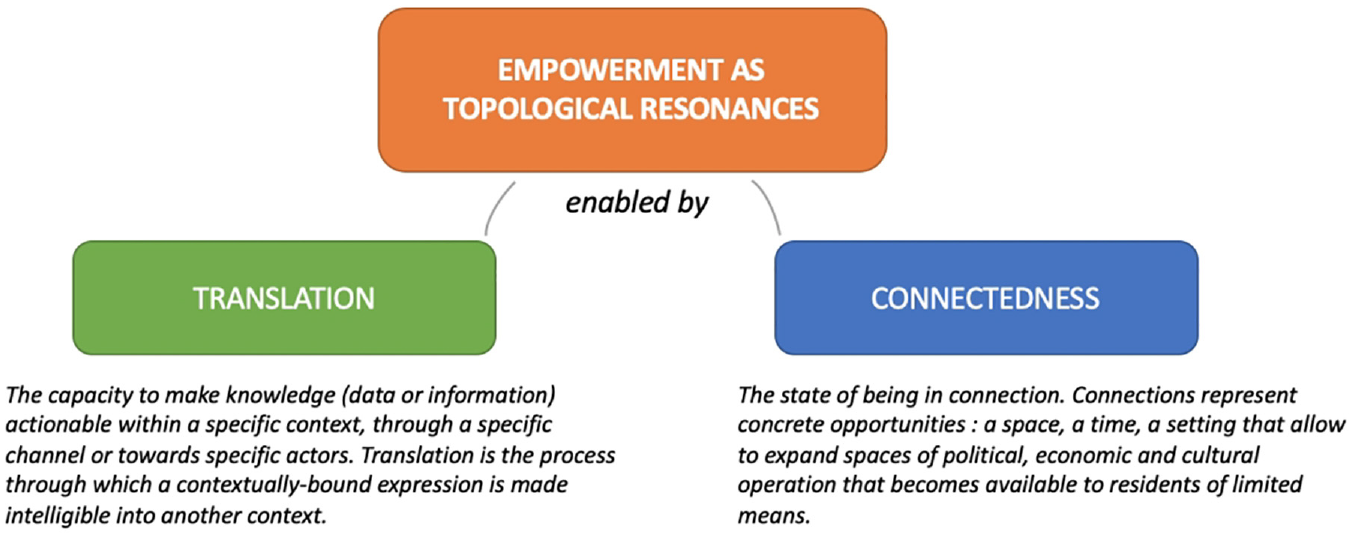
Conceptual framework. Empowerment as topological resonances is the capacity to analyze power leverage which comes from learning new languages and from getting to know new actors and to identify the causal agents. (Barella, 2022).
Results: Translation and Connectedness as Two Modalities of Empowerment for S Section Community in Khayelitsha
This section brings evidence of empowerment as translation and connectedness emerging from the action-research conducted with DAG and S section informal settlement (Figure 2). Action-research stems from feminist approaches and prioritizes experiential knowledge by drawing on mixed-methods as participant observation, interviews, and document analysis (Kindon et al., 2007). I observed and worked closely with 10 community volunteers divided in four teams, all of them amaXhosa people, most of which were women under 30 y.o. and, at the time, unemployed (NB. details on participants are not disclosed for anonymity purposes). Some stories stem from observations made during the PME activities; some others from a meeting led at the Andile Msizi Hall in Khayelitsha, which brought together various community leaders, S section community volunteers, NGO members as well as a few ward councilors. In-text quotes referred to as “DAG Human settlement meeting, 17th March 2018” were translated from isiXhosa to English by N. Moshani (Khawuta Xhosa Services). The “s/he” form results from the translation of isiXhosa non-gendered phrases into gendered English morphology.
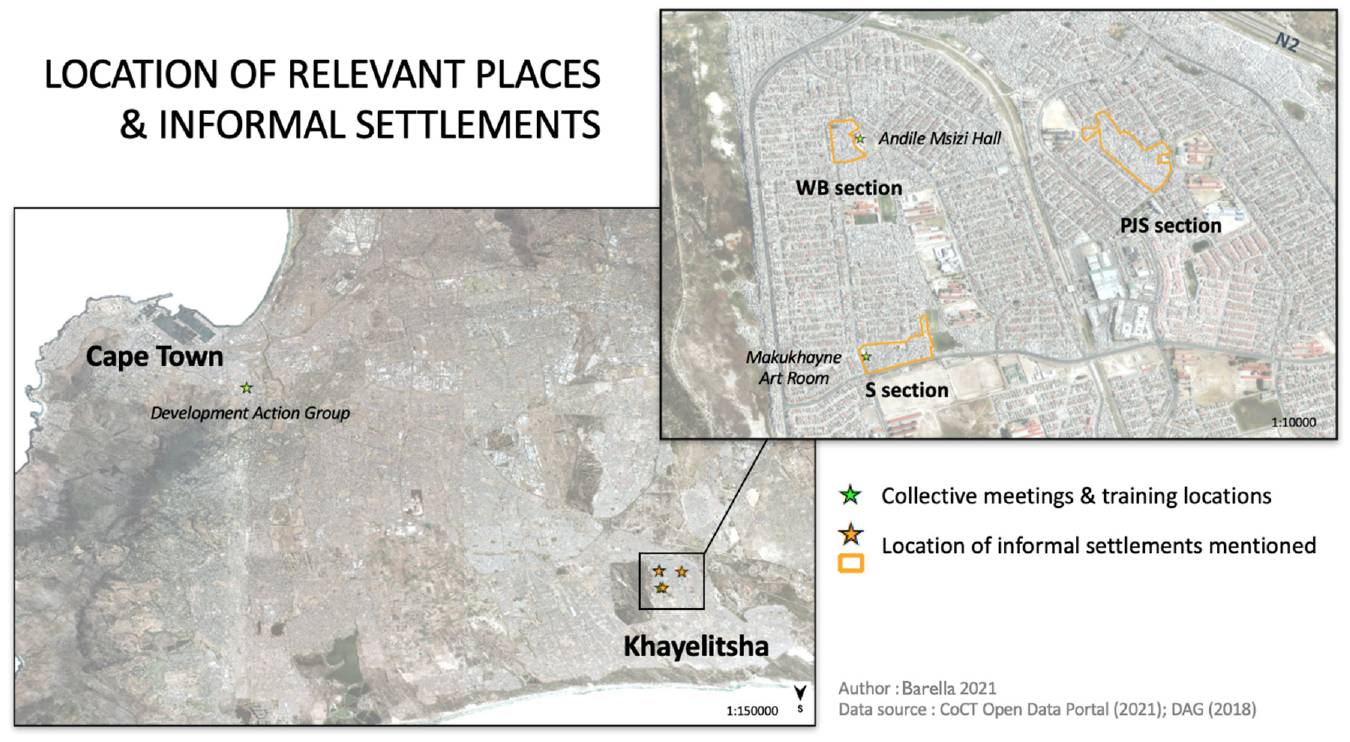
Map of main relevant places and informal settlements mentioned in the empirical section. (Barella, 2021).
Translation
Spatial Learning and Map Reading: The Hayibo! Moment
In the first phase of the PME a “rough layout mapping” and counting of the settlement’s structures is needed to sketch the neighborhood. Many A0 prints of aerial photographs of the area and examples of other settlements’ mapped layouts were taken to the S section volunteers at Makukhanye Art Room—where the activities were run—in order to start the mapping activity on the ground. Initially, many of the volunteers did not understand what they were looking at, or could not make sense of the task.
The facilitators—NGO members and myself—had the group gather around the A0 paper representing their settlement and gave them time to try and figure out the utility of that piece of paper. The print was turned upside down and jumped from hand to hand. Suddenly, one participant ran outside, came back into the shack, grabbed the A0 print and took everyone else out into the sunlight to show that that particular square on the bottom-left of the picture was the roof of the Art Room, and that this other roof was his house. A collective and surprised “Hayibo?!” (isiXhosa interjection here intended as sign of revelation) brighten up the place. The volunteers spent the next 30 min looking for their own roof on the image, sticking their finger on it, and then leading the group to the location of the finger to show, with a big smile, that that place was their home.
This is an example of translation, in its dimension of comprehension, taking place due to the circumstances created by the PME setting in this specific introductory stage of the mapping activity. In this occurrence, empowerment was enabled by the resonances of:
-the collective presence: people sharing their understanding of the object and then of the task;
-the materials: paper maps and prints. As observed by Qiu et al. (2020), paper maps are more conductive to the acquisition of spatial learning than their virtual equivalents;
-the location of the activity itself: a community facility within the settlement. The chosen location implied that participants were familiar and comfortable with the site, and that it was much easier to compare the spatial images with the reality on the ground.
Although the literature tends to focus on technical issues when evaluating PME processes, the actual first “technical issue” that emerged was related to the uneven spatial orientation and map reading skills of participants. Therefore, spatial literacy, and the ability to read maps, should not be taken for granted—anywhere in the world. Having configurational spatial knowledge is a key skill for understanding the value of spatializing information and claiming one’s rights (Figures 3 and 4).
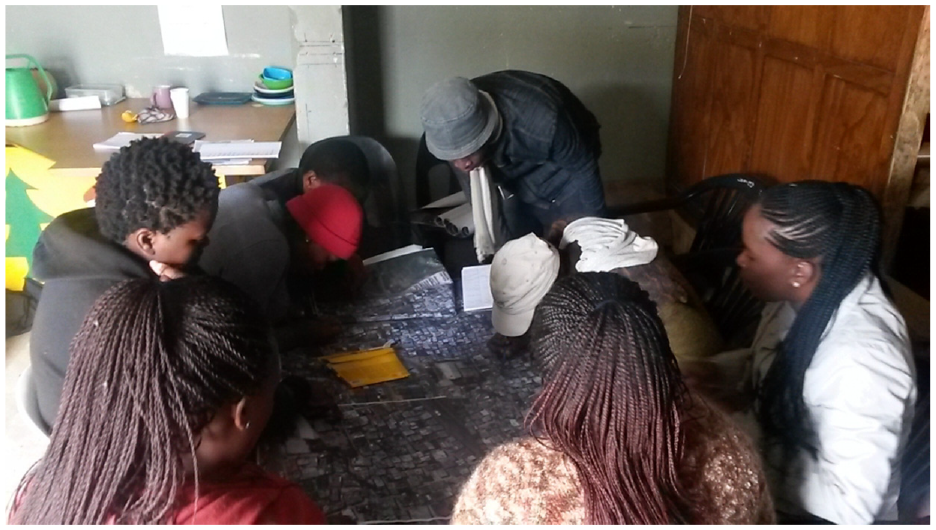
S sections volunteers gathered around the settlement’s A0 aerial image at Makukhanye Art Room (Barella March 2018).

S section volunteers starting the settlement’s rough mapping on the ground (Barella March 2018).
Multilingualism and Forms of Language
The enumeration of S section settlement was conducted through a GIS- and form-based data collection application, at the household level, with the intent to gather basic socio-demographic information about the settlement. The first draft of household questionnaire was elaborated by the NGO and was discussed and edited with community members during a community meeting. The choice of the language (English, isiXhosa, or Afrikaans) in which the survey would be formulated was debated within the NGO and with S section community. Eventually, English was chosen for the written questionnaire, but the door-to-door interviews were then conducted in English and isiXhosa by the community volunteers.
English was best understood by all parties and it was considered the easiest way to communicate with the government and other potential stakeholders. The NGO considered the possibility of setting up the app in two—or more—different languages. Although the GIS-based app allowed this duplication quite easily, it would have meant investing more time for re-translating some of the answers as part of the post-processing of data. The original answers, with the interviewee’s choice of words, were then preserved.
The example refers to translation as the ability to understand and to navigate between different languages. This is a form of empowerment since a lack of interpretative resources often results in a lack of access to the technology in use and/or to the specific jargon that accompanies policies and technologies (Weyer et al., 2019, p. 4). By learning how to navigate policies official language, people were able to access information in its original and customary form (English) outside the PME. The process of navigating between several languages allowed community volunteers to collectively learn and agree on a technical jargon. During PME, the interviewers—community members who conducted the door-to-door surveying—took the role of isiXhosa-to-English interpreters. Using this form of translation, community members were able to learn and use their knowledge to become a point of contact between community members, the NGO, and the government.
From the NGO perspective, this experience confirms that, in order to enable empowerment through PME processes, it is crucial to provide clearly understandable information in one or more languages and in a form that is accessible to local residents. This multilingual communication keeps all channels of communication open between stakeholders, but also preserves the coherence of PME action, which is necessary for achieving empowerment goals.
Spatializing Rights
According to South Africa’s free basic services and water policy, every household should have access to drinking water and sanitation within 200 m of their home (DWAF, 2001). This information about a legal measure was presented by the NGO facilitators during a workshop with community volunteers. The aim of the workshop was to discuss a draft of the settlement’s profile map, and to present the importance of spatializing claims. In order to demonstrate the spatial meaning of such information, an NGO member roughly drawn a 200 m circle on the settlement’s map. Any houses not included in this sketchy buffer were then technically in an illegal situation in terms of basic services. The attitude of participants changed from one of silent listening to one of surprised and commenting fingers pointing at the divide created by the imaginary 200 m line.
The effect of a spatial visualization changed the perception of dwellers’ circumstances and their ways of talking about it, at least for the time of the meeting. The waiting for livelihoods improvement characterized by makeshift strategies for accessing water was perceived as precarious and highly problematic. However, with the emergence of the word “illegal,” as label associated to some households, suddenly their living conditions became more than unbearable, as the injustice became spatially visible.
The translation of information into spatial information had an effect that was anticipated by the NGO facilitator in this case. This example shows how the translation of an information onto a map turned a known reality into the realization of an injustice. It shows the performative power of maps in understanding the scope of a law and basic rights. Policy’s language is otherwise hermetic or difficult to access for most citizens, exacerbated by the high illiteracy rate measured in the area. This also speaks to the affective response that the spatialization provoked. Once the imaginary 200 m line was drawn, people became more active in the discussion and were able to make sense of the overall scope of the PME as they could see the potential impact of the mapping. This is key in a development activity such as PME, where facilitators need to ensure that participants take ownership of the process.
What is “Land Tenure”?
Testing phases are important when implementing GIS-based tools for data gathering and conducting household surveys. In particular, when developing co-designed questionnaires, all the questions and their implications for the overall scope of the activity need to be understood by participants. For this reason, a long meeting was organized to discuss and edit the questions. Participants could ask for clarifications, suggest additional questions, edit the format, etc.
However, when we checked the results of the first data-collection test in the field, the answers to the questions “Tenure type” and “Type of land document of the current structure” were inconsistent. We soon realized that the interviewers—and apparently the respondents—did not fully understand the word “land tenure” and its meaning. The language gap identified above (see section “Spatializing rights”) did not help to unify the task. Initially, when reporting back the results of the test phase to the volunteers’ team, the realization of this gap provoked hilarious comments due to the perceived inherent irony of such a misunderstanding. Then, a short introduction to “tenure rights” and its jargon was proactively given by an NGO member, so that everyone was on the same page and any doubts were cleared up. This event informed the design of the technology: in response to this observation, the question on the survey was edited and pre-set with four possible answers to ensure data standardization and to avoid further potential misunderstandings on the issue.
Understanding the language, concepts, and modes of functioning in urban planning and distribution of urban rights is necessary when advocating for housing improvements. Land ownership and land representation are bound to the past colonial and Apartheid’s regimes, which ensured the possession of valuable land for the white minority (Weyer et al., 2019). Although there have been efforts to address these injustices since the 1997 White Paper on Land Reform, the above scene suggests that the terminology of spatial planning tools perpetuates this divide (Strauss, 2019; Weyer et al., 2019).
In this example, PME provided with recurring spaces for (re)discussion and verification of the activity—both for technology implementation and for clarifying the purpose of the activity itself. During the testing phase a significant misunderstanding was identified, and precautions were taken to address it. The merit of the space provided by the PME was to make such misunderstanding visible and “fixable” in a very short time. Moreover, the interviewers were asked to explain the term to the households during the survey in order to raise awareness of the way in which one’s housing claim could be formulated. They became translators themselves. In terms of technological impact, the misconception that the way “land tenure” and “ownership of the shack” were asked and configured in the GIS-based application required a redefinition.
Translation as Positioning: Becoming the Expert
The capacity to become an informed citizen and to gain a place at the discussion table is enabled by the acquisition of translation skills. The ability to navigate through different jargon and demonstrate expertise on a subject is essential for gaining a “vantage point” when dealing with the authorities.
During PME, a collective meeting was organized gathering local politicians, the NGO, and the community, and used as a platform to present the responsibilities of the different levels of government. The meeting also aimed to publicly discuss the updated Housing White Paper (HWP) criteria for access to social housing and its scope. The HWP is the official document that defines who is eligible for which type of housing program—the data-collection was intended to verify the eligibility criteria for S section. Printed copies of the new draft HWP and regulations were distributed to community leaders, along with social housing application forms and verbal explanations of how to complete them.
“… in the Human Settlement, it is good to know what the policy says so that if you are cornered by a certain official, having a meeting with him/her, you can corner him/her saying there is that certain policy. This policy says… s/he will also be knowing that. S/he can also not deceive you because s/he knows that, “Here I am conversing with a person who is very clear in terms of policy and Human Settlement challenges and who is also putting solutions on the table”. (DAG Human settlement meeting, 17th March 2018). …so that if there are public hearings that are being done by the national government, when a person goes to participate in those public hearings, s/he must know what questions s/he will ask because s/he has gotten that discussion document (DAG Human settlement meeting, 17th March 2018).
Relationally, language plays a role in power relations and is key to building relation of trust and legitimizing one’s expertise in a collective discussion. Being informed, being taken seriously, elevating ordinary knowledge to the level of informed expertise is key to influencing decision-making and being prioritized. This positioning as a fully empowered and informed citizen is essential in a context such as CoCT, where local government accountability is under constant scrutiny (Sikhakane & Reddy, 2011). More broadly, the intervention cited above, ensured that, in the eyes of the local councilors, all citizens present at the meeting were considered to be fully informed about their rights. In this way, translation helps to reduce mistrust.
This example resonates with the “connectedness” dimension of empowerment, as the set-up of the meeting allowed for a public connection between authorities and community members, through the oversight of the NGO acting as mediator and creating the space-time for this encounter to take place, as well as limiting the potential political hijacking of the space by authoritative actors (see Barella, 2020a for an example based on the same case study).
Connectedness
Following the observations, connectedness revealed two main modes of topological resonances: connectedness acting as trigger and connectedness acting as safety net. The former being an active search for change, the latter being a way for preserving and securing one’s current position and resources. The link between these following experiences is the presence of NGOs as intermediaries for unblocking connections or supporting people’s voices within a power relation setting. Connectedness values as the experience of belonging to social networks within which the exchange of experiences, resources and mutual recognition is attainable.
Connecting the Dots
At collective level, connectedness enabled by compresence fosters social cohesion by constructing trust, a sense of shared commitment and reciprocity. Within this setting, data participates to mutual learning: identifying people’s needs and fostering collective organization for moving outside marginalization.
As a member of PJS settlement community explained to S section’s community volunteers: “the older people, we must also know them so that we can assist and link them to the correct offices,… to know the wheelchair bound people so that we can link them to the correct offices right away” (Fieldnotes, March 2018). Identifying vulnerable people and direct them to the correct offices is a form of connection that empowers, and, within PME these vulnerabilities are backed by data verified by an external stakeholder. Through PME, local needs are identified and directly addressed through the support of the NGO, which can inform people about government procedures to obtain the assistance to which they are entitled. This link can trigger a change in financial resources and support for a specific population of the settlement. This new connection allows for a small step towards getting out of marginalization while waiting for housing improvements. Moreover, bringing together people in a similar situation in a collective action was seen as key for fostering development: “let’s link people who are a priority because it is important for us to know them. Do the leaders know them so that we can align them, and there is a space in the community for them and development progresses?” (DAG Human settlement meeting, 17th March 2018).
As well as building social connections, this process also highlights residents’ specific needs in terms of urban planning. For instance, it may lead to a redevelopment plan that includes wheelchair access or a children’s playground.
In Figure 5, people from PJS community shared their experiences with S section community, while also explaining how to read the 3D settlement layout model that PJS volunteers elaborated in a previous project. There was not only a transfer in terms of knowledge, but also in terms of local contacts and strategies. The first-hand feedback came from various community leaders and councilors in direction to S section members, so that S section members could learn from them. Therefore, connectedness also operates as an exchange of knowledge based on previous experiences with PME or other datafication tool, which is shared with S section through the mediation of the NGO.

Materiality of experience sharing on PJS community previous project (Barella March 2018).
PME also allows for a more horizontal way of connecting the dots, by bringing together people from different communities experiencing similar struggles. Mutual learning from peers is referred to here as connectedness but could also be seen as translation skill, as members of other communities act as translators of the NGO’s instructions. They provide first-hand advice on how to conduct the PME exercise, as well as a broader vision of how the mapped information was used and what it had enabled. The compresence of the actors enabled these informal exchanges and supported S section members with enlarging their network collectively, but also for individual purposes.
If taken further, this co-learning could lead to the creation of a city-wide network of communities and a scaling-up of action in informal settlements’, as many stakeholders are brought together around a common goal.
Settlement Safety and Emergency Response
In the event of an emergency, connections as “knowing your neighbors” are crucial to ensuring neighborhood safety, for self-organizing first aid and assessing the extent of damage. As an NGO member explained to S section community leaders during a collective meeting:
The enumeration thing is very important in terms of numerating people and know how things are everyday”. “If there could be a fire, you can put a face on the paper as well as the map that supports all of that (sic) (DAG Human settlement meeting, 17th March 2018).
The mapping and enumeration activity provides an opportunity to get to know the people and activities in the area. Community volunteers in charge of the enumeration went door-to-door to interview and listen to their neighbors’ stories—this allowed for a strong mutual recognition. The household enumeration included taking pictures of each house and each person who was there at the time. Community volunteers then had a clear overall picture of who lived where, in what conditions, and the nature of neighborhood relationships. They became aware of the materiality of their livelihoods, in terms of how their homes were organized and built (what the layout was, where the entrance and main exits were, what kind of materials were used, etc.; Figure 6).

The first map legend spontaneously elaborated by S section volunteers enumerating the neighborhood (Barella March 2018).
Knowing your neighbors and who lives where is a powerful form of mutual support and surveillance in emergencies. For instance, informal settlements are at high risk of fire, which can cause immense human and material damage. In the event of a fire outburst, those living in the settlement act as first responders—they need to know who might be at home, what shack they live in, and help them save their belongings. Mutual surveillance and support are vital for informal dwellers (Brown-Luthango, 2019). Datafication enhances and strengthens this “safety net dynamic.” First, PME produced actionable knowledge about the community and households. Then, participants who led the data-collection process became experts on their own neighborhood and were recognized as such by their fellow residents.
Clarifying Political Responsibilities and Channels for Claiming
The PME process also enhances empowerment by visibilizing actors responsible for specific actions related to the community’s claims. PME makes this possible through the coordination meetings needed to review the data collection process and to bring together the various actors involved in the urban development process. In the case of S section, this meant clarifying the role of the ward councilors and community leaders. It was necessary to know who should receive what kind of information and to whom demands should be addressed in order to make the knowledge actionable.
During a PME-related public meeting, a discussion emerged on the role of community leaders and local councilors when it comes to support informal dwellers’ claims for housing improvements.
Those are the things that help us to know each other so that when there are benefits from the councillor saying, I want the amount of people who struggle, the leaders do not hesitate, they know that they go to which number. As a leader to know your area. (…) So, the leaders, more than looking for the councillor and what s/he does, be responsible in your area…(DAG Human settlement meeting, 17th March 2018)
This intervention emphasizes that leaders are responsible for the information collected and guarantee the collective ownership of the information about the community. They thus become the gatekeepers of the claims to the local government level—in this case the ward councilor. The community knows that leaders have this information, and leaders know that their discussions with councilors or with other government representatives are backed by data and maps as negotiation tools. The process also allows for a better communication between community leaders and local councilors.
Chair (NGO facilitator): (…) People expect councillor to have something to do with the houses or to deliver the houses. Let me ask …, what is the role of the councillor? And not beat the wrong person and burn a person’s house for something that is not in his power… Voice: A councillor is people’s messenger to do something for us to the government, not necessarily that the councillor has money to build houses …, I think a councillor is a people’s messenger… From people to the government. (DAG Human settlement meeting, 17th March 2018)
Finally, clarifying actors’ responsibilities was also appropriate in order to protect all parties from (misdirected) outbursts of frustration directed at members of the local government—as suggested in the quote.
Clarifying political responsibilities is empowering, as it optimizes the channels for making claims and makes it easier to hold people accountable (Figure 7). This is particularly important in similar contexts, where people take on different roles at different times and it is difficult to assign clear “values” to people as they participate to various collective operations (Simone & Pieterse, 2017)—for instance one of the community leaders is also an entrepreneur and runs a local car wash.

“What is the role of ward councilor?” Posters resulting from a brainstorming and discussion led at Andile Msizi Hall (Khayelithsa) (Barella March 2018).
Unexpected Access to Short-Term Resources
Empowerment also occurred through PME as a means of configuring a different access to resources at individual level. During PME, participants were paid by the NGO as a compensation for their time. This was not intended as a form of salary, as the NGO was careful to select community volunteers who were primarily motivated by the purpose of the project. Snacks and breakfasts were sometimes provided. The NGO members leading the PME activities in the field would collect food and drinks on the way to S section (Figure 8). Nevertheless, one participant explicitly stated that these financial and food resources were the main reasons for participating in the PME. S/he had a child and was not touching social grants at the time. The modest amount of money and food represented a good enough way to alleviate some of the stress caused by her/is living conditions. Although not the main intention, these strategies help to redistribute resources, if only for a moment, in time during the long waiting for livelihood improvements. In this case, for the PME duration, the participant was able to obtain some kind of material resource as a short-term coping strategy. In the end, s/he was no less committed to the PME than participants who had a more political motivation for entering the project.
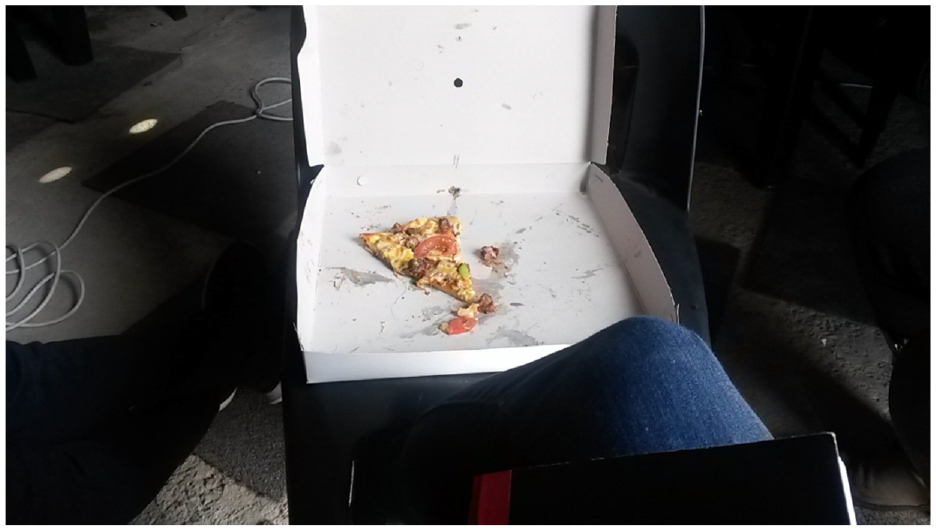
The last slice of a nourishing lunch break in Khayelitsha (Barella April 2018).
A similar example is provided by the “ambivalence” of a participant who was deeply involved in the process but who also managed to make use of the resources provided. In order to ensure immediate synchronization of the data collected, the household enumeration was carried out using tablets equipped with a SIM card and a generous data bundle. Within 24 hr, the respondent used the entire data connection bundle on the tablet for which s/he was responsible. Usage was mainly for surfing the web, live streaming and downloading games to the tablet. This level of “digital enjoyment” would otherwise have been difficult for him/her to appreciate due to the high cost of data services.
These examples show a form of short-term intrapersonal empowerment—albeit very fleeting in the second example. It was made possible by connectedness as a form of resource redistribution brought to the table by the PME process.
Networking and Negotiating Positions
An illustration of connectedness as catalyst for change at an individual level is provided by the attitude of one community volunteer during the PME activities. A volunteer wanted to highlight his leadership skills to the community leadership and NGO members. S/he wanted to integrate the pool of leaders and become part of the local authorities. S/he used this space in his/her own personal strategic way. In the field, s/he was always keen to take the lead at the start of a new activity and to explain to the comrades how the operations would unfold. During the first phase of the mapping, s/he took personal responsibility for verifying the information collected on toilets and water points. During the set-up of the household questionnaire, s/he actively suggested ways of rephrasing some of the questions. Overall, he/she took it upon himself/herself to ensure that the report was delivered to the community leaders. This volunteer was aware of power relations and look for a space within the hierarchy into which s/he could move. S/He was more interested in the opportunities that the participatory space opened up than in the PME for S section in itself, or in the end goal of housing improvements. In a personal conversation s/he explained that s/he saw PME as a platform that could provide job opportunities, social connections (including NGO members) and strategic knowledge. Nevertheless, his/her proactivity and willingness to network was useful in promoting PME activities, as other participants relied on him/her to take the lead.
This example shows how connectedness is necessary for individual and interpersonal empowerment, as it allows to discover spaces of maneuver for finding vantage points and opening up new networks. The volunteer’s strategies for promoting his/her own leadership position within the mapping activity, within the volunteers’ groups, within the community, allowed to gain visibility. In turn, these strategies shaped the PME activities. This example shows that power relations are inherent in the practice of PME tasks, as PME opens up a space for such makeshift strategies to be deployed.
Conclusion
The livelihoods of informal settlements in South Africa are characterized by a structural waiting for improvements. NGOs and organizations that support the demands of informal dwellers urge civil society to be self-critical and responsive—and not to rely on the patience of dwellers to wait indefinitely for commitments that should be within their grasp. PME acts as an empowerment tool during the waiting phase. It is a trigger for deepening democracy, as it is a tool for activating this waiting phase and for introducing public accountability measures.
This paper analyses empowerment fostered by PME practices during that phase of waiting in the S section informal settlement (Khayelitsha). It is based on two main arguments. Firstly, the paper considers NGO- and community-led PME as an empowering tool for active waiting for livelihood improvements in South Africa. While the existing literature has discussed empowerment in terms of the final output of PME and emphasized the production of data and maps, this paper captures the importance of the interstitials empowering dynamics that occur in between during the process. Secondly, a specific form of empowerment enabled by PME is conceptualized as “topological resonances,” following Simone and Pieterse (2017). Two modalities of empowerment as the actualization of topological resonances were observed and applied to the case study of S section informal settlement (Khayelitsha). Translation and connectedness refer to mechanisms for gathering up existing resources and making them actionable through the enactment of PME process. It shows that different forms of empowerment are triggered by bringing people, materials, and resources into contact with each other. Figure 9 summarizes main findings of the paper.
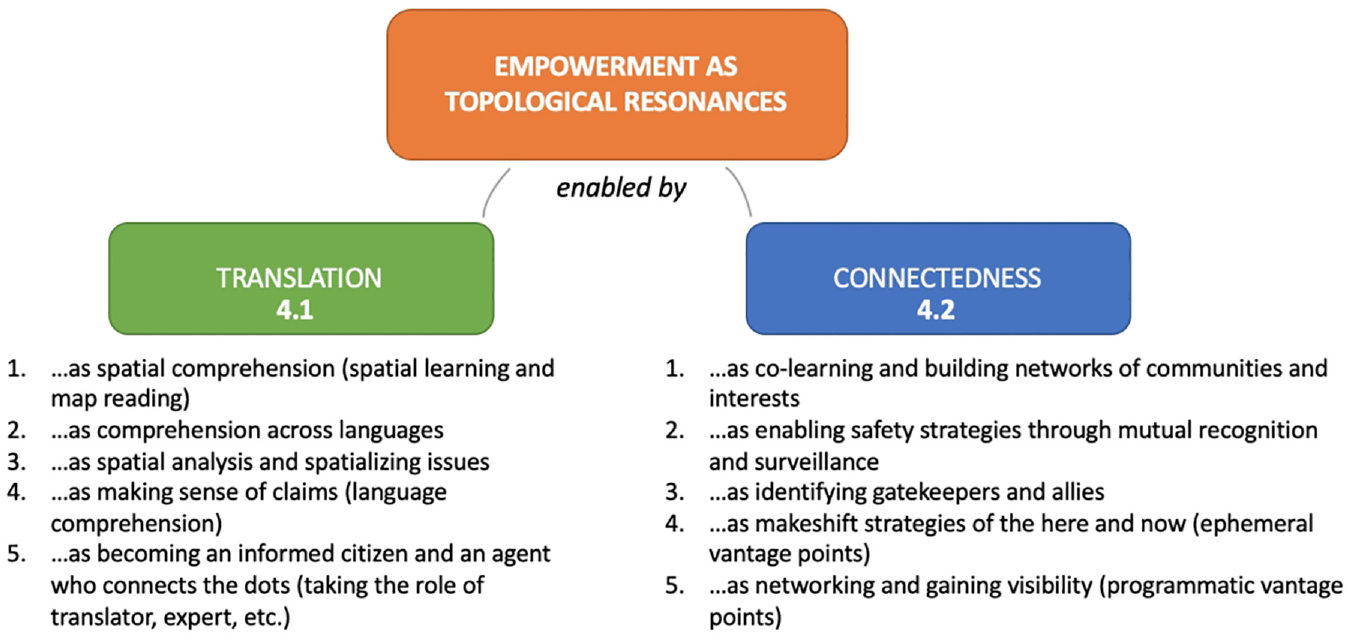
Summary of main results. Type of empowerment observed through the lense of the topological resonances framework. Bullet points numbers correspond to empirical sub-sections of the paper. (Barella, 2022).
For Capetonian NGOs «empowerment» must work toward a broader transformative change within society to overturn unjust structures. The findings show that empowerment is part of the process of PME, and not only its output, since PME makes power leverage visible while activating mechanisms of accountability. In return, these elements are key for determining the success of housing programs implementation (Sikhakane & Reddy, 2011).
For the S section experience, physical and material compresence appears as key factor for “translation” and “connectedness” to operate. When leading PME practices, in order to maximize the collateral learning for participants, materiality and spatial settings determined the kind of “topological resonances” that occurred or could be seized by them.
The paper emphasizes the importance of looking beyond the expected outcome when talking about PME for empowerment, and rather focusing on interconnections between people, materials and circumstances that are established throughout the process—sometimes programmatically, sometimes circumstantially. Any large-scale ambition of claiming or empowering through PME needs to be tempered by the micro impacts that the process of PME itself will carry in tow—these were visible through the translation/connectedness framework.
This discussion invites us to move beyond the instrumental purpose of PME to a detailed picture of how resources are used and reallocated. Treating empowerment as a process enhances the capacity to capture individual and collective learning gained through the process. These are forms of sustainable gain that people take with them beyond these participatory exercises and beyond a punctual outcome. Participatory spaces provide a theater where citizen roles can be played and actors are forced to be visible—and where mutual control and exposure are ensured by the presence of NGO as a mediator. Within this framework, people can identify which resource is relevant to which type of claim, who is responsible for what, who to approach for specific claims, and how to talk to these actors. The relationship with welfare state in South Africa is crucial in shaping this vision. Seeing the state as “the house provider” urges us to see empowerment as a mechanism for holding authorities accountable, rather than absolving them of their developmental duty. Moreover, the predominant role of NGOs creates a risk of empowerment being superimposed (Barella, 2020b). By framing empowerment in terms of topological resonances, translation, and connectedness, we focus on communities and individuals’ capacities to play different roles at different times, thus turning the opportunities provided by participatory spaces into vantage points.
Far from proposing a one-size-fits-all solution, this paper explores other ways of assessing PME impacts that go beyond the Capetonian context alone and speak to the widespread use of these techniques regardless of their specific field of application. The importance of framing empowerment differently is underscored by the specificity of the context and the fact that the instrumental goal in itself (the production of data or of a cartographic artefact) is not enough to guarantee a real improvement of people’s lives and of daily strategies. Wherever these participatory techniques are implemented to respond to an emergency or a struggle for housing and adequate living conditions, there will be the need and make visible and actionable unrecognized leverages for change.
Footnotes
Acknowledgements
I would like to thank Development Action Group and S section community (Enkosi kakhulu!) for their trust and for giving me the opportunity to be involved in their advocacy actions. Also, I would like to thank the reviewers for their helpful comments, and the Bureau Egalité and the Fonds des Donations of the University of Neuchâtel for supporting my doctoral fieldwork.
Declaration of Conflicting Interests
The author(s) declared no potential conflicts of interest with respect to the research, authorship, and/or publication of this article.
Funding
The author(s) disclosed receipt of the following financial support for the research, authorship, and/or publication of this article: The author has received funding from the Bureau Egalité and the Fonds des Donations of the University of Neuchâtel for the realisation of the research fieldwork on which the current publication is based.
Ethical Approval
Not applicable.

Data Availability Statement
Data sharing not applicable to this article as no datasets were generated or analyzed during the current study.