




Abstract
There are more than 6.6 million students with disabilities in U.S. public schools who receive special education services, which means that there are 6.6 million Individualized Education Programs (IEPs) that have been developed and are being implemented at any given time. Each IEP represents real cost in educational opportunity, relationship building between families and schools, time, and resource allocation. Given this information, it is important to examine what we have learned from research on the development of IEPs, and to begin charting a new direction for research and practice related to IEP development. This literature review examines published, peer-reviewed research studies that have examined IEP development since the 1997 reauthorization of the Individuals With Disabilities Education Act (IDEA). The review concludes with a discussion of how findings from previous research on IEP development can inform future research agendas, educator practice, and federal and state policies.
Beginning with the authorization of the Education for All Handicapped Children Act (EHCA) in 1975, public school districts are responsible for providing the instruction, services, and supports needed for students with disabilities to make effective progress in school. Renamed the Individuals With Disabilities Education Act (IDEA) in the 1990 reauthorization and again renamed as the Individuals With Disabilities Education Improvement Act (IDEIA) in 2004, this federal law specifically calls for students with disabilities to receive a “free appropriate public education in the least restrictive environment” (IDEIA, 2004). The primary tool for enabling schools to provide this required level of support to students with disabilities is the Individualized Education Program (IEP; Simon, 2006). Due to its central function as both a planning tool and a map for services and interventions, the IEP has been described as “the cornerstone of IDEA” (Gartin & Murdick, 2005, p. 327), the “heart of IDEA” (Huefner, 2000, p. 195), and the “sine qua non of IDEA . . . for special education, there is no document more significant to districts, agencies, administrators, teachers, parent and educational advocates, and students” (Smith, 1990, p. 1).
Since the authorization of the EHCA in 1975, there have been changes to the meaning and description of the IEP as detailed in statute and regulation (U.S. Department of Education, Office of Special Education Programs, 2003). For the first two decades of the IEP requirement (1975-1995), educators struggled to meet paperwork requirements, convene effective IEP team meetings, develop compliant and meaningful IEPs, and to coordinate services between general educators and special educators (Huefner, 2000; Smith, 1990). In response to these challenges, substantive revisions to the IEP requirements in federal law came during the 1997 reauthorization. There was increased emphasis on addressing ways to involve students with disabilities in the general education curriculum, and the new statutory and regulatory requirements enacted in 1997 provided more explicit language regarding the scope of the content of the IEP, the membership of the IEP team, and the process for development (Huefner, 2000; U.S. Department of Education, Office of Special Education Programs, 2003). In effect, the 1997 reauthorization established the IEP requirements as currently enacted and followed in educational practice. The most recent reauthorization of IDEIA in 2004 did not provide any significant changes to the definition or requirements of the IEP, but did promote a subtle shift toward aligning the IEP requirements with the goals of the No Child Left Behind Act (NCLB) of 2001 by ensuring that the content of the IEP is focused on a student’s academic needs, and not solely on behavioral or functional concerns related to the student’s disability (Gartin & Murdick, 2005; U.S. Department of Education, Office of Special Education Programs, 2006).
The current federal statutory and regulatory language defines the IEP as “a written statement for each child with a disability that is developed, reviewed, and revised” on an annual basis (Definition of IEP, 2006). Each IEP must include information on the student’s current levels of academic and functional performance, annual goals that serve to focus special education interventions, a plan for monitoring progress toward these goals, detailed information on the services and supports provided to the student, and a description of the extent to which the student will participate in general education classes (Definition of IEP, 2006). The IEP is developed or revised annually by a group of key stakeholders called the IEP team. The team must include the parent(s) of the student, at least one general education teacher and one special education teacher, a knowledgeable administrator who understands programming for students with disabilities and has the authority to commit district resources, an individual qualified to interpret any student evaluation results, and the student when appropriate (IEP team, 2006).
Purpose
It has now been almost 40 years since the enactment of the first federal special education law (the EHCA) and over 15 years since substantive revisions to the IEP requirements were made through the 1997 reauthorization. Through all of this time, the IEP has remained a central part of the special education process. There are more than 6.6 million students with disabilities in U.S. public schools who receive special education services (“IDEA Part B Data,” 2012), which means that there are approximately 6.6 million IEPs that have been developed and are being implemented at any given time. Each one of these IEPs represents a real cost in educational opportunity, relationship building between families and schools, time, and resource allocation.
Given this information, it is important to examine what we have learned from research on the development of IEPs, and to begin charting a new direction for research and practice related to IEP development. To address these issues, this literature review was designed to address the following questions:
With an eventual reauthorization of IDEIA on the horizon, these are timely questions to explore. This study was designed to address the above questions through an in-depth literature review of published, peer-reviewed research studies that have examined IEP development since the 1997 IDEA reauthorization. Synthesizing what we know about IEP development can help inform current educator practice at the school and district levels, and can inform future research agendas and policy making at the federal and state levels.
Method
Search Procedures
The literature review identified published, peer-reviewed research studies that examined issues related to IEP development. The review covered a 16-year period from January 1998 through February 2014. This particular starting point was selected because it was the year immediately following substantive revisions to the IEP requirements, as enacted through the reauthorization of IDEA in 1997. The sources for the literature review were identified through a variety of methods, including searches of electronic databases prominent in the field of education research, specifically Academic Search Premier, Education Full Text, PsycArticles, and Social Sciences Full Text; internet searches using Google Scholar; and review of the bibliographies found in studies identified through the previous methods. The primary term used for electronic searches was individualized education programs. In addition, secondary terms were used to improve the quality of the search, including special education, students with disabilities, and education planning. The common abbreviation, IEP, was also used individually and with each of the secondary terms.
Selection Criteria
Based on the search procedures described above, articles were initially excluded according to the following criteria: not relevant to IEP development and the research questions not published in peer-reviewed journal; not a research article; written prior to January 1998; or not written in English. After this initial screening of the studies, each article was examined by a team of two reviewers during a second stage of screening to determine inclusion in this literature review. Each reviewer examined each article separately, and then met to compare their respective lists of selected articles and to negotiate differences. Articles were included if they described the results of at least one research study related to IEP development. To be considered a research study, the article had to articulate a research question(s), present a research design and methodology, and describe study results. Articles that solely focused on describing and/or recommending strategies for instruction or treatment—and did not describe the conduct and results of a research project examining the strategies—were excluded from the study.
Coding and Analysis
A total of 51 research studies on IEP development were identified that met the above criteria for inclusion in this review. Once these articles had been selected, the two reviewers read each article again. They each assigned codes to the articles based on the aspect(s) of IEP development examined in the study. After each round of coding, the two reviewers met to explore consistencies and differences in the two code sets. Inter-coder reliability was calculated using a straightforward formula suggested by Miles and Huberman (1994): Reliability = (Number of agreements)/(Total number of agreements plus disagreements). The final inter-coder reliability calculation for all assigned codes by the two reviewers was 94.1%. In addition, information was recorded on the research design and the grade levels and categories of disability associated with IEP development for each study.
Overview of Selected Journal Articles
The 51 peer-reviewed, published studies on IEP development addressed in this literature review are presented in Table 1.
Articles Included in Literature Review (n = 51).

Note. IEP = Individualized Education Program.
While the “Findings” section of this article discusses the aspects of IEP research and the results of these studies, it is relevant to consider the population characteristics of the research and the types of research methodologies utilized. To the extent that information was provided in the articles, the target populations were recorded for disability categories and grade levels at which IEP development was examined. There were only two articles in which none of this information was provided (Watts, O’Brian, & Wojcik, 2004; Wilson, Michaels, & Margolis, 2005).
The majority of studies utilized categorical designations for disabilities. Of the 47 studies that included disability information on the target population for IEP development, there were 39 studies that addressed multiple categories of disability. This included studies that did not use categorical designations and instead described disability as severe, low-incidence, or high-incidence. There were five studies that focused on students with autism spectrum disorders and three studies that focused on students with developmental disabilities (also referred to as intellectual disabilities in some articles). The grade bands of the target populations for studies on IEP development were relatively evenly distributed. Of the 49 studies that included information on grade levels, there were 16 studies that focused on students across a wide range of grade levels (elementary, middle, and high school), 11 studies on elementary grade levels, 9 studies at the high school level or above (i.e., students up to age 22), 7 studies at the middle and high school levels, 4 studies at the middle school level, 1 study at the elementary and middle school levels, and 1 study at the preschool level.
Information was also recorded on the types of research methodologies utilized. In the vast majority of studies, the authors provided a thorough description of their research designs and methods for data collection and analysis. Qualitative studies were the most frequent research design (19 studies). These studies typically consisted of interviews, observations, and document review. There were 16 intervention studies, which consisted of experimental or quasi-experimental designs that examined a specific treatment and its impact on the sample population. Intervention studies typically consisted of pre- and post-intervention measurements, with an intervention provided to the target population between data collection periods. Seven articles are best described as having utilized a mixed-methods approach. These studies included elements of both qualitative and quantitative methodologies. Another seven studies used survey methodologies as their primary research design and guiding structure, and two studies used quantitative methods applied to previously existing national data sets.
Findings
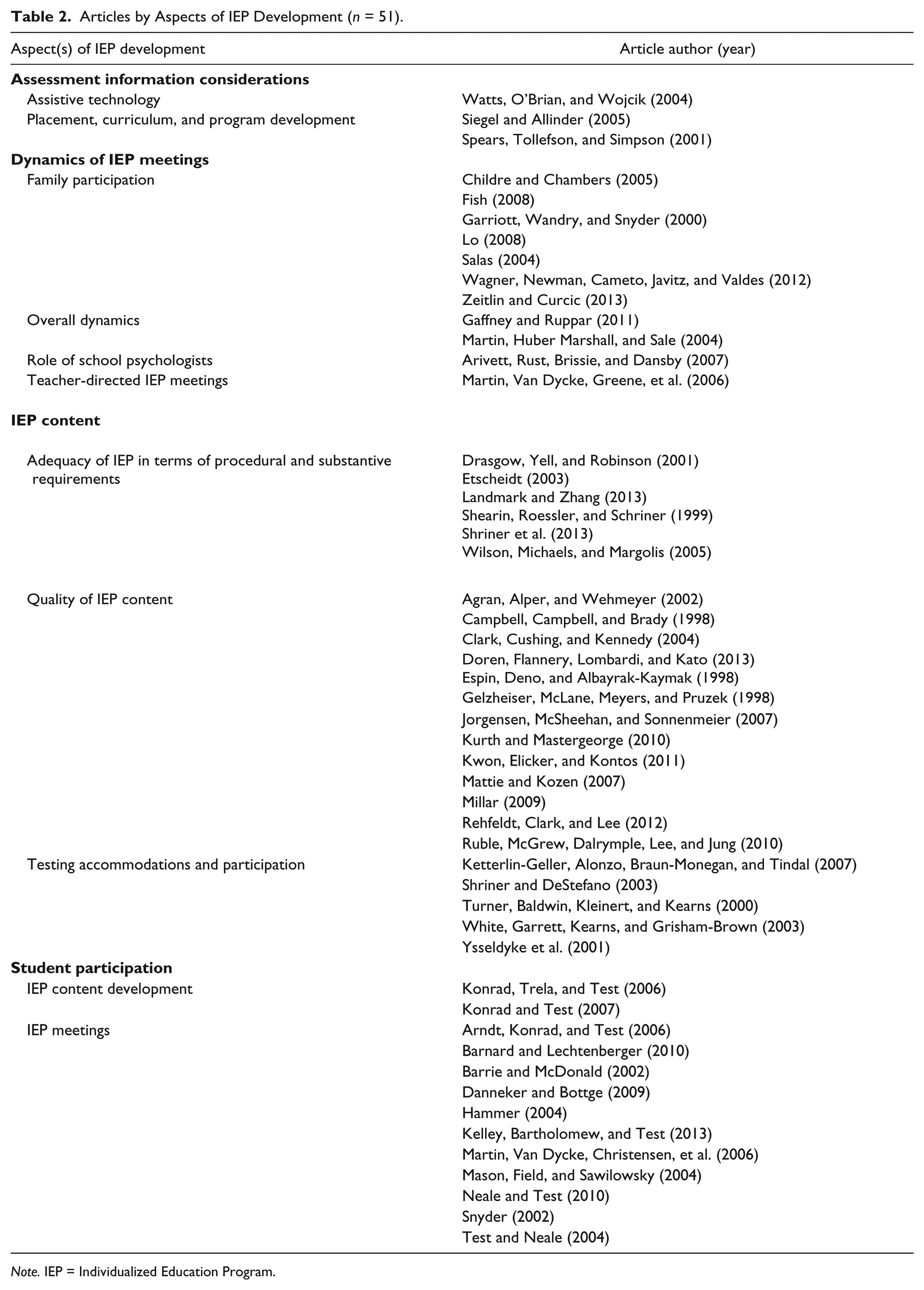
The central question that focused the literature review was, “What do research findings tell researchers, practitioners, and policy makers about IEP development?” The identified studies addressed a variety of aspects of IEP development. For purposes of analysis and discussion, the aspects of IEP development examined in the literature were divided into four broad categories, with supporting subcategories:
Assessment information considerations (3 studies), including assistive technology, placement, and program development;
Dynamics of IEP meetings (11 studies), including family participation, overall dynamics, and teacher-directed IEP meetings;
IEP content (24 studies), including adequacy of IEP in terms of procedural and substantive requirements, quality of IEP content, and testing accommodations and participation; and
Student participation in the IEP development process (13 studies), including IEP content development and participation in meetings.
Table 2 lists the studies by topical category, including identified subcategories as applicable. Findings from these studies are described in the section to follow.
Articles by Aspects of IEP Development (n = 51).
Note. IEP = Individualized Education Program.
Assessment Information Considerations
A total of three studies addressed assessment information considerations related to IEP development. There were two studies that focused on general assessment practices related to IEP development, including the use of assessment for placement, curriculum, and program development. The authors found that teachers (Siegel & Allinder, 2005) and psychologists (Spears, Tollefson, & Simpson, 2001) utilized effective assessment practices related to the diagnosis and placement of students with disabilities. However, Siegel and Allinder (2005) also examined special educators’ assessment practices related to curriculum and program development. The findings were less positive, indicating the teachers were less likely to engage in effective assessment practices that informed IEP development in these areas. The authors noted that there were often not meaningful connections between assessment practices, IEP objectives, and instructional planning.
There was one study (Watts et al., 2004) that focused on the ways in which assistive technology needs are assessed as part of the IEP development process. The authors compared research on four models of assistive technology assessment to recommended practices in the larger field of educational assessment. The models reviewed were the Chambers Consideration Model, the Education Tech Points model, the Student, Environment, Task, Tools (SETT) Framework, and the Unifying Functional Model. The authors found that each of the models offered positive contributions to assistive technology considerations during IEP development, but that all of the models also featured limitations related to technical adequacy and consistency that did not meet the recommended criteria for educational assessment.
Dynamics of IEP Meetings
There were 11 studies that addressed IEP development through research on the dynamics of IEP meetings. The two research studies that focused on the overall dynamics of IEP meeting participation took very different approaches, yet yielded similar results. While Gaffney and Ruppar (2011) utilized a case study approach that focused on the dynamics of one IEP meeting, Martin, Huber Marshall, and Sale (2004) surveyed a wide range of IEP meeting attendees over a 3-year period. In both studies, findings indicated that team members, particularly families and general educators, did not always express their opinions in the meeting, and that participants’ roles (e.g., special education teacher, parent, administrator) impacted the extent to which they contributed to IEP development during the meeting. In these cases, administrators and special education teachers talked more and played a larger role in IEP development than families.
Six studies that focused primarily on family participation in IEP development had similar findings. Research on the role of Mexican American families (Salas, 2004), Chinese American families (Lo, 2008), and families from a range of racial/ethnic groups (Fish, 2008; Garriott, Wandry, & Snyder, 2000; Wagner, Newman, Cameto, Javitz, & Valdes, 2012; Zeitlin & Curcic, 2013) all indicated that while parents frequently attend IEP meetings, they are often not provided the opportunity to make significant contributions to the content of their children’s IEPs. A study of teacher-directed IEP meetings (Martin, Van Dycke, Greene, et al., 2006) had similar findings. Observations of IEP meetings and surveys of IEP meeting participants indicated that teachers largely controlled the IEP development conversations. In these instances, families and students were not meaningful, active participants in the process. Over half of the 51 parents surveyed in the Fish (2008) study indicated that they would like to have more influence in IEP meetings.
One final area of findings that raised concern about the dynamics of IEP meetings were the differences in rates of participation and satisfaction noted across family characteristics (Wagner et al., 2012). Analyzing data from both the Special Education Elementary Longitudinal Study and the National Longitudinal Transition Study–2, the authors found varied rates of participation and satisfaction in IEP meetings according to differences in child’s disability, family’s income, and family’s racial/ethnic background. In an attempt to address these types of inequities in participation, Childre and Chambers (2005) examined the impact of a student-centered IEP planning tool on family participation in the IEP process. The authors developed and used the Student Centered Individualized Education Planning (SCIEP) tool, a person-centered planning tool designed to increase the role of families. In the study, the authors found that the SCIEP tool increased the overall level of involvement and input for families in the IEP development process.
A final study on the dynamics of IEP meetings concentrated on the role of school psychologists (Arivett, Rust, Brissie, & Dansby, 2007). Over 100 special educators responded to a survey that explored their perceptions of the contributions made by school psychologists during IEP meetings. The findings indicated that special educators hold widely ranging opinions regarding the contributions of school psychologists. While teachers acknowledged the role of psychologists in the IEP development process, they were perceived to be more or less helpful/important in correlation to their level of participation in and leadership of IEP meetings.
IEP Content
Studies that focused on various aspects of IEP content were the most commonly identified articles for this literature review, including studies that focused on the adequacy of IEP content in terms of procedural and substantive requirements, studies focused on the quality of IEP content, and studies focused on the testing accommodations and participation aspects of IEP development. Regarding the research on IEP adequacy in terms of legal requirements and procedures, two studies focused primarily on the results of special education due process hearings as a means of determining the extent to which IEPs were developed in accordance with federal regulations (Drasgow, Yell, & Robinson, 2001; Etscheidt, 2003). In both studies, the authors reported that districts struggled to develop IEPs that met all substantive requirements. The areas of difficulty included the sections on present levels of educational performance, IEP goals and objectives, and identified instructional and related service supports.
Findings from two studies (Landmark & Zhang, 2013; Shearin, Roessler, & Schriner, 1999) indicated that procedural and substantive requirements related to secondary transition planning were not being addressed in many IEPs. Shearin et al. (1999) examined 68 IEPs for transition-related content, and found that these documents were deficient in goals and supports related to postsecondary education and employment, daily living skills, and residential options. Landmark and Zhang (2013) had similar findings in an analysis of IEPs from 212 students. The authors reported that (a) the majority of IEPs were non-compliant with IDEIA requirements; (b) there was a limited amount of research-based transition practices detailed in the IEPs; and (c) the IEPs of students with emotional-behavioral disabilities and/or learning disabilities were more likely to be non-compliant with the procedural and substantive requirements for transition planning components in the IEP.
The role of software programs in developing IEPs that meet procedural and substantive requirements was examined in two studies (Wilson et al., 2005; Shriner et al., 2013). To determine the extent to which these programs could assist IEP teams in developing legally appropriate IEPs, Wilson et al. (2005) analyzed two IEP development software programs and Shriner et al. (2013) examined the impact of a web-based IEP tutorial. In both studies, the authors concluded that although software and/or web-based programs can assist teams in developing IEP content that meets legal requirements, the extent to which the IEP is appropriate to individual student needs remains dependent on the knowledge and skill of IEP team members.
A related area of research concerned the quality of IEP content. Multiple studies (Agran, Alper, & Wehmeyer, 2002; Espin, Deno, & Albayrak-Kaymak, 1998; Gelzheiser, McLane, Meyers, & Pruzek, 1998; Kurth & Mastergeorge, 2010; Kwon, Elicker, & Kontos, 2011; Mattie & Kozen, 2007; Ruble, McGrew, Dalrymple, Lee, & Jung, 2010) reported findings that raised concerns about the quality of IEP content as it related facilitating student to access to the general education curriculum. In particular, the authors of these studies presented findings that identified problems with the extent to which instructional supports, services, and IEP goals were appropriate to ensure student participation in the general education program (Agran et al., 2002; Kurth & Mastergeorge, 2010; Ruble et al., 2010), support peer-interactions (Gelzheiser et al., 1998; Kwon et al., 2011), and address behavioral supports (Mattie & Kozen, 2007). There were also findings that raised concerns about the extent to which IEP content was individualized based on student needs (Espin et al., 1998), and adequately addressed transition-related needs (Millar, 2009).
As a possible means of addressing these types of challenges, five research studies (Campbell, Campbell, & Brady, 1998; Clark, Cushing, & Kennedy, 2004; Doren, Flannery, Lombardi, & Kato, 2013; Jorgensen, McSheehan, & Sonnenmeier, 2007; Rehfeldt, Clark, & Lee, 2012) examined the impact of specific training models on IEP content development. A range of training models were utilized in these studies: the Team Environmental Assessment Mapping System (Campbell et al., 1998), the Transition Planning Inventory (Rehfeldt et al., 2012), the Beyond Access model (Jorgensen et al., 2007), and on-site professional development and technical assistance (Clark et al., 2004; Doren et al., 2013). All were found to have positive effects on IEP content development. For example, Jorgensen et al. (2007) found that professional development emphasizing the presumption of competence in students with intellectual and developmental disabilities resulted in IEP goals and objectives focused on learning the grade-level curriculum, increased overall time in the general education classroom, and more special education and related services delivered in the general education classroom.
A final area of research on the development of IEP content focused on testing accommodations and participation. There were five articles (Ketterlin-Geller, Alonzo, Braun-Monegan, & Tindal, 2007; Shriner & DeStefano, 2003; Turner, Baldwin, Kleinert, & Kearns, 2000; White, Garrett, Kearns, & Grisham-Brown, 2003; Ysseldyke et al., 2001) that examined issues related to IEP content and high-stakes assessments. Of these, two articles (Turner et al., 2000; White et al., 2003) focused specifically on the relationship of IEP content to student performance data. Neither study found definitive relationships between the content/quality of IEPs and student performance. Findings from the other three studies (Ketterlin-Geller et al., 2007; Shriner & DeStefano, 2003; Ysseldyke et al., 2001) identified issues regarding the extent to which instructional and testing accommodations are aligned, and how a lack of alignment may lead to diminished quality of educational programming.
Student Participation in IEP Content Development and IEP Meetings
Studies on student participation in IEP content development and IEP meetings were frequent subjects of the articles examined in this literature review. Of the 13 studies identified, 11 articles focused on student participation in IEP meetings, including 8 intervention studies that examined the effects of explicit instructional strategies on student participation. Four of these studies (Arndt, Konrad, & Test, 2006; Kelley, Bartholomew, & Test, 2013; Martin, Van Dycke, Christensen, et al., 2006; Snyder, 2002) examined the impact of the Self-Directed IEP intervention on student participation in IEP meetings. The findings were consistent across the four studies. As a result of the intervention, students at the middle and high school levels demonstrated increases in self-advocacy and participation during IEP meetings. Four additional studies (Danneker & Bottge, 2009; Hammer, 2004; Neale & Test, 2010; Test & Neale, 2004) examined similar models of providing students with explicit skill instruction as a means of increasing IEP meeting participation. The results of these studies also indicated that direct instruction increases the levels of student participation during IEP meetings.
Student participation in IEP meetings was addressed in four additional studies (Barrie & McDonald, 2002; Mason, Field, & Sawilowsky, 2004; Test & Neale, 2004). Barrie and McDonald (2002) described positive results from the implementation of student-led IEP meetings at schools in two districts, and a study of longitudinal data indicated the possibility of a positive relationship between student participation in the IEP process and academic outcomes, as well as self-determination skills (Barnard & Lechtenberger, 2010). Although the findings from all of the above studies highlighted the importance of student participation in IEP meetings, results from a survey of special educators (Mason et al., 2004) indicated that many teachers felt that they were not adequately preparing students to take leadership roles in their own IEP meetings.
The other two studies (Konrad & Test, 2007; Konrad, Trela, & Test, 2006) that examined student participation in IEP development measured the effects of a self-regulated writing strategy on the development of IEP goals and objectives. In these similar projects, students were trained in a specific methodology designed to help them writing IEP goal paragraphs for purposes of IEP development. For both studies, the authors reported that the use of the strategy led to students becoming more actively involved in the IEP development process and also led to higher quality IEP content.
Discussion
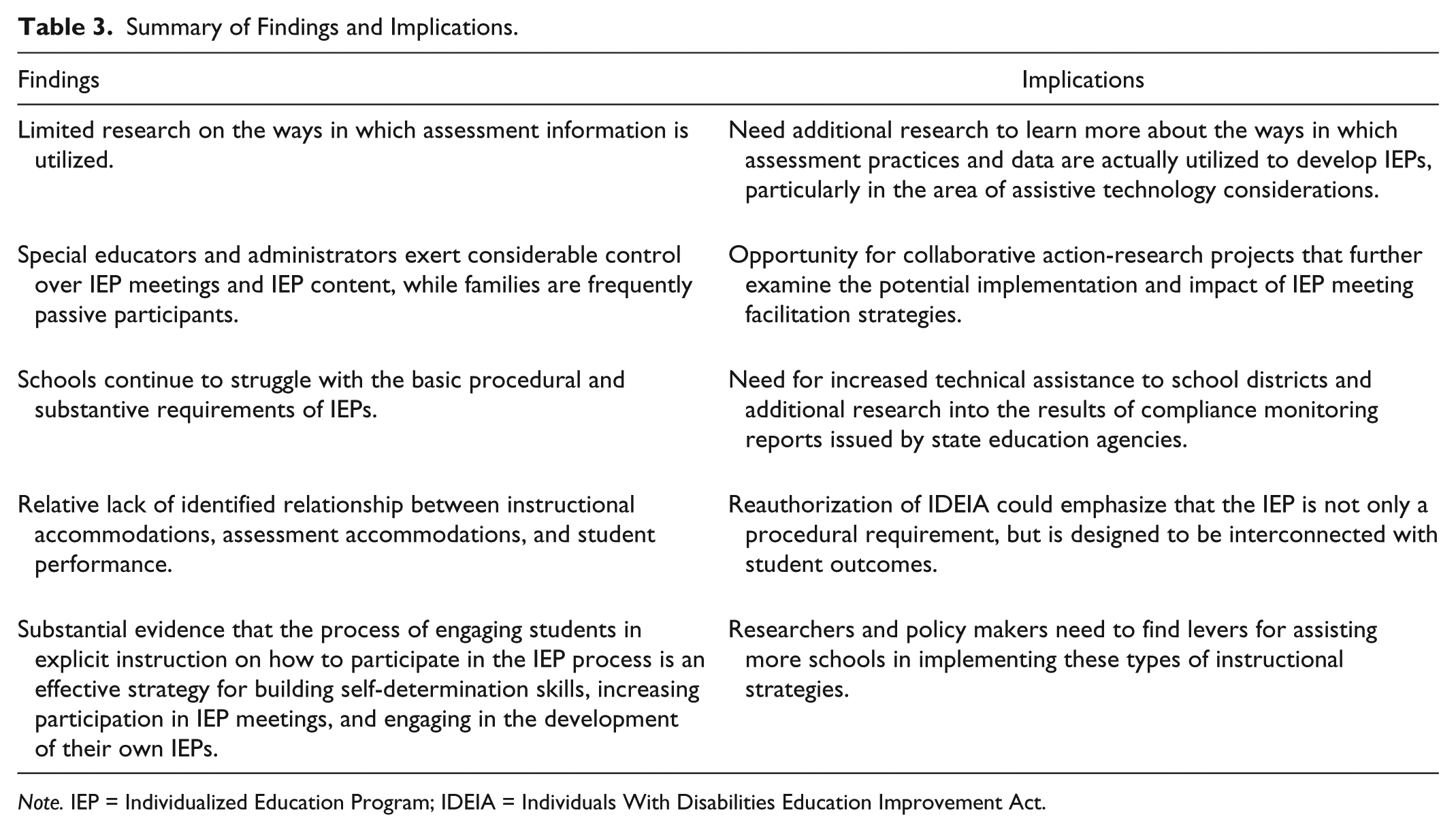
The central question to this discussion was: “How can these findings inform future research, practice, and policies related to IEP development?” The discussion is presented for each category of IEP development research (assessment information considerations, dynamics of IEP meetings, IEP content, and student participation in the IEP development process). Table 3 provides an overview of the findings and implications.
Summary of Findings and Implications.
Note. IEP = Individualized Education Program; IDEIA = Individuals With Disabilities Education Improvement Act.
Concerning the relationship of assessment practices to IEP development, there was comparatively limited research on the ways in which assessment information is utilized. The existing research leads to concerns about the extent to which assessment practices inform curriculum and program development within the context of the IEP (Siegel & Allinder, 2005). It would be informative for researchers to learn more about the ways in which assessment practices and data are actually utilized to develop IEPs that effectively individualize services for students with disabilities based on their strengths and needs. Perhaps more notably, there was only one study (Watts et al., 2004) focused on assistive technology considerations during the IEP process. Considering the rapid ascent of available and affordable assistive technologies, additional research needs to be conducted to ensure that this important aspect of IEP development and special education services is being effectively addressed by practitioners.
The research on the dynamics of IEP meetings produced consistent findings that align with the anecdotal experiences of many IEP participants. Special educators and administrators exert considerable control over the direction of IEP meetings and content, while families are frequently passive participants (Fish, 2008; Gaffney & Ruppar, 2011; Garriott et al., 2000; Lo, 2008; Martin et al., 2004; Salas, 2004; Wagner et al., 2012; Zeitlin & Curcic, 2013). These findings clearly suggest that the federal intention of parents and guardians being equal partners in collaborating with schools to develop IEPs is not being realized. Furthermore, some researchers found different rates of participation and satisfaction in IEP meetings based on differences in characteristics including the child’s disability, the family’s level of income, and the family’s racial/ethnic background (Wagner et al., 2012). The research from Childre and Chambers (2005) offers a potential solution to some of these challenges through the use of IEP planning tools that are designed to foster a more collaborative IEP development process. There is an opportunity for collaborative action-research projects that further examine the potential impact of IEP meeting facilitation strategies. Special educators and administrators need to be provided with training to improve their facilitation skills, and families can benefit from established processes that are proven to balance the roles of team members during IEP development.
The research on IEP content raises a number of important implications for practitioners, researchers, and policy makers. The studies on IEP development as it relates to legal requirements and procedures present concerning findings. The research indicates that schools continue to struggle with the basic procedural and substantive requirements of IEPs (Drasgow et al., 2001; Etscheidt, 2003), including components related to secondary transition planning (Landmark & Zhang, 2013; Shearin et al., 1999). In addition, multiple studies (Agran et al., 2002; Espin et al., 1998; Kwon et al., 2011; Mattie & Kozen, 2007; Millar, 2009; Ruble et al., 2010) reported findings that raised concerns regarding IEP content, including the quality of IEP goals and objectives and the extent to which the goals facilitated access to the general education curriculum.
Considering the emphasis placed on compliance monitoring and procedural safeguards in both federal and state special education laws, as well as the clear mandate that the IEP is an individualized program, this is an important area for future research and increased technical assistance. District-level compliance monitoring reports issued by state education agencies could provide valuable data in better understanding the extent to which schools are able to fulfill the IEP development requirements as outlined in federal and state laws. Future research projects can continue to examine the extent to which IEPs are individually designed, through comparisons of IEPs within and across schools and districts. In addition, the expanded use of specific training models for improving IEP content (Campbell et al., 1998; Clark et al., 2004; Doren et al., 2013; Jorgensen et al., 2007; Rehfeldt et al., 2012) offers another potential avenue for improving the procedural and substantive content of IEPs. Implementation of any such models should include assessment and follow-up to ensure that school staff achieved and maintain stated goals and outcomes.
Also related to the existing research on IEP content development, the relative lack of identified relationship between instructional accommodations, assessment accommodations, and student performance is an important area that merits closer examination (Turner et al., 2000; White et al., 2003). As the IEP is supposed to serve as the central point for educational planning for students with disabilities, more information needs to be known on the extent to which the current IEP requirements assist teams in developing and implementing meaningful and effective educational plans. A possible area for future research would be expanding on the work of these authors to further examine the relationship between IEP quality and student performance. Student performance measures could include academic, behavioral, social, and functional assessments. It is recommended that the next reauthorization of IDEIA emphasize that the IEP is not only a procedural requirement, but is interconnected with student outcomes. Language regarding IEP requirements could take on a more results-oriented approach, with an increased focus on progress monitoring and using this information to inform and revise student IEP content.
Finally, in considering the findings from published studies on IEP development, the research on student participation in IEP meetings and IEP development is particularly noteworthy. The research has provided substantial evidence that the process of engaging students in explicit instruction on how to participate in the IEP process is an effective strategy for building self-determination skills, increasing participation in IEP meetings, and engaging in the development of their own IEPs (Arndt et al., 2006; Danneker & Bottge, 2009; Hammer, 2004; Kelley et al., 2013; Konrad & Test, 2007; Konrad et al., 2006; Martin, Van Dycke, Christensen, et al., 2006; Neale & Test, 2010; Snyder, 2002; Test & Neale, 2004). The potential importance of student participation in the IEP development process has been emphasized by results from a study (Barnard & Lechtenberger, 2010) that indicated a positive relationship between student participation in IEP meetings and increases in academic achievement. As the next reauthorization of IDEIA approaches, it is important for researchers and policy makers to find levers for assisting more schools in implementing these types of instructional strategies. While the articles written by Barrie and McDonald (2002) and Mason et al. (2004) examined issues related to increasing student participation in the IEP process from the perspectives of educators and schools, additional research is needed in this area. Further research will better enable technical assistance organizations, universities, and schools to increase the knowledge and skill-base of educators and administrators regarding student participation in the IEP process. Federal and state laws might also consider increasing the requirements for student participation in IEP meetings and IEP development, or providing a more explicit definition of what constitutes student participation.
Limitations
This literature review was limited to peer-reviewed research articles published since the 1997 reauthorization of IDEA (1998-2014). As federal special education law was originally enacted in 1975, there are over two decades of studies that were not included in this literature review. It should also be noted that this review focused on studies related to IEP development. There could be significant research published on IEP implementation that was not considered in the present project. The translation of IEPs into a cohesive delivery of specialized instruction, related services, accommodations or modifications, and other individualized supports reflects a complex process during which there is potential for a wide variety of outcomes with many possible barriers to or facilitators of quality. Literature in this domain is important to examine, and will likely be a subject for a future study. Finally, this study attempted an exhaustive review of the literature within the stated criteria as opposed to a qualitative meta-synthesis or quantitative meta-analysis of research findings. The other types of analyses can contribute additional depth to each of the categories and subcategories reported in this literature review.
Conclusion
The literature reviewed for this study covered a variety of aspects of IEP development. While the research on student participation in IEP meetings and IEP development is promising, there are other areas of practice that need further research and increased policy emphasis. If the IEP is to remain a central component of special education requirements and practices, then there should be a continued emphasis on better understanding how IEPs are developed and implemented for students across the spectrum of disabilities and grade levels. The IEP is the conceptual and practical intersection of policy, schools, and families of students with disabilities. As such, it most definitely is the foundation for effective special education and related services and positive student outcomes. When the IEP is viewed only as a paperwork requirement, then a crucial opportunity for developing and implementing meaningful educational experiences for students with disabilities will be missed, and the intentions of IDEIA will not be fulfilled.
Footnotes
Declaration of Conflicting Interests
The author(s) declared no potential conflicts of interest with respect to the research, authorship, and/or publication of this article.
Funding
The author(s) received no financial support for the research and/or authorship of this article.