




Abstract
This study investigated the effects of a co-teaching training program on female pre-service teachers of special education at the Faculty of Education, King Saud University. It also examined whether the participants’ academic majors affected their total knowledge gains obtained from the administered training program. A co-teaching training program was designed to train the assigned participants of the study on the main principles of co-teaching. Fifty-one female pre-service teachers were randomly selected to receive the co-teaching training program for six sessions. They studied in four different academic majors: behavioral disorders, mental disabilities, learning difficulties, and deaf and hearing impaired. A pre-measurement scale was administered prior to the treatment and immediately after the treatment to see the possible knowledge gains from the program. Results revealed significant improvements in the students’ knowledge from pre-treatment to post-treatment. However, no statistically significant differences among the participants could be ascribed to the participants’ academic majors. Recommendations, limitations, and tips for future studies have been provided.
Introduction
A new trend adopted by many international organizations, such as Individuals with Disabilities Education Improvement (Individual with Disability Education Improvement Act (IDEA) 2004), has been to focus on how students with disabilities learn rather than where they learn (McDuffie et al., 2009). Inclusive education, an approach that expresses how to change educational structures and other learning atmospheres to meet the needs of the variety of learners (UNESCO, 2005), is one the best strategies used to integrate students with disabilities with their peers in general education, considering that isolating learners with disabilities from accommodating with their peers deter them from academic achievements and thus could negatively affect their learning outcomes (Jeannite, 2018). Furthermore, one of the benefits of inclusive education is to raise the self-esteem of learners with disabilities and build their self-confidence to be part of society and not to feel that disability has a stigma. The considerable demand for inclusive education is justified by the increasing number of students with learning disabilities and related minor disabilities worldwide who receive their education in public schools (Gebhardt et al., 2015).
The current study is based on international statements reported by my many international organizations such as IDEA (2004) and Slamacana statement which affirm the right for any individual to receive education specially children with disability. Another justification to conduct such a study related to the study context where it was carried out in Saudi Arabia that could meet the Saudi Arabian Vision 2030, which devoted to achieving a successful comprehensive integration of students by building a comprehensive learning environment for all students. This could be achieved through creating high-quality curricula that meet all students’ needs by applying the best modern educational practices and developing teachers’ capabilities to promote education to its highest levels and achieve effective outcomes that accomplish social development of the Saudi society (Vision 2030, 2016). Therefore, the current study aims to find out how pre-service teachers who teach students with disabilities can improve their teaching capabilities to align with Saudi Arabia Vision 2030.
Comprehensive education is the simplest way to describe public education of students with disabilities according to accommodations that suit their individual needs. For comprehensive education to succeed, schools require conditions of high-quality services, well-trained teachers, supportive staff and financial resources (Bouillet, 2013; Curski, 2008). Therefore, conditions in Saudi Arabia have been established to ensure the successful implementation of comprehensive education. The most important conditions are the collective work of each person involved, involvement of parents, modification of curricula and teaching practices and provision of support for staff and students. These conditions allow team members to exchange knowledge and skills and help improve achieving learning goals. The optimal benefits of comprehensive education have not only benefited learners with disabilities who require individual educational support but also non-disabled students. However, this approach involves the significance of thoroughly developing each lesson’s work agenda, so teachers and students can focus on its instructional objectives (Villa et al., 2013).
This research study emerged from the urgent need to provide a database that contributes to co-teaching methods’ optimal employment in regular classrooms within comprehensive education programs. This goal is achieved through the special-education teacher and the public-school teacher’s cooperation in the regular, “less restricted” classroom environment, considering individual differences of students with special needs (The IRIS Center, 2018). The significance of the present study lies in directing educators’ attention to the importance of co-teaching, in identifying models for its application and in identifying competencies teachers need to implement co-teaching successfully. Therefore, this study aims to find a training program’s effect on female special-education pre-service teachers through a newly developed co-teaching training program at King Saud University and to reveal their knowledge level according to academic track. Additionally, the study identifies the importance of pre-service training and measures the training program’s effect on student teachers’ understanding of the co-teaching concept. The study attempts to answer the following two questions:
Do pre- and post-measurement performances in the co-teaching concept differ significantly among female special-education student teachers?
Do pre- and post-measurement performances in the co-teaching concept differ significantly according to academic track among female special-education student teachers?
Literature Review
Legislative law has continued to protect the rights of students with special needs and to provide access to free comprehensive education in regular classrooms by highly qualified teachers and private education teachers since the Salamanca Declaration (UNESCO, 2019), the United Nations Convention on the Rights of Persons with Disabilities (2006) and other laws on eligibility for free education and less restrictive environments. The No Child Left Behind Act (U.S. Department of Education, 2001) has contributed to consideration of co-teaching by emphasizing students’ need to access the public-education curriculum with all schools meeting all students’ comprehensive educational needs and all students having access to effective learning, including those with disabilities (Friend, 2017). To raise schools’ performance levels, school teams needed to collaborate and provide differentiated teaching according to needs in regular classes (Tomlinson, 2017). Collaboration is one of the best strategies used to ensure educational interventions success especially for students with special needs.
The Every Student Succeeds Act (ESSA; U.S. Department of Education, 2015) confirmed for the first time that all United States students are taught according to academic standards sufficiently high to prepare them to succeed in university study and their careers. ESSA’s implementation has resulted in the historically highest graduation rates from high schools, while dropout rates have fallen to a historical low (Every Student Succeeds Act (ESSA), 2015). Therefore, in accordance with ESSA’s accounting system for low graduation rates, U.S. schools have become keen on instructional quality and providing public-school services to students with special needs. Additionally, the Council for Exceptional Children raised the importance of teachers’ awareness to apply evidence-based practices (Council for Exceptional Children [CEC], 2014). The previous literature stated a considerable need to identify how teachers conceptualized evidence-based practices and how to develop their knowledge about them (Gapsis, 2017). Although IDEA mandates that teachers use evidence-based practice with the students with special needs, some of them do not apply it in their classrooms, affecting practice opportunities (Scheeler et al., 2016).
Teacher preparation programs need to develop pre-service teachers’ skills in using evidence-based practices including co- teaching skills. Moreover, these programs should prepare teachers to practice these skills efficiently in the classroom with students with disabilities and their peers (Scheeler et al., 2016). Teachers’ preparation programs should prepare pre-service teachers to be well-informed, aware of their own strengths and appreciate the impact of the environment on their instructional decisions. It is known that pre-service teachers are trained in many teachers’ preparation programs in evidence-based practice. However, training to use and generalize newly acquired skills to classrooms is still lacking. Hence, teacher education programs should orient pre-service teachers to be aware in selecting and implementing practices that were supported by research findings (Detrich & Lewis, 2013). Faculties of education are the best places that could refine the capabilities, competencies, and skills of pre-service teachers to be capable to practice co-teaching skills collaboratively with their peers. Cooperation among teachers is the key for successful co-teaching (Abbye-Taylor, 2013). In addition, preservice teachers need to be trained in how to achieve the students’ learning outcomes by providing them with the most effective tools and teaching strategies.
To develop pre-service teachers’ skills, studies (Kim & Pratt, 2021; Sebald et al., 2021) indicate that it is useful to practice co- teaching with pre-service teachers until they master it. This will ensure that their implementation of co-teaching in future will be better improved with students with disabilities. In addition, Kim and Pratt (2021) suggested that much implementation of a co-teaching in a university classroom would increase positive perceptions of pre-service teachers toward the use co-teaching. Preservice teachers must be prepared in using evidence-based practice in the teacher preparation programs because research suggests that they are likely to continue to practice the same techniques throughout their teaching career (Scheeler et al., 2016).
Studies indicated that the more the implementation of evidence-based practices, the more the progress in students’ performance (Cook et al., 2012). Despite the positive effect of these practices on the learning outcomes of students with disabilities, they are not used effectively and consistently in schools (Aubyn et al., 2018). However, the most important puzzling issues in the field of special education were the limited implementation of evidence-based practices in the classroom and poor teachers’ education programs that meet the needs of students with disabilities (Borgmeier et al., 2016). These deficiencies could be ascribed to the low level of teachers’ competence from the lack of training. According to Faraclas (2018), pre-service and in-service teachers indicated that one of the challenges they faced was that they were asked to implement co-teaching strategies without even receiving sufficient training, resulting in difficulty in teamwork. Despite the provision of co-teaching services, teachers do not practice it well. Therefore, they need more training in co-teaching models to improve their self-efficacy in collaboration and to apply these models effectively and successfully (Raybould, 2017). Scheeler et al. (2016) discussed six challenges: insufficient preparation, lack of reinforcement, competing demands, lack of generalization, absence of evidence-based practice culture and lack of expertise.
Efforts to instruct students with learning disabilities sound incomplete if general education teachers and special education teachers do not share educational services for students with special needs in general education classrooms (Dollarage & Lewis, 2011). This initiative requires training them to use teaching strategies based on scientific evidence in teaching general education classes. One of these important strategies is co-teaching.
The increasing number of students with learning disabilities who receive their learning in general education classes with their non-disabled peers within the inclusive education department imposes needs for implementation of reforms and significant changes in teaching practices by teachers of general education and teachers of students with learning difficulties in the classroom. Teaching these students in the classroom has become a responsibility that requires improved communication and cooperation between teachers to ensure the achievement of the planned teaching objectives. Therefore, many collaborative and evidence-based teaching practices have emerged to address the educational challenges of teaching students with learning disabilities in general education classrooms, including co-teaching (McDuffie et al., 2009). Studies have argued that co-teaching as an evidence-based practice leads to improvement in students’ performance and has contributed to meaningful learning (Hurd & Weilbacher, 2018). Training in co-teaching in teacher education programs is an urgent need and is driven by pedagogical theories, considering it the most appropriate strategy for engaging students with learning difficulties in regular classes (Ellis & Gary, 2018).
Despite this, the limited use of evidence-based teaching strategies in the classroom and providing effective teachers’ education programs to meet students with special educational needs remains a crucial issue in special education since the release of the special education laws (Borgmeier et al., 2016). Many educators have agreed that the wide application of evidence-based practices leads to augmenting the students’ learning performance (Cook et al., 2012; Slavin, 2008). However, evidence-based practices are still not up to the expected level in classes of students with disabilities (Pellicano et al., 2018), possibly because of a lack of pre-service teacher training. Previous studies (Pancsofar & Petroff, 2013) have demonstrated that teachers’ practices of co-teaching could be shaped before and during service besides their individual practical experience of co-teaching during the internship program. This finding demonstrates that teacher education programs have a pivotal role in preparing teachers for evidence-based practices such as co-teaching. Raybould (2017) also reported that teachers continue to see the need for more pre-service training on these evidence-based practices to improve their performance, implement co-teaching and solve challenges to co-teaching. Bantwini (2013) asserts that co-teaching training in teacher education programs is a promising practice for enhancing collaborative skills, increasing student participation and contributing to improved classroom teaching and professional growth for all participating teachers.
By contrast, a number of empirical studies have indicated that effective professional development should be characterized by five basic elements: adequate training duration, meaningful content, coherence, active learning, and group participation (Darling-Hammond et al., 2009; Snow-Renner & Lauer, 2005). Given educational frameworks, current inclusion practices and differentiation demands that all depend on teachers working together, the adoption of co-teaching within the framework of the teacher education and in-service training program is an urgent and fundamental need for education (Ellis & Gary, 2018). Chitiyo and Brinda (2018) conducted a study that aimed to reveal the level of education programs of teachers who use co-teaching. The study found that the majority of teachers are not well prepared. Although they understand the basics of co-teaching, they need training in how to implement it efficiently. Cramer et al. (2010) confirmed that the need for training in implementing co-teaching, especially in the selection, planning and application of different methods of co-teaching. In this regard, Barnes (2017) recommended that teacher education programs should be evaluated to determine whether teachers perceive themselves qualified enough to be involved in co-teaching.
Several studies (e.g., Chapple, 2009; Gebhardt et al., 2015) have recommended and highlighted the importance of training teachers, students and co-teachers on inclusive practices and the needs of students with disabilities. This training helps the next generation of teachers become prepared for co-teaching in a comprehensive learning environment. To the best of the author’s knowledge, studies that address the issue of pre-service teachers training on the co-teaching model are lacking. Thus, the present study is needed for training pre-service female student teachers in co-teaching skills.
Theoretical Framework
Co-teaching is often applied by special and general educators who are considered part of an initiative to create a more comprehensive classroom (CAST Professional Publishing, 2021). Bin Jalal (2018) defined co-teaching as a “teaching model in which public-education teachers collaborate with teachers of students with disabilities in planning, teaching, and evaluating responsibilities within the classroom that includes students with learning disabilities in middle and secondary schools, and it is applied in several ways.” Abahusain and Al Hussein (2016) further explained that “[co-teaching] is an educational process, based on collaboration and cooperation between regular classroom teachers and learning-difficulties teachers. They collaborate in presenting subjects and educational plans for the benefit of students in general and those with learning disabilities in particular and is applied in different ways.” Wilson (2006) stated that co-teaching is a combination of public and special-education teachers who teach in public school, and in most forms of co-teaching, teachers plan to coordinate and adapt lessons using a variety of strategies, followed by evaluation of student performance.
Co-teaching models
Several studies Cook and Friend (2017); Friend and Cook (2010); Lerner and Beverly (2014) have explained that co-teaching involves professionals who plan for education and implement it using six methods.
One characteristics of this model is that a teacher instructs all the students even if they are assigned in different groups, leading to achieve equivalence resulting from the equal status between students and their teacher. Station teaching requires teachers to share responsibility for planning to divide the instructional content. It has the advantage that each one has separate responsibility to deliver the instructional content. Thus, this method can be fruitful when teachers have different teaching strategies or do not know each other well. However, teachers must be careful in dividing the content and taking into account the importance of knowledge sequence so that it does not affect students’ understanding.
By using these six methods, teachers achieve the goals and objectives of individual education programs for students with disabilities, while at the same time helping to meet other class members’ educational needs (Al-Sudairi, 2019).
Previous Studies
Bin Jalal (2018) identified the effects of a co-teaching model in middle and high schools as perceived by the study participants, students with learning disabilities and their teachers (N = 323). The study also attempted to determine the efficiency of the co-teaching model and reveal if there were statistically significant differences that could be attributed to the type of work and co-teaching training and identified the correlation between the implementation and the effectiveness of the program. Results showed a high level of effectiveness of the co-teaching model and found significant differences that ascribed to the work type for the benefit of the public-education teachers and students with learning disabilities.
Abahusain and Al Hussein (2016) also conducted a descriptive study identifying the situation of implementing co-teaching in learning-difficulties programs in Riyadh, Saudi Arabia. Results indicated learning-difficulties teachers’ high level of knowledge of co-teaching, its components and the basics of its implementation.
Following a descriptive approach over two consecutive semesters, Shaffer and Thomas-Brown (2015) identified practical foundations of the teaching style that integrates co-teaching and professional development. The sample consisted of two teams of public-school teachers and a participant’s special-education teacher. Data were collected through informal conversations, self-reports and semi-permanent interviews. The most important study results were that teamwork is a main element in the co-teaching professional development model.
In another descriptive study, Magiera and Zigmond (2005) compared the effect of a special-education teacher’s presence in public classes on the educational experiences of middle school students with disabilities to the same students’ experiences when taught by a regular teacher under routine educational conditions. Study results indicated statistically significant differences in target students in the interaction between the public-education teacher and individual education.
Using a questionnaire to address the challenges that face co-teaching, Chitiyo and Brinda (2018) conducted a study to reveal co-teachers’ extent of prior training. The result of descriptive analysis showed that most teachers were not properly trained and that such training was urgently needed. Similarly, Chapple (2009) conducted a descriptive study that aimed at identifying the obstacles facing successful co-teaching teams and provide solutions to these obstacles. Data were collected through interviews with a sample (N = 15) from general teachers, special education teachers, school leaders and university professors in the field of co-teaching in the US. Results revealed that the most major obstacle facing the co-teaching teams is the lack of professional development; the study revealed that workers who received professional training before applying co-teaching were more compatible and achieved greater communication and integration in collaborative classes. Another obstacle is time allocated for planning co-teaching because setting time for lesson planning in teachers’ timetables was difficult. Additionally, low professional satisfaction, low compatibility and poor cooperation were reported as obstacles that limit co-teaching success.
Sims (2010) investigated whether the professional development resulting from co-teaching affects the improvement of teachers’ attitudes toward students with disabilities, their teamwork when implementing co-teaching and their teaching competence. The author used action research and the mixed-method design in a suburb of Arizona in the US. The study sample consisted of seven teachers who were divided into three teams, each with a special education teacher and a general education teacher, except for one of the teams that consisted of two general education teachers and a special education teacher. Results from a questionnaire, verification forms, focus interviews, class notes and observations using computer programs revealed that the participants’ perceptions and attitudes toward co-teaching improved in curricula objectives and modifications, personal communication and evaluation after conducting a training program. Results also revealed that the training and various sources and support provided to the participants helped them improve their co-teaching competence. Results indicated the participants’ desire to increase professional development in co-teaching to further improve their practice in co-teaching.
To gauge teachers’ perceptions, Malian and McRae (2010) conducted a study that aimed to determine the perceptions of general education teachers and special education teachers toward the compatibility and contradiction between their teaching strategies, their personal characteristics and the effectiveness of co-teaching, using a descriptive survey approach. The study sample was selected randomly and consisted of 290 teachers in general education and special education who implement co-teaching from 160 primary schools. Results revealed that co-teaching reduced the gap between general education and special education. Results also showed no significant differences between teachers of general education and special education in their beliefs, teaching methods and personal characteristics toward co-teaching, reflecting their willingness to cooperate to improve the students’ learning outcomes.
Similarly, Tzivinikou (2015) examined how general education teachers and special education teachers could improve the concept of co-teaching in an inclusive setting in Greece. The study analyzed 15 cases of co-teaching in which the special education teacher supports students with disabilities in an inclusive class from first grade to fourth grade. The study used the descriptive analytical approach, and the study sample was selected convincingly. The sample consisted of 15 classes in general education, and in each class, at least one student with learning disabilities is present. A total of 30 teachers (3 males, 27 females) were included, and the average years of experience for teachers is 10 years. Findings showed that creating a spirit of cooperation between teachers is practical and appropriate, leading to building co-teaching models that cope with the special circumstances in schools. The results showed that the tension and disagreement that existed between teachers in general education and special education disappeared after training in co-teaching. Furthermore, teachers’ attitudes toward cooperative education change after in-service training.
In a qualitative study, Hoppey and Mickelson (2017) explored (1) organization of a partnership between a primary school and a college of education in an American state, (2) co-teaching practices to refine teachers’ skills before serving in collaborations and (3) the ability to integrate students with disabilities in comprehensive education classes. Results revealed that partnership played a prominent role in collaborative work, helping pre-service teachers develop their knowledge of policies to meet the needs of students with disabilities. Similarly, Hoppey and Mickelson (2017) conducted a qualitative study to identify the collaboration between a primary school and a US faculty of education and how co-teaching practices could contribute to the improvement of pre-service teachers’ co-teaching skills and the capabilities of integrating students with disabilities in an inclusive education program. The results of the triangulated data collection tools, namely, interviews, observation, lesson plans and journals, revealed that collaboration played an integral part in boosting the cooperative work which helped the pre-service teachers to meet the needs of students with disabilities.
Härkki et al. (2021) explored how co-teaching emerged in light of second-order educational change and the challenges that teachers faced when implementing co-teaching practices. The authors conducted their study in the Finnish context in which L2 teachers were recruited to appear in a semi-structured interview. Many themes and sub-themes were generated to focus on six topics: planning, co-teaching concept, shared reflection on time, structural support, and linear pedagogy. Results showed that co-teaching in the Finnish context was highly implemented that could help develop teachers’ co-teaching practices. The participants reported that insufficient planning time and low resources and instructional materials were the top barriers facing implementing meaningful co-teaching.
Barnes’s (2017) mixed-design case study determined the effects of professional development in co-teaching on teachers’ attitudes and classroom practices in California middle and high schools. Results concluded that time planning, managerial support and teacher-related teaching methods were some of co-teaching’s influential factors. Similarly, Jeannite (2018) qualitatively examined how co-teachers from general education and special education programs used strategies to improve the concept of co-teaching and identify the students’ academic achievement. The results of the structured and semi-structured interviews with the sample teachers indicate that lack of training, poor instructional strategies to teach students with disabilities and low content awareness were the main reasons for the low competencies of general and special educations teachers to meet the challenges of integrating the students with disabilities with non-disabled students. Kim and Pratt (2021) investigated the pre-service teachers’ perceptions about co-teaching after they received a co-teaching program in a special education context. Their participants viewed positive attitudes to the co-teaching paradigm and showed their willingness to carry out co-teaching in their future careers. They also expressed the role played by the university to form positive opinions about co-teaching and its optimal benefits on achieving learning outcomes.
Research on how to find out effective strategies that helped pre-service teachers to accommodate students with disabilities in inclusive classrooms is severely lacking. In the Saudi Arabian context, to date, no single study has investigated how pre-service teachers could be prepared to meet the needs of students with disabilities to be a part of general education and to integrate them with their peers of non-disabled students through implementing a co-teaching strategy. Therefore, it examining empirically the feasibility of preparing pre-service teachers is of paramount interest, as is finding out how the possible gains of a training program prepared by the author are moderated by the variable of the academic track of the participants.
Method
Design
The present study adopted a quasi-experimental design, specifically, a design with one group that received the treatment where the author is interested to see the development of the group from the pre- to the post-measurement as a result of the independent variable (i.e., the co-teaching training program).
Sample and Population
The study population consisted of female pre-service teachers (N = 100) in the Department of Special Education, College of Education, King Saud University, 2017 to 2018. The participants studied in four different academic majors; Behavioral Disorders, Mental Disability, Learning Difficulties, and Deaf and Hearing Impaired. All the population (N = 101) of the study was invited to take part. A random sample of 51 was chosen to compose the sample of the study where they received the training program. The sample was told that their participation in the treatment was voluntary and those who agreed to participate were selected to take part in the study. Table 1 shows the distribution of sample participants according to the academic major variable.
Distribution of Sample Participants According to Academic Major Variable.

Instruments
The data collection tools consisted of the following:
First: The co-teaching training program
The co-teaching training program included six training sessions based on this study’s general objectives and recent literature. The program’s main outline was as follows.
The co-teaching model’s emergence and historical context
Laws and legislation that support co-teaching
Definition of co-teaching, as distinguished from related concepts
Elements of co-teaching
Stages of co-teaching
Implementation methods of the co-teaching model
Competencies of co-teachers
Obstacles to implementation of co-teaching
Benefits of implementation of co-teaching
Principles of collaboration between co-teachers
Advantages and disadvantages of co-teaching
The most significant challenges that teachers and students might face in implementation of the co-teaching model.
The program was carried out with the participants of the present study who had voluntarily agreed to be involved in the treatment to receive the content during (6) sessions. The participants’ background knowledge had been determined through the administering a scale prior to the treatment (see Appendix 1). Next, the program sessions (N = 6) have been implemented for about 4 hours a day; each session lasted for 30 minutes and preceded by a pre-evaluation session and a post-evaluation session. Each session included a specific goal stemmed from the predetermined goals, which were 12 goals using various teaching strategies such as: lecture, discussion, work groups, practical application, video, stories, brainstorming, worksheets, training games, and a mini teaching. After reviewing the theoretical framework of the program regarding the goal of the six co-teaching strategy, the micro-teaching strategy was adopted by the participants as a type of diagnostic activities to ensure the appropriate performance of the participants for those strategies. The participants were provided feedback during the sessions to develop performance and the weaknesses were investigated with the trainers as to be avoided.
The participants showed high positive impressions of the quality of the information presented. They expressed their positive perceptions through meaningful comments during the sessions. It was also observed through their involvement with the program activities. The participants unanimously agreed that this kind of training on co-teaching was presented in scientific form. In addition, the views of the participants about the program were collected through a survey conducted by the department administration to evaluate the program at the end of the day, resulting in positive responses.
Second: Scale design
The researcher designed a scale to measure the participants’ gain of the program |and was administered before and after the training program’s implementation. The scale has been constructed by the author to achieve the training program outcomes used as a main intervention of the present study. The author built the scale considering the previous literature related to the co-teaching models and the surveys used in the previous studies that examined the efficacy of co-teaching to aid learning objectives (Brown, 2013; Friend, 2016; Friend & Cook, 2010; Gately & Gately, 2001; Tzivinikou, 2015; Wilson, 2006). The scale is composed of 24 statements (Appendix 1), using a multiple-choice question on a three-point Likert scale (agree, neutral, disagree). The scale was validated to ensure reliability and validity. It was first sent out to seven specialist referees from different disciplines. They provided their constructive feedback and new modifications were made based on their suggestions. The final 24 statements that composed the scale were produced in their final forms. Statistically, Pearson correlation was run to calculate the degree of correlation of each item with the scale’s overall correlation. Table 2 shows these correlation coefficients. Cronbach’s alpha was also used along with the split-half equation to confirm the reliability of the scale, and it is depicted in Table 3.
Pearson’s Correlation Coefficients of Questionnaire Items.
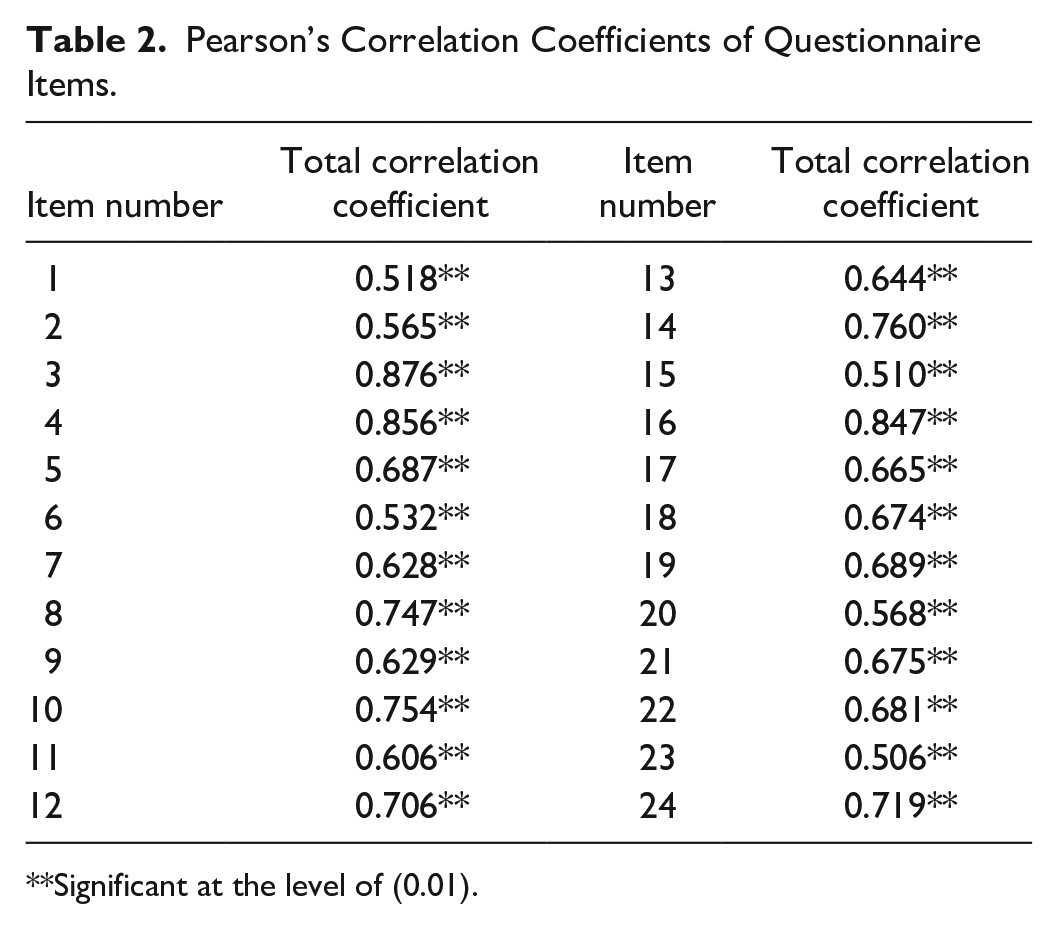
Significant at the level of (0.01).
Calculation of Scale Consistency by Cronbach Alpha and Half-Split Equations.

Table 2 indicates that every statement has a high internal consistency with the total items, meaning that a high validity of the scale items was found. The consistency is summarized in Table 3.
Table 3 shows that the Cronbach’s alpha coefficient of consistency was 0.765 while the split-half segment was 0.710, indicating that the tool has an acceptable degree of reliability because it exceeds the reliability threshold (>0.7). Therefore, the findings can be generalized to other populations in the field.
Data analysis
Descriptive and statistics (frequency, means and standard deviation) were used to answer the research questions. Furthermore, inferential statistics (paired-sample t-test, one-way ANOVA) were used to identify the development of students’ gains before and the post-treatment. The statistical significance was used at the level of 0.05.
To answer this question, the researcher used the paired-sample t-test, and the results are shown in Table 4.
Paired-Sample T-Test Results for Statistically Significant Differences Between Pre- and Post-Measurement.

Statistically significant at 0.05 and below.
The results in Table 4 indicate statistically significant differences at 0.05 between pre- and post-measurements in favor of post-measurement, thereby indicating that the proposed training program was effective in developing the co-teaching concept among female special-education student teachers.
To answer this question, the researcher used one-way ANOVA analysis, with results shown in Table 5.
Results of One-Way ANOVA for Differences in Post-Measurement by Academic Major Variable.

Results in Table 5 indicate no statistically significant differences at 0.05 in the study sample’s post-measurement performance by the variable of academic major.
Discussion
This study sought to understand whether a designed program that entailed a co-teaching strategy could improve their knowledge about the concept of co-teaching. The participants of the present study were pre-service teachers of students with disabilities from different academic departments. After the comprehensive training sessions, the results obtained from a scale showed the positive effect of the training program in developing the concept of co-teaching among the pre-service teachers, indicating the contribution of the training program to the development and growth of the concept among the study participants. This finding could be attributed to a number of reasons that are related to the training program and the study participants.
The training program includes the meaningful content training program, time appropriateness, the activities and experiences in which the participants were involved and a variety of strategies used such as lecture, discussion, cooperative learning, brainstorming and problem solving. These approaches helped the participants acquire skills. The training program was also concerned with providing room for involvement and interaction between the trainer and the participants through group discussions.
The study participants showed their willingness to get training and their desire to benefit from these skills presented and their awareness of the intended objectives and clarity of objectives for the participants, making them interested in achieving the planned objectives at the end of training. Furthermore, the participants’ use of their experiences greatly helped in developing and consolidating the concept of co-teaching.
The present study results corroborate with Chapple’s (2009) findings where teachers who received professional training before implementing co-teaching were more compatible and achieved greater communication and were much more inclusive in co-teaching sessions, thereby emphasizing the importance of training prior to implementing co-teaching lessons. This finding is also confirmed by Tzivinikou (2015), who revealed that the tension and dispute that existed among teachers in general education and special education disappeared after receiving training in co-teaching and teachers’ attitudes toward cooperative education dramatically changed after they received training. The results of this study were also in line with the findings of Abahusain and Al-Hussein (2016), in that the lack of training is one of the biggest obstacles facing general education teachers and learning difficulties.
This result is also consistent with Bin Jalal (2018), who found that the differences tend to favor female teachers who received training in co-teaching, indicating the high effect of pre- and in-service training on co-teaching. These findings also agree with those of Shaffer and Thomas-Brown (2015), who argued that the professional training on co-teaching implementation would mainly depend on teachers’ cooperation and their willingness to use it. This result was demonstrated during the training application of the participants who accepted this type of training, their cooperation in understanding some co-teaching concepts and their involvement in co-teaching exercises.
This finding is consistent with those of Sims (2010), which demonstrated that training, diverse resources and support provided helped teachers raise their competence toward co-teaching. The study also revealed the participants’ desire for extra professional development about the co-teaching to further improve their practice of co-teaching.
The results of this study agree with those of previous studies findings (Barnes, 2017; Chitiyo & Brinda, 2018; Härkki et al., 2021; Kim & Pratt, 2021) that the more the teaching education programs, the higher the level of co-teaching practices that teachers would obtain. More training programs for teachers would also enhance teachers’ positive attitudes, thereby leading to improvement in their co-teaching implementation.
The second research question investigated whether statistically significant differences in the participants’ knowledge from the training program could be attributed to their academic major. No significant differences were found. A possible justification for this result is that the training program was presented to all participants in the same manner, and the target gains were attained regardless of the students’ academic majors. The participants’ prior knowledge and the courses they received during their academic career are the same, and the field training period in the major is the same. In addition, the whole group’s showed considerable enthusiasm for the training program sessions, making them achieve similar results. This finding aligns with those of Malian and McRae (2010), which showed no differences between special-education and public-education teachers and their beliefs about co-teaching. This result is consistent with those of Hoppey and Mickelson (2017), which indicated that co-teaching practices contribute to improving the level of co-teaching for pre-service teachers. This finding is also observed during training which the participants showed high cooperation, leading to positive results.
The present study results are partially consistent with those of Shaffer and Thomas-Brown (2015) in that teachers’ acceptance of the co-teaching model plays a pivotal role in successful teaching. This finding is indicated by our results which showed no significant differences obtained between pre-service teachers with different academic majors in comprehending the concept of co-teaching. All the participants showed progress in conceptualizing co-teaching.
Likewise, the present study results are in line with those of Shaffer and Thomas-Brown (2015) that teachers’ acceptance of the co-teaching model is the most important factor in teaching success. Our results indicate no statistically significant difference in developing the concept of co-teaching among the pre-service teachers of the special education department that could be attributed to the academic major. All the participants showed considerable improvement in the concept of co-teaching. Results of the present study confirm previous studies findings which emphasized the role of training programs that could enhance the teachers’ knowledge about the co-teaching concept. For example, Jeannite (2018) argued that the absence of training programs would boost the teachers’ professional development regardless of their academic majors. Similarly, Bin Jalal found that no differences were recorded among the teachers who received training that could be ascribed to academic major. The results are also consistent with those of Barnes (2017) and Kim and Pratt (2021), which affirmed that the co-teaching concept was similarly obtained by teachers in different academic majors. They affirmed that teaching strategies and the role of the institution would help in successful teaching and ensure the best implementation of co-teaching. By contrast, the study findings contradict those of Magiera and Zigmond (2005), who found significant differences in favor of special education teachers over general education teachers in providing instructional experiences for students with disabilities.
Conclusion
This study draws on global application trends of the intervention response model that considers co-teaching one of the most important early intervention strategies. Additionally, as far as the author knows, this study is one of the first directed toward female student teachers to raise their co-teaching awareness. The study revealed the effectiveness of the training programs that focused on improving the pre-service teachers’ co-teaching skills that enable them to adopt the newest strategies to meet the students’ needs and help integrate them with non-disabled students in general education. The study found statistically significant differences in the participants’ gains for the content proposed in the training program from the pre-measurement to the post-measurement achievement, indicating that pre-service teachers need to be fully oriented on skills and capabilities that help them improve their teaching skills and provide them with the newest techniques and strategies to accommodate the students with disabilities to be a part of the society and integrate them in general education.
Limitations, Recommendations and Tips for Future Research
The study was conducted during the intact class where the participants received their normal classes at their university. Future studies are recommended to examine training programs on teachers of special education and general education programs. One limitation of the present study is the absence of a control group. Future research could manipulate a control group that would receive no intervention; the participants’ gains from such programs would be compared. The present study recommends that policymakers augment training workshops for pre-service teachers and normal teachers to improve their teaching skills and prepare them to be oriented with new trends in teaching strategies that help achieve learning outcomes and improve the students’ knowledge and abilities to learn new concepts and gain knowledge. Another recommendation is to increase the number of pre-service training programs to develop concepts of teaching students with special needs in comprehensive education schools. Supervisors and special education and general education teachers are also advised to improve themselves and find ways to implement mechanisms that help to implement comprehensive education in schools.
Footnotes
Appendix 1
Declaration of Conflicting Interests
The author declared no potential conflicts of interest with respect to the research, authorship, and/or publication of this article.
Funding
The author received no financial support for the research, authorship, and/or publication of this article.
