




Abstract
This study assessed variability in Historically Black Colleges and Universities’ (HBCUs) educational outcomes. Analyses were conducted on two nationally representative databases via hierarchical linear and nonlinear modeling. Intraclass correlation coefficients for HBCUs were compared with those of (a) a random sample—theorized to have no systematic similarity in educational outcomes to HBCUs and (b) a sample of other Predominately Black Institutions (PBIs). Findings indicate that HBCUs’ educational outcomes were generally more cohesive than those of the random sample, and this cohesiveness followed a different pattern than the cohesiveness of outcomes at other PBIs. On the whole, then, this study suggests that educational outcomes at HBCUs are cohesive and distinct from other institutional groups.
Keywords
Despite policy initiatives to the contrary, the achievement gap between Black and White students in post-secondary education persists in the United States. As of March 2010, 33% of White Americans over 25 had completed at least a bachelor’s degree compared with only 20% of Black Americans over 25 (National Center for Educational Statistics [NCES], 2010). Historically Black College and Universities 1 (HBCUs) significantly buffer the severity of this achievement gap—even though these institutions represent a small pool of roughly 100 institutions and capture only 1.7% of total U.S. college enrollment (Aud, Fox, & KewalRamani, 2010). In fact, one of the most up-to-date, comprehensive studies concluded that as of 2001, HBCUs awarded more than one fifth of all undergraduate degrees conferred to Black Americans (Provasnik & Shafer, 2004). HBCUs also reduce the achievement gap among Black and White Americans at the post-graduate level inclusive of critical areas such as Science, Technology, Engineering, and Mathematics (STEM). From 24% to 33% of Black, doctoral recipients in science and engineering earned their undergraduate degrees from HBCUs from 1986 to 2006 (Burrelli & Rapoport, 2008).
However, no generally accepted theoretical model or empirical study demonstrates whether or how HBCUs as a whole are distinct from other post-secondary institutions. Ostensibly, HBCUs appear to be remarkably eclectic. They are about evenly divided in terms of their public (48%) versus private status (52%); 14% are 2-year institutions, and 86% are at least 4-year institutions. More specifically, 4% are classified as Carnegie Doctorial Intensive or Extensive; 30% are Carnegie Master’s Level I or II Institutions; 47% are classified as Baccalaureate Institutions; 14% are Associate’s Institutions; and 5% are Carnegie Specialized Institutions (Coaxum, 2001). Furthermore, Coaxum’s (1999) cluster and discriminant analyses of 86, 4-year HBCUs suggest that these institutions should be classified into 10 categories: nontraditional HBCUs (n = 3), tuition-driven HBCUs (n = 24), diverse programmatic HBCUs (n = 19), highly accessible HBCUs (n = 5), traditional HBCUs (n = 12), community-oriented HBCUs (n = 14), high expectations HBCUs (n = 6), distinct-cluster-but-label-could-not-be-determined group 1 (n = 1), distinct-cluster-but-label-could-not-be-determined group 2 (n = 1), and distinct-cluster-but-label-could-not-be-determined group 3 (n = 1). Hence, the extant literature clearly generates questions about whether HBCUs are more heterogeneous than they are homogeneous.
This heterogeneity in institutional characteristics contributes to ambiguity in extant knowledge about commonly studied educational outcomes at HBCUs (e.g., college grade point average [GPA], Allen, 1992; degree completion, Provasnik & Shafer, 2004; and STEM vs. non-STEM major, Burrelli & Rapoport, 2008) for several reasons. First, most studies on HBCUs (K. Cokley, 2000, 2002; Kim & Conrad, 2006) are based on small, convenience samples of HBCUs that cannot necessarily be generalized to all HBCUs with any reasonable degree of confidence. Second, even nationally representative studies (Provasnik & Shafer, 2004; Wenglinsky, 1996) have not studied the variability in educational outcomes between HBCUs. Consequently, it remains uncertain whether HBCUs produce educational outcomes that are uniform across institutions. HBCUs may generate successful outcomes among Black Americans in a uniform fashion. Alternatively, a subset of institutions may be driving the academic successes typically credited to all HBCUs.
The purpose of this study, then, is to evaluate the homogeneity of educational outcomes at HBCUs. In particular, this study addresses the following research questions via two nationally representative databases:
The first research question produces a benchmark of the variability in educational outcomes at HBCUs themselves. However, this benchmark alone has the potential to be misleading. It fails to assess how the variability in educational outcomes at HBCUs compares with the natural variability of outcomes at other institutional groups. Hence, the second research question estimates the variability in educational outcomes for a random sample for which no systematic similarities in educational outcomes would be expected. The third research question yields further information about the variability of educational outcomes at HBCUs by comparing the variability of outcomes at HBCUs with those of other institutions where there are also high levels of Black American attendance. Together, then, these research questions provide a quantitative estimation of HBCU distinctiveness in terms of educational outcomes.
These findings have implications for whether and how HBCUs should be theoretically conceptualized. In other words, should HBCUs be conceptualized as an institutional group characterized by only one or all of the following: historical ancestry, educational mission, ethnicity of students served, or educational outcomes? In addition, this study’s findings may have implications about the degree of confidence that should be placed in the external validity of small sample studies of HBCUs, as well as how to design those studies. To place this study in better context, I have reviewed the extant literature on educational outcomes (i.e., STEM, GPA, and degree completion) commonly studied in association with HBCUs in the next section.
Literature Review
STEM
According to recent data available from the National Science Foundation (NSF, Division of Science Resources Statistics, 2010), Black Americans are underrepresented consistently among STEM degree recipients in the United States. More specifically, Black Americans earned fewer than 9% of bachelor’s degrees, 7% of master’s degrees, and 3% of doctoral degrees awarded in STEM each year from 1997 to 2006. Female Black Americans have tended to outperform male Black Americans in terms of percentages of degrees earned by gender, however. For example, in 2006, the percentage of total degrees earned by gender among Black American females compared with those earned by Black American males for bachelor’s, master’s, and doctoral were 11% versus 6%; 9% versus 4%; and 4% versus 2%, respectively.
HBCUs’ contributions to the degrees earned among Black Americans have been substantial—with these institutions having awarded 22% of bachelor’s degrees, 17% of master’s degrees, 12% of doctoral degrees earned by Black Americans in STEM in 2006 (NSF, Division of Science Resources Statistics, 2010). With the exception of master’s degrees earned, differentials in percentages of STEM degrees earned by gender appear to be less pronounced at HBCUs than at U.S. institutions as a whole. Black American females (males) at HBCUs earned 23% (20%) of all bachelor’s degrees awarded to Black American females (males) at all U.S. institutions in 2006. Black American females (males) at HBCUs earned 23% (14%) of all master’s degrees awarded to Black American females (males) in 2006; and Black American females (males) at HBCUs earned 13% (11%) of all doctoral degrees awarded to Black American females (males) in 2006.
In addition to awarding degrees in STEM, HBCUs serve as feeder institutions to doctoral programs in STEM at all institutions. Burrelli and Rapoport (2008) reported that 24% to 33% of Black doctoral recipients in science and engineering from 1986 to 2006 earned their undergraduate degrees from HBCUs. Only a subset of HBCUs appear to be substantial feeders of post-doctoral degrees in STEM among Black Americans—given that just 20 HBCUs are in the top 50 feeder institutions. The overall variability in STEM degrees awarded by HBCUs does not appear to have been reported in the literature.
An explanation for success in STEM at HBCUs remains somewhat elusive largely because extant evidence is restricted to case studies. In particular, Perna et al.’s (2009) case study of Spelman College suggests the following factors may drive success at that institution among Black American females: small classes; faculty availability, expectations, and encouragement; dynamic instructional approaches; and institutional supports through the campus career center, peer tutoring, and research opportunities. However, Perna et al. purposefully studied Spelman due to its selectivity and reputation in STEM—which makes generalizing this study’s findings to other HBCUs precarious.
Palmer, Davis, and Thompson’s (2010) examination of four STEM initiatives at an HBCU in a mid-Atlantic state suggests that academic and social integration, or supportive environments, at HBCUs may be an underlying explanation of success at HBCUs. Although Perna et al. (2009) and Palmer et al. developed different labels for factors behind the success in STEM at HBCUs, their underlying explanations appear to be largely synonymous. Jett’s (2011) qualitative analysis of Black American male success in mathematics echoes the importance of supportive environments for four men who began their post-secondary educations at HBCUs. Although not a study specific to HBCUs, Espinosa’s (2011) analysis of Black American female persistence in STEM is similarly indicative of the importance of academic and social integration based on data from 135 institutions in the Cooperative Institutional Research Program (CIRP) from 2004 to 2008. Espinosa also reports that high institutional selectively is negatively associated with persistence in STEM among female Black Americans. This finding may highlight HBCUs’ reputation for being highly accessible institutions (Kannerstein, 1978) as an additional explanation of HBCUs’ success in STEM.
GPA
In his seminal study, Allen (1992) collected data on about 1,800 Black students who attended eight Primarily White Institutions (PWIs) and eight HBCUs in the early 1980s. Black students at HBCUs reported higher GPAs than Black students at PWIs. Allen concluded that HBCUs tended to provide more supportive academic and social environments, which likely fostered higher GPAs among Black students at HBCUs. He also concluded that higher GPAs at HBCUs contributed to higher career aspirations observed among students at HBCUs. Fries-Britt and Turner’s (2002) qualitative analysis based on 19 Black students at an HBCU and 15 Black students at a Traditionally White Institution (TWI) affirmed the connection between GPA and supportive environments at HBCUs. K. Cokley (2000) also reported that Black students at HBCUs have significantly higher GPAs than Black students at PWIs based on a sample of two public PWIs and three private HBCUs. Subsequent research, however, has generated questions about how generalizable these findings on GPA actually are. K. Cokley’s (2002) study on one public PWI and two public HBCUs did not reveal a significant difference in the GPAs across institution type among the 396 Black students studied. In contrast with other studies, Wenglinsky (1996) relied on a nationally representative sample, the National Postsecondary Aid Study of 1990. Although analysis suggested no significant differences in GPAs among Black students across institution type, it did indicate that White students had significantly lower GPAs at HBCUs than at TWIs.
In addition to being equivocal about whether students’ GPAs are higher at HBCUs compared with other institutions, evidence is also unclear about what GPA represents. In other words, do Black American students learn more at HBCUs than they do at other institutions? Flowers and Pascarella (1999) suggested that Black students at HBCUs may learn more in some subject areas, based on a 3-year longitudinal study of 92 Black students who attended an HBCU and 80 Black students who attended a Historically White Institution (HWI) from 1992 to 1995. In particular, HBCU students’ gain scores on the Collegiate Assessment of Academic Proficiency in reading were nearly 0.31-standard deviation higher than those of HWI students. Gain scores on the same standardized instrument in critical thinking were not statistically different across institution type. In contrast, Bohr, Pascarella, Nora, and Terenzini’s (1995) analysis detected no differences across institutions on these same assessments for a sample of 243 Black, HBCU freshmen and 162 Black, PWI freshmen. Both studies are constricted to small institutional sample sizes with data nearly 20 years old—making generalizations further ambiguous.
Numerous threats to external validity complicate drawing generalizations from these prior studies’ findings. In particular, data do not typically reflect recent time periods (Allen, 1992; Wenglinsky, 1996). In addition, conclusions are often drawn from convenience samples of institutions (Allen, 1992; K. Cokley, 2000, 2002) and students (K. Cokley, 2000, 2002). Given the small institutional samples previously available, prior researchers have had little opportunity to examine variability in GPA by institution. This study addresses each of these confounds by relying on more recent data and random samples, and by examining variability in GPA at the institutional level. Thus, it has the potential to shed light on these incongruent findings about GPA.
Degree Attainment
One of the most widely recognized studies on degree attainment was conducted outside of traditional academic circles by the Associated Press (Pope, 2009). This analysis, which was not peer reviewed, reported that the 6-year graduation rate at 4-year HBCUs is 37%, or 4% lower than the 6-year graduation rate for Black Americans at other institutions. However, Kim and Conrad (2006) concluded that Black students at HBCUs and at PWIs were about equally likely to earn undergraduate degrees over a 9-year period. However, all study data for HBCUs and PWIs were drawn from 1985 to 1994. Consequently, the literature does not appear to provide any definitive information about how current graduation rates for Black students at HBCUs compare with those of other institutions. In addition, the literature does not report on the variability in graduation rates across HBCUs.
Two other themes about graduation rates at HBCUs do recur in the literature and throughout academic discussions. First, experts have argued that graduation rates at HBCUs are not logically comparable with those at other institutions. Instead, they suggest that such comparisons are skewed because students at HBCUs come from more challenging backgrounds and are less academically prepared. As Ashley, Gasman, Mason, Sias, and Wright (2009) explained,
Traditional graduation rate measures, which result in lower overall rates for HBCUs than for HWIs, simply do not reflect either the unique educational challenges or significant accomplishments of HBCUs . . . these measures do not capture the distance that students must travel in life to attain their degrees. HBCUs typically move their students past significant barriers of class (as measured by percentage of students receiving Pell Grants) and academic preparation (as measured by median SAT score) to arrive at graduation day. And, they do so with fewer financial resources. HBCUs also enroll a much larger proportion of part-time students, transfer students, and those who step in and out of college due to life circumstances. These students’ degree completion rates simply do not register on a six-year, first-time, full-time graduation yardstick. (p. 4)
Second, the literature typically affirms that the number of degrees that Black students earn at HBCUs is practically significant. In fact, one of the most up-to-date, comprehensive studies concluded that as of 2001, HBCUs awarded more than one fifth of all undergraduate degrees conferred to Black Americans (Provasnik & Shafer, 2004). By relying on recent, random samples, and by assessing variability in degree completion by institution, this study has the potential to help resolve previous lack of consensus on degree completion at HBCUs.
Method
Participants
Participants in this study were drawn from the following restricted, secondary data sets collected by the NCES:
The National Postsecondary Student Aid Study (NPSAS:08, U.S. Department of Education, 2009), a nationally representative sample of all institutions and students enrolled in post-secondary education in 2008; and
The third wave (2008-2009) of the Beginning Postsecondary Students Longitudinal Study (BPS:04/09, U.S. Department of Education, 2011), a nationally representative sample of first-time post-secondary students in 2003-2004 who were re-surveyed in their third year (2005-2006) and sixth year (2008-2009).
Hence, NPSAS:08 provides a cross-sectional snapshot of all students enrolled in 2008, while BPS:04/09 data are more cumulative because they represent 6-year outcomes.
NPSAS:08 provided four sets of institutional and student 2 subsamples. The HBCU sample consisted of 40 3 institutions with 1,660 students (range = n 4 > 10-100 students per institution; M = 43 students per institution). I also selected a clustered, random sample of institutions—stratified to represent the same collapsed Carnegie classifications types (i.e., whether the institutional type is associate, research and doctoral, baccalaureate, master’s, or special focus) as the weighted HBCU sample. Minority-serving institutions (MSIs) were excluded from the NPSAS:08 prior to drawing this random sample. The resulting random sample consisted of 40 institutions. These institutions provided a sample of 2,360 students (range = 10-310 per institution; M = 61 students per institution). In addition, the other PBIs sample (i.e., percent of Black student enrollment greater than 40% with all other MSIs excluded) consisted of 20 institutions with 1,720 students (range = 20-310 students per institution; M = 72 students per institution). 5 Additional descriptive data about the NPSAS:08 samples are provided in Table 1.
Descriptive Statistics for the NPSAS:08 Weighted Institution Samples.

Note. NPSAS:08 = National Postsecondary Student Aid Study; HBCU = Historically Black Colleges and Universities; PBI = Predominately Black Institution.
BPS:04/09 also provided four sets of institutional and student subsamples. The HBCU institutional sample consisted of 40 institutions with 300 students (range = n > 10-40 students per institution; M = 8 students per institution). In addition, I selected a clustered, random sample of institutions—stratified to represent the same collapsed Carnegie classification types as the weighted HBCU sample. MSIs were excluded from the NPSAS:08 sample prior to sampling. The resulting random sample consisted of 50 institutions. These institutions provided a sample of 380 students (range = n > 10-30 per institution; M = 9 students per institution). Then, I sampled other PBIs (i.e., percent of Black student enrollment greater than 40% with all other MSIs excluded). This sample of other PBIs consisted of 30 institutions with 230 students (range = n > 10-40 per institution; M = 6 students per institution). Additional descriptive data on the BPS:04/09 samples are provided in Table 2.
Descriptive Statistics for the BPS:04/09 Weighted Institution Samples.

Note. BPS:04/09 = Beginning Postsecondary Students Longitudinal Study; HBCU = Historically Black Colleges and Universities; PBI = Predominately Black Institution.
Measures
Outcome measures in this study were GPA, STEM major, and 6-year degree completion. GPA was standardized to a 4.0 scale for all institutions. STEM major was assessed through a dummy variable (i.e., 1 = STEM major, 0 = not STEM major). Degree completion was also specified as a dummy variable (i.e., 1 = degree completed within 6 years, 0 = degree not completed with 6 years). I relied on NPSAS:08 for snapshots of GPA, and STEM in 2008, whereas BPS:04/09 provided data on GPA, STEM, and degree completion among first-time students in 2004 followed 6 years to 2009. More information about study measures is available in Table 3.
Descriptive Statistics for GPA, STEM Major, and 6-Year Degree Completion.

Note. GPA = grade point average; STEM = Science, Technology, Engineering, and Mathematics; HBCU = Historically Black Colleges and Universities; PBI = Predominately Black Institution; NPSAS:08 = National Postsecondary Student Aid Study.
Data Analysis
The primary mode of analysis for continuous outcomes (i.e., GPA) was hierarchical linear modeling (HLM; Raudenbush & Bryk, 2002; Snijders & Bosker, 2012). GPA was assessed based on the following fully unconditional model (i.e., one-way ANOVA):


The variance in GPA between institutions was estimated as the intraclass correlation coefficient,

I relied on restricted maximum likelihood estimation for models with continuous outcomes.
Non-continuous outcomes (i.e., degree completion; STEM vs. non-STEM major) were evaluated based on hierarchical nonlinear modeling. More specifically, a Bernoulli sampling model with logit link function was evaluated for STEM major (yes = 1 or no = 0) and degree completion within 6 years (yes = 1 and no = 0). I estimated the intraclass correlation coefficient as,

where π is an irrational number approximated as 3.14159 (Snijders & Bosker, 2012). I relied on Laplace approximation for estimating models with non-continuous outcomes.
For each of the three institutional groups, I evaluated two models for GPA and STEM because these measures were available in both databases. In addition, I assessed degree completion, which was available only in BPS:04/09, for each sample. Hence, I evaluated nine models in total. All analyses were weighted in HLM 6.06 with the appropriate sample weight.
Results
STEM
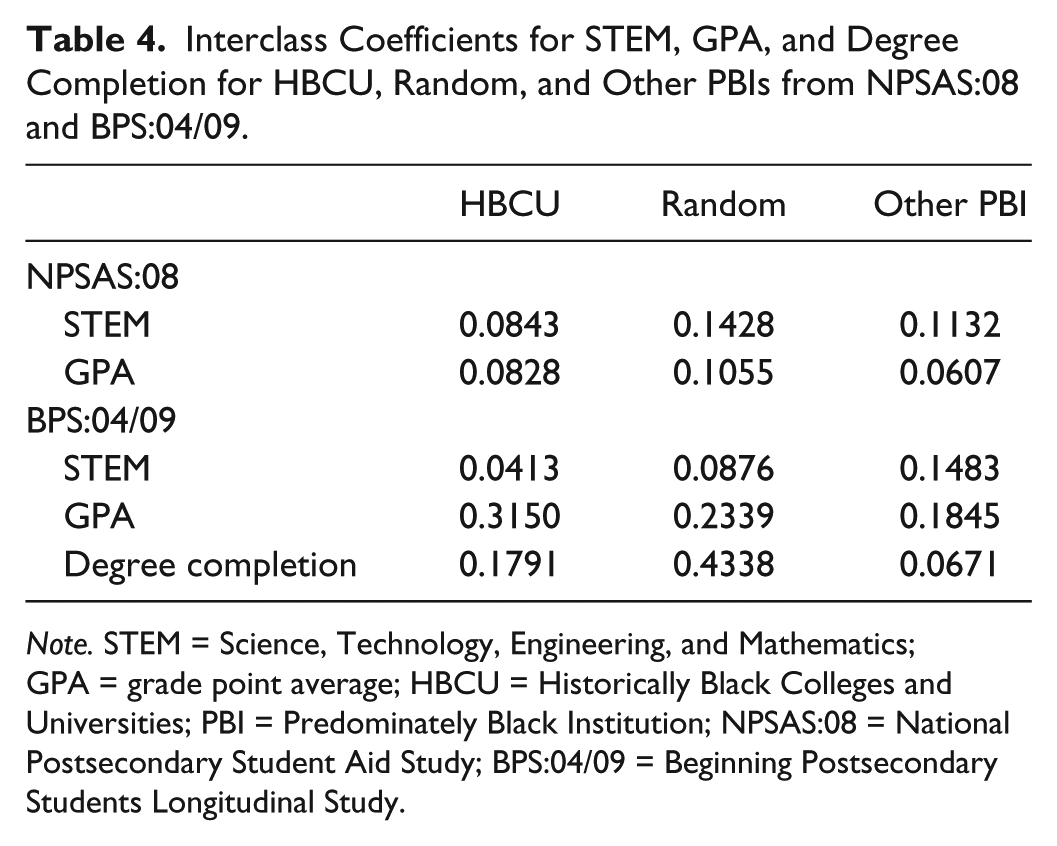
Intraclass correlation coefficients for STEM for the HBCU, random, and other PBI in NPSAS:08 were .08, .14, and .11, respectively (Table 4). In other words, among HBCU students, 8% of the variability in choosing a STEM major was explained by the institution of attendance. Similarly, 14% and 11% of the variability in majoring in STEM was accounted for at the institution level for the random and other PBI samples, respectively. Intraclass correlation coefficients for the HBCU, random, and other PBI for BPS:04/09 were .04, .09, and .15, respectively.
Interclass Coefficients for STEM, GPA, and Degree Completion for HBCU, Random, and Other PBIs from NPSAS:08 and BPS:04/09.
Note. STEM = Science, Technology, Engineering, and Mathematics; GPA = grade point average; HBCU = Historically Black Colleges and Universities; PBI = Predominately Black Institution; NPSAS:08 = National Postsecondary Student Aid Study; BPS:04/09 = Beginning Postsecondary Students Longitudinal Study.
GPA
Intraclass correlation coefficients for GPA for the HBCU, random, and other PBI NPSAS:08 samples were .08, .11, and .06, respectively (Table 4). Thus, among HBCU students, 8% of the variability in GPA was explained by choice of institution. Institutions of attendance also accounted for 11% and 6% of the variability in GPA for the random and other PBI samples, respectively. The intraclass correlation coefficients for GPA for the HBCU, random, and other PBI BPS samples were .32, .23, and .18, respectively. I recomputed the intraclass correlations for HBCUs by restricting GPA in two ways: (a) to grades earned solely at HBCUs (available in the BPS transcript file) and (b) to grades earned by students who attended only one HBCU (also available in the BPS transcript file). Resulting interclass coefficients were essentially identical to those reported.
Degree Completion
Intraclass correlation coefficients related to degree completion for the HBCU, random, and other PBI BPS samples were .18, .43, and .07, respectively (Table 4). In other words, 18% of the variability in whether HBCU students completed their degrees was explained at the institution level. Similarly, institutions of attendance accounted for 43% and 7% of the variability in degree completion for the random and other PBI samples, respectively. (NPSAS:08 is a cross-sectional sample, and it does not provide information about 6-year degree completion.)
Discussion
For generations, researchers, policy makers, the press, and the general public alike have talked about HBCUs as a distinct institutional group, despite fundamental differences in HBCUs’ basic institutional characteristics. This study has contributed to the literature by testing this heuristic of HBCUs distinctiveness via a very stringent standard: It evaluates whether educational outcomes at HBCUs (e.g., STEM major, GPA, and degree completion) are cohesive across institutions. Hence, this study is strictly an evaluation of institutional outputs. It essentially ignores other potentially unifying traits of HBCUs (e.g., history, mission, student demographic served, geographic commonality, and supportive environments). A finding of institutional cohesiveness in terms of education outcomes, then, is surely a sufficient, but not a necessary condition for institutional distinctiveness. Interestingly, the evidence evaluated in this study suggests that HBCUs’ educational outcomes are cohesive as explained below, and thus, satisfy this sufficient condition for distinctiveness.
More than 18% of HBCU students in both nationally representative samples majored in STEM. This percentage appears to be fairly consistent with percentages reported elsewhere, which indicate that STEM is an HBCU hallmark (NFS, Division of Science Resources Statistics, 2010). In addition, very little variability in students’ decision to major in STEM was a function of the particular HBCU that students elected to attend (i.e., 8% for the NPSAS:08 and 4% for the BPS:04/09). As benchmarks from NPSAS:08, consider that variability between institutions was nearly 1.75 times more for the non-MSI random sample; and nearly 1.4 times more for the other BPI sample. Among first-time students followed for 6 years in BPS:04/09, variability between institutions was more than 2 times higher for the non-MSI, random sample. This variability between institutions was nearly 3.6 times higher for other PBIs. Consequently, it seems reasonable to conclude that HBCUs are an institutional group uniformly characterized by a higher concentration of STEM majors, even compared with other institutions that do not primarily educate Black Americans.
Findings for GPA are more difficult to interpret. In addition, whether these findings reflect positively or negatively on HBCUs is virtually impossible to establish—given the general lack of convincing evidence about how well GPA reflects true academic achievement. Consequently, whether low mean GPAs at HBCUs are functions of rigorous academic standards, poorer teaching, or simply different perspectives on grading are all possible explanations. The bulk of the literature certainly suggests the existence of more academic rigor combined with better teaching at HBCUs (Boone, 2003; Perna et al., 2009; Seifert, Drummond, & Pascarella, 2006). However, some commentaries criticize HBCUs for being weak institutions that do not necessarily serve students’ best interest (Vedder, 2010). Determining whether the findings in this study advocate for or against HBCUs, however, was not the aim of this study. Instead, the purpose was to assess whether GPAs at HBCUs are somehow distinct.
Cross-sectional evidence available from NPSAS:08 suggests that at any particular point in time, grade distributions at HBCUs are relatively consistent across institutions—given that institution explains only about 8% of the variability in GPA. This variability between HBCUs is somewhat lower than the cross-sectional findings for the random sample of non-MSIs, where institution explained about 11% of the variability in GPAs. Interestingly, grade distributions at other PBIs were more consistent than at HBCUs, and these grade distributions at other PBIs were nearly twice as cohesive between institutions as those of the random sample.
Differences in GPA were more striking and unusual when the same student was followed longitudinally over 6 years in the BPS:04/09. HBCUs themselves appear to account for a considerable amount of the variability in GPA (i.e., 32%). This percentage was higher than for the random sample (23%) as well as for other PBIs (18%). Unexpectedly, what distinguished HBCUs in terms of longitudinal GPA, then, was that they were very eclectic in grading patterns across institutions. Future research should endeavor to understand why this is true. In addition, readers should consider that this one study alone cannot rule out whether this finding is an artifact of the data.
The ultimate output of post-secondary education—degree obtainment—was relatively more cohesive across HBCUs, despite considerable variability in GPA for the same student followed over time. This finding may suggest that HBCUs have more similar standards about whether students are qualified to graduate, even though students’ grade distributions differ widely over time between HBCUs. More specifically, variability between HBCUs accounted for only 18% of the variability in 6-year degree attainment. In comparison, variability between the institutions accounted for 43% of variability in graduation rates for the random, non-MSI sample. HBCUs were also distinct from other PBIs, but in the opposite direction. HBCUs had about 3 times more variability in degree completion than did other PBIs.
As a whole, then, the evidence suggests that HBCUs are systematically different from other institutions. In terms of STEM major, cross-sectional GPA, and degree completion, HBCU’s education outcomes were much cohesive than those of a random sample. In terms of the grade distributions for the same student followed over time, HBCUs were uniquely eclectic. Furthermore, the pattern of variability between institutions differed for HBCUs compared with other PBIs.
These findings have several implications and potential extensions. Perhaps, most obviously, this study affirms the logic of conceptualizing and evaluating HBCUs as a separate institutional group—given HBCUs’ overall cohesiveness and the unique pattern of their cohesiveness (i.e., distinctiveness). Given this cohesiveness, a comprehensive, generally accepted theory of how HBCUs foster student success would be highly appropriate. In a sense, such a theory would be more appropriate than a general theory on student success or retention (e.g., Tinto, 1993)—considering the lesser cohesiveness of educational outcomes among U.S. institutions selected at random. Unfortunately, such a conceptual framework is currently missing from the literature.
Also absent from the literature are up-to-date, large-scale empirical evaluations of extant theories on HBCUs derived from convenience sample studies. Although such large-scale studies may simply corroborate small sample studies, it is important to remember that in the past, this has not always been the case (Wenglinsky, 1996). Indeed, analysis conducted here should not be extended so far as to assume that HBCU distinctiveness implies that small, convenience samples will yield robust findings. Findings do suggest that small institutional samples may not be the chief concern when designing HBCU studies—with the exceptions of longitudinal studies of GPA. Rather, threats to the external validity are more likely to arise at the student level. If student samples are convenience samples or are otherwise systematic (e.g., all students with the same major), these studies may be particularly vulnerable because most of the variability in educational outcomes at HBCUs occurred within students (i.e., 69%-96%). Hence, reasonably large, random student samples are especially advisable for HBCU research.
Like all studies, this study should be interpreted in consideration of its limitations. In particular, although this study is based on a representative sample of college students in the United States, neither the NPSAS:08 nor the BPS:04/09 contains all HBCUs. In fact, fewer than 40% of HBCUs are represented. Given the variability in HBCUs’ institutional characteristics, this study should be replicated on a more extensive sample of HBCUs. Unfortunately, such a sample does not exist at this time. This constraint may mean that all variability in educational outcomes between HBCUs was not adequately captured in this study. At the same time, this constraint could also indicate that educational outcomes at HBCUs are even more uniform than this study indicates.
Conclusion
On the whole, this study suggests that educational outcomes at HBCUs are cohesive and distinct from other institutional groups. It is critical that policy makers and researchers act now to understand HBCUs distinctiveness in terms of how HBCUs contribute to Black Americans’ post-secondary outcomes. Otherwise, this understanding may largely disappear along with HBCUs themselves. With the advent of online for-profit universities, the number of post-secondary institutions in the United States has the potential to increase dramatically. However, due to statutory restrictions, the static pool of HBCUs will become even more dwarfed relative to the number of other institutions of higher learning. Furthermore, current austere economic conditions (Gasman, 2009) combined with arguments about duplication of services raised in United States v. Fordice (1992) may contribute to the demise of some HBCUs.
Footnotes
Acknowledgements
I would like to thank (a) Andrew T. Arroyo, PhD, for comments on my review of the literature related to the American Educational Research Association (AERA) grant proposal and (b) Sara Bock, BA, and Donald G. Simms, MBA, for their helpful comments and editorial assistance related to this study.
Author’s Note
Opinions reflect those of the author and do not necessarily reflect those of the granting agencies.
Declaration of Conflicting Interests
The author(s) declared no potential conflicts of interest with respect to the research, authorship, and/or publication of this article.
Funding
The author(s) disclosed receipt of the following financial support for the research and/or authorship of this article: This research was supported by a grant from the American Educational Research Association that receives funds for its “AERA Grants Program” from the National Science Foundation under NSF Grant DRL-0941014.