




Abstract
This action research study explored the use of Elegant Tasks for 30 Primary One pupils from a typical public school in Singapore to learn art. According to Sandra Kay, an Elegant Task is an open-ended-problem approach that serves to elicit “creative thoughts” and “elegant” or “aesthetically meaningful” solutions from pupils. Apart from making the teaching of art interesting, the use of Elegant Tasks helps to amuse the pupils into developing an awareness of his or her own style of thinking including its strong points as well as its weaknesses. Qualitative data were collected through focus group discussions. The findings from this study showed that pupils like the adoption of Elegant Tasks in their art lessons as they were given enough room to explore materials, make new discoveries, and work collaboratively in groups. Besides, this approach has also developed a strong sense of ownership and pride in their artworks as witnessed from pupils’ presentation of their artworks at the end of each Elegant Task topic.
Keywords
Introduction
I have been a primary school art teacher for many years. Prior to this research study, I taught art to my pupils in the same manner that I was taught this subject when I was a primary school pupil. The strategy that I had adopted all these years was a teacher-centered, product-driven approach in which I provided all the required information, instructions, demonstrations, samples and followed by my pupils’ production of artworks. Hence, my pupils learnt art merely through imitating the samples that I had prepared prior to the lessons.
However, as witnessed in the past art lessons, pupils listened passively to me while I imparted my knowledge. Although the majority of pupils were able to produce impressive and eye-catching artworks by imitating my styles, colors, and methods shown in the samples, I found that their artworks lacked creativity, imagination, emotion, and personal voices. In addition, they neither demonstrated ownership of nor pride in their artworks. I also observed that over time, most of my pupils became disengaged during the art lessons as they were not required to actively participate in the process of ideation and art-making. A few of them even became restless and caused unwanted disruptions in class.
These observations of my pupils’ lack of interest in learning art and the disruptive behaviors of some of them raised concern and this in turn led me to reflect on and question my own instructional strategies in class. I had asked myself why I was still using the one-mould-fits-all strategy to teach the children despite my cognizance that all children are different, and they love to express themselves and to learn new drawing techniques and skills from their art teachers. I had also asked myself whether there was a better way to teach art as well as to nurture a child’s creative development. This soul searching gave rise to the conviction that there must be better ways to teach art and to develop the artist within each child. Fueled by this conviction, I decided to embark on this action research journey with a view of exploring a pupil-centered pedagogy that can offer a beneficial impact on teaching art.
This research study was conducted through a series of five action research cycles with each cycle that alternated between action and critical reflection. As pointed by Dick (2001), action research is both a change methodology and a research methodology within a single process. In this research study, action research has helped to bring about change or improvement (the action) in such a way that better understanding was developed as parallel outcome at hand. Action research also assisted the teacher to pursue understanding (the research) that allowed the action to be based on a better understanding of the current situation and the research was achieved by being responsive to the situation and by searching strenuously for disconfirming evidence.
Action Research Cycle 1: Derivation of Research Questions
While searching for a pupil-centered pedagogy, I was introduced to “Elegant Task” approach by one of the officers from STAR (Singapore Teachers’ Academy for the aRts) during an art workshop in February 2013. During the workshop, I learnt ways of designing art lessons that focused on pupils’ creativity and imagination using Elegant Task. This approach also allows pupils to explore materials and participate actively in the art-making process. After learning about this new approach, I was eager to find an opportunity to try it out on my pupils.
During my first consultation session with STAR officers in May 2013 for my action research study project, we brainstormed a few possible pupil-centered methodologies suitable to be used for this study, such as inquiry-based approach, experiential learning approach, and Elegant Task approach. After debating on the pros and cons of each method, we came to a unanimous consensus that Elegant Task approach was more suitable for this study as it was a relatively new approach which had not been used or tested in a primary school in Singapore before and it also fulfilled the criteria of being a pupil-centric, process-driven approach that could develop pupils’ creativity and imagination. By using Elegant Tasks to teach art, my pupils would have opportunities to make choices and decisions in the ideation stage and during the art-making process. The choice of using Elegant Tasks was subsequently adopted for my art lessons, and simultaneously I embarked on my research project. Hence, for the research, the broad question that my study addressed was as follows: “What are the Primary One pupils’ perceptions on the use of Elegant Tasks in art lessons?”
Beside the broad research question, we also crafted six specific questions to guide my inquiry and to enable me to collect data to answer the broad research question. The STAR officers helped me to scope my research area into three broad themes, first, we wanted to find out whether the pupils liked the Elegant Task approach; second, we wanted to find out what pupils actually learned if I use Elegant Task approach in art lessons; and last, we wanted to find out whether Elegant Task approach helped the pupils to produce quality artworks. With these three themes in mind, we further broke down each theme into six manageable bite-size questions. These six specific questions were later used during the focus group discussions to collect data.
The six specific questions were as follows:
Do the pupils like the Elegant Tasks approach to learning art and doing artwork? If yes/no, why?
Give an example of an Elegant Task art lesson which the pupils liked and disliked. Which parts of the lessons do they like/dislike and why do they like/dislike those parts?
What can the pupils learn about art-making when Elegant Tasks are deployed?
Apart from art-making, what else can the pupils learn during the Elegant Task Art lessons?
Can the Elegant Task approach help the pupils to produce quality artworks? If yes, in what ways? If no, why?
What else can be done to enhance the art lessons? Can the lessons be improved based on pupils’ feedback at the end of each Elegant Task?
Action Research Cycle 2: Conduct Literature Review
In this action research cycle, the findings of literature review are presented in three different sections. The first section, “The 2009 Primary and Lower Secondary Art Syllabus and Its Influence on the Teaching of Art,” describes the syllabus set by authority. The second section, “Elegant Tasks, Its Characteristics, and Its Effect,” describes an Elegant Task and how an Elegant Task can meet the learning objectives mentioned in the first section. The third section, “Understanding the Different Types of Learning Dimensions in Learners and Their Stages of Artistic Development,” provides a set of pointers for designing a lesson using an Elegant Task.
The 2009 Primary and Lower Secondary Art Syllabus and Its Influence on the Teaching of Art
In Singapore, art is deemed by the Ministry of Education (MOE) as an important subject through which pupils at all educational levels can be equipped with the 21st-century competencies and be holistically prepared for successful adult life. This is seen in the recent move by the MOE to strengthen aesthetic education (MOE, 2010). Its revised 2009 Primary and Lower Secondary Art Syllabuses recommended that the primary schools’ planning of their Art Instructional Program should be guided by six principles, namely, “learner-centered,” “process-oriented,” “contextualized,” “interactive,” “initiative-related,” and “fun” to fulfill seven objectives, among which are (a) “create artworks to share their ideas, thoughts and feelings,” (b) “cultivate a spirit of innovation and experimentation,” and (c) “develop sensory awareness and imagination” (MOE, 2008, pp. 3, 7). The implementation of the guiding principles for planning the Instructional Program and the objectives spelt out in the revised 2009 Primary and Lower Secondary Art Syllabus was concretized in 2010 when MOE moved to strengthen art education.
The learning outcomes for the Primary One and Two pupils are spelt out in the 2009 Art Syllabus as follows: 1. Identify simple visual qualities in what they see around them 2. Be curious about what they see 3. Share their imagination, thoughts and feelings through art making 4. Wide use of art materials and medium 5. Enjoy looking at and creating art 6. Talk about what they see and experience. (MOE, 2008, p. 5)
These learning outcomes, which are derived from the objectives and the framework of “Seeing,” “Expressing,” and “Appreciating” in the Art Syllabus, will allow the students to “observe their environment, generate ideas, create artworks, discuss about art and value the role of art in society” (MOE, 2008). In short, art education in Singapore aims to enable every student to be visually literate and to appreciate art.
Elegant Task, Its Characteristics, and Its Effect
Teaching for creative development necessitates designing lessons that allow learners to perceive, select, and explore, through their own lenses, all the possible visual solutions to the problem (Kay, 1998). In short, teaching of art needs to be pupil-centric and process-driven so as to develop the creativity and imagination of learners. For this study, I had adopted the Elegant Task approach for my art lessons. The concept of Elegant Task originated from Sandra Kay (1998) who defined it as an open-ended problem that will elicit “creative thoughts” and “elegant” or “aesthetically meaningful” solutions from pupils. According to Kay, an Elegant Task is one that is worth solving, is studio based, and contains forced choices and constraints, and the level of the Elegant Task, which ranged from “beginner” to “independent,” is determined by the degree the choices and constraints co-vary (Sukaimi, 2013).
Therefore, in setting Elegant Tasks, the art teacher should select problems that are relevant to the experiences of the pupils for them to be able to relate to and to find them worth solving. The elegant problem should also be sufficiently flexible for all educational levels and all categories of pupils to adapt it for their own use (flexibility); will allow many possible, creative, and original solutions as it is open-ended (fluency); and should also be studio based (Kay, 1998).
It is envisaged that setting such elegant problems will empower the pupils to make choices and meaningful decisions in the ideation and art-making process, will enhance their technical and intellectual growth, and encourage them to discover and explore the attributes and characteristics of the materials in greater depth, thereby leading to other extraordinary forms of the craft (elaboration; Sukaimi, 2013). An elegant problem will improve the pupils’ engagement in the task as it will evoke reflection, decision-making, and meaning-making which are processes for deriving original and creative solutions (originality). Pupils will intuitively feel a sense of ownership and pride when the art-making experience is meaningful and satisfying (Sukaimi, 2013). According to Sukaimi (2013), by designing tasks that invite flexibility, fluency, elaboration, and originality of responses, the teacher is engaging his/her pupils in the creative thought process.
The way the teacher shapes an Elegant Task can affect what and how her pupils learn. Kay (1998) says, Visual problems that are challenging and can be solved successfully by diverse learners have more than one answer. This takes practice on the part of a teacher and a willingness to establish criteria and parameters that allow for individualism. Designing elegant problems takes thoughtful practice. (p. 331)
Thus, Elegant Task approach is chosen for my research study as it best fits the 2009 Art Syllabus set by MOE. During the study, pupils were given opportunities to identify visual qualities they see around them during the tuning-in activity, arouse their curiosity through guiding questions during the exploration and the discovery stages, and express their inner thoughts, feelings, and imagination through different medium during the art-making process.
Different Types of Learning Dimensions in Learners and Their Stages of Artistic Development
According to Kay (1998), “Elegant Tasks” is grounded in theories which are consistent with other theoretical works. Among these are the different types of learning dimensions which affect the pupils’ learning of art. The learning dimensions are categorized as affective, social, and cognitive and are elaborated below.
The affective dimension of learning is described in Csikszentmihalyi’s “flow construct” motivational theory in which he suggests that learning will be intrinsically motivating when a problem is pitched at an appropriate level of difficulty for the pupil (Csikszentmihalyi, 1990). That is, the task set by the art teacher must be within the pupils’ current ability level to handle for it to be appealing to them. If it is beyond or below their ability, then they will experience anxiety or boredom accordingly when handling the task. Learning will occur when the pupils find the task assigned by the art teacher intrinsically motivating and can handle it (Kay, 1998).
The social dimensions of learning are grounded in Vygotsky’s theory of intellectual development. Vygotsky (1978) believed that “cognitive development originated from social interaction” before knowledge is internalized and the “capability to learn under a teacher’s guidance varies tremendously in children with equal levels of mental development (pg. 33).” Vygotsky terms this “area of fluctuation” in developmental level as the “zone of proximal development (ZPD)” and views “good learning” as “that which is in advance of development.” ZPD is the “distance between the actual developmental level as determined by independent problem solving and the level of potential development as determined through problem solving under adult guidance or in collaboration with more capable peers” (Vygotsky, 1978, pg. 33). Based on this theory, art tasks must be pitched at a higher level than the pupils’ current level of problem-solving skill (Kay, 1998).
The cognitive dimensions of learning are premised on the differences in cognitive development among individuals in artistic problem solving. Arnheim (1974) “suggests that the imagination necessary to engage in artistic problem solving requires abstract thought”(as cited in Kay, 1998, pg. 264). Kay (1998) therefore advocated that art teachers need to first understand the cognitive processes associated with thinking in art if they are to systematically develop abstract thought in their pupils. According to her, pupils respond to an assignment or problem differently. They used problem-solving strategies that required thinking when handling the assignment or problem. Their choice of problem-solving strategies is influenced by their prior experience and whether the assignment/problem is close- or open-ended in nature (Kay, 1998). That is, the level of the students’ expertise in the subject matter affects their perception and interpretations of the assignment/problem and influences the approach they used to perform the assignment or to solve the problem. The higher the level of expertise, the more advanced is the product of their work (Kay, 1998).
On the other hand, understanding the stages of artistic development in children can also aid the art teacher to plan and execute lessons effectively. Lowenfeld (1947) argues that there are six defined stages of artistic development in children and that these stages can be witnessed in their artworks. The six stages are as follows: Scribble Stage (1-3 years old), Preschematic Stage (3-4 years old), Schematic Stage (5-6 years old), Dawning Realism Stage (7-9 years old), Pseudo-Naturalistic Stage (10-13 years old), and lastly Decision Stage (13-16 years old). As my Primary One pupils are between the ages of 6 to 7, majority of them are progressing from the Schematic Stage to the Dawning Realism Stage as observed in their artworks. Thus, during the study, the four Elegant Task unit topics were designed to pitch at the Dawning Realism Stage whereby pupils were required to use more complex schema when conceptualizing and creating their artworks.
Hence, to design meaningful assignments/problems for optimal engagement and learning in pupils, the art teacher needs to know the different types of learning dimensions in learners and the stage of artistic development the pupils are at so as to set the tasks to be done in art accordingly. By paying attention to the affective and social dimensions of learning, the art teacher could empower the pupils to take ownership of their learning while being cognizant of the cognitive dimensions of learning which “can enhance the learning of a novice or assist the non-artist’s appreciation of the complexity of thought in producing ideas in art” (Kay, 1998, pg. 266).
In summary, I have summarized the above literature review of different types of learning dimensions in learners as follows:
Point a: Task must be within the pupil’s ability
Point b: Opportunity for independent problem solving
Point c: Collaboration with more capable peers
Point d: Choice of problem-solving strategy
Action Research Cycle 3: My Intervention in Class
The study commenced in May 2013 and ended in September 2013. However, the research project spanned a total of 10 months from conception to completion of the written research report.
Selection of Participants
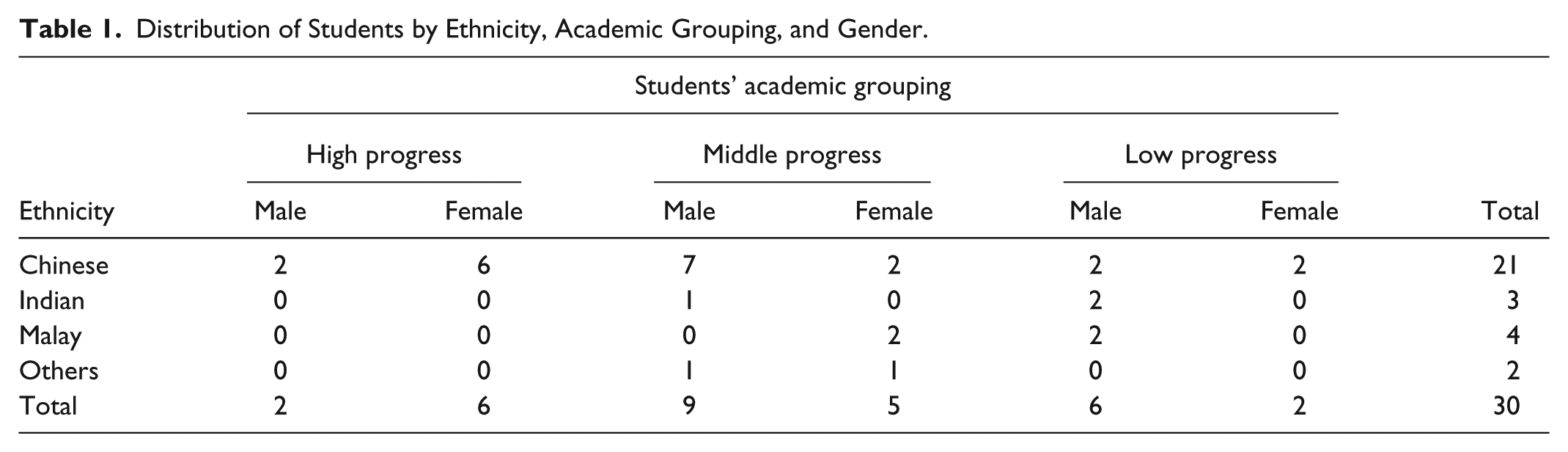
The sample for this research study comprised a class of 30 Primary One pupils, who were 7 year old from a typical public primary school. This class was a multi-ethnic class with mixed-ability and mixed-gender. Table 1 below shows the distribution of pupils by ethnicity, academic grouping, and gender. There were 13 girls and 17 boys, of whom 8 were high-progress pupils, 14 middle-progress, and 8 low-progress pupils.
Distribution of Students by Ethnicity, Academic Grouping, and Gender.
Primary One pupils were selected for this research study as they were fresh from Kindergarten and had not gone through any formal primary school art education yet. There were no previous primary school art experiences to influence their views.
Elegant Task Lessons
Four unit topics totaling 11 Elegant Task lessons were carried out with the pupils who participated in this study. These unit topics were (a) Color Theory, (b) Drawing From Observation, (c) Fold and Dye, and (d) Printmaking. Refer to Appendices A to D for the detailed lesson plans. I have used the Color Theory lesson plan (Appendix A) as an example on how I have linked the Literature Review to my lesson plan by incorporating the Points (a, b, c, and d) as highlighted in this Action Research Cycle 2. In addition, I have also added three new points here as my own initiative to value-add and to enhance my pupils’ engagement in the art lessons. The three new points are as follows:
Point e: Pupils’ safety
Point f: Group discussion
Point g: Class presentation
Pupils’ safety is very important during art lessons. I always make sure that my pupils are not allowed to handle sharp objects that would compromise their safety. Teacher’s supervision is necessary when pupils are exploring art medium and materials. Group discussions are also added into each unit topic as pupils could also learn from their peers when they talked among themselves in their own language. To conclude each unit topic, I have added in the class presentation segment to create opportunity for pupils to share and talk about their feelings, experiences, thoughts, and ideas before, during, and after the art-making process.
The 11 Elegant Task lessons were conducted between May 2013 and September 2013. The pupils had their conventional (teacher-centered) art lessons from January 2013 to April 2013 before the commencement of this research study.
Color Theory was covered over 2 weeks while the lessons on Drawing From Observation, Fold and Dye, and Printmaking took 3 weeks each to complete. The last two units focused on concepts and skills. The pupils had two periods of art lessons per week. Each period was half an hour long. All the lessons were conducted in the classroom.
Table 2 below shows the number of lessons, what the teacher did, what the pupils learnt, and the Elegant Tasks by unit topic.
Descriptions of the Four Elegant Task Art Lessons.

For Unit Topic 1, Color Theory, the data collected from the two lessons were not used for this study as the pupils studied this topic twice, once via the conventional way and the second time using the Elegant Task way. However, the latter lessons served as a time for training and hand-holding the pupils to learn art via Elegant Task. Two lessons were used to introduce pupils to Elegant Tasks.
During the three lessons in Unit Topic 2, Drawing From Observation, the pupils did different art activities. In Lesson 1, they shared what a house meant to them personally, discussed about some unique houses found around the world, played with the building blocks, and attempted to build their dream house for the first time. In Lesson 2, they confirmed their designs after several attempts and sketched these in their respective sketch books. In Lesson 3, they colored their sketches and presented their designs to their group members. Finally, a few pupils were selected by the teacher to present their dream houses to the whole class.
In Unit Topic 3, Fold and Dye, the art-making activities progressed from simple to complex tasks. During the first lesson, the teacher introduced the Fold and Dye technique. After that, each pupil was given five small pieces of rice paper to explore the technique. They then pasted their completed work in their sketchbook as part of their learning process before sharing their best piece of artwork with their group members in the next lesson. In Lesson 3, the pupils did fold and dye on a desk-size piece of rice paper. By this lesson, each pupil would have decided on how they wanted to fold their paper. When all the students had completed their artwork, they stood in a big circle to appreciate each other’s handiwork. A few students who had not presented before were chosen to present their artwork to the whole class.
For the Unit Topic 4 on Printmaking, three lessons were conducted. In Lesson 1, after the teacher had taught the printmaking technique, each group chose one fruit or vegetable to explore four different ways of cutting and printing it. The pupils in each group discussed which way they wanted to cut the fruit or vegetable. After they had discussed and decided, I would then cut the fruit or vegetable for them as pupils at this age are not allowed to handle a knife. After each cut, pupils printed the fruit or vegetable on their individual worksheet. At the end of Lesson 1, the pupils pasted their prints in their sketchbook. They presented their group findings to the whole class during Lesson 2. They taught their classmates how to cut the fruit or vegetable to achieve certain unique shape when printed. There was interaction between the group doing the presentation and their classmates seated on the floor. Some pupils even suggested other ways of cutting the fruit or vegetable after the group had presented. In Lesson 3, guided by the Elegant Task, the pupils used the given fruit, vegetables, and other textured materials to create their individual print. A few pupils were then selected to present their prints to the whole class near the end of the lesson.
Action Research Cycle 4: Data Analysis
Data Collection and Instrumentation
As this research was a qualitative study, data were collected via focus group discussions. Refer to Appendix E for the list of focus group discussion questions. Five focus group discussions of six pupils per group were conducted to gather data on their perception of using Elegant Tasks to learn art and doing artworks. The questions for the focus group discussions were patterned after the six specific questions. They covered the three themes of pupils’ reactions to the use of Elegant Tasks to learn art, what they had learnt in the Elegant Task Art lessons, and how the use of the Elegant Task approach helped them to improve their artworks.
As the Primary One pupils were still very young, being only 6 to 7 years of age, the size of each focus group discussion was kept small to avoid their being easily swayed by the views of their classmates. Also to help them to overcome inhibitions during the discussions, the pupils answered an open-ended questionnaire patterned after the six specific questions prior to the focus group discussions so that they could speak up at the discussion sessions. I was the facilitator for all the focus group discussions and another teacher assisted in note-taking. The focus group discussion sessions were also video recorded.
Data Analysis
The qualitative data from the focus group discussions were then compiled based on the three themes identified. The three themes were as follows: the pupils’ reactions to the use of Elegant Tasks in art lessons, what the pupils learnt through the Elegant Task Art lessons, and ways the Elegant Task Art lessons enabled the pupils to produce quality artwork. The three themes were used to narrate the data on the pupils’ perceptions on the use of Elegant Task to learn art.
Questions 1 and 2: Pupils’ Reactions to the Use of Elegant Tasks in Art Lessons
The pupils’ reactions to the use of Elegant Tasks in art lessons were very positive, favorable, and encouraging. To the pupils, the Elegant Task lessons were “exciting,” “fun” with “a lot of interesting activities to do,” and “cool and amazing.” They not only “got to play with their friends when doing art” but they also learned “new things,” “a lot of new techniques,” and “new skills.” They found learning meaningful because they understood the reasons for doing their artworks, and they could do them “creatively” as exemplified by this remark, “No right answers. We can do our own art creatively.” Besides providing opportunities for them to play and learn, the use of Elegant Tasks also helped them to improve their art as they could draw and paint better compared with the artworks done before the research study. The pupils were highly motivated by the use of Elegant Tasks to learn art as seen from these responses of the students: “I can’t wait for Thursdays to have art lesson. I am happy when it is Thursday”; “It is better than normal art lesson”; “The lessons are great and I love them all”; and “It is exciting, interesting, and fun. I look forward to [the] art lesson. Although it is at the last 2 periods but I am not tired at all. I’m excited when [the art teacher] comes in.”
In terms of the four unit lessons, the most popular lesson with the pupils was Fold and Dye. In their words, it was “fun,” “exciting,” and “interesting.” The pupils liked different parts of the Fold and Dye lessons. Some liked the painting part, some like the dyeing part, and others like the folding and opening of the rice paper. The painting and dyeing appealed to the pupils because they liked to paint and create different designs and patterns. The opening of the rice paper was thrilling for the pupils as they excitedly anticipated seeing the patterns they had created. These feelings are summarized by a pupil when he said, I like the Fold and Dye because it is interesting. I like the opening part because it is exciting to see what the final artwork look like. When I’m painting the patterns, I don’t know how it will look like until I open it.
The least popular topic was Drawing From Observation. Only two pupils voted for this topic. One of them liked to draw the blocks while the other liked to color the blocks using different tones to make them look three dimensional. Most pupils mentioned that the sketching part was the toughest as this could be that they have not grasped the concept and skill of three dimensional drawing.
The pupils also strongly approved the use of Elegant Tasks to teach art. Personally, they wanted more lessons using Elegant Tasks. In the words of one pupil which was echoed by many of his/her classmates, “I want every art lesson to be Elegant Task. It is so fun.” Eleven art lessons using Elegant Tasks were not sufficient for them. They wanted more of such lessons. Besides thinking of themselves, they also wanted all the Primary One classes to have the opportunity to learn art using Elegant Tasks. As several pupils recommended, “Every P1 class should have Elegant Task. It is very good”; “All P1 classes should use Elegant Task because it is fun”; and “All classes should have Elegant Task. It is very good.” Their reactions to the Elegant Task Art lessons were positive and they had nothing to suggest for improving the lessons.
Questions 3 and 4: What the Pupils Learned Through the Elegant Task Art Lessons
Through the Elegant Task Art lessons, the pupils acquired artistic and technical skills. They learned to mix primary colors to get secondary colors, draw the side views of the building blocks to make their house look more three dimensional, create their own repeated patterns and paint them on the rice paper, and print the same fruit or vegetables in many different ways after exploring and experimenting with their group members. In the course of art-making, some of them also made other discoveries to their delight and amazement. They explored and discovered for themselves how to paint repeated objects instead of just creating patterns and that everyday objects found around them could also be used for printing and making beautiful artworks. For example, one of the pupils painted a quarter of a butterfly and when she opened the rice paper, to everyone’s pleasant surprise, there was a complete butterfly on the paper. They also learned how to draw a portrait and make a card (e.g., “I learned to make a Mothers’ Day card for my mother. I feel proud”), to fold papers creatively, to dye and wait until the rice papers were dry before opening them (so that they would not be torn), to stack up six blocks to make a dream house, and “to look at things carefully before drawing.”
In addition to mastering the art-making techniques during the Elegant Task Art lessons, the pupils also acquired soft skills, including teamwork, interpersonal, and presentation skills. For teamwork they had learned, they shared,
“I learned to cooperate with my friends during group work. We helped each other and cleaned up together.”
“I learned to share things with my group members. We must take turn to use the brushes.”
“I learned to wait for my turn patiently.”
“I learned to do my part during group work. For example, I laid out the newspapers on the tables. I put the art materials in the middle to share with my friends.”
“I learned how to work with my friends. I share materials with them and also help them when they are in trouble.”
Examples of interpersonal skills which the pupils said that they had learned included “be nice to my friends,” “help them when they need help” or “are in trouble,” “listen when others are talking,” “help each other and cleaned up together,” and took responsibility for mistakes made, for example, “I accidentally dropped a drop of paint onto my friend’s pencil case. I quickly took out my handkerchief and wiped the paint off. Luckily, my friend was not angry with me.” and “I accidentally topple a container of batik dye. I . . . clean the tables and mop the floor myself.”
In terms of presentation skills, one pupil said, I can stand in front of my class and talk about my artwork. I know what to say and I say it loudly. Last time, I’m very scared and very shy. After doing in my group a few times, I can now talk in front of my class.
The pupils also developed characteristics that were related to the 21st-century competencies (such as Critical and Inventive Thinking, and Communication, Collaboration, and Information Skills) and student outcomes (such as being a confident person, self-directed learner, and active contributor; taken from website: http://www.moe.gov.sg/education/21cc/). The pupils learned to persevere, to problem-solve “creatively,” “to face fear,” to be “more willing to try new things during art lessons,” to focus when doing art and not to be distracted easily, and to concentrate when doing art instead of talking to friends. One pupil said, “I learned how to solve problems myself. For example, when dyeing the rice paper, I cannot get the right color I want, so I keep trying by mixing two colors until I get it.” Another pupil added, “I learned to face my fear. When I have fear of doing things, I tell myself to be brave and try it. Now, I’m more willing to try new things during lessons.” They took ownership of their learning.
Questions 5 and 6: Ways the Elegant Task Lessons Enabled Pupils to Produce Better Artwork
According to the pupils, their artwork had improved compared to the beginning of the year. One area which they indicated that had improved was drawing. From their perspective, their drawing now had “improved a lot”; was “nicer,” “more interesting,” and “better”; and “look more real.” Not only were they able to produce quality artwork, they also picked up skills and developed better habits and quality. They could “draw more shapes” and “hold the pencil properly.” They also practiced “drawing more often at home” and during “free time” and had more patience now when drawing, thus showing their ability to self-direct their own learning.
Besides drawing, they improved their painting and coloring as well. Their painting was “nicer” because they could “control the brush well,” “paint within the line,” paint and color “without white spaces,” and “paint in one direction.”
Action Research Cycle 5: My Reflection and Personal Learning
The results of this study showed that the Elegant Task Art lessons were well-received by this group of Primary One pupils. They enjoyed the art lessons because they were more meaningful, interesting, fun, and exciting than past art lessons (from January to April). They also benefited from the exposure to Elegant Tasks both in terms of artistic skills and personal development. They viewed their artworks with pride. They were so motivated and inspired by the Elegant Task approach to learning art that they did extra practice of artwork at home and during free time and they wanted more of such lessons not only for themselves but also for other Primary One pupils. These findings supported Sukaimi’s (2013) point that “when the art-making experience is meaningful and satisfying, students will intuitively feel a sense of ownership and pride.” The use of Elegant Tasks to teach art seemed to have fulfilled the principles of “learner-centered,” “process-oriented,” “contextualized,” “interact-tive,” “initiative-related,” and “fun” as articulated in the 2009 Art Syllabus (MOE, 2008).
I had also observed some positive behavior that the pupils exhibited while learning art using Elegant Tasks. First, I noticed that most of the pupils were able to think independently and critically to explore and generate new ideas during the group discussion and collaboration stages. When guided by me, they were able to expand and develop their ideas further (ZPD as mentioned in this Research Cycle 2), and completed their final artwork independently and confidently. Second, the pupils were also able to communicate effectively with me and their peers during the group presentation and class presentation. Third, they were more outspoken and asked questions and sought clarification when they were in doubt and following clarification, they would reflect on their own actions during the art-making process and persevere till they completed the tasks. Fourth, the pupils were able to work effectively in groups. Good teamwork not only promoted a deeper level of learning among the peers but also learning to talk with and to listen to one another were important communication skills that pupils had acquired along the way. Last, they took responsibility for their own learning as all of them had completed and handed in their final individual artwork for all the art lessons. These observations made (triangulated) support the perceptions of the pupils that they had grown cognitively, affectively, and socially through the Elegant Tasks Art lessons.
The notion of Elegant Task could only provide a framework or a structure for me to work on. Ultimately, I had to decide what could work or not in my class by knowing my pupils well when planning the lessons. Therefore, my selection of topic and the design of the lesson plans in this research study were not a do-this-and-do-that lesson. They were based on three considerations: simplicity, involvement, and achievement. They were intended to amuse the pupils into developing an awareness of his or her own style of thinking, its strong points, and its weaknesses. One pupil might get blocked at a certain point. Another pupil may never make use of certain strategies. Awareness is the first step to correction and improvement in any skill—this is the essence of my lesson plans. In fact, the only effort required from a pupil is that he or she should ask himself or herself the question:” Why am I having difficulty over this?” during the art lessons.
I observed some limitations during this research study. This study was carried out over one term, from July to September. A few lessons were disrupted due to public holidays and closure of school due to National Examination. Thus, I could not carry out the full lesson in each unit as planned. I had to borrow periods from other subject teachers to make up for the lost time. As the period for implementing the Elegant Task Art lessons was short, with only four unit lessons, it was not possible to see its full impact.
In addition, this research project is a very small-scale study. The data collected and analysis could not be generalized due to the small sample size. Time did not permit the use of other methods of data collection so that the additional data source(s) could be used for triangulation. Furthermore, no similar previous research studies were done in this area. Consequently it was also not possible to validate the findings of this study with the findings of other similar research.
Hence, it is recommended that this study be replicated in future with modifications to the design to avoid the pitfalls/gaps of this study. The sample size should be increased and the duration of the study lengthened to better determine the effect of the Elegant Task approach. It is also recommended that the timing of the project be changed to the beginning of the year so that there would be sufficient time to implement the Elegant Task Art lessons to assess their impact.
Conclusion
In conclusion, the pupils’ perceptions on the use of Elegant Tasks in art were favorable and promising. The 11 Elegant Task lessons benefited this group of pupils by developing them artistically, socially, and affectively.
In fact, Hase and Kenyon (2007), Hase and Tay (2004), and Tay and Hase (2004, 2010) make a distinction between knowledge and skill acquisition and that of learning. Knowledge and skills or competencies can be acquired and even reproduced. But, this is not learning at a deeper cognitive level. Learning is an integrative experience where a change in behavior, knowledge, or understanding is incorporated into a pupil’s existing repertoire of behavior and schema (values, attitudes, and beliefs). For example, let’s recall a pupil’s comment from “Questions 3 and 4” in the “Data Analysis” section. That particular pupil learned that a third color could be formed by mixing two different colors in class. However, to get the intended color for dyeing the rice paper, that pupil had to go beyond just merely mixing of two colors. First, that pupil had to identify the valid category of color by selecting a pair of different colors. Second, that pupil had to work out the required proportions of each color from the chosen pair of colors from Step 1 to obtain the intended color tone. The two steps mentioned were not taught to that pupil. That pupil had to keep trying in unanticipated situation by mixing the two colors until the intended color was obtained. In other words, it is possible to acquire a set of competencies that one can repeat in familiar or known circumstances. However, if learning has taken place, competencies can also be repeated and even adapted in unfamiliar, unanticipated situations.
After using this pupil-centered approach in my study, I realized that the benefits outweighed those from the traditional teacher-centered approach to teach art. Looking forward, I will be switching to this new approach to teach art without hesitation. I strongly believe that for now this is a positive way forward in teaching art and would strongly recommend it to all art teachers.
Footnotes
Appendix A
Appendix B
Lesson Plan—Drawing from Observation
Name of teacher: Mrs. Poh-Lim Shir Pei, Fiona
School: Ngee Ann Primary School
Class: Primary One Love
Day/Date: Thursday/11, 18, & 25 July 2013
Duration: 1 hour (per week)
Appendix C
Lesson Plan—Fold and Dye
Name of teacher: Mrs. Poh-Lim Shir Pei, Fiona
School: Ngee Ann Primary School
Class: Primary One Love
Day/Date: Thursday/1, 14 & 22 August 2013
Duration: 1 hour (per week)
Appendix D
Lesson Plan—Printmaking
Name of teacher: Mrs. Poh-Lim Shir Pei, Fiona
School: Ngee Ann Primary School
Class: Primary One Love
Day/Date: Thursday/29 August, 2 & 5 September 2013
Duration: 1 hour (per week)
Appendix E
Acknowledgements
I would like to extend my heartfelt thanks to:
My school leaders, Mr. Koe Ee Tiong (Principal), Mr. Edwin Hoy (Vice-Principal), my Reporting Officer, Miss Sharon Kuah (HOD Aesthetics) for giving me their support and the opportunity to embark on this Action Research (AR) project with the pupils in Ngee Ann Primary School. My colleagues in Ngee Ann Primary School for their help in video-taping all the AR lessons and their kind assistance in one way or another to complete my AR journey. Ms. Tang Hui Jing and Ms. Ira (STAR Officers), and Ms. Poh Chwee Sian (STAR AR Consultant), for their tireless guidance and financial support throughout this Action Research journey. Dr. Tay Boon Hou for his invaluable support, guidance, and constructive comments in my Action Research journey. Mdm Sangeetha and
Declaration of Conflicting Interests
The author(s) declared no potential conflicts of interest with respect to the research, authorship, and/or publication of this article.
Funding
The author(s) received no financial support for the research and/or authorship of this article.