




Abstract
International Non-Governmental Organizations (INGOs) in developing countries promote interests of the poor, provide social services, and stimulate community engagement. The exponential growth of INGOs during the last four decades was accompanied by major financial scandals and corruption charges leading to an increase in research on the impact of INGOs on community well-being in developing countries. Due to sparse empirical studies that evaluate the role and functions of INGOs, the question of the impact of INGOs on community well-being has remained largely rhetorical. Our study attempts to provide preliminary evidence on the impact of socio-economic programs carried out by an International Governmental Organization (INGO), Adventist Development and Relief Agency (ADRA), in four Latin American countries. Results from the quasi-experimental study suggest that communities with ADRA programs have a higher level of social capital than communities without them. While the results reported here may not be generalized to all INGOs, our study is unique in providing a valuable empirical approach toward examining the role of INGOs in developing countries.
Introduction
Social capital has long been recognized as an essential element in building healthy communities. Improvements in social capital are coterminous with increases in trust within a growing number of relationships that characterize expanding social networks (Hope, 1995; Lane & Henry, 2004).The term “social capital” was first introduced by Putnam (1993) to label “generalized reciprocity” that existed among people who share similar levels of power and status within community settings (Misztal, 1996; Stadelmann-Steffen & Freitag, 2011). Trust is an attribute that develops over time as individuals become acquainted with each other and engage in generalized reciprocal relationships that are reasonable and predictable. Opportunities to develop trusting relationships involve social participation in a wide variety of formal and informal settings that allow transition from individual norms to shared norms (Kadushin, 2011; Mesch, Talmud, & Quan-Haase, 2012; Putnam, 1993).
Civil society organizations involved in developmental work, especially in developing countries, attempt to encourage community participation in the process of building social capital for socio-economic development. NGOs, in particular, are natural partners in fostering social capital given their focus on empowerment, as trust involves power sharing. However, the role of NGOs in promoting socio-economic development has become the subject of intense debate among scholars and policy makers, nationally and internationally. Some argue that NGOs lack accountability and that they have not effectively translated the social and political capital at their disposal to social and economic well-being of the populations they serve (Edwards & Hulme, 1996; Lehr-Lehnardt, 2005). Others point to the impressive slate of achievements resulting in social development in countries such as Bangladesh due to commendable NGO leadership (Sen, 2011). Even as the debates continue, there is a clear demand for evaluative studies on the effectiveness of NGOs based on performance and quality of service provided in developing countries (Shah, 2007; Zadek & Gatward, 1995). The literature on NGO performance and accountability appears to be based mostly on popular comments and opinions rather than on empirically based evaluations of varying outcomes over time, space, and social groups resulting from NGO interventions (Edwards & Hulme, 1996; Mondal, 2000).
Normative, organizational, and culturally specific characteristics of NGO types are likely to influence the strategies as well as methodologies for assessing NGO performance (Lecy, Schmitz, & Swedlund, 2012). In addition, the case for empirical evaluations is convoluted by the presence of a large variety of NGOs ranging from the local grass root level NGOs to the international. International NGOs, in particular, have emerged as a group increasingly influential in international decision-making within the context of globalization (Brown, Khagram, Moore, & Frumkin, 2000). International Non-Governmental Organizations (INGOs) now number about 40,000. Billions of dollars in aid from developed countries have been funneled through INGOs to developing countries during the last two decades. However, measurement and evaluation of INGO performance are daunting given the many intersections of their operations at the local, national, and international levels with changing demographic, political, and socio-economic characteristics of their target populations. Perhaps for these reasons, empirical evaluations of INGOs are few and far between. The objective of this study is to investigate the impact of one INGO on the level social capital in the communities it serves in selected Latin American countries.
Conceptual Framework
Putnam’s (1993) conceptualization of social capital essentially focuses on trust and development of cooperation among members of a community. Trust is an internalized perception of reliability and security within mutually dependent relationships among individuals with some shared history (Uphoff & Wiyayaratna, 2000). Cooperation, however, is reflected in behaviors that engage individuals in transactions and exchanges based on participation and resource-based interdependence (Anthony & Campbell, 2011).
The identity of INGOs as a civil society organization directly places almost all activities of INGOs open to public participation and cooperation (Gray, Bebbington, & Collison, 2006). Putnam (1993) proposed that interactions through participation facilitate the formation of personal trust and development of generalized reciprocity. In general then, NGO’s presence in communities should result in improvements in the levels of trust as well as the degree of cooperation with increases in social capital.
Materials and Method
The data for this study were obtained from a survey of social capital and demographic behavior in four Central and South American countries: Bolivia, Honduras, Peru, and Nicaragua (Carbajal, Pillai, Sahelin, & Sharma, 2012; Díaz, Ramírez-Johnson, Basham, & Pillai, 2008). The selected data set had several unique attributes such as a focus on a NGO as a change agent in a variety of international settings, and a large sample size well over a thousand cases.
The purpose of the Díaz et al. (2008)’s study was to identify the impact of the Adventist Development and Relief Agency (ADRA), an International Non-Governmental profit organization, on developmental outcomes. ADRA is an agency of the Seventh-Day Adventist Church, a Christian religious denomination headquartered in the United States that operates a worldwide system of health, educational, and social programs and institutions (http://www.adventist.org). It also provides disaster relief and socio-economic development services around the world primarily with funding from the United States Agency for International Development (USAID). As a non-governmental organization autonomous from the Church, it draws only 7% of its annual funding from the Church. ADRA’s development and relief work covers five core activities: Food Security, Economic Development, Primary Health, Disaster Preparedness and Response, and Basic Education (www.adventist.org/mission-and–service/adra.html.en).
Sample
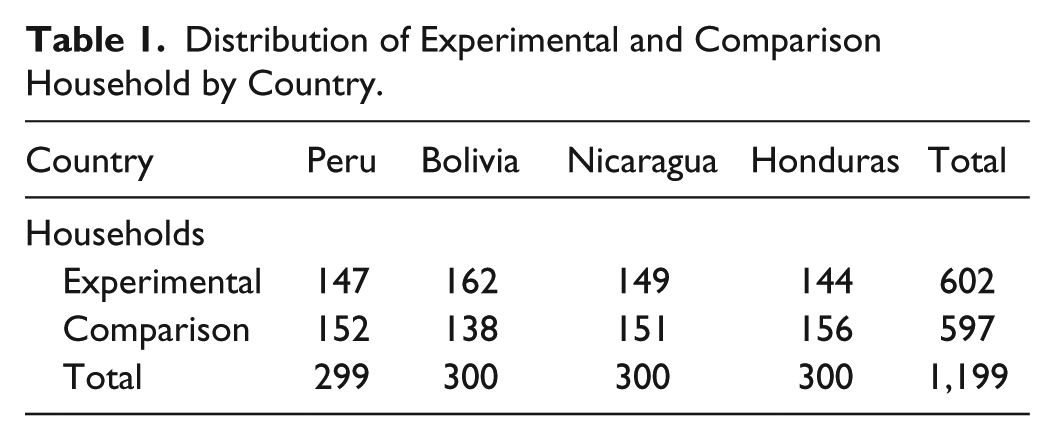
The sampling design of the Díaz et al. (2008) study was quasi-experimental with communities receiving ADRA-based community support labeled experimental and the rest, “comparison communities.” Several criteria were used to select comparison communities. First, communities had to be located within the same political district as the experimental communities. Second, the ethnicity composition of the experimental and comparison community residents was roughly similar. Finally, all communities needed to be of similar socio-economic levels. From the several comparison communities satisfying the selection criteria, a similar number of comparison communities were randomly drawn as there were experimental communities in each country. Nearly 300 households, comparison and experimental, were chosen from each country. The distribution of households from the four countries is presented in Table 1.
Distribution of Experimental and Comparison Household by Country.
Operationalization of Variables
The two interrelated sub-dimensions of social capital, participation, and resources (Carbajal et al., 2012; Díaz et al., 2008) were defined and measured using items from Bullen and Onyx (1998) social capital. These two dimensions are similar in content to the two concepts, Cooperation and trust, respectively, proposed in our conceptualization of social capital. The items for the Bullen and Onyx social capital scale were obtained from Bullen’s (n.d.) website. To measure social capital, Bullen and Onyx identified eight sub-dimensions: (a) participation in the local community, (b) being proactive in the social context, (c) feelings of trust and safety, (d) neighborhood connections, (e) family and friends connections, (f) tolerance of diversity, (g) value of life, and (h) work connections. Of the 68 items in the Bullen and Onyx scale, 32 were selected as culturally relevant to the Latin American cultural context and translated into Spanish to form a social capital scale (Carbajal et al., 2012). Carbajal et al. (2012) attempted to empirically validate the 32-item scale proposed by Díaz et al. (2008). Both studies identified participation in the community as a significant component of social capital. However, the Carbajal et al. study identified yet another component, resources, using a series of statistical analysis procedures such as principal components analysis and confirmatory factor analysis (CFA). The short-form scale of social capital proposed by Carbajal et al. appears to fit the data well as indicated by a goodness of fit index (GFI) and adjusted goodness of fit index (AGFI) of .972 and .959, respectively, and root mean square error approximation (RMSEA) = .048. This project uses the same set of scale questions measuring participation and resources as proposed and empirically validated by Carbajal et al. The items for the social capital scale are presented in Table 2
List of Items Selected From the Bullen and Onyx (1998) Social Capital Scale Utilized in the Modified Social Capital Scale for Latin America.

Missing Values
In general, missing values were not a serious problem as most variables in the study had less than 1% missing values of the total sample. The Propensity Score Matching (PSM) method was used to estimate quantities to be assigned to values that are missing at random (D’Agostino & Rubin, 2000). The PSM method is a semi-parametric hot-decking method to produce unbiased estimates with corrected variances. As a hot-decking method, estimates for the missing values are produced by imputing predicted values that accompany non-missing values of selected fixed covariates. Variables: education in years, age, and average annual income in U.S. dollars were used as covariates for generating donor pools limited to the about 10 closest cases around the missing value. From the donor pool, one specific value per missing is selected through an approximate Bayesian Bootstrap method (Siddique & Belin, 2008). No large deviations were found when the average values and standard deviations of variables before and after imputation were checked.
Data Analysis and Results
Our hypothesis is that mean levels of social capital indicated by participation and resources are likely to be significantly higher in the experimental communities than in the comparison communities characterized by the absence of ADRA activities. The test for the equivalence of latent mean structures (LMS) within well-known confirmatory analysis procedures constitutes an excellent technique for evaluating the proposed hypothesis empirically. The LMS testing process involves a number of steps.
In the first step, CFA models of social capital are fit separately for the two groups, experimental and comparison communities. Next, the equivalence of factor structures is tested by constraining the factor loadings of “participation” and “resources” to be the same in the two groups. Third, if the factor structures are equivalent, the intercepts of all the observed variables are constrained to be 0 in one group, the reference group. The reference in our analysis is the comparison group. The intercepts are set free in the experimental group. Finally, the LMS procedure is implemented to examine if the latent means of participation and resources are significantly different.
The results from the four steps are as follows. The key assumption in the CFA approach is that all exogenous variables are normally distributed. The maximum likelihood (ML) method is used to estimate the CFA models at this stage. The ML procedure is appropriate for evaluating CFA models in the presence of multivariate normality (Byrne, 2010). In the first step, CFA models of social capital are estimated separately for the experimental and comparison communities. Table 3 presents the factor loadings derived from CFA for the two groups separately. All factor loadings on participation and resources in the comparison and experimental groups are significant. The scale reliabilities were obtained using Raykov’s (2006) method for participation and resources in the experimental and comparison groups. The scale reliabilities for participation in experimental and comparison groups are .926 and .913, respectively. Similar values for “resource” are .969 and .956, respectively. Scale reliabilities of approximately .6 or more are necessary for investigating the structural coefficients of confirmatory factor models (Nunnally, 1978).
Factor Loadings, Standard Errors, and Critical Ratios for Experimental and Comparison Groups.

Note. CR = critical ratio.
See Table 2 for variable description.
p<.01
In the second step, we examine the factor structure equivalence of the model of participation and resources between the experimental and comparison groups. This is accomplished by constraining all the factor loadings equal across the two groups. Table 4 presents the goodness of fit indicators for factor invariance.
Goodness of Fit Indices for Constrained and Unconstrained Models: Test of the Hypothesis of Factor Invariance.

Note. GFI = goodness of fit index; AGFI = adjusted goodness of fit index; RMSEA = root mean square error approximation.
All the fit indicators have values above the desired levels. GFI and AGFI values are above .90 and the RMSEA is below .05. The difference in the chi-square is 25.49 with a df of 20 indicating that the factor structure is invariant across experimental and comparison groups. The presence of factor invariance of latent variables “resource”’ and “participation” facilitates the test of the null hypothesis that the means of latent variables “resources” and “participation” are not significantly different. The confirmatory factor analytical procedures for the test of latent means involve assigning zero values to the intercept of the latent variable of a selected reference group. The latent variable intercept in the second group is estimated free. Table 5 presents the results of the tests for the equivalence of latent means structures with “comparison communities” as the reference group.
Test of Equivalence of Latent Means—Experiment Versus Comparison Communities.

Note. CR = critical ratio.
The mean levels of participation and resource are higher compared with those of the comparison group. The mean differences are significant at the .05 level. These results suggest that ADRA has played a noteworthy role in improving the level of social capital in the communities with ADRA programs.
Discussion and Conclusion
The controversy surrounding the relevance and effectiveness of INGOs in improving community well-being may be resolved through empirical research. As the population of INGOs is large, cost containment measures may necessitate the selection of a random sample of INGOs that may be evaluated using the approaches developed in our article. This calls for large investments of human and monetary resources that may not be immediately available in the face of the current crisis of funding for research. An alternative is to replicate this study in a few countries across the continents in the Global South. Evidence in support of INGOs contribution to social capital building in developing countries across a variety of cultural contexts may play a part in improving the social and political image of INGOs. Though social capital building is essential for successful community development programs, the goals and objectives of INGOs may not be realized in the presence of social capital alone. It is therefore necessary to evaluate the effectiveness of INGOs regarding their stated objectives and goals.
In the presence of evidence for ADRA’s ability to generate social capital in Latin American countries, its social and organizational characteristics may be associated with INGOs success in general. ADRA has a presence in more than 20 in the Central, South American, and Caribbean regions. In these countries, ADRA is involved in a variety of projects such as providing assistance to farmers, improving sanitation, helping victims of disasters, tuberculosis prevention and control, and supporting young women involved in subsistence agriculture. Almost all ADRA programs are developed on the basis of expressed needs of the communities they serve. The programs are flexible and continuously attuned to the changing needs of the community. Thus, program flexibility and community needs-based programming characterize ADRA’s approach to community development as a Non-Governmental Organization. Yet another ADRA characteristic is that as a faith-based Non-Governmental Organization it does not impose its agenda on the people it serves. A strong faith in social justice and human rights guides ADRA initiatives. Consequently, it serves without fear and is committed to integrity and transparency.
Only a small proportion, less than 10% of ADRA’s staff in Latin America were trained social workers. Though social workers are undoubtedly trained in providing leadership at all levels of community work, INGOs have not adequately recognized their expertise. Claiborne (2004) found that social workers in NGOs are far more involved in program coordination than in providing leadership. She found that 83% of the direct service positions were occupied by non-social workers. This tendency ignores the need to pay close attention and care to the delivery of NGO client services. Several aspects of provision of NGO services involve: providing clients with accurate facts about services, supporting clients and targeted populations in sustained access to services, encouraging service recipients to share their feelings and opinions, and describing alternatives that are open to clients. These functions are best undertaken in conjunction with the practice of social justice and human rights principles. The professional training required for such an approach is seldom found outside of social work training and practice. Social workers as a professional group will have to engage in advocacy and awareness rising to secure leadership roles within INGOs.
This study has several drawbacks. One drawback of this study is that it assesses the impact of only one INGO on social capital. The internal characteristics of the organization as well as the unique aspects of the communities they work with might have influenced our findings. Factors such as organizational structure, program design, methods of social service delivery, and implementation do impact the development of social capital. Data on these important factors were not available from the Díaz et al. (2008) survey used in this study. Furthermore, our finding that the INGO in our case study did significantly influence social capital study may not be generalized over time. To firmly argue that our findings are sustainable over time, it is necessary to examine several aspects of the INGO that are not only universal but are also structurally specific to INGOs in general.
Our case study approach limited us from identifying the impact of universal and structurally stable characteristics of several INGOs on social capital limiting our ability to present evidence of sustainable effects on social capital. Though ADRA has five core areas of activity, community needs to shape the goals and objectives of ADRA activities in various communities. This contributes to large variation in the nature of programs and activities carried out by ADRA communities in our study. The impact of variations in the nature of programs on social capital was not adequately investigated owing to lack of data availability. The quasi-experimental design used in this study is limited in its ability to test hypothesized causal linkages because of several threats to internal validity inherent in quasi-experimental designs. This limitation is particularly problematic given our lack of ability to control for various spurious organizational and structural factors. In spite of these limitations, our study offers a preliminary approach toward the evaluation of INGO impact on communities.
Footnotes
Declaration of Conflicting Interests
The author(s) declared no potential conflicts of interest with respect to the research, authorship, and/or publication of this article.
Funding
The author(s) received the following financial support for the research and/or authorship of this article: The original research was funded by ADRA International, 12501 Old Columbia Pike, Silver Spring, MD, USA. But no funding was received for writing this article.