



Abstract
Women who live in rural areas are fundamental to achieving the necessary economic, environmental and social changes for the sustainable development of their territory/region. To analyze professional development through sociodemographic factors, resilience and social capital of women in rural areas. A comparative analysis of a sub-sample of men is also proposed. A cross-sectional descriptive study was developed. A total of 229 women and 58 men from rural areas of Spain participants in the study. Sociodemographic, labor, resilience and social capital variables were analyzed. The results show that the participants have an average age of 46.14 years. There are high levels of resilience and social capital. Analysis reveals self-employed women are more likely to have irregular working hours and to be more resilient. Significant differences are also observed in certain aspects of social capital, such as exchanging favors with neighbors and volunteering, which are higher for self-employed women. There is a need to address existing gender challenges and inequalities, and to harness the social capital and resilience of rural women to support their professional development and improve their quality of life.
Introduction
Women living in rural areas play a crucial role in driving the economic, environmental, and social transformations necessary for the sustainable development of their regions (Chintakindi, 2019). Their active participation is essential to maintaining dynamic rural communities, contributing to economic and social growth, and ensuring the long-term sustainability of these areas (Ministerio de Cultura Pesca y Alimentación, 2021). This involvement goes beyond mere presence; it encompasses professional and social integration, decision-making, addressing unemployment, and mitigating the challenges of rural-to-urban migration (Palmer, 1980).
Professional development is a key factor in enhancing the economic and social well-being of rural women. It involves the expansion of skills and competencies through education, training programs, and practical work experience. It also includes continuous learning aimed at improving job performance and is often associated with structured interventions, reflective methodologies, and career advancement within professional communities (Elman et al., 2005).
For rural women, professional development encompasses multiple dimensions: skill-building, empowerment in decision-making and leadership, meeting basic needs, and implementing gender-transformative policies as well as training programs (Assibey-Mensah, 1998; Kalva et al., 2014; Wickramasinghe, 1993). This process creates opportunities for women to access diverse and higher-quality employment, enhance their skills through ongoing education, and acquire the tools necessary to become entrepreneurs and community leaders (Ahamad et al., 2016; Ram Krishna & Samal, 2023). Effective strategies may include online training to overcome geographic isolation, community-based workshops to increase accessibility, and policies that promote work-life balance. By implementing these tailored approaches, rural women can achieve career advancements that contribute to their communities' economic and social development.
Social entrepreneurship has established itself as a key route to labor insertion and the economic empowerment of rural women. Unlike traditional entrepreneurship, which prioritizes financial profitability, social entrepreneurship is oriented towards generating value for the community through sustainable and inclusive business models (Sutter et al., 2019). The economic and social empowerment of rural women through social entrepreneurship not only impacts their individual autonomy but also transforms community dynamics by promoting more equitable production models (Martínez-Daza, 2024).
Beyond personal growth, women’s participation in the workforce is a driver of gender equality and the reduction of longstanding disparities in rural economies. Ensuring equal opportunities for career advancement and economic empowerment enables rural areas to cultivate a more dynamic and inclusive workforce, which is essential for sustainable development (Kutsmus & Kovalchuk, 2020; Ministerio de Cultura, Pesca y Alimentación, 2021). However, according to the latest Red Cross report on depopulation in Spain, two out of three people migrating from rural villages are women, which has a negative impact on the social and productive dynamics of these territories (Cruz Roja, 2020; Pinyol-Jiménez et al., 2020). This exodus has led to increasing masculinization and an aging population in rural areas inequalities. The outflow of young women of working age not only affects the labor market but also exacerbates demographic challenges by reducing the birth rate and limiting opportunities for generational renewal in traditional economic activities (Ministerio de Cultura, Pesca y Alimentación, 2021). Moreover, gender inequalities are more deeply entrenched and persistent in rural settings than in urban ones. Stereotypes continue to limit women’s participation in productive work, resulting in lower salaries, greater job insecurity, and higher unemployment rates (Consejo Económico y Social, 2021). The unequal distribution of domestic and unpaid workplaces creates an overload that hinders their participation in the labor market, the development of their professional careers and their well-being in different areas. Moreover, the historical lack of recognition for women’s unpaid domestic labor reinforces workplace inequalities, particularly in the care sector, where women remain the majority. These challenges have intensified in recent years due to the impact of the pandemic, which increased unpaid work responsibilities and further reduced opportunities for work-life balance (Consejo Económico y Social de España, 2022).
In addition, rural environments require greater mobility, making it more difficult for women to balance work and personal life (Ministerio de Cultura, Pesca y Alimentación, 2021; Moreno Mínguez, 2011). The support system for social entrepreneurship in rural areas is heavily concentrated in a few key locations, primarily major cities, limiting accessibility for those living in rural communities. García et al. (2019) and García-Uceda, Murillo-Luna, and Asín-Lafuente (2019) identified up to 90 key stakeholders addressing social, economic, and business challenges at European, national, and local levels. However, these resources and support networks are predominantly based in urban centers, creating significant barriers for rural entrepreneurs. This uneven distribution underscores the need for improved digital connectivity to facilitate rural economic development. The urban-centric nature of these support structures further exacerbates the challenges faced by rural women, as the labor market remains largely male-dominated. Nevertheless, the 2021 Diagnosis of Gender Equality in Rural Areas (Ministerio de Cultura, Pesca y Alimentación, 2021) shows a positive trend, with increasing female workforce participation and a narrowing of the gender gap in employment. The potential for rural women to achieve professional success and contribute to community development is shaped by their social, relational, and systemic capital. The existence of collaborative networks provide access to valuable resources such as information, trust-based task sharing, solidarity, and mutual support (Esser, 2008).
In rural areas, various stakeholders operate at different levels to drive social innovation and implement measures to correct imbalances in the political, economic, cultural, and social spheres (Hernández-Ascanio et al., 2016). Social capital, defined as the set of support networks, trust and norms of reciprocity within a community, has been identified as a determining factor in the professional insertion and growth of women in rural areas (Coleman, 1994; Harper, 2002). However, recent research highlights three dimensions of social capital that currently limit rural women’s political and economic participation: networks, trust, and social norms. These include both structural factors (such as interpersonal connections and community networks) and cultural aspects (such as social norms, values, and levels of trust) (ClosinGap, 2022; Vásquez González, 2018). For rural women, leveraging their opportunities is essential to boosting the economy, increasing employment, curbing depopulation, and fostering innovation. Their work should not be seen merely as an extension of domestic activities or a supplementary family income but as an integral part of the economic fabric (Millán-Vázquez de la Torre et al., 2017). Younger rural women, in particular, are beginning to cultivate a healthy and legitimate ambition for prosperity. Their motivation and resilience enable them to overcome adversity, turn challenges into opportunities, and foster innovation in their communities (Asensio-Martínez et al., 2018). However, despite improved access to education and training, social norms regarding family responsibilities evolve slowly and continue to impact rural women’s professional growth (Baylina et al., 2017; Porto Castro et al., 2015). In this sense, public policies focused on female entrepreneurship in rural environments can play a key role in reducing the gender gap and promoting the active participation of women in economic development (Sahasranamam & Nandakumar, 2020).
In this sense, the European Social Innovation Agenda (EaSI) provides financial support to achieve high levels of employment, fair social protection, a skilled and resilient workforce, and inclusive and cohesive societies to eradicate poverty (Slee et al., 2022). The increasing focus on social innovation aims to promote quality and sustainable employment, ensure adequate social protection, combat social exclusion and poverty, and improve working conditions. Addressing the social, environmental, and economic challenges that governments, businesses, and society fail to resolve requires creative and innovative solutions that foster interest in social entrepreneurship (Hoogendoorn et al., 2019; Sahasranamam & Nandakumar, 2020). Social entrepreneurs identify local problems and interpret them as business opportunities. They believe in their ability to drive positive social change and are willing to take risks to do so. Their sustainable, socially-driven, and economically viable initiatives generate measurable social and financial value (Costanzo et al., 2014; Murillo-Luna et al., 2021; Nicholls, 2006; Rosca et al., 2020). In this way, funds allocated to social entrepreneurship initiatives have enabled the implementation of training and support strategies for groups at risk of exclusion, including women in rural environments (Slee et al., 2022). An example of this is the support ecosystem developed in Zaragoza, Spain, where entrepreneurship incubator initiatives have facilitated the creation of cooperatives led by women in sectors such as agro-industry and sustainable tourism (García-Uceda et al., 2019). In a complementary manner, in Spain, the Spanish Network of Women Entrepreneurs in Rural Areas has promoted business incubators in regions such as Castile and León. These initiatives have allowed rural women to access financing and specialized advice, consolidating sustainable businesses in sectors such as rural tourism and the circular economy (Haugh & Talwar, 2016).
However, purpose alone does not guarantee the sustainability of social entrepreneurship initiatives. Constant exposure to complex problems and the lack of support structures can lead to burnout among rural women entrepreneurs, making it difficult for them to consolidate their projects (Dsouza & Panakaje, 2023; Henry et al., 2016).
Therefore, this study aims to analyze the professional development of women in rural areas by examining sociodemographic factors, employment conditions, resilience, and social capital. A secondary objective is to compare these variables between men and women within the same rural setting to provide a gender-based perspective on professional development disparities.
Methodology
Design
A cross-sectional descriptive study was developed using a survey.
Participants and Sample Size
The study focused on women living in the rural areas of Aragón, an autonomous community in northern Spain divided into three provinces (Zaragoza, Huesca and Teruel). This population was selected due to the distinctive demographic characteristics of the region, which covers an area of 47,719 km2 with a low population density of 28.20 inhabitants per square kilometer. Aragón also has a significant aging population, particularly concentrated in rural areas. Rural nuclei, which account for 86% of the municipalities but only 16.8% of the population, provide a unique opportunity to study the impacts of demographic change on rural women. The population pyramid of Aragón shows a contracting structure with a notable increase in the population over 65 years of age, due to a substantial decrease in fertility rates and an increase in life expectancy, especially among older cohorts. Consequently, both crude birth rates and death rates are low, highlighting the high aging rates (percentage of people over 65) in these rural areas. These demographic trends provide a compelling backdrop for investigating rural women's professional development and social capital.
The sample size was determined according to the resilience variable's mean (26.87) and standard deviation (7.21) in the general population (Asensio-Martínez et al., 2019). With a confidence level of 95%, a margin of error of 5%, a precision level of 5%, and a potential non-response rate of 10% in questionnaire completion, a minimum of 177 participants was required. Ultimately, 229 women participated, providing a robust sample size that exceeds the threshold required for statistical validity. The participants were distributed proportionally by province according to the total number of women living in the rural areas of Aragón (Instituto Nacional de Estadística, 2022), with 119 from Zaragoza, 70 from Huesca, and 40 from Teruel, which is in line with the demographic distribution and ensures good external validity of the results.
A subsample of 58 men, who responded to the call for participation, was included to facilitate a comparative analysis by gender. They were specifically recruited from the province of Zaragoza rather than other provinces in order to control for regional variations that might affect the comparability between men and women. The province of Zaragoza was selected for its central administrative importance and accessibility, which ensured easier logistics and greater consistency in data collection. The number of men, 58, was determined based on the proportion of the total sample size, with the goal of achieving a representative but manageable comparison group. This aligns with the female sample size from Zaragoza (61 women), ensuring direct comparability. All participants, both men and women, were from the same rural area—the municipality of Daroca.
Taking into account the sample size required in each province, the sample was selected through proportional sampling of the female population aged between 25 and 65 registered in these rural areas, following the age distribution of the population served by health centers in rural areas, since primary health care in Spain is universal and covers nearly 100% of the Spanish population. Therefore, recruitment was carried out through health center professionals and posters informing the women who used the center about the study, as well as through other means such as information sent via schools and high schools to parents' associations. Information was also sent to women's associations, trade union sections, federations or business associations. This method ensured a diverse representation from different facets of rural society and the recruitment of participants from all sociocultural, economic, and civil/legal status strata in rural areas. Participants gave their consent before responding to the questionnaire. The project was approved by the Clinical Research Ethics Committee of Aragón (Spain) and Data Protection Office of the University of Zaragoza approved our study and interviews (approval: PI22/453 and RAT 2022-154). The procedures followed in this study adhered to the ethical standards established by the relevant ethics committee and conformed to the principles of the 1975 Helsinki Declaration, as revised in 2008. Before participation, all individuals provided informed consent after receiving detailed information about the study's objectives, procedures, and their rights as participants, including the voluntary nature of their involvement and the right to withdraw at any time without consequences. Respondents gave written consent for review and signature before starting interviews. The study employed a non-invasive, cross-sectional survey design. Participants' data were fully anonymized, ensuring that no personally identifiable information was collected or stored, and that it was not possible to trace responses back to individual participants. This design significantly limited any psychological, social, or legal risks to participants throughout the research process.
This methodological approach was designed to provide a detailed and representative insight into the resilience, social capital, and professional development of women in rural Aragón, while also allowing for meaningful gender comparisons within a consistent regional context.
Variables and Instruments
Sociodemographic, labor, resilience and social capital variables were analyzed through the following self-reported questionnaires.
Sociodemographic Variables
Analyzed variables included date of birth, sex and gender identification, marital status, nationality, educational level, income, and economic situation (financial stress).
Labor Variables
Data collected covered occupation, current work situation, employment conditions, and domestic and care responsibilities.
Resilience
Defined as the process of overcoming the negative effects of risk exposure, coping successfully with traumatic experiences, and avoiding negative trajectories associated with risk (Fergus & Zimmerman, 2005). This variable was evaluated through the Connor-Davidson Resilience Scale (CD-RISC), which is a self-administered questionnaire consisting of 10 items. These items correspond to a Likert-type scale with 5 response options, ranging from 0 (never) to 4 (almost always). The final score is the sum of the answers to each item (ranging from 0 to 40), indicating that the higher the score, the higher the level of resilience. The Spanish version was validated by Soler Sánchez et al., (2016) and has demonstrated adequate internal consistency (α = .87). The Cronbach's alpha of the resilience scale obtained in this study was .845, indicating a high reliability of the data collected with this scale.
Social Capital
Defined as “the benefit-producing resource that operates as a function of the subject's exchanges and social relations” (Coleman, 1994). It was evaluated using the harmonized questionnaire proposed by Blaxter et al. (2001), in which four dimensions are identified and defined by Scrivens and Smith (2013): (a) personal relationships refers to the structure and nature of personal interactions and efforts to establish and maintain these relationships, people who know each other, and what is done to establish and maintain these relationships; (b) social support network, refers to the strength and quality of each individual’s social life and personal support activities; (c) civic engagement, which includes activities that contribute to civic and community development, such as volunteering, political participation, and other community actions; and (d) trust and cooperation norms, which refer to the trust, cooperation norms, and shared values that underpin societal functioning and determine the willingness of individuals within a society to cooperate. Results are presented as the percentage of the population in each category. The Kuder-Richardson Index (KR-20) obtained in this study for the social capital scale is .634, indicating an acceptable level of reliability of the data.
Procedure
Between November and December 2022, association and community centers were contacted to provide information about the study and to request permission to contact people interested in participating by telephone. Once the people interested were contacted, their informed consent was obtained.
Statistical Analysis
Although parametric tests were deemed appropriate due to the large sample size—since statistics in large samples tend to follow a normal distribution, even when the underlying data distribution is non-normal (Lubin Pigouche et al., 2005)—a distributional analysis of the quantitative variables was conducted, revealing non-normal distributions. Therefore, means and standard deviations are presented for these variables, along with medians and interquartile ranges.
To enhance the robustness of the data, non-parametric statistics (Mann–Whitney U test) were used for the bivariate analysis, and bootstrapping with a simulation of 2,000 samples was performed in the logistic regression analysis. In addition, to assess the reliability of the data from the administered scales, Cronbach’s alpha was calculated for the resilience scale, and the Kuder-Richardson index (KR-20) was applied to the social capital scale.
A descriptive analysis was first conducted on the study's sample comprising 229 women. Mean and standard deviation, as well as median and IQR were used for continuous variables, while frequencies and percentages were used for categorical variables.
In order to study in depth the professional development of women in rural Aragon a bivariate comparison was performed between women who work as employees and women who are self-employed. The Mann–Whitney U statistic was used to compare continuous variables (such as age, number of people living together at home, and resilience), and the chi-square statistic was used to compare categorical variables. Subsequently, a multivariate logistic regression model using bootstrapping was performed to analyze the predictive factors or factors associated with being employed or self-employed, introducing the variables from the comparative bivariate analysis into the model.
Furthermore, a gender-based comparison was conducted using the chi-square test for categorical variables and the Mann–Whitney U test for continuous variables within the same rural area.
Statistical analyses were performed with IBM® SPSS® Statistics version 22.0.0.0 and Microsoft Excel. Significance levels were set at 0.05.
Results
The study focused on a cohort of 229 women living in rural areas of Aragón, an autonomous community in northern Spain. Regarding the description of the sample in terms of the sociodemographic variables collected, as shown in Table 1, the mean age of the participants was 46.14 years, with a standard deviation of 9.79 years, revealing a mature demographic. The marital status distribution indicates that the majority, 67.3%, are married or living with a partner, followed by 18.8% who are single and 11.8% who are divorced.
Sociodemographic, Occupational and Economic Characteristics of the Sample.

Continuous variables (mean and standard deviation/median and interquartile range).
Regarding nationality and household composition, the vast majority of participants, 94.3%, were born in Spain, with smaller percentages from other European (3.9%) and Central or South American countries (1.8%). The average household size was 2.85 people, suggesting that many participants live in family settings.
The level of education of the participants was remarkably high, with 55.5% holding a university degree and 39.3% having completed secondary education.
In terms of employment, 83% of the participants were employed, with a significant segment, 32.6%, being self-employed. The diversity of working hours was evident, with 34.1% working a continuous day and 28.4% working irregular or variable hours, indicating flexibility in their work arrangements.
The economic conditions among the participants varied, with 27.35% finding it difficult to make ends meet, while a larger percentage, 69.6%, found it easy to do so. This variation points to differing financial circumstances within the rural female population. The distribution of monthly family income is wide, with the largest group (27.5%) earning between €2,001 and €3,000, and a significant number also falling into higher and lower income brackets.
In terms of resilience, as shown in Table 2, the participants demonstrated high levels, with an average score of 30.78 (SD: 5.91) on a scale of 0 to 40. This suggests that these women are well-equipped to handle stress and challenges, reflecting their strong adaptive capacity in a rural setting. In terms of social capital, the women in the study have robust personal relationships and social support networks. A significant majority, 98.7%, are active on social networking sites, indicating a high level of digital engagement that complements their social interactions. In addition, 89.9% of the participants frequently engage in conversations with their neighbors, which highlights the strong community ties that exist in these rural areas. Civic engagement is also noteworthy, with every participant belonging to at least one organization. However, political engagement appears to be lower, with only 36.2% showing a keen interest in politics. Norms of trust and cooperation within the community show some variation; while a substantial 75.5% have a strong sense of belonging to their neighborhood, only 31.9% trust the national government. Trust in local neighbors is higher, with 68.1% expressing confidence in those around them.
Description of the Sample Regarding the Variables of Resilience and Social Capital.

Continuous variables (mean and standard deviation/median and IQR).
If we take a closer look at the professional development of the participating women who live in rural areas, 83% are employed, 6.2% are unemployed (receiving or not receiving unemployment benefits), and the rest are in other situations (sick leave for more than three months, housework, etc.). A total of 67.4% of working women are employed by others and 32.6% are self-employed.
Professionally, a significant proportion of the women, 83%, are actively employed, demonstrating a high participation rate in the workforce. This includes 67.4% who are employed by others and 32.6% who are self-employed, indicating a vibrant mix of employment types within this demographic. Despite this high activity rate, unemployment affects 6.2% of the population, including those who are either receiving unemployment benefits or not. Other situations such as long-term sick leave and housework are also noted, indicating the diverse roles that women play in rural settings.
In the bivariate analysis, comparing the characteristics of self-employed women and women employed by others, as shown in Table 3, significant differences in working hours, resilience emerge, and social capital. Self-employed women are significantly more likely to have irregular or shift working hours, with 68.91% reporting such schedules compared to only 32.02% of employed women. In addition, self-employed women show higher resilience, with an average score of 32.22, compared to 30.33 for employed women.
Comparison of Employed and Self-Employed Women About Sociodemographic, Working Day, Economic, Resilience and Social Capital Variables.
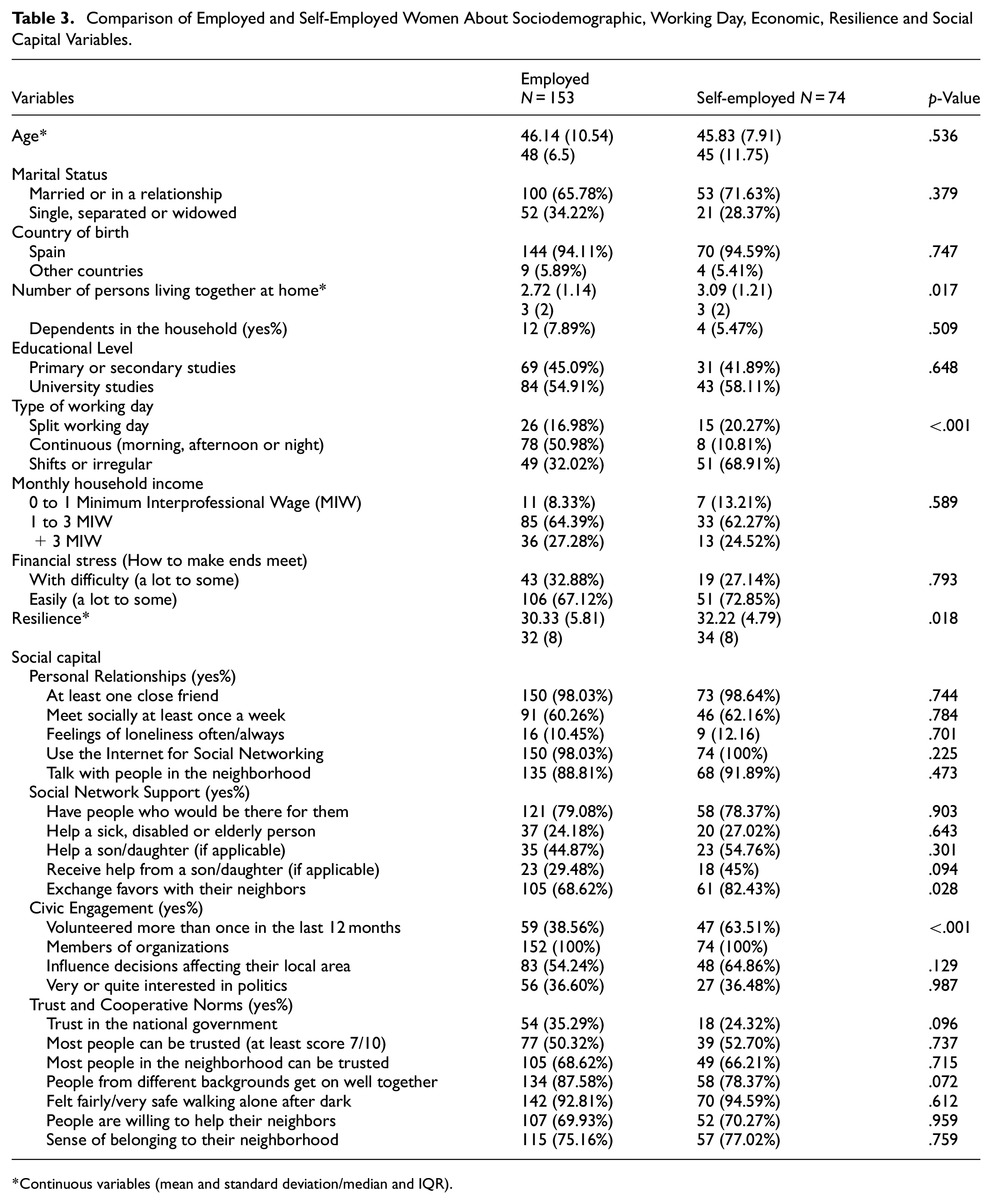
Continuous variables (mean and standard deviation/median and IQR).
Regarding social capital, self-employed women show greater engagement in community involvement activities. Specifically, 66.21% of self-employed women actively exchange favors with neighbors, compared to 44.87% of employed women. Furthermore, 78.37% of self-employed women have volunteered more than once in the last 12 months, substantially more than the 38.56% of employed women. These differences are statistically significant (p = .028 for exchanging favors and p < .001 for volunteering).
Despite these differences in working patterns, resilience, and social capital, there were no significant variations between the two groups in other aspects such as financial stress and the overall sense of belonging to their neighborhood.
To explore in more depth the factors associated with working as an employee, a multivariate logistic regression analysis was carried out by introducing the factors that were significant in the bivariate analysis into the model. As can be seen in Table 4, the factors related to working as an employee are having a continuous working day, less exchange of favors with neighbors and less volunteering activity throughout the year. These factors account for 24.2% of the variability in paid work. In addition, it is observed that having a continuous working day multiplies the probability of being employed by 12.258, while less exchange of favors with neighbors and fewer volunteering activities during the year would multiply the probability of being employed by 2.260 and 3.599, respectively.
Multivariate Analysis of the Factors Related to Being in Employment versus Being Self-Employed.

CI = Confidence interval.
The results from Table 4, which presents a multivariate logistic regression analysis, provide a deeper understanding of the factors influencing the employment status of women in rural areas. This analysis specifically contrasts the characteristics of being employed versus being self-employed, highlighting several key determinants.
One of the most significant factors associated with being employed is having a continuous working day. The odds ratio of 12.258 indicates that women with a continuous working day are much more likely to be employed, with this factor increasing the likelihood of being in paid employment twelvefold compared to those with irregular working hours.
In addition, social engagement, particularly in the form of neighborhood interactions and volunteering, also plays a role. Women who exchange fewer favors with neighbors and participate less in volunteering activities are more likely to be employed, with odds ratios of 2.260 and 3.599, respectively.
Overall, these factors combined explain 24.2% of the variability in being employed, highlighting the complexity of employment dynamics in rural settings.
Finally, a sub-sample of 119 people was compared. Fifty eight of them identified themselves as men and 61 of them identified themselves as women. All of them lived in the rural area of the province of Zaragoza (municipality of Daroca). As shown in Table 5, there is a significant difference in the type of current occupation and in the social capital item “I can rely a lot on my partner, family and friends when I have a serious problem.” It can be seen that there is a higher percentage of men who are self-employed compared to women (41.38% compared to 13.56%), a higher percentage of women who are employed compared to men (86.44% compared to 58.62%), and a higher percentage of women who trust their partner, family and friends a lot or quite a lot when they have a serious problem compared to men (76.46% compared to 59.32%).
Comparison of Sociodemographic, Occupational, Economic, Resilience, and Social Capital Variables by Gender.
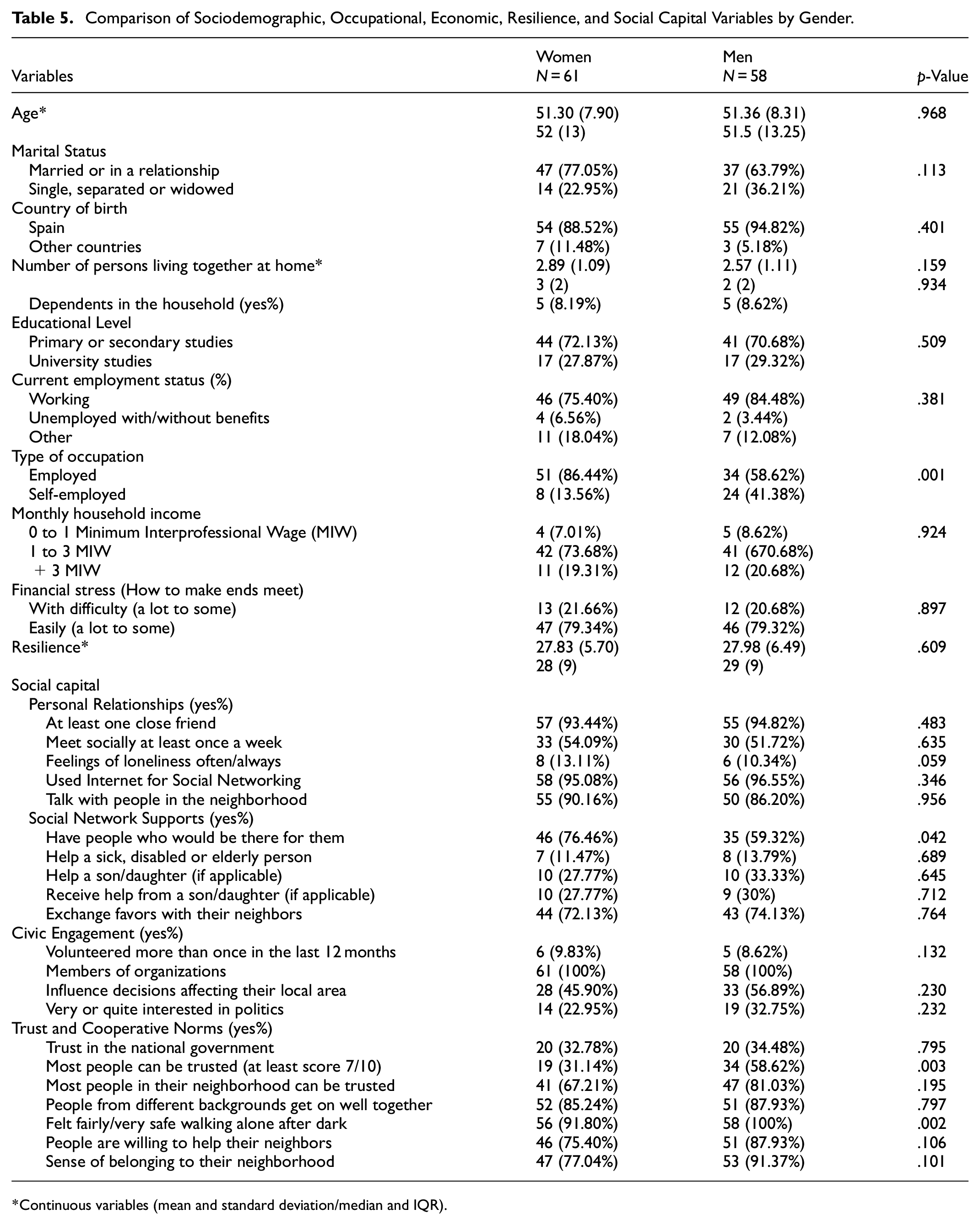
Continuous variables (mean and standard deviation/median and IQR).
The detailed examination by gender of employment types and social capital between men and women from the rural area of Zaragoza, as shown in Table 5, highlights significant differences, especially in the types of occupations and specific aspects of social capital. The findings reveal a higher prevalence of self-employment among men compared to women (41.38% vs. 13.56%), which suggests that men in these rural areas are more likely to engage in entrepreneurial activities or freelance work. Conversely, a higher percentage of women are in employed positions (86.44% compared to 58.62% for men), indicating a tendency towards more traditional employment roles among women.
The social capital dimensions show notable differences in community engagement behaviors. Women report higher levels of trust and reliance on their partner, family, and friends in times of serious problems (76.46% compared to 59.32% for men), suggesting stronger supportive networks among the female participants. In addition, self-employed women are more involved in exchanging favors with neighbors and are significantly more active in volunteer activities throughout the year, as evidenced by a comparison that yielded p-values of .028 and <.001, respectively.
Discussion and Conclusions
Women living in rural areas are critical to fostering innovation, entrepreneurship, and the sustainable development of their communities (Cobano-Delgado & Llorent-Bedmar, 2020). Their presence ensures the vitality of rural environments and contributes to economic and social growth. However, rural society remains predominantly male, with high rates of population aging and declining birth rates. At the same time, rural-to-urban migration continues to be largely female-driven (Ministerio de Cultura, Pesca y Alimentación, 2021). Given this context, this study aimed to explore the professional development of rural women by analyzing sociodemographic factors, employment conditions, resilience, and social capital. Additionally, a gender-based secondary analysis examined differences in professional development and entrepreneurship.
This study, which included 229 rural women, highlights the dual burden they face in managing both professional and personal responsibilities, consistent with previous national research (Merino, 2002). These findings provide valuable insights into their sociodemographic profiles, educational attainment, employment status, and economic conditions. Such data are essential for understanding the opportunities and constraints present in these communities and can inform targeted interventions to support rural women’s professional development.
One of the major challenges for rural women in Spain is employment disparity, where gaps persist in job rates, wages, and both vertical and horizontal occupational segregation—factors that further widen the rural-urban divide (Gorfinkiel, 2019; Ministerio de la Presidencia, 2018). Our findings indicate that self-employment rates among rural women remain below the national average, revealing a persistent entrepreneurial gap influenced by traditional gender roles and economic barriers.
The women in this study reported strong social ties and high levels of engagement in community-based networks, reflected in their high scores on the “personal relationships” and “social support network” subscales. This aligns with the increasing trend of associationism observed among rural women, who are progressively engaging in mutual-benefit organizations and local initiatives (Ministerio de Cultura, Pesca y Alimentación, 2022). They are actively involved in civic and community development, although their interest in politics and trust in government institutions is limited, reflecting the uneven evolution of association and political development in rural areas (Vitelli-Martínez, 2011). On the one hand, an increasing number of rural women are assuming political roles, such as mayors and councilors, suggesting a growing political interest. On the other hand, women's associations have limited integration into broader political or social movements beyond their immediate local environment (Langreo Navarro & Benito García, 2005).
The findings also confirm that rural women exhibit high levels of resilience, enabling them to cope with adversity, learn from challenges, and drive positive change. Prior studies have highlighted the protective role of resilience factors—such as spirituality and strong social support networks—in improving rural women’s quality of life (da Silva et al., 2022). This resilience strengthens their ability to participate in community, local, and regional development, reinforcing their empowerment (Mulet et al., 2021). No significant gender differences were found, but self-employed women showed greater resilience than those employed by others, likely due to the economic, social, and psychological risks associated with entrepreneurship. In particular, self-employed rural women need higher resilience to cope with these risks. However, despite their entrepreneurial potential, rural women still face major challenges, including care responsibilities, the invisibility of their work, and the effects of an aging and male-dominated rural population (Alonso & Trillo, 2014; Sampedro Gallego & Camarero Rioja, 2007).
A key finding is the contrast between self-employed women and those employed by others. While the latter typically have fixed work schedules and lower community engagement, self-employed women tend to have more irregular working hours, greater resilience, and a stronger commitment to their communities, as seen in higher rates of volunteering and more frequent exchanges of favors with neighbors (Majoral & Sanchez-Aguilera, 2002; Ministerio de Cultura Pesca y Alimentación, 2022; Navarro Yáñez, 1999). This suggests that entrepreneurship may serve as a pathway to improving work-life balance and fostering deeper community integration.
While entrepreneurship can offer a pathway to balancing work and life demands in rural settings, these women still face significant barriers, including unpaid care responsibilities, the invisibility of their work, and structural challenges related to rural aging and masculinization (Alonso & Trillo, 2014; Sampedro Gallego & Camarero Rioja, 2007). The increasing caregiving responsibilities of working-age women further limit their ability to pursue entrepreneurial opportunities, deepening gender disparities in rural areas.
The gender-based analysis of employment highlights key differences in job types and social capital. Men are significantly more likely to be self-employed, whereas women predominantly work for others. This aligns with broader trends in rural labor markets, where male entrepreneurship remains dominant, and rural and agricultural subsidies disproportionately favor men (Ministerio de Cultura, Pesca y Alimentación, 2021).
Women entrepreneurs continue to face additional barriers in accessing business opportunities due to their dual responsibilities in both the productive and domestic spheres (Garncarek et al., 2021). This dual role is particularly evident in their greater reliance on close personal networks—partners, family, and close friends—for support when facing challenges, while men tend to cultivate broader external connections (Durston, 2002).
Female participants, particularly younger women in rural areas, demonstrate strong social ties within their immediate circles, frequently engaging in meetings with friends and neighbors to reinforce local support networks. However, while they show a growing ambition for economic growth and professional advancement, they tend to express lower levels of trust in social circles beyond their family and close friends, remaining cautious about expanding their connections outside their local environment.
They rely heavily on social support from their partners and family members, and tend to trust their friends more than men do. This close-knit support system may explain why younger rural women increasingly develop a strong and legitimate ambition for economic and professional advancement. However, despite this strong interpersonal trust, they express less confidence in expanding their social networks beyond their immediate circle, particularly within their broader local community.
Given these findings, expanding and strengthening women’s associations is essential to promoting the economic, social, and cultural revitalization of rural communities (Garncarek et al., 2021; Sánchez-Muros Lozano & Jiménez Rodrigo, 2013). These associations not only foster well-being and mutual support but also serve as crucial mechanisms for building social capital and compensating for the scarce institutional resources available to rural women.
The main strength of this study is its analysis of key variables in rural areas, such as social capital and resilience, which have been relatively understudied. However, it also has limitations. The most significant is the generalizability of the findings to other countries with different population structures and geographical distributions. This study focuses on rural women entrepreneurs in a single geographic region, which provides in-depth insights into their unique challenges and opportunities. However, this narrow focus may limit the applicability of the results to other regions or contexts.
Factors such as cultural norms, access to resources, and regional policies affecting entrepreneurship vary widely across rural settings, which may influence the extent to which these findings can be applied internationally. Nevertheless, the demographic characteristics of the studied community—low population density and a high proportion of older adults—are representative of many European and global rural areas. Additionally, this study follows a cross-sectional design that does not capture long-term changes or the impact of evolving socio-economic conditions. Future research should address these limitations by incorporating comparative studies across different rural regions and longitudinal approaches to better understand the dynamics of rural women’s entrepreneurship over time.
This research aims to shed light on the challenges rural women face in entrepreneurship. Further studies on the barriers they encounter and the role of social capital in their professional development are essential, as these factors shape the economic and social growth of their communities. Promoting gender equality and equitable participation is crucial, as these efforts will increase economic growth, reduce poverty, and improve governance efficiency (Sánchez-Oro Sánchez & García García, 2015).
Women in rural areas must continue to advance in their professional development to drive the economic, environmental, and social changes needed for sustainable development. Recognizing, valuing, and making visible their contributions is a priority, as their presence is essential to ensure a vibrant and thriving rural future.
Footnotes
Acknowledgements
The authors would like to thank the Aragonese Primary Care Research Group (GAIAP, B21_23R) that is part of the Department of Innovation, Research and University at the Government of Aragón (Spain) and the Institute for Health Research Aragón (IISAragón); the Research Network on Chronicity, Primary Care and Health Promotion (RICAPPS, RD24/0005/0004) that is part of the Results-Oriented Cooperative Research Networks in Health (RICORS) (Carlos III Health Institute); and ERDF “Another way to make Europe,” NextGenerationEU funds and the University of Zaragoza. And the authors would like to thank the University of Zaragoza and the General Technical Secretariat of the Department of Agriculture, Livestock and Environment (Government of Aragon).
ORCID iDs

Ethical Approval
The Clinical Research Ethics Committee of Aragón (Spain) and Data Protection Office of the University of Zaragoza approved our study and interviews (approval: PI22/453 and RAT 2022-154) on Novembre 16 and 17, 2022. The procedures followed in this study adhered to the ethical standards established by the relevant ethics committee and conformed to the principles of the 1975 Helsinki Declaration, as revised in 2008. Before participation, all individuals provided informed consent after receiving detailed information about the study's objectives, procedures, and their rights as participants, including the voluntary nature of their involvement and the right to withdraw at any time without consequences. Respondents gave written consent for review and signature before starting interviews. The study employed a non-invasive, cross-sectional survey design. Participants' data were fully anonymized, ensuring that no personally identifiable information was collected or stored, and that it was not possible to trace responses back to individual participants. This design significantly limited any psychological, social, or legal risks to participants throughout the research process.
Funding
This study is funded by an agreement between the University of Zaragoza and the General Technical Secretariat of the Department of Agriculture, Livestock and Environment (Government of Aragon). In addition this work was supported by the Aragonese Primary Care Research Group (GAIAP, B21_23R) which is part of the Department of Employment, Science and Universities the Government of Aragón (Spain) and funded by the European Union “Next Generation EU/PRTR” funds, and with group funds of the Research Network on Chronicity, Primary Care and Health Promotion (RICAPPS, RD21/0016/0005). The funder plays no role in study design, data collection and analysis, decisión to publish, or manuscript preparation.
Declaration of Conflicting Interests
The author(s) declared no potential conflicts of interest with respect to the research, authorship, and/or publication of this article.
Data Availability Statement
The datasets used and/or analyzed during the current study are available in Zenodo Database (DOI 10.5281/zenodo.10491297).