




Abstract
A body of international and Australian research demonstrates connections between certain types of occupations and elevated suicide rates, relative to suicide rates observed in other occupations or within the general population. In Australia, it has been suggested that miners face a heightened risk of suicide relative to the population overall, but there is very little empirical data available to support this proposal. The current study provides unique data about male miners who died by suicide. Miners were compared against men in other occupations. Demographics, psychiatric history, and life events were examined. Miners were significantly more likely than men in other occupations to have experienced relationship problems prior to their death. Relationship problems may be an important predictor of suicide among miners. This could in turn provide helpful information for identifying miners who are at risk of suicide, as well as point the way to possible industry-specific intervention strategies in Australia and elsewhere.
A body of international and Australian research demonstrates connections between certain types of occupations and elevated suicide rates, relative to suicide rates observed in other occupations or within the general population. For example, agriculture and construction occupations have been consistently identified as over-represented in suicide statistics (e.g., Andersen, Hawgood, Klieve, Kolves & De Leo, 2010; Gallagher, Kliem, Beautrais, & Stallones, 2008; Hawton et al., 1999; Heller, Hawgood, & De Leo, 2007; Notkola, Martikainen, & Leino, 1993). Similarly, higher suicide rates among “blue collar” (manual or unskilled) workers relative to “white collar” workers have been observed across a number of studies (e.g., Agerbo, Gunnell, Bonde, Mortensen, & Nordentoft, 2007; Cubbin, LeClere, & Smith, 2000; Kposowa, 1999; Roberts & Marlow, 2005; Stack, 2001), although it should be noted that there are exceptions to this pattern (e.g., Hawton, Agerbo, Simkin, Platt & Mellanby, 2011; Platt, Hawton, Simkin, Dean, & Mellanby, 2012).
Connections between occupation and suicide are typically explained with reference to workers in certain occupations having a combination of demographic, individual, and socioeconomic characteristics associated with suicide risk (e.g., being male, having lower levels of education, or living in areas of greater relative disadvantage) in conjunction with risk factors for suicide that are related to a particular workplace or type of employment, such as highly stressful environments with intense physical or psychological demands, isolated workplace locations, shift work, and access to lethal means (e.g., Andersen et al., 2010; Chae & Boyle, 2013; Hawton & Van Heeringen, 2009; Roberts, Jaremin, & Lloyd, 2013), which may also be associated with other suicide risk factors such as social isolation, sleep disturbance, alcohol or substance misuse, mental illness, and relationship or family stress (e.g., Berkman et al., 2004; de Barros, Martins, Saitz, Bastos, & Ronzani, 2013; Pearce, Barnett, & Jones, 2007; Trofimovich, Reger, Luxton, & Oetjen-Gerdes, 2013).
As labor force dynamics and patterns of industry employment continually shift in response to market forces, it is important to conduct research into suicide in occupations and/or industries that may have experienced particular change over time; one such example, in Australia, is the resources sector. Australia is one of the world’s foremost mining nations, with significant economic resources of brown coal, mineral sands (rutile and zircon), nickel, uranium, lead, and zinc (Australian Bureau of Statistics, 2012b). In 2009 to 2010, the mining industry was the fourth largest contributor to Australia’s gross domestic product (GDP) with around 8% of total GDP, and mining businesses paid a total of $16.8 billion in wages and salaries (Australian Bureau of Statistics, 2012b). In Australia’s three major “mining states” (Western Australia, Queensland, and New South Wales), mining industry employment has grown steadily throughout the past decade and currently accounts for around 4% of the employed population (Australian Bureau of Statistics, 2012a)
While the economic and employment benefits of the mining industry are well documented, potentially negative aspects of mining industry employment are less clearly understood. Mining workers may—due to the often arduous conditions, geographic remoteness, and long working rosters associated with many types of mining—experience a range of social, physical, and emotional challenges and stressors. In popular debates and lay press, it is increasingly claimed that mining—as an occupation—may be associated with a heightened risk of suicide (e.g., Bainbridge, 2012; Sundstrom, 2012; Turner, 2011). International studies and the very limited amount of existing evidence from Australia are discussed below and indicate that the possible connection between employment in mining and suicide is worth deeper examination. However, it is important to adopt a cautious approach given that the small number of Australian studies into miners’ wellbeing have typically been qualitative and have not included comparative or control groups.
For example, it has been suggested that interpersonal relationships (including marital relationships and family functioning) and positive social participation (such as engagement with friends and community activities) can be disrupted by shift work (Simon, 1990), which—along with long working rosters—is a common feature of many mining operations. The contribution of long working hours to “work-family spillover” and associated stress has been well documented internationally (e.g., Grosswald, 2004; Grzywacz, Almeida, & McDonald, 2005), and there is evidence that this occurs among mining workers. For example, Oldfield and Mostert (2007) found relationships between job demands, ill health, and work–home interference among South African miners, while Jacobs, Mostert, and Pienaar (2008) showed that among a sample of Afrikaans and Setswana mining workers, the consequences of work pressure, heavy workload, stress, and family obligations included a lack of quality time for the self and family, physical and emotional strains, and low levels of productivity. However, these South African observations may not be generalizable to other countries.
In Australia, Torkington, Larkins, and Gupta’s (2011) qualitative study of 11 Fly-in Fly-Out (FIFO) mine workers in Charters Towers (Queensland) found that some workers identified negative impacts of their work on family life, including missing out on time with their children, feeling like an “outsider” when they went home at the end of a work roster, and difficulties in their relationship with their partners (due in part to fatigue and disruptive or “mismatched” routines). Kaczmarek, Sibbel, and Cowie (2003) suggest that family stress may be higher among Australian FIFO families, relative to military families, and link this with frequent partner absence from home. Collis’ (1999) qualitative study of how shift workers’ wives negotiate power relations found a number of sources of relationship tension associated with the Australian “culture” of mining work, such as drinking with colleagues taking precedence over time with family. In addition to potential relationship problems, broader forms of emotional stress may affect mining workers. For example, Iverson and Maguire (2000) note that social and emotional isolation (in part relating to living in a remote location) was a key variable affecting life satisfaction among 286 male mining employees in a remote Queensland location.
The psychosocial challenges associated with life events such as relationship and family problems may also contribute to the development of mental illness (which can in turn contribute to, or exacerbate, disruptions in other aspects of social and emotional functioning). In the Netherlands, for example, van der Molen and colleagues (2012) found that workers in mining and quarrying had the second highest annual incidence of occupational illness per 100,000 worker years (second only to construction workers). While breakdowns of the types of illness per sector were not provided, mental illnesses were the most frequently recorded type of condition (van der Molen et al., 2012). In Australia, a qualitative study of 10 resident (i.e., not FIFO) miners found that those workers identified possible mental health concerns as part of their occupation, with particular mention of depression and stress (Mclean, 2012). Others, however, suggest that the prevalence of mental illness among mining workers is likely to be comparable with the community as a whole (New South Wales Minerals Council Minerals Council, 2012).
An accompanying factor that can contribute to, as well as arise from, relationship problems and/or mental illness (especially depression and anxiety) is substance misuse. Alcohol use has received particular attention in public debates around mining, although, once again, there is relatively little hard data available (see Driscoll, 2007). Iverson and Maguire (2000) found that reported levels of alcohol consumption among a sample of Queensland miners were above the Australian average, which is broadly consistent with Midford, Marsden, Phillips, and Lake (1997) study of miners in the Pilbara (Western Australia).
In terms of suicide (and noting the abundance of literature concerning mental illness as a risk factor—see Baxter, Charlson, Somerville, & Whiteford, 2011), living in a remote location (e.g., Kolves, Milner, McKay, & De Leo, 2012), stressful life events such as relationship problems and marital breakdown (e.g., Wyder, Ward, & De Leo, 2009; Yip et al., 2012), and substance misuse (e.g., Borges, Walters, & Kessler, 2000; McLean, Gladman & Mowry, 2012; Oei, Foong, & Casey, 2006) are all documented risk factors. Consequently, the suggestive (but inconclusive) evidence given above highlights the need to evaluate possible relationships between employment in the mining industry and the occurrence of particular risk factors among workers who died by suicide.
The current study sought, first, to describe demographic and psychiatric characteristics, and the occurrence of stressful life events among miners who died by suicide in Queensland. Second, it compared miners and workers in other occupations, who died by suicide, to establish whether those two groups exhibit different characteristics and whether miners were more likely to experience substance misuse, psychiatric illness, and/or stressful life events in the months prior to death.
Method
Data Source and Sample Selection
Suicide data were extracted from the Queensland Suicide Register (QSR), a comprehensive database designed by the Australian Institute for Suicide Research and Prevention (AISRAP) that details Queensland (QLD) suicide cases from 1990 to the present (see De Leo & Sveticic, 2012, for further description). Information in the database is based on post-mortem, police, and psychological autopsy reports, and includes a wide range of demographic, medical, and psychiatric information regarding the deceased.
Demographic and Socioeconomic Variables
Demographic and socioeconomic variables considered were age at time of death, marital status, ethnicity, nonenglish speaking background (NESB), and living arrangements at time of death. Marital status was coded into one of five categories: “married/de facto,” “divorced/separated,” “single/never married,” “widowed,” and “unknown.” Living arrangements consisted of with spouse, with parents, shared accommodation (with a friend/relative/other person or persons), alone, in an institution, homeless, temporarily away from home, and unknown.
Occupation
To maximize sample size, employment as a miner was classified broadly as any work directly connected with the mining industry (including, for example, mine laborers, mine supervisors, and scientific, technical, and other mining support work but excluding more generic roles such as administrative assistants). Non-mining occupations were classed as “other.” Only persons for whom occupation data were available, and who were employed at their time of death, were included.
Communication of Suicidal Intent and Past Suicide Attempts
The QSR contains information about whether the deceased had communicated suicidal intent in the 12 months before death, as well as whether the deceased had previously attempted suicide in the 12 months before death. This information is coded into the categories “once or twice,” “several times,” “no,” and “unknown.” Two dichotomous no/yes items were created, where the “yes” category included any communication of intent or past attempt, irrespective of frequency (i.e., once or twice and several times). It should be noted that the coding “no” does not necessarily mean that the deceased did not communicate suicidal intent to any person or that they had not previously attempted suicide; it may also indicate, for instance, that no information was available. Similarly, the “unknown” category does not necessarily denote the presence of an overt response of “not knowing” about intent; it may simply indicate that no information was recorded (or, in some instances, that no complete investigation was performed). As such, it is likely that under-reporting occurs on these variables.
Psychiatric Conditions
Psychiatric history variables included contact with a mental health professional (whether the deceased had consulted with a mental health care professional for a psychiatric condition in the 3 months prior to death); presence of a diagnosed psychiatric condition; current or past treatment for a psychiatric disorder; and evidence for an untreated psychiatric condition.
Information in these variables was coded to the categories “yes,” “no,” and “unknown.” The coding “no” does not necessarily mean that the deceased did not have a psychiatric condition; it may also indicate, for instance, that information about the variable of interest was not communicated, or that no relevant information was recorded. Similar caveats apply to the “unknown” category, which may simply indicate that no information was recorded. Again, this is likely to result in under-reporting.
For the purpose of the current study, all “unknown” responses were treated as missing data, on a variable by variable basis.
Life Events
The occurrence of significant life events prior to death was coded dichotomously as present or absent (noting that absence may denote lack of information rather than lack of the event). The events included were relationship problems, bereavement, conflict, pending legal matters, financial problems, recent or pending unemployment, work problems (not financial), child custody dispute, alcohol/drug dependency, illness, and “other.”
Alcohol Use
In addition to the alcohol/drug dependency life event variable, “problematic” alcohol use was considered. A dichotomous variable was created: no problematic use (virtually never used or drank but not in a way that was cause for concern) or problematic use (caused problems–violent, caused problems–nonviolent, caused problems–unspecified).
Age, Sex, Location, and Suicide Probability Matching
All suicides in miners occurred among males, hence the non-miner sample was restricted to men only. The age range of miner and non-miner samples was matched, ensuring that only men of a comparable age range at the time of death were included. Location was matched to the level of Statistical Local Area (SLA), using 9-digit Australian Standard Geographic Classification (ASGC) information (for further information, see Australian Bureau of Statistics, 2006). Only SLAs that contained at least one miner suicide were included, as a proxy (albeit imperfect) control for the possible influence of being in a remote location. Finally, only those cases where the cause of death was classified as “Suicide–beyond reasonable doubt” or “Suicide–probable” (see De Leo & Sveticic, 2012) were included, given that all miner suicides were classed as beyond reasonable doubt or probable.
Analyses
Bivariate differences between miners and workers in other occupations were assessed using chi-squared tests. Comparisons were performed only where cells had three or more cases. Where possible, logistic regression was used to further investigate bivariate differences between miners and other workers.
Results
Once age, sex, location, and suicide probability matching methods were applied, the final sample consisted of 218 men who died by suicide between 1990 and 2008 (inclusive). Of these men, 42 (19.3%) had been employed in the mining industry at the time of their death (five were in scientific/technical/other roles, with the majority being mine laborers, machinery operators, supervisors, etc), with the remaining 176 men (80.7%) employed in other occupations. Age at time of death among miner suicides ranged from 23 to 74 (inclusive), with a mean of 39.2 years (±11.6). Restricting the age range of non-miner suicides to between 23 and 74 (inclusive) resulted in a mean age of 40.2 years (±11.4). Independent samples t tests confirmed that there was no significant difference in age at time of death between the groups (t = .51, p = .61).
There were few demographic differences between miners and other workers who died by suicide (Table 1). While miners were, on the basis of pair-wise comparison, significantly more likely to be married or in a de facto relationship than other workers, this difference was not statistically significant when a family-wise error correction was applied to the result (however, the result was still considered important—see below).
Descriptive Data.
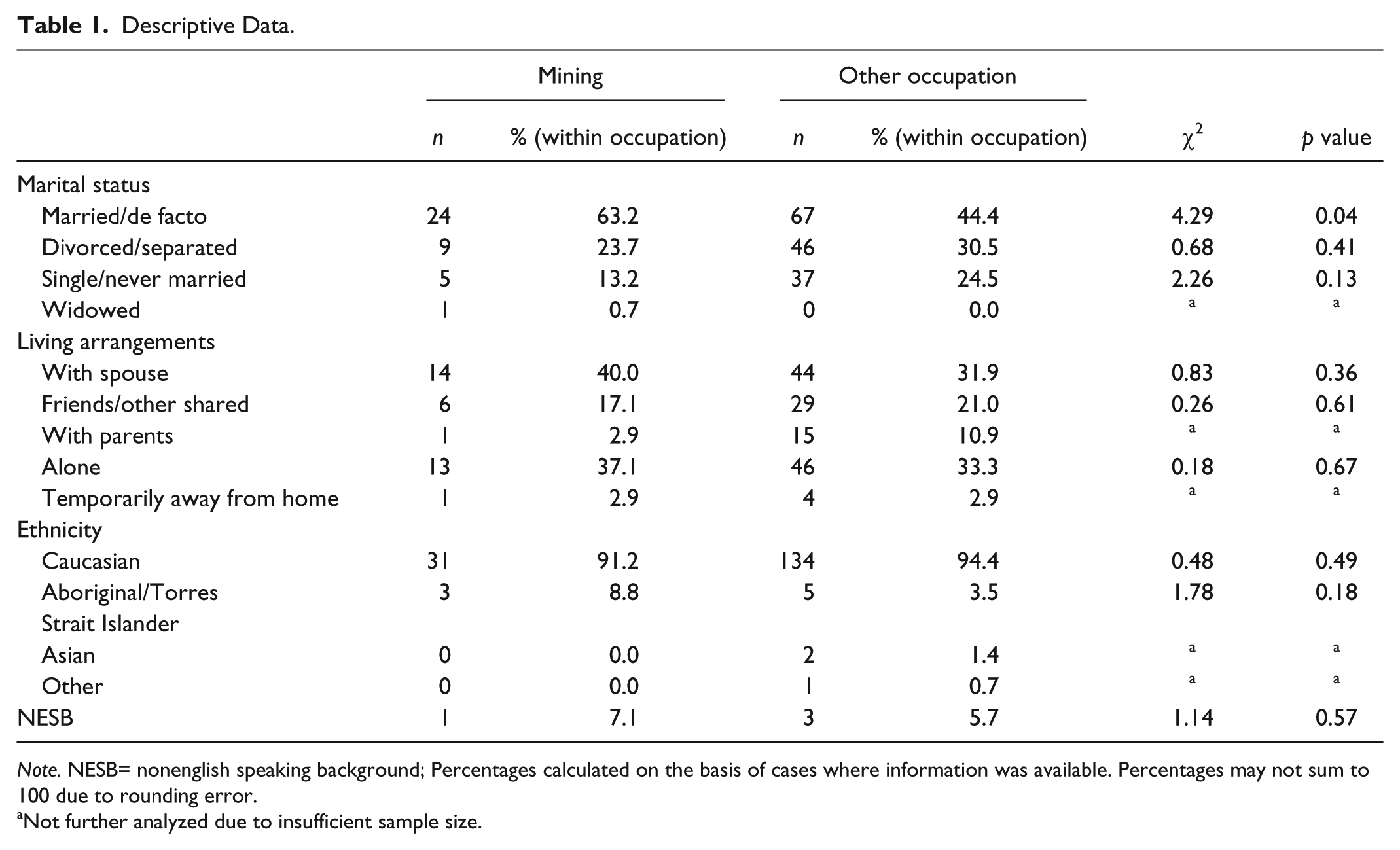
Note. NESB= nonenglish speaking background; Percentages calculated on the basis of cases where information was available. Percentages may not sum to 100 due to rounding error.
Not further analyzed due to insufficient sample size.
Psychiatric History
Table 2 shows comparative psychiatric histories for miners and other workers. No comparisons reached statistically significant levels.
Psychiatric History Comparisons.

Note. Percentages calculated on the basis of cases where information was available.
Alcohol Use
Regarding alcohol use, information was available for 21 mining workers and 83 other workers. Among miners, 7 individuals (33.3% of the cases where information was available) had a reported history of problematic alcohol consumption, compared with 30 other workers (36.1% of the cases where information was available) with reported problematic alcohol use. This difference was not statistically significant (χ2 = .06, p = .81).
Life Events
Table 3 provides information about life events prior to death by suicide. While relatively few differences emerged, it was apparent that relationship problems were significantly more common among mining workers relative to workers in other occupations. Although the sample of deceased persons who experienced child custody disputes was low and barely reached significance at the 5% level, the data are suggestive that miners were more likely than other workers to have experienced this life event prior to death. However, the number of reported instances of this event was too low to enable more detailed analysis.
Life Events.

Note. Percentages calculated on the basis of cases where information was available.
Fisher’s exact test was used.
Not further analyzed due to insufficient sample size.
Given the small sample of miners in the current study and the correspondingly low frequency of most life events, as well as the relative absence of demographic and other differences between the two groups, a parsimonious logistic regression model was applied. This analysis simply considered whether the association between mining and relationship problems persisted when marital status was held constant, given that marital status was the only variable where miners and other workers showed any notable difference. While the statistical significance was marginal, this is nonetheless a difference of theoretical interest.
Using this method, the association between mining work and relationship problems persisted, with miners almost two and a half times as likely to experience relationship problems prior to death by suicide, relative to other workers (odds ratio [OR] = 2.46, confidence interval [CI] = [1.12, 5.40], p = .02; Pseudo R2 = .10). Unsurprisingly, relative to married/de facto status, divorce/separation was independently associated with relationship problems (OR = 3.50, CI = 1.67-7.34, p < .01); however, it should be noted that miners who died by suicide were marginally (but not significantly) less likely than other workers to be divorced/separated.
Discussion
Presently, the capacity of policy makers to properly identify occupation-related health, psychiatric, and other personal issues, and the ability of employers to respond appropriately to the needs of their workforce, is limited by an absence of empirical investigation into the social and emotional wellbeing of Australian mining workers. The current quantitative results build on the very limited amount of evidence currently available about work in the mining industry and represent the first study of completed suicide among mining workers in Australia.
While the relatively small number of miners in this study entails that due interpretive caution should be used, this research nonetheless lends tentative support to the theory that employment in the mining industry may be associated with specific factors that are in turn associated with elevated suicide risk. The current study did not find any major differences between miners and other workers who died by suicide in terms of demographics, psychiatric history, problematic alcohol use, and non-relationship-related life events. However, the results do provide suggestive evidence that relationship problems prior to death may be more commonly observed in the context of suicide among miners, than among other workers who died by suicide. While the observation that relationship troubles may precede suicide is not in itself novel, the seeming difference in exposure to this factor, between miners and other workers who died by suicide, is a new finding.
This begs the question of why miners who die by suicide may have higher levels of relationship difficulties. Drawing on existing literature around workforce characteristics and work-family balance and relationship strain, a possible explanation is that some modes of employment in the resources sector—such as long rosters/rotating shifts—may both increase relationship strains and decrease an individual’s capacity to cope with such strains (for example, by increasing levels of fatigue and decreasing levels of emotional functioning; Craig & Powell, 2011; Liu, Wang, Keesler & Schnieder, 2011; Mesmer-Magnus & Viswesvaran, 2005; Strzemecka et al., 2013; Wittmer & Martin, 2010).
An important limitation of this study is that it was unable to examine prevalence of risk factors for suicide in living mining workers relative to living workers in other occupations. It is possible, for example, that mining workers experience higher levels of relationship problems overall than other workers (as other studies have speculated—e.g., Torkington et al., 2011), which could in turn explain the higher percentage of mining workers who had relationship problems prior to death by suicide—that is, the percentage of the deceased sample with prior relationship problems may be representative of the percentage of a living population of mining workers who experience relationship problems.
It is also possible that the occurrence of relationship problems may reflect differences in marital/relationship status between the groups; although the differences did not reach statistical significance in this study once adjusted for statistical error, a relatively greater proportion of mining workers were married or living in de facto relationships, which may open them to greater likelihood of experiencing relationship problems. Interestingly, differences in the proportion of individuals in each occupation group who were divorced/separated were not observed, which raises the possibility that among some married/de facto workers who died by suicide, relationship problems coupled with the prospect of divorce/separation (rather than divorce/separation itself) may have played a role in their death. This merits further consideration in future work, as it may have implications for policies supporting healthy relationships and family functioning. Alternatively, the prevalence of relationship problems and other psychosocial stressors may be comparable between living samples of miners and other workers (Clifford, 2009) or with the population as a whole (New South Wales Minerals Council Minerals Council, 2012) but may be more strongly associated with death by suicide among mining workers—that is, exposure to a stressful life event may be comparable between groups, but the influence and impact of that event may differ between groups. It is necessary to consider this question further using alternative data sources.
While the reasons underlying the current study’s observation about relationship problems certainly merit closer examination, there are nonetheless practical implications associated with this observation. For example, in terms of addressing possible risk factors for suicide among mining workers, family relationships may be a key issue for many men. From a policy perspective, this suggests a role for programs that strengthen and support family functioning (including support for partners of mining workers). In addition, as aspects of workforce design may affect, both directly and indirectly, family relationships, it may be valuable to consider elements of workforce design that are amenable to change. It is known, for example, that many mining operations involve long working rosters and rotating shift work, with corresponding sleep disturbance and fatigue, which can affect not only an individual’s physiological condition but also his or her psychological wellbeing, family relationships, and social and emotional functioning (see Breslau, Roth, Rosenthal, & Andreski, 1996; Muller, Carter, & Williamson, 2008; Peetz, Murray, & Muurlink, 2012; Presser, 2000; Strine & Chapman, 2005).
Overall, despite its preliminary nature, the current research provides a suggestive insight that relationship problems may play a notable role in contributing to suicide among mining workers, and that the experience of relationship problems prior to death appears to be a characteristic that differentiates between suicide by miners and men in other occupations. This information could in turn potentially provide helpful information for identifying miners who are at risk of suicide, as well as point the way to possible industry-specific intervention strategies.
Footnotes
Acknowledgements
The authors gratefully thank the Queensland Mental Health Commission for their continuing support of the Queensland Suicide Register.
Declaration of Conflicting Interests
The author(s) declared no potential conflicts of interest with respect to the research, authorship, and/or publication of this article.
Funding
The author(s) received no financial support for the research and/or authorship of this article.