




Abstract
This article reports on the evidence for mental health occupational therapy in peer-reviewed journals from 2000 to 2013. Descriptive and inductive methods were used to address this question, with evidence from CINAHL, OTDBase, PSYCInfo, SCOPUS, and Google Scholar® included. Many articles (n = 1,747) were found that met the inclusion and exclusion criteria. A total of 47 different methods were used to develop evidence for mental health occupational therapy, and evidence appeared in 300 separate peer-reviewed journals. It takes on average 7 months for an article to progress from submission to acceptance, and a further 7 months to progress from acceptance to publication. More than 95% of articles published between 2000 and 2002 were cited at least once in the following decade, and around 70% of these citations were recorded in non-occupational therapy journals. The current evidence base for mental health occupational therapy is both substantial and diverse.
Introduction
Peer-reviewed journals are the primary source of credible evidence for clinicians to use in practice. Peer-reviewed journals exist to promote research (Fricke, 2004), and include and promote many ways of knowing that are an essential resource for clinicians seeking to enact evidence-based practice (Fossey, 2005; Froude, 2012). This article reports on the sources of evidence for mental health occupational therapy in peer-reviewed journals from 2000 to 2013.
Prior to 2000, the American Journal of Occupational Therapy in 2008 and 2009 reported an analysis of journal articles on mental health (n = 7) published as part of the American Occupational Therapy Association’s Centennial Vision (D’Amico, Jaffe, & Gibson, 2010). The articles in this small sample addressed intervention effectiveness, instrument development, and descriptive research. A review of articles published in the Indian Journal of Occupational Therapy was undertaken for the decade from 2002 to 2012, and found 10 studies relevant to mental health practice (Acharya, 2013). Again, much of the evidence was descriptive (50%), although there were also several control trials (40%). Both D’Amico et al. (2010) and Acharya (2013) only included a very small percentage of the overall evidence base for mental health occupational therapy. Their samples would have been influenced by the publication policies of the single journals from which they were drawn.
A retrospective analysis of evidence published in the Occupational Therapy Journal of Research covered 20 years from 1981 (Brown & Brown, 2005). The majority of authors were found to be academics, and descriptive studies comprised the largest proportion of articles published (23.7%). However, other methodologies were also well represented, particularly correlation studies (23.8%) and quasi-experimental studies (20.7%). Brown and Brown also investigated the citations from these articles, and noted that journal articles were substantially more likely to be cited than books (including chapters). The journal “Work” conducted a 20-year review of evidence that was published in it (Shaw, Campbell, Jacobs, & Prodinger, 2010), and found that more than half of their articles reported on the psychometric properties of assessments. Conceptual articles made up 22% of the evidence in this journal. The profile of the journal “Work” is quite different from what was reported in the Occupational Therapy Journal of Research, where, for example, conceptual articles are not published. In the study of evidence (n = 52) authored by occupational therapists and published in non-occupational therapy journals between 2004 and 2010, Lajevardi, Rassafiani, Shafaroodi, Mehraban, and Ahmadi (2011) found descriptive studies were the most common methodology (52%) followed by randomized controlled trials (29%).
Mental health is an important area of practice, which is generally considered to be in a period of expansion globally (Ceramidas, de Zita, Eklund, & Kirsh, 2009). Research into the evidence for mental health occupational therapy to date has been from peer-reviewed publications in a single journal or formed an undifferentiated part of more general reviews of occupational therapy evidence. An analysis of the evidence that is currently available to mental health occupational therapists across a range of publications is needed to identify what already exists and guide targeted research in the future. From this knowledge, we can begin planning how to proceed with regard to the types of evidence we wish to develop and the stakeholders we wish to include in this process.
In a review of the evidence relevant to mental health occupational therapy from 2000 to 2012, three questions were explored. These were as follows:
Method
Search Strategy
This study used both descriptive and inductive methods to address the research questions. Four databases (CINAHL, OTDBase, PSYCInfo, SCOPUS) and a search engine (Google Scholar®) were searched using terms designed to capture a broad range of evidence relevant to mental health occupational therapy—“occupational therapy” AND (“mental health” OR “mental illness” OR “psychiatry”).
To answer the first and second research questions, the inclusion criteria were as follows: (a) Articles formally published between 01/01/2000 and 31/12/2013; (b) articles published in English (either originally or available in translation); (c) articles published in peer-reviewed publications; (d) articles where at least one author self-identified as an occupational therapist, consumer of occupational therapy services, or organization representing the profession; and (e) articles for which full text was available. The exclusion criteria were, therefore, (a) articles formally published prior or subsequent to these dates, or only available as “early access” during this time, and (b) articles published in non-peer reviewed publications.
To answer the third research question, a different search strategy was used. The databases and search terms remained the same; however, the search was limited to articles published in the first 3 years of this century (2000, 2001, and 2002) to enable enough time to elapse since publication for a comprehensive analysis of impact on future research. If there were going to be any citations as a result of a publication, you could reasonably expect them to come within the first decade. This led to the identification of 289 articles, a subset of the overall sample analyzed previously, on which the analysis around citations was undertaken.
Sample
One thousand forty-seven articles were found that met the inclusion and exclusion criteria. A system of classification was developed to deconstruct the sample into a manageable form using Microsoft Excel. To extract relevant data for evidence in mental health occupational therapy from each article, 13 variables were used: author names, author designation, number of authors, year, title of article, journal, practice category, practice sub-category, type of evidence, level of evidence (quantitative), level of evidence (qualitative), submission to acceptance (days), and acceptance to publication (days). The practice categories and sub-categories were based on both the International Classification of Diseases (ICD10; World Health Organisation, 2010) for diagnoses. No standardized taxonomy for defining areas of practice in mental health occupational therapy currently exists, and so these categories were generated from the first author’s understanding of practice across several countries (Australia, Canada, and the United Kingdom). Table 1 displays the classifications used for practice categories used to deconstruct the sample data. The category of ambiguous/mixed diagnosis was used for studies where the participants’ diagnoses were not clearly recorded or the sample included people from a range of diagnostic categories.
Practice Categories and Sub-Categories Used to Deconstruct Data.

Data Analysis
Type and Level of Evidence
Analysis began with a careful reading of each article, using highlighting and notes to identify the knowledge contained within. The article was classified according to the practice category it belonged to, and further classified according to relevant sub-categories (see Table 1). Finally, all the evidence in each article was subjected to two further triage steps, classifying it with regard to type and level of evidence. Type of evidence was grouped into four classes of scientific evidence: quantitative, qualitative, mixed, and other evidence. For evidence that had been classified as “other,” no further classification was required. Articles in the first three classes of scientific evidence were classified according to the level of evidence they presented.
The level of evidence for qualitative evidence was assigned using the Rosalind Franklin Qualitative Research Appraisal (RF-QRA) instrument (Henderson & Rheault, 2004). Trustworthiness in the RF-QRA comprises credibility, transferability, dependability, and confirmability. Each component of trustworthiness is measured on a 2-point scale (Yes/No). These scores contribute to the overall level of trustworthiness, which varies between I and V (1 = trustworthiness confirmed for all four components, 5 = trustworthiness confirmed for none of the components). Each piece of qualitative evidence was subjected to key questions, which were as follows: (a) Credibility—Can you believe the results? (b) Transferability—Can the results be transferred to other situation? (c) Dependability—Would the results be similar if the study was repeated? and (d) Confirmability—Was there an attempt to enhance objectivity by reducing research bias?
If evidence existed that supported that element of trustworthiness, the study received one point for that element, which contributed to its ranking on a range of I to V. Unlike the quantitative hierarchy of evidence to follow, this method is dependent on whether authors have reported their efforts to increase trustworthiness in their publication. This reporting can vary, and recommendations have been made for its adoption as a standard feature of qualitative research reports (Mortenson & Oliffe, 2009).
For assignment of level of evidence for quantitative studies, the National Health and Medical Research Council (NHMRC; 2000) levels of evidence were used. Each quantitative study was assigned a ranking from I to V (I = systematic reviews and meta-analysis, V = expert opinion, including literature/narrative reviews, consensus statements, descriptive studies, and individual case studies). Table 2 shows the RF-QRA instrument and NHMRC levels of evidence together, to illustrate how rigor was determined in this study.
Measures Used to Determine Rigor in This Study.

Note. NHMRC = National Health and Medical Research Council; RF-QRA = Rosalind Franklin Qualitative Research Appraisal.
Publication Characteristics
Data analyzed for publication characteristics included authors, year, article title, journal, and the number of authors recorded. The affiliation of all authors on an article was classified into one of three categories: academic only, clinician only, or mixed. The number of days between submission and acceptance, and between acceptance and publication, were recorded where these data were given. This information was important to understand how rapidly evidence was disseminated and available for use by mental health occupational therapists.
Citation Rates
Each article was entered into Google Scholar®, and the number of citations was recorded between 2000 and 2012. This time frame meant that each of the articles had been published for at least 10 years. Citations from all sources (i.e., peer-reviewed journal articles, books, gray literature) were included in the citation count. In common with the overall project, citations in languages other than English were excluded. A number of citations without any year recorded were found, and these were excluded. Citations were recorded on a year-by-year basis and grouped into occupational therapy and generic sources. In this study, “generic” journal sources are all those that do not have a specifically occupational therapy focus or remit. To qualify as an occupational therapy source, the citation needed to be in an occupational journal or have occupational therapy in the title.
Statistical Analysis
The data were analyzed using several groupings: across the entire sample, across a sub-category (such as Intervention/Child and Adolescent), or within a subset of a sub-category (such as qualitative data around Lived Experience/Schizophrenia). For each article, descriptive statistics described the patterns and characteristics for each variable. Inductive statistics were also used to analyze data relating to some variables, with independent sample t tests applied.
Results
The analysis for the first two research questions on type of evidence and source of evidence included the total sample of 1,747 peer-reviewed articles. To answer the third research question, the same inclusion and exclusion criteria were adopted with the exception of the years of publication. The analysis was limited to the first 3 years (2000, 2001, and 2002) to enable enough time to elapse since publication for a comprehensive analysis of impact by citation rate. This resulted in a sub-sample of 289 articles.
Evidence Published in Peer-Reviewed Journals From 2000 to 2013
There were 1,747 peer-reviewed articles written by occupational therapists in English about mental health occupational therapy between January 1, 2000, and December 31, 2013, for which full text could be accessed. There were also an additional 229 articles excluded due to being written in another language, and Table 3 displays the languages that were represented.
Articles Published in Languages Other Than English About Mental Health Occupational Therapy.

Published in French/German journal, but abstract did not specify language.
Authors
The vast majority of articles in the sample were written either by academics only (56%, n = 984) or academics in partnerships with clinicians (33%, n = 569), with the remainder attributed to clinicians only. Across the entire sample, the average number of authors per article was 3.17 (range = 1-15, SD = 2.15) with a noticeable increasing trend as demonstrated in Figure 1.

Average number of authors over time.
There was a very significant difference in the number of authors on articles published in occupational therapy journals (M = 2.62, SD = 1.62) and generic journals (M = 4.15, SD = 2.62; p = .00).
Practice Categories and Sub-Categories
The proportions of evidence for each of the practice categories and sub-categories are shown in Table 4.
Classifications of Evidence Published About Mental Health Occupational Therapy.

For some of the sub-categories, the number of articles was also mapped by year. For both intervention and lived experience, half of the categories displayed a trend toward consistently low numbers of articles. These categories were Drug and Alcohol, Mood (intervention), Anxiety, Personality/Behavior, and Ambiguous/Mixed Diagnoses (lived experience). However, articles about child and adolescent interventions (particularly autism) and organic interventions (particularly dementia) have steadily increased in recent years. In addition, there has been a steady increase in the number of articles about the lived experience of people with mood disorders and schizophrenia.
Articles about forensic, older adults and private practice programs showed consistently low numbers of articles. As shown in Figure 2, there was an increasing trend for articles about vocational programs, and articles about programs for children and adolescents, and for adults, both peaked in the middle of the first decade of this century. The reasons for these peaks are not immediately clear, and may warrant further investigation.

Trends in articles about vocational, adult, and child and adolescent programs.
With regard to theory, there was an increase in articles about conceptual practice models and related knowledge toward the end of the first decade of the new millennium, but this appears to have tailed off from 2012.
Types of Evidence
Most of the evidence found was quantitative, as illustrated in Figure 3.

Proportion of different types of evidence.
A total of 47 different methods were used to develop evidence for mental health occupational therapy, and a full list is provided in the appendix. Many of these were used in single studies, and the top 10 methods spanned all types of evidence, as shown in Table 5.
Top Ten Methods Used to Support Ways of Knowing in Mental Health Occupational Therapy.

As descriptive methods were the most frequently encountered, it is unsurprising that the majority of the quantitative evidence available to mental health occupational therapists was rated as Level V. However, as shown in Figure 4, the profile for qualitative evidence was quite different, with the majority being higher up the hierarchy.

Quantitative and qualitative levels of evidence within this sample.
A different pattern emerged in the articles where mixed methods were used. Both the quantitative and qualitative methods tended toward the lower ends of each hierarchy, as illustrated in Figure 5.

Mixed-methods levels of evidence within this sample.
Range of Journals
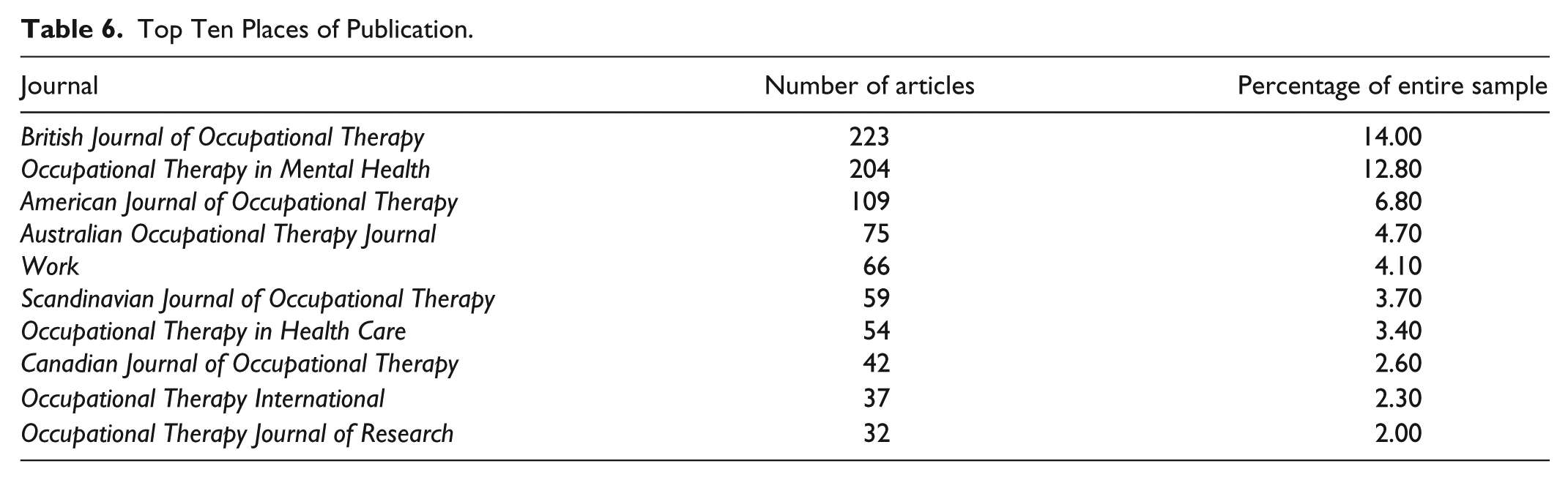
Across the 14 years reviewed, there was an average of 122.47 articles (range = 88-169, SD = 26.41) published each year by occupational therapy authors about mental health occupational therapy. The articles in this sample appeared in 300 separate peer-reviewed journals, and the majority of articles were published in occupational-therapy-specific journals (59.87%, n = 1,046). Many of the top 10 publications were occupational therapy-specific journals for articles regarding mental health occupational therapy, but none garnered a substantial proportion of the articles (as shown in Table 6).
Top Ten Places of Publication.
Journal Process
Some journals publish information about the publication process, usually in the form of dates for submission, acceptance, or publication. The data for these variables were inconsistent, as not all journals publish it, and some changed their policy in this regard during the time of this study. Sometimes the data were given only by month, and in this case, it has been assumed the date was the first of that month. The following results should therefore be regarded as estimates.
More than one third of the articles (n = 652, 37.32%) included information about the time taken between submission and acceptance. The values ranged between 1 day and 939 days, indicating a wide range of procedural speed. The mean number of days between submission and acceptance was 207.94 (SD 156.13). A higher proportion of articles (n = 726, 41.56%) included information about the time taken between acceptance and publication. Again, there was a wide range of values (1-994), and the mean number of days was 230.81 (SD 147.88). Therefore, the average article written by occupational therapists about mental health occupational therapy takes approximately 7 months to be accepted for publication, and a further 7 months (approximately) to appear in its final version in print. As shown in Figure 6, these times have tended to slightly decrease since 2000.

Trends between submission to acceptance, and acceptance to publication, over time.
There was a significant difference in the average time between submission and acceptance between occupational therapy journals (M = 239.79, SD = 154.87) and non-occupational therapy journals (M = 180.13, SD = 135.10), t(488) = 4.98, p = .00. Articles progressed from submission to acceptance significantly more quickly (approximately 2 months) in non-occupational therapy journals. There was also a difference in the average time between acceptance and publication between occupational therapy journals (M = 228.21, SD = 163.05) and non-occupational therapy journals (M = 228.23, SD = 170.59), but this did not reach statistical significance.
Citation Rates
A total of 7,218 citations were recorded for the 289 articles in this sample, giving an overall average of 24.97 per article. Of these 7,218 citations, 6,271 citations were included in this analysis due to the exclusion criteria of English language or for not including a year of publication. The following results are based on 86.88% of the total citations.
The number of citations per article ranged from 0 to 465. Twelve articles were not cited (4.15%, n = 12) by 2013, and a possible factor appears to have been publication in difficult-to-access journals. Six articles were in the Irish Journal of Occupational Therapy, South African Journal of Occupational Therapy, and World Federation of Occupational Therapists Bulletin. Of the remaining six, three described interventions (Gregg, McRobert, & Pillar, 2002; Lee & Dawe, 2002; Lloyd & Samra, 2000), two were overviews (Babiss, 2002; Gutman & Haynes, 2002), and one addressed a workforce issue (Wigham & Supyk, 2001).
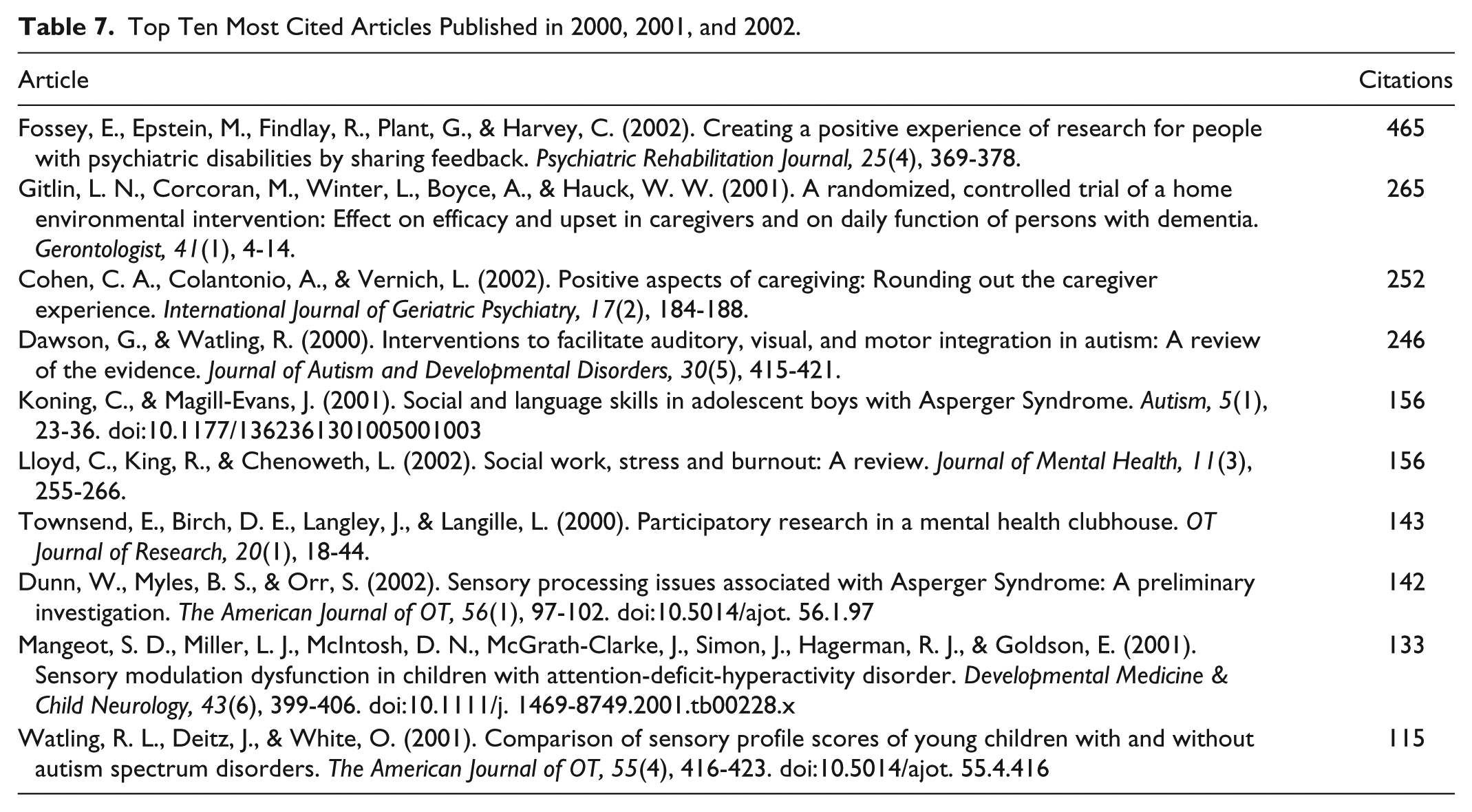
The majority of the articles were cited between once and 20 times (n = 183, 65.40%). At the other extreme were 10 articles that were cited more than 100 times in the subsequent decade. As shown in Table 7, the most cited article (Fossey, Epstein, Findlay, Plant, & Harvey, 2002) garnered the majority of these citations. Five of these 10 articles were about children or adolescents (4 of which referred to sensory processing), 2 were about involving clients in the research process, and 2 concerned working with people with dementia.
Top Ten Most Cited Articles Published in 2000, 2001, and 2002.
Around 70% (n = 4,409) of the citations were recorded in non-occupational therapy journals. Although there was no appreciable trend within occupational therapy journals (average change across all years = 0.01%), there was a marked trend for increased rates of citation in generic journals (average change across all years = 11%), and this rate of citation continues to accelerate (as shown in Figure 7).
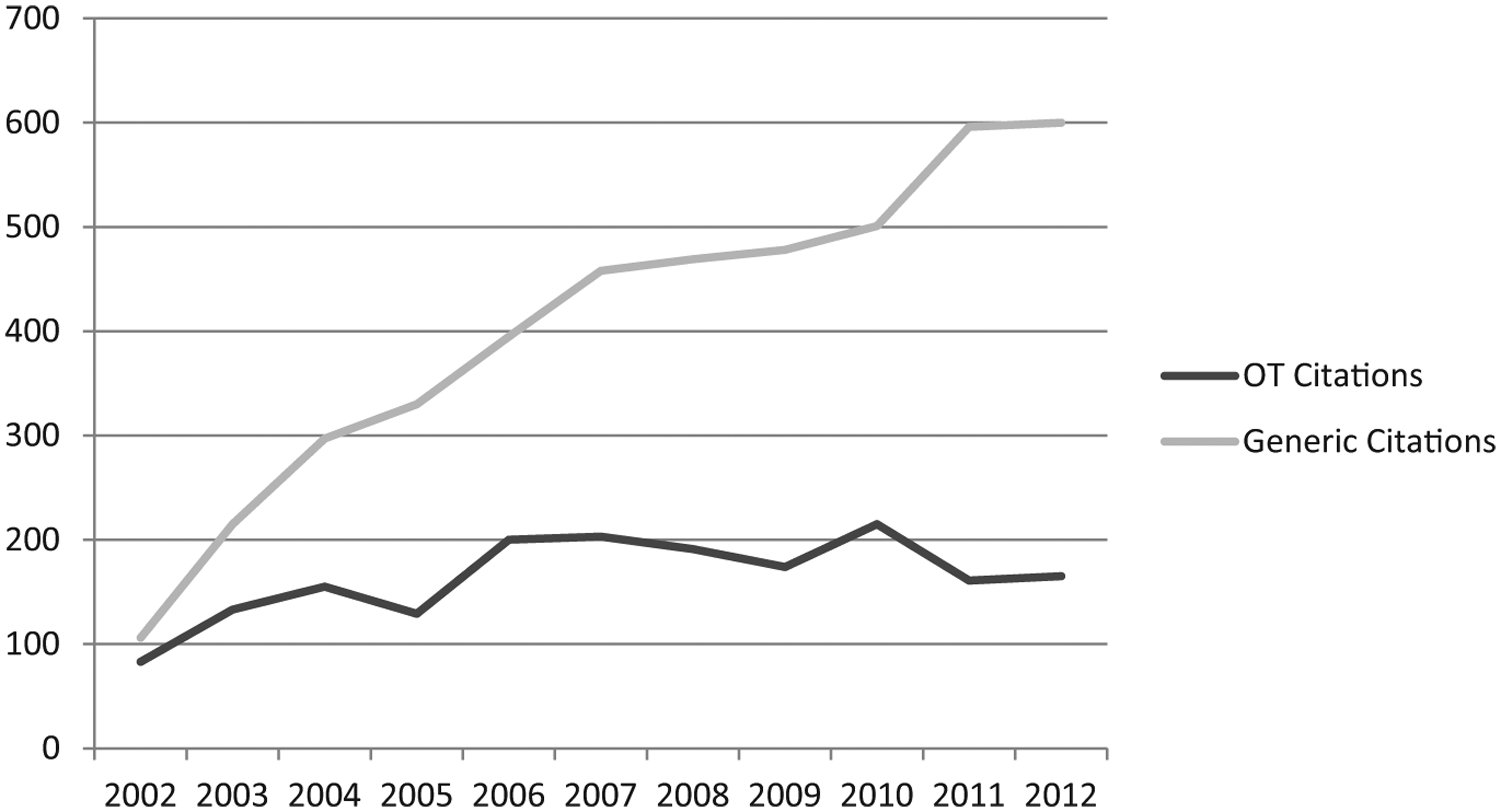
Number of citations by location.
There was a significant difference in the total number of citations between articles published in occupational therapy journals (M = 16.92, SD = 22.30) and generic journals (M = 42.87, SD = 68.04; p = .00), with articles in generic journals cited far more frequently. Articles published in occupational therapy journals were significantly more often cited in occupational therapy journals (M = 7.55, SD = 9.15) than generic journals (M = 4.20, SD = 7.50; p = .002). Articles published in generic journals were significantly more likely to be cited in generic journals (M = 32.44, SD = 57.61) than occupational therapy journals (M = 7.43, SD = 15.17).
The average time between publication and first citation was 2.83 years in occupational therapy journals and 3.05 years in generic journals. Articles in generic journals were cited significantly more quickly in generic journals (M = 1.80, SD = 1.87; p = .000) than in occupational therapy journals (M = 3.97, SD = 2.87).
Discussion
The results of provided a detailed picture of the current evidence available to occupational therapists in mental health. Several trends were identified in the evidence published from Years 2000 to 2013. Intervention for people with organic diagnoses was prominent, as were studies that included a sample with ambiguous or mixed diagnoses. Interventions for children and adolescents, and those for people with schizophrenia, also form noteworthy proportions of the evidence base. Much of this evidence on programs focuses on services for adults and vocational services, which may be reflective of the professions priorities or simply where many occupational therapists are employed. With momentum growing toward early intervention in mental health and aging populations in many Western nations, further research supporting programs for children, adolescents, and older adults is both timely and required to support practice.
Most of the evidence available to mental health occupational therapists was produced using quantitative methods. However, a broad range of research methods was used, with the top 10 cited articles including examples from all traditions. Generally, the quantitative evidence was ranked in the bottom two levels of the hierarchy of evidence, while qualitative evidence tended to be ranked higher in the second and third tiers. Previous studies into patterns of evidence published in mental health have confirmed this pattern for quantitative studies (Brown & Brown, 2005; Shaw et al., 2010); however, patterns in qualitative research have not been studied previously. Given qualitative evidence constitutes almost one in five mental health occupational therapy studies published, great attention to its quality and distribution is warranted.
Articles using mixed methods tended to combine less rigorous methods from the bottom two levels of the hierarchies. However, it could also be argued that the triangulating effect of using mixed methods, where the findings of each method are used to complement each other, acts to increase the overall rigor of the study (independent of the rigor of the individual methods).
The majority of articles written by occupational therapists about mental health occupational therapy are cited, and those that are uncited tend to be in journals that are difficult to access. This may become less of a problem in the coming years, as the majority of journals move to electronic formats and open access becomes more common. The articles that were most cited included a large proportion addressing autism (particularly sensory processing). In occupational therapy practice, autism is more commonly associated with pediatric occupational therapists, although it is classified in the ICD10 (and the Diagnostic and Statistical Manual of Mental Disorders [DSM]) as a mental health disorder. Along with autism, dementia has also been an area with increased publications in recent years, and is also an area of occupational therapy practice where the “physical” and “mental health” sides of the profession are more closely aligned.
Citations for these articles were far more likely to be found in generic journals, and there is a strong trend for ongoing acceleration in citation rates in these publications. Articles that were originally published in generic journals were cited statistically significantly more often than those in occupational therapy journals, and were also statistically significantly more often cited in the sub-group of generic journals. However, those originally published in occupational therapy journals were statistically significantly more often cited in occupational therapy journals. The impact of an article with regard to its chances of future citation is therefore somewhat dependent on the place where the original article was published. Whether this is a factor in the choice of journal made by authors is currently unknown, and would be instructive to clarify. However, it is clear that occupational therapists should expand their searches beyond occupational therapy literature to ensure they have access to all the latest developments in the field.
The impact of an article on future research takes approximately 3 years to appear using citation rates as a measure. Articles initially published in generic journals were cited in generic journals significantly more quickly than those published in occupational therapy journals. However, citation counts are a relatively blunt instrument with which to measure impact. Future research that follows the influence of the content of the evidence, by tracing the development of ideas through a line of articles on a particular subject, would be illuminating.
There are several limitations to this study, which limit the applicability of these findings. The exclusion of articles in languages other than English did lead to the loss of a number of articles. In the absence of translated copies, monolingual occupational therapists will not have access to potentially valuable evidence (regardless of the language it is published in). Although it is important to preserve linguistic diversity within the profession, resources for translation would be a good investment. With regard to the publication process, only some of the journals publish information usually in the form of dates for submission, acceptance, or publication. This introduced some potential inaccuracy into the findings, but they are the most accurate possible in the circumstances and should be regarded as estimates.
Conclusion
The current evidence base for mental health occupational therapy is substantial and diverse, having grown considerably in the last decade. The vast majority of the evidence was written either by authors in academic roles or collaborative teams comprising academics and clinicians. The aforementioned diversity was also evident in the fact the articles were found in so many peer-reviewed journals.
Our knowledge in some areas (such as autism and dementia) is relatively comprehensive, or rapidly developing. In others, there is a distinct lack of evidence (such as personality disorders), and the reasons for these omissions are not clear. There was a gap in published evidence about mood and anxiety disorders, which are the mental health problems with the highest prevalence. Accepting the inclusive perspective of this study has enabled a comprehensive understanding of what is available to mental health occupational therapists. This article has documented the evidence based for the first decade of this century in mental health occupational therapy that was written in English.
Footnotes
Appendix
Methods Used to Construct Evidence for Mental Health Occupational Therapy.

| Type of evidence | Method | No. of studies |
|---|---|---|
| Quantitative | Descriptive | 470 |
| Pre–post | 109 | |
| Control | 104 | |
| Randomized controlled trials | 52 | |
| Systematic review | 25 | |
| Meta-analysis | 5 | |
| AB | 4 | |
| ABA | 3 | |
| ABAB | 2 | |
| Qualitative | Unspecified | 127 |
| Phenomenology | 60 | |
| Grounded theory | 36 | |
| Focus groups | 30 | |
| Ethnography | 16 | |
| Narrative | 18 | |
| Consensual qualitative | 3 | |
| Framework analysis | 2 | |
| Meta-synthesis | 5 | |
| Interpretative interactionalism | 1 | |
| Institutional textual analysis | 1 | |
| Deductive interpretative approach | 1 | |
| Sociolinguistic analysis | 1 | |
| Mixed methods | Case studies | 93 |
| Participatory action research | 9 | |
| Other evidence | Overview | 141 |
| Psychometric | 121 | |
| Literature review | 70 | |
| Program description | 49 | |
| Opinion | 45 | |
| Reflection/personal testimony | 34 | |
| Critical analysis | 26 | |
| Role statement | 16 | |
| Practice evaluation | 19 | |
| Theoretical | 14 | |
| Critically appraised topic | 12 | |
| Practice guidelines | 9 | |
| Path analysis | 3 | |
| Historical | 3 | |
| Scoping review | 2 | |
| Evidence mapping | 1 | |
| Needs assessment | 1 | |
| Critical incident technique | 1 | |
| Logic model | 1 | |
| Cost effectiveness | 1 | |
| Interpretative biography | 1 |
Declaration of Conflicting Interests
The author(s) declared no potential conflicts of interest with respect to the research, authorship, and/or publication of this article.
Funding
The author(s) received no financial support for the research and/or authorship of this article.