




Abstract
In any discourse on sociology and anthropology, one fact that clearly emerges is that women can generally be trusted to perform their duties with utmost care and attention. This is more so in the case of agriculture and allied activities. No wonder women are playing a very important role in the sericulture industry. Their qualities like maternal instincts and loving care of those under their charge prove to be very helpful in the successful breeding of silk worms. The sericulture industry has opened up phenomenal employment avenues and helped women to become important players in the decision-making process—whether in the household or in the community at large. The active involvement of women is very essential for the success of the any community development initiative. This has been proved on many occasions all over the world—more so in the developing countries. For instance, the success of Self Help Groups (SHGs) in Andhra Pradesh and other states of India is all due to the active role played by women. The thrust of this article is on the role of women in promotion of sericulture activities in the village, and how their participation has led to community development. Given the above backdrop, the present article is based on an empirical work undertaken in Kotha Indlu village, Chittoor District of Andhra Pradesh in South India. Sericulture is an important means for generating employment, income enhancement crop enterprises, and is a most appropriate household activity. In all these activities, women have shown their mettle and performed their tasks most skillfully. In the village under study, women are playing an important role in silk rearing and processing activities. This article will endeavor to show how “sericulture,” an agro-based activity, has brought about overall development of individual households, the village, and the community at large.
Introduction
Numerous studies have brought out the vital role that women have been playing in all farm-related activities—ranging from land preparation to marketing. They constitute a higher proportion of the labor force in the agricultural sector than men. However, they are generally not active in decision making in the community (Barman, 2001; Bose, Ahmed, & Hossain, 2009; Joshi, 2000; Nathan & Kelkar, 1997; Rahman & Routray, 1998; Satyavathi, Bharadwaj, & Brahmanand, 2010). However, in the present study, it has been found that women are equally involved in decision making in their households, as well as in the village. The study by Regmi and Weber (1997) has critically assessed the existing gender relations in agriculture, in the cross-cultural, historical, and contemporary perspectives. Barman (2001) argued that social and cultural constraints lead to less mobility of women and less involvement in income-earning activities in far-off places. Women are largely involved in unpaid housework and crop production and livestock rearing within their homestead areas.
Sericulture, as a crop enterprise, has emerged as one of the dominant fields in the theoretical and methodological understanding in the disciplines of sociology and social anthropology in India. Thus, sociological analysis of sericulture and its emergence in the development literature gives us an idea of the activity which would trigger further theoretical and critical studies. Here an attempt has been made to understand the sociological view of sericulture and women’s role in the development of the enterprise and also the community.
It has been seen that the sericulture activity brings regular income to the community without any bias of caste, creed, gender, or religion. A remarkable feature of this activity is its egalitarianism—sericulture farmers, rich and poor, earn the same income from it. As women has a crucial role in the activities of sericulture, it equally creates opportunities and make them independent socially, economically, politically, and otherwise (Geetha & Indira, 2010, 2011; Goyal, 2007; Pillai & Shanta, 2011; Thomas, Muradian, de Groot, & de Ruijter, 2010; Vasanthi, 1992; Vijayanthi, 2002).
The present article will mainly explore the role of women in sericulture. This includes the concept of work, division of labor, segregation of occupations, dimension of labor and household activities, and role of Development of Women and Children in Rural Areas (DWCRA) in relation to sericulture, and so on. This article will further discuss the perception of women toward silkworm, feeding, and so on, and the role of children in sericulture activities.
The article is organized into four sections. The first section “Background” will briefly explain the background of the development of sericulture in India. The second section “Methodology” will deal with the methodology used for the study and ethnographic profile of the village and community. The third section “Women in Sericulture” will present an overview of sericulture and the role of women in it, concept of work, division of labor, women in relation to DWCRA, and sociological analysis of pollution and purity. The last section “Summary and Conclusion” will summarize the article.
Background
India, the second largest producer of silk in the world, enjoys the unique distinction of producing all the four varieties of natural silk, namely, tasar, eri, muga, and mulberry. The silk industry can be found in vastly diverse regions such as temperate (Kashmir), subtropical (Jammu, Himachal Pradesh, Uttar Pradesh, North-Eastern Region), and tropical (West Bengal, Bihar, Orissa, Madhya Pradesh, Andhra Pradesh, Tamil Nadu, and Karnataka). Mulberry silk accounts for about 90% of the total production in the country (Geetha & Indira, 2011).
Sericulture is essentially a village-based industry that provides employment to both skilled and unskilled labor (Lakshmanan & Jayram, 1998). At present, it is estimated that every hectare of mulberry plants provides employment to about 16 persons. Although sericulture is considered a subsidiary occupation, technological innovation has made its cultivation possible on an intensive scale, making it capable of generating huge revenues. All family members, irrespective of gender and age, can contribute to the success of sericulture and, in this sense, it can be considered a home-based industry.
Today, mulberry is being cultivated in about 0.192 million hectares in India. Around 6 million people from around 800,000 farm families are engaged in sericulture activities, concentrated mainly in the three southern states of Karnataka, Andhra Pradesh, and Tamil Nadu. The 2007 Mulberry Silk Production Statistics estimated the world silk production to be 98,725 metric tonnes. China’s contribution to world silk production is 80% (78,000 metric tonnes), and the share of Indian silk production is 16,245 metric tons (13%). China and India together account for 93% of world silk production. According to the Annual Report of the Central Silk Board (CSB) for the year 2007-2008, India recorded a production of 16,525 metric tonnes of mulberry raw silk. A total of 796,685 sericulture families from 53,814 sericulture villages contributed to the production of raw silk. Karnataka, followed by Andhra Pradesh, West Bengal, and Tamil Nadu, contribute to the bulk of production. Export earnings from silk and silk goods were Rs. 33,383,500,000 ($333 million; CSB, 2008). The market share of Indian silk exports in the global silk trade is 4% to 5%.
In its long history, sericulture in India has experienced many ups and downs. However, during the last 30 years, India has made tremendous progress in the production of mulberry silk for which there is an increasing international demand. There is tremendous scope for the expansion of its production in the country. In recent years, considerable progress has been achieved in evolving suitable mulberry varieties and techniques to evolve new silkworm species suitable for tropical climatic conditions. With the evolution and introduction of more productive silkworm species, the productivity has increased and sericulture has become a highly remunerative activity. Attracted by these advantages, many more farmers have taken up sericulture and the industry has spread to almost all the States in India (Balasubramanian, 1986).
Karnataka has been the leading producer of mulberry silk—accounting for more than 50% of its production in the country. This state is now regarded as the “Silk Bowl of India.” Andhra Pradesh comes next to Karnataka. In Andhra Pradesh, sericulture has proved to be a money-spinner for many middle-class families. Except for Hyderabad district, almost all the districts in the State have taken to sericulture activity. In 1956, mulberry cultivation in the State was only in 1,212 hectares. It went up to 4,03,144 hectares during 2000-2001 (CSB, 2010-2011).
Once confined to a few pockets in Anantapur and Chittoor districts bordering Karnataka, sericulture has caught up in such a big way that in just 10 years time, the state of Andhra Pradesh ranks next to Karnataka, the premier silk-producing state in the country. Though almost all districts in the state have taken up sericulture, the mulberry silk production is mainly concentrated in the four Rayalaseema districts, namely, Anantapur, Chittoor, Cuddapah, and Kurnool. Of these Anantapur and Chittoor stand first and second, respectively, in the entire state in production of mulberry raw silk. At present, Anantapur and Chittoor have shown enormous growth rates in sericulture development in Andhra Pradesh.
Kasi (2000) rightly opined, “Sericulture is a labour-intensive agro-based activity” (p. 1-5) and is also an industry. It includes growing of mulberry plants, rearing of silkworms, production of cocoons, and reeling of silk-yarn. While cultivation of mulberry and rearing of silkworms are agricultural activities in character, reeling of silk, twisting, and weaving are distinctly industrial in nature. The reeling of cocoons is done in cottage establishments or in large factories, called filatures. The development experience in our country reflects the extent to which economic growth per se does not lead to improvement in the socioeconomic conditions of the people. However, at times, processes that aimed at optimum utilization of resources have led to increased marginalization of people, especially children and women, in the long run. A critical area of concern in this regard should be to rethink our development policies and agendas. These should largely reflect people’s aspirations and responses to both an immediate and long-term macro-economic perspective and the social implication of these policies on their lives. Progress, if viewed from an economic and development pathway appropriate to the conditions existing in a given sociocultural milieu, will ensure a balance between economic development and improving the quality of life of the people at large.
The development of sericulture industry in India is a case in point. Sericulture is said to provide an excellent opportunity for socioeconomic progress in the context of a developing country like India, due to various reasons. First and foremost, sericulture is a highly labor-intensive industry. Excluding mori-culture (mulberry cultivation), which is a cottage industry, silkworm rearing itself generates 1.5 and 4.5 person-years of employment per year per hectare of mulberry garden, under rain-fed and irrigated conditions, respectively. The article tries to explain the concept of “Development” in the light of the discussion into the practice of Sericulture in India, and more so in Andhra Pradesh. Thus, to carry the concept for further discussion, here an attempt has been made to gain an anthropological understanding of the processes of development.
In considering the anthropological approach to development, three terms and two spheres of scholarly activity must be distinguished. The terms are as follows: “growth,” “performance,” and “development.” The spheres of activity are anthropological contributions to the macro-analysis of social processes, and the implications of empirical field studies for development theory and interpretations.
“Development” represents an increase in the capacities of a society to organize for achieving its objectives and carry out its programs more effectively. The essential element here is organization. Anthropologically speaking, when one society is developed and another underdeveloped, the former is, by comparison with the latter, able to make much more complicated decisions and perform more complex tasks. It is widely assumed that an improvement in development implies an improvement in the level of satisfaction or welfare of the members of that society. The fact is that some forms of development under some circumstances improve performance, while other forms of development do not (Kasi, 2006).
Anthropologists find themselves uncomfortable in the movement back and forth between micro-field studies and macro interpretations that are increasingly necessary. More than other social scientists, they are aware of the gap between general theory and broad interpretations, on the one hand, and empirical, down to earth interpretations, on the other (Kasi, 2009).
In the light of the above discussion, it would be fruitful to view sericulture as a development strategy and analyze whether the above perspectives hold good in this context. A review of available literature on sericulture in India would provide us an understanding of the role of sericulture in ameliorating the conditions of the rural poor, in general, and women and children, in particular. The phenomenal growth of sericulture in Andhra Pradesh and Karnataka, especially in the backward areas, has led many an institution and individuals to conduct research studies and surveys. A brief review of the studies undertaken so far on various aspects of sericulture in India can give us the nature of the studies and their intent.
S. R. Charsley’s “Culture and Sericulture” (1982) dwells on the significance of livestock industry and sericulture in the development of communities. It is not only a case study of silk industry of south India but also a very good example for considering the role of social anthropology in development. Increasingly, anthropological interpretations of comparative development have been sought when economic ones prove insufficient. This book is a thorough study of a local community through an industry, its structure, it policies, and their implementation. It is able to offer an anthropological interpretation of development and suggests ideas on the role of anthropology in development.
The CSB, Bangalore; the Central Sericultural Research and Training Institute (CSRTI), Mysore; Institute for Social and Economic Change (ISEC), Bangalore; and National Institute of Rural Development (NIRD), Hyderabad, have conducted many workshops, seminars, and surveys on sericulture development and published reports. These reports are very useful in formulating an idea of the growth potential of sericulture in Andhra Pradesh and Karnataka.
The studies undertaken in Andhra Pradesh, especially in Rayalaseema districts, were also mostly by the economists. The existing literature clearly demonstrates a need for an anthropological study of sericulture in Andhra Pradesh, as sericulture is positively impacting the lives of many a poor, most importantly women and children residing in the backward areas of the state. The present study is anthropological in nature with focused attention on the role of women in sericulture, concept of work, division of labor, sociological analysis and links of pollution and purity, women in DWCRA, and so on.
In order to fill this gap in the knowledge about sericulture, a village in Kuppam Mandal of Chittoor district was chosen for the study. Chittoor stands second in the production of mulberry and silkworm rearing in the State. It has the distinction of introducing new breeds of bivoltine like “Swarnandhra” and “Jica.” Kuppam is one of the regions that is growing quite fast and occupies a prominent place in the sericulture map of Chittoor. The village Kotha Indlu has pioneered the adoption of new varieties of bivoltine seed and also new techniques and methods of mulberry cultivation.
Method
This article is based on the data collected from Kotha Indlu village of Chittoor district in Andhra Pradesh. This study is a qualitative micro-level study of sericulture being practised in that village. The primary data were collected through a structured household schedule, informal interviews using detailed checklists, key informant interviews, case studies, and observation from all respondents in the village. Quantitative information with regard to the technological development, land holding, demographic aspects, cropping patterns, and irrigation systems were collected by using household schedules and the District Statistical handbook. Secondary data and information were collected from the annual reports of the Department of Sericulture, Andhra Pradesh; the studies and reports brought out by the CSB, Bangalore; Centre for Economic and Social Studies (CESS), Hyderabad; Indira Gandhi Memorial Library, University of Hyderabad; ISEC, Bangalore; NIRD, Hyderabad; and CSRTI, Mysore.
Village Profile
Kotha Indlu is situated in the Kotha Indlu Panchayat of Kuppam Mandal in Chittoor district, about 15 kilometres from Kuppam, the mandal headquarters. It is a multi-caste village, predominantly inhabited by persons belonging to the Balija, Vanniar, Scheduled Castes, and washermen castes. The Balijas are the dominant caste in this village. They are dominant politically, economically, educationally, and also numerically. While the Balija occupy the highest position in the local caste hierarchy, Vanniar, Chakali, and the Scheduled Castes occupy the subsequent positions in that order. Vanniars, who are a backward caste, are competing with the Balijas economically and educationally, though they are weak numerically and politically. Next to the Balijas, the Scheduled Castes are numerically more than Vanniars and Chakalis. The total population of the village is 274 formed by 50 families.
On the basis of land holdings, the residents of Kotha Indlu are classified into marginal, small, medium, and large farmers, and the landless. In Kotha Indlu, the number of small farmers forms the majority. The next bigger group is the medium farmers. The numbers of large and marginal farmers are quite few, whereas the number of landless is almost insignificant.
The crops cultivated are Paddy and Ragi, which constitute the staple diet of all communities. Commercial crops like flowers and groundnuts are also grown in the village. Floriculture is especially found among the Balija farmers, while all the castes raise groundnut crop on their lands. Though sericulture occupies the second position after agriculture, it is the major source of income for the farmers in the village. Cattle, goat, sheep, buffaloes, and donkeys are the major livestock in the area. Several varieties of grass, along with stocked paddy straw, maize stalk, groundnut, and bhoosa, are used as fodder. Poultry is widely prevalent in the village and only the Scheduled Caste members practice piggery.
The village is very well connected by road and has good transport facilities. Except Scheduled Castes sericulturists, the remaining sericulture farmers of the village use tillers, tractors, and bullock carts to transport their produce to the towns. The village has telephone as well as postal facility, an upper primary school, and a high school. It also has a ration shop under the public distribution system to supply essential commodities to the people who fall under the below poverty line (BPL) at concessional rates.
The residents of Kotha Indlu village attach a lot of importance to rituals. Rituals are associated with all their activities. The president of the Gram Panchayat is from the Scheduled Caste community. In fact, this (Panchayat) seat was reserved for the Scheduled Castes in the last elections held for the local bodies on rotatory basis. There is a farmers’ club in the village, which takes care of their problems both in the society and outside.
Women in Sericulture
Sericulture is an extremely labor intensive industry and occupies a pivotal position from the point of providing employment and additional income to weaker sections (Best & Maier, 2007; Bhatta & Rao, 2003; Geetha & Indira, 2011; Vijayanthi, 2002). In this context, the transformation of sericulture industry from subsistence type of operation to a modern scientific system requires the attention of all major players like policy makers, administrators, and personnel associated with the industry. Here, the word personnel mainly refers to women laborers who are the full-time workers and who look after silkworm rearing and management and whose contribution is more than that of men in this area. It has been reported that women contribute about 50% and 60% of labor to mulberry cultivation and silkworm rearing, respectively (Gate, 2001; Goyal, 2007; Kasi, 2011; Panda, 2007; N. Singh, 2006; Srinath, 2008; Thamizoli, 2001; V. Vijayalakshmi, 2002).
It has been rightly observed by Inbanathan and Vijayalakshmi (1997) that
economic development has been one of the main objectives of many governments of countries around the world. And, improving the socio-economic condition of women has also been an important aim in their development programmes. In this context, and in India, sericulture has been found to be very helpful in meeting the development objectives of the Government. This is because it is labour intensive, and provides employment and income to many people, both in rural and urban areas. As such, it is of particular significance in anti-poverty programmes. Sericulture is not one occupation, but includes several activities, from planting and growing mulberry plants, rearing of silkworms to reeling of silk yarn from cocoons. In much of these activities, the labour contribution of women is significant. (pp. 37-38)
From time immemorial, women have been involved in different sectors of the silk industry. According to a legend, the discovery of the silkworm and cocoon was by a beautiful Chinese princess. But for her foresight and imagination, perhaps, the silk industry would not have been what it is today. The industry is well established in the traditional countries like Japan, China, and Korea (Geetha & Indira, 2011). The progress has been equally rapid in the developed and underdeveloped countries. In India, sericulture is practiced as an agro-husbandry-based subsidiary occupation. From the household, women are employed in sericulture operations. As mentioned earlier, about 51% of women are assisting men in this lucrative industry to produce the “queen of textiles” (Kannan, 1987).
Women are mostly favored because of their industrious nature. They are employed in a mulberry garden or silkworm rearing or in a grainage or in weaving or in a garment-making factory, and so on. As mentioned earlier, sericulture offers a vast scope to augment the family income. Women are actively engaged in the mulberry fields for the removal of weeds and in leaf plucking. The leaf plucking is a skilled and delicate operation. The workers must have full knowledge about which leaves to be plucked to suit different ages of silkworms. Women go to the fields in the morning for plucking the mulberry leaves and return to the rearing house before noon.
In the rearing house, it is not uncommon to find women folk assisting men in feeding the silkworms. Feeding is an art very aptly done by the fair sex, though men do chopping of leaves. Women assist in bed changing and they do this with utmost tenderness, so as not to hurt the delicate worms. Women have become experts in Chawki rearing, which is a highly delicate operation that needs to be performed with a great deal of care and patience. Good harvests depend on good Chawki rearing. When the silkworm matures and time is ripe for spinning the cocoons, it is again women who are employed for picking the ripe worms and putting them on the chandrikas (bamboo mountages on which silkworms are placed when they are just about to spin their cocoons). Any over crowding will lead to an increase in the spinning of double cocoons, which would be unsuitable for the production of high-grade raw silk. When the cocoons are ready for harvesting, it is mostly women who sort out the flimsy, stained, double, and deformed cocoons from the chandrikas.
Coming to the post cocoon technology, the involvement of women is greater, commencing from silk reeling, weaving, and garment manufacturing industry. Whether it is a charkha, cottage basin, steam filature, or automatic or semiautomatic reeling, women are preferred due to the dexterity of their fingers in getting the fine filaments from the cocoons, casting of the ends, and their patience to work in hot water and seam for long hours. It is really a touching sight to see women sitting near the boiling water all day long, reeling the crude charkha silk. Women’s greater involvement in reeling industry is seen not only in India but also in all silk-producing countries. The ultimate success of the post-reeling operations depends much on good winding, that is, yarn without breaks. There should be continuity in the yarn. Otherwise there will be too many knots which hinder good weaving, be it on a handloom or a power loom.
However, their work has not always been properly recognized or suitably rewarded. Cultural factors have complicated the proper evaluation of the quantum and quality of women’s contribution. This includes elements such as the structure of work in each society, segregation of women and men in specific occupations, and the division of labor.
Work and Division of Labor
Bose et al. (2009), in their sociological study, have clearly depicted the patterns of women’s work and analyzed the factors that influence the gender division of labor. Furthermore, they viewed that the persistent gender division of labor in rural Bangladesh has been found to be associated with both economic and sociocultural factors. Rural economic activities within the household were found to have a weak impact on women’s empowerment. Earlier, Inbanathan and Vijayalakshmi (1997) rightly stated,
“Work is regarded in many ways in different societies, and, the conception of work has also varied from time to time. The transition from simple hunting and gathering communities to agrarian technology entailed a major shift in gender relations. The sociology of gender and, to some extent, sociology of work has attempted to explain the work of women by relating it to two realms prevalent in society. It has been argued that women’s involvement with child rearing and domestic work was responsible for their exclusion from the public sphere. (p. 38-39)
It has been amply demonstrated that though women participated in both spheres of work context, they are still confined to “home-based” jobs than “outside home” jobs or tasks. Even in cases where they do both jobs, they are to be performed under the guidance or supervision of men. Their home-based jobs are not even considered as productive work and in the same vein, all home-based jobs done by women, including silkworm rearing, are relegated to a lower status and are virtually considered insignificant and unskilled. This also has a bearing on their decision-making power vis-à-vis men (Dankleman & Davidson, 1988; Inbanathan & Vijayalakshmi, 1997).
Division of Labor
The epistemological debates on the issues of division of labor in Indian society have been critically examined by the scholars of sociology and social anthropology (Amer, 2009; Arya, 2007; Channa, 1997; Damodaran, 2002; Datta & Sinha, 1997; Everingham, 2002; Gate, 2001; Goyal, 2007; Illo, 1994; Jose, 2003; Kelkar, 2007; Mandal, 2010; Padhi, 2007; Ramdas, Yakshi, & Deepika, 2001; Rao, 2001; Rustagi, 2004; Shah, 2000; N. M. Singh, 2001; D. P. Singh, 2005; Thamizoli, 2001; Vissandjée, Abdool, Apale, & Dupéré, 2006; Xaxa, 2004). The division of labor in Kotha Indlu shows (Table 5) a typical gender divide in various activities that the women and girls perform, as compared to men and boys. All the household chores, rearing children, looking after the needs of their husbands and other members of the family, are all tasks perceived to be performed by women alone.
Work by women in agricultural field, as well as looking after sericultural tasks, which are usually branded as “feminine” tasks, are generally not recognized as productive jobs. These include a wide variety of tasks like domestic chores and agricultural and sericultural tasks like sowing, weeding, cutting, or plucking leaves, and so on. These tasks are, as a matter of fact, more arduous and back-breaking. Tables 1 and 2 above amply bring out this sort of discrimination against women.
Area Under Mulberry in Different States of India in 2010-2011.

Source. Central Silk Board (2010-2011).
Division of Household Activities (in %).
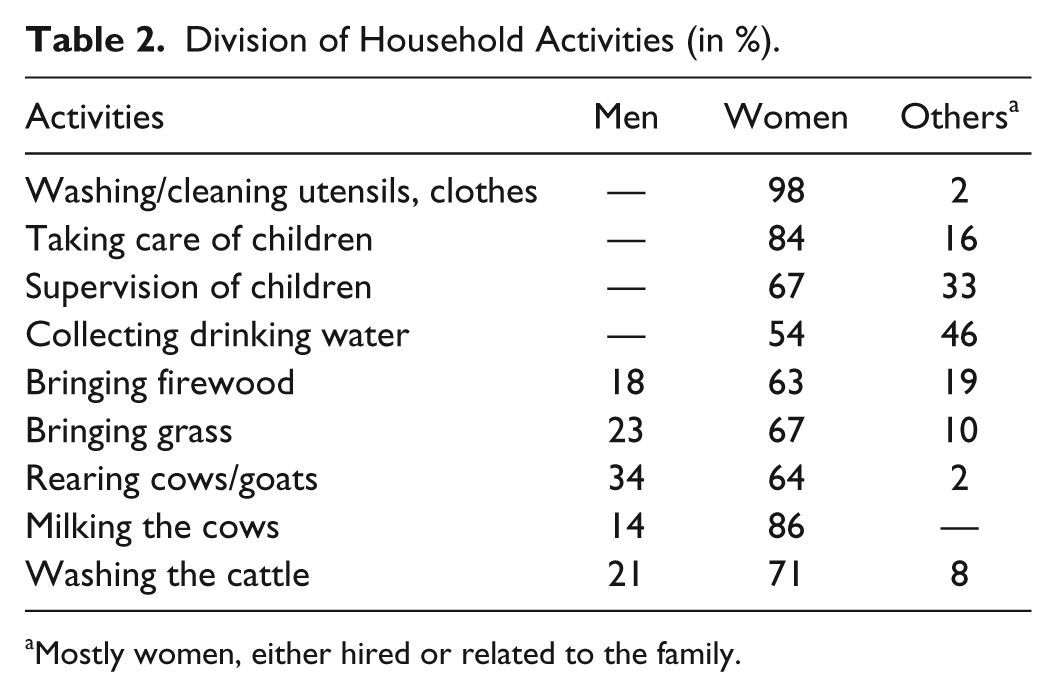
Mostly women, either hired or related to the family.
Some people in Kotha Indlu believe that men are more skilled and knowledgeable in the application of fertilizers, and wherever women are involved, they work under the supervision of men. A division of labor is also seen in the activities pertaining to maintenance of mulberry gardens. Both men and women participate in farmyard manure (FYM) application and irrigation. Thus, men are mainly held responsible for activities like pruning, ploughing, and fertilizer application, and women for weeding. Maintenance and upkeep of mulberry garden is the male realm and any “skilled work,” be it in raising and maintenance of mulberry garden or silkworm rearing and marketing of cocoons, is a male domain and if women are involved in these tasks, they have to “consult” and work under the “guidance” of men. Men do not engage themselves in “less skilled,” “unskilled,” or “no skilled” jobs (Table 3).
Division of Labor in Establishing Mulberry Gardens (in %).

Note. FYM = farmyard manure.
Even in silkworm rearing, the sharing of tasks follows the same logic of “skilled” and “unskilled” jobs in mulberry cultivation. Thus, except for chawki rearing and harvesting of cocoons, which are “skilled” jobs and hence are done mostly by men, women in Kotha Indlu perform all the other tasks. Bed cleaning and disinfecting the trays are considered “women’s jobs” and 92.5% of women are involved in it. However, both men and women perform disinfecting of the rearing house (Table 4). Hiring of labor is not a practice commonly found in Kotha Indlu. Still there is the prevalence of exchange labor, which stresses on the traditional linkages. When the workload is more and when more hands are required, the help of their kinsmen and friends is taken.
Division of Labor in Mulberry Garden Maintenance (in %).

Note. FYM = farmyard manure.
Division of Labor in Silkworm Rearing (in %).

Marketing of cocoons is considered a predominantly male activity, so is purchasing of disinfectants, trays, and nets. Women are more involved in renting of the chandrikas, because a majority of the households rent chandrikas from the DWCRA groups in Kotha Indlu or from the neighboring villages. In the study village, there are 7 DWCRA groups, each group consisting of 10 to 15 members, and each group has its own name. In every group, there is a first leader and second leader, who convene and coordinate the meetings. For all the groups, there is one accountant, called cluster associate, who looks after the monetary transactions and accounts.
Case Study
Udaylakshmi, aged 28, whose husband practices floriculture, has three children and all of them are school going (Convent and Montessori) in Kuppam. Her husband studied up to fifth class, whereas she studied up to ninth class. After joining as a member in the DWCRA group, “Bhagylakshmi,” she became a little more assertive. Slowly, she became a leader and now she is cluster associate to 15 DWCRA groups, which are functioning in the Kotha Indlu Gram Panchayat. Out of these DWCRA groups, 9 are in Kotha Indlu. She is also an accountant to all these 9 groups. Without Udaylakshmi, they cannot conduct meetings. She is a cluster associate in “DAN” Foundation, which is an NGO, whose headquarters is in Madurai in Tamil Nadu.
“DAN” society has been conducting training classes to women in Andhra Pradesh, especially in Chittoor district, where a number of DWCRA groups and Thrift groups are located in Tirupati and Chittoor regions. According to “DAN” estimates, there are 350 DWCRA groups in Kuppam mandal alone. They are conducting women awareness camps, 10 days in Tirupati and 3 days in Kuppam. They are also participating in the Akshara Tapashman programs; vaccination programs, Janmabhoomi; V.S.S.; Shramadanam; and other awareness increasing programmes, participation in which is voluntary.
According to Udaylakshmi, before joining the group, she was very short-tempered and was getting very angry even over minor issues. But after joining the group she became more cool headed, patient, and bold, and her self-confidence improved. Now she does not think about caste distinction, but is more concerned about one’s effective participation in DWCRA. She said that earlier she had lot of caste bias, some kind of bias against lower caste women/men. She is now very much interested in educating woman.
She gave one example of a problem, which was sorted out through her intervention in the village. There was a problem of stomach ache to one woman. Her husband, a drunkard, did not take care of his wife. Because of her pressure, the project director wrote a letter to the Government General Hospital for checking and scanning. They found that she has a tumor in her stomach and demanded Rs. 10,000 for the operation. Because of Udaylakshmi’s pressure, Government gave money for the operation. Now the woman is in good health. This amply demonstrates the emergence of some leadership among women.
Activities of DWCRA in Relation to Sericulture
DWCRA program was launched in 1982, as part of the Integrated Rural Development program (IRDP). Its aim was to empower rural women living BPL by helping them to create sustainable income-generating activities through self-employment. It was the first program of its kind that specifically focused on improving the quality of life of rural women (Acharya, 2003; Arya, 2007; Best & Maier, 2007; Jakimow & Kilby, 2006; Panda, 2007; Raju, 2005; D. P. Singh, 2005). In the study village, DWCRA arranges meetings with sericulture officials to learn about new methods of technology/crop/seeds. It coordinates the members’ training programs. It conducts awareness programs in areas such as cleanliness of the rearing house and trays and chandrikas and acts as a mediator between sericulturists and Department of Sericulture. It advises the members on issues related to their personal health. DWCRA provides chandrikas to the rearers on rent and it also constructs shed to keep chandrikas and trays. It provides loan to members to buy silkworm seed (Matti).
Whenever women were associated in marketing, it was always with the help of a male member of the household since it is considered a “male activity” and a relatively difficult task to perform. This is mainly because it involved going out of the village, interacting with strangers, and money transactions. The dominant culture of the village does not encourage women to undertake activities where they have to travel away from home. In this situation, marketing is considered a male preserve, and is likely to remain so in the foreseeable future as well. However, this principle was not always strictly followed, and according to the class/caste, and economic circumstances, women may need to take up marketing and also wage labor, and their families would necessarily have to accept these. Marketing under these circumstances, that is, whenever women have to travel relatively long distances away from the village, is usually with male escorts.
In the households which are engaged in both agriculture and sericulture, women are usually more active in sericulture, which involves staying back at home. However, they are more often confined to “less skilled” occupations, as perceived by the sericulturists. While agriculture has a relatively clear-cut division of labor, sericulture in Kotha Indlu also has divisions based on gender. Agriculture is still the major activity for people of the village.
Women and Silkworm Rearing
Women in Kotha Indlu village feel that worms are very sensitive in nature. For them, tending the worms is like looking after children. While feeding worms, women take utmost care. Sometimes, they feel that they do not take that much care of their own children. Women consider bed cleaning and litter cleaning as a natural thing that they do in case of children, and it requires utmost patience. Here girls are mostly involved in all of these activities. In most of the sericulture households in Kotha Indlu, girls’ participation in sericulture activity is higher than that of boys. There are a couple of exceptions to this general rule. This is evident in case of Tulasibabu.
Case Study
Tulasibabu, aged 15, is studying in the 10th class and is the eldest son of the family. He can do all work relating to sericulture. Even though he is in the 10th standard, he can concentrate on sericulture as well. The officials, right from assistant director to lower staff, came to the village and gave him guidance on sericulture. He is the third man to grow Swarnandhra (it is a new variety of bivoltine silkworm) in this village.
He is very intelligent and hard working, according to the Convenor of the Farmers’ Club. He had learnt about sericulture from his father and other persons in the village through observation and experience. He says that because of sericulture, his family’s lifestyle and living conditions have improved a lot. They have modern gadgets like T.V. and tape recorder. He said that though he is still a “child,” he should be a bit careful about his future too. After joining the 10th class, he has spent around Rs.1, 000 for books and other materials.
He is studying in the 10th class, but somebody will be there to see all the works in the house. If he gets the chance to study, he will go for college and enjoy college life. He has a great desire to go for higher studies and after that he wants to become “Chief Minister” of Andhra Pradesh.
Regarding health, he does not have any complaints. Very rarely he may get cold and fever, which is not because of sericulture. There is no complaint about any disease with this crop.
He did not feel sorry for pursuing sericulture along with his education. Though his father is there, he is very busy with politics and other meetings of the Telugu Desam Party and is also the president of Education (Vidya) volunteers committee and electricity committee. His teachers and friends have been encouraging him to do both the tasks. Most of the teachers know that he is performing both tasks reasonably well.
Pollution and Purity
The sociological debate on the issues of pollution and purity has engaged the attention of the academia for quite a long time (Arun, 2007; Ciotti, 2007; Cort, 2004; Galanter, 1967; George, 2002; Heredia, 2000; Hollup, 1993; Hospital, 1980; Ishwaran, 1966; Iversen & Raghavendra, 2006; Karanth, 2004; Keshodkar, 2010; Khandelwal, 1997; Krishna, 1978; Lamb, 1999; Mencher, 1966; Pandian, 2009; Parry, 1991; Pinney, 1999; Saavala, 2001; Sahay, 2004; Shah, 2006; Sharma, 2010; Srinivas, 1984; Thaiss, 1978; Thapan, 2004; Tharamangalam, 1989). These debates are not restricted to India alone. These are taking place in parts of Asia, Oceania, and Africa (Gray, 1980; Hayashida, 1975; Jayaram, 2006; Nigosian, 1999; Philips, 2005). Sericulture farmers in the village are practicing pollution and purity in relation to death of a family member, puberty period of a girl child, menstrual cycles of women etc, very sincerely. During pollution period, they do not allow the polluted person into the rearing house. Purity is considered very much important to get a good yield. Everyday, they apply bleaching powder to the surroundings to control the other smells and to maintain the purity. They also apply “samrani” in the belief that after offering samrani, the silkworms would eat more leaves.
During the Chawki period, they perform a day-long puja to Lord Ganesh and distribute sweets when they get a good yield. Officials gave them small training like in the beginning, because this crop was a bivoltine (Swarnandhra). They also offer potatoes and coconuts to officers after getting a good yield.
The elderly persons play an important role in sericulturist households. Their role can be seen from third molt stage onwards, where labor requirement is more and, at the same time, they look after their grandchildren. Children too have an important role in sericultural operations. They look after the worms in the chandrikas.
Generally, in most areas where sericulture is practiced, women have relatively poorer access to productive resources such as land, credit, and extension (government provided support of technical services and sericulture materials). While the quality of extension services may vary from place to place, it has almost uniformly been found that land is a resource that is generally not within the reach of women. In most cases, land is held in the name of male member of the family. Only in very rare cases could one find that women have land in their names. This has directly affected the credit opportunities for women, when banks consider them as less than credit worthy since they do not fulfill collateral requirements for taking loans. In rural areas, land has emerged as the most visible and tangible collateral for loans. To sum up, women play a significant role in sericulture activity of Kotha Indlu. In some spheres, their role may be limited, but women perform the majority of sericultural work.
Summary and Conclusion
In this article, a sociological understanding of the sericulture development, as studied by the scholars of the different disciplines across the states of India, has been provided. Sericulture is best suited to a country like India, where manpower and land resources are in surplus. It generates direct and indirect employment in various ways. More and more farmers in India have taken up sericulture activity and this activity, which was once confined to only five states, has spread to almost all states of India. Of all the states, Karnataka has emerged as the leading producer of silk—accounting for more than 50% of the mulberry silk production in the country. Andhra Pradesh, though not a traditional state in silk production, occupies the second place in the country.
Presently it is being practiced in 23 states of India, of which only 5 are traditional states and the remaining 18 are nontraditional States. Karnataka, a traditional silk state, has been called the “Silk Bowl of India” as it produces more than 50% of the total raw silk in the country. Andhra Pradesh comes next in this regard. The general climatic conditions in these two states are quite favorable for the growth of sericulture. The promotional agencies have played an essential and dynamic role in the development of sericulture. The Directorate of Sericulture, Hyderabad, and the State Sericultural Research and Training Institute, Hindupur, have been helping by providing suitable technologies, and evolving new varieties of mulberry and silkworms.
The sericulture respondents also cultivate other crops like paddy, groundnut, Ragulu, small millets, and vegetables. Owing to continuous research and improvement in recent years, sericulture has established its superiority over other principal crops. Employment opportunities in sericulture can be categorized under two heads. One, opportunities related to mulberry cultivation and silkworm rearing which are agricultural in nature and which are undertaken in rural areas. Two, opportunities relating to silk reeling, twisting, weaving, and marketing, which are mostly undertaken in semiurban and urban areas.
Sericulture also creates gainful employment for women and aged persons at homes at minimum risk. Thus, the analysis clearly establishes the importance of sericulture over other crops in the generation of fresh employment opportunities in rural areas. Furthermore, as a predominant sector of rural development, stability is the vital need of sericulture enterprise. Hence, efforts should be made to put the fortunes of this labor-intensive activity on sound lines by establishing regional organizations for stabilizing the silk prices.
In the study, it emerged that there have been instances of women being actively involved in the decision-making process, with special reference to sericulture practice and also community development. As mentioned earlier, it was a woman who pioneered and initiated the sericulture in the study village. Though this finding cannot be generalized across societies and places, the success story of Udaylakshmi and other women in the study area needs to be replicated in other areas as examples of the outstanding role of women in triggering community development.
Footnotes
Acknowledgements
Author would like to thank anonymous referee, Prof. Rama Moorty, for his help in editing, SGO team and especially to Ms. Laura Dale for her consistent support throughout in completion of this research paper.
Declaration of Conflicting Interests
The author(s) declared no potential conflicts of interest with respect to the research, authorship, and/or publication of this article.
Funding
The author(s) received no financial support for the research and/or authorship of this article.