




Abstract
Students’ mathematics learning is influenced by school factors (i.e., teachers’ knowledge of content, pedagogy, students, and curriculum) and nonschool factors (parental involvement, expectations, and teaching techniques). This study looks holistically at the way these factors impact the learning of mathematics of first-grade Romanian students, examining the interactions between teachers, students, and their parents, as well as the interactions between parents and their children. Findings reveal that successful mathematics learning occurs when teachers and parents meet frequently to discuss the mathematics teaching and learning that takes place at school and at home.
Keywords
Introduction
The performance of the U.S. students in the international competitions, such as Programme for International Student Assessment 2000 (PISA), and Third International Mathematics and Science Study 1999 (TIMSS) was reported as average (Stedman, 1997). Recent results of the same studies (PISA, 2006; TIMSS 2007) showed US students performing above average. In comparison, the performance of the Asian students in these competitions has always been exemplary. To have a clearer understanding of this performance gap, and to improve the mathematics performance of the U.S. students, researchers (Huntsinger, Jose, Larson, Krieg, & Shaligram, 2000; Ma, 1999; Schmidt et al., 2001) have investigated the school and nonschool factors deemed responsible for the success of the Asian students.
In analyzing the schooling factors, Ma (1999) found that the stronger mathematical content knowledge and pedagogical knowledge of the Chinese elementary school teachers may lead to a better mathematics understanding of the Chinese students. This advantage, coupled with a more cohesive curriculum exposing students to fewer but more in-depth topics (Li, 2000), may explain the better performance of Chinese students in various research studies and competitions.
Huntsinger et al. (2000), and Huntsinger and Jose (2009) analyzed the different ways American and Asian American parents helped their children with mathematics at home. Findings indicated that the Asian American students exposed to more formal types of interactions (drills, worksheets, rubrics, more practice) had a stronger understanding of mathematics than their American peers. Moreover, Tsui (2005) found a high correlation between parental expectations and student mathematics scores: the higher the expectations of the Chinese parents, the higher the scores of the Chinese students, as opposed to U.S. students.
While the above studies show the impact of particular factors on students’ mathematics performance, they only analyzed these factors in isolation, providing a limited understanding of the Asian students’ success and the performance gap. A closer look at the TIMSS 2007 (Mullis et al., 2008) scores revealed that Romanian students performed significantly lower than their Asian and the U.S. peers, although the former possessed some of the characteristics believed to make the Asian students successful (i.e., a more cohesive curriculum, more rigorous instruction).
The complexity theory of interrelated factors (Maturana & Varela, 1984; Senge, 1990; Waldrop, 1992) may provide a more thorough understanding of student mathematics learning than would the analysis of these factors in isolation. This study used the complexity theory to analyze the interrelatedness between school and nonschool factors, in an attempt to understand why some students perform better than others despite being exposed to a similar educational context. The researcher looked at the interaction between four elementary school teachers, their students, and the students’ parents in a school district in Romania, a country that shares some of the characteristics deemed to render the Asian students successful.
Review of Literature
Teacher education literature and comparative education literature provide a lens to analyze the factors influencing student mathematics learning. Studies such as TIMSS 2007 (Mullis et al., 2008), Perry (2000), and PISA (2006) revealed that school factors widened the gap in performance; other studies (Huntsinger & Jose, 2009; Tsui, 2005) focused on the influence of cultural factors on student mathematics learning. Researchers believed that the study of the factors responsible for the Asian students’ success might help teachers, educators, and policy makers in reforming the U.S. educational system.
School Factors
Teachers’ subject matter knowledge
By now, it is universally acknowledged that teachers’ knowledge of mathematics impacts their classroom practice and their students’ learning (Ball & Bass, 2000, 2003; Hill, Rowan, & Ball, 2005; Shulman, 1986, 2000, 2007). Over two decades ago, Shulman and his colleagues (Shulman, 1986, 1987; Wilson, Shulman, & Richert, 1987) were among the first to look into what constituted knowledge for teaching mathematics. As a result of this line of research, Shulman (1986) proposed three categories of knowledge needed for teaching mathematics: knowledge of content, knowledge of pedagogy, and knowledge of curriculum. Defined as the “amount and organization of knowledge per se in the mind of the teacher” (Shulman, 1986, p. 9), content knowledge represents the category comprising the facts and concepts in a domain, as well as the teachers’ understanding why facts and concepts are true. Shulman’s second category, the pedagogical content knowledge, “goes beyond knowledge of subject matter per se to the dimension of subject matter knowledge for teaching” (p. 9). Teachers who possess pedagogical content knowledge can accurately represent specific parts of the content for their students, being aware of the challenges students may face learning certain topics. The third category, curriculum knowledge, represents the teachers’ understanding of how topics are arranged, as well as their ability to make use of different curriculum resources. According to Shulman (1986), curricular knowledge is the full range of programs designed for the teaching of particular subjects and topics at a given level, the variety of instructional materials available in relation to those programs, and the set of characteristics that serve as both the indications and contraindications for the use of particular curriculum or program materials in particular circumstances. (p. 10)
In an attempt to refine Shulman’s previous categories of mathematics knowledge, Ball, Thames, and Phelps (2008) developed a comprehensive framework for the knowledge needed to teach mathematics, which they named the “mathematics knowledge for teaching” (MKT). According to Hill et al. (2008), this type of knowledge comprised not only the mathematical knowledge common to individuals working in diverse professions, but also the subject matter knowledge that supports that teaching, for example, why and how specific mathematical procedures work, how best to define a mathematical term for a particular grade level, and the types of errors students are likely to make with particular content. (p. 431)
Ball et al.’s (2008) “egg” model maintained Shulman’s (1986) three original knowledge categories (i.e., subject matter knowledge, pedagogical content knowledge, and curriculum knowledge). Their innovation, however, lay in further dividing the first two categories. The researchers viewed subject matter knowledge as made of common content knowledge (CCK) and specialized content knowledge (SCK). While CCK represents the knowledge common to teaching and other professions that use mathematics, SCK represents specialized knowledge tailored for the teaching profession (Hill et al., 2008). Pedagogical content knowledge, in turn, was divided into knowledge of content and students (KCS), which combines knowledge about students and knowledge about mathematics, and knowledge of content and teaching (KCT), which combines knowledge about teaching and knowledge about mathematics.
Effective teachers possess a multidimensional understanding of mathematics, knowing not only how to do the mathematics they are teaching, but also to explain and represent ideas in a variety of ways to their students (The Final Report of the National Mathematics Panel, 2008; Hill, Sleep, Lewis, & Ball, 2007). Hill et al. (2005) found a significant correlation between teachers’ mathematics content knowledge and student achievement, suggesting that “teachers’ content knowledge plays a role even in the teaching of very elementary mathematics content” (p. 399). The researchers advocate the need for mathematics teachers to possess a deep conceptual and procedural understanding of mathematics to be effective. If teachers only possess a procedural knowledge of mathematics, they fail to develop a conceptual understanding of mathematics in their students. Results of a study conducted by Schoenfeld (1988) indicated that when exposed to memorization and drill, high school students could apply the studied procedures without understanding the problems they were solving. Ball (1990) confirmed Schoenfeld’s findings, while examining the mathematics knowledge of preservice elementary and secondary teachers. Even if the participants knew how to solve the problems, they lacked the conceptual understanding that enabled them to teach the topic effectively to their students.
Ma’s (1999) study discussed this limited understanding of content knowledge of the U.S. elementary teachers. Despite a longer formal mathematics training of the U.S. teachers, findings showed that the American teachers were more procedurally focused, while the Chinese teachers possessed a procedural and a conceptual understanding of the concepts. The knowledge of the Chinese teachers was coherent, while that of the American teachers was fragmented.
This procedural knowledge of mathematics in most cases informs the teachers’ choice of instructional strategies: if knowing mathematics means knowing how to do it, teaching mathematics is realized by following step-by-step procedures to arrive at answers (Ball & McDiarmid, 1990; Mestre & Lochhead, 1983). If preservice teachers see mathematics concepts presented as procedures rather than theories, they develop a fragmented understanding of mathematics, which, in turn, influences their teaching.
Instructional strategies
The above studies discussed the impact of content knowledge on teachers’ classroom practice. Looking at content knowledge alone only provides a limited understanding of student mathematics performance, as other factors may be responsible for student learning. Hill et al. (2008) analyzed the relationships between the MKT and the mathematics quality of instruction (MQI), and they found a strong relationship between what teachers knew, how they knew it, and how they conducted their classroom instruction. While MKT represents teachers’ content knowledge, their pedagogical content knowledge, and their knowledge of the curriculum “MQI is composite of several dimensions that characterize the rigor and richness of the mathematics of the lesson, including the presence or absence of mathematical errors, mathematical explanation and justification, mathematical representation, and related observables” (p. 431). According to Hill et al. (2008), the following elements influence the MQI: addressing students’ misunderstandings and interpreting their answers appropriately, the accuracy of mathematics language used for instruction, as well as the presence of rich mathematics opportunities (varied examples, equitable opportunities to learn, multiple representations, mathematical explanations).
Perry (2000) investigated the impact of instructional practice on student learning, looking at the mathematical explanations given by American, Taiwanese, and Japanese elementary school teachers. Findings showed discrepancies regarding the complexity of these explanations. Overall, the Asian students heard more complex mathematics explanations than their U.S. peers. If students are exposed to more complex mathematics explanations and regard them as an appropriate form of discourse in the mathematics classes, they develop a stronger understanding of mathematics concepts (Matthews & Rittle-Johnson, 2009). These findings may shed light on the performance of the Asian students, addressing the influence of instructional practice on student learning, and indirectly connecting teachers’ knowledge of mathematics with the quality of mathematics instruction (Hill et al., 2008).
However, an analysis of instructional practice alone may not provide a deep understanding of the performance gap in the international mathematics comparisons, indicating that relationships between multiple factors may explain student achievement in mathematics. The cross-country analysis below is attempting to show that when looking at instructional practice in isolation, one cannot explain the underperformance of Romanian students, despite the advantages given by the instructional practices common in this country.
Romania may serve as an informative case in looking at the performance gap, as the scores of the Romanian students are closer to those of the U.S. students in the PISA 2006 and TIMSS 2007 studies, despite the fact that some of the instructional practices could provide them with an advantage over their Chinese and U.S. peers. The following international comparisons are based on the results of the eighth-grade students from three countries: United States, Chinese Taipei, and Romania. The researcher realizes the confusion the analysis of older students (than the students investigated in the current study) may pose, but PISA and TIMSS are the only studies discussing these three groups of students together. Moreover, Romanian students only participated at the eighth-grade level. To maintain accuracy, the researcher only looked at student scores and instructional factors related to eighth-grade students in the above three countries. TIMSS 2007 study provided complex examples of mathematics classroom practices in 49 different countries. This analysis briefly looked at a few instructional practices believed to place students at an advantage in learning mathematics (i.e., providing rationales for the answers; being engaged in active learning, decision making, and problem solving).
There has been much discussion about the fact that students learn more mathematics when engaged in active learning rather than just listening to lectures (National Center for Research on Teacher Learning, Michigan State University, 2005). When students are engaged in problem solving and decision making, their mathematics learning increases, as they learn to first represent the problem and then move toward finding the solution (Montague, 2003, 2005; Montague, Warger, & Morgan, 2000). Moreover, researchers found that when students are enabled to provide explanations and rationales for their answers, they discover connections between these concepts, which increases their learning (Matthews & Rittle-Johnson, 2009; Rittle-Johnson, Saylor, & Swygert, 2008; Wong, Lawson, & Keeves, 2002).
Results from the TIMSS 2007 study show that Romanian students had many opportunities to provide rationales for their answers, as Romanian teachers involved their students in providing rationales 87% of the instructional time, versus only 47% of the instructional time in China and 77% in the United States. Moreover, 63% of the instructional time in Romania was also spent in involving students in deciding procedures for solving complex problems, while U.S. students were only involved in generating procedures 44% of the time and their Chinese peers only 25% of the time. According to the above research, these strategies should place the Romanian students at an advantage. However, students from 25 other countries outperformed Romanian students in the TIMSS 2007 study. The PISA (2006) study revealed similar results: Chinese Taipei students outperformed all the countries in mathematics, the U.S. students ranked 35 out of 57 countries, while the Romanian students performed below average, ranking 45. What other factors may be responsible for this achievement gap?
Curriculum
Researchers (Manouchehri & Goodman, 2000; Rodriguez, 2000; Stedman, 1997) have long discussed the connection between the mathematics curriculum and student learning, analyzing mathematics textbooks from different countries. Valverde, Bianchi, Wolfe, Schmidt, and Houang (2002) conducted a cross-cultural curriculum analysis using the TIMSS 1994 database, looking at the impact the structure of the mathematics textbooks had on classroom experiences. Findings revealed that the U.S. textbooks had a fragmented content structure, based on the repetition of the same topic spread across the book, while books from China had a progression of sequential themes. Researchers also found that the eighth-grade U.S. textbooks covered more topics than did the Chinese books.
Schmidt et al. (2001) analyzed the number of content strands in the Chinese and U.S. textbooks, counting the number of times a content strand ends and a new one begins. They found that the U.S. textbooks had 215 strands, while books from China had only 75 content strands. These findings may link the number of topics to student performance: The more topics covered, the weaker the U.S. students’ mathematics performance. However, the Chinese students’ mathematics performance may be explained by the fact that the Chinese textbooks covered fewer topics, but more in depth. However, this hypothesis does not provide a clear explanation for the results of the Romanian students in the TIMSS 2007 study. If curriculum impacts student performance, how can one explain the below-average performance of the Romanian students in mathematics competitions, despite similar curricular characteristics to the Chinese curriculum (Schmidt et al., 2001)? Similar to the Chinese books, Romanian books had a progression of sequential themes, covering fewer topics than did U.S. books. Most importantly, the Romanian textbooks had fewer content breaks (20), than did the U.S. textbooks (215) and the Chinese textbooks (75), which would imply more cohesion between topics.
The above studies looked at subject matter knowledge, curriculum, and instructional practices of teachers from different countries in an attempt to understand the performance gap in mathematics achievement. Looking at these factors in isolation only provided weaker explanations when Romania was introduced as a case. Similar to the advantage placed by instructional practice (TIMSS 2007), the curricular advantage in the case of Romania fails to explain the weak performance of the students in the international competitions, challenging the factors responsible for the success of the Asian students. Along with school factors, cultural factors (home interactions, parental expectations) may provide a deeper understanding of the Asian students’ success in the international competitions.
Nonschool Factors
Home influences: Teaching strategies, expectations, and motivation
Researchers in the comparative education field (Chao, 2000; Huntsinger & Jose, 2009; Tsui, 2005) discussed the impact of parental teaching strategies and expectations on children’s mathematics learning. The author of this article is aware that other cultural factors are also significant (native language, socioeconomic status [SES], parents’ preparation level), but as they do not constitute the object of this study, they will not be discussed. In an attempt to uncover the most common teaching practices among parents with diverse cultural backgrounds, Huntsinger et al. (2000) investigated mathematics practices in Asian American and Caucasian American homes of preschool and kindergarten children. The researchers interviewed the parents and they videotaped the home interactions in which parents taught their children counting games and helped them with mathematics word problems. Test findings showed that Chinese American students outperformed their Caucasian peers. The researchers explained this superior performance from the perspective of the more formal teaching approaches (i.e., longer duration of interactions between parents and students, expecting children to spend greater amounts of time in studying mathematics, using memorization, drills, and worksheets). Caucasian students whose parents used similar strategies scored higher than their peers whose parents taught using more informal techniques.
Tanase’s (2008) study discussing Romanian parental practices confirmed the above findings: children whose parents used more formal teaching strategies (developing and using worksheet, spending a longer time interacting with their children, and drilling them), displayed a stronger knowledge of place value concepts before and after the teacher taught these concepts. While findings from these two studies shed light on parental teaching approaches at home, they also question similar teaching approaches at school. Would students benefit more from being exposed to formal teaching approaches at home and at school?
Huntsinger and Jose (2009) analyzed parental involvement and its impact on student learning with Caucasian American and Asian American parents. The researchers conducted home observations when the students were in preschool and kindergarten, then 2 years later when they were in first and second grades, and finally when students were in third and fourth grades. Findings indicated that more structured teaching methods had a stronger influence on students’ mathematics learning. While American parents tended to volunteer more in school activities, Asian parents were more involved in their children learning at home. The researchers linked this higher involvement of the Asian parents at the kindergarten and preschool level to the students’ mathematics performance in higher grades (Englund, Luckner, Whaley, & Egeland, 2004).
Chao (2000) investigated the different parenting styles of Chinese American and European American parents of first- through third-grade students. The researcher discussed two different types of parental involvement: managerial (checking homework) and structural (purchasing extra workbooks and outside materials, arranging for private tutoring). Findings indicated that Chinese American parents were more structurally involved, which may be explained by the immigrant parents’ weaker understanding of the U.S. school system. This structural approach (Chao, 2000; Schneider & Lee, 1990), coupled with the managerial type of involvement (early tutoring provided by parents) may lead to a stronger mathematics achievement of the Asian and Asian American students. However, Fan and Chen’s (2001) meta-analysis of literature revealed that parental expectations for their children are a stronger indicator for student achievement than parental supervision and involvement.
Tsui (2005) explored the relationships between parental expectations and student performance in mathematics in Chinese and American families. The researcher interpreted the higher mathematics achievement of eighth-grade Chinese students in light of parental expectations. Overall, Chinese parents had higher expectations for their children and talked more frequently with them about school than did the American parents. The researcher concluded that other factors might explain the superior performance of the Chinese students, such as the national curriculum, the Chinese teachers’ mathematics knowledge, as well as the students’ attitudes toward mathematics.
Cao, Bishop, and Forgasz (2006) discussed the role parental expectations have on Chinese and Australian students’ mathematics learning. Findings showed that students in China demonstrated a higher level of perceived parental expectation than Chinese-speaking students in Australia and than the Australian students, but students in China and Chinese-speaking students in Australia showed a similar level of perceived parental encouragement. However, this study did not link parental expectations to student achievement. More studies need to investigate this connection to understand student mathematics achievement in depth.
The above studies showed the impact of different factors on students’ mathematics performance. While these factors may explain achievement gaps for the U.S. and Chinese students, this understanding is limited when comparing countries sharing similar curriculum and parental practices (China and Romania) but with significant differences in terms of student achievement. No study has to date analyzed the impact the interaction of these factors might have on students’ mathematics achievement.
Theoretical Framework
Complexity is “a science of learning systems, where learning is understood in terms of the adaptive behaviors of phenomena that arise in the interactions of multiple agents” (Davis & Simmt, 2006). The major assumption underlying the complexity theory is the fact that there are no independent agents, each agent being part of a team (Senge, 1990; Waldrop, 1992). Cobb (1999) discussed the need to apply complexity theory to the field of mathematics, advocating for the shift from mathematics as content (mathematics made available to students through the curriculum) to mathematics as emergent terms (mathematics ideas emerging from the practices of the classroom community). Davis and Simmt (2006) stated that complexity has become a source of advice for mathematics teachers, who should be no longer thinking in terms of “What’s happening?” but in terms of “How can it be made to happen?” thus impacting teaching and learning of mathematics. Moreover, Davis and Sumara (2006) discussed the nestled levels of school mathematics, stating that teachers needed to consider the interactions between multiple agents, such as individual understanding, collective knowledge, curriculum structures, and classroom collectivity.
By looking at what happens within a mathematics classroom (the interactions between teachers and students) and outside the classroom (the interactions between parents and their children), one may become aware of how the educational whole is greater than the sums of its parts (Senge, 1990). This study used complexity theory as a proposed model of the interaction effects between school factors (teacher knowledge, classroom instruction, curriculum, and teacher-student interactions) and nonschool factors (parental expectations, parental knowledge of place value concepts, and parent−children interactions). The researcher hypothesized that students’ mathematics performance is greatly influenced by teachers’ knowledge of content, pedagogy, students, and curriculum (Ball et al., 2008; Hill et al., 2005). The researcher also hypothesized that student performance is also impacted by home interactions, such as parental expectations and/or strategies used to teach mathematics (Chao, 2000; Huntsinger & Jose, 2009; Tsui, 2005). More importantly, and in accordance with complexity theory, the researcher hypothesized that teachers’ mathematical knowledge influenced home interactions, which in turn, influenced student mathematics learning. As parents interacted with teachers, they learned about the concepts and the strategies used by the teacher, which influenced the types of interactions they had at home with their children (i.e., the activities they engaged their children in, the worksheets they created, etc.).
The following questions provided a basis for inquiry: (a) What knowledge do students possess about place value concepts? (b) How do classroom interactions influence student understanding of place value concepts? (c) How do home interactions influence student understanding of place value concepts? And (d) How do teacher−parent interactions influence student understanding of place value concepts?
Method
Context and Participants
Two general schools in Romania (Iorga and Delavrancea) were selected from a large, southeastern city referred to as Tomis. 1 In Romania, general schools host elementary and middle school students. Based on the scores from the mathematics national test 2 taken at the end of the eighth grade, as well as student awards and prizes obtained in local and national competitions in Grades 1 to 8, Iorga is considered high performing school while Delavrancea is considered average performing in this study.
Four first-grade teachers participated in this study: Ms. Ali and Ms. Reiz (the less experienced teachers) and Ms. Ionescu and Ms. Popescu (the veteran teachers). A veteran and a less experienced teacher were selected in each school to account for the impact of the level of experience and curriculum on student understanding of place value concepts. All teachers were females. The veteran teachers had been teaching for 20 years (Ms. Ionescu) and 33 years (Ms. Popescu), while the less experienced teachers had been teaching for 9 years (Ms. Reiz) and 4 years (Ms. Ali).
In all, 64 first-grade students were tested on their knowledge of place value. First graders were purposefully selected to be participants in this study for two reasons: first, home interactions with younger students influence their academic achievement in later grades (Chao, 2000; Englund et al., 2004). Second, Romanian students are taught place value concepts in first grade, and this topic is crucial for children’s understanding of other mathematical concepts, like addition, multiplication, etc. (Ho & Cheng, 1997). Parents of the students also participated in this study, as the researcher wanted to analyze the parent−teacher and parent−children interactions.
Data Collection and Analysis
This study utilized a qualitative methods approach. Gathering data is a discovery process: talking to people, observing actions and interactions will provide a deeper understanding of the educational setting, namely the first grade. According to Rossman and Rallis (2003), interviewing, observing, and studying material culture are the primary ways to learn in the field: Through observing, interviewing and documenting material culture, qualitative researchers capture and represent the richness, texture and depth of what they study. Data gathering is accomplished by practicing these techniques . . . The techniques provide structure; the resulting complex tapestry—the final product—is a unique expression woven by the researcher. (p. 153)
The researcher interviewed the teachers and the parents, observed the teachers in the classroom, analyzed the curriculum, as well as analyzed students’ tests and homework. The selection of the multiple instruments served for triangulation purposes, enabling the researcher to interpret the results in the light of the complexity theory approach.
Teacher interviews
The researcher conducted two open-ended interviews with the teachers. The 20 open-ended questions in the preinterview (see Appendix A) addressed the teachers’ educational background and their teaching experience, their understanding of place value concepts, as well as their lesson objectives. In the postinterview (see Appendix B) the teachers briefly described their lesson and discussed whether they reached their goals. Teachers also discussed the nature of the interactions with their students’ parents. The interview data were coded and assigned to the following categories: (a) knowledge of subject matter (based on the teachers’ definition of Base 10 numbers, the objectives, and tasks they developed for the lesson), (b) knowledge of students (teachers’ understanding of their students when planning instruction), (c) knowledge of curriculum (how teachers made use of resources), (d) pedagogical content knowledge (how teachers taught place value numbers), and (e) interactions with parents (the frequency and nature of parent−teacher interactions).
Data from the interviews enabled the researcher to understand the nature of subject matter knowledge of the teachers, as well as how this knowledge impacted the way teachers used the curriculum to plan for instruction. Moreover, the purpose of the interviews was to understand how teachers used their past experience in teaching the same lesson as well as whether the type of knowledge they possessed influenced their teaching. Both interviews were conducted in Romanian and were further translated into English by the researcher. Both interviews were semistructured, allowing the researcher to ask the structured questions and further probe for deeper understanding when needed. All teacher interviews were audio taped.
Curriculum study
Schools have a choice in the selection of the textbooks, and different schools and teachers may use different textbooks. Both teachers at Iorga used the same textbook, while the teachers at Delavrancea used different textbooks. The researcher analyzed the textbooks used by the four teachers, focusing on the chapters on numbers 10 to 100, counting the pages and the numbers of exercises dedicated to these concepts, and investigating the nature of the exercises. In coding the exercises, the researcher used as model two U.S. first-grade mathematics textbooks: Everyday Mathematics (Bell & Bell, 2004) and Investigations in number, date and space (Foresman, 2004). According to the exercises in these two textbooks, the researcher coded the exercises in the Romanian textbooks as lower-order thinking (if they asked students to perform simple computations) and higher-order thinking (if they asked students to perform more complex computations). Furthermore, the researcher grouped the exercises in the following types: T/U (tens/units), C (counting), C/D (composition/decomposition), CP (comparison), N (neighbors), CB/CF (counting backward/forward), and Skip C (skip counting) (Table 1).
Textbook Sample Exercises.

Classroom observations
Observations are fundamental to all qualitative research (Merriam, 1998), as they place the researcher inside the setting, helping him or her discover the complexity of a social setting. The researcher conducted two classroom observations with each teacher in the context of teaching numbers 10 to 100. During these observations, the researcher paid attention to the content of instruction and to the classroom interactions. When looking at the content of instruction, the researcher systematically wrote in a notebook the types of exercises the students were engaged in as a whole class as well as in groups. After the observations, the researcher classified the types of exercises according to the curriculum categories discussed above (i.e., exercises involving neighbors, units, composition/decomposition, counting backward/forward, skip counting, etc.), and ranked them as low/high according to the same categorization. When analyzing the classroom interactions, the researcher monitored the amount of time the teacher spent instructing whole class, as well as the time spent in interacting with small groups. The student−student interactions were coded in a similar way, as the researcher monitored the time students spent working in small groups or pairs (i.e., games).
Tests
The teachers tested their students at the end of the unit on numbers 10 to 100. The four teachers designed their own tests that differed in their degree of complexity. Because teachers graded the tests individually, the researcher only considered perfect tests for the grade of A, a complication of the study being the fact that A may not mean the same across the four classrooms. The researcher coded the test exercises and assigned them to the higher-order and lower-order thinking categories, following the model discussed in the above curriculum study. The following were all the types of exercises encountered throughout the four tests: (a) lower-order thinking: T/U (tens and units), C/D (composition/decomposition), CB/CF (counting backwards/forwards), N (neighbors), and C (counting); and (b) higher-order thinking: C (counting) and 2D (exercises involving two digits).
Homework
The researcher collected all student homework focusing on numbers 10 to 100, which had been previously marked by the teacher as correct or incorrect. Because the homework had not been assigned a grade, but rather a qualifier (correct/incorrect), the researcher maintained the teacher’s notes in analyzing the homework. Moreover, the exercises were coded as lower-order thinking and higher-order thinking following the model discussed in the curriculum study. The following types of exercises were encountered in student homework: C/D (composition/decomposition), C (counting), CB/CF (counting backwards/forwards), CP (comparisons), T/U (tens and units), N (neighbors), and Skip C (skip counting by 2, 3, 5, 10).
Parent questionnaires
The questionnaires gathered demographic information and asked parents to discuss the degree of involvement in the children’s education, their comfort with helping their children, and the nature of help provided at home. These questionnaires helped the researcher to understand what type of knowledge parents had about place value concepts as well as whether and to what extent this knowledge and their involvement in their children’s education at home may impact children learning. The questionnaires were written in Romanian and later translated into English by the researcher.
Parent interviews
The researcher randomly selected two families from each class to further interview them, to find out what parents knew about place value concepts, how they helped their children learn place value concepts at home, and how they interacted with the teacher regarding place value concepts. The researcher coded parental definition and understanding of place value concepts as strong or weak. Parents with a weak understanding struggled to define place value concepts and to discuss their significance. Parents with a strong understanding defined place value concepts easily, addressed the importance of learning place value concepts, as well as discussed the misconceptions their children could have learning these concepts.
The researcher also prompted the parents to describe the support they provided for their children before and after the classroom instruction. The parents discussed whether and how they (re)explained place value concepts at home, what instructional materials they used, what concepts their children struggled with the most, and finally whether they believed they helped their children understand place value concepts. Moreover, parents discussed their interaction with the teacher. The researcher coded the parents’ self-reported interaction with the teacher as strong (if the teachers discussed how they would teach numbers 10 to 100 and clarified what parents needed to do at home to enhance learning) or weak (if the teachers and parents only discussed student progress).
Results
Student Knowledge of Place Value Concepts
To account for student knowledge of place value concepts, the researcher analyzed the results of the end of the unit tests. Each teacher created her own test using the classroom textbook as well as other mathematics books as resources. The tests contained higher-order thinking and lower-order thinking problems. Higher-order thinking problems required students to discover the rule and then count, as well as apply their prior knowledge to new concepts (i.e., “Write all two-digit numbers that have 3 in the place of tens”). Lower-order thinking problems required students to do simple operations, such as count, compose/decompose numbers, find neighbors, compare numbers (i.e., decompose the given numbers in tens and units: 67, 87, 99, 60; compare the following pairs: 30 and 54, 12 and 22, 15 and 65).
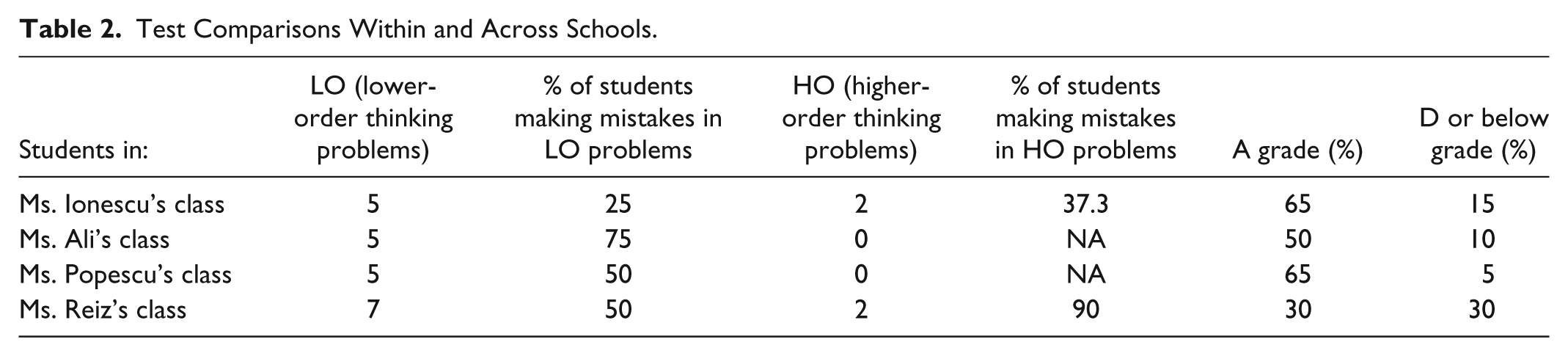
At Iorga, Ms. Ionescu assessed her students on two higher-order thinking and five lower-order thinking problems, and Ms. Ali assessed her students on five lower-order thinking problems. At Delavrancea, Ms. Reiz tested her students on two higher-order thinking and seven lower-order thinking problems, and Ms. Popescu tested her students on five lower-order thinking problems. The test results in Table 2 show that students at Iorga scored higher than students at Delavrancea, and that they made fewer mistakes throughout the test. Moreover, students at Iorga who were tested on higher-order thinking concepts outperformed their peers at the same school who were only tested on lower-order thinking concepts. However, the better results of Ms. Popescu’s students at Delavrancea could be explained by the lack of complexity of the test items, while their peers in Ms. Reiz’s class scored lower overall but they were tested on higher-order thinking items.
Test Comparisons Within and Across Schools.
The Impact of Classroom Practice on Student Learning
In the best learning environment, teachers’ classroom practice is informed by the teachers’ knowledge of subject matter, their knowledge of students, and their knowledge of the curriculum. To account for the influence of school factors on student learning of place value concepts, the researcher analyzed the types of goals the teachers set for their students, as well as the teacher’s ability to tailor these goals and meet their students’ diverse needs. Moreover, the researcher looked at the instructional strategies and the learning environment.
Lesson goals, student needs, and learning opportunities
At Iorga, Ms. Ionescu stated that she wanted her students “to read, write, compare, and order numbers 1 to 100,” as well as “to discover numbers from tens and units respecting certain requirements: given the ten and unit, the sum of numbers is a certain number.” The teacher introduced numbers 10 to 100 in different types of exercises, making sure her students mastered the easier concepts before increasing the difficulty level. The students played games with group diagrams, or they grouped the elements by tens on charts. The teacher created individual sheets that allowed the students to work at their own pace. To provide additional challenge to the students who needed it, the teacher involved the students in problems that required them “to find the highest number formed of two digits,” “find all two-digit numbers that have the sum ten,” “discover the rule and count: 31, 33 . . . 70, 65 . . . ” However, Ms. Ali, the novice teacher, had as objective for students to “understand the formation of Base 10 numbers, their composition/decomposition, ordering, to count them backwards and forwards, and find neighbors to numbers.” To practice with numbers, the students found neighbors to certain numbers (44, 66, 32); they decomposed the numbers (34, 47, 77, 53) and they used manipulatives (sticks, slide rules) to form different numbers (12, 14, 17, 20). This practice was done individually on worksheets or at the board. Despite the fact that Ms. Ali stated she had stronger learners in her classroom, she involved all her students in solving lower-order thinking exercises.
At Delavrancea, Ms. Popescu’s objective was for her students “to know how to count backwards and forwards, to compose and decompose numbers, and to order and compare them.” To reach this objective, she involved her students in lower-order thinking exercises, prompting students to compare numbers (45-42; 36-86), to decompose numbers (30, 45, 46), to skip count by 1 (from 30 to 40), or to find the neighbors of given numbers (47-49, 38-40). The students used different manipulatives (i.e., sticks, shapes) to perform these simple computations. Ms. Reiz, the less experienced teacher, wanted her students “to know how to count correctly to 100, to pronounce correctly the numbers 10 to 20, to understand their formation, composition and decomposition.” At the board or on their workbooks, her students were involved individually in skip counting by 1 (from 10 to 20) and by 2 (from 0 to 30), in comparing pairs of numbers (16-15, 14-11, 12-14), or in writing the neighbors of given numbers (18, 15, 46-48, 88-90). Ms. Reiz involved her students in few higher-order thinking exercises in class, yet she had assigned them for homework and had tested students on them.
The learning environment and teachers’ role
Besides engaging their students in exercises of varying complexity levels, the teachers also differed in the strategies they used to teach place value concepts. Some teachers emphasized active learning, providing ample opportunities for student−student interactions and hands-on learning, while others were more conventional in their approach, asking their students to solve exercises at the board or assigning them individual seatwork.
At Iorga, Ms. Ionescu engaged her students in hands-on learning. The teacher was a facilitator of the learning, monitoring group and pair work, providing support when necessary, and constantly asking students to generate multiple solutions. In pairs and small groups, students solved problems that required them to discover the rules, used manipulatives to make sets of tens, and grouped elements in tens and units. Ms. Ali’s teaching approach was a mixture of hands-on learning and transmission of knowledge. The teacher created some opportunities for student−student interactions, as she occasionally paired her students to count numbers and form groups of tens and units using manipulatives. Although Ms. Ali previously stated that group work seemed to benefit her struggling students, she used direct instruction most of the time, modeling and then asking her students to work independently at the board.
At Delavrancea, Ms. Popescu created some opportunities for her students to learn through games, by asking a lot of questions and encouraging them to help one another. For example, students had to find the neighbors to certain given numbers and skip count backward and forward by 2 and 5 working in small groups. Despite the more active approach to learning, when the students made mistakes the teacher provided the students with the correct answer, not allowing them to come up with the answer. However, Ms. Reiz engaged her students in a very limited number of hands-on activities, as students counted numbers using sticks, abacus, and class objects. The teacher walked among her students checking their answers and naming students to answer and go to the board. When students made a mistake, Ms. Reiz provided the correct answer, or she called on another student to answer. Opportunities for group/pair work were rare, independent work and whole class instruction dominating the class time.
Overall, the teachers’ role in the classroom had an impact on student learning. When teachers facilitated instruction, enabling students to work together to generate multiple solutions, their students scored higher than their peers who were mostly drilled. For example, at least 50% of the students scored A in the final tests when engaged in active learning in Ms. Ionescu’s, Ms. Ali’s, and Ms. Popescu’s classes, as opposed to only 30% in Ms. Reiz’s class. These results confirm similar research findings (Matthews & Rittle-Johnson, 2009; Montague, 2003, 2005; Montague et al., 2000), namely that when students are engaged in problem solving and are expected to provide explanations for the solutions they reached, they make connections between concepts and their mathematics learning is enhanced. Analyzing the results of the students in this study, a look into instructional practice alone cannot fully explain the achievement gap, even when students are exposed to similar classroom learning opportunities. An analysis of the interactions that exist between parents and their children may provide better explanations for the performance of the Romanian students.
The Impact of Home Interactions on Student Learning of Place Value Concepts
To understand the role of parents in their children’s learning of place value concepts, the researcher surveyed a total of 64 families. Thirty-eight families returned the questionnaires and agreed to participate in the study: nineteen families in Ms. Ionescu’s class, 10 in Ms. Ali’s class, 5 in Ms. Popescu’s class, and 4 in Ms. Reiz’s class. The researcher further randomly selected 8 families, 2 in each class, for an interview. The data from the questionnaires of those families who returned the questionnaire showed that both teachers at Iorga had some parents holding college degrees, while only very few parents did not have a high school diploma. However, none of the parents who returned the questionnaires at Delavrancea had a college degree, while 60% of the parents also did not have a high school diploma. Table 3 presents a breakdown of parental education backgrounds in all four classes. These demographic data are significant, as parents’ education has been long related to student achievement.
Parent Questionnaire.

Note. P.V. = place value.
Parental understanding of place value concepts
When surveyed about their degree of comfort with mathematics, a high percentage of the parents in all the classrooms felt comfortable with mathematics concepts and teaching these concepts to their children. The researcher also surveyed parents about their degree of comfort with place value concepts and teaching these concepts to their children. Most of the parents in Ms. Ali’s, Ms. Ionescu’s, and Ms. Popescu’s classes were (very) comfortable with the place value concepts, but only 5% of the surveyed parents in Ms. Reiz’s class stated they were comfortable with these concepts. These data are relevant in that parents’ mathematics knowledge impacted how they helped their children at home.
To further probe the parents’ understanding of the place value concepts, the researcher interviewed two families in each classroom. These data showed that at Iorga, the parents of the students in Ms. Ionescu’s class had a solid understanding of the nature and significance of place value concepts. When asked to define Base 10 numbers, the interviewed parents in Ms. Ionescu’s class stated that these were “all positive and whole numbers, higher than 0,” or “all numbers comprised between 0 and 100.” Moreover, the parents stated that learning these concepts was significant as numbers represented “the basis of mathematics,” as “students deal with these numbers all their life, using them with other subjects as well,” and because these numbers will provide them with “a complete image of what follows, number order, negative numbers.” In Ms. Ali’s class, one of the interviewed parents defined these numbers as “positive numbers,” while the other parent stated “something that you must learn, to count them, and add them and subtract them.” Similarly, these parents had a harder time describing how students would benefit from learning numbers. Most of their responses were general, “they must learn them to do well in life,” “it will be good for them later,” “we must really learn them because without counting them we can’t really get by.”
At Delavrancea, when asked to define Base 10 numbers, the parents in Ms. Popescu’s class stated that these numbers “represent the basis of mathematics,” and that “they are formed by adding units.” When discussing the significance of learning these concepts, the parents stated that these numbers represent “the cornerstone of future mathematics concepts,” and that “everything depends on these numbers, you need to know to count backwards and forwards.” However, one of the parents in Ms. Reiz’s class was not sure what Base 10 numbers were: “All numbers 10 to 100, right?” while the other parent could not define them. These parents also provided vague reasons for the importance of these numbers: “They need to know to count,” “it will be good for them later.”
Home involvement in teaching place value concepts
The results of this study are indicative of a connection between parental knowledge and understanding of place value concepts and their involvement with teaching or reinforcing these concepts at home. At Iorga, findings show that 95% of the surveyed parents in Ms. Ionescu’s class felt (very) comfortable with Base 10 numbers. The interviewed parents stated they helped their children understand these concepts before the teacher taught them in class, playing counting games with their children and practicing with numbers. After the teacher addressed the concepts in class, these parents stated they checked their children’s homework, they created their own worksheets, and used different resources to reinforce the concepts taught. Similarly, 80% of the surveyed parents in Ms. Ali’s class felt (very) comfortable with base 10 concepts, yet none of the interviewed parents explained the place value notions to their children before classroom instruction. In this case, the high degree of comfort with place value concepts did not fully transfer in help with these concepts prior to classroom instruction. However, both interviewed parents stated they got involved after the class instruction, following the teacher’s example to reexplain these concepts, and using money and fingers to count numbers. The lack of involvement prior to instruction may be due to their fear their explanations may create misconceptions in their children’s learning.
At Delavrancea, 90% of the surveyed parents in Ms. Popescu’s class felt comfortable with Base 10 numbers. As in Ms. Ali’s case, the interviewed parents in Ms. Popescu’s class only stated they got involved after the classroom instruction. One parent stated in her interview that when helping her child, she followed the model of the teacher and that of the textbook, using sticks and fingers to count. The other interviewed parent stated that she developed her own number examples, besides using the textbook and the teacher’s modeling as examples. However, the parents in Ms. Reiz’s class felt the least comfortable with place value concepts, as only one of the surveyed parents stated she was very comfortable helping her child understand these notions. This lack of comfort is shown in their lack of involvement with helping their children learn place value concepts before and after school (i.e., neither one of the interviewed parents stated they helped out their children at home).
Overall, when parents possessed a stronger knowledge base of mathematics, they were more engaged in their children’s learning. For example, the interviewed parents in Ms. Ionescu’s class stated they made their own rubrics and worksheets and played games involving counting with their children, providing their children with the knowledge base needed to understand the concepts taught in class. Both these parents were confident in the degree of support provided, as they stated they believed they did a good job helping their children learn place value concepts before and after class instruction. Conversely, when parents lacked the confidence in their ability to teach place value concepts to their children, they were less involved before the teacher taught the concepts for fear they would make mistakes, as the surveyed parents in Ms. Reiz’s class confessed. They mostly followed the teachers’ model and were less confident of the level of support provided, as they stated they did “as much as they could” or “not a good job” in explaining the concepts. If parents designed their own instructional activities, student understanding increased, as shown by the final test results. These findings must be interpreted with caution, as the parent−children home interaction data were self-reported by parents. In addition, the sample of interviewed parents was fairly small. Had these interactions been observed, or more parents interviewed, the data may have differed.
When asked about their involvement in their children learning at school, the interviewed parents in all the classrooms stated they felt comfortable with the way the teacher addressed the concepts in class and had no suggestions for the teacher. Parents also stated that the only involvement in their children learning took place at home, and was conducted with the purpose “to strengthen and diversify the concepts taught in class.” Although the parents of the students in Ms. Ionescu’s class stated that the teacher had encouraged them to attend mathematics school activities, they also stated that due to time constraints they did not take advantage of this invitation. However, the parents shared that Ms. Ionescu discussed support with homework, motivating them to get involved at home and assigning routines to help them when doing homework with their children. These clear expectations for parental involvement in schoolwork helped the parents understand they are a significant factor in student learning, which might explain the better results of Ms. Ionescu’s students. However, all the interviewed parents seemed reluctant to get involved in children learning past support with homework, which may be explained through their beliefs that they could not influence curriculum and/or instruction. Even the parents with a strong mathematics knowledge stated they did not get involved at school as it was not their profession, a finding in agreement with previous work (Huntsinger & Jose, 2009).
Parental involvement in children’s education should, however, not be limited to home interactions. Without understanding how the teacher taught these concepts, parents mostly relied on their own instructional methods, using fingers to count, as was the case of one of Ms. Ali’s parents, or teaching misconceptions, as in the case of one of Ms. Ionescu’s parents. These findings warrant the following conclusions: unless parents understand the nature and significance of place value concepts, they possess a fragmented understanding of these topics. This limited understanding may negatively impact their children learning, as reflected in the student results in the final tests. Teachers and parents need to be in close contact, as teachers need to help parents understand the topics they address in class, in particular those parents who are not very confident in helping their children with mathematics. A close school−home interaction may lead to a stronger student understanding of place value concepts.
Teacher−parent interactions and their impact on student learning
In an attempt to understand what type of interactions teachers had with parents, and to analyze whether and to what extent these interactions impact student learning of place value concepts, the researcher interviewed the teachers about their interactions with the parents. Asked how often they talked to the parents about their children’s progress, all four teachers reported meeting the parents formally at least once a month for parent−teacher conferences. They all also stated they met some of the parents daily, as they dropped off/picked up their children from school. To understand the nature of these meetings, the researcher asked the teachers to discuss whether they helped the parents understand place value concepts, sought their points of view in teaching place value concepts, or whether and how they communicated expectations for parents to be involved at home in helping their children learn place value concepts.
At Iorga, Ms. Ionescu stated that to help parents understand how their children learned, she explained the concepts she was about to teach. Ms. Ionescu stated, Every time we meet for parent−teacher conferences I tell parents what we will be learning at math and how I will explain these notions to the students so that I help them understand these notions and explain them correctly to their children. I do this every time.
Moreover, Ms. Ionescu was open to receiving suggestions from parents, as “they know their children better than I know them. I am just starting to know them . . . and if they have suggestions that I think I can use, I believe this is fantastic!” The teacher also deemed very important to keep the parents informed about their children’s learning, as she believed the lack of progress to be dangerous: At our last PT conference we looked at the final test together to see if there are any problems, and then I gave them the tests at home to analyze them with their children and tell me if the mistakes they made were real or they were due to other causes.
One example is a parent discussing the results of her son’s test with the teacher, and teacher and parent decided to allow the student to retake the test, as the student confessed he had been affected by home factors. On retest, the student progressed to a B. Furthermore, Ms. Ionescu’s expectations for parental involvement at home were clearly communicated, “Every time, for every homework, they have to explain the concepts to them, and if they see the children do not understand certain concepts, to offer to help them if they can, if not to let me know so we can take care of it together.” Moreover, the teacher informed the parents about the benefit of setting up routines for students: “If they know that between certain hours they have work to do, they become ordered and can fulfill more complex requirements.”
The less experienced teacher at Iorga, Ms. Ali, also stated that during PT conferences she informed the parents about the lesson on place value concepts, explaining what place value concepts were: “They come to school and ask me things, and I have to explain them what to do, like I explain it to my students. Even if I insist a lot, this is all some of them can do.” Ms. Ali also communicated to the parents the need to be involved in their children’s learning at home: For example in case of the moms that do not know, I tell them you do not necessarily need to check their homework, because we do this in class anyway, and I check their homework, but it is important they feel your presence there, and that he/she is checked by you and monitored by you. Most of my students have older brothers. And generally speaking the younger ones tend to be more neglected.
At Delavrancea, Ms. Popescu stated that some of her students were a little behind at the beginning of the school year. To help these students catch up with the rest of the class, the teacher asked their parents to get involved at home beyond their children’s homework. Ms. Popescu stated that parents were very helpful in the beginning: Every morning parents who came to school had my support and I had their support. I explained to them this is what they need to know today for math class, and parents helped me. Now I ask for help quite rarely, as most of these students are caught up with the rest of the class.
To help parents see the progress of their children, Ms. Popescu kept a file on each student with tests and classroom observations, and parents checked the folder and were being kept up to date about progress/lack of progress. The teacher communicated her expectations for parents to be involved with homework: They need to supervise their children. Not to do their homework for them, but to monitor them with the homework, because they are so young and sometimes they go home and say there is no homework, and then parents need to look for homework and find out if the homework is on the worksheets or on the textbook.
Moreover, the teacher encouraged the parents to set up routines for their children: At the beginning of the school year I handed them the home schedule for the kids and they know the kids go home, they need to eat, to sleep and to work. I insisted they do not do the kids’ homework, you stay with them, ask them questions, if you see they do not know the answer to these questions, ask them other questions until they get it.
The less experienced teacher, Ms. Reiz, explained to the parents “which ones are the units, which are the tens, and they understand easier than the kids do anyway. I ask them to work at home with these notions.” For the most part, the teacher stated that she had to teach the parents these concepts so they could help their children at home. Home involvement, in this case, meant reexplaining the concepts following the teacher’s model, and monitoring homework, as Ms. Reiz also stressed the significance for parents to be involved in homework and to set up routines: “I ask them to set routines. I insist they should.”
The above data suggest that parents are a vital link in student learning. The more knowledgeable and comfortable parents were with place value concepts, the more they got involved in their children education at home and at school. The nature of parental interaction with the teacher and home support seemed to make a big difference in student learning. Parental education background was a strong indicator of parental understanding of mathematics concepts, and it set the tone for the interaction. For example, most of the surveyed parents in Ms. Ionescu’s class had a college degree and generally felt comfortable with helping their children learn place value concepts. The interviewed parents created their own resources to reinforce the concepts. However, if parents held a high school diploma (or no diploma at all), fragmented understanding of the mathematics concepts dictated the nature of the interaction with the teacher. In most of these cases, the teachers (Ms. Ali, Ms. Popescu, and Ms. Reiz) taught the parents the concepts the same way they taught their students. The parents’ lack of comfort with these notions was evident in their heavy reliance on the teacher’s model, as they reexplained the concepts at home by modeling the teacher explanations.
Limitations, Discussions, and Conclusions
The major limitation of this study is the small sample size of teachers, as only four first-grade teachers participated in the study. To reduce this limitation, the researcher used different sources to collect data. This triangulation enabled the researcher to verify data obtained from parents, teachers, and students and served to make a stronger case for the interactions among the factors assumed responsible for student understanding of place value. An additional limitation of the study may have been the fact that the tests were individually developed and graded by the teachers. Because teachers were the only ones who graded the tests, only perfect tests were considered for the grade of “A.” The researcher coded the test exercises and assigned them to the higher-order and lower-order thinking categories, following the model discussed in the curriculum section.
The researcher started this study with the assumption that there are a variety of factors influencing student learning. At school, teacher knowledge of subject matter and pedagogy, as well as their knowledge of their students, and the use of the curriculum could influence what and how students learn (Ball, 2003; Manouchehri & Goodman, 2000; Schorr & Koellner-Clark, 2003; Senger, 1999; Shulman, 1986). At home, the quality and quantity of parent−children interactions impact student learning (Chen & Stevenson, 1995; Huntsinger et al., 2000). In an effort to understand why some students perform better than others when provided with similar learning opportunities at school or at home, the researcher analyzed the above factors, and described the impact the interrelatedness of these factors may have on the way students understand place value concepts.
At school, the teacher is the most significant factor impacting student mathematics learning. Findings show that teachers’ mathematical knowledge for teaching and the quality of mathematics instruction influenced what and how students learn, a finding in agreement with previous research (Ball et al., 2008; Hill et al., 2008). When teachers had a strong understanding of the nature and significance of place value concepts (both veteran teachers), and when they accounted for differences in student learning (Ms. Ionescu), they designed learning activities for their students, building on what the students knew and increasing the difficulty level. These teachers created opportunities for students to work with different manipulatives, engaging students in whole class, small group, and individualized instructions. In the case of Ms. Ionescu, this knowledge of content, pedagogy, and students influenced her use of curriculum, as she supplemented the textbook with new and challenging materials. The better results of Ms. Ionescu’s students in the final test may be justified by the interaction of these different types of teacher knowledge. When students were engaged in learning by doing, as well as exposed to more complex problems in class, they performed better in the final test and possessed a stronger understanding of numbers.
The findings from the other teachers’ classrooms reveal the following: although Ms. Popescu had a strong knowledge of nature and significance of place value, she did not engage her students in higher-order thinking problems, even if she recognized that some students were more advanced. Despite the good results in the test scores, all students were tested on lower-level thinking exercises. This prompts the question: Would the results have differed if her students were exposed to and tested on more complex issues?
The same uniformity in pedagogy and curriculum was evident in Ms. Ali’s and Ms. Reiz’s classrooms. Coupled with a weaker understanding of the nature and significance of place value concepts, as found in their interviews, this difference in the learning environment may explain the average-to-low performance of the students in both these teachers’ classrooms.
Schooling factors seemed to impact the way students learned place value concepts. However, as complexity theory relies on the interaction between multiple agents, looking at the mathematics performance of Romanian first graders from the perspective of school factors only provided a limited understanding of student learning. A look at parental involvement in children learning may provide a deeper understanding of how students learn mathematics.
When parents had a good understanding of place value concepts, they were more comfortable to explain these concepts to their children, as is the case in the interviewed parents in both veteran teachers’ classrooms. These parents designed their own activities to provide their children with additional challenge, going beyond teachers’ explanations and curriculum. However, when parental understanding of place value concepts was fragmented, as was the case of the parents in the less experienced teachers’ classes, parents highly relied on following the teacher’s model after the formal classroom instruction.
The overall conclusion is that while teachers and parents have a strong impact in student learning, when analyzing these interactions separately we only have a limited understanding of student mathematics learning. A look at the school−home interactions provides a more holistic understanding of student learning of mathematics. Teachers explained to the parents how the concepts would be taught, discussing the expectations regarding homework involvement at home, helped the parents understand their role in monitoring and helping their children learn (Ms. Ionescu, Ms. Popescu). However, if parent−teacher interactions focused mainly on teaching the concepts to the parents, because of their limited understanding of mathematics (Ms. Ali and Ms. Reiz), or merely discussing student progress, the parents’ home support was limited to following the teacher’s model and reexplaining the classroom problems, instead of engaging children in more challenging number exercises.
Implications
The researcher started this study with the hope to gain a deeper understanding of the performance gap in mathematics achievement by looking at the interactions between teachers, students, and parents. Findings show that a variety of factors are responsible for student learning, as teachers and parents are a vital link in student learning. While these data could provide a reasonable explanation for the performance gap of the students in the four classrooms, can they provide plausible explanations regarding the performance gap of students in international comparisons?
Extending the above explanation to the international context, the assumption is that the Asian students outperform their peers in the mathematics competitions due to all these factors working together (Waldrop, 1992). Furthermore, the average and below-average performance of U.S., and respectively, Romanian students in the international competitions may be due to poorer interactions between school and nonschool factors. These are mere assumptions, as no study has analyzed yet the interactions between these factors in different educational systems.
The researcher hopes that this study will raise the awareness of the teachers about the impact the opportunities they create for students in class and through homework had on student learning. Moreover, teachers should consider the nature of their interaction with parents on student learning, as it could help parents develop a better understanding of the mathematics concepts to help their children. Last, this study aims at helping teachers develop a better understanding of the interaction of all these factors and their impact on student learning. If the goal of education is to enhance student learning, teachers are responsible to provide the students with the best learning opportunities, through engaging students in higher-order thinking in school and at home. Moreover, by reinforcing the significance of parental engagement in children education in school and at home, teachers may help parents understand of the vital role these play in their children’s education, and facilitate the home−school collaboration.
Footnotes
Appendix A
Appendix B
Declaration of Conflicting Interests
The author(s) declared no potential conflicts of interest with respect to the research, authorship, and/or publication of this article.
Funding
The author(s) received no financial support for the research and/or authorship of this article.