




Abstract
This article presents reliability and validity analyses of the Perception of Child Maltreatment Scale (PCMS). The scale comprised 34 items that measure abusive behaviors related to emotional/psychological abuse (10 items), sexual abuse (6 items), child neglect (6 items), child labor (7 items), and physical abuse (5 items). Analysis was based on a convenience sample of 317 participants in Nigeria. Exploratory factor analysis with promax rotation was used to determine construct validity of its five-factor structure (subscales). The overall internal consistency of the PCMS was .95; subscales of Emotional/Psychological Abuse (.93) and Sexual Abuse (.91) were high, whereas those of Child Neglect (.89), Child Labor (.86), and Physical Abuse (.84) were good. Cutoff scores were computed categorizing scores into low/weak, medium/moderate, and high/strong perceptions of child maltreatment. Strengths and limitations as well as practical applications and implications of the scale for research were discussed.
Perception of child maltreatment remains an area of child maltreatment infrequently examined despite its relevance to understanding risks of maltreatment of vulnerable children. Apart from its relationship to childhood maltreatment (Goldsmith, Freyd, & DePrince, 2009), perception is of particular interest to understanding maltreatment because of its relevance to perpetration or propensity to perpetrate maltreatment (Madu, Idemudia, & Jegede, 2002; Varia, Abidin, & Dass, 1996). Yet, knowledge about perception of maltreatment is sparse. Although many factors may be attributed to this sparse knowledge, including variability in legal and conceptual definitions of maltreatment across regions, proliferation of terms related to maltreatment, and inconsistent examination of abusive behaviors across studies (Baker, 2009; Riddle & Aponte, 1999), the majority of existing measures focus primarily on direct accounts of maltreatment or retrospective accounts of childhood maltreatment and few on direct measurement of perception of maltreatment.
Although several measures are used to operationalize current or retrospective experience of child maltreatment, those that measure perception of maltreatment are sparse and primarily framed from perspectives of respondents in developed societies (Baker, 2009; Curtis, Langworthy, Barnes, & Crum, 1998; Dunne et al., 2009; Hulme, 2004; Levis, 2012; Malik & Shah, 2007; Riddle & Aponte, 1999; Walsh, MacMillan, Trocmé, Jamieson, & Boyle, 2008; Zolotor et al., 2009). From these measures, some abusive behaviors peculiar to developing societies are missing. However, measures operationalized in developed societies may not translate to developing societies because of differences in sociocultural conditions and experiences. Even within developed societies, there are indications that perception of maltreatment differs across racial, cultural, and ethnic backgrounds (Ashton, 2010; Shanalingigwa, 2009). Therefore, the purpose of this study was to develop and validate an instrument that measures perception of child maltreatment in a developing country, Nigeria, where empirical knowledge about perception of abusive behaviors is sparse.
Perception of Maltreatment in Nigeria
To date, empirical reports suggest that maltreatment such as physical and sexual abuse, child neglect, and child labors is prevalent in multiple settings, including homes, institutions, streets, or places of worship in developing countries (Akmatov, 2011; Bammeke, 2008; Collings, 1997; King et al., 2004; Lalor, 2004a, 2004b; Madu & Peltzer, 2001; McCrann, Lalor, & Katabaro, 2006; Owolabi, 2012; Shumba, 2004; UNICEF, 2010; United Nations, Department of Economic and Social Affairs, Population Division, Population Estimates and Projections Section, 2010), although empirical reports describing perceptions in the regions, especially in Nigeria, are sparse. Recent reports in Nigeria, for example, suggest that respondents perceived activities such as “fetching water, splitting firewood, sweeping, farming and cooking” as child labor (Okoye & Tanyi, 2009, p. 1). Though another recent study suggest that teachers perceived some physically and verbally abusive behaviors such as slapping, beating students with hands, kicking, and pushing students as unacceptable, they also perceived corporal punishment such as flogging of students with stick or cane as acceptable form of punishment (Umezinwa & Elendu, 2012). Sexually abusive behaviors, such as showing pornographic materials to children and fondling of breasts and genital of a child, were perceived as sexual abuse (Ogunyemi, 2000). Although qualitative details of abusive experiences and anecdotal reports of perception of abusive behaviors abound in the region, psychometrically sound empirical measures of perception of maltreatment remain sparse.
Existing Measures of Perception of Child Maltreatment
Some measures have been developed to examine perception of maltreatment and most are particularly operationalized through hypothetical vignettes, questionnaires (Likert-type scales), interviews, focus groups, and scenarios (Bensley et al., 2004; Portwood, 1999). Some of these measures were developed to cover perception of major types of maltreatment, whereas others focus on perception of only one type of maltreatment, such as physical or sexual abuse (Ogunyemi, 2000; Robertson, 2007). Yet, validity and reliability of psychometric information is lacking, limiting comparability or generalizability of findings. Also, most existing measures reflect abusive experiences in developed societies that may not cross-validate in developing societies. Nevertheless, advantages of measuring perception of maltreatment in developing countries are many, including the possibility of understanding risks for maltreatment perpetration, childhood maltreatment, and generating maltreatment-related knowledge.
Considerations for Empirical Evidence
After a careful examination of existing measures of perception of maltreatment, empirical knowledge of abusive behaviors remains the next reliable source of materials for developing perception of maltreatment instruments. Knowledge about abusive behaviors deemed to constitute long-term negative consequences for children abounds (Beltchman et al., 1992; Silverman, Reinherz, & Giaconia, 1996; Springer, Sheridan, Kuo, & Carnes, 2007; Tanaka et al., 2011), although empirical indicators of abusive behaviors often differ from social considerations of abuse across regions. Nevertheless, many abusive behaviors transcend sociolegal boundaries because of cumulative evidence of their physical and psychological consequences to children and because of their contraindications for societal survival. Because abusive behaviors are best deemed abusive through empirical demonstration of their long-term negative consequences (McGee, Wolfe, Yuen, Wilson, & Carnochan, 1995), perception of maltreatment is best operationalized through abusive behaviors demonstrated to result in long-term negative consequences to children. Beyond empirical knowledge of negative consequences of maltreatment for children, factors such as sociocultural values and beliefs about maltreatment, knowledge of existing regulations regarding maltreatment (Ashton, 2009), and perhaps childhood experience of maltreatment are generally believed to influence perception of maltreatment. Thus, integration of these factors into measures of perception of maltreatment will enhance validity and reliability of developed measures.
Theoretical/Conceptual Background
Perception of abusive behaviors considered for current scale rests on constellations of theoretical reasonings including harm/evidence model (Drake, 1996; Drake & Jonson-Reid, 2000; Drake, Jonson-Reid, Way, & Chung, 2003). According to the model, behavior (i.e., commission or omission) may be perceived abusive when characteristics of the behavior are sufficient to qualify the behavior as maltreatment and when such characteristics are consistent with existing laws and regulations describing the behavior as harmful. Thus, the conception of evidence and harm suggests that social and legal considerations are given to perception of abusive behaviors and beliefs and conclusions about abusive behaviors are partly influenced by existing laws. As a result of this conception, the model may be deemed as empirically flexible to comprehend perception of maltreatment across regions. For every maltreatment (i.e., emotional/psychological abuse, sexual abuse, child neglect, child labor, and physical abuse), evidence or indicator of abuse may be visible or invisible and may be derived verbally, visually, or empirically from existing laws or scientific investigation. Similarly, harm or risks of harm may be physical or psychological and may be informed by impairment or strong likelihood of impairment in the functioning of a child.
As a model for describing perception of maltreatment, the harm/evidence model assumes that conditions for perceiving behaviors as abusive differ across types of maltreatment (Drake, 1996). As a result, the criteria of evidence or harm for perceiving the abusiveness of a type of maltreatment may be irrelevant for perceiving the abusiveness of another. The model has been used to examine maltreatment substantiation decisions (Cross & Casanueva, 2009; Fuller & Nieto, 2009; Kohl, Jonson-Reid, & Drake, 2009; Trocmé, Knoke, Fallon, & MacLaurin, 2009) and legal decisions in contested cases of maltreatment (Fakunmoju, 2009). Its relevance to cross-cultural understanding of perception of maltreatment cannot be oversimplified. Therefore, the sociolegal elements that inform the model imply that knowledge of risk factors and regulations about maltreatment underlie perception of maltreatment, and any scale designed to measure abusive behaviors across cultures must clearly integrate empirical evidence of harm (or substantial risks of harm) and sociolegal conditions related to differential perception of maltreatment.
Method
The study utilized self-report methodology to collect data from respondents about their perception of maltreatment. Activities preliminary to collecting data included comprehensive review of the literature for questionnaire development, evaluation of questions by experts in the United States and Nigeria, and pilot testing of survey.
Questionnaire Development
The questionnaire was developed based on a comprehensive review of theoretical and empirical literature on child abuse and neglect at the local and international levels and informal exploration of knowledge about maltreatment in Nigeria during a 2-year period (Bensley et al., 2004; Dunne et al., 2009; English, Bangdiwala, & Runyan, 2005; Lalor, 2004a, 2004b; Pinheiro, 2006; Portwood, 1998, 1999; Riddle & Aponte, 1999). The list of abusive behaviors that were developed and examined should not be deemed as exhaustive of abusive experiences of children in the region but rather represent a broad range of abusive experiences that are frequently (i.e., physical, sexual, and emotional/psychological abuse as well as child neglect) or less frequently (i.e., child labor) examined empirically. Some abusive behaviors deemed to be redundant, rare in occurrence, controversial, religiously/culturally sanctioned, too restrictive to local experience, inconsistent with international standards, or better amenable to qualitative approach were rephrased or excluded from the list. Some behaviors were qualified with specific ages to ensure conformity with legal definitions and local perceptions of a child in the region.
Expert Opinion/Review
After developing preliminary items, experts in child abuse and neglect in the United States and Nigeria were invited to critique (online) the items for content and face validity as well as for relevance, comprehensiveness, and cultural appropriateness. Experts in the United States had backgrounds in academic research (i.e., social work) and child protection practice and experts in Nigeria had backgrounds in academic research (e.g., sociology, linguistics, history, and international relations) as well as in nonacademic professions. In addition to providing a critique of the abusive behaviors, experts were instructed to determine whether the identified behaviors may be deemed abusive, whether they fit the specified type of maltreatment, whether they capture the range of abusive experiences of children, and whether they are socially, culturally, and legally relevant. Comments and suggestions received from the experts were integrated into revision of the items: some of the suggested items were integrated into the survey; some items were rephrased for cultural adaptation and relevance to reflect common cultural disciplinary practices and abusive behaviors in the region. In addition to ensuring that items were culturally appropriate, some items were revised to ensure that they met the standards of child protection in developed countries to enhance future comparisons with perceptions of maltreatment in other regions.
Pilot Test
The questionnaire was pilot tested online via SurveyMonkey.com™ by 22 graduate students who completed the survey and provided feedback. In general, feedback suggested that the items were clear, culturally appropriate, and relevant to common experiences of maltreatment of children in the target region.
Abusive Behaviors
The items for analysis include 71 abusive behaviors comprising emotional/psychological abuse (16 items), sexual abuse (17 items), child neglect (14 items), child labor (11 items), and physical abuse (13 items). For each type of maltreatment, participants were asked, “Do you think the following is emotional/psychological abuse?” “Do you think the following is sexual abuse?” “Do you think the following is child neglect” “Do you think the following is child labor?” and Do you think the following is physical abuse?” Participants rated (online through SurveyMonkey.com™) the extent to which they perceived the 71 behaviors to be abusive, using a Likert-type scale of 4 = yes, 3 = maybe or sometimes, 2 = don’t know, and 1 = no. In addition to responding to the abusive behaviors, participants also provided their demographic information.
Sample Characteristics
The survey collected data through SurveyMonkey.com from a convenience sample of university students (i.e., graduate and undergraduate) and nonstudents who have access to the Internet in Lagos State, Nigeria. To reach a broad range of participants, the link to the survey was forwarded to respondents in other regions of the country and Internet café operators were consulted to recruit participants who did not have personal access to the Internet. A total of 376 participants responded to the survey. Some respondents were only able to complete the survey after more than one attempt due to Internet connection problems. As a result, listwise deletion was applied to the data to avoid duplication of responses. Only completed surveys were considered for analysis. After excluding incomplete perception and demographic information, 317 cases remained for analysis.
Participants (N = 317) were graduate (n = 100, 31.5%) and undergraduate (n = 144, 45.4%) students and nonstudents (n = 73, 23%) in urban centers in Lagos State, Nigeria. The majority were single (n = 278, 88.8%) and male (n = 180, 57.5%), although some reported being married, divorced, or widowed (n = 35, 11.2%) and female (n = 133, 42.5%), with an overall average age of 25.87 years (SD = 5.99). Four cases were missing in data analysis. Additional demographic characteristics are reported in Fakunmoju and Bammeke (2013).
Data Analysis
Descriptive analysis was used to describe the demographic characteristics of participants. Exploratory factor analysis (principal-axis factoring) with promax rotation was used for the extraction of factor structure, loadings, and relevant estimates associated with the abusive behaviors. Varimax rotation and principal components analysis were performed to determine similarities and possible differences in the factor structure derived from promax rotation and principal-axis factoring. Other analyses included computation of means, standard deviations, descriptive analysis for cutoff points, bivariate correlations, internal consistency estimates, item-total correlation technique for item analysis, and independent-samples t test to determine gender differences in responses for the scale. The 71 items considered for analysis measured specific types of maltreatment based on theoretical considerations, empirical evidence, and expert judgment.
Exploratory factor analysis followed three processes: (a) analysis of the 71 items to determine their loadings and clustering around respective factors, (b) examination of loadings and correlations to determine their meeting necessary requirements for replication, and (c) removal of problematic items and reanalysis of selected items. Rationale for presenting exploratory factor analysis rather than principal components analysis was discussed. Presentations of findings follow recommendations by Neill (2008), as well as presentations by Malik and Shah (2007). SPSS 19® (IBM Corp, 2010) was used for the analysis, and principal-axis factoring option with promax rotation was the extraction method used for the final analysis.
Results
Data Screening
Data entry errors were avoided because data were exported from Surveymonkey.com, although this does not preclude response errors by respondents. Listwise deletion was applied to an overall sample of 376 respondents, resulting in a sample of 317 respondents, which is well above the recommended sample size of 200 (MacCallum, Widaman, Zhang, & Hong, 1999; see also MacCallum, Widaman, Preacher, & Hong, 2001) or 300 (Burton & Mazerolle, 2011a, 2011b; Comrey & Lee, 1992) for conducting exploratory factor analysis. A sample size of 317 for the final 34 items resulted in a ratio of approximately 9.06 cases per variable.
Preliminary Analysis
A preliminary exploratory factor analysis of the 71 items 1 was conducted. The analysis was specified to extract five factors (i.e., five types of maltreatment) based on theoretical considerations, empirical evidence, and expert judgment that informed the development of the items and collection of data. Although all items clustered under respective types of maltreatment (explaining 67.69% of the variance), an examination of correlation matrix suggests that many items correlated greater than .70 on multiple items, suggesting that “the items are contributing something unique to the construct, and therefore, . . . are not unidimensional” (Burton & Mazerolle, 2011a, p. 30). As a result, identified factors may not be replicable or overidentification of factors might occur when extraction of fixed number of factors is not specified. Moreover, the retaining of the 71 items might lead to respondent burden. To address these problems, decisions were made to eliminate items that correlated highly with each other. Criteria for selecting items for further analysis included the fact that the items must correlate “at least .30 with at least one other item” (Neill, 2008, p. 6) and that the items not correlate .70 and above on two or more items (Burton & Mazerolle, 2011a). As a result, 37 items were eliminated, leaving a total of 34 items for further analysis.
Table 1 reports means and standard deviations of the 34 items and Table 2 reports the correlation matrix. As shown in Table 2, correlations between items were significant at p < .01 and p < .05. Correlations oscillated between low and moderate. All items correlated at least .30 with at least one other item and no item correlated .70 and above on two or more items. For example, only three items correlated highly with each other: Item 11 (fondling the breasts of a child for sexual pleasure) correlated highly (.76) with Item 13 (asking a child to perform oral sex on adults), Item 14 (having sex in the presence of a child) correlated highly (.76) with Item 15 (engaging in mutual sexual stimulation with a child for sexual pleasure), and Item 30 (inflicting injury or physical pains on child from punching, kicking, or pushing) correlated highly (.75) with Item 31 (strangling or choking a child so tight that the child could not breathe).
Means and Standard Deviations for Items of Perception of Child Maltreatment Scale (PCMS) by Type of Maltreatment.

Correlation Matrix for the 34 Perception of Child Maltreatment Scale Items.
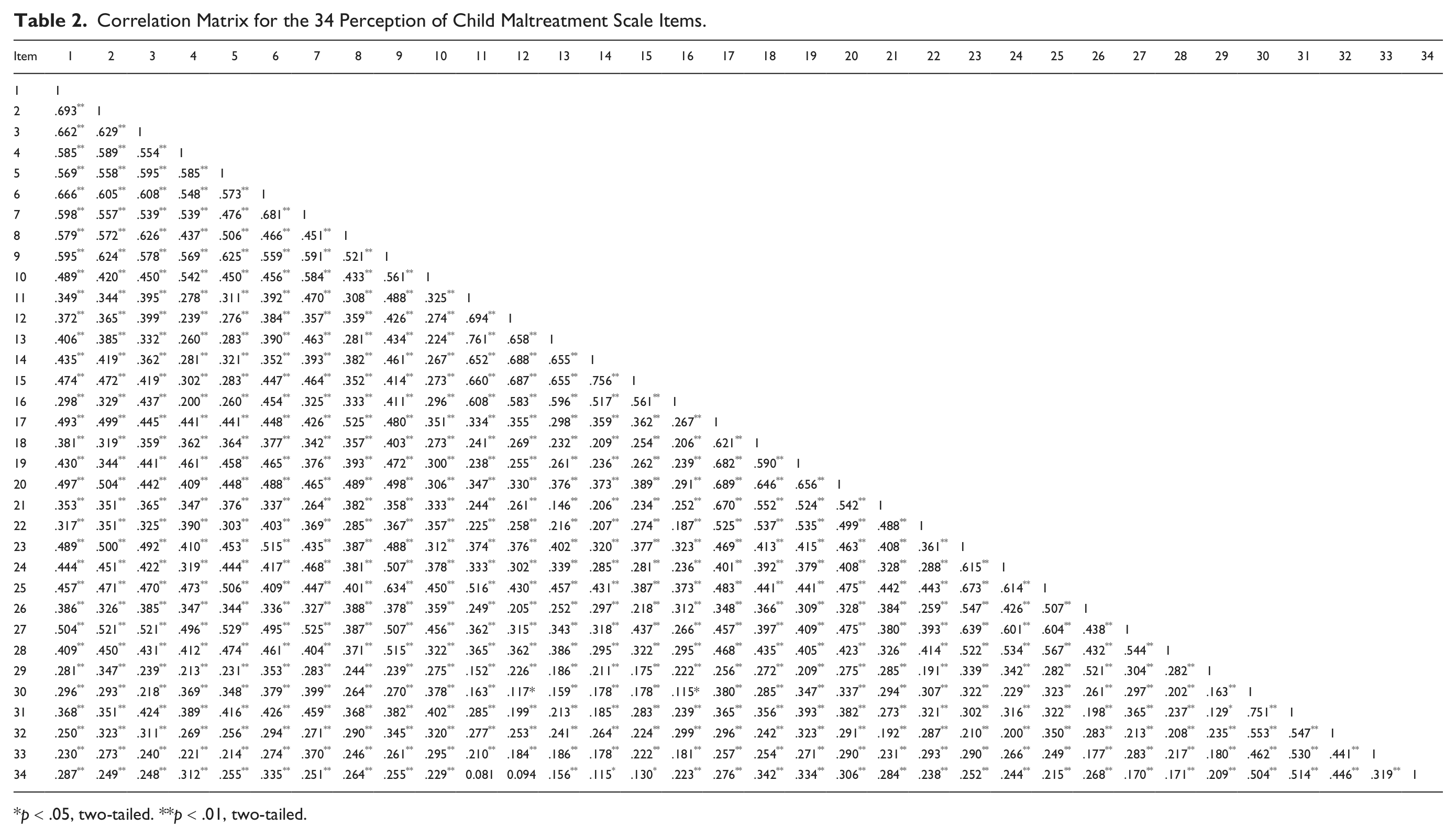
p < .05, two-tailed. **p < .01, two-tailed.
Item Analysis
Table 3 reports the item-total correlation (i.e., correlations of each item with total score of the Perception of Child Maltreatment Scale [PCMS]) of the 34 items. The table indicates that the items significantly correlated with the total score of the PCMS (p < .0001), suggesting some meaningful relationships between the items and the overall PCMS. The overall correlation was between .46 (Item 29: forcing a 7-year-old child to perform excessive and tedious household chores almost daily) and .75 (Item 8: locking a child younger than 11 years old alone in a room for a whole day as a form of discipline).
Item Analysis of the Selected 34 Items for Perception of Child Maltreatment Scale (PCMS).
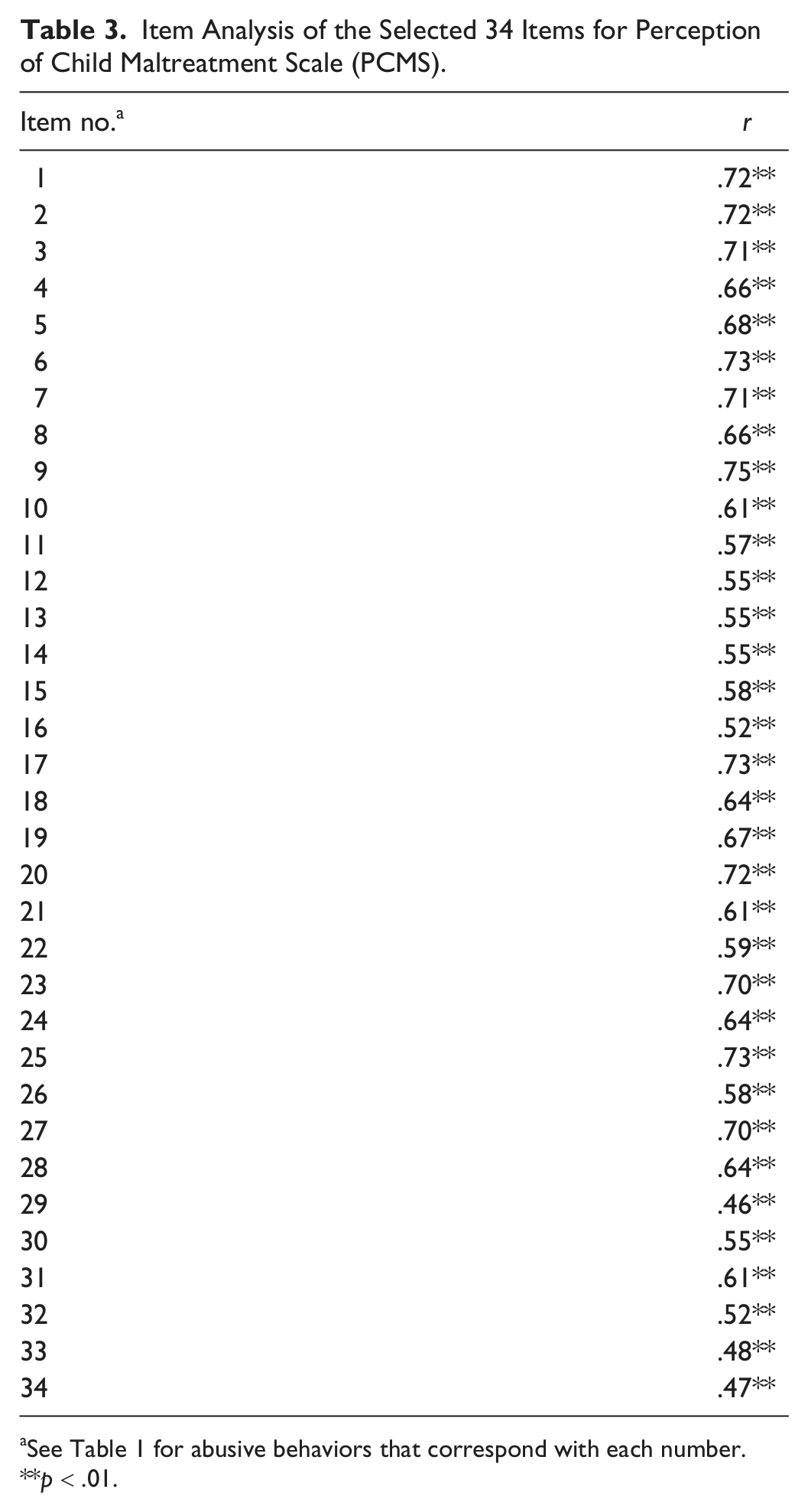
See Table 1 for abusive behaviors that correspond with each number.
p < .01.
Factor Analysis
Principal-axis factoring was used to examine the construct validity of the PCMS because of the need to specify the factors that are theoretically related to the abusive behaviors examined. Based on theoretical considerations, empirical evidence, and expert judgment, a five-factor solution of the 34 items using promax rotation method was specified. The 34 items clustered into five factors that represent the respective types of maltreatment: emotional/psychological abuse (10 items), sexual abuse (6 items), child neglect (6 items), child labor (7 items), and physical abuse (5 items). All items correlated with each other and Bartlett’s test of sphericity was significant, χ2(561, N = 317) = 7,307.93, p < .0005, suggesting that the correlation matrix was not an identity matrix or that the items were related with each other. Measures of sampling adequacy (Kaiser–Meyer–Olkin [KMO] = .93) was well above the recommended value of .6, confirming the adequacy of sample size for the analysis. Most communalities were very high (as high as .736 for Item 11: fondling the breasts of a child for sexual pleasure), with the lowest communality being .384 (Item 33: beating a 5-year-old child with a belt or stick or other objects), indicating that the items shared some common variance (Table 4).
Factor Loadings, a Communalities, Eigenvalues, Percentage of Variance Explained, and Cumulative Percentage of Variance Explained for the Perception of Child Maltreatment Scale (N = 317).

Factor loadings less than .30 are suppressed.
See Table 1 for abusive behaviors that correspond with each number.
Initial eigenvalues suggested that the five factors (Factor 1, emotional/psychological abuse; Factor 2, sexual abuse; Factor 3, child neglect; Factor 4, child labor; and Factor 5, physical abuse) explained 40.25% (Factor 1), 8.41% (Factor 2), 5.85% (Factor 3), 5.02% (Factor 4), and 4.10% (Factor 5) of the variance (Table 4). The five-factor solution, which altogether explained 63.63% of the variance in the overall scale, was specified because the factors represented the types of maltreatment that the items were theoretically predetermined to support, based on empirical evidence and expert judgment. As indicated in the scree plot of the factors (Figure 1), they corresponded with the point on the scree plot where the eigenvalues began to level off and they demonstrated the point from which considerations of additional factors were theoretically meaningless. For example, from the extraction method based on eigenvalues greater than 1, the sixth factor contained primary loadings on two items (Item 26: forcing a child younger than 11 years old to take care of parents/guardians or siblings almost daily; and Item 29: forcing a 7-year-old child to perform excessive and tedious household chores almost daily), which are theoretically insufficient to constitute a meaningful, independent factor and lack empirical bases to be differentiated from the fourth factor (i.e., child labor).

Scree Plot of Factors for Perception of Child Maltreatment Scale (PCMS).
Table 4 reports the factor loading matrix of the final solution for the PCMS. The criteria for selecting an item were that the item must load on the primary factor .40 or greater (Matsunaga, 2010) and that the loading on a secondary factor, if any, must be reasonably less than the loading on a primary factor. (Factor loadings less than .30 were suppressed in the analysis.) An item that loaded .40 or greater on a secondary factor was regarded as a complex variable. As indicated in Table 4, all items loaded on their respective factors. Most loadings were very strong and as high as .893 (Factor 1, Item 1: belittling a child habitually). The lowest loading was .444 (Factor 4, Item 29: forcing a 7-year-old child to perform excessive and tedious household chores almost daily). There was no indication of double loading or complex variables.
Principal-axis factoring was chosen for this analysis over principal components analysis because respective items clustered around the specific types of maltreatment that they were theoretically predetermined to support and because both analyses produced the same pattern of loadings. Similarly, varimax (orthogonal) and promax (oblique) rotation methods were examined and both rotation methods produced similar solutions, although three items with loadings less than .40 (Items 9, 20, and 25) and one complex variable (Item 27) cross-loaded between primary and secondary factors under varimax rotation. Almost all of the secondary loadings (Factors 2-5) occurred on Factor 1 (emotional/psychological abuse), thus validating the co-occurrence nature of maltreatment (Clemmons, DiLillo, Martinez, DeGue, & Jeffcott, 2003; Finkelhor, Ormrod, & Turner, 2007; Jonson-Reid, Drake, Chung, & Way, 2003; Malik & Shah, 2007) and the theoretical and empirical complexity of real and perceived impacts of different types of maltreatment on the emotional/psychological well-being of children (Goldsmith et al., 2009). However, the discrepancy between primary and secondary loadings was significantly large or larger, in half of the items, than the loadings in secondary factors (i.e., the loadings on the primary factors doubled or almost doubled the loadings on the secondary factors in most of the cases). Thus, most loadings with promax and varimax rotation met even the most conservative requirements of .60 or .70 for retaining items, as well as the “primary-secondary discrepancy” rule of .3 to.4 for retaining items that cross-loaded on secondary factors (Matsunaga, 2010, p. 101).
Regarding the analysis presented in Table 4, promax rotation was preferred to varimax rotation because of its simplicity and efficiency in accomplishing a simple structure and because of its ability to allow factors to remain correlated (Abdi, 2003; Burton & Mazerolle, 2011a; Costello & Osborne, 2005; Matsunaga, 2010). Given the small difference in loadings between the two rotation methods and between analysis based on fixed number of factors extracted (5) and the extraction method based on eigenvalues greater than 1, the five-factor solution with promax rotation was retained for final presentation.
Correlation Matrix and Internal Consistency Estimates
Means, standard deviations, correlation matrices, and alpha reliabilities that further establish the construct validity of the PCMS are presented in Table 5. The correlations between PCMS and emotional/psychological abuse (Factor 1), sexual abuse (Factor 2), child neglect (Factor 3), child labor (Factor 4), and physical abuse (Factor 5) were .90 (p < .01), .66 (p < .01), .81 (p < .01), .84 (p < .01), and .68 (p < .01), respectively. The subscales (the five factors) also correlated with each other significantly: emotional/psychological abuse and sexual abuse r = .55 (p < .01), emotional/psychological abuse and child neglect r = .63 (p < .01), emotional/psychological abuse and child labor r = .70 (p < .01), and emotional/psychological abuse and physical abuse r = .51 (p < .01). Other significant correlations included sexual abuse and child neglect r = .39 (p < .01), sexual abuse and child labor r = .50 (p < .01), and sexual abuse and physical abuse r = .30 (p < .01). Child neglect and child labor r = .62 (p < .01), child neglect and physical abuse r = .48 (p < .01) as well as child labor and physical abuse r = .42 (p < .01) also significantly correlated with each other.
Means, Standard Deviations, Correlation Matrix, and Alpha Reliabilities of Subscales of Perception of Child Maltreatment Scale (PCMS) (N = 317).

Note: PCMS = Perception of Child Maltreatment Scale; E/PA = Emotional/Psychological Abuse; SA = Sexual Abuse; CN = Child Neglect; CL = Child Labor; PA = Physical Abuse. M = Mean; SD = Standard Deviation; α = Alpha.
p < .01.
As indicated by Cronbach’s alpha, the PCMS and subscales are internally consistent. The alpha coefficient for the PCMS was .95 and for the subscales were .93 (Emotional/Psychological Abuse), .91 (Sexual Abuse), .89 (Child Neglect), .86 (Child Labor), and .84 (Physical Abuse).
Table 6 demonstrates that gender differences did not influence scores on the PCMS, as the mean scores and standard deviations for females (M = 121.77, SD = 19.83) did not differ significantly from the mean scores and standard deviations for males (M = 118.84, SD = 21.10), t = 1.25, df = 311, p = ns.
Mean Scores and Standard Deviations of Perception of Child Maltreatment Scale (PCMS) for Gender.

Note: Four cases contain missing data on gender. df = 311, p = ns.
Cutoff Scores
The total score on the PCMS was the summation of all items on the scale and the total score of the subscales was the summation of individual items that comprised the subscale. The score range on the PCMS was 34 to 136. Levels of perception of child maltreatment (i.e., high/strong, medium/moderate, and low/weak) were determined through analysis of percentile scores and the “criterion of one standard deviation above and below the mean of the distribution” (Malik & Shah, 2007, p. 174). The scores on the 25th, 50th, and 75th percentile ranks were 115, 127, and 134, respectively. The mean score was 120.19 (SD = 20.51). Examination of frequency distributions suggested that approximately 46% of respondents scored 126, while approximately 75% scored 134, indicating the upper range of perception of child maltreatment (Anastasi & Urbina, 1997, as cited in Malik & Shah, 2007). Thus, a score of 126 and below, between 127 and 133, and 134 and above were interpreted as low/weak, medium/moderate, and high/strong perception of child maltreatment, respectively.
Discussion
The purpose of this study was to utilize empirical evidence in Nigeria to develop a reliable, valid, and internally consistent scale that measures perception of child maltreatment. From a pool of items generated empirically and through consultations locally, 34 items emerged from correlation analysis. Exploratory factor analysis with promax rotation was performed on the 34 items to determine their loadings on the five factors that were theoretically predetermined to support emotional/psychological abuse, sexual abuse, child neglect, child labor, and physical abuse, collectively labeled perception of child maltreatment. Thus, the present analysis constitutes the initial step in developing and examining the psychometric properties of the PCMS beyond face and content validity.
The initial attempt to collect data online was aimed at reaching the population of literate young and middle-aged adults whose responses might provide a clear understanding of current perception of child maltreatment in Nigeria. This was done for the purpose of providing background data with which responses of an older and perhaps less literate population in the region might later be compared, as well as for the purpose of providing background data that might facilitate future comparisons with perception of child maltreatment in other regions.
Evidence supporting the construct validity of the PCMS was established through several indices. Item analysis using the technique of item-total correlation suggests that the individual items are related to the overall PCMS. Independent loadings of items on respective constructs (subscales) that comprise the scale suggest that the items are related to the constructs that they were theoretically predetermined to support. This was further supported by significant correlations between the PCMS and its subscales: the correlations were moderate for sexual abuse and physical abuse and high for emotional/psychological abuse, child neglect, and child labor. The coefficient of reliability, Cronbach’s alpha (Cronbach, 1984), suggests that both the overall scale and all subscales are internally consistent. The internal consistency of the scale and the subscales of Emotional/Psychological and Sexual Abuse are excellent and that of Child Neglect, Child Labor, and Physical Abuse are good. As indicated by the analysis, scores on PCMS did not differ by gender. Through analysis of percentile scores and the “criterion of one standard deviation above and below the mean of the distribution” (Malik & Shah, 2007, p. 174), scores on the PCMS were categorized into high/strong, medium/moderate, and low/weak for future considerations.
Although perception of child maltreatment has been examined in Likert-type and non-Likert-type questionnaires and vignettes, PCMS adopts the Likert-type questionnaire format to provide opportunity for future validity and reliability analysis. Standardization of abusive behaviors across types of maltreatment makes it possible to understand perceptions psychometrically, compare perceptions between and across regions, precisely measure the impacts of relevant variables on abusive behaviors, track possible changes in attitudes and beliefs, and determine their effects on perception.
Strengths and Limitations
This scale facilitates the measurement of perception of child maltreatment in Nigeria where empirically based instruments are often lacking. As a result of drawing items deemed to be abusive from local and international sources, the scale provides the initial step for understanding perception of abusive behaviors in Nigeria and for cross-cultural validation of abusive behaviors across regions. Thus, the standardized scale provides opportunity for cross-cultural comparison of perception and beliefs about child maltreatment and for generating knowledge that may influence policy, research, and practice.
Although majority of participants in this study were young and middle-aged students and nonstudents in urban centers of a state, samples from rural areas and other regions, as well as samples of practitioners and professionals who work with children such as teachers and social workers, will provide further validity to this scale. Because generational differences may influence perception of child maltreatment, including older populations (as well as respondents with lower levels of education) in further studies may provide additional information concerning the validity of the scale. Although common in many scales, the absence of negatively worded abusive behaviors may make the scale susceptible to response set. This concern may be addressed by inclusion of negatively worded questions in a scale. Similarly, expansion of response choices from four response choices to seven response choices also may enhance measurement precision, quality of data, and meaningful interpretation of results.
Practical Applications and Implications
Understanding perception of maltreatment is vital in many respects, because perception has implications for reporting maltreatment, identifying intervention needs of vulnerable children, formulating and implementing policy, determining potential for maltreatment, and susceptibility for victimization of children. The current scale has some practical applications and implications for personal, professional, social services, policy, and research. Similar to other measures of perception of maltreatment, the PCMS may be useful for working with parents to determine their disciplinary practices, their maltreatment values and beliefs, and their susceptibility to perpetration of maltreatment. It also may provide valuable information about the influence of parenting styles experienced during childhood on perception of maltreatment (when combined with appropriate instruments). Because perception of abusive behaviors is related to acceptance of maltreatment-related services, PCMS may be relevant to understanding or predicting clients’ responses to intervention and service.
The PCMS like other measures may be useful for practice. Because perception of maltreatment is related to outcomes of assessment of harm or risk of harm, PCMS may be useful for recruitment purposes to determine maltreatment perception of practitioners working with children. It also may be useful for identifying the training needs of practitioners as well as their professional suitability for working with children and families. It may be useful for policy decision making as it can help to determine general population norms and beliefs about maltreatment that may guide policy intervention necessary to protect vulnerable children. For research purposes, the scale may be utilized to examine the influence of childhood maltreatment on perception of maltreatment as well as the influence of perception of maltreatment on propensity to perpetrate or report maltreatment (when combined with appropriate instruments). It also may be utilized to examine the influence of perception of maltreatment on investigative decisions or outcomes by practitioners in child protection practice in the region.
Conclusion
Although knowledge about perception of child maltreatment in developing societies is still in its infancy stage, the absence of psychometrically sound instruments to measure the perception remains a challenge in utilizing knowledge about perception to inform policy, practice, and research. Therefore, the development of this scale, as well as the preliminary information provided through analysis, is a step in the right direction.
Footnotes
Declaration of Conflicting Interests
The author(s) declared no potential conflicts of interest with respect to the research, authorship, and/or publication of this article.
Funding
The author(s) received no financial support for the research and/or authorship of this article.
Notes
Author Biographies