




Abstract
Past research suggests that our ability to recall information increases when atypical items are presented within otherwise homogeneous sets. We investigated whether this effect applied to performance on practical, everyday tasks. In a computer-simulated restaurant scenario, participants acted as virtual servers, delivering “plates of food orders” to tables set up in different “rooms.” Plate destination was communicated using either a distinctive alphanumeric code or a homogeneous numeric code, both of which indicated the room and table number for delivery of food orders. We examined accuracy of plate delivery when two (low load) or three (high load) coded assignments were given per delivery trial. As expected, performance declined from the low- to high-load condition. Importantly, performance declined less with alphanumeric compared with all-numeric communication of assignments. Results suggest that increasing the distinctiveness of assignments, by using alphanumeric codes, can boost performance in real-life situations to significantly improve memory-related task performance, particularly when cognitive load is taxed.
There is no place like a restaurant for showcasing the feats and follies of human memory. Flustered servers buzz around tables prioritizing simultaneous requests in a desperate effort to “save footsteps” and remember who ordered what. It is no wonder that classic studies on memory mnemonics have investigated the on-the-job performance of bartenders (Beach, 1988) and waiters (Bekinschteina, Cardozoa, & Manes, 2008; Bennett, 1983; Ericsson & Polson, 1988; Zeigarnik, 1927, 1967) to discover the “tricks of the trade.” With three or four hot plates in hand, keeping track of where the food is to be delivered can be difficult, especially when inundated with details on individual food specification, and table location, of the hungry guest who ordered it! Could cognitive concepts, or known effects from cognitive psychology, help in developing a system for plate delivery that could minimize errors? As Bekinschteina et al. (2008) showed in their study of waiters in Buenos Aires, who memorize all the orders without written support, waiters can use a feature/location strategy to link clients with position at the table and food order. They suggest that memory-schemas link working memory to long-term memory networks through rapid encoding, making such information resistant to interference and enabling its fast retrieval if necessary cues are present. While this study suggests there are indeed methods being used by experts to improve memory in real-world situations, the authors suggest there is a need for more lab-based studies that can directly manipulate factors thought to influence memory performance. In this study, we do just that by examining how a cognitive theory could be used to aid memory in a real-life scenario in which memory demands are high.
A series of cognitive studies by von Restorff (1933) demonstrated that people make fewer errors when recalling atypical items (e.g., an isolated letter) presented within homogeneous sets of numbers than when recalling items (e.g., a particular number) presented within a homogeneous set of numbers. This memory effect is analogous to the finding in studies of perception, whereby a black square is more distinct when portrayed within a white than gray background (Craik, 1983). The von Restorff effect, also known as the isolation effect, is robust (for reviews, see Schmidt, 1991; Wallace, 1965). Essentially, the effect shows that when a distinctive item is embedded in a stimulus display of otherwise related items, that item is retained significantly better than a comparably located, but related item, in a similar set. It has been observed with a variety of stimuli such as words, using related paired associates compared with unrelated associates (Kimble & Dufort, 1955); with digits mixed with syllables compared with other digits (Fabiani & Donchin, 1995); and with three-letter trigrams of consonants mixed with vowels, compared with other consonants (Jenkins & Postman, 1948), to name a few. The effect can also be used to confer an overall memorial advantage to lists containing an isolate; the explanation being that under conditions in which an organizational process on memory can occur, material is encoded in a more structured manner, in turn producing greater memory performance (Cimbalo, Capria, Neider, & Wilkins, 1977; Webster, Leland, & Bartlett, 1997). Recent work also suggests this effect extends to spatial information. For example, Guérard, Hughes, and Tremblay (2008) showed that short-term serial recall was enhanced for both the location and the serial position of a red dot when presented among a sequence of otherwise black dots, highlighting the role of distinctiveness in enhancing memory. Based on these studies, we can make predictions about how to maximize accuracy when busy servers deliver plates of food to specific rooms and table locations in a restaurant.
The current work extends this traditional research in the cognitive domain to a real-life scenario. We examined the role of distinctiveness of delivery instructions on memory for location of plate deliveries to tables in a simulated restaurant setting. In contrast to studies of the isolation effect that have examined retention of syllables, digits, or word lists using conventional laboratory procedures, we created a simulation of a work setting in which memory was central to performance, and the form of encoding could draw upon the von Restorff effect (or not). Specifically we manipulated whether locations for plate deliveries were communicated to servers using a number-only (homogeneous) or an alphanumeric (atypical, or nonhomogeneous) coding system for room and table location for plate delivery assignments. Indeed, numerous large restaurants currently use a numeric-only code to represent the destination for plates of food. For example, orders are picked up from the kitchen, with table location coded as a series of numbers, such as 421, signifying delivery to Table 21, in Room 4. As suggested by the recent popularity of television cooking shows, in high-pressure restaurant environments (e.g., Fox broadcasting’s popular show Hell’s Kitchen), and video games that simulate high-pressure restaurant scenarios (e.g., Restaurant Empire, Enlight Software, USA), there is a need for optimizing plate delivery in large restaurant settings, with multiple rooms. What sets apart good versus poor waiters is not their ability to remember a couple of orders, but instead it is their ability to recall multiple orders and locations (Bennett, 1983; Ericsson & Polson, 1988). Cognitive research suggests that errors in delivery could be reduced by taking advantage of the isolation effect. For example, memory for destinations would be improved if location were coded using an alphanumeric code, such as A21, in which room location is denoted with a letter rather than a number.
We know that working memory has a limited capacity (Baddeley, 2000; Miller, 1956), and that the amount and complexity of information given to a learner also contributes to cognitive performance (Baddeley, 2000; Sweller, 1988). To determine the extent to which these factors would likely impact performance on our restaurant task, we manipulated “load” of to-be-remembered information. In our “low load” condition, two codes, or delivery assignments, were given to participants, and in the high-load condition, three codes were given. In all conditions, to mimic real-world conditions in restaurants, each assignment was compound, involving various specific plates (e.g., “steak, medium rare”) assigned to particular seats. It was expected that in the high-load relative to low-load condition, accuracy would decrease. As suggested by Baddeley and Hitch (1974), because working memory has a limited capacity, the amount of information given to a learner likely contributes to cognitive overload. If the von Restorff effect, and limited working memory capacity, applies to performance in more realistic situations, the effect of load should interact with code type in our study, such that accuracy will be higher in the alphanumeric than numeric condition but only in the high-load condition. Knowing whether memory can be enhanced in scenarios such as these could delineate how cognitive theories and strategies might be applied to attain expertise in everyday activities.
Method
Participants
Sixty-six undergraduate students from the University of Waterloo (UW), with a mean age of 19.98 years (SD = 2.0; range = 17-35 years), took part in the study. Participants were recruited from the University’s introductory psychology course. They received academic credit toward their psychology course for participating.
Design
The study design consisted of one within-participant factor, load (low vs. high), and two between-participant factors, order of load (low-load first vs. high-load first), and the form of code used at encoding of assignment (numeric vs. alphanumeric). Performance in relation to these factors was assessed using each participant’s score of correct deliveries of plates to the specified room, table, and seat (proportion correct).
Stimulus Material
The computer task was created for this study using Microsoft’s Visual Studio 2008. Participants completed the task using a laptop computer, headphones, and a mouse. An overhead view of simulated rooms containing tables was shown on the computer screen (see Figure 1).
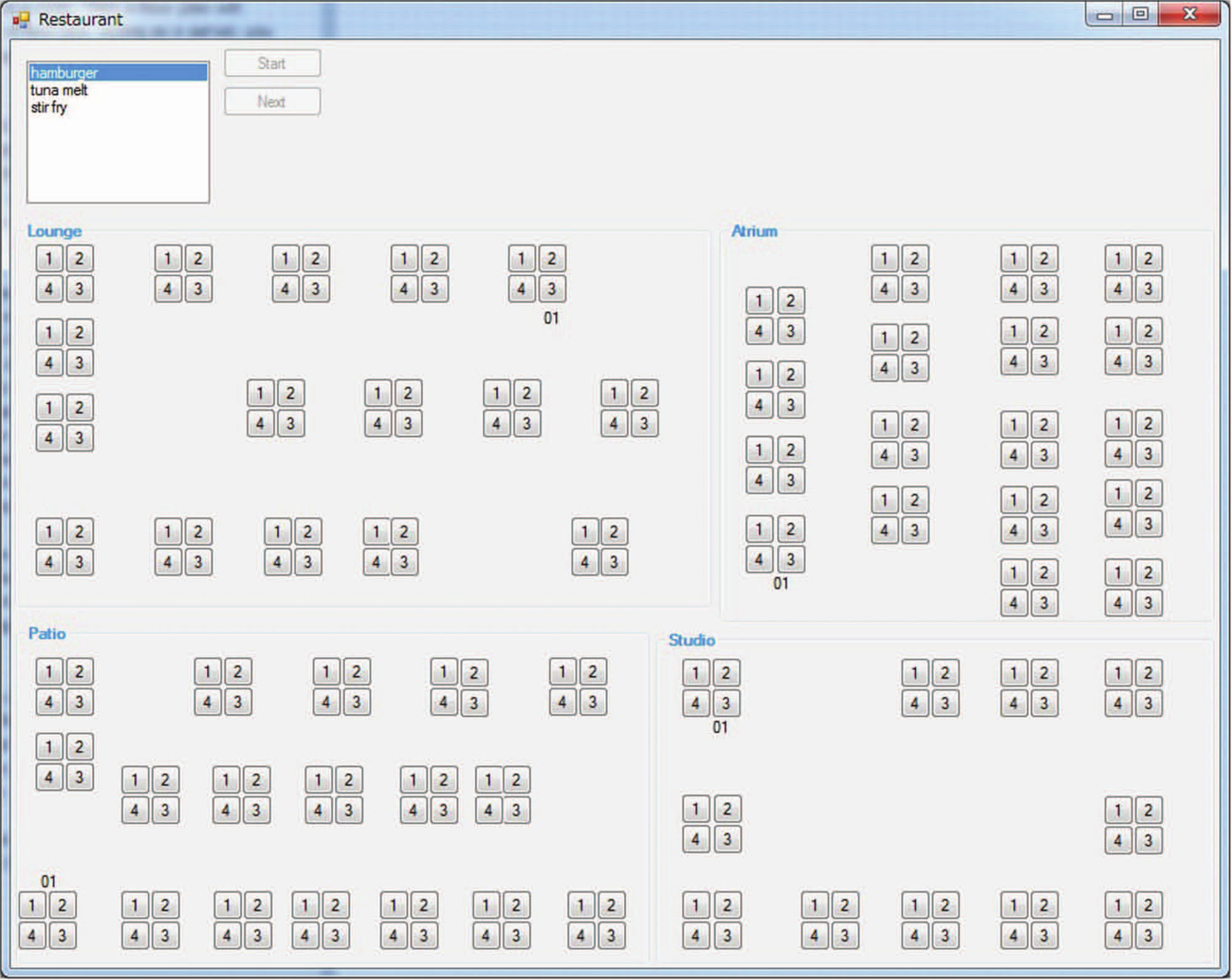
An overhead view of the simulated restaurant scene shown on a computer screen to participants in our study.
Procedure
Briefing
Each participant was instructed that the computer task involved acting as a “server in a busy restaurant.” They were told to deliver plates to assigned destinations as quickly and accurately as possible.
Simulated Restaurant Task
On a computer screen, participants were familiarized with an overhead view of the restaurant floor plan (Figure 1). The experimenter pointed out the different rooms where plates would be delivered. Each room had a configuration of tables numbered in sequence. Only when participants were able to demonstrate their understanding of the layout by describing it back to the experimenter were they provided with headphones. In this way, we were able to control for bias on the part of participants who might simply choose to deliver plates to the closest table possible in an effort to move quickly through the task.
Depending on the participant’s randomly assigned encoding condition, information on the room and table number was contained either in a numeric code (a three-digit number such as 324) or an alphanumeric code (a letter and a two-digit number, for example, A24) that was spoken through the headphones. The first character in a numeric code was the number 1, 2, 3, or 4, representing the Patio, Lounge, Atrium, and Studio, respectively. The first character in the alphanumeric code was the letter P, L, A, or S, representing the Patio, Lounge, Atrium, or Studio, respectively. In both encoding conditions, the final two characters in the code were digits representing a table number. Following presentation of the code, entrée names (plates) with respective seat numbers were given. An example of a complete serving assignment given by numeric code is
Table 124; spaghetti, seat 1, hamburger, seat 2, rolled ribs, seat 3.
An example of an alphanumeric coded assignment is
Table A24; spaghetti, seat 1, hamburger, seat 2, rolled ribs, seat 3.
As detailed below, participants heard either two (low load) or three (high load) such assignments on each trial, with codes either all numeric or all alphanumeric depending on encoding condition. Presentation of assignments took approximately 5 to 8 s, depending on the load condition. After all of the assignments were given, a list of entrée names for that trial would appear in a textbox in the same order as presented (simulating the fact that in real life, a server would be able to see all of the plates arrayed in front of him or her). Participants were instructed to deliver the plates in the order they had been assigned, by finding on the computer screen the correct room and table for each plate, and then clicking on the appropriate seat. As participants thus delivered plates to seats, entrée names disappeared from the textbox.
In the low-load condition, two different assignments were given on each of 20 trials. In the high-load condition, three such assignments were given on each of 30 trials. In both load conditions, approximately half of the assignments involved three entrées (like the examples stated above) and others involved four entrées (in a mixed ordering). Specifically, for the low-load condition, there were 9 three-entrée and 11 four-entrée assignments, and for the high-load condition, there were 13 three-entrée and 17 four-entrée assignments. Participants were randomly assigned to receiving either the low-load or high-load condition first.
Participants were required to achieve an 80% accuracy level on a set of 10 practice trials before commencing the experimental trials. Our intent was to minimize “learning effects” on initial experimental trials.
Results
A 2 × 2 × 2 repeated measures ANOVA was conducted, with one within-participant factor, load (low vs. high), and two between-participant factors, order of load condition and encoding (numeric vs. alphanumeric). The dependent variable was the percentage of instances in which participants correctly executed their assignments for placing plates at particular tables. This score may be considered to be a proportion-correct score, as it was calculated as the total number of correct seat placements divided by the total number of assignments given (e.g., 50/71 = 73.2%).
Estimation of the main effect of load yielded the expected high level of statistical significance, F(1, 62) = 149.00, mean square error (MSE) = 73.11, p < .001, partial η2 = .71, with low- and high-load means overall at 77.60 (SD = 13.90) and 59.60 (SD = 18.22), respectively. This reduction in performance with high load, relative to low, was evident both with the alphanumeric encoding, t(32) = 4.87, p < .001, and the numeric encoding, t(32) = 10.36, p < .001.
Although the main effect of encoding was not statistically significant overall, F(1, 62) = 1.97, MSE = 418.69, p = .17, partial η2 = .03, importantly, there was a significant Load × Encoding interaction, F(1, 62) = 13.83, MSE = 73.11, p < .001, partial η2 = .18. Figure 2 shows the study’s primary finding: From the low-load to the high-load condition, performance declined less with the alphanumeric encoding compared with the numeric encoding.
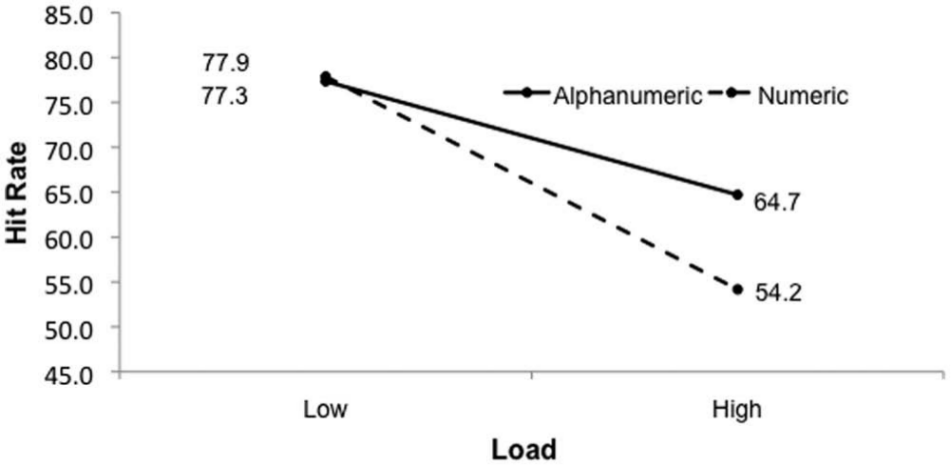
Mean proportion correct for correct placements of plates in relation to load (number of table assignments given per trial) and type of encoding of assignment (numeric vs. alphanumeric).
Secondarily, although the main effect of order did not yield statistical significance, F(1, 62) = 0.44, MSE = 418.69, p = .509, partial η2 = .00, this factor did interact with load, F(1, 62) = 20.94, MSE = 73.11, p < .001, partial η2 = .25. This interaction appears to reflect a practice effect, inasmuch as high-load performance was particularly poor when it was the first condition encountered and low-load performance was slightly lower when first. Finally, the test of the three-way interaction of load, order, and encoding was not significant, F(1, 62) = 1.14, p = .29, partial η2 = .018, nor did the test of the remaining interaction, involving the between-subjects variables order and encoding, F(1, 62) = 0.10, p = .92, partial η2 = .00.
Discussion
Our broad goal in this study was to produce actionable research by examining whether a well-established effect, from cognitive psychology, would influence performance on the practical, everyday task of delivering food orders to tables as assigned. Knowing whether memory can be enhanced in scenarios such as these, by taking advantage of the well-established von Restorff (1933) effect, would extend current cognitive theories and importantly, suggest strategies that can be applied to enhance memory in everyday activities. Given the limited capacity of working memory, we predicted that if the von Restorff effect applies to performance in our simulated restaurant environment, the effect of assignment load should interact with code such that accuracy would be higher in the alphanumeric than numeric condition—though only in the high-load condition. This is precisely what was found.
It is possible to argue that the benefit of the alphanumeric code arose because the letters we selected, P, L, A, and S, are the first letters of the “room” locations, Patio, Lounge, Atrium, and Studio, respectively. This correspondence may have conferred a semantic advantage, rather than providing more distinctiveness, to the alphanumeric code. We favor a distinctiveness explanation, however, because the restaurant “servers” were otherwise unfamiliar with the simulated restaurant. This unfamiliarity implies that the semantic meaning of P, L, A, and S was slight, thus minimizing any semantic facilitation of memory and performance. What is more, in a pilot experiment, arbitrary letters (W, X, Y, and Z) were used in the alphanumeric code instead of letters corresponding to words (e.g., P signifying the Patio room). Results took the same form as in the present study, with higher proportion correct in the alphanumeric than numeric condition—though only in the high-load condition. The letters used in the procedure were changed in the current study, in part, because of difficulties that some participants had in understanding the computer-generated pronunciations of the pilot study’s letters, which limited our ability to find a statistically significant interaction.
The change to the primary experiment’s particular letters also enhanced the procedure’s external validity. In actual restaurants, it is difficult to imagine that when management of that restaurant takes our advice to switch to an alphanumeric code, that arbitrary letters such as W, X, Y, and Z will be preferred over P, L, A, and S. Thus, by allowing some potential “contamination” of the isolation effect, which inspired this research, from semantic effects, we demonstrated enhancement of performance by a change in procedure that restaurants may actually use (and should use, from what we have observed).
Indeed, a paradox challenges the designer of any applied experiment: to incorporate the blend of ecological factors that make up reality, while conducting a tightly controlled experiment where distinct variables can be manipulated to draw causal inferences. Given the scope of our research question, it was impossible to fully satisfy both of these ideals in one study. In any event, our study has shown that well-known effects within the lab can be applied to enhance everyday performance on memory-related tasks.
The von Restorff effect has been shown in other work to enhance memory, even in populations known to have memory difficulties. Bireta, Surprenant, and Neath (2008) showed that memory performance in a lab setting can be increased in a population of senior citizens when one item is made distinct from the other items in a list during encoding (akin to our alphanumeric vs. numeric code in the current study); they showed memory for the distinctive item is improved, in line with the isolation or von Restorff effect. Smith (2011) recently showed the same pattern of memory benefit in older adults, when the contrast between an isolated and background items was increased. There is no reason to suspect that the benefits to performance documented in the current study, from employing an encoding strategy that takes advantage of the isolation effect, would not extend to such populations. Research in patient populations suggests the isolation effect is reliant on the integrity of the medial temporal lobes, and it is only in populations in which this brain region is compromised, or lesioned, that we fail to see a benefit (Kishiyama, Yonelinas, & Lazzara, 2004). It seems that encoding strategies that highlight distinctiveness by increasing the contrast between items at encoding, such as using an alphanumeric compared with numeric code, are a general means to best organize input to promote enhanced output; even studies in chimpanzees show a similar isolation effect on memory (Beran, 2011). In conclusion, our results extend this line of research by showing that increasing the distinctiveness of delivery assignments in a restaurant-like setting, by using alphanumeric codes that promote an isolation effect, can significantly improve memory-related task performance, particularly when cognitive load is taxed as is often the case in real-life scenarios.
Footnotes
Acknowledgements
We thank Lim Goh for assistance in programming the computer simulation used in this experiment.
Declaration of Conflicting Interests
The author(s) declared no potential conflicts of interest with respect to the research, authorship, and/or publication of this article.
Funding
The author(s) disclosed receipt of the following financial support for the research and/or authorship of this article: This research was funded by a grant from the Natural Sciences and Engineering Research Council of Canada awarded to author Myra Fernandes.
Author Biographies