




Abstract
This article examined the effects of family environment on the risks of premarital intercourse for male and female youth. Previous research in sub-Saharan Africa (SSA) on the linkages between family structures and sexual debut mainly utilized cross-sectional data. In a sample drawn from Cameroon Family and Health Survey (N = 2,166), descriptive and multivariate results showed that youth who resided in nuclear two-parent families, those who reported higher levels of parental monitoring and higher quality of parent–child relationships during childhood and/or adolescence, had significantly lower rates of premarital intercourse. Polygynous families, parent–child communication, orphanhood, and change in family structure were significantly associated with higher rates of premarital intercourse. Programmatic implications for reproductive health interventions in SSA are discussed.
Introduction
An abundant literature based on U.S. data and developed countries has consistently reported that family structures are an important factor associated with youth sexual behavior (Albrecht & Teachman, 2004; Thomson, Hanson, & McLanahan, 1994; Thomson & McLanahan, 2012; Wu & Thomson, 2001). In sub-Saharan Africa (SSA), a few studies have also addressed the linkages between family structures and sexual debut (Babalola, 2004; Babalola, Tambashe, & Vondrasek, 2005; Camlin & Snow, 2008; Diop-Sidibé, 2005; Djamba, 2003; Kumi-Kyereme, Awusabo-Asare, Biddlecom, & Tanle, 2007; Ngom, Magadi, & Owuor, 2003; Rwenge, 2003; Tambashe & Shapiro, 1996; Thurman, Brown, Richter, Maharaj, & Magnani, 2006). Empirically, studies in both developed and SSA uncovered similar results: Youth who resided with two married biological parents reported later age at sexual initiation. The linkages between family environment and premarital intercourse have practical policy implications because early sexual initiation is often associated with the risks of contracting HIV/AIDS, sexually transmitted infections (STIs), and unwanted pregnancies. These risks are drastically higher in SSA compared with any other region around the world (Clark, 2004; Mensch, Grant, & Blanc, 2006; Joint United Nations Programme on HIV/AIDS [UNAIDS], 2011; Zaba, Pisani, Slaymaker, & Boerma, 2004).
Notwithstanding this body of research, only few studies have included in their analyses the potential influences of parent–child interactions (e.g., quality of parent–child relationships, parent–child communication, and parental control). Yet, scholars suggested that family processes—referred to as parent–child interactions—may have a high explanatory power (Wu & Thomson, 2001). Thus, ignoring family processes when studying the relationship between family environment and premarital intercourse may result in misleading conclusions. Furthermore, previous studies in SSA typically relied on cross-sectional data and used theories that are not family-centered. Obviously, findings from those studies are informative; however, they must be interpreted with caution, in part because the context of first sex may have changed in the meantime. Indeed, those studies explained past events (e.g., sexual initiation) with current individual, familial, and community characteristics. This article contributes to existing literature in SSA by drawing on a family-centered theoretical perspective and family antecedents to document the occurrence of premarital intercourse. Detailed retrospective family histories available in the Cameroon Family and Health Survey (CFHS) are used to estimate the effects of family structures during childhood and adolescence. Findings indicated that the effects of family environment (including family structures and parent–child interactions) and parental marital status varied during childhood and adolescence. In contrast, the effects of family instability and changes were substantial regardless of the timing of its occurrence.
Conceptual Framework
Previous research has focused on three main explanations of the associations between family structures and sexual initiation, including early socialization, parental control/supervision during adolescence, and family instability and changes. Each explanation explores different aspects of family influences on youth sexual behavior; however, they are not mutually exclusive. In fact, socialization may affect parental control/supervision under certain circumstances. Likewise, family turbulences may impair socialization processes and parental control. We argue that those assumptions are relevant in SSA but are not yet fully examined. Likewise, we extend the literature from developed countries to account for specific family traits in SSA. Polygyny is the most distinguishing characteristic of African family structures (Kayongo-Male & Onyango, 1984); it is still prevalent (Westoff, 2003) and a normative marital system (van de Walle, 2006). As such, findings from studies on the relationship between family environment and sexual debut that overlooked the role of polygyny may be inconclusive. Finally, we consider the intervening roles of parent–child interactions to understand how family structures affect premarital intercourse.
Socialization
The theory of socialization emphasizes the role of parents as the most influential socializing agents during early childhood. For sociologists and child development theorists, appropriate behaviors are the core of child socialization. Norms and family values and parenting models are fundamental in this theory holding that married two-parent homes are protective (Albrecht & Teachman, 2004; Wu & Thomson, 2001). Researchers argued that youth from unmarried parents often witness their parents’ dating or cohabiting relationships while learning to deal with their own romantic relationships (Pearson, Muller, & Frisco, 2006). Hence, they were more likely to experience early sexual initiation or reported higher rates of sexual activity. Robust empirical evidence is largely from developed countries (Albrecht & Teachman, 2004; Thomson & McLanahan, 2012; Wu & Thomson, 2001).
Few studies have documented the effects of family structures on sexual behavior while taking into account the type (polygynous vs. monogamous) of union (Amoran, Onadeko, & Adeniyi, 2005; Slap et al., 2003). They found that youth from polygynous families have higher rates of early sexual debut. Nonetheless, the extent to which socializing mechanisms differ between monogamous and polygynous families remains unclear. The effects of polygyny on youth sexual behavior may operate through the economic deprivation of family members. Polygynous families have greater needs due to the larger number of people than monogamous families and consequently have fewer material and financial resources to support their children (Kuate Defo, 2004; Meekers & Calvès, 1997). Economic hardship may explain why youth from polygynous families lack basic needs such as food, housing, or schooling fees, and therefore engage in premarital intercourse (Amoran et al., 2005; Slap et al., 2003). Economic deprivation that is higher among one-parent families may also explain higher rates of early sexual debut for youth raised in those families. Socialization theory also emphasizes the negative effects of the father’s absence during childhood (East, Jackson, & O’Brien, 2006). The key point is that role-model fathers provide help children to develop a healthy gender identity, appropriate sex-typed behaviors, and a positive sexual self-image (Albrecht & Teachman, 2004). A lack of father’s presence can translate into adverse outcomes such as premarital intercourse (Babalola, 2004; Karim, Magnani, Morgan, & Bond, 2003; Ngom et al., 2003).
Increasingly, researchers included measures of parental involvement in their analyses of the effects of family structure. The quality of parent–child relationships and parent–child communication are central to socialization. Parent–child relationships encompass closeness and connectedness, the type and level of support and security that parents provide to children (Kumi-Kyereme et al., 2007; Slap et al., 2003). The internalization of parental values (strictness vs. permissiveness) about sexual attitudes and behaviors may be higher in supportive two-parent families. Hence, youth who benefit from those family contexts likely refrain from early sexual initiation. Although previous research from developed countries reported mixed results, positive parent–child relationships within two-parent families are often associated with lower rates of premarital intercourse (Regnerus & Luchies, 2006).
Communication is the main channel for parents to transmit knowledge and attitudes about sexuality. Good, open, and higher levels of parent–child communication are often associated with lower rates of premarital intercourse (Dittus & Jaccard, 2000). In SSA, studies on the content, time, and frequency of parent–child communication reported that parents usually feel uncomfortable to talk about sex topics (Kouinche & Tagne, 1998). Empirically, associations between parent–child communication and premarital intercourse in SSA are inconclusive. Some researchers found a weak relationship (Karim et al., 2003; Kumi-Kyereme et al., 2007) while others found no effect (Fatusi & Blum, 2008). The tempo of discussions about sex topics has sparked much debate: “Should parents talk to children before or after they have engaged in sexual activity?” One might argue that talking to children before they engaged in sexual relationships could prevent adverse reproductive health (RH) outcomes. This issue is not well documented in SSA. Likely, the cross-sectional nature of the data has limited previous research to capture the time order of parent–child communication and sexual initiation. In this article, we consider parent–child communication prior to sexual debut.
Social Control
According to the social control theory, the so-called “parental supervision” or “monitoring during adolescence,” young people are naturally inclined toward deviance, but bonds to conventional society cause most individuals to refrain from such behaviors (Crockett, Bingham, Chopak, & Vicary, 1996). Researchers argued that the probability of adolescents to engage in premarital intercourse is in large part due to the levels of parental supervision (DiClemente et al., 2003). The underlying assumption is that youth from two-parent families are more likely to report higher levels of parental supervision/monitoring than neither- or one-parent families, thus providing youth with fewer opportunities to engaging in sexual activities (Albrecht & Teachman, 2004; Biddlecom, Awusabo-Asare, & Bankole, 2009; Kumi-Kyereme et al., 2007).
During adolescence, the role of a second caregiver 1 (namely, the father) becomes particularly important when the mother’s authority begins to compete with extrafamilial factors, including peer influences and community opportunities. In Western contexts, supervision is primarily a parental task; the absence of one parent can be detrimental for youth. Where polygyny is rife like in African cultures, parental supervision can be challenging even for two-parent families. Indeed, parents like polygynous fathers may lack time to oversee the elevated number of children and homes. Therefore, only mothers are the primary supervisor similar to single-parent households in the Western context. Hence, a lack of authority and clear rules from mothers about sexual matters can be detrimental for youth in polygynous and one-parent households. Compared with Western contexts, guidance and supervision of youth in SSA is a social and collective task in which parents play the most important role (Verhoef, 2005). Finally, African societies have different expectations for girls and boys about sexuality. Indeed, premarital sexuality is prohibited for females but it is sometimes encouraged or not sanctioned for boys (Kuate Defo, 1998). Thus, the effects of parental control likely vary by gender and age.
Family Instability and Changes
From the perspective of family instability and changes, early sexual initiation among youth is a function of family instability and changes occurring after a divorce, remarriage, or parental death (Albrecht & Teachman, 2004; Cavanagh & Huston, 2006, 2008). The increasing rates of divorce in developed countries led researchers to focus primarily on the negative effects of marital disruption on sexual onset (Amato, 1987). Single-parent households in SSA generally resulted from parental death. Parental death is a strong, traumatic, and stressful event that was found to correlate with negative outcomes such as school dropouts (Case, Paxson, & Ableidinger, 2004; Gertler, Levine, & Ames, 2004) or risky sexual behavior (Thurman et al., 2006).
Finally, some researchers conjectured that the three aforementioned perspectives can be viewed as complementary rather than competing (Wu & Thomson, 2001). For instance, demographic events like divorce or parental death are also associated with family instability and changes (Bicego, Rutstein, & Johnson, 2003; Thurman et al., 2006). These changes lead to many stressful events for parents and children, and therefore may affect parent–child bonds. In fact, frequent changes within family environment may decrease the effectiveness of social control through a decrease of number and types of parents present in the home. Emotionally, psychologically, and economically, new family environments require new adaptation. Hence, they can impede socialization processes. Social control and socialization processes may be linked in many ways (Wu & Thomson, 2001). Strong social networks among parents in a neighborhood may provide youth with great opportunities for a collective socialization. For instance, most youth in Bandjoun know that premarital intercourse is prohibited (Kouinche & Tagne, 1998). Likewise, the quality of parent–child relationships leads to more effective control of children because when parents provide a stable and warmth environment, children likely internalize familial values and attitudes about sexuality. In Bandjoun, parent–child relationships vary depending on parents’ gender. Fathers’ relationships, especially for daughters, are mostly vertical ones, whereas mother–child relationships are rather horizontal and characterized by companionship, confidentiality, and flexibility with respect to the acceptance or rejection of normative behaviors (Ngom et al., 2003). In this context, fathers provide more disciplinary environments even though mothers may exercise more effective control over children.
Hypotheses
The literature presented above leads to a number of relevant hypotheses in SSA. Overall, young people from two-parent monogamous families will experience premarital sexual intercourse at a later age compared with those who resided in other types of families. From the socialization perspective, higher quality of parent–child relationships and higher levels of parent–child communication about sexuality topics are expected to correlate with lower rates of premarital intercourse. From the social control perspective, it is expected that higher levels of parental supervision lead to a later sexual initiation. From the instability and change perspective, we expect that youth who experienced family changes and/or parental death likely report premarital intercourse. Specifically, socialization and social control hypotheses are tested here using family antecedents at childhood and adolescence, respectively. Instability and family change hypotheses are tested with parental survival and an indicator of family structure change between childhood and adolescence.
The Study Setting
Cameroon is often referred to as a miniature Africa due to its geographic, climatic, and ethnic diversity (more than 200 ethnic groups). There are three main ethnic groups in the country, two in the predominantly Christian southern part of the country, and the other in the northern part. The Bamiléké is the largest ethnic group in the country. The Bamiléké people are a migration population which has contributed through its highest fertility nationally to the peopling of all regions of Cameroon from West highlands region of their origin. The Fang-Béti is the second largest ethnic group; they live in the forested region in the Center, South, and Eastern regions. The Fulani are about one third of the population and live in the Northern part of the country. They are mostly Muslims and form a very homogeneous group in terms of religion and lifestyles. In contrast, our study setting (Bandjoun) is culturally homogeneous because people are mainly the Bamiléké. Previous studies reported that the Bamiléké have plenty of rules disapproving sexual immorality, including incest, adultery, and fornication (Bouwa, 2006). Polygyny is not uncommon among the Bamiléké. As such, it is almost inconceivable for a man to divorce his wife (or wives) for any motive. Hence, the divorce rates are lower in this region compared with national levels and trends (Kuate Defo, 1998). Consequently, extended families appear to be the predominant pattern in Bandjoun; at the same time, nuclear families remain under the influences of extended families.
In cultures where the rules about sexual activity are strict, it is common that information about sexuality topics is passed on through cultural initiation rites precluding biological parents. In Bandjoun traditional societies, sexuality was taught within homogeneous sex-specific groups organized to prepare youth for household chores and parental/societal responsibilities. Parents were not the primary source of sexual education. Nowadays, the increasing urbanization in the country brought many changes regarding initiation rites. There is still evidence that initiation rites about sexuality do exist in Cameroon; however, they are less common. In spite of the changes occurring in traditional cultures, sexuality remains a taboo topic in Bandjoun. Consequently, the Bamiléké feel discomfort and shame when talking about sexuality with children. Such parent–child interactions may impede the potential for parents to act as sexual educators and help youth to overcome negative outcomes associated with premarital intercourse.
Data and Method
Data were drawn from a random and representative sample of CFHS carried out in 2002 (CFHS-2002) among individuals aged 10 years and older in the 75 localities forming the prefecture of Bandjoun (Kuate Defo, 2005). Each locality used probability samples in which all households have a nonzero chance of inclusion. When selected, all individuals aged 10 years and more in the household were interviewed. A total of 4,950 respondents of both sexes were interviewed using standard questionnaires. The present study used a subsample of 2,166 adolescents and young adults of both sexes, aged 12 to 29 years. 2 CFHS-2002 gathered retrospective information on family histories at ages 6 and 12 representing two important transitions for youth in Cameroon. The primary school starts at age 6. Age 12 represents the emerging adolescence and the transition from elementary to high school. Methodologically, choosing these two markers limited recall biases inherent in retrospective surveys.
Measures
Dependent Variable
Timing of premarital intercourse
The validity of respondents’ self-reported age at first sex or the waiting time to premarital intercourse is debatable. Previous studies reported that measurement of age at premarital intercourse is problematic, especially for older youth (Mensch et al., 2006). A vast literature questioned the consistency and reliability of self-reported age at first sex in surveys from developing countries (Hewett, Mensch, & Erulkar, 2004; Zaba et al., 2004). For instance, age at first sex varied with interview modes. Likewise, underreporting is widespread among girls (Mensch et al., 2006). In SSA, the social context can undermine the accuracy of self-reported age at first sex: For boys, having sex represents prestige among peers. In contrast, it is shameful for females to be sexually active because virginity is still valued.
In this article, age at premarital sex 3 is measured by the respondents’ self-reported age at first sex with a partner of opposite gender (recorded in years). From an event history perspective, the occurrence of premarital intercourse at each age is defined as a single event and the nonoccurrence of first sexual initiation is defined as censoring in the last interval (e.g., young people who are not sexually experienced at the time of interview but may experience transition to sexual initiation in the future). In practice, the probability of sexual debut in each interval of time (a year) is estimated using a binary variable taking the values 1 if the premarital intercourse has occurred and 0 otherwise. Respondents were asked the questions, “Have you ever had sexual intercourse?” If so, “How old were you when you had first sexual intercourse?” It was also possible to determine whether first sexual intercourse occurred within or before marriage using the following additional information about age at marriage: “Have you ever been married?” and “How old were you when you first got married?”
Independent Variables
Family structure
Defining and/or measuring family structure is also a subject of debate. The resulting ambiguity in terminology and measurement has nurtured confusions about its effects on youth’s sexual behaviors. Data about family structure in SSA often used the variable/question “Relationship to household head” collected in censuses and surveys. This variable provides limited information to determine parental coresidence. To overcome these shortcomings, Demographic and Health Surveys (DHS) program introduced additional questions to capture whether the child lives in the same household with his or her biological parents. Fortunately, detailed information was available in CFHS-2002 about family members present in the household at each time. Family structures here emphasize coresidence with biological parents. This approach differs from other aspects of family structure such as household size, number of siblings, or the number of generations within the household. The major rationale is that these aspects are more difficult to capture due to recall biases. Family configurations at ages 6 and 12 may also be subject of recall problems; however, changes in family structure are not very common in semiurban areas in Cameroon.
A total of 10 dichotomous questions were asked to capture family structures at a given age t (ages 6 and 12) about members of a typical African family: “With whom did you live at [age t]?” Responses included members of nuclear family (father, mother, brother/sister), extended family (cousins, uncle/aunt, grandfather/grandmother), nonrelatives (friend, playmate), and other situations (living in institution or alone). Only a few cases felt in items such as “friend, playmate, in institution, and alone.” Therefore, they were excluded. Six items were used to build five mutually exclusive categories of family structures: nuclear one-parent, extended one-parent, nuclear two-parent, extended two-parent, and other relatives. This last category included brothers/sisters, uncles/aunts, and grandparents. Ideally, this group should be divided into subgroups; however, analyses with subgroups led to statistically unstable models. For similar reasons, one-parent families (mother-only and father-only) were combined.
Parental marital status
Respondents were asked the following question: “What was the marital status of parents/guardians at age t?” Responses included single, married monogamous, cohabiting, married polygynous, separated, divorced, and widowed. A new variable was created that distinguishes young people who lived in monogamous and polygynous families, and other (single, separated/divorced, and widowed).
Family processes
Family processes (e.g., quality of parent–child relationships, parent–child communication, and parental control) are complex and multidimensional concepts. They are important components of effective family environment; however, the context-specific instruments to capture parent–child interactions are lacking in SSA. Thus, findings should be interpreted with caution. For instance, parent–child relationships and parental control are measured with a single item response. Although parent–child communication about sex topics was measured using five yes/no items, a Likert-type scale could provide a wider range of values between respondents. Family processes identified as mediators of the effects of family structures on premarital intercourse are described below.
Quality of parent–child relationships at age t was captured through the following question: “How did you see the quality of your relationships with your parents/guardians at age t?” Reponses ranged from 1 = very good to 5 = difficult/bad. They were reversely recorded in the analyses.
Parent–child communication was measured with five yes/no questions: “Did you ever have conversations with your parents/guardians about puberty, sexual education, STIs and HIV/AIDS, pregnancies, and alcohols or drugs at age t?” Items were summed; the scores ranged from 0 to 5, higher scores indicating higher levels of parent–child communication (Cronbach’s α = .86).
Parental control
This study used direct measures of parental supervision at age t, indicating whether parents were aware of youth whereabouts: “Were your parents or guardians controlling your leisure at age t?” Responses ranged from 1 = a lot to 5 = not at all. Responses were reversed to obtain a gradient; higher scores correspond to higher levels of parental control.
Parental survival
The question “What was the main reason why you weren’t living with your biological parents at age t?” measured parents’ survival status. Responses included the following: mother and father died, father died, mother died, school, and other. This variable was coded 1 if at least one parent deceased and 0 otherwise.
Economic deprivation is proxied with three variables. First, “What was the lighting type that you were using in the home at age t?” Responses were electricity, lamp, candle, and other. This variable was coded 1 if the lighting mode was electricity and 0 otherwise. Second, the presence of radio/television at home, “Did you have a radio or a television at home at age t?” coded 1 = yes and 0 = otherwise. Third, the educational attainment of parents/guardians was measured by the following question: “What was the education level of your responsible at age t?” Responses were recorded 0 = none, 1 = primary, and 2 = high school or university. These variables represent different aspects of socioeconomic status (SES). Hence, they are introduced separately in the estimations.
Other variables associated with sexual onset include age (in years), gender (male vs. female), education (years completed), and place of residence (rural vs. urban).
Method
Bivariate and multivariate analyses were performed. Kaplan–Meier life tables were used to determine the median age at premarital intercourse. For multivariate analyses, discrete-time hazard models were used because the timing of premarital intercourse can be viewed as an age-dependent process. Using the person-age observation (in a person-year file) as the unit of analysis, multivariate discrete-time models with a logit transformation (Allison, 1984) were fitted to capture the effects of key independent variables on the probability of premarital intercourse. The log odds of premarital intercourse can be parameterized with a general formulation as follows:

where p represents the risk of premarital intercourse at age t given that the individual i has not yet experienced a first sex before age t, β designs the effect of family structure (FS), ψ is the effect of parental marital status (MS), δ is a vector of parameters corresponding to covariates X that mediate the effects of family structure and parental marital status in each hypothesis, ξ is a vector of parameters of other covariates Z, and α represents the specific effect of being in a given age interval.
The logit coefficients represent the effects that being in the estimated variable category has on the odds of having a premarital intercourse relative to remaining virgin. This analytic strategy is appropriate because the events occurred in discrete time intervals, and premarital intercourse was measured in completed years. Specifically, Models 1 to 4 (Tables 2 and 3) are performed to test the socialization and social control hypotheses, respectively. Finally, parental survival and family changes were used to test instability and change hypotheses (Table 4). The indicator of family change is only included in models using variables at age 12.
Another methodological issue relies on the nature of data: All individuals aged 10 years and above in the household were interviewed in CFHS-2002; therefore, observations were not independent. They are correlated because they share the same characteristics within the household. It is therefore necessary to account for this correlation so as to derive unbiased estimates of standard errors, p values, and confidence intervals. The analyses controlled for the correlation of observations on youth for the same household by using the appropriate options in STATA software (Cleves, Gould, & Gutierrez, 2004; StataCorp, 2005). In STATA, when the cluster option is specified, it then corrects for the fact that youth within a household are not independent observations. This yields robust standard errors, those obtained via the Huber–White sandwich estimator of variance. Moreover, should there exist intrahousehold correlation, the robust standard errors are better indicators of the sample-to-sample variability of the parameter estimates and therefore produce more accurate tests of the effects of the covariates (Cleves et al., 2004).
Results
Descriptive Analysis
Table 1 provides descriptive statistics of the sample for family structure, parental marital status, family processes, and demographic characteristics, and the median age at first sexual intercourse for categorical independent variables. Overall, 35% of young people had premarital intercourse. The median age at premarital sex is 17.7 years. These figures do not differ significantly from the national trends. According to the Cameroon Demographic and Health Survey (CDHS)-1998 and CDHS-2004, the median age at first sex among young adults aged 20 to 29 years old ranged between 15.9 and 18 years. Findings in Table 1 also indicate that youth living in two-parent families at age 12 significantly reported the oldest age at first sexual intercourse (17.8 years), and those who resided in extended one-parent families the youngest (16.9 years). Likewise, youth in monogamous families reported the oldest age at premarital intercourse (17.7 years) than those from polygynous families (17.2 years) or other homes (17.3 years). Age at premarital intercourse does not vary as much by parental education (17.5-17.9 years). Youth who lived in homes with a radio/television significantly reported younger age at first sex (17.5 vs. 18.3 years). Conversely, youth in electrified houses marginally reported older ages at first sex (17.9 vs. 17.6 years). There were significant differences in the age at premarital intercourse with respect to parental survival: Orphans reported significantly younger age at sexual onset (17.5 years) than nonorphans (17.8 years). Change in family structure between ages 6 and 12 also shows significant differences. Youth who experienced family changes reported early age at premarital sex compared with sedentary respondents (16.8 vs. 17.6 years). In this sample, no gender differences were observed about the age at premarital intercourse (17.9 for males vs. 17.6 years for females, p > 10%).
Percentage Distribution of Respondents, Percentage Who Have Had Premarital Intercourse, and Median Age at First Sex in Bandjoun.

Source: CFHS-2002.
Note: Cont. = continuous variables; CFHS = Cameroon Family and Health Survey.
People who completed at least high school. This category encompasses people with high school and above.
Significance testing is based on Wilcoxon’s test for homogeneity across survival curves for each categorical time-varying covariate.
p < .10. **p < .05. ***p < .01.
Table 1 also displays descriptive statistics of the sample. The distribution of family structures at ages 6 and 12 indicates that one-parent families were marginal. In fact, 7.4% and 2.8% were living in nuclear one-parent and extended one-parent families at age 6. Corresponding figures at age 12 were 8.2% and 4.4%. In contrast, most adolescents and young adults were living in nuclear two-parent families (41.7%) and extended two-parent families (32.2%) at age 6. Likewise, 36.7% and 29.1% were living in nuclear two-parent families and extended two-parent families at age 12. Moreover, a significant proportion of youth resided with other relatives at ages 6 and 12 (15.8% and 21.7%, respectively).
Most parents/guardians were monogamous (65% and 63% at ages 6 and 12, respectively) or polygynous (27% and 28% at ages 6 and 12, respectively). Roughly 10% of youth lived in a family environment theoretically at risk, including households headed by never-married or single (divorced, widowed) people. These findings provide insights into the persistence of polygyny in many African countries. At the national level, the recent CDHS-2004 showed that 30% of married women were living in polygynous unions. As regard to parental survival, the proportion of orphans increased significantly as youth were getting older. While 6% of youth were orphans at age 6, these figures quadrupled at age 12. The increasing levels of AIDS prevalence in the country probably likely explain these trends.
Turning to family processes, findings show that the levels of quality of parent–child relationships and parental control were higher, with averages ranging from 3.79 to 3.96 at ages 6 and 12. Although one might expect variations in terms of the quality of parent–child relationships and parental control as children grew, results indicated only small changes between ages 6 and 12. Although a modest increase was observed between ages 6 and 12, the levels of parent–child communication were expectedly low. Demographic characteristics show that the sample consisted of 57% of females, with an average age of 17.3 years. Unlike African settings, nearly all respondents (99.9%) were enrolled in school at some time of their life. As a result, the average years of education was high (M = 8.3, SD = 2.3). Urban residents represented 16.8% of the sample.
Results From the Multivariate Hazard Models
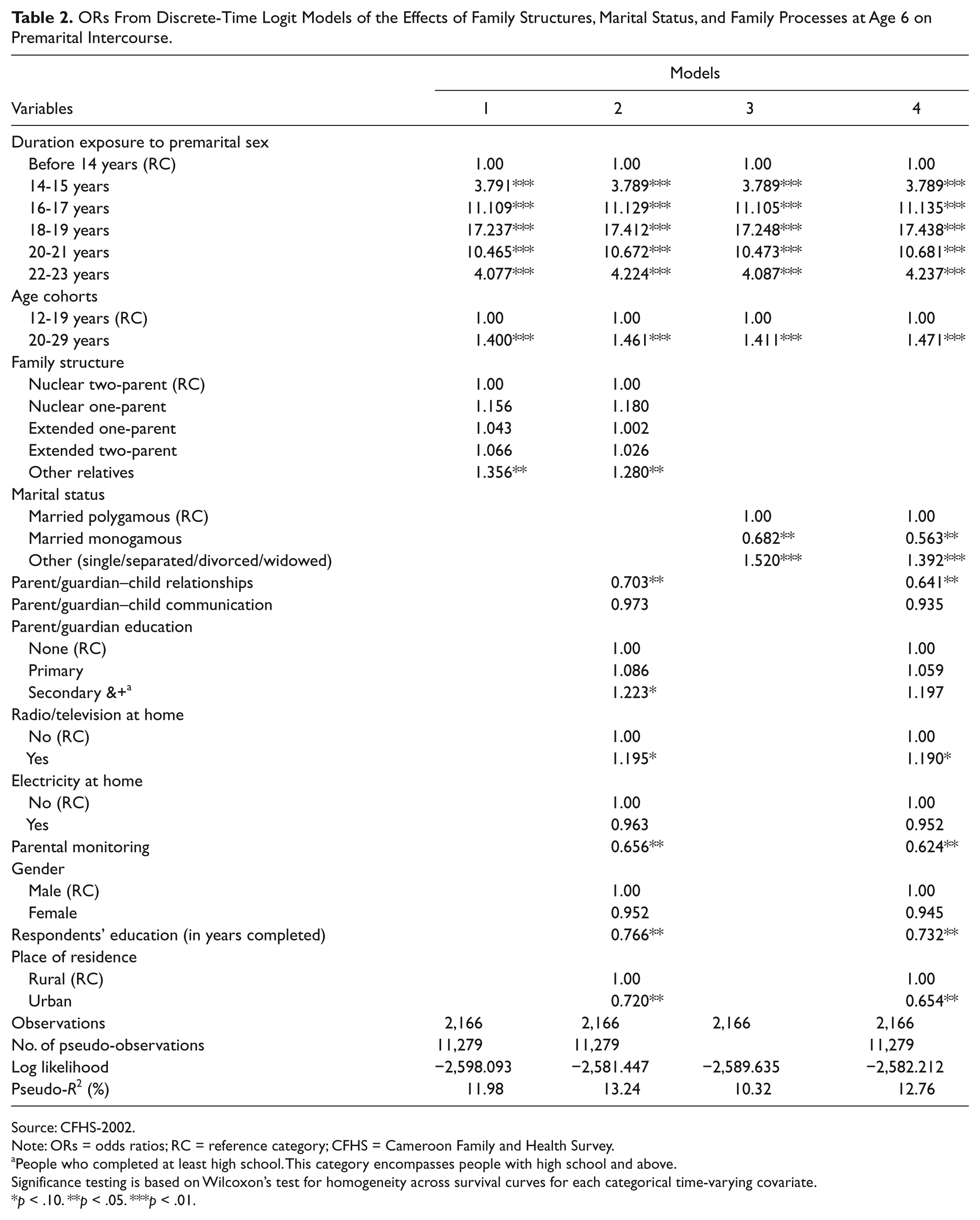
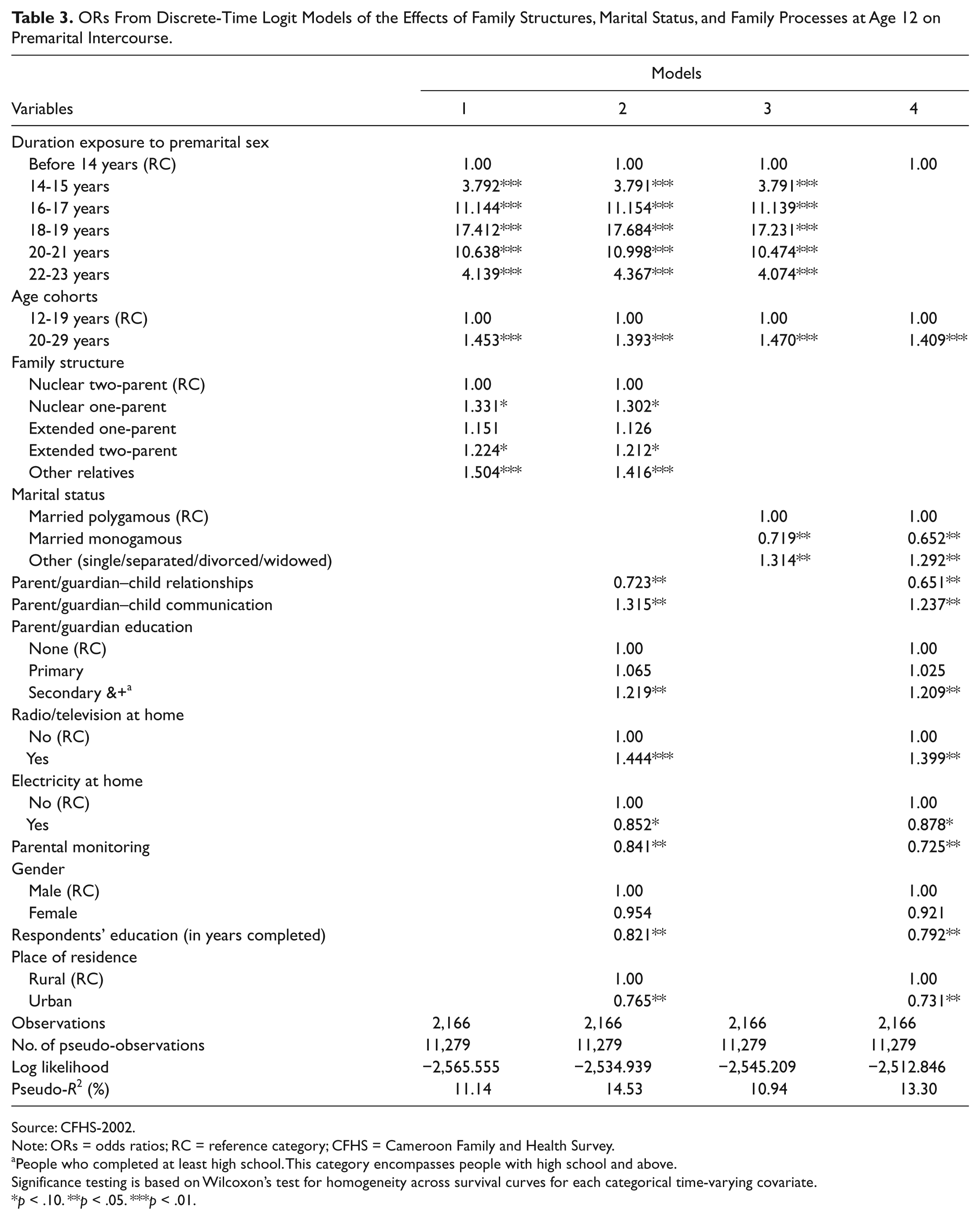
Multivariate results are structured to follow our conceptual framework. To achieve these goals, Tables 2 and 3 present the estimated coefficients of discrete-time logit models using family background at ages 6 and 12 to test the socialization and social control hypotheses. Models 1 and 3 in Tables 2 and 3 are the baselines for the two key independent variables, namely, family structures and parental marital status. These models are extended to include family processes and control for demographic characteristics such as gender and age cohorts. Generally speaking, if we consider findings from Tables 2 and 3, the odds of having premarital sex among youth aged 12 to 29 years at the time of the survey increased monotonically with the length of exposure to premarital intercourse. Likewise, older youth (20-29 years) were 1.45 times more likely to have premarital sex compared with adolescents (12-19 years).
ORs From Discrete-Time Logit Models of the Effects of Family Structures, Marital Status, and Family Processes at Age 6 on Premarital Intercourse.
Source: CFHS-2002.
Note: ORs = odds ratios; RC = reference category; CFHS = Cameroon Family and Health Survey.
People who completed at least high school. This category encompasses people with high school and above.
Significance testing is based on Wilcoxon’s test for homogeneity across survival curves for each categorical time-varying covariate.
p < .10. **p < .05. ***p < .01.
ORs From Discrete-Time Logit Models of the Effects of Family Structures, Marital Status, and Family Processes at Age 12 on Premarital Intercourse.
Source: CFHS-2002.
Note: ORs = odds ratios; RC = reference category; CFHS = Cameroon Family and Health Survey.
People who completed at least high school. This category encompasses people with high school and above.
Significance testing is based on Wilcoxon’s test for homogeneity across survival curves for each categorical time-varying covariate.
p < .10. **p < .05. ***p < .01.
Socialization Hypothesis
According to this hypothesis, family structure and processes during childhood are influential to premarital sex. Findings are summarized in Table 2.
Although findings went in the expected direction, family structures at age 6 showed only marginal effects on premarital sex (Model 1). Compared with two-parent families, living with other relatives during childhood increased significantly by 36% the odds of having premarital sex. This effect declined slightly when all other variables were introduced in the estimations (Model 2) but remained statistically significant at p < 5%. Of interest in this article are family processes related to socialization, including the quality of parent–child relationships and parent–child communication at age 6. Youth who reported higher levels of the quality of parent–child relationships were less likely to have premarital sex. In fact, an increase in the quality of parent–child relationships decreased by 30% the odds of having premarital sex. Parent–child communication about sexuality was not associated with the risk of premarital intercourse, in part because of the low levels of parent–child communication observed during childhood. The article also considered three socioeconomic variables, including parental education and two household assets (radio/television and electricity at home as the lighting mode at age 6). Overall, the socioeconomic variables are significantly associated with the risk of premarital sex. Youth from better-educated parents were significantly 1.223 times more likely to report premarital sex. Likely, youth from households with a radio/television at age 6 were marginally 1.195 times more likely to report early sexual debut. Considering other family processes, especially parental control, findings show that youth who reported higher levels of parental control were less likely to have ever had premarital sex. Higher levels of parental control decreased by 34% the odds of having premarital sex.
Turning to parental marital status at age 6 (Model 3, Table 2), findings indicate youth from monogamous families at age 6 were less likely to have premarital sex (odds ratio [OR] = 0.682, p < 5%) whereas those living with other relatives were significantly more likely to have premarital sex (OR = 1.520, p < 1%) compared with those from polygynous families. After controlling for all other variables, these effects remained statistically significant (Model 4). Family socialization processes showed similar effects than those observed when family structure was the key independent variable. Indeed, the quality of parent–child relationships was significantly associated with lower rates of premarital sex (OR = 0.64, p < 5%). Having a radio/television at home at age 6 increased marginally the odds of premarital sex. Finally, higher levels of parental control were significantly associated with lower odds of premarital sex (OR = 0.624, p < 5%).
Social Control Hypothesis
This hypothesis emphasizes the family environment during adolescence measured by the types and number of parents at age 12. Results are reported in Table 3. From Model 1, findings indicate that living with other relatives significantly increased the risks of premarital intercourse (OR = 1.504, p < 1%). Other family structures (nuclear one-parent and extended two-parent families) also showed marginal effects on premarital intercourse (ORs = 1.331 and 1.224, respectively, at p < 10%). Overall, these effects declined slightly when family processes and demographic characteristics are included (Model 2) but they remained statistically significant.
Considering the effects of family processes in Model 2, findings show that the quality of parent–child relationships was significantly associated with lower rates of premarital sex (OR = 0.723, p < 5%). Parent–child communication at age 12 increased significantly the odds of premarital sex (OR = 1.315, p < 5%). Two variables of household SES (e.g., parental education and having a radio/television at home at age 12) increased significantly the risk of premarital sex. In fact, youth from better-educated parents and households having a radio/television at home at age 12 were significantly more likely to report premarital intercourse (OR = 1.219, p < 5% and OR = 1.444, p < 5%, respectively). In contrast, youth from homes with electricity asset reported marginally low rates of premarital intercourse (OR = 0.852, p < 10%). This article is also interested in the parental control as a mechanism to oversee children to limit their opportunities to initiate sexual debut. From Model 2, findings show that parental control is significantly associated with lower rates of premarital sex (OR = 0.841, p < 5%).
Compared with polygynous families (Model 3 in Table 3), youth from monogamous families are significantly less likely to report premarital intercourse (OR = 0.723, p < 5%) whereas those who resided with other relatives are significantly more likely to initiate premarital sex (OR = 1.315, p < 5%). When all variables are included in the estimations (Model 4), the effects diminished but showed modest mediation. For instance, the effects of monogamous families declined from 0.723 to 0.651 that represents a decline of nearly 10%. Family processes showed similar effects to those observed in Model 2.
Instability and Change in Family Structure Hypothesis
The key argument of this hypothesis is that the number of changes in family structures following divorce or remarriage and parental death can accelerate the entry into sexual initiation. Two models were performed for each independent variable (e.g., parental survival at age 6 or 12 and change in family structures). Baseline models (results not shown) are extended to control for family processes during childhood or adolescence.
From Model 1 in Table 4, orphanhood that occurred during childhood is modestly associated with the odds of premarital intercourse (OR = 1.264, p < 10%). Although parental death is theoretically a stressful event for children, findings showed that losing parents during childhood has only weak effects on premarital intercourse. Stated differently, an early parental death leaves enough time to youth to adapt within the new family environment, thus limiting its deleterious effects. Conversely, parental death during adolescence is more influential (Model 2 in Table 4); it increased significantly by 22% the risks of premarital intercourse (OR = 1.221, p < 5%). Finally, changes in family structures between ages 6 and 12 significantly affect the timing of sexual initiation. Youth who moved at least once are more likely to report premarital intercourse (OR = 1.363, p < 1%). When parental death and changes in family structures are all included in the estimations and after controlling for other variables (Model 4), the two variables still have significant effects on the rates of premarital intercourse (OR = 1.287, p < 5% and OR = 1.327, p < 5%, respectively).
AORs From Discrete-Time Logit Models for the Effects of Parental Survival and Change in Family Structures on Premarital Intercourse.

Source: CFHS-2002.
Note: AORs = adjusted odds ratios; RC = reference category; CFHS = Cameroon Family and Health Survey. In Models 1 and 2, parental survival at ages 6 and 12 are used as key independent variables, respectively. Hence, family characteristics at ages 6 and 12 are controlled for, respectively. In Model 3, change in family structure (referred to as whether the family structure changed between ages 6 and 12) is the key independent variable. In Model 4, both parental survival at age 12 and change in family structure are utilized as key independent variables, controlling for family characteristics at age 12.
p < .10. **p < .05. ***p < .01.
Discussion and Conclusion
This study has examined the effects of family environment on the timing of premarital intercourse in Bandjoun (West Cameroon). Although the article replicated findings about the centrality of the family environment, the primary interest was to further our understanding on the nature of family influences on youth sexual behavior in SSA. By using family background prior to sexual initiation and a family-centered perspective, this article made theoretical, methodological, and empirical contributions in African contexts. On a theoretical point, this article suggests that specific family configurations such as polygyny in SSA need to be incorporated to account for cross-country differences of the effects of family structures on sexual initiation. Methodologically, not only did the article use appropriate methods to highlight the effects of family environment but also evidenced how prior family experiences affect the timing of premarital intercourse and how these effects are partially explained by the levels of parent–child interactions. Specifically, the article revealed the changing nature and strength of the effects of family environment early in life on subsequent sexual behavior.
From a socialization viewpoint, researchers argued that, under normal circumstances, nuclear two-parent families during childhood provide warmth, strong emotional and psychological support (Pearson et al., 2006), which thereafter leads to positive sociopsychological adjustment and appropriate sexual behaviors. Findings indicated marginal effects of childhood family structures. Instead, we found strong and significant protective effects of the quality of parent–child relationships. Because parent–child relationships are youth self-reported perceptions, data collected from parents and youth may be more useful for policy makers and practitioners working on RH interventions.
Parent–child communication, another key factor for early socialization, was not associated with premarital intercourse during childhood. This result is not fortuitous; descriptive results showed low levels of parent–child communication. Possibly parents predicate that children are not ready to learn about sexuality. Although youth identified family members as an important source of information about sexuality (Meekers & Ahmed, 2000), parents usually adopt fear tactics and warning messages about sexuality when talking to youth. Such messages inadequately explain why and how youth can manage sexual matters and sex-related adverse outcomes.
Because studies on the protective effects of family environment in SSA are still rare, no definitive conclusions are drawn here. Rather these findings can serve as the benchmark for more in-depth research on family influences. Indeed, families per se are not protective or at risk. Greeff and Van Der Merwe (2004) identified additional criteria, which are not included in this study, to ensure family protectiveness (e.g., family cohesion, parental commitment, adaptability, communication, spirituality, connectedness, time together, and efficacy).
Another intriguing finding was the positive effects of household socioeconomic assets. Studies from developed countries revealed the benefit of better-off homes. In contrast, findings in SSA are mixed. Studies have reported a negative link between household wealth and sexual onset (Madise, Zulu, & Ciera, 2007) while others have found a positive relationship between SES and HIV prevalence in SSA (Djamba, 2003; Msisha, Kapiga, Earls, & Subramanian, 2008). With regard to household SES, Djamba (2003) posited that girls from wealthier families likely receive lesser paternal attention. Men with more economic resources tend to invest searching for more female sexual mates while devoting less time to children.
We suggest another explanation derived from youth social status and popularity. Higher parental SES provides youth with higher social status and popularity among peers: they are well dressed, have more pocket money, and therefore they are more attractive. As a result, they have more opportunities for dating compared with their counterparts from disadvantaged households. Because dating is generally accompanied with gifts and parties, ceteris paribus, youth from advantaged households are more likely to have money, to attend parties, and to make gifts. Taken together, this may increase their risks of premarital intercourse. Likewise, girls from wealthier families can face more sexual pressure. In the context of poverty, family SES becomes an important selection criterion because male youth expect gifts from females residing in advantaged households. Conversely, female youth from poor households are in needs and have nothing to share. Therefore, at the same levels of beauty/attractiveness, female and male youth from wealthier families are favored.
Monogamous families were associated with lower rates of sexual onset. A plausible explanation is that polygynous families provide less appropriate environments for a positive youth development that likely increases the risks of premarital intercourse. Data about family conflicts were not collected in this survey; however, previous research pointed to conflicts in polygynous families (Elbedour, Bart, & Hektner, 2007). To augment our understanding of the effects of polygyny, we performed an ANOVA (results not shown). Youth from polygynous families significantly reported lower levels of quality of parent–child relationships and parent–child communication. Our findings are better conceptualized with the quality of parent–child relationships. Poor quality of parent–child relationships partly explains the higher rates of premarital intercourse in polygynous families.
From a social control viewpoint, two main conclusions are drawn. First, youth from two-parent families significantly reported later age at premarital intercourse. These findings are in line with previous research from developed (Albrecht & Teachman, 2004; Wu & Thomson, 2001) and developing countries (Ngom et al., 2003). Second, youth who resided in monogamous families at age 12 reported later age at premarital intercourse. In contrast, youth who lived with other relatives were at higher risks of premarital intercourse. These findings stress the importance of biological parents regardless of the type of parental marital status.
Parental control is considered the main mechanism mediating the effect of family structure on premarital intercourse. On average, higher levels of parental control were significantly associated with lower risks of premarital intercourse, in line with previous research (DiClemente et al., 2003; Kumi-Kyereme et al., 2007). To understand the extent to which parental control varies across family structures, ANOVA was performed (results not shown). The levels of parental control were higher in monogamous families. Although our measures of parental control have some limitations and require more refinements, this article pointed to the importance of equipping parents/guardians with appropriate parenting styles and strategies to improve parental guidance and control during adolescence.
From a family instability and change viewpoint, parental death and change in family structures were significantly associated with premarital intercourse. We argue that parent-like figures care about youth after parental death; however, they cannot equally provide them with affection and psychological support as biological parents do. The links between orphanhood and premarital intercourse are probably more complex. The economic and physical vulnerability parental death brought may hasten sexual initiation among orphans. Finally, the positive effect of family changes may be interpreted with changes in family processes. Youth who experienced changes in family structures between ages 6 and 12 were likely exposed to different parenting styles that can influence early sexual debut. To test this conjecture, family processes were regressed on “changes in family structure”: Youth who experienced family changes significantly reported low-quality levels of parent–child relationships and parental control. Therefore, the modifications of family processes subsequent to changes in family structures explain the significant effects on premarital intercourse.
Programmatically, family environment—defined as family configurations and parent–child interactions—is an important factor that should not be ignored in activities targeted at youth in SSA to delay sexual initiation and its adverse consequences, such as unwanted pregnancies and STIs (World Health Organization [WHO], 2007). Lessons learned from the past suggest that RH interventions carried out in SSA have inefficiently affected youth sexual behavior. Indeed, they have neglected or poorly integrated family environment in their design and implementation. Policy makers and practitioners in RH need to work cooperatively with parents and other adults in the home and community, irrespective of family structures, to enhance the quality of parent–child interactions that mediate the influences of family structures on RH outcomes.
Footnotes
Declaration of Conflicting Interests
The author(s) declared no potential conflicts of interest with respect to the research, authorship, and/or publication of this article.
Funding
The author(s) received no financial support for the research and/or authorship of this article.