




Abstract
This study examines U.S. international broadcasting efforts through the Office of War Information and Voice of America to provide a philosophy and foundation for the use of Alhurra Television. This station was launched during the Iraq war to reach audiences and influence public policy in the Middle East. This study found high percentages of Alhurra viewing classification using the discriminant function, suggesting that the combination of key cultural indicator variables is a sound predictor of viewing this news source. Thus, this study validates the premise of U.S. policy as it confirms the challenges faced by international broadcasting 70 years ago and today—the role key cultural indicators play when these viewers decide to turn to or away from Alhurra for news and other information. Demographic, media usage, and attitudinal variables were used to test a model developed to understand cultural differences for prediction of Alhurra viewing or nonviewing.
During a Committee on Foreign Affairs hearing in May 2007, at a time when the United States was in the middle of the war in Iraq, U.S. Representative David Scott asked a question central to public diplomacy efforts since the founding of the country, “How do we win the hearts and minds of foreign peoples so that we may foster productive relationships with them and their governments to mutual benefit?” (Scott, 2007, p. 4). The broad question is difficult to answer, especially during times of regional conflict, when the United States seeks to maintain friendly relationships with countries such as the United Arab Emirates (U.A.E.) and limit damage in other countries more hostile to the United States, such as Iraq. The question also assumes that people can be influenced and are capable of seeing various sides of an issue. It also very clearly ignores the role that culture plays in any type of conflict and the difficulties that emerge when the values of one culture clash with the values of another. Social identity theory may help explain the impact of cultural differences in such conflict situations, as people in the Middle East strongly identify with their culture. Social identity theory posits that identification with a group or culture often includes a favorable bias toward one’s own group and rejection of the other group (Tajfel, 1978).
Over the years, the media, in various forms, have played a pivotal role, often in times of conflict, in the attempt by the U.S. government to win the hearts and minds of those “foreign peoples” and to shape public opinion to support foreign policy. This rationale led to the development of Alhurra Television, a satellite network designed to reach countries throughout the Middle East with news and information from a U.S. government perspective. Alhurra is an Arabic term for “The Free One” and offers news discussion programs, current affairs, and a variety of feature programming. Alhurra is intended to “give its audience insights into life in America and the American system of government” (Blaya, 2007, p. 38).
Using social identity as a basis for understanding the role media play in this international communication environment, this current research adds to the limited academic discourse on Alhurra and seeks to shed some light on whom Alhurra is reaching, specifically by developing a model that predicts cultural attributes of viewers and nonviewers. The challenges faced at the beginning of U.S. international broadcasting efforts were much the same as those faced by entities like Alhurra today. As Senator Richard Lugar noted in a Senate report on current U.S. international broadcasting efforts,
In addition to multiple commercial and other foreign government broadcasters competing with U.S. efforts, with different forms of media have also come different methods of repressing it. Some nations completely block U.S. broadcasting efforts by jamming our radio broadcasts, satellite TV or Internet programming, while others imprison, torture, or kill both local and international journalists. (Committee on Foreign Relations, 2010, p. 3)
The technical and programmatic problems faced by U.S. international broadcasters are not new. To put these issues into perspective, it is important to look back at the founding of U.S. international broadcasting.
U.S. government efforts to reach audiences through international broadcasting began with George Creel and the Committee on Public Information. His committee used various propaganda techniques to influence countries around the world and was followed in World War II by the Office of War Information (OWI). From its creation as a tool of public diplomacy, the OWI’s mission was
undermining morale in enemy countries; keeping alive the hope of liberation in enemy occupied territories; winning the moral support of people in neutral countries; and countering enemy propaganda, promoting morale, and fostering better understanding of the United States in Allied nations. (Davison, 1963, p. 29)
In looking back on that time, Senator Richard Lugar notes,
[The U.S.] has always addressed two audiences. One audience views the United States positively, as a democracy based on the free flow of information, the freedom of expression, civic discourse and active citizen participation in government. This group will more often than not be supportive of U.S. actions and initiatives, or at least give us the benefit of the doubt. Members of the second group believe that these strengths are, instead, weaknesses and are predisposed to assume the worst about America; they reject—or worse, attack—us as a result. Successful Public Diplomacy (PD) keeps the first group engaged and increases its numbers while reducing the size and impact of the second. (Committee on Foreign Relations, 2010, p. 5)
Reaching two diverse audiences is a challenge. In particular, reaching the second category of audience described by Senator Lugar—those who think the worst about America—could be described as being hostile to American sources of news information. The OWI used a simple philosophy to undergird its efforts to reach people overseas: “that simple truth, offered in a friendly spirit, is the best of all possible propaganda” (Barnes, 1943, p. 43).
Operating under that philosophy, the OWI began producing radio programs in January 1942, when the Office of the Coordinator of Information produced its first broadcasts for retransmission in London over the British Broadcasting Corporation (BBC). Although it started later than other countries (the Netherlands, Russia, and Britain, for example, had been broadcasting for almost 20 years), the United States started to catch up quickly. On February 1, 1942, seven programs were produced each week, but a year later 2,682 programs were produced each week (Carlton, 1943). Within a year of starting operations, OWI was transmitting “from the United States continuously—twenty-four hours a day to Europe and Africa alone—programs in twenty-four different languages, over twenty-one short wave transmitters” (Carlton, 1943, p. 48). OWI,
disseminated to literally every country of the world, save the Americas, more than two million words and more than 200,000 pictures which regularly found their way into more than 3,500 publications and spread their message through uncounted leaflets, through radio broadcasts abroad, and through numerous underground channels. (Barnes, 1943, p. 43)
The primary radio service used by OWI was Voice of America, which began in February 1942. Although the United States had led the world in radio broadcasting, this was its first effort at government-sponsored international broadcasting.
Leonard Carlton (1943), chief of the program preparation division of the Overseas Operation Branch of the OWI recognized that understanding what international audiences needed and wanted was a learning process for the fledgling broadcaster. He said,
We have had to recognize the fact that in our most important audiences the great hunger is for very hard, factual news. Even our best friends in occupied lands distrust “propaganda,” and many of them have made known that distrust to us quite clearly. They want information, hard news—the true account of what is going on, even when the news is unpleasant. American short wave radio, therefore, insists upon truth in its news as well as in the commentaries which are based upon the news. Such bitter pills as Pearl Harbor have been presented without apology. (Carlton, 1943, p. 47)
One of the main program series used by the OWI to present information about the United States was called “Answering You.” For this program, the BBC would supply questions provided by a variety of Englishmen on all aspects of American life and culture, which would then be answered by various well-known Americans such as Clifton Fadiman, George Gallup, Henry Kaiser, John Gunther, Geoffrey Parsons, Publisher W. W. Waymack of the Des Moines Register & Tribune, Carl Van Doren, Eleanor Roosevelt, Margaret Mead, and Dorothy Kenyon. The series was broadcast over the BBC in Britain “at a peak hour [and] . . . an audience report show[ed] that 12.1 per cent of the English adult civilian population listened” (Carlton, 1943, p. 52). A similar series of programs was started in February for the Australian Broadcasting Corporation, and a similar series was also started in Arabic.
Other types of programming featured music and also testimonies from immigrants in the United States directed at their former country. For example,
To Arabic countries, Outpost sends records of their countrymen in America. Interviews with students of Turkish nationality in America, women’s programs, and Hollywood interviews are sent to Turkey. To Sweden the Outpost Division sends messages from Swedish Americans, and a weekly report from Minnesota. (Carlton, 1943, p. 53)
Using individuals from different cultures in this way was an attempt to bridge the wide cultural gap that the United States faced. It also understood that to reach an out-group, it was important to not only broadcast in a way that appealed to them but also use technology that was accessible and familiar to them.
The OWI explored many different ways in which to “transmit” its programming. The first was the development of shortwave transmissions through Voice of America. However, the OWI also used what it termed “relay broadcasting” where a shortwave signal was picked up and rebroadcast via medium wave (MW) by stations all over the world. Finally, the OWI also prerecorded programs and then sent those programs to MW stations in “allied and neutral lands” (Carlton, 1943, p. 48). Languages used for the broadcasts included English, Persian, Turkish, Afrikaans, Arabic, Italian, Portuguese, Spanish, German, Swedish, French, and Icelandic (Carlton, 1943).
What the Overseas Radio Bureau of the OWI found effective was that through rebroadcasting it was able to “reach large audiences listening on their own small radio sets to their home stations” (Carlton, 1943, p. 53).
As Carlton (1943) noted, through the broadcasts,
Friendly and neutral nations can be told about the American people and their institutions, their music and their general attitude on the war and the post-war world. These programs, because they are our radio ambassadors to so many people, are produced according to the best standards of American radio. Because they are not subject to the mechanical limitations imposed by short wave radio (fading, atmospherics, and jamming), Outpost programs can be more subtle and can use emotional techniques which are of limited usefulness in other phases of international radio. (p. 53)
Finally, to broadcast to a foreign audience via shortwave, the OWI and Voice of America encountered issues that the average domestic station did not have to deal with. As Carlton (1943) stated,
American domestic radio had never been called upon to face such problems as how to get a short wave message through atmospheric disturbances or through deliberate enemy jamming. Certain voices excellent on regular domestic radio were found quite unusable in international broadcasting. Problems of speaking speed, of the use of music, of humor, and of sound effects had to be solved. Faced with the urgency of war, the United States has had to solve these problems and build a world-wide radio service with great rapidity. It has had to build under many difficulties and with little previous experience in the field. It stood its first great test on November 7. There will be other tests in the future, and for these tests it is gathering its resources in technical facilities, sense of direction, and experience. (p. 54)
Today, shortwave broadcasting in the United States appears to be on its way out. As part of its Financial Year (FY) 2011 budget submission, the Broadcasting Board of Governors (BBG) proposed to close the last U.S.-based shortwave broadcasting facility, estimating that US$3.2 million can be saved by the closure. This proposal to severely curtail shortwave broadcasts is causing concern, particularly as there are many people in the world who still use shortwave, and as countries such as China continue and even increase their shortwave operations as the United States draws down (Committee on Foreign Relations, 2010).
The challenges faced by early government broadcasting policy makers have changed little in the past 70 years; however, the means to reach the audiences have changed. Instead of using shortwave as the primary broadcast tool, the U.S. international broadcasting services are focusing on the Internet, terrestrial broadcasting, and satellite television. But, as early government radio officials realized, the critical importance of identifying with the audience to provide credible news and information has not changed, and the raison d’être and the programming content is very similar today as it was in 1942.
Targeting the Middle East
Following the attacks of September 11, 2001, the Middle East became a renewed priority for U.S. broadcasting efforts. The latest effort by the United States to use television to reach audiences in the Middle East is Alhurra. Alhurra is an Arabic-language television network launched on February 14, 2004, and initially covered 22 countries in the Middle East using the same satellites that regional Arabic stations use (Blaya, 2007). The network is operated by The Middle East Television Network, financed by the American government through a grant from the BBG, a U.S. federal agency that oversees U.S. international broadcasting efforts (About Us, 2005). Alhurra is expensive to operate with a budget of about US$90 million (Committee on Foreign Relations, 2010). According to Gary Ackerman (2007), chairman of the Foreign Affairs subcommittee on the Middle East and Asia, Alhurra was,
Created . . . as an alternative with a purpose, with a motive, not to distort journalism, not to lie, not to change the truth, not to deny real facts, but to present a view that was prevented from being presented on most of the existing media . . . It was not created just so that we could present both sides of the issue. We are the other side of the issue, or that is what I believe the Congress thought at the time of establishing this. (p. 45)
The station covers U.S. elections, with coverage of candidates and issues, and it has reporters who cover the White House, Congress, State Department, and the Pentagon. In addition, Alhurra offers current affairs programs and documentaries that show U.S. life. For example, Inside Washington takes viewers behind the scenes of the political process in Washington with guests such as Supreme Court Justices and various politicians. The station also produces a documentary series on American culture and values, Americans, and another current affairs program, Equality. Joaquin Blaya (2007) noted that Equality is
hosted by a Saudi journalist, [and] discusses the rights of women and tackles subjects such as young girls being forced into marriage, the right of women to drive and the rights of women in Islam. There has been remarkable feedback on this program and others, some praising the courageousness of this program and others condemning Alhurra for discussing these topics. (p. 38)
In March 2009, Alhurra began airing a brand new show called Al Youm (Arabic for “Today”). The show is based on the NBC Today Show and is a live three-hour news show, produced Sunday through Thursday. Al Youm broadcasts from a studio in Dubai, and “seeks to present the news in a more relaxed, conversational environment” (Committee on Foreign Relations, 2010, p. 39). Journalists on the show are based in five cities: Cairo, Beirut, Jerusalem, Dubai, and Washington, D.C., “from where they are projected onto a screen in the Dubai studio to interact with the hosts” (Committee on Foreign Relations, 2010, p. 39).
To assess audience reception to Al Youm’s 2009 launch, Dr. Nancy Snow of Syracuse University examined sample media coverage of the program provided by the Middle East Broadcasting Networks (MBN; Snow, 2010). Snow also
conducted an independent survey of online news stories about “Al Youm” in its first ten months of operation [and found the] response has been overwhelming positive and a marked contrast to the negative coverage that had dominated the media landscape about Alhurra from 2004-2008. (Snow, 2010, p. 10)
According to Snow, there are a number of things that make this program appealing to viewers in the Middle East. Snow (2010) reported that Al Youm uses “a hybrid style of news programming that offers breaking news, soft news, finance, education, science, and other topical subjects that appeal to the region” (p. 10). She also calls the program “groundbreaking” (p. 11) because “Never in the history of television news has a live program originated from five bureaus (Beirut, Cairo, Dubai, Jerusalem, Washington, D.C.) across three continents” (Snow, 2010, p. 11). Finally she says the show features well-known anchors and reporters, and the programming has high production values (Snow, 2010).
According to a model posited by Clark and Christie (2004), Alhurra and its programs such as Al Youm can be classified as facilitative communication; that is, it serves to create a friendly atmosphere and place the host country in the best possible light. Martin (cited in Fisher & Merrill, 1976) believes governments do not spend the most money on propaganda but on “facilitative communication” (p. 263) where the primary function is to create “a friendly atmosphere, or, as a psychologist might put it, a favorable affect” (p. 263). Such programming includes newscasts, press releases, and artistic and cultural programs. However, as of late it appears that the audience for Alhurra has dwindled (polling has not been conducted to assess the success of Al Youm). A recent government report states that Alhurra is watched in Iraq but not really anywhere else. The report states that “given the crowded media environment of the Middle East, either greater resources must be devoted to marketing and promotion or additional programming changes must be enacted in pursuit of increasing the channel’s market share” (Committee on Foreign Relations, 2010, p. 6).
Alhurra Reviews
In 2008, two universities and the U.S. Department of State and the BBG Office of Inspector General (OIG) conducted reviews of Alhurra’s programming, operation, and journalistic practices. The University of Southern California report, “An Evaluation of Alhurra Television Programming” (2008), found that there was “A lack of news and topical programming tailored to the interests of the Arab audience” (p. 4). By this, the researchers felt that Alhurra was perceived as being similar to state-funded broadcasters and had done little to create a unique brand, differentiating itself in “style, format and breadth of coverage” (p. 4) to attract a large audience.
In terms of journalistic practice, the study cited “weak journalism” (An Evaluation of Alhurra Television Programming, 2008, p. 4) and “perceived bias” (p. 5) in two areas. Technically, the product was not as good as that of its competitors, and the stories lacked balance and attribution. The study noted that
When Alhurra was critical of a particular view of issues, it was six times more likely to be critical of the Arab/other perspective than the Western viewpoint. Moreover, it was twice as likely to praise the Western outlook rather than the Arab/other perspective. (An Evaluation of Alhurra Television Programming, 2008, p. 5)
When personal opinions were expressed, they were more likely to favor the West, particularly when the topics were Israeli–Arab relations and Arab human rights.
The University of Southern California report stated that Alhurra’s programming was likely to be seen as propaganda when compared with its competitors because its coverage was not evenhanded. This was also observed in its reporters’ reliance on official sources instead of independent voices or those of the average Arabic citizen.
Kent Collins (2008) from the University of Missouri conducted a thorough review of Alhurra stories and newscasts for a study titled, “Alhurra Television Focus Group Research Project.” The study found that “despite recent criticism in the American media and politically biased criticism in the Middle East, Alhurra Television does most things right most of the time” (Collins, 2008, p. 3). The Missouri study noted that development of Alhurra was without parallel in American television history. The station was established very quickly, and now more attention needs to be paid to content and journalistic practices. As the study notes,
Journalism everywhere is subject to criticism and second-guessing and political influence. Compare the current critique of the American media in the coverage of the domestic presidential campaign to the more complicated political, ethnic, religious and nationalistic environment in which Alhurra operates. (Collins, 2008, p. 11)
In May 2008, the U.S. Department of State and the BBG OIG released a Report of Inspection on Alhurra’s Programming Policies and Procedures (2008). The report was in response to a request by the House Committee on Appropriations. According to the OIG report (2008),
Congress’s concern dates back to at least December 2006, when certain programs were aired on Alhurra that did not appear to some to follow the editorial principles stated in the U.S. International Broadcasting Act of 1994. Specifically, the House Report asked for a review of the editorial policy in place in 2006 and 2007 regarding broadcasts involving terrorists or those who support them; whether any changes were made to that policy or the Alhurra’s journalistic code during the period; who was responsible for enforcing the policy; what action, if any, was taken against those who violated the policy; what management changes have been made to ensure the policy and journalistic code is monitored and enforced; and whether there are clear lines of authority at Alhurra to provide for accountability of journalistic decisions. (p. 4)
The OIG report noted that “MBN during the past year has put into place more vigorous policies, procedures, training, and tools for transparency in order to preserve its credibility” (p. 13). Credibility is critical to such an international broadcasting operation. If it is not deemed credible by its audience, the station will not achieve its foreign policy goals. As Seib (2008) noted,
The relationship between media ownership and news product integrity is a global issue, whether it involves the Emir of Qatar and Al Jazeera or the U.S. government and Alhurra . . . In the Middle East, where trust is a limited commodity, the issue is particularly significant for any news organization trying to enter or expand in the market. (p. 32)
Therefore, in the case of Alhurra, it is important to understand the influence of such broadcasting efforts and to be able to predict who might watch Alhurra’s programming. The “injection” of a government’s message is not automatic or assured—a government’s efforts to change hearts and minds starts with an understanding of the nature of the audience. Although studies have determined the basic nature of Alhurra use, there have been no studies integrating the culture of the viewers, and no studies have attempted to analyze those audience characteristics that predict either viewing or nonviewing. Instead, studies have focused on estimating audience size or basic credibility. In discussing the need for a greater depth of research in this area, U.S. Congressman Gary Ackerman (2007) noted,
To be sure, Radio Sawa, Alhurra, Radio Farda, and VOA’s Persian and Urdu language television play crucial roles in providing news and information to audiences in ways they would not otherwise see or hear it . . . Simply measuring audience size is great, but it does not tell us how much or whether our broadcasting influences those who receive it. I have heard, anecdotally, that Radio Sawa is very popular among its target audience in the Arab world, but I have also heard that those who listen to it turn it off when the news comes on because they know it is an American broadcast. If that is true, how does that help us? (p. 2)
Dabbous and Nasser (2009) conducted a survey of how Alhurra was perceived by Lebanese university students. They found that Lebanese students tended to watch Al Jazeera and Al Arabiya much more than Alhurra. They found that the number of hours a student spent watching Alhurra is not a predictor of the student’s positive attitude toward the United States. Those who knew that the station was sponsored by the United States viewed it as less credible than those who were unaware of its affiliation with the United States.
Douai (2010) conducted focus groups in Morocco, and when the topic of Alhurra was raised found that “no [participant] was able to isolate Alhurra from the United States, and no [participant] was able to isolate the credibility of the station from the credibility of the United States” (p. 86).
To place this study in context, it is important to understand a little more about the U.A.E., including demographic information, its relationship with the United States, and the media climate in the country.
Reaching the U.A.E. Through Cultural Understanding
The U.A.E. is one of the few countries in the Middle East that maintains close ties with the United States and has actively assisted the United States in its attempts to fight terrorism. The U.A.E. has been an important target of the U.S. government in its attempt to provide its perspective on news and information in the Middle East (BBG in the News, 2004). The United States was the third country to establish formal diplomatic relations with the U.A.E. and has had an ambassador resident in the U.A.E. since 1974. In 2002, the United States and the U.A.E. started a dialogue on virtually every aspect of the bilateral relationship. In 2004, the U.A.E. signed a Trade and Investment Framework Agreement (TIFA) with the United States and agreed to negotiate toward a Free Trade Agreement (FTA) with the United States (U.S. Department of State, 2007). The U.A.E. is a key partner with the United States in the War on Terror. The U.A.E. ports host more U.S. navy ships than any port outside the United States (U.S. Department of State, 2007).
The U.A.E. is a Middle Eastern federation of seven states located in the southeast of the Arabian Peninsula, bordering the Gulf of Oman and the Persian Gulf, between Oman and Saudi Arabia. The capital city is Abu Dhabi.
The U.A.E. has one of the most diverse populations in the Middle East. Of the 4.45 million people living in the country, Emiratis, the national ethnic group, accounts only for 19%. Other significant ethnic groups are other Arab and Iranian (23%), South Asian (50%), and Westerners and East Asians (8%; Central Intelligence Agency [CIA], 2007).
U.A.E.’s gender imbalance is the highest in the world with a ratio of 2.19 males to females. Almost 79% of the U.A.E.’s population is between the ages of 15 and 64, with the total median age being 30.1 years (32 years for males and 24.5 years for females). Almost 88% of the population lives in urban areas with the most populated city being Dubai, with approximately 1.5 million people. The official language is Arabic, although the other widely used languages include Persian, English, Hindi, and Urdu. About 96% of U.A.E. citizens are Muslim with 4% being Hindu or Christian (CIA, 2007).
Characteristics of U.A.E. Media
The 2007 Freedom of the Press report, published by the Freedom House, suggests the mass media in the U.A.E. are not free (Freedom House, 2007). Formally, the constitution guarantees freedom of the press. However, journalists often practice self-censorship because of laws that prohibit criticism of the government, ruling families, and friendly governments, and outlaw other statements considered a threat to social or economic stability. All publications must be licensed with the Ministry of Information (Freedom House, 2006).
The media industry in the U.A.E. is developed through a number of microcities, for example, Dubai Media City (www.dubaimediacity.com). Dubai Media City is a tax-free zone within Dubai and is designed to be the media hub of the region. It encompasses both the creation of media and the advertising and marketing industry. Numerous international news organizations, such as Reuters, Associated Press, France Press, Bloomberg, Dow Jones Newswires, CNN, and the BBC, have local offices in Dubai Media City.
Alternatives to mainstream media in the U.A.E. are limited as the U.A.E. uses filtering software to block sites with what it deems to be objectionable Internet content. These include pornography, gambling, religious conversion, and illegal drugs sites. The state also blocks access to all sites in the Israeli top-level domain (OpenNet Initiative, 2006).
Understanding the media climate in the U.A.E. is important because if audiences within the U.A.E. perceive media sources from within their country to be not objective or not credible, then they will look to outside alternatives for their source of news and information. Conversely, audiences may be happy with what they receive from the local media but still be interested in what other sources have to say about issues around the region and the world.
Social identity theory may explain the use of international media in a culture markedly different from the United States. For example, given the unpopularity of the U.S. involvement in Iraq throughout the Middle East, the Middle East populations may feel a strong identification within their countries. According to Social identity theory, identification with a group often includes a favorable bias toward one’s own group, and out-group rejection and even discrimination toward the other group (Tajfel, 1978). This is increasingly likely to be true when a group is very important to its members and when they perceive conflict with the out-group (Brown, 1996). Thus, due to the nature of the conflict between the United States and Iraq and other parts of the Middle East, people from the Middle East may identify strongly with themselves and tend to discount the ideas and beliefs of the United States presented on a television network in their country. This identification could be followed with a comparison with other groups on the basis of a value dimension. Tajfel and Turner (1985) noted that classification in social identity theory is revealed though several social categories including religion, gender, and age.
Thus, in our attempt to understand the audiences and profile factors in viewing or not viewing Alhurra Television, key variables related to these attitudinal, cultural, and media use characteristics were selected for examination, in an effort to answer the following research questions:
Research Question 1: To what extent, if any, do basic audience characteristics such as age, gender, education, and employment of the population in the U.A.E. predict Alhurra Television viewing/nonviewing?
Research Question 2: To what extent, if any, does general media use predict Alhurra Television viewing/nonviewing?
Research Question 3: Do assessments of favorable attitudes toward the United States by audiences (as an out-group) predict Alhurra Television viewing/nonviewing?
Even though these audience variables alone do not define an in-group’s culture, they are indicators of patterns, behaviors, and values needed to gain an understanding of the audience sought by U.S. international broadcasting efforts. In addition, if these indicators were found to be actual predictors of viewing the U.S. broadcasting outlets, the finding could either validate or negate the premise of U.S. international broadcasting policy that has existed for more than 70 years.
Method
Such audience characteristics can best be observed through surveying members of the target audience. Therefore, data for this study were drawn from a July-August 2007 survey exploring the audiences of Alhurra Television and Radio Sawa in the U.A.E. The survey was conducted by the Pan Arab Research Center of Dubai, U.A.E. The sample was designed to be nationally representative of the 15- to 34-year-old population group (n = 503).
This age group was identified as an important and influential group for the U.S. government to target in their efforts to reach the Middle East (Pattiz, 2005). Pattiz (2005) noted that, while Alhurra Television reaches all age groups, the younger Arab population is a particular concern to the U.S. government because of unemployment and disaffection, having “few opportunities for social mobility and progress. They are ripe for exploitation by radical Islamic fundamentalist ideology and elements of Arab media that seek to incite them. Reaching them is key” (p. 76). After drawing a random sample of the U.A.E. among Arabic respondents aged 15 to 34 years, face-to-face interviews with respondents at their places of residence were used to complete questionnaires translated into the Arabic language.
To examine the effects of viewing Alhurra Television, it was necessary to identify two basic groups of individuals—those who viewed this source of information and those who did not. The dependent variable used to answer research questions ascertained the use or nonuse of Alhurra Television. Respondents were asked, “Could you please tell me if you watch Alhurra Television?” The two groups of viewers and nonviewers were derived from this response. Thus, the two groups of viewers and nonviewers comprised the dichotomous categories of the dependent variable in this study.
Independent variables used to predict either viewing or not viewing Alhurra Television included demographic variables of gender, media use, age, education, and employment status. In addition to these variables, the possible influence of two other variables was explored: use of Radio Sawa and attitudes toward the United States. The Radio Sawa variable was worded, “Do you listen to Radio Sawa?” with a value of “1” assigned for listening and a value of “0” for nonlistening. The “attitude toward the U.S.” variable was worded, “How favorably do you feel about the U.S.A.?” A 1- to 10-point semantic differential scale was provided for response to this question, with a higher score indicating an unfavorable attitude.
To prepare the data for the statistical method selected for analysis, responses to most demographic questions were recoded as dummy variables, with values of 1 assigned to a positive response, and negative responses to the questions were coded with a 0. The education variable contained interval-level categories, with the lowest of four values (1) assigned to less than a high school education and the highest value (4) assigned to a postgraduate education. The age variable was coded by 4-year categories of the reported years of age.
Results
The results are based on face-to-face survey interviews of a random U.A.E. nationwide sample of 503 adults between the ages of 15 and 34, during July-August 2007. Of those responding, 48.7% (n = 245) of the respondents were male, and 51.3% (n = 258) were female. This younger group may represent a somewhat higher proportion of females than what is found in the general population among this age group.
Married respondents were 43.7% of the sample, and 56.3% reported being single. The largest group of respondents, 42.9% (n = 216) of the sample, was U.A.E. nationals, followed by Egyptian (11.5%), Jordanian (8.7%), Sudanese (8.5%), and Palestinian (7.6%) respondents. The remaining nationalities included in the survey were Lebanese, Syrian, Yemeni, and those from other Arabic countries.
A relatively high degree of media usage was found among respondents. When asked if they listen to radio, for example, 85.9% (n = 432) respondents answered positively, and 14.1% (n = 71) said they do not listen to radio. Almost a half of respondents (48.1%) who listen to radio reported listening daily.
Respondents who listen to radio were asked if they listen to Radio Sawa. About two thirds (60.2%) of respondents replied positively, and 39.8% said they do not listen to Radio Sawa. These listeners were asked how much time on average are they listening to Radio Sawa. Almost one third (31.5%) listen daily, another 19.6% listen 5 to 6 times a week, 18.1% listen 3 to 4 times a week, 19.6% and 11.2% listen to Radio Sawa 1 to 2 times a week or less often, respectively.
Asked if they watch television, 98.6% (n = 496) of respondents answered positively and 1.4% (n = 7) did not watch television. Among respondents who watch TV, 86.9% watch TV daily, 4.6% suggested they watch TV 5 to 6 times a week, 4.8% watch TV 3 to 4 times a week, 2.6% and 1% watch TV 1 to 2 times a week or less often.
Respondents who watch TV daily or 5 to 6 times a week (n = 454, 91.5%) were asked if they watch Alhurra Television. Half of respondents (50.7%) replied positively and the other half (49.3%) said they do not watch Alhurra Television. Respondents watching Alhurra Television (n = 230) include 12.6% who watch it daily, 13% who watch it 5 to 6 times a week, 23% who watch it 3 to 4 times a week. The remaining viewers—almost half of the group—watch Alhurra Television 1 to 2 times a week or less often.
When asked about the reasons for not watching Alhurra Television, respondents mentioned the following rationale: (a) prefer to watch other channels like Al Jazeera and Al Arabia because they are more credible (33.5%), (b) do not care about watching news (15.2%), (c) Alhurra is not a trustworthy channel (11.2%), (d) do not like Alhurra (10.3%), (e) never heard about it (8%), (f) no entertaining programs (3.1%), (g) there are lots of channels to watch (3.1), and (8) none (3.1%).
Respondents who did not report watching Alhurra Television (n = 224) were asked to indicate where they get their television news. Two thirds of the respondents mentioned Al Jazeera, and more than half of the respondents (54.9%) also mentioned Al Arabiya. Other TV sources that were mentioned were Al Ekhbariya (5%), Al Manar (4.1%), CNN (2.5%), Dubai TV (2.3%), Al Alam (0.9%), BBC World (0.7%), Egypt (0.5%), MBC (0.5%), Dream (0.2%), and Dubai Sports (0.2%).
In responding to all three research questions, a discriminant function analysis was used to determine the extent that basic audience characteristics such as age, gender, education, and employment of the population in the U.A.E.; media listening habits; and attitudes toward the United States predicted Alhurra Television viewing/nonviewing. The test was conducted to investigate the importance and association of a set of predictor variables—gender, media use, age, education, employment status, Radio Sawa listening, and attitudes toward the United States—to discern Alhurra viewing (or nonviewing) using these variables. This test was best suited to answer the research questions in this study because of the previously cited work that identified these two groups of interest to researchers and because of the test’s ability to predict group membership (viewing or not viewing) from a linear combination of variables. Discriminant function “uses mathematical techniques to determine the way of computing scores that results in the best separation among the groups” (Norusis, 1988, p. 379). Thus, given a set of potential predicting variables, the test can best determine the set of viewer and nonviewer characteristics within those variables. More commonly used statistical tests, such as multiple regression, were not appropriate for this study because of the ordinal nature of the dependent variable—in this case, viewing and not viewing. Actual survey results indicate that 57.1% of the respondents of the U.A.E population view Alhurra; 42.9% of the respondents did not view Alhurra and comprised the nonviewing group. The canonical discriminant functions, a measure of how well the function discerns viewing and not viewing Alhurra, revealed an eigenvalue of .08, representing the between-groups variance divided by the within-groups variance on the function for viewing or not viewing Alhurra (Table 1). The canonical correlation is .27 on this function, indicating discriminating power (predicting viewing or not viewing based on this set of variables).
Canonical Discriminant Functions

With the function included in the analysis, Wilks’s Lambda is .93 for Alhurra viewing and not viewing, indicating differences between groups account for 9.2% (p < .05) of the variance in the predicting demographic, media use, and attitudes toward the U.S.A. variables. Table 2 presents the standardized canonical discriminant function coefficients of the independent variables, indicating the strength or weakness of the individual variables as predictors of viewing and not viewing. Five of seven Alhurra viewing/not viewing predictor variables drawn from the three research questions (education, age, Radio Sawa listening, gender, and radio listening) rated high on this function and were the stronger predictors of viewing and not viewing. Two of the variables were negative predictors (education and radio listening). The employment predictor was a weaker predictor, and the “feelings about the U.S.A.” variable was the weakest predictor of Alhurra use.
Standardized Canonical Discriminant Function Coefficients
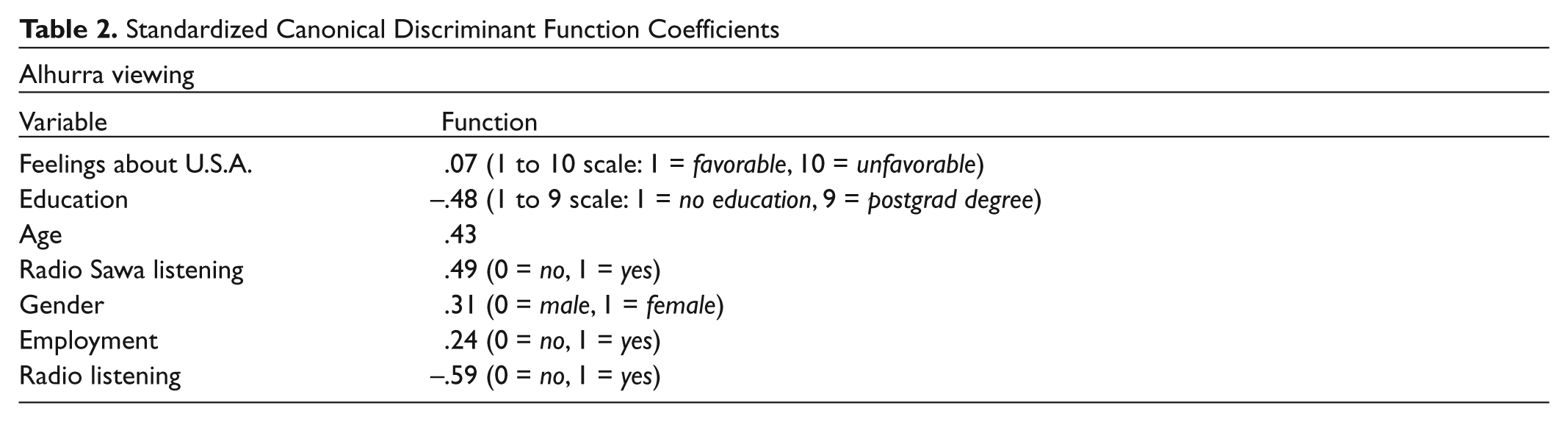
Using this set of independent variables to predict Alhurra viewing, 65.5% of all cases were correctly classified by this analysis.
Discussion and Limitations
This study found the high percentages of Alhurra-viewing classification using the discriminant function suggest that the combination of key cultural indicator variables is a sound predictor of viewing this news source. Thus, this study validates the premise of U.S. policy as it confirms the challenges faced by international broadcasting 70 years ago and today—the role key cultural indicators play when these viewers decide to turn to or away from, in this case Alhurra, for news and other information.
U.S. international broadcasting efforts began 70 years ago with the creation of Voice of America. The challenge back then was to reach two audience groups: those who were friendly toward the United States and those who were antagonistic. The challenge was also to preserve the friendship of one group while attempting to win the hearts and minds of those who had a less favorable view of the United States. The philosophy was that if the truth was presented in a friendly (and culturally sensitive) way, people hostile to the United States might be won over. That effort, with its many challenges, technical and programmatic, continues today through the use of Alhurra. Examining the traditional media use variables (Research Question 2), regular radio listening appears to be a relatively strong predictor of Alhurra viewing or nonviewing. This suggests that Alhurra Television may be considered another media source by this population in the U.A.E.
Listening to Radio Sawa (its radio counterpart) was a strong predictor of Alhurra viewing or nonviewing, suggesting a possible linkage between perceptions of the two media. Radio Sawa listeners who also view Alhurra may be doing so to find a video source to complement the information they hear by radio. Perhaps these viewers need more perspective based on their exposure to Radio Sawa. In this case, an individual’s value judgment of Radio Sawa may prompt Alhurra viewing. This suggests that, in this sense, the two media sources are complementary.
The findings related to the demographic variables examined (Research Question 1) suggest that the in-group identity of the population, as manifested in the age, education, gender, and employment variables, are powerful predictors of viewing or not viewing Alhurra. Although the exact nature of this influence cannot be determined in this study, this study finds that these key cultural indicator variables are core predictors among this younger age group. From a U.S. government programming perspective, these factors should inform Alhurra programming decisions. For example, creators of content on Alhurra should understand that reaching this key younger demographic involves further exploration of the influence of gender, age, and educational levels on viewing.
The results also suggest that feelings toward the United States play little or no role in predicting Alhurra viewing or nonviewing. This suggests that this basic attitude about a major out-group—the U.S. government (Research Question 3)—may not affect whether or not this U.A.E. population either turns to or rejects Alhurra Television. For example, it is possible that the U.A.E. population watches Alhurra even if they disagree with the news presentation. Perhaps viewers watch for reasons of curiosity or to confirm previously held negative beliefs.
Limitations of this study center on a need to understand the audience’s motivations for viewing Alhurra news. Further studies could explore why these viewers watch the programming, even if they dislike the United States or the U.S. source of programming. Qualitative research methods such as focus groups on in-depth interviews would be useful in ascertaining why these media choices are made. In addition, this study only examined a younger demographic in the U.A.E, a nation historically friendlier to the United States than other Arabic nations. Surveys should also be conducted in less friendly nations to confirm the findings of this study. Other limitations of this study include possible audience resistance to simply discussing Alhurra Television and surveying audiences in this region given the prevalence of anti-Americanism in the Arab world (Douai, 2010).
As we look back on the early efforts of the OWI, and on the use of Alhurra today, what is interesting is that this study reveals that the criticism that OWI received back then could apply to U.S. international broadcasting efforts in the present time. In 1943, Joseph Barnes wrote, “The charge is that our propaganda work is too simple, too provincially American, and too deeply committed to using truth as a weapon with which to confuse our enemies and give heart to our friends” (p. 34).
One area of departure from the 1940s is that the United States is now recognizing the need to reach audiences at home in addition to audiences abroad. The U.S. committee on foreign relations is considering revising the Smith–Mundt act and allowing international broadcasters to target audiences within the United States. As the Senate Foreign Relations Committee notes,
Russia and China and other entities currently broadcast in English in the United States. Additionally, recent Arabic speaking immigrants to the United States are able to watch Al Jazeera but prevented by Smith-Mundt from viewing Al Hurra. These realities, coupled with the rise of the Internet, which enables computer users in the U.S. to receive video and audio streams of BBG broadcasts and readily access BBG Web sites, demonstrate that aspects of the legislation are both anachronistic and potentially harmful. (Committee on Foreign Relations, 2010, p. 8)
In 1943, Hawkins and Pettee wrote that “Revolutionary developments in the media have loaded the opinion process with a dynamite which it has never before possessed” (pp. 15-16). The same could be said today about Alhurra. Any effort made by a government to influence public opinion needs to first take into account the audience, and in particular, the specific cultural characteristics of the audience that predict the use of the medium conveying the message. This study reveals that media use and key cultural in-group variables play critical roles in predicting whether the U.A.E. population turns to or away from this U.S.-government-funded television network. It is noteworthy that existing feelings toward the United States were shown to play no role in predicting Alhurra viewing or nonviewing, suggesting that viewers may be drawn by the content of the programming of this outlet and not by the likes or dislikes of the U.S. government. As was the case in 1943, when the OWI realized the importance of reaching these in-groups by incorporating people from these groups into radio programming, the same challenge exists for the U.S. gover-nment today—the need to relate on a cultural level with these populations to convey credible messages through international broadcasting.
Given the findings of this study, further studies should examine the extent to which this programming results in more (or less) favorable views of the United States and its policies. Although Alhurra has made some major inroads in attracting viewers, it remains to be seen if negative attitudes and government policies about the United States will be changed by this initiative and if the 70-year-old challenges of reaching a hostile audience by bridging a cultural divide through international broadcasting will be successful.
Footnotes
Declaration of Conflicting Interests
The author(s) declared no potential conflicts of interest with respect to the research, authorship, and/or publication of this article.
Funding
The author(s) disclosed receipt of the following financial support for the research and/or authorship of this article: The survey was funded in part by a grant from the Public Relations Society of America Foundation.