




Abstract
The study sought to find out whether factors such as parental, peer, and media influences predict Ghanaian adolescent students’ eating habits. A random selection of 150 students from a population of senior high school students in Ghana were asked to complete the Eating Habits Questionnaire for Adolescents. Data were analyzed by the use of bivariate correlation, t test, and multiple regression analytical techniques using SPSS version 16. The findings revealed a significant positive relationship between peer influence and eating habits suggesting that the higher the peer pressure, the more unhealthy the students’ eating habits. Counterintuitively, parental and media influences did not significantly correlate with students’ eating habits. Gender difference in eating habits suggested that girls had more unhealthy eating habits than boys. Finally, multiple regression analysis revealed that peer influence was a better predictor of students’ eating habits than parental and media influences. The findings were discussed and recommendations were given in light of the study’s limitations.
Introduction
Good nutrition plays a major role in the prevention of several chronic diseases, including obesity, coronary heart disease, stroke, type 2 diabetes, and certain types of cancers. For this reason, nutrition is a priority area for humans (U.S. Department of Health and Human Services [U.S. DHHS], Public Health Service, 2000). In view of that, Demory-Luce and Jensen (2009) explained that to help prevent diet-related chronic diseases, researchers have proposed that healthy eating behaviors should be established in childhood and maintained during adolescence.
The same authors further reported that national and population-based surveys have found that adolescents often fail to meet dietary recommendations for overall nutritional status and for specific nutrient intakes and that many adolescents receive a higher proportion of energy from fat and/or added sugar and have a lower intake of a vitamin A, folic acid, fiber, iron, calcium, and zinc than is recommended. The low intake of iron and calcium among adolescent girls is of particular concern. Iron deficiency can impair cognitive function and physical performance, and inadequate calcium intake may increase fracture risk during adolescence and the risk of developing osteoporosis in later life (Demory-Luce & Jensen, 2009). These may have occurred sometimes due to the factors that influence their eating habits. Demory-Luce and Jensen (2009) noted this by stating that the dramatic increase in energy and nutrient requirements coincides with other factors that may affect adolescents’ food choices and nutrient intake and thus nutritional status.
In Ghana, for instance, some rural and urban areas due to traditional beliefs abhor certain food items; which in a way may have caused certain alterations in the eating habits of adolescents and consequently their nutritional intake.
Nutritional needs during adolescence are increased because of the increased growth rate and changes in body composition associated with puberty but nutritional intake by adolescents is interrupted by a myriad of factors. Rea (2007) posited that being aware of the factors that influence what and how much one eats can help you make informed eating choices. These factors, including the quest for independence and acceptance by peers, increased mobility, greater time spent at school and/or work activities, preoccupation with self-image, routine, marketing, cultural and social issues, high availability of foods, parental influence, gender, self-concept, and personality contribute to the erratic and unhealthy eating behaviors that are common during adolescence (Bester & Schnell, 2004; Demory-Luce & Jensen, 2009; Rea, 2007). A search through literature reveals that these factors are of great influence on the adolescents, and preventive measures such as education of parents as to what their children eat from the onset and also education of these children in school through their teachers and guidance and counseling coordinators are being implemented in various countries. Nevertheless, the problems still exist. The quest for solutions to these problems is the reason why the researchers investigated into the factors that influence adolescents’ eating habits in the Central Region of Ghana.
The study therefore sought to enable nutritionists and dietitians better appreciate the relationship between eating habits of students and the roles parents, peers, and the media play. The study also provides information about the differences that exist between the eating habits of adolescent boys and girls. It provides information that will again enable the stakeholders be aware of the factors that predict the eating habits of students the most. Finally, the study serves as literature in nutrition and the education sector.
In view of that, the following hypotheses were made:
Hypothesis 1: There will be a significant relationship between eating habits of adolescent students and the factors of parents, peers, and media.
Hypothesis 2: Parents, peers, and media will predict the eating habits of adolescent students.
Hypothesis 3: There will be a significant difference in the eating habits of adolescent boys and girls.
Literature Review
Eating Habits in Adolescents
According to Rodriguez (2009) eating habits refers to why and how people eat, which foods they eat, and with whom they eat, as well as the ways people obtain, store, use, and discard food. Everybody eats to survive. People eat according to learned behaviors regarding etiquette, meal and snack patterns, acceptable foods, food combinations, and portion sizes.
According to the authors, the components of a meal vary across cultures, but generally include grains, such as rice; meat or a meat substitute, such as fish; or beans and accompaniments, such as vegetables. Various food guides provide suggestions on foods to eat, portion sizes, and daily intake. However, personal preferences, habits, family customs, social setting, and other factors largely determine what a person consumes.
Eating habits are generally formed right from childhood through to the adolescent years (Speck, Bradley, Harrell, & Belyea, 2001). The period of adolescence is very crucial, involving a variety of physiological and psychological changes that usually affect dietary needs and eating habits (Moreno et al., 2007). Hence they tend to have particular food choices and eating habits compared with younger children and adults (Alexy, Sichert-Hellert, & Kersting, 2002; Hoglund, Samuelson, & Mark, 1998).
Factors That Influence Eating Habits
Parents are a major influence in the lives of their adolescent children. The ways in which parents consume food will influence their children (H. Koivisto, 1999; U. K. Koivisto, Fellenius, & Sjödén, 1994; Michela & Contento, 1986). If the parents do not eat fruit, for example, then the children will be unlikely to do so. This assertion is further emphasized by Videon and Manning (2003), on studying the determinants of fruits, vegetables, and dairy products consumption among adolescents in the United States. They concluded that the presence of parents during evening meals associated positively with increased consumption of fruits, vegetables, and dairy products. Nevertheless, Wood-Wright (2009) in an examination of dietary intakes and patterns among U.S. families found that the resemblance between children and their parents’ eating habits is weak and that factors other than family and parental eating behaviors may play an important role in affecting children’s dietary intakes.
In a research done by Luepker et al. (1996), older children whom the juniors looked up to had a positive influence on their junior peers’ behaviors including what they eat. Experienced counselors and school and preschool teachers often use this approach informally by identifying which child is an “opinion leader” and then recruiting him or her to influence the other children’s behaviors.
Presently, the media is a very brute and powerful force and can influence the lives of many in a very quick manner. Television has several roles in many families: It can be a useful child minder, a source of constant stimulation, an escape into fantasy, and/or a source of information about people and the outside world (Salmon, Timperio, Telford, Carver, & Crawford, 2005). Television and the mass media, which most of us are highly dependent on, play important roles in the postmodern society. Australian children are exposed to more television food advertising than probably children of every other nationality (Salmon et al., 2005). They showed that 80% of food advertising in children’s viewing hours is for confectionery and foods and beverages that contain large amounts of fat, sugar, and salt. Long hours of exposure to television programs were also associated with increased risk of obesity in children. Current guidelines suggest that children should spend no more than 2 hr per day viewing all electronic entertainment media (American Academy of Pediatrics, 2001; Australian College of Paediatrics, 1994)
We may eat foods because we were brought up eating them and find them comforting. Rea (2007) reported that some people eat, or do not eat, certain foods based on religious, political, or social beliefs. These factors are also reflected in the food choices parents make for their children.
With regard to gender, it appears that adolescent girls do experience more stress than their male counterparts due to the physical and physiological changes and are at a greater risk of developing unhealthy eating habits (Bester & Schnell, 2004). Furthermore, Thomsen, Weber, and Brown (2002) reported that girls are more affected by the media. They read fashion magazines that influence their decision to restrict calories or take diet pills. Bester and Schnell (2004), who cites Keel, Fulkerson, and Leon (1996), found that girls have more unhealthy eating habits than boys and they spend more time dieting than boys. This is consistent with the study from McCabe and Ricciardelli (2001) who found that the most frequent method adopted by boys to change their body is exercise rather than changing eating patterns as girls do.
Method
A cross-sectional survey design was adopted for the study. Participants for the study were adolescent students from three senior high schools in the Central Region of Ghana. Simple random sampling was adopted in selecting 50 students from each of the three schools who responded to self-structured and closed-ended questionnaires adopted from Bester and Schnell (2004) Eating Habits Questionnaire for Adolescents (EHQA). The psychometric properties were as follows:
As can be seen in Table 1, eating habits has a reliability coefficient of .65 for five items, media has a reliability coefficient of .70 for eight items, parents have a reliability coefficient of .73 with five items, and peer influence, .68 with five items.
Reliability Statistics

With regard to data collection, permission was sought from school authorities, and students were made to respond to the questions independently. Bivariate correlation with the use of SPSS version 16 was used to analyze the first hypothesis, multiple regression for hypothesis 2 and t-test to answer hypothesis 3.
Results
Table 2 shows the demographic information of the students. In all, 150 students were sampled for the study. Majority of the students (52.7%) were boys. Also 70.6% of them were found to be between the ages of 18 and 20 years. The students were also grouped according to their years in school. Those in the 1st year (Form 1) were found to be about 32.7%, the 2nd years (Form 2) 29.3%, and the 3rd years (Form 3) 38%.
Demographic Information of Students (N = 150)

Hypothesis 1: There will be a significant relationship between predictors and eating habits
A two-tailed hypothesis that there will be a significant relationship between predictors and eating habits was statistically tested using the Pearson’s correlational method. As shown in Table 3, the test revealed that there was a highly statistically significant positive correlation between peer influence and eating habits (r = .214; p < .01). This result is consistent with the study hypothesis by suggesting that the more an adolescent is influenced by peers and friends, the more unhealthy will be the adolescent’s eating habits. Similarly, the hypothesis that there will be a significant relationship between media and parental influence and eating habits was also tested using Pearson’s correlational method. As indicated in table 3, media (r = .016, p > .05) and parental influence (r = .094, p > .05) were not significant. This does not confirm the hypothesis. Therefore, the null hypothesis that there is no significant relationship between media and parental influence with eating habits is accepted.
A Bivariate Correlation Between Predictors and Eating Habits (N = 150)
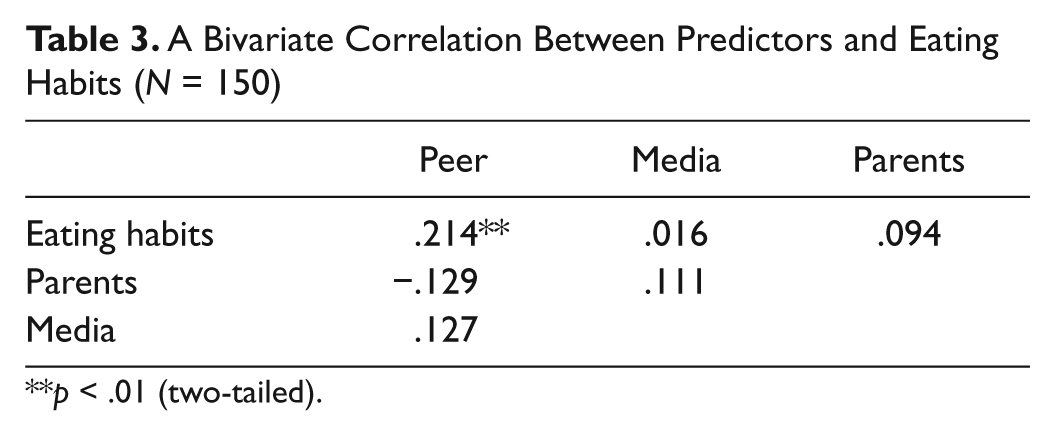
p < .01 (two-tailed).
Hypothesis 2: Parents, peer, and media will predict eating habits of adolescent students
Regression analysis using the forced entry method was performed using SPSS to assess the contribution of media, parent, and peer influence in the prediction of the extent to which adolescents have unhealthy eating habits. Table 4 displays unstandardized (β) regression coefficients, the multiple correlation coefficients (R) adjusted, and the value of t and its associated p value for each variable that was entered into the equation. As shown in Table 4, media, parents, and peer collectively explained 5% (adjusted = .05) of the variance in eating habits. Based on the order of entry chosen for the present sample, it would appear that peer explained the bulk of the variance in eating habits (β = −.210, t = −2.565, p < .05) and was the best predictor of eating habits among the adolescents. As can be seen in Table 4, the contributions of media and parents to the variance in eating habits was not statistically significant at .05 level, that is, media (β = .036, t = .442, sig. = .659, p > .05) and parent (β = .063, t = .768, sig. = .444, p > .05). In summary, it would appear that peer emerged as the single best predictor of eating habits among adolescents.
Forced Entry Regression of Eating Habits on Parental, Peer, and Media Influence

Hypothesis 3: Female adolescents have unhealthy eating habits than their male counterparts
Table 5 presents the hypothesis that female adolescents have unhealthy habits than their male counterparts. As can be seen in Table 5, the mean score for the females was more (M = 2.7712) than that of the males (M = 2.4402). To test whether there was a significant difference, independent-samples t test for the two independent groups were used. The results from Table 5 show that there was a significant difference between the female and male adolescents (t = −2.618, sig. = .010, p < .05). Therefore, the hypothesis that suggests that female adolescents have unhealthy eating habits compared with their male counterparts is confirmed because a higher score on the scale of eating habits implies unhealthy eating habits.
Independent-Samples t Test of Sex and Eating Habit

Note: Sig. = significant
Discussion, Recommendations, and Conclusion
The only factor that had a relationship with eating habits was peer influence. It appears that peer influence in the life of the adolescent students should be taken into account when dealing with eating habits. The confirmation was brought about from the highly significant positive relationship between peer influence and eating habits (r = .214, p < .01). As stated earlier, too much of peer influence can result in unhealthy eating habits.
To ascertain whether these factors can predict the eating habits of the students, multiple regression showed that peer influence predicted the eating habits of the adolescent students the most and was significant. This could be the result of adolescent students spending most of their time both in school and at home with peers. At school, they gather with friends and end up choosing the same kind of food to eat during break time as well as their leisure time. At home, often parents are at work and so the adolescent spends almost the whole day with friends. This result is therefore in accordance with Luepker et al. (1996). Similarly, the peers of adolescents tend to impact a lot of influence in the general behavior of the adolescents, mainly because of the enormous time they spend with their friends (Story, Lytle, Birnbaum, & Perry, 2002). This amount of time spent with friends can be duly used as a tool to encourage healthy eating among adolescents. Taking advantage of the influence of peers is feasible when used effectively. This was demonstrated by Story et al. (2002). Their study capitalized on the concept of adolescents finding independence, self-recognition, identity, and being accepted as part of a group of friends as a way of improving their eating habits through nutrition education. They further stated that “peer pressure” can be used potentially to influence the adolescent’s social behavior. On the contrary, some other studies failed to observe a clear link between peer influence and adolescents’ eating habits. French et al. (1999) observed that the influence of peers was the least crucial motivation for adolescents’ selection of snacks.
The significant difference between the adolescent boys and girls as far as eating habits were concerned was much to be desired. Similar results from Bester and Schnell (2004) and McCabe and Ricciardelli (2001) concluded that girls appear to have unhealthier eating habits than boys. A probable reason may be that during the adolescent stage, girls experience more physical and physiological changes and must be thin to be accepted by both sexes (Bester & Schnell, 2004, cites Nichter & Vuckovic, 1994). It may also be that girls are more affected by the media through watching and reading fashionable books to restrict their way of eating compared with boys who use exercise most (Thomsen et al., 2002).
It would be recommended that adolescents are guided on healthy eating habits with the assistance of guidance coordinators in their schools, parents, teachers, and dieticians.
Peers being a great influence in the life of the adolescent as far as eating habits is concerned should require a lot of concern from parents. It therefore behooves on parents to provide the needed information in this regard. If they are unsure, a dietician can help by planning meals and structure the eating habits of the family and the adolescent.
Counselors, teachers as well as parents should encourage and assist adolescents, particularly girls, to obtain appropriate information on healthy eating. Educational programs should also be organized to promote eating well.
Nutritious food such as vegetables and fruits should be made available in school and at home to be eaten as snacks by adolescents instead of having sweets and soft drinks.
In conclusion, the study purposed to investigate whether parents, peers, and the media predict the eating habits of the adolescent students. According to the results, peers negatively and significantly correlated with eating habits and also were the only predictor of eating habits. Only 5% of the variance of a predictor in eating habit implies that there is 95% variance, which remains unexplained. Therefore, there may be other internal and again external factors that may result in the 95%. Internal factors such as intelligence, self-concept, gender, age, and personality of the individual could be researched upon to determine their level of influence regarding adolescents’ eating habits. Also, external factors such as time spent in school, advertising, cultural values pertaining to food, socioeconomic status, family, and availability of food could be worked upon to enable researchers know the real predictors of the eating habits of the adolescents. It is recommended that future research should include these to obtain a better understanding of the adolescents’ eating habits. In addition, an expanded work can be done using qualitative tools such as focus group discussions to collate views from adolescents regarding what could account for the other influences on their dietary habits.
Footnotes
Declaration of Conflicting Interests
The author(s) declared no potential conflicts of interest with respect to the research, authorship, and/or publication of this article.
Funding
The author(s) received no financial support for the research and/or authorship of this article.