




Abstract
The purpose of this study was to examine issues related to female representation within the governance structure of the National Collegiate Athletic Association (NCAA). A descriptive statistics approach through the lens of feminism was taken in collecting and analyzing data related to the gender representation of staff leadership positions within the NCAA national office and gender representation within the NCAA Division I, II, and III governance structure. This was coupled with a review of NCAA programming initiatives related to leadership opportunities. Although a number of strategies are being implemented by the NCAA to provide greater access and leadership opportunities for women (e.g., diversity initiatives, Senior Woman Administrator legislation, and guaranteed representation on committees), women continue to be underrepresented within NCAA governance substructures and upper leadership levels within the NCAA national office. In addition, nongender neutral sport governance policies still exist that impede the progress of achieving gender equality.
Introduction
In 2006, at the International Working Group on Women in Sport Conference, Carolyn Hannan, the director of the Division for the Advancement for Women from the United Nations gave an opening keynote speech on “Challenging the Gender Order” in sport. Her remarks included the need to focus greater attention on addressing the gender inequities in sport that still exist. This includes conducting a more thorough analysis of gender issues in sport to sufficiently address the underrepresentation of women in decision-making roles in all areas and at all levels, addressing discriminatory practices, and holding decision makers accountable. She shared key lessons learned in promoting gender equality, good practices identified in challenging the gender order, and ideas on empowerment of women in policy areas. Hannan’s speech essentially challenges researchers and decision makers from all regions of the world to do more to address and resolve gender inequities within sport governance organizations.
As the predominant intercollegiate sport governance organization in the United States, the National Collegiate Athletic Association (NCAA) is ripe for an analysis of gender issues in sport governance. Although the NCAA revenue stream is at an all-time high (US$750 million annual budget; NCAA, 2011c), the percentage of women in NCAA athletics leadership positions is still very low at less than 20% (Acosta & Carpenter, 2010). To achieve greater equality, it is important to gain insight into the operations of this sport governance organization with the purpose of identifying gender-equity issues, as well as ideas and solutions for today’s and tomorrow’s decision makers.
It is important to review historical information on the NCAA/the Association for Intercollegiate Athletics for Women (AIAW) merger and federal civil rights laws on educational access and employment opportunities to better understand current issues related to women in collegiate sport leadership. In addition, a brief overview of the current NCAA governance structure, the NCAA national office staffing structure, and the NCAA policy manual is included as background information to establish a solid foundation from which to review gender-equity issues in NCAA sport governance. Also, a review of previous literature on barriers affecting women in sport and strategies for change is provided.
Although research exists on women as athletes, athletics directors, and coaches, there is little research available regarding women in NCAA sport governance. To fill the gap in the literature, this current study focuses on gender composition of NCAA governance entities (committees, councils) and type of roles assigned in NCAA Divisions I, II, and III. It also examines the role of women within the NCAA national office staff, as these are the individuals who support the governance structure. In addition, NCAA policies, programs, and initiatives are critically examined to reflect whether the NCAA is meeting its obligation to foster an inclusive culture and promote career opportunities.
The collection, analysis, and disclosure of baseline data regarding women’s representation within the NCAA governance system and NCAA national office leadership are designed to add to the body of knowledge on gender-equity issues with an eye toward identifying strategies to address inequities. The analysis and gender-equity recommendations may be of use to the NCAA as well as researchers and leaders of other sport governance organizations worldwide who strive to provide gender equality in sport governance.
Background Information
A Historical Perspective— The Merging of the NCAA and AIAW
The NCAA was formed in the early 1900s because of concerns about serious injuries in the sport of football, and it began offering national championships for men’s collegiate sport teams in 1921 (Crowley, 2006; NCAA, 2011e). The AIAW was formed in 1971 to host national championships for women. At its peak, the AIAW offered 41 championships for intercollegiate women across three competitive divisions in 19 different sports (Wushanley, 2004). After women’s sports garnered their first television contract, the NCAA membership orchestrated a hostile takeover of the AIAW by voting at the 1981 Convention to offer NCAA women’s championships, which essentially put the AIAW out of business in 1983 (Suggs, 2005; Wushanley, 2004). Owing to this “merger,” opportunities for women dramatically decreased, both in the number of championship sports offered for female participants by the NCAA and in the number of women who retained administrative leadership positions (Grappendorf & Lough, 2006).
A Historical Perspective—Title IX, Title VII, and Women’s Leadership Numbers
Federal laws in the United States (Title IX and Title VII) require equal access and opportunity for women in education and employment. Although the percentage of women as collegiate student-athletes has increased substantially (Yiamouyiannis, in press), the same is not true for women in collegiate sport leadership positions. Before Title IX was adopted (pre-1972), more than 90% of head athletics administrators of women’s programs were female; however, within a few years after Title IX’s enactment, “about 85% of the athletic administrators were men who had control over both the men’s and women’s programs” (Acosta & Carpenter, 1992). Today, only 19.3% of collegiate athletics directors are women, with the fewest female athletic directors (9.0%) at the prominent Division I level and the highest percentage of female athletic directors at the lowest division (29% at the Division III level; Acosta & Carpenter, 2010). The percentage of female coaches of women’s teams also declined after the passage of Title IX, from 90% in 1972 to only 40% of females coaching women’s teams in 2010, with little change in the percentage of women coaching men’s programs (less than 3%; Acosta & Carpenter, 2010).
Background Information on the NCAA and Its Governance System
The NCAA comprises more than 1,000 collegiate institutions categorized into three divisions: Divisions I, II, and III. The NCAA’s stated core purpose is “to govern [sport] competition in a fair, safe, equitable and sportsmanlike manner, and to integrate intercollegiate athletics into higher education so that the educational experience of the student-athlete is paramount” (NCAA, 2011a, p. 1).
Of the 1,062 NCAA collegiate institutions, 350 are classified in Division I, 209 in Division II, and 350 in Division III (U.S. Department of Education, 2010). Within Division I, the three subdivisions include Football Bowl Subdivision (formerly I-A), Football Championship Subdivision (formerly I-AA), and I-AAA (no football). The NCAA is a voluntary membership association, meaning that the schools are the members of the organization, and representatives from the member schools and affiliated conferences are responsible for regulation of the association.
The NCAA publishes three manuals (legislative policy rulebooks) annually for the three federated divisions. The manual is the comprehensive governing document for all NCAA member institutions and includes all legislation that members are expected to comply with as a condition of membership (NCAA, 2011b). The NCAA Constitution, Articles 1 through 3, is identical for all three divisions. The remainder of the manual contains additional legislative provisions that are also identical for all three divisions as well as division-specific regulations (e.g., rules on eligibility, recruiting, playing seasons, personnel, and financial aid) that are unique to each division. The membership must approve any changes to NCAA legislation or playing rules through processes identified in the NCAA constitution. The membership is also directly responsible for many other functions, such as the selection of teams for championships and the determination of rules infractions, and administering penalties (NCAA, 2011e).
The NCAA national office headquarters is based in Indianapolis, Indiana, under the leadership of President Mark Emmert. The national office is divided into seven major units. The senior management group includes the President, Chief Policy Advisor, General Counsel, Chief Operations Officer, and Vice Presidents of Communications, Membership and Student-Athlete Affairs, and Championships and Alliances. The other major units are Membership and Student-Athlete Affairs, Enforcement, Communications, Finance and Operations, Championships, and Administrative Services. The role of the NCAA staff is primarily to assist the member institutions in the administration of college athletics, including the development, interpretation, and enforcement of the rules. Contrary to the popular media-prompted perception, the national office does not dictate NCAA rules. The national office also is responsible for the general promotion of intercollegiate athletics and the NCAA brand (NCAA, 2011e).
Previous Research on Gender-Equity Issues in Intercollegiate Athletics
Most of the previous research on gender-equity issues in intercollegiate athletics has centered on tracking the number of women in athletics, identifying both workplace barriers and personal barriers, as well as identifying strategies to address perceived barriers. Acosta and Carpenter (2010) have conducted a 33-year longitudinal study on women in intercollegiate athletics as female sport participants, administrators, coaches, and officials. The NCAA (2010) has also tracked the number of female sport participants, as well as women in leadership positions at collegiate institutions as coaches and administrators for the last several decades. Lapchick (2010) and his staff periodically analyze NCAA data for use in developing racial and gender reports to indicate areas of improvement, stagnation, and regression in the racial and gender composition of intercollegiate athletics personnel (e.g., 2009 Racial and Gender Report Card: College Sport).
In regard to identifying workplace barriers that impede women’s access and progress, researchers have identified issues related to the hiring process, a chilly work environment, pay inequities, and situations of homophobia and sexual harassment (Bruening & Dixon, 2008; Burton, Grappendorf, & Henderson, 2011; Dixon & Sagas, 2007; Greenhill, Auld, Cuskelly, & Hooper, 2009; Inglis, Danylchuk, & Pastore, 1996, 2000; Kane, 2001; NCAA, 2009; Stangl & Kane, 1991; Yiamouyiannis, 2008). Researchers have also identified a number of personal barriers that include interest level, qualifications, work/home conflicts, and burnout (Acosta & Carpenter, 1988; Cunningham, 2008; Grappendorf & Lough, 2006; NCAA, 2009; Yiamouyiannis, 2008).
Recommended strategies to address barriers include the following: implementing gender neutral hiring policies, offering additional training/education, assisting with time management/support, and offering additional mentoring/networking opportunities (Inglis et al., 1996; Kilty, 2006; Lough, 2001; NCAA, 2009; Sisley, 1990; Weaver & Chelladurai, 2002; Yiamouyiannis, 2008). From an organizational perspective, frameworks to conceptualize organizational diversity and to manage diverse organizations have also been developed (Chelladurai, 2009; Cunningham, 2011; DeSensi, 1995; Doherty & Chelladurai, 1999; Doherty, Fink, Inglis, & Pastore, 2010; Shaw & Frisby, 2006; Skirstad, 2009).
Researchers who study gender inequities in society and sport typically use a critical theory perspective through the lens of feminism (Bourque, 2001; Cadenhead, 2004; Coakley, 2004; Cunningham, 2011; Kane, 2001; Talbot, 2002). Specifically, as it relates to employment issues, Kanter’s sex segregation theory (1977) from business research (focusing on power, opportunity, and numbers) and Witz’s (1991, 1992) model of occupational closure (from medical profession research relating to exclusionary tactics employed by the dominant group and inclusionary strategies employed by the subordinate group) have been used to examine issues related to the low representation of women in sport leadership positions (Shaw & Frisby, 2006; Sibson, 2010; Yiamouyiannis, 2008).
Less common is the use of sex-role theory or a gender-difference approach. The sex-role theory and gender-difference approach have received criticism by some researchers (Hall, 2002; Knoppers, 1989) for reinforcing existing stereotypes, such as placing blame on the underrepresented population for lack of interest, when the impact of structural and societal barriers have not fully been taken into account. This approach (use of role congruity theory) in studying the underrepresentation of women is now more commonly used to explain situations of prejudice or discrimination (Burton et al., 2011; Eagly & Karau, 2002).
Based on Kane’s (2001) analysis of research related to the low representation of women in leadership, “what has happened to women with respect to leadership roles [within intercollegiate athletics] has very little to do with logic, or women’s qualifications, and everything to do with power” (p. 118). Kane suggests that what becomes key to an analysis of gender and leadership in this “post-Title IX world order” is to examine issues related to power, including issues related to the struggles of the dominant group to retain its position and the subordinate group’s attempt to challenge this position. The need to focus on issues related to power has also been identified by other researchers over the years (Aitchison, 2005; Lovett & Lowry, 1995; McDonald & Birrell, 1999).
Yiamouyiannis and Ridpath (2009) illustrate this power play (inclusionary and exclusionary strategies) in intercollegiate athletics. The researchers conducted a critical analysis of the 2008-2009 NCAA Division I manual and identified the presence of NCAA legislation designed to support gender-equity initiatives (inclusionary strategies) as well as structural elements that impede progress (exclusionary strategies). NCAA legislation that supports the association’s principle of achieving gender equity includes the Senior Woman Administrator (SWA) designation, emerging sports legislation, and gender quotas for sport governance representation. However, the Division I “male model of sport governance,” which is centered around the sport of football, was identified as impeding women’s ability to achieve gender equality (Yiamouyiannis & Ridpath, 2009).
In reviewing the NCAA policy manual, NCAA Constitution 2.3 (the principle of gender equity) indicates that the activities of the NCAA are to be conducted in a manner free of gender bias, that each member college is to comply with federal and state laws regarding gender equity, and that the association should adopt legislation to enhance member institution compliance with applicable gender-equity laws (NCAA, 2011d). The NCAA Constitution, Article 4, establishes specific gender and diversity requirements for the governing units (e.g., the floor for gender is set at 35% for the combined membership of Division I councils and cabinets).
As mentioned by Hannan (2006), a more thorough analysis addressing the underrepresentation of women in decision-making roles in all areas and at all levels is needed. In this regard, because there is so little research available on women’s role in sport governance at the collegiate level, this study was conducted to help fill that gap. Specifically, it assesses gender representation within the NCAA governance structure, gender representation within the NCAA national office staff, and the impact of NCAA programs designed to achieve gender equity.
Method
In regard to philosophical assumptions, the knowledge claim position used is a pragmatic advocacy approach (Creswell, 2003) in which the search for knowledge uses the lens of the underrepresented group to address problems of inequity and to identify solutions (Hall, 2002; Lather, 1991; McDonald & Birrell, 1999). As summarized by Yiamouyiannis (2008),
the advocacy approach arose during the 1980s and 1990s from individuals who felt that both the positivist assumptions and the constructivist approaches were inadequate to address the needs of marginalized individuals. It was their belief that the structural laws and theories of positivists did not adequately address issues of social justice of marginalized people, and the constructivist stance did not go far enough in advocating for an action agenda and change. (p. 63)
The works of Marx, Adorno, Habermas, Freire, Fay, Heron, and Reason, and more recently Kemmis and Wilkinson have been used to support this viewpoint (Creswell, 2003).
Advocacy researchers focus on social issues of concern, and unlike strict empirical studies that take a neutral stance toward research, the advocacy stance is one where inquiry is “intertwined with politics and a political agenda” (Creswell, 2003, p. 9). A part of this research approach is to acknowledge upfront that the research is being conducted with an eye toward change and/or reform. The theoretical perspective taken involves addressing aspects of sports organizations that may appear to disadvantage women (Thompson, 2002). Specifically, a leftist feminist approach is taken that focuses on the need to go beyond working within the structure by placing emphasis on “the need to transform educational and societal institutions” (Perreault, 1993, p. 4).
The strategy of inquiry used is a mixed method approach using transformative procedures. Transformative procedures involve the use of a “theoretical lens as an over- arching perspective within a design that contains both qualitative and quantitative elements” (Creswell, 2003, p. 13). For purposes of this study, a concurrent approach was used in examining and analyzing quantitative data (NCAA statistics on gender representation of women in NCAA governance and NCAA national office leadership) as well as qualitative data (NCAA programs and services dedicated to achieving gender equity).
The NCAA data on gender representation (and minority representation) in national office leadership and NCAA governance were requested and obtained directly from the NCAA national office staff. The NCAA Human Resources staff compiled the NCAA gender/minority representation in NCAA leadership data and furnished a report in May of 2011. The Human Resources staff defines NCAA national staff leadership as staff members who hold the title of director, managing director, or above.
The NCAA governance staff also furnished a May 2011 report on NCAA committee representation, which included gender and ethnic representation for Divisions I, II, and III. The NCAA governance structure is included in Figure 1. The gender representation for members of the executive board, the presidents council/board of directors, the councils (management, leadership, legislative), as well as committees (division-specific and association-wide committees) are provided in the results section.

NCAA Governance Chart (based on 2010-2011 NCAA manual)
For purposes of this study, the term representativeness is operationally defined at 43%, which is an expectation for an equal percentage of female athletics administrators as compared with the percentage of female athletes participating in intercollegiate athletics. This definition is consistent with the frameworks established in previous research conducted by the Institute for Diversity and Ethics in Sport and the Laboratory for Diversity in Sport.
The information on NCAA programs and services was obtained through the NCAA website, www.ncaa.org. The descriptions of programs offered were examined to identify which programs provided leadership or professional development opportunities that benefit women. Of those programs that included leadership or professional development, the program descriptions were analyzed to identify the target population and type of programming offered.
Results
NCAA National Office Leadership
Information obtained from the NCAA Human Resource staff was compiled and appears in Table 1. The NCAA leadership as of May 2011 consisted of the executive leadership group, managing directors, and directors. The executive leadership includes the president, 3 executive vice presidents, 1 senior vice president, and 12 vice presidents. Female minority representation appeared only at the lowest level of management (the director level).
Gender Composition of National Office Leadership

Note: NCAA = National Collegiate Athletic Association.
NCAA Governance
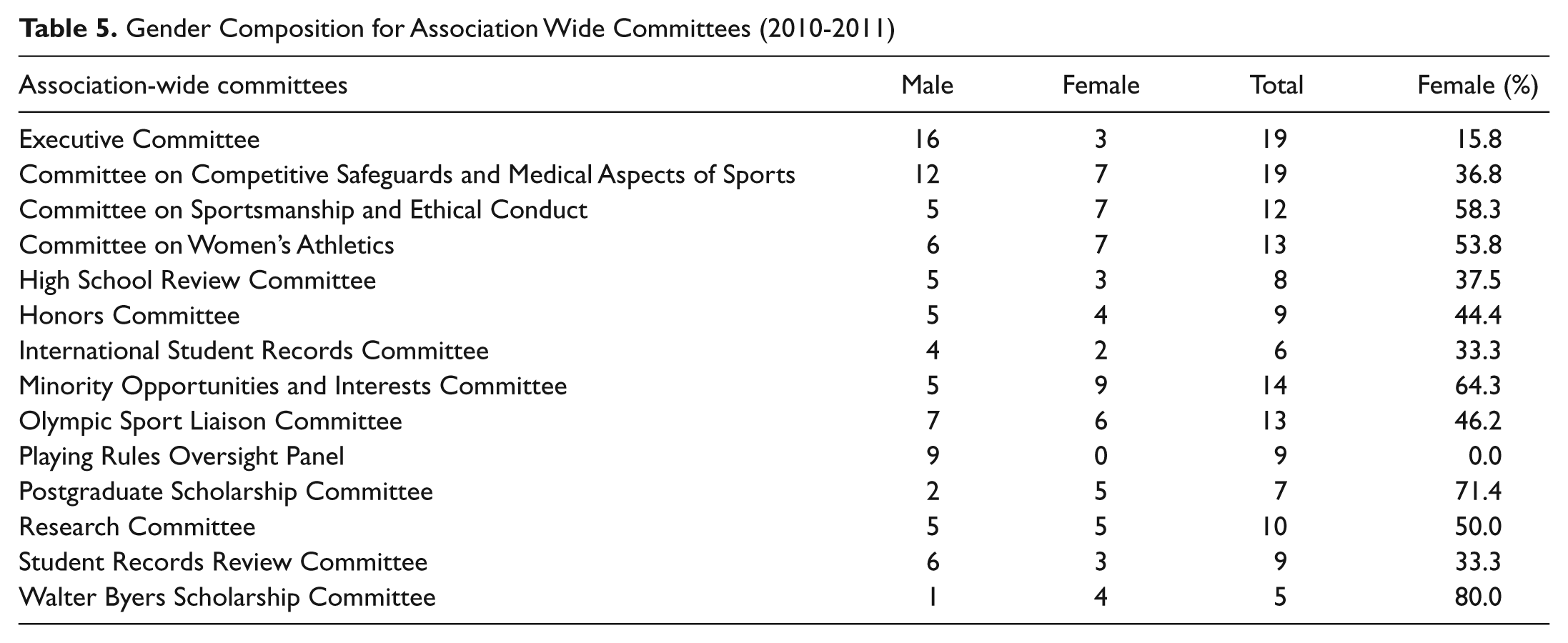
The NCAA’s governance structure consists of an executive committee, Division I, II, and III governance substructures, and a collection of association-wide committees (see Figure 1). The gender representation statistics for the NCAA Executive Committee, Division I, II, and III substructures, as well as association-wide committee representation are included in Tables 2-5.
Gender Composition for Division I Governance (2010-2011)

Gender Composition for Division II Governance (2010-2011)

Gender Composition for Division III Governance (2010-2011)

Gender Composition for Association Wide Committees (2010-2011)
Executive committee
The NCAA Executive Committee is the highest governing body within the association. This group of Division I, II, and III university presidents is responsible for the selection of the association’s president, oversight of the association’s budget, strategic planning, legislative authority, and other responsibilities identified in Figure 1. Based on the May 2011 report, of the 19 individuals serving on the committee, 3 of the individuals were women (15.8%).
Division I governance
The Division I governance substructure consists of a board of directors, two councils (a leadership council and a legislative council), six cabinets, and a number of division-specific committees (see Figure 1). As indicated in Table 2, at the top of the Division I governance substructure, women represent 16.7% of the board of directors. At the second tier within the Division I governance substructure, women represent 25.8% of the leadership council and 54.5% of the legislative council. At the third tier of the Division I governance substructure (within the six Division I cabinets), women’s representation ranges from a low of 31.8% in the Amateurism Cabinet to a high of 56.5% in the Academics Cabinet. At the fourth tier (the committee level), women’s representation on Division I–specific committees ranges from 0% on the Football Issues Committee to 88.2% on the Women’s Basketball Issues Committee.
Division II governance
The Division II governance substructure (see Figure 1) consists of a president’s council, a management council, and a number of division-specific committees. On the Division II president’s council, women represent 33.3% of the members. At the second tier within the Division II management council, women represent 52.5% of the members. At the third tier within Division II, women’s representation on committees ranges from a low of 12.5% on the Planning and Finance Committee to a high of 66.7% on the Legislation Committee. (See Table 3 for additional information.)
Division III governance
The Division III governance substructure (see Figure 1) consists of a president’s council, a management council, and a number of division-specific committees. As indicated in Table 4, on the Division III president’s council, women are 33.3% of the members. At the second tier within the Division II management council, women represent 42.9% of the members. At the third tier within Division II, women’s representation on Division II–specific committees ranges from a low of 12% on the Chancellors/Presidents Advisory Group to a high of 53.8% on the Student-Athlete Advisory Committee.
Association-wide committees
In addition to the executive committee and the Division I, II, and III substructures, there are a number of association-wide committees that exist that are intended to provide cross-divisional input on association-wide issues. Women’s representation on the association-wide committees for 2010-2011 ranged from 0% on the Playing Rules Oversight Panel to 80% on the Walter Byers Scholarship Committee. (See Table 5 for additional details.)
NCAA Programmatic Initiatives
In addition to identifying and examining the representation of women in NCAA governance, this study also examined the NCAA programs and services dedicated to achieving gender equity. To help achieve its stated objective to provide “an inclusive culture that fosters equitable participation for student-athletes and career opportunities for coaches and administrators from diverse backgrounds,” the NCAA provides a myriad of programs and opportunities. Of the 57 association-wide grants, programs, and services offered by the NCAA in the current 2010-2011 academic year, 22 include a stated purpose of leadership or professional development (NCAA, 2011e). Table 6 identifies these programs. These programs come in a variety of forms, with 11 programs focused on providing skills and/or leadership development training, 4 that provide funding for new positions to encourage hiring and skill development, 4 that provide scholarship assistance, and 3 that provide scholarships or funding to attend conferences or leadership development programs. Only 9 of the programs are limited to women, and 1 program is limited to minority women. Only 5 programs are targeted at women and minorities, and 1 is limited to men and women of color. The remaining programs are not gender specific.
2010-2011 NCAA Professional Development Grants, Programs, and Services

Note: NCAA = National Collegiate Athletic Association; NACWAA = National Association for Collegiate Women Athletic Administrators; NADIIIAA = National Association of Division III Athletic Administrators.
Grants, programs, and services that are not gender or minority specific.
Discussion and Conclusion
This study, consistent with the literature review, finds that female leadership representation inequalities exist within virtually all levels of the NCAA (females as coaches, administrators, conference commissioners, representatives on committees, and in upper leadership positions within the NCAA national office staff). This is despite federal law that prohibits sex discrimination in employment and the Principle of Gender Equity in the NCAA Constitution. Legislative initiatives adopted by the NCAA and programming initiatives implemented by the NCAA to further gender-equality efforts may have assisted in achieving the current levels of women’s representation but have not succeeded in achieving equality.
Governance and National Office Leadership
Overall, the higher the level of importance in the governance structure, the lower the percentage of women involved in leadership roles. This phenomenon may be reflective of the perceived differences in male and female leadership ability within sport that has been identified in prior studies (Acosta & Carpenter, 1988; Burton et al., 2011; Cunningham, 2008). Ultimately, the NCAA Executive Committee (and the Division I, II, and III boards/president councils) is the governance entity responsible for ensuring that the NCAA is operating consistent with its fundamental policies and general principles, including its principle of gender equity. With only three women (15.8%) serving on the executive committee, the most powerful governing group within the NCAA, it is not surprising that women have not achieved equity within intercollegiate athletics. Over- or underrepresentation of women on association-wide committees can almost be predicted based on conventional stereotypes about men and women. Women are underrepresented on the committees that determine who plays and how they play: High School Review Committee, International Student Records Committee, Student Records Review Committee, and the Playing Rules Oversight Panel. The Playing Rules Oversight Panel has no female representation, perhaps reflecting a stereotype that men know more about sports. Also consistent with a long-standing stereotype of woman as moral guardian and nurturer, women are overrepresented on the Committee on Sportsmanship and Ethical Conduct and significantly overrepresented on “congratulatory” postgraduate scholarship committees (Postgraduate Scholarship Committee—71.4%, and Walter Byers Committee—80.0%). Women are also overrepresented in committees that reflect special interests such as Minority Opportunities and Interests and the Committee on Women’s Athletics.
In Division I governance, women are underrepresented in almost two thirds of the various councils, cabinets, and committees. At the highest level, there are only 3 women (16.7%) of 18 total members of the board of directors. At the next level, women are significantly underrepresented in the Leadership Council (25.8%) but overrepresented in the Legislative Council (54.5%). This imbalance at the council level is quite interesting. The Leadership Council is a powerful committee that has broad policy and oversight responsibility, making recommendations regarding finances, competition, academics, and championships, suggesting policies, coordinating strategic planning, and advising the board of directors. It also exercises power by overseeing the appointment of cabinet and committee members. Ironically, this council is also charged with making “policy recommendations concerning opportunities for women in athletics at the institutional, conference and national levels, and other issues directly affecting women’s athletics” (NCAA, 2011d, p. 25). The underrepresentation by women on the Leadership Council may be a significant structural barrier to women’s advancement within intercollegiate athletics at the Division I level. Conversely, women are overrepresented on the Legislative Council, which serves as the primary legislative authority. While NCAA rules are certainly important, this council is also charged with developing educational materials for pending legislation and making interpretations of the bylaws. Essentially, the Legislative Council is a housekeeping responsibility that is highly detailed and time-consuming. Applying role congruity theory, overrepresentation of women on this committee is almost expected, as men serve in the more powerful decision making roles whereas women serve in the labor-intensive “housekeeping” positions.
The imbalance of power based on representation of men and women continues at the cabinet level. Cabinets report to the Leadership Council relative to policy issues and to the Legislative Council for legislation-related items. Women are slightly overrepresented on the Administration Cabinet and Academic Cabinet, whereas men dominate the cabinets that manage the “more important” issues such as championships, financial aid, amateurism, and recruiting. Female representation on the committees that report to the various cabinets reinforce not only the lack of representation of women but also the lack of power that women hold within the governance structure. Women are overrepresented on committees that involve housekeeping (athletics certification, initial-eligibility waivers, legislative review, and interpretations) and student involvement (Student-Athlete Advisory Committee). Women are underrepresented on the committees that deal with the most newsworthy issues such as amateurism fact-finding, academic performance, progress toward degree waivers, and student-athlete reinstatement. Arguably, the committee on infractions is one of the most powerful (and feared) committees within the NCAA governance structure; not surprisingly, it has one of the lowest representations of women of all committees (18.2%).
Closer examination of the sport-specific committees yields more interesting observations. At the Division I level, there are three committees that are sport specific: football, men’s basketball, and women’s basketball. The men’s basketball issues committee is one of the most underrepresented by women—only 2 of 14 members (14.3%). The women’s basketball issues committee is equally overrepresented by women, with only 2 of 17 members (11.8%) being men. The football issues committee has 0 women represented. On its face, these numbers may seem to make sense—Men are overseeing men’s sports and women are overseeing women’s sports. However, the importance of football and men’s basketball within the NCAA cannot be overlooked. The men’s basketball tournament drives a majority of the NCAA’s revenue through its media rights. The overall NCAA Division I governance structure is a model built on whether an institution plays football or not, and at what level. Lack of access for women to these two incredibly powerful committees is a substantial, if not insurmountable, barrier for women’s advancement within the leadership of college athletics.
The power imbalance illustrated by the lack of women on men’s sport issues committees becomes more apparent when compared with a committee that is charged with focusing solely on women’s issues—the Committee on Women’s Athletics. If it makes sense for only men to serve on the football issues committee, then why should almost half, 6 of 13 members, of the Committee on Women’s Athletics representatives be men? This finding raises the question of whether the intended purpose is to encourage male involvement in the achieving gender-equity process or whether it serves to illustrate a continuing practice (since the takeover of the AIAW) to co-opt/neutralize the women’s equity movement. In the future, women’s power may become even more marginalized, as the NCAA is considering combining three gender and diversity bodies (the Committee on Women’s Athletics, the Minority Opportunities and Interests Committee, and the Executive Committee’s Subcommittee on Gender and Diversity) into a single entity (Brown, 2010). This anticipated governance change appears to mirror the restructuring changes that recently took place within the national office where the new diversity and inclusion unit combines gender and minority issues under one unit now headed by a male (Bernard Franklin) rather than a female (Charlotte Westerhaus; Brown, 2010).
At the Division II level, female representation within the governance structure is substantially higher than at Division I, although the power imbalance is still apparent. Women are underrepresented on the Presidents Council (33%), and on the important and relatively powerful committees for championships and infractions appeals. Most alarming is the representation by just one woman on the important Planning and Finance Committee. As was alluded to earlier, money is power within the NCAA governance structure, and a lack of representation on committees that oversee money is a substantial barrier to women’s advancement.
Representation of women is slightly more balanced at the Division III level than at the other two divisions. At the highest level in Division III, the Presidents Council, women were underrepresented at 33.3%. The pattern of underrepresentation in the most powerful committees continued in Division III, with only 3 women out of 25 members (12%) on the Chancellors/Presidents Advisory Group, 37.5% for the Championships Committee, 25% for the Strategic Planning and Finance Committee, and 33.3% for the Student-Athlete Reinstatement Committee. The Interpretations and Legislative Committee was also underrepresented at 37.5% women, which contrast with the overrepresentation of women on those committees at Divisions I and II. However, Division III was actually overrepresented in some committees that have relative importance: Financial Aid (50%), Infractions Appeals (50%), and the Nominating Committee (50%). The other two committees that women were overrepresented could be expected—Membership (50%) and Student-Athlete Advisory (53.8%)—as these committees would be more nurturing in nature and consistent with skills identified as feminine. Although the improvement in women’s representation at the Division III level is noted, the relative lack of power for Division III in the NCAA governance structure overall still indicates barriers for women’s advancement in leadership positions within college athletics. It may be easier for women to access positions and gain experience at this level, but few individuals are able to advance from Division III to the positions of power within Division I.
Within the NCAA national office, power imbalance is also apparent. At the NCAA executive level, women represent only 23.5% of the leadership. Representation of women at the managing director level drops significantly to only 16.7%. However, at the lowest level of leadership within the national office, women comprise almost half (47.3%) of the directors. This may reflect a conscious attempt by the NCAA leadership to put a diverse face on the most visible leaders within the national office, while maintaining a work environment that overrepresents women at the worker-bee level.
Programs
The majority of NCAA-sponsored programs focus on personal agency, putting the onus on the individual to acquire knowledge and skills that qualify her for leadership positions. This emphasis ignores the potential structural barriers that exist within the organization that continue to prohibit women from advancing despite significant leadership development and career-advancement training. In addition, the researchers were unable to find sufficient evidence that these programs do in fact achieve their stated purpose. The NCAA does, to a much lesser extent, provide some programming that addresses one structural barrier—initial access. Only 4 of the 22 NCAA programs provide funding to create new positions. Focus needs to be directed toward the power imbalance within the NCAA governance structure, and programs are initiated that can eradicate the gender discrimination that is present at every level.
Recommendations
As it relates to strategic initiatives within sport governance organizations, Hannan (2006) recommends setting and working toward target numbers for female involvement as a first step because experience has shown that this works. The NCAA currently uses this approach (e.g., with an overall floor for representation at 35% in Division I councils and cabinets combined). However, 35% is not representative of women’s interests within the NCAA, as female athletes comprise 43% of all participants. The floor should be raised to at least this level. Also, the floor for gender representation at the highest level currently requires only one person of each sex. Unless the power structure of the organization is committed to appropriate gender representation, there is little hope for achieving gender equity within intercollegiate athletics. As such, it is recommended that the minimum number of female representatives on the NCAA Executive Committee be raised to approximately 43%.
Hannan (2006) also reminds us that simply increasing the number of women in organizations is not enough to bring about necessary change in how organizations do business. She mentions, “increasing women’s impact on policy formulation and implementation, through explicitly advancing an agenda for gender equality and promoting the mainstreaming of gender perspectives into policy development is critical” and that “values, norms, rules, procedures, practices, can restrict women’s potential to make real choices and to give explicit attention to gender perspectives” (Hannan, 2006, p. 6). Discriminatory attitudes and practices exist in traditional ways of working in organizations that can discourage women.
In other words, it is not sufficient for sport governance organizations to set and track target goals for female involvement. The NCAA must also look at broader issues related to the policy development process, as well as procedures and practices that serve to either support or impede women’s involvement. This is apparent in the underrepresentation of women in the structures that wield power and the overrepresentation of women in those committees that do not. It is recommended that the NCAA further revise Article 4 within the Constitution to mandate 43% representation of women on every committee, not just a floor for representation within the governance structure as a whole.
In regard to the NCAA policy formation, Yiamouyiannis and Ridpath (2009) reported that the NCAA Division I governance structure is not gender neutral, as NCAA Division I affiliation, conference affiliation, and voting privileges are currently predicated on football affiliation (a men’s only sport team). To work toward eliminating gender bias, it is recommended that the Division I board of directors further explore alternative governance systems that are based on gender neutral outcomes. In addition, as the NCAA is currently undergoing a review of their revenue distribution formula (NCAA, 2011b), a consideration for the allocation of additional dollars is recommended to support and incentivize gender-equity programs and initiatives to help eradicate structural barriers within intercollegiate athletics.
Women’s representation in NCAA governance and representation in NCAA national office staff positions is a work in progress and warrants continued review and attention. In addition, further research to examine issues specific to representation by minorities, particularly female minorities, is needed.
Footnotes
Declaration of Conflicting Interests
The author(s) declared no potential conflicts of interest with respect to the research, authorship, and/or publication of this article.
Funding
The author(s) received no financial support for the research and/or authorship of this article.