




Abstract
Higher education is anticipating vacancies in senior leadership positions over the coming years. Women are likely to be candidates for these openings, as the number of women pursuing doctoral degrees is rising. However, in the present scenario, there is a dearth of women in senior leadership positions in India. With a purpose to identify the factors influencing the decision of women to take up senior leadership positions, a cross-sectional survey was planned in India. Female faculty (n = 136) employed on a tenure basis in state public universities were the respondents. Data were collected using a self-administered questionnaire and focus group discussions. About 48% of the participants expressed that they decline opportunities for administrative positions. The distance to the workplace was found to be a barrier to take up senior leadership positions. Recommendations to promote the readiness of women to take up senior leadership are discussed.
Introduction
Higher education is anticipating many vacancies in senior leadership positions over the coming years (Marshall et al., 2009). Approximately half of the university and college presidents will be approaching retirement within the next 10 years. VanDerLinden (2004) argued that finding well-trained leaders for these positions would be a critical challenge to administrators. In India, with the rising number of women enrolling in doctoral programs, they are the likely candidates for these openings (Banker & Banker, 2017). All India Survey on Higher Education data show that approximately 42% of doctoral recipients were female, demonstrating the increasing interest of women in being educated (Government of India, 2018). However, in the current Indian scenario, women are hardly visible in senior leadership positions in academia, and the majority (66.22%) of women are stagnant at the middle-level leadership positions (Banker & Banker, 2017; Ghara, 2016). Only 6.67% of women were in senior leadership positions, namely, Vice Chancellor, Director, or Dean (Banker & Banker, 2017), in India. It was 15.64% when the positions of Principal, Professor and Equivalent, and Associate Professor were added with the aforementioned positions (Ghara, 2016). Although underrepresentation of women in senior leadership positions in higher education is a global phenomenon (Banker & Banker, 2017), the scenario is too unpleasant in South Asia (Morley & Crossouard, 2015) and India in particular (Banker & Banker, 2017).
Person-centered (psychosocial attributes), structure-centered (organizational), and culture-centered (gender-based roles) factors are at play, preventing women from crashing through the glass ceiling into the top positions (United Nations Educational, Scientific and Cultural Organization [UNESCO], 2002). Woman’s tendency to underestimate one’s potential perceived uncertainty of one’s profile to the job specification (Banker & Banker, 2017) and own desire to remain out of competition (UNESCO, 2002) are some of the person-centered reasons for women to remain away from senior leadership roles. The absence of enabling conditions and discriminatory salary scales, fringe benefits, and recruitment policies (UNESCO, 2002) demotivate the career advancement goals of women. A few female administrators report uncongenial higher education environment (Gangone, 2008; Marshall et al., 2009), lesser job satisfaction due to job stress and lack of support from constituents (Mahapatra & Gupta, 2013), and limited access to opportunities and resources (Marshall et al., 2009). Legislation on gender equality, infrastructure support (Equal Employment Opportunity Offices, training programs, and courses), networking with academic women, mentoring, gender management systems (UNESCO, 2002), policies on gender equality and mainstreaming, and review of policies on recruitment and selection (Morley & Crossouard, 2015) are a few recommendations suggested to attract women into leadership positions.
Among the southern states of India, the number of women (18.4%) in senior leadership positions is higher in Karnataka (Ghara, 2016). With 3,594 higher education institutions (HEI) in Karnataka (Government of India, 2019), there is a large scope for women to fill the senior leadership positions. The absence of gender-disaggregated statistics and research-based evidence to inform policy development on gender and leadership in the region (Morley & Crossouard, 2015) motivated researchers to plan this study. This study assessed the work environment as perceived by female faculties in Karnataka and identified the influencing factors, barriers, and solutions to take up leadership positions in higher education. The results of this study will help aspiring female faculties and leaders in the higher education sector to gain insights into the barriers and expectations that may be unique to females and to develop strategies to attract women to senior leadership positions.
Review of Literature
Gender is a composite of a range of characteristics that are socially constructed and are learned through socialization. From the sociologist’s perspective, gender socialization begins at birth. The different approaches and treatment by families since then shape the behavior patterns and define the boundaries of gender. From the psychoanalytic perspective, gender socialization begins in early childhood. Girls learn femininity by observing their mothers and boys learn masculinity as an oppositional construct to femininity. The rejection of femininity in boys occurs throughout their life. From the ethnomethodological perspective, gender is a routine, methodical, and recurring accomplishment. The roles and tasks in society are gendered, created, and maintained by the society (Carter, 2014).
According to identity theory, gender is a diffuse status characteristic. Gender identity developed, socialized, and internalized early in the family, and the gender socialization process becomes the reference for acting in various contexts. According to identity theory, the self as multiple identities (personal identity, role identity, and group identity) is revealed to others in social interactions through the identities that fit specific situations. The internalized gender socialization is maintained by the identity control mechanisms that compare internalized standards with the perceptions of others. Identity control focuses on the set of meanings attached to the self and how one perceives the self in the given situation (Carter, 2014).
In India, gender relations are defined in a system of hierarchical structure with a prescriptive code of conduct (e.g., husband over the wife and brother over the sister) (Gupta & Sharma, 2002). Gender-appropriate behavior is taught by the parents (family setting), usually the mother during the family socialization process. Girls are taught that men are in authority position and subordination of woman’s interest in family welfare is important. Girl’s mobility and education are restricted; and modesty, chastity, and obedience are emphasized. Girls are instructed gender-appropriate dressing and household chores (such as cooking, serving food, cleaning, and washing utensils or clothes) to prepare them for the role of wife or mother, at an early age of 8 years. Boys mature in a male-dominant context and thus enjoy the privileges of autonomy, mobility, and opportunity. However, at puberty, both boys and girls are instructed not to look or talk to the opposite sex, for fear of development of a romantic relationship which may destroy the “family honor.” Religious and moral values, attitudes, and beliefs also articulate expectations for gender-appropriate behavior in India (Basu et al., 2017).
By and large, the outlook of male faculty toward women faculty in the higher education sector in India was no different from the rest of the society in the Science, Technology, Engineering, and Mathematics disciplines (Gupta & Sharma, 2002). Gender segregation was often noticed in HEI. Male faculty expected women to be submissive, and assertive women who spoke their minds were considered “not normal.” Married women faculty were respected than the single women faculty, and interaction with the male faculty was easier for married women than the single or the divorced. Men faculty viewed that women cannot excel in research primarily because they lack accessibility of contacts and have limited geographical mobility, and due to lack of female mentors. Male faculty also expressed that women are not in the committee because they cannot chat, sit, or drink in the evenings during which names of faculty for committees are decided. Both male and female faculty believed time constraint (due to family commitments and family pressures) was the major hurdle for women to excel in the higher education sector. Women faculty considered male faculty insensitive to the special needs of women (e.g., male faculty was not happy when female faculty went on maternity leave). Marriage and motherhood affected their research productivity alone and not their job involvement. Indian female faculty were less keen on having paid help during their motherhood as they believed those providing paid help may be untrained or illiterate. However, some of the female faculty received spousal support, although their mothers-in-law were not happy to see their spouse helping them in the household chores (Gupta & Sharma, 2002).
Underrepresentation of women in senior leadership in academia is a major concern in India and is observed at each level of the education system (Banker & Banker, 2017; Mythili, 2017). Variations in the number of women in senior leadership at each level across states exist. In Karnataka, equal representation of men and women in the senior leadership position was observed at the primary- and secondary-level education institutions but not at the tertiary-level education institutions. Post-wise percentage of women faculty in Karnataka from 2015 to 2019 against the vacancies filled in the public universities offering Arts, Science, Commerce, and Management programs is shown in Table 1 (The website of the All India Survey on Higher Education (AISHE) (http://aishe.nic.in/aishe/home) includes Institution-wise, Post-Wise Number of Male & Female Teachers in University & its Colleges). The underrepresentation of women in the filled seats and the availability of vacant seats imply that women have opportunities for ascension to leadership positions.
Post-Wise Percentage of Women Faculty Against the Vacancies Filled in State Public Universities and Their Affiliated Colleges.

Source. All India Survey on Higher Education, Teaching Staff Report 17, 2015–2016 to 2018–2019.
Note. Universities teaching Arts, Science, Commerce and Management. There were 11 universities in 2016, which increased to 13 in 2018–2019.
Materials and Methods
Study Design and Target Population
The study was part of a larger cross-sectional survey, which used a mixed-methods approach (Mayya et al., 2020). In Phase 1, a cross-sectional survey was held to collect quantitative data. In Phase 2, focus group discussions (FGDs) were held to collect qualitative data with a purpose to supplement the data gathered in Phase 1 to achieve a deeper understanding of the problem under study. Senior leadership in this study was defined as any position in authority (officio or ex-officio) held by the tenured faculty in addition to the regular role as full-time faculty in the HEI, offering at least an undergraduate program. The population of this study was women faculty employed on tenure basis in teaching departments of state public universities and their affiliated colleges in Karnataka. The scope of this study was limited to institutions offering Arts, Science, Commerce, and Management programs. Eleven state public universities were offering these programs in Karnataka during 2016, and the administrative/teaching faculty distribution in these universities during 2015–2016 to 2018–2019 is presented in Table 1.
Tools for Data Collection
In Phase 1, a self-administered questionnaire was used to collect data. The questionnaire had two parts. Part A contained sociodemographic characteristics. Part B was an 18-item, 5-point scale, titled “Women employees’ perception/expectation and the challenges or barriers to take up leadership positions.” The response options were as follows: strongly agree (5), agree (4), neutral (3), disagree (2), and strongly disagree (1). The items of Part B were compiled by reviewing the literature (Ali & Akhter, 2009; Ballenger, 2010; Ch, 2013; Green et al., 2004; Karikari, 2008; Rani et al., 2015; Sabharwal & Corley, 2009; Tiao, 2006). The description of the items is presented in the results section.
Toward the end of the questionnaire (Part B), four open-ended questions were included: (a) Is there anything else that you consider as a barrier for women to take up administrative positions? (b) Suggest ways to overcome the barriers you experienced in your institutions, (c) What can universities/colleges do to motivate women faculty for an administrative position? and (d) What are the adjustments needed to overcome the barriers of women employees who occupy or take up administration positions? The primary purpose of these open-ended questions was to assess whether the participant perceived any other factor that was not listed in the tool as a barrier for women to take up administrative positions and to get suggestions to overcome the barriers. The responses to these open-ended items were thought to be useful, for framing the probes in the FGD in Phase 2.
A “Guide to Focus Group Discussion” was prepared by reviewing the literature (Ballenger, 2010; Karikari, 2008; Strand et al., 2005; Tiao, 2006). The guide to FGD consisted of open-ended questions in four broad areas, namely, (a) barriers faced by women to take up a leadership position, (b) solutions recommended or implemented by women, (c) measures that universities/colleges can take to support women, and (d) changes that women have to make to themselves to succeed academically. The probes under each area were framed to achieve an in-depth understanding of the problem under study.
Ethical Considerations
The study was approved by the Institutional Ethics Committee (IEC 61/2016 dated January 13, 2016). Official permission from the universities and affiliated colleges was obtained. Participants were assured of anonymity, confidentiality, and were requested for voluntary participation. Written consent was obtained in both Phases 1 and 2.
Data Collection Procedure
Four of the 11 state public universities were less than 10 years old. The Vice Chancellor/Registrar/coordinator of the center for women studies of seven universities, which were more than 10 years old, were contacted for permission for the administration of a questionnaire to the tenured faculty and to hold an FGD among the senior women faculty. Five universities responded to the request positively. In Phase 1, tenured female faculty from university teaching departments and four to five colleges (convenience sampling) affiliated to these five universities who consented to participate were included in the study. The Principal Investigator, the Co-Investigator, and a Research Associate were involved in data collection. A minimum of 35 female faculty per university who signed the informed consent were administered the questionnaires. Of the 200 questionnaires distributed, a total of 158 faculties responded (79% response rate). Twenty-two questionnaires filled by the faculty on annual contracts were excluded.
The participants of Phase 2 were tenured faculty in positions of Associate Professor or Reader and above, allocated by the head of the teaching department of the university or the college. In each FGD, 8 to 11 women faculty from the teaching departments of the university and three principals from nearby colleges participated actively. After the welcome and self-introduction of the participants and the investigators, the purpose of the study and the general instructions to the FGD were briefed. Participation was voluntary. Each FGD was held in English language, and the guide prepared to conduct FGD was used to focus on the research question. One of the co-investigators and a Research Associate made notes, while the principal investigator facilitated the FGD. Notes made during the discussion were read out before the closure of FGD to ensure all points of discussion were included. The time duration of FGD varied between 60 and 80 min. With the fourth FGD, data saturation was noted.
Data Analysis Methods
The statistical package SPSS V.15 was used to analyze the data. The data in Phase 1 were described in frequencies and percentages. Chi-square test and logistic regression were used to identify the factors associated with readiness to take up the administrative position. Responses to the open-ended questions were listed and they represent the views of female tenured faculty irrespective of the designation or position in senior leadership. The qualitative information from FGD represents the views of women faculty at the level of Associate Professor and above, and some of them were in leadership positions. The qualitative information within the broader areas, from the FGD, was subjected to content analysis.
Results
A total of 136 female faculties responded to the survey. Of them, 18 were Professors, 45 Associate Professors, and 73 Assistant Professors. The mean and standard deviation of the age of the respondents were 42.49 and 8.84 years, respectively. The majority (81.6%) were married. About 14.7% were single and others (3.7%) were divorced, separated, or widowed. The majority (62.5%) of the participants in Phase 1 did not hold a leadership position. Table 2 describes the leadership positions held by 37.5% of the participants.
Distribution of Leadership Positions Held by Participants.

Note. HOD = head of department; NSS = National Service Scheme.
Women employees’ perception of the workplace environment
Table 3 presents the responses to the questionnaire on “Women employees’ perception/expectation and the challenges or barriers to take up leadership positions.” The responses, which were rated as “strongly agree” and “agree,” are presented as “Agreed” to make the summary simple. About 50% of the female faculty believed that they get recognition from their male counterparts for their performance. Nearly 40% perceived that belief systems create barriers to career advancement for women. More than 25% were not satisfied with the extent of encouragement for research-related work and perceived that a male teacher’s opinion is often considered although a female teacher’s opinion is much better. About 30% felt that the faculty members treat male administrators more professionally than female administrators do. As a whole, about 47.8% of the women opt out or decline opportunities for administration positions. A comparatively higher percentage of women who have not held any leadership position agreed that they opt out or decline opportunities for administration position and give priority to personal responsibilities than professional role.
Women Employees’ Perception/ Expectation.

Note. Items are arranged in the ascending order of overall percentage agreed to each statement.
Percentage were computed taking the number of married women as the denominator (held position = 43, not held position = 68, total = 111).
Factors influencing readiness to take up an administrative position
The influence of demographic variables on readiness to take up the administrative position was assessed based on the response to the item, “I opt out or decline opportunities for an administration position.” The univariate analysis presented in Table 4 indicated that a significantly higher percentage of female faculty staying within 10 km from the workplace is ready to take up administrative positions compared with those who must travel more than 10 km for their workplace—χ2(1 df) = 6.54, p =.011. A significantly higher percentage of those involved in research is found to be ready to take up administrative positions compared with others—χ2(1 df) = 4.05, p = .044).
Factors Associated With Readiness to Take Up an Administrative Position.
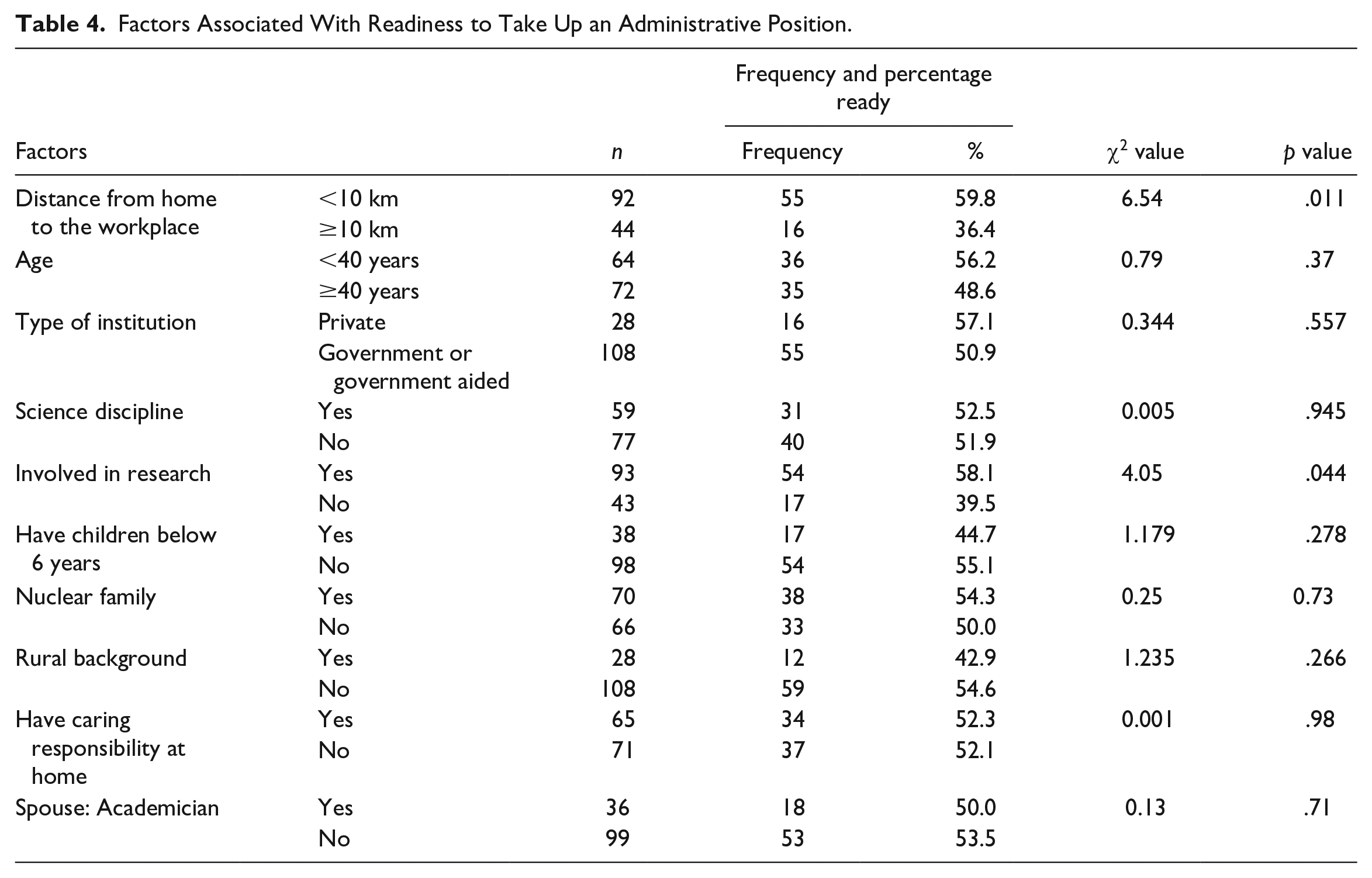
Multiple logistic regressions indicated that of all the demographic variables, only distance from home to the workplace is significantly associated with readiness to take up the administrative position (Table 5). Female faculty staying within 10 km from the workplace are 2.77 times more likely to take up administrative positions compared with those who must travel more than 10 km for their workplace (Adj. odds ratio [OR] = 2.77, 95% confidence interval [CI] = [1.23, 6.22], p = .014).
Logistic Regression and Adjusted OR Showing Factors Associated With Readiness to Take Up an Administrative Position.

Note. OR = odds ratio; CI = confidence interval.
Barriers faced by women
Participants of FGDs brought out how society viewed women and men differently regarding work. Many of the respondents indicated that women were expected to take charge of households, keep meals ready, and be home “on time.” Women were also considered “emotional” and “indecisive,” thus were considered not suitable for leadership. One of the respondents mentioned that when a female takes the work home, she would be considered a workaholic and someone who liked her work more than her family. But when a man did the same, he would be considered hardworking. Similarly, staying back after the regular work hours at the workplace was regarded as a sign of dedication in men, whereas when a woman does the same, she is judged for being a poor wife, mother, or daughter.
Women viewed family responsibilities, house responsibilities, kids’ responsibilities, and elders’ care as barriers to rise to the leadership positions. Women argued that they were expected to take charge of households, keep meals ready, and be home “on time.” One of the participants explained that reaching home within a stipulated time was essential for the emotional, mental, and physical well-being of kids, in-laws, and the elderly in the family. Food, medicines, company, and care were to be provided, and it was not possible to take up any duties that hindered these. Another participant thought that changes to the routines or traditions to suit the needs of working women were not welcomed in the family. It was usually the woman who had to adjust her schedules, priorities, and the career for the family needs. One of the participants expressed a family member’s disapproval in moving to a distant location when promotion to a position demanded a transfer. Women also recognized that eligibility for promotions emerged at the crucial period when childbirth was most important. A career break after childbirth was a necessity, and such breaks mean that the time needed to make up the lapse in time is double.
Women expressed discrimination and a lack of support from men in authority and male colleagues. According to them, men occupied positions of power and were often at the forefront. Women were assigned to committees which according to them were “meant for women,” for example, receiving guests. One of the participants shared an experience where a task was assigned wherein there was no groundwork and the likelihood of the completion of the task within the stipulated period was impossible. Such an incident was then used by male colleagues to prove the incompetence of women. So she ended up quitting tasks or positions of any nature. Women, in general, felt that men in senior leadership positions or as colleagues did not understand them well from the context of their dual role as a working woman and a homemaker. Furthermore, they were also not approachable for mentorship, were not even ready to listen to issues and problems, and even were frowned upon when they worked late in the office.
Women vocalized the difference in treatment and respect given to them at the workplace. They were not encouraged to take new roles or take risks; as a result, female employees lacked confidence. A woman who executed tasks herself was considered “bossy” and “dominating” which was very demotivating for someone who was trying to succeed in a managerial position. One of the participants opined that when the children are very young, the woman has to be more frequently available at home and may keep refusing additional work. This creates a mindset that women are not dedicated. Later, additional roles were not offered to them.
Long working hours, inadequate leave provisions, nonflexible timings, nontransparent selection procedures, lack of women representation in committees, lack of autonomy in decision-making, favoritism, and lack of support, encouragement, appreciation, or recognition of services demotivated women to seek a senior management position. Some of the participants perceived that women were deliberately left out of nominations or promotions. Lack of on-campus facilities such as accommodation, transportation, health care, and support services, namely, day care/elderly care center, discouraged women from taking a responsible position. Negative attitude and dominating behavior of male faculty, issues of personal safety, and lack of gender sensitization or stress management programs were also considered as barriers. One of the participants also expressed that she did not want to invite trouble by raising concerns on organizational practices; she believed that social connections and goodwill were far more important at the workplace than individual ambition. Furthermore, women pointed out self-confidence, time management, and own health and safety as major barriers at a personal level. The barriers mentioned in the focus group discussion were almost the same as mentioned in the responses to open-ended items (Box 1), except the caste as a barrier.
Box 1. Barriers for Women to Take Up a Senior Leadership Position

Solutions recommended or implemented by women
Participants expressed concern over the work environment and demanded equality, respect, understanding, recognition, and encouragement in all endeavors of the institution. Women demanded exposure, involvement, or refresher training programs. Some of the participants recommended training programs on leadership, risk-taking and assessment, stress management, gender sensitization, women empowerment, and confidence building. A few others requested orientation to the institutional policies, procedures, guidelines, and job descriptions of the senior leadership positions. Some suggested on-the-job training through involvement in various committees. One of the participants believed that social fabric does not raise women as leaders. According to her, female mentors with experience and vision would be better as they may understand the specific problems of women at the workplace and may even enable women to build self-confidence. Other opinions were in line with the responses to the open-ended item of the questionnaire, presented in Box 2.
Box 2. Ways to Overcome the Barriers Experienced in the Institution
Respect and recognition of achievements of faculty irrespective of gender and financial background
Consideration of opinions of co-workers of both gender
Involvement of women faculty and provision of opportunity to participate in administrative tasks
Promotion of females to administrative positions
Development of confidence of women through training
Open-mindedness to accept changes
Work and life balance through the management of resources or skill mix
Measures that universities/organizations can take to support women
Women articulated a few expectations from the HEI for their readiness to take up senior management positions. They expressed that managing research, administration, and family at the same time is challenging and hence demanded that 50% of the work time per day of women in a leadership position may be allocated to administrative and research work. Flexibility in duty timings and orientation to job responsibilities in each position were sought. Improved technological facilities at the workplace and on-campus accommodation facilities to make work–life balance easier were requested. Motivational talks to boost confidence and develop a positive attitude; conferences, workshops, or training programs on gender sensitization; and women empowerment and administrative systems were suggested. Recognition of achievements of women, their safety and transparency in selection or promotion procedures, and equal opportunities in the representation of committees/decision-making forums were highlighted. Women also demanded open competition than a nomination for the top positions, merit-based promotions, and priority while allocating in-campus accommodation. Other responses were similar in line with the responses to the open-ended questions, which are presented in Box 3.
Box 3. Measures to Be Taken by the Universities/Organizations to Support Women to Take Up Senior Leadership Positions
Women-friendly support system: flexible work hours or leave, especially when children are young, and in-campus facilities such as day care, accommodation, transportation, and health management
Reduce teaching workload of 16 hr/week to 8 hr (teaching) and 8 hr for administration + research work
Open communication between employees and administration
Recognize the sincerity and promptness of work done. Provide incentives for additional responsibilities
Encourage to take up the new role. Build a cooperative work environment
Institutionalize fair and timely career advancement through a merit-based selection process for all key positions
Higher administrative authorities outside the institution must be efficient and honest so that they can give promotions based on the experience and merit
Teach morals and values for all the workers (top to bottom)
Improve technological facilities and research support in terms of grants-in-aid
Let the positions like Directors, Dean, Registrar, coordinator, and so on be announced through an advertisement and not by nomination.
Implement common rules and regulations/laws. Provide equal opportunities to apply knowledge and creativity. Involve all the faculties irrespective of the gender
Recognize capabilities and give opportunities to participate in decision-making
Increase the number of support staff
Create awareness of available opportunities
Organize workshops or seminars on administrative systems, and interactions with the women achievers in the senior leadership position at higher levels
Respect the opinions of female co-workers. Involve women faculty and provide the opportunity to participate in administrative positions
Promote females to an administrative position with dignity, respect, and safety
Reserve some higher administrative seats for women only
Changes that women have to make to themselves to succeed academically
Although female faculty highlighted expectations from the institution, they also realized that a change in the behavior and attitude of women themselves were also necessary. Women did express the need to boost their knowledge in the field of work and develop open-mindedness to changes in the workplace. Women urged the need to avoid the feeling of guilt and instead vocalize or develop tactfulness to deal with the issues of gender sensitivity, safety, and system-related concerns. Female faculty stressed the need to remain confident and strong to face hardships and challenges at all steps. Some women mentioned that it is not physically possible to excel in both the home and work fronts. One of the FGD respondents who is currently also occupying a senior administrative position at a State University mentioned that women owe it to other women to take every opportunity provided to them and prove that women are just as capable as men. She believed that the onus of proving their worth and capacity lies in the women themselves. Respondents called out women to be confident and strong to face hardships and challenges at all steps. Responses to the open-ended item in this area are presented in Box 4.
Box 4. Changes That Women Have to Make to Themselves to Succeed Academically
Compromise with family-based matters and duties
Seek support and guidance (from family members) and cooperate with co-workers
Enroll in training programs and upgrade administration skills
Time adjustment or effective management of resources
Enhance knowledge in the respective field
Learn tactfulness to deal with the issues
Be proactive and vocal
Discussion
Underrepresentation of women in a senior leadership position in the education sector is a concern especially at a time where female entrants to higher education programs are on the rise (Banker & Banker, 2017; Government of India, 2019). Institutions of higher education of today are becoming gender diverse, and hence a balanced governing board is thus crucial. Gender-diverse environment at the institutions sets an example for more diverse initiatives and learning. The representation of women in the senior leadership position in this study (37.5%) is twice the figure reported by Ghara (2016). However, the finding cannot be viewed as a gentle pat on the back for Karnataka, for the figure is likely to drop, if requisite measures to retain women in leadership are not taken now. One-half of the women, especially with managerial experience, are declining leadership positions, and this is certainly not a healthy development for the education sector in Karnataka. Women in India today are well qualified and they do not leave careers because of family responsibilities (Mishra, 2013). There are invisible barriers within the structure and function of the organizations, which need to be streamlined.
Women who have made advances in acquiring senior-level positions report unique difficulties in their ascension to leadership roles in institutions of higher education (Chliwniak, 1997; Mahapatra & Gupta, 2013). Women experience biased attitudes, marginalization, and lack of support and acknowledgment from male colleagues (Bamji, 2005; Drury, 2010). Drury (2010) reports an incident wherein a female officer felt offended when a male co-worker questioned her as to how she got her job. The male colleague did not expect that she had that level of expertise when she explained her qualifications. Career paths to their leadership are often slower and sometimes even blocked (Ballenger, 2010). The attitude of men demoralizes and negatively affects women’s self-esteem and performance (Steele, 1997). Gender inequality, good old boy network, lack of mentors, lack of transparency in recruitment, and selection or promotion procedures are the core areas where women have major concerns (Ballenger, 2010; Bamji, 2005; Drury, 2010). In addition, women in this study expressed disregard for their opinions, nonrecognition of their work, the disparity in the professional treatment, and less speed of their promotion. Furthermore, the qualitative information unfolds a few invisible barriers within the structures, be it the attitude of men/the society/the family or procedures and practices at the workplace.
Male superiority is deep rooted within the culture and structure of organizations, which provides a critical advantage for men to be in leadership positions and power (Acker, 1999; Drury, 2010; Maier, 1999; Martin, 2003). During gender and family socialization, girls and boys are raised to behave in specified ways (Kekelis et al., 2005) and are taught that certain roles and places are appropriate for men alone (Drury, 2010). Boys are trained to be authoritative and enjoy the privileges of mobility and opportunity, unlike women (Basu et al., 2017). The expressions of women in FGD in this study inform that women still experience socialization-driven male dominance, gender discrimination, and inequality, amid the national efforts to address them through gender sensitization. This study findings reveal that equality is articulated to some extent; however, women do not fully experience it in every endeavor. Sandwiched between the two extremes (social norms on one side and right to be treated equally on the other), are some women losing their true identities? Lorber (2000) suggests that if feminists want to address the issue of gender insensitivity or inequality, they must challenge the division of people into two unequally valued categories (social constructivist structural gender perspective). If not, the perpetuated negative stereotype that women are for supportive functions and male are competent for the managerial position would persist (Appelbaum et al., 2003; Basu et al., 2017; Drury, 2010; Eagly & Carli, 2007).
Traveling a long distance to the workplace and long hours of work and safety concerns were considered a barrier to women faculties’ academic productivity or ascension to leadership (Bamji, 2005; Kurup et al., 2010; Morley & Crossouard, 2015). In this study, distance to the workplace emerged as an important barrier in the quantitative analysis. Distance does matter for women, especially when they depend on local transport (Green et al., 2004). Limited transport facilities on the one side and the unwillingness of family to move residence closer to the workplace (similar to the finding of this study) on the other side are a concern for teachers in Karnataka. For this reason and for concerns on personal safety, teachers were found to wind up work as per the timings of local transport to ensure they do not miss the local transport (UNESCO Office New Delhi and Regional Bureau for Communication and Information in Asia and the Pacific, 2001). Thus, the demand for transport and in-campus facilities (accommodation and dependent-care facilities [creche, school, clinic]) from women (Kurup et al., 2010; Morley & Crossouard, 2015) appear genuine in the local context. Regarding longer hours of work, travel to distant locations on official visits, and safety concerns, women may have alternatives especially in the current virtual era, where the majority of the managerial functions are just a click or touch away, and in addition, family and spousal support in household chores is available for academicians or researchers in India (Gupta & Sharma, 2002; Kurup et al., 2010). Thus, it is time for women to visualize opportunities for senior management positions than consider distance, travel, and safety as barriers.
Women in this study perceived belief system and family responsibilities as one of the barriers for their readiness to senior leadership positions. Women harbor patriarchal expectations learned during the family socialization process or from other female colleagues and adhere to the patriarchal views and beliefs without even realizing they do it (Drury, 2010; Mishra, 2013; Morley & Crossouard, 2015). Women tend to value interpersonal relationships with same-sex peers as an identity (Carter, 2014) and thus have limited social networks (Gupta & Sharma, 2002). They are uncertain of their own profile’s fitment to the role and credentials and often underestimate their potentials when applying for the job. While a few women genuinely lacked employable skills (Bamji, 2005), most women in leadership positions either were endorsed by their direct superiors or were at the grace of the third party who showed faith in their credentials (Banker & Banker, 2017). It is time for women to know that the label of woman’s less competence is socialization-driven and not fact-based (Appelbaum et al., 2003). Women of today no longer leave careers because of family responsibilities, but they await opportunities where they can show their competence (Mishra, 2013). Women in India need to give genuine thought to one’s abilities and invest in building/rebuilding self-confidence, self-esteem, assertiveness, emotional stability, and ability to handle a crisis, which are the essential psychosocial attributes of leadership (UNESCO, 2002). They must use available opportunities and take risks to excel. Thus, the best and foremost intervention to overcome barriers to a senior leadership position is to invest on recognizing the limitations within self and building own strengths.
Women have immense potentials to contribute to the leadership skill base, yet they are often an underutilized resource, especially in the higher education system in India (Banker & Banker, 2017; Ghara, 2016; Mahapatra & Gupta, 2013). Appelbaum et al. (2003) argue that certain feminine features such as heightened communication skills (listening and empathy), advanced intermediary skills (for negotiation and conflict resolution), well-developed interpersonal skills, and a soft approach make women better leaders. The leadership style of women is regarded as considerate, participative, socio-expressive, people-centered, and transformational. Thus, women are at a better advantage than men in matters of leadership (Appelbaum et al., 2003). However, women’s potentials to leadership are rarely identified, supported, encouraged, recognized, and developed in the workplace (Drury, 2010; Green et al., 2004; Morley, 2014), which is true in Karnataka as evident in the findings of this study. Appelbaum et al. (2003) quote, “When women attempt to prove their competence by ‘acting like men’, they are considered to be less than women. When there seems to be some merit in what would normally have been considered a ‘female’ approach, men adopt it as their own” (p. 49). With equal opportunities being given for leadership for academicians in Karnataka, there is room for women to demonstrate their competency and to be a role model, to enable other men and women to look up to them for mentorship or get motivated. This approach would, in itself, bring recognition of work, identity, encouragement, and support. Banker and Banker (2017) recognize the outstanding performance of women in commercial firms and anticipate women in academia to bring such positive changes.
The expectations/solutions/recommendations vocalized by women to overcome barriers at societal, family, and organizational levels are noteworthy. These measures collectively may help women perceive a conducive psychosocial work and living environment. Motivational talks, especially from women leaders; effective mentoring; training on gender sensitization and women empowerment; flexible timings; due recognition of work performance; transparency in selection and promotion procedures (Ballenger, 2010; Banker & Banker, 2017; Kurup et al., 2010; Morley & Crossouard, 2015); and orientation to the gender equality law, as well as roles and responsibilities expected of them in the managerial position (Gupta & Sharma, 2002; Kurup et al., 2010), have been documented in the literature. Women’s empowerment and recommendation for reserving seats for women are valued at the national level in India. The institutions of higher education in Karnataka need to remain open to the demands of women and build the necessary infrastructure to enable women to realize their career advancement goals or deliver quality output.
This study adds a few positive developments (institutional and family level) in Karnataka in favor of women to rise to senior leadership positions. The majority of the women had family and spousal support and prioritized professional work over personal responsibilities. Only a few perceived that taking up leadership positions would affect their relationship with their husband or prioritized their husband’s career over that of their career opportunities. These developments indicate that traditional beliefs are slowly changing. This study also reveals that the majority of women noticed equal opportunities, autonomy in decision-making, and no loss of opportunities for a senior position due to low expectations or negative attitude of men, and that they were not perceived incapable of handling tough tasks. This reflects that the work environment in academia in state public universities in Karnataka is becoming woman-friendly.
The findings of the study have implications for the education sector. Although study findings reflect that a woman-friendly work environment is evolving, factors that hinder the female faculties’ decision to opt out or decline senior leadership positions require genuine attention. Administrators in academia must identify and understand the issues faced by women in the HEI of Karnataka. Support facilities and recognition of work performed by women require due consideration. Enhancing the managerial potential of women faculty and providing the necessary infrastructure and opportunities to help them realize their goals of career advancement should be an ongoing process. With senior leadership positions being vacant at the institutions of higher education, authorities can recruit and select women in senior leadership positions or reserve a proportionate number of seats for women based on the enrollment in the programs.
As participants of this study were predominantly from the government institutions, the scenario in private universities/institutions of higher education needs to be explored. Small sample sizes, selection of colleges through convenient sampling, and the inclusion of only female faculty in FGD are the limitation of this study. In-depth interview of successful/reputed female faculty in administrative position (Principal/Directors of the HEI/Registrar of the university/Vice Chancellor/Pro-Vice Chancellor) to identify the obstacles and perceived solutions would strengthen the findings. A study with a larger sample size would reveal a more reliable picture of the factors associated with readiness to take up an administrative position.
Conclusion
There is a dearth of women in senior leadership positions in India. Although the figures in Karnataka of women in leadership are promising, the number of women in managerial positions declining senior leadership positions is a concern. Sociocultural, organizational, and person-centered factors have been the barriers for women in academia to realize their career advancement goals. Although changes in the sociocultural and organizational scenario would be gradual and are evolving, modifications in the personal factors may be attended to as a priority by women faculty in academia. Organizations must support women through recognition of their work and managerial potential and addressing the organizational barriers which prevent their ascension to senior leadership positions.
Footnotes
Acknowledgements
The authors would like to express her gratitude to the Indian Council of Social Science Research for financial support and encouragement. A special word of appreciation to all the participants for their cooperation during the focus group discussion and taking their time to complete this survey.
Declaration of Conflicting Interests
The author(s) declared the following potential conflicts of interest with respect to the research, authorship, and/or publication of this article: This article is the original work. We are submitting this work for the first publication in the Journal. It is not being considered for publication elsewhere and has not already been published elsewhere.
Funding
The author(s) disclosed receipt of the following financial support for the research, authorship, and/or publication of this article: Author has received research grants from Indian Council of Social Science Research, Government of India (Grant No. F. No. 02/04/2015-16/ICSSR/RPR)
Ethical Approval
Institutional Ethics Committee of Kasturba Hospital Manipal (IEC 61/2016) approved the study.
