




Abstract
The present study analyses factors associated with the propensity for piercing and tattooing among adolescents, from a survey conducted in 2007 in high schools in the Veneto Region (Northeast Italy). After some descriptive analyses, multinomial logistic regression models were applied to identify what predicts the practice of, interest in, or indifference to piercing and tattooing. Results show gender differences in the approach to body modification: For girls, body art is considered a mainstream activity involving younger cohorts; piercing and tattooing become a way of increasing their own body satisfaction. For boys, factors connected with the propensity for these practices are a low cultural background and the importance given to physical appearance. For both boys and girls, a significant aspect in defining attitudes toward body art practices is the values system: Values such as enjoyment, beauty, and youth, are found to be closely connected with a high propensity for these practices.
Increasing numbers of adolescents have had body piercing and tattooing carried out in recent years (S. T. Carroll, Riffenburgh, Roberts, & Myhre, 2002; for Italy, see, for example, Pietropolli Charmet & Marcazzan, 2000). These practices of body modification may now be considered a mainstream activity among adolescents in Western society (Millner & Eichold, 2001; Stirn, 2003). As the prevalence of piercing and tattooing has increased, adverse health risks associated with these forms of body art have been documented (for reviews, see Gold, Schorzman, Murray, Downs, & Tolentino, 2005; Schorzman, Gold, Downs, & Murray, 2007), together with a potential correlation between such body modifications and other risk-taking behaviors among adolescents (S. T. Carroll et al., 2002; Deschesnes, Fines, & Demers, 2006; Roberts, Auinger, & Ryan, 2004). In view of the prevalence of body modifications and the list of documented risks and complications, it is important to understand exactly which type of adolescent population has undergone or is interested in these forms of body art. As the spread of body art has increased and the risks associated with it have become more clearly defined, researchers have begun to explore the underlying attitudes and ideas surrounding it. To date, most of the published data have been collected from adults or older adolescents, and very few published works deal with early adolescents. In addition, studies of body modifications among adolescents have mostly been conducted within particular groups already defined as “at risk,” such as patients in clinics or prison inmates, military populations, and so on (Brooks, Woods, Knight, & Shrier, 2003; L. C. Carroll & Anderson, 2002; Drews, Allison, & Probst, 2000). These studies are also scarce and some of them are based on relatively few cases (Stirn, 2003). In the few studies within a general adolescent population, tattooing and body piercing have been associated with substance use (Armstrong & Pace Murphy, 1997; Deschesnes et al., 2006; Greif, Hewitt, & Armstrong, 1999; Roberts & Ryan, 2002), gang affiliation, sexual involvement, and some learning difficulties (Houghton, Durkin, Parry, & Turbett, 1996; Roberts & Ryan, 2002). Finally, most studies have focused, on one hand, on the medical complications of tattooing or piercing and, on the other hand, on the explanations for such body modifications (for a review, see L. C. Carroll & Anderson, 2002).
The present study, thanks to a survey conducted in high schools in a northeastern Italian region in 2007, helps to establish a clear picture of this phenomenon in a generally young adolescent population (aged 14-18). This provides us with an expanded view of the individual and family contexts in which body modifications such as piercing and tattooing among young adolescents are more common. The following part of the article is organized as follows: The next section discusses individual and family factors influencing interest in body modifications, in the light of explanations, hypotheses, and empirical results in the literature; then the data, methods, and variables used are described; we then provide the results of multivariate regression models; and finally, comments on results are presented.
Background
We know surprisingly little about the type of person who chooses to acquire markers such as tattoos and piercings. The few available studies consider personality correlates. In particular, many authors have hypothesized a link between body modifications and low self-esteem (e.g., Farrow, Schwartz, & Vanderleeuw, 1991) because several studies describe cases of individuals who underwent body art to increase their self-esteem and subjective beauty (Atkinson, 2002; Schildkrout, 2004). In fact, empirical studies designed to evaluate directly the association between body modifications and low self-esteem have found mixed results. Some report small to null correlations (L. C. Carroll & Anderson, 2002; Frederick & Bradley, 2000); others found no differences between body-modified and nonmodified individuals in their perception of their own bodies (Wohlrab, Stahl, Rammsayer, & Kappeller, 2007). Conversely, other studies showed that adolescents with piercings or tattoos were less satisfied with their bodies than their counterparts without them (see Nathanson, Delroy, & Williams, 2006; Suris, Jeannin, Chossis, & Michaud, 2007).
Other empirical studies found associations between some family characteristics and the prevalence of body modifications. In particular, adolescents from single-parent households were more likely to be tattooed or pierced than adolescents living with both parents (Roberts & Ryan, 2002; Suris et al., 2007). In addition, adolescents whose parents had received little education were found more likely to have undergone body modifications (Roberts & Ryan, 2002; Suris et al., 2007).
The Italian literature is quite scarce. Some authors (e.g., Scanagatta & Segatto, 2007) examined the spread of these phenomena among high school adolescents, with particular attention to the sociological and pedagogical dimensions. They studied the incidence of adolescents with piercing and tattoos according to type of school and peer practices but only focused on this issue by means of descriptive analyses.
Data
Our data source is the “Indagine socio-epidemiologica sulla pratica del tatuaggio e del piercing nei giovani” 1 (“Socio-Epidemiological Survey on the Practice of Tattooing and Body Piercing Among Young People”), conducted in 2007 in the Veneto Region in northeastern Italy. The survey was based on a sample of students of high schools of the Veneto Region. The sample was selected in three steps. First, schools were selected by judgmental sampling taking into account the territorial areas (the seven Provinces of the Veneto Region) and the school typology (the six types of Italian high schools): In this way, the sample included 42 (=7 × 6) schools. In the second step, two sections of students attending the 1st-, 3rd-, or 5th-year level were randomly selected in each sampled school, leading to 252 (=2 × 3 × 42) classes. Finally, all students of a selected class were interviewed. In this way, more than 4,000 participants (4,524 in total) personally filled in an anonymous classroom questionnaire (no refusal to participation was observed), which collected data on students’ experiences with and attitudes toward body piercing and tattooing, their knowledge of the associated health risks, and the practitioners to whom they had gone. Their background context of reference, defined by the characteristics of their family of origin and their values system, was also examined.
Response rates to the main questions were very high (missing data in the questions used in this article range between 0.3% and 4.5%). A total of 4% (204 observations) of the survey participants had some very important information (like age and sex) missing and were excluded from further analysis, leaving 4,320 usable surveys. 2 Girls made up 65% of the sample (see Clerici & Meggiolaro, 2009, for details about this overrepresentation). Due to the great gender differences in all kinds of phenomena connected with personal identity, in particular bodily identity, the present study considers body modification practices separately by gender.
The last columns of Tables 1 and 2 (in these descriptive tables, weighted values will be used) present a brief picture of the main individual and family background characteristics of survey respondents. The percentages of first-level students (37%) were higher than those of the third and, especially, of the fifth levels. Most students (95%) were Italian, and almost 45% of them lived in urban areas with fewer than 15,000 inhabitants. As regards their family characteristics, almost 25% of respondents had at least one parent with a university degree, and more than half (53%) had at least one parent with complete high school education. 3 Most students lived with both parents (90%) and had siblings (75%). Regarding personal traits, only 10% of students were not satisfied with their bodies, and they assigned quite high importance to their physical appearance (mean of values, ranging from 1 to 10: 7.35). The survey also provided some information about values systems. In particular, respondents were asked to choose the 5 values that they considered the most important from a list of 10 (beauty, youth, friendship, success, money, family, work, study, enjoyment, and voluntary work). A preliminary factor analysis suggested considering only some of the values of the original data set (Clerici & Meggiolaro, 2009). In particular, we focused on the choices of beauty or youth, voluntary work or study, and enjoyment. On one hand, these are the values that may influence interest in body modifications; on the other hand, they may simply distinguish and characterize the values systems of adolescents (e.g., values such as family and friendship were considered the most important by all respondents). The last columns of Tables 1 and 2 show that most students gave importance to enjoyment (73%) and the percentages of those who considered voluntary work or study, and beauty or youth, as important were lower.
Characteristics of Survey Respondents, According to Gender and to Subgroups Defining the Practices and Attitudes Toward Piercing (n = 4,213) a
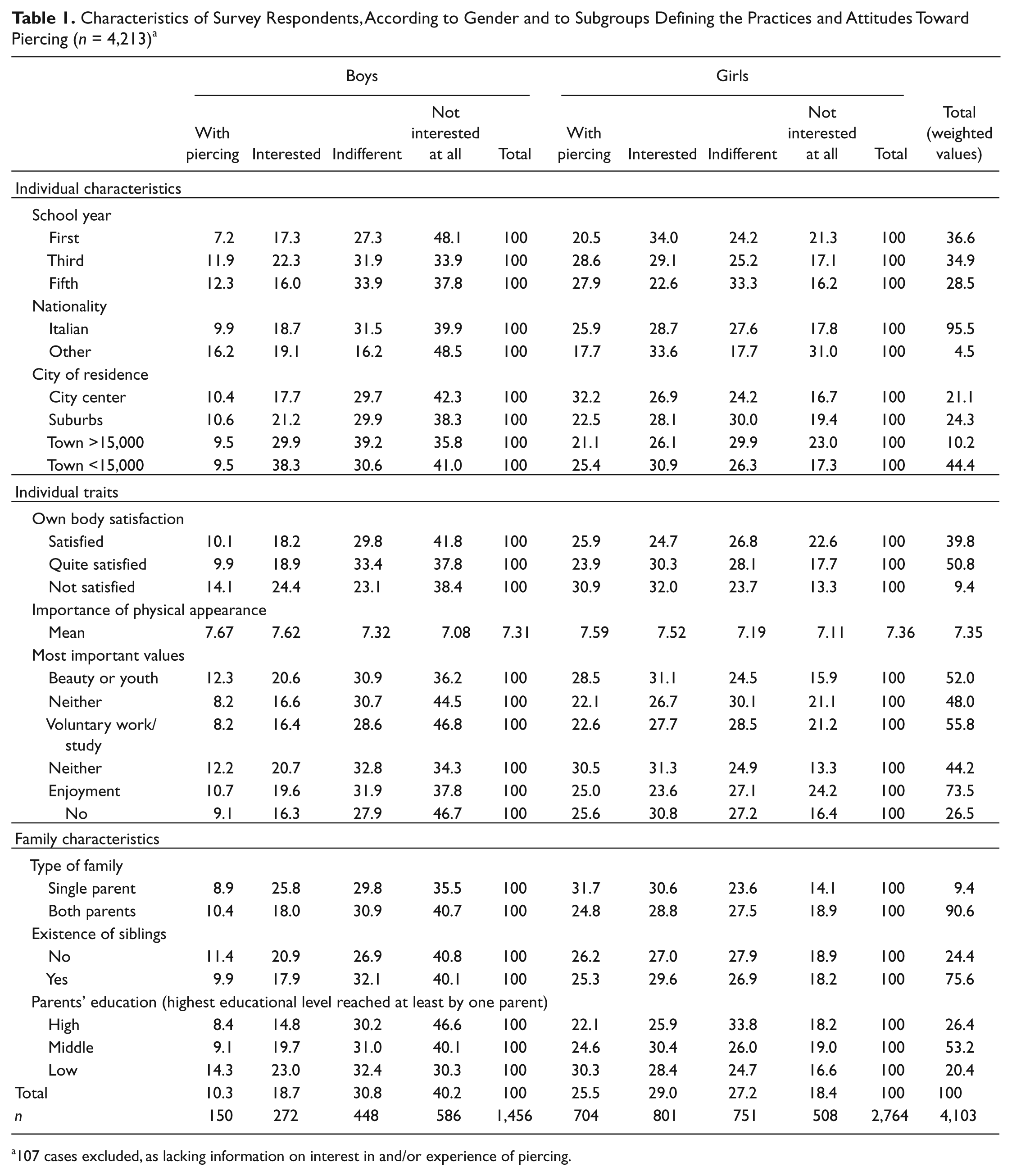
107 cases excluded, as lacking information on interest in and/or experience of piercing.
Characteristics of Survey Respondents, According to Gender and to Subgroups Defining the Practices and Attitudes Toward Tattoo (n = 4,125) a

195 students are excluded, as lacking information on interest in and/or experience of tattooing.
Data on experiences and attitudes toward body piercing were obtained by examining responses to two questions in the survey. The first asked every interviewee about their personal attitude toward this practice and their interest was ranked on a five-category scale (greatly interested, interested, ready to undergo piercing, indifferent, and not interested at all). The second question asked whether they had undergone body piercing. These two items were matched, and students were grouped into four categories: those with piercing (present or in the past), students without piercing who were interested in it (very interested, interested, ready to experience), students without piercing who stated that they were indifferent, and students without piercing who were not interested at all in this form of body art. In this way, four subgroups of adolescents were identified and each subgroup is of interest in this article. A similar approach was used to measure experiences and attitudes toward tattooing, identifying, again, four subgroups of adolescents. The last rows of Tables 1 and 2 list student distributions according to these subgroups describing attitudes toward piercing and tattooing, respectively. The final sample totaled 4,213 participants as regards analyses on piercing and 4,125 on tattooing (due to the exclusion of participants who did not answer these questions).
Among male students, 10.3% had at least one body piercing and 6.4% had at least one tattoo. Body piercing was more frequent among girls (25.5%) than boys; no differences in the prevalence of tattooing between boys and girls were found. The estimates and gender differences for piercing were completely in line with those reported in another Italian study (Scanagatta & Segatto, 2007), and a similar observation was made for tattooing among boys. Instead, in the present research, a lower incidence of tattooing among girls was found with respect to the results of Scanagatta and Segatto (2007). The higher prevalence of piercing over tattooing in both genders seems intuitive, especially in view of the lack of permanence of piercing: Rings, studs, and so on can easily be removed and thus do not require the same level of commitment as a tattoo, which is permanent. The great interest in tattooing is in line with this observation. In fact, girls were more interested in both practices (29% and 50.9% for piercing and tattooing, respectively) than boys (18.7% and 40.3%, respectively).
Table 1 (piercing) and Table 2 (tattooing) show the characteristics of the subgroups of adolescents defining the prevalence and interest in body modifications among boys and girls.
The prevalence of piercing increases with year level, probably due to an age effect, although the increase from the 3rd to 5th years is small and was only observed among boys. Greater prevalence and more interest in comparison with Italian students were noted among boys with other nationalities, and the opposite happened among girls. No strong residence differences were found among boys; instead, higher percentages of girls undergoing piercing were noted in city centers compared with other points of residence. Considering individual traits, high percentages of students who underwent piercing were found among those who were less satisfied with their bodies and who gave more importance to their physical appearance. It is interesting to note that, as regards the values system, more students with piercing considered beauty or youth as the most important values; lower percentages were found for those who gave importance to voluntary work or study. Differences in interest in piercing were lower when “enjoyment” was considered. Finally, as regards family characteristics, girls living with both parents were less likely to have piercing, and the opposite was the case among boys; for both genders, interest in piercing was greater in students living with only one parent in comparison with those living with both parents. No differences were found between students with or without siblings. Higher percentages of students (both boys and girls) with piercing (and lower ones of individuals interested in it) were found among those whose parents had low educational level in comparison with those whose parents had gone to university.
As regards the subgroups defined considering the second form of body modification examined here (Table 2), the prevalence of tattooing clearly increased across year levels for both genders. Interest in it was greater among 3rd-year students and among girls living in city centers. In comparison with Italian students, greater interest was noted among adolescents of foreign nationality, both boys and girls. However, a higher percentage of those who actually experienced tattooing was observed among Italian boys in comparison with non-Italian ones. The highest percentages of students who were interested in and had undergone tattooing were found among those who were not satisfied with their bodies and, surprisingly, those who were; intermediate values were observed among those who were simply quite satisfied. Tattooed individuals give more importance to their physical appearance. As regards values, as observed with reference to piercing, more students with tattoos were those who considered beauty or youth as the most important values; lower percentages are found for those who gave importance to voluntary work or study. Considering family characteristics, boys and girls who had tattoos were more likely to live in a single-parent household and to be those whose parents had a lower educational level.
Method
Multinomial logistic regression (Agresti, 1996) was used to analyze which determinants and context influence interest in body modifications. The polytomous dependent variable, experience of and interest in piercing and tattooing, had four categories, corresponding to the subgroups of adolescents defined in the previous section by the experience and interest in body modifications. For example, considering piercing, we distinguished students with piercing into those who were interested in it, indifferent to it, and not interested at all; the last served as the reference category. The estimation of a multinomial logit model was similar to the simultaneous estimation of several binary logit models: A set of J-1 coefficients was estimated for each explanatory variable, where J was the number of categories of the dependent variable. The estimated coefficients indicate the effects of the independent variables on the log-odds (odds, once exponentiated) of each adverse outcome category in relation to the reference category (here, the subgroup of uninterested students). In particular, in this model, log-odds are expressed as a linear function of K covariates X ik (with coefficients b jk ):


where pij is the probability that student i expresses propension j, 4 a j represents the intercepts, and the fourth category of outcome variable is considered the reference category. 5
As noted above, boys and girls were analyzed separately. Model estimation was carried out by PROC CATMOD in SAS. Covariates were grouped into three following classes:
Individual characteristics: This refers to year level, nationality, and city of residence. A student’s year level at school was defined by the year attended and thus had three categories (1st, 3rd, and 5th year). Nationality was measured by a dichotomous covariate (Italian, other nationality) as the low percentage of foreign students in our sample did not allow us to use a more detailed variable. Four categories were considered as city of residence (city center, suburbs, towns with 15,000 or more inhabitants, and towns with fewer than 15,000 inhabitants).
Personal traits: This refers to body satisfaction, importance given to physical appearance, and values system. Body satisfaction was measured by a three-category covariate (satisfied, quite satisfied, and not satisfied at all). A continuous variable was then used to investigate personal emphasis on physical appearance. Three dichotomous covariates described the values system (according to the results of a preliminary factor analysis; Clerici & Meggiolaro, 2009), in particular, whether students considered beauty or youth, voluntary work or study, and enjoyment as the most important values.
Family background: This refers to type of family, existence of siblings, and parents’ education. Two dichotomous covariates defined the structure of the family of origin—a value of 1 was given for students living with only one parent and 1 for those who had at least one brother or sister. Finally, the highest level of parental education (university [high], high school [middle], and junior school [low]) was examined with a three-category covariate. 6
Results
Table 3 lists the parameter estimates of two regression models: one for boys and one for girls. Considering significant coefficients, adolescents who had a greater propensity toward undergoing piercing (first column of Table 3), those who were interested in it (second column), or indifferent to it (third column) were profiled in comparison with adolescents who were not interested in it at all.
Factors Influencing Experience of and Interest in Piercing, According to Multinomial Logistic Model (1,354 boys and 2,564 girls)

p < 0.10. **p < 0.05. ***p < 0.01.
As regards boys, the first contrast (having undergone/not interested at all) showed that boys with the greatest probability of undergoing piercing rather than not being interested in it at all were 3rd- and 5th-year students (clearly, year level is a proxy of age) and had parents with middle to low educational level; they attached much importance to their physical appearance; they considered enjoyment, beauty, and youth as the most important values; in line with this, boys who believed that voluntary work or study is the most important activity had a lower probability of having (or having had) a piercing compared with not being interested in it at all. The likelihood of being interested in piercing (in contrast to the subgroup of uninterested students) was influenced by same factors, which explained the experience; in addition, younger age (indirectly expressed by year level) and belonging to a single-parent family were aspects connected with interest. The propensity of being indifferent (rather than not being interested at all) increases with the importance given to physical appearance and to enjoyment (on the contrary, it decreases with the importance given to voluntary work and study).
The results were partially similar to those for girls. As observed in boys, the probability of having undergone piercing rather than not being interested in it at all is higher among girls oriented toward enjoyment and beauty/youth and not toward voluntary work or study. In addition, girls with a higher propensity toward having piercing compared with not being interested in it at all were those who lived with only one parent and resided in the center of the city, rather than in small towns. It was interesting to note that girls who feel more satisfied with their bodies had a lower propensity toward piercing (vs. no interest) than those who were unsatisfied with their bodies. Girls’ interest in piercing compared with not being interested in it at all had similar characteristics to those observed among adolescents who had already experienced piercing, although the effects associated with the place of residence disappeared. In comparison with the subgroups of uninterested students, girls indifferent to piercing had more highly educated parents and did not give as much importance to their physical appearance as their pierced or interested counterparts did; nevertheless, they showed some similarities with the two previous subgroups (the pierced and the interested) as regards their values system.
Table 4 lists the results of two similar models on tattooing; again, all contrasts were profiled in comparison with adolescents who were not interested in tattooing at all. However, in this analysis, attitudes toward piercing were also considered: The two practices are often associated, but the experience of and interest in piercing usually come before those of tattooing. Results show that, as expected, the association of tattooing with piercing was very strong in both boys and girls: Adolescents with piercing(s) were also more likely to have tattoos. As regards the other covariates, for boys, the experience of tattooing compared with not being interested in it at all was not connected with family or place of residence. Instead, the effect associated with body satisfaction was highly significant: More satisfied boys had a lower propensity toward having a tattoo rather than not being interested with tattoos at all. The interest (vs. no interest) in tattooing was strongly correlated with the importance given to one’s physical appearance and with the values system (positively with youth/beauty and enjoyment, and negatively with voluntary work/study). Significant effects of year level (and thus of age) and nationality were observed for girls: Older girls and girls of Italian nationality were more likely to be tattooed rather than not being interested in it at all. Considerations on the effects of the values system were similar to those noted for boys.
Factors Influencing Experience of and Interest in Tattoo, According to Multinomial Logistic Model (1,325 Boys and 2,493 Girls)
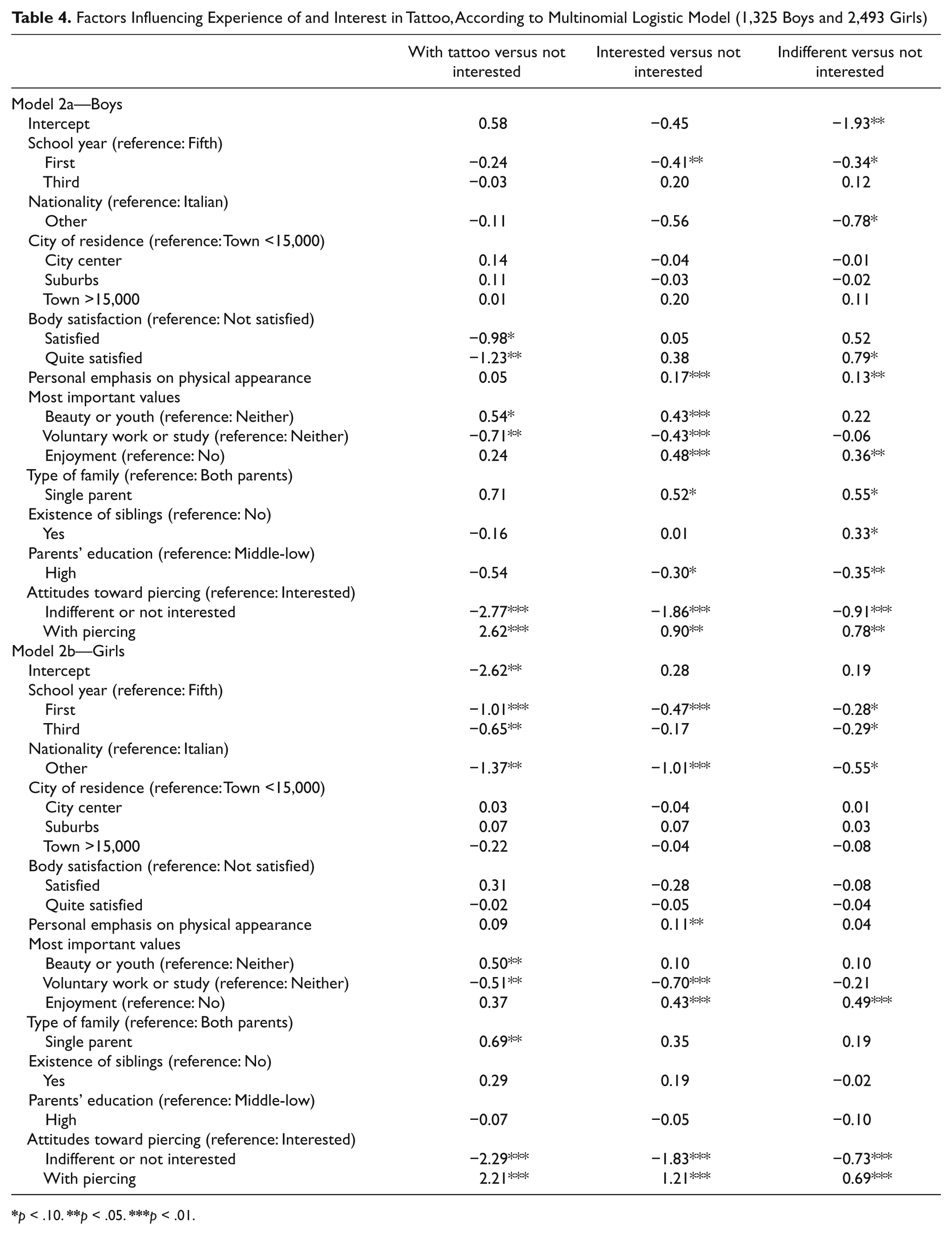
p < .10. ** p < .05. *** p < .01.
Discussion and Conclusions
In Western societies, body modifications such as piercing and tattooing are becoming more and more common. The increase in the experience and interest in these practices, particularly among adolescents, and the potential association with adverse health consequences and with risk-taking behavior, explain the need for research focused on the attitudes of adolescents toward body art practices.
The data of the survey presented here and conducted in high schools in a northeastern Italian region provide a picture of the phenomenon among adolescents aged 14 to 18 years. The data present these adolescents’ family characteristics, attitudes toward physical appearance, and values system. After some descriptive analyses, the present study uses multivariate methods to identify the factors and contexts associated with the propensity toward piercing and tattooing. Multinomial logistic regression models were applied to examine the experience in, the interest in, or the indifference to these practices.
Both descriptive and multivariate analyses were conducted separately for boys and for girls, due to the relationship between gender, their attitude toward their own bodies, and personal identity. Piercing is more common among girls (25%) than boys (10%) and interest in it is very high—again higher among girls (29%) than boys (19%).
Multivariate analyses show the importance of family context: Having parents with middle-low educational level (for boys) or living in a single-parent family (for girls) increases the probability of experiencing and being interested in piercing rather than not being interested at all. In addition, some individual characteristics are of primary importance in determining choices and propensities. The level of physical satisfaction plays a significant role in girls’ choices: Unsatisfied girls are more likely than the satisfied girls to undergo piercing and to be interested in it compared with not being interested in it. Thus, piercing is probably a way of physically improving and better accepting oneself. With other factors being controlled, we showed that male and female adolescents who assign much importance to their physical appearance have greater propensities toward undergoing piercing rather than not being interested in it at all. Values systems are very important. Significant positive effects on the experience and interest in piercing (vs. no interest) were observed for values such as enjoyment, beauty, and/or youth.
Tattooing is slightly less common than piercing (it was undergone by almost 6%), although interest in tattoos is high among boys (40%) and very high among girls (51%). The attitude toward this practice is closely connected with that toward piercing. However, controlling for the effect associated with interest in piercing, the values system is of primary importance for both boys and girls. In particular, values such as enjoyment and youth/beauty are closely and positively correlated with interest in tattooing in comparison with no interest; however, tattooing is negatively correlated with values such as voluntary work and study.
Some of the results of the present study are surprising. Given the increased spread of body modification practices, their transgressive value will presumably decrease, and they are expected to become a mainstream phenomenon: We therefore hypothesized that these practices are being adopted by more and more adolescents from various social classes. This is true for girls, for whom body modification (piercing in particular) is closely associated with younger age; hence, it is a sort of new fashion. Among boys, body modification practices are mostly adopted by those from a low cultural (family and individual) background, although incomplete data on the type of school attended do not allow us to analyze this aspect in greater depth. Further study is necessary.
Finally, there are some potential limitations to the present study. First, the data are based on a sample of students: Thus, our results can be applicable only to students, and they may not be applicable to adolescents who are not in high school, for example, adolescents in vocational training, apprenticeships, or work placements. Nevertheless, this is not a strong limitation: In Italy, most adolescents aged 14 to 18 years (those who are the focus of this article) are in high school (92% - data from the National Statistical Institute website, Banca dati territoriale sulle politiche di sviluppo [Territorial Information System on development policies], www.istat.it/it/archivio/16777). Similarly, our sample population was not sufficiently diverse to capture racial or ethnic differences in these practices, but even this is a weak limitation. The percentage of adolescents aged 14 to 18 years with nationality other than Italian are relatively low: For example, in the school year 2006-2007, only 3.9% of high school students are non-Italian (Ministero della Pubblica Istruzione, 2008); when the number of adolescents aged 14 to 18 who resided in Italy in 2006 is considered, this percentage increases (to 4.55%) but remains relatively low (Source: our elaborations from data from the National Statistical Institute website—www.demo.istat.it). Another potential limitation is that the questionnaire did not give a clear definition of piercing, thus respondents might have considered “piercing” as other practices, such as ear-piercing, which has traditional roots in Western society among girls and is wide spread in mainstream society. Nevertheless, the definition of piercing is usually quite clear among adolescents (Gold et al., 2005). In addition, the information gathered in the present study did not distinguish superficial body modifications from their more extreme forms, although it is realistic to believe that, in a general adolescent population such as that considered here, most instances of tattooing and piercing are superficial. In line with this observation, the location, number, and size of piercings and tattoos were not considered. Finally, the lack of longitudinal data meant that we could not examine some causal links in more depth: For example, it is unclear from our results whether piercing or tattooing changed students’ values system or not.
In any case, this study generated information in an area where, at least in Italy, little is available, and it provides a good starting point for further examination. Additional investigations could provide in-depth analyses of this complex phenomenon and consider some aspects neglected here, such as the effect of peer expectations and practices (to become accepted members of the group, adolescents may be tempted to copy the behavior of peers whom they perceive as “cool”).
Footnotes
The author(s) declared no potential conflicts of interest with respect to the research, authorship, and/or publication of this article.
The author(s) received no financial support for the research and/or authorship of this article.