




Abstract
There is a huge literature regarding the main determinants and sources of economic growth. Most of the recent work emphasizes on the role of knowledge and innovation activities typically produced by a specific sector of the economy, and on analyzing the implications and the importance for economic growth. Moreover, the socioeconomic and public policies aim to distinguish the determining factors of growth to enhance the regional cohesion and the convergence process. Much of the recent work on regional growth can be viewed as refining the basic economic insights of economic geography. This article attempts to analyze the European systems of innovation and the effects of European technological policy to regional growth.
Introduction
During the past quarter of a century or so, many arrangements for international economic integration have come into existence. The most important for the European Community is in reality an amalgamation of three separate communities: the European Coal and Steel Community (ECSC) established by the Treaty of Paris in 1952 and valid for 50 years, the European Economic Community (EEC) created in 1957 by the Treaty of Rome for an unlimited period, and the European Atomic Energy Community (EURATOM) founded by another Treaty of Rome in 1957 and also of an unlimited duration. The Treaty of Rome states that the aim of establishing the EEC is “to promote throughout the Community a harmonious development of economic activities, a continuous and balanced expansion, an increased stability, an accelerated raising of the standard of living and closer relations between its member states” (Article 2). To achieve this aim, the EEC member states will consider their economic policy as a matter of common interest. They will consult with each other and with the Commission on measures to be taken in response to current circumstances (Article 103). With the EEC, the European integration reached a decisive stage in development providing a drastic form of integration: First of all, complete the customs union, the free movement of persons and capital, and finally, an integrated policy in a number of areas such as, agricultural policy, transportation, research and technological policies.
For many years, technological change has been widely considered as an engine of growth and an important factor in development process. Today, there is keen technological competition among the EEC, the United States, and Japan. The aim of technological policy is to reinforce technological capabilities and international competitiveness. European technology policy also aims to increase convergence among member states and to reduce disparities of the Community’s less favored regions. European technological policy is implemented through various rolling framework research programs that consist of various research projects and cover various sectors and scientific subjects.
The countries of Europe have a long cultural and scientific tradition. Major scientific discoveries and the main developments in technology are products of European civilization. The Treaty of Rome did not endow the Commission with explicit power to conduct research and technology policy. The Commission operated only through unanimous decisions of the Council of Ministers. In the first phase of the Community’s research policy only eight articles from EURATOM treaty were devoted to the promotion of research activities. This treaty did not provide a framework for a general research policy. However, the Community’s research activities were developed within this framework and provided the basis for the work being done today. The ECSC and EEC treaties do not contain such detailed provisions as the EURATOM treaty. During the first period, 1953 to 1974, there was thus no clear common framework for the Community’s research policy. The Community’s research programs for this period concentrated mainly in the nuclear, steel, and agricultural sectors. Only the Single European Act (SEA) extended the Commission’s competence in technological subjects and strengthened the Commission’s role in these fields. This article attempts to identify the European research policy and also to investigate the effects on regional cohesion and convergence in Europe.
The European Regional Systems of Innovation
Regional differences remain the prime sources of competitive advantage. A long-term approach to development of regional knowledge economies must therefore combine local (regional) bottom-up approaches with global or European top-down approaches. There is no contradiction between global and local approaches to development of knowledge economy (Freeman, 1991). Regional policy should evolve from supporting general R&D efforts toward innovation promotion. It should also change the emphasis from a “technology-push” a “demand-pull” approach to identify and understand the demand for innovation in firms in the less favored regions. Technological transfer is essential for regions that lag behind. It might even be more important than the development of indigenous R&D activities in the weaker regions (Nelson, 1993). Regional policy should facilitate the identification, adaptation, and adoption of technological developments elsewhere in a specific regional setting (Gregersen and Johnson, 1997; Noisi et al., 1993). It might be less costly, avoiding duplicating previous errors and reinventing the wheel. Regional policy should facilitate technology transfer and the flow of knowledge across regions, maximizing the benefit of the European dimension by facilitating access from less favored region’s economic actors to international networks of “excellence” in this field. They encourage regions to take actions such as
promoting innovation, new forms of financing (for instance, venture capital) to encourage start-ups, specialized business services, and technology transfer;
interacting between firms and higher education/research institutes;
encouraging small firms to carry out R&D for the first time;
networking and cooperating in industry; and
developing human skills.
The theoretical framework for the concept can be found mainly in the work of Cooke and Morgan (1994, 1998). According to the author, the first references to the term appeared at the beginning of the nineties and their evolution has its origin in two major theoretical currents. The first current originates in research on technological innovation, particularly that which refers to National Systems of Innovation (Lundvall, 1992); the second results from advances in theories of regional development. The discussion of National Systems of Innovation emphasizes the importance of innovations on national processes of development. These innovations are the result of the interaction between firms, clients, and government and research institutions, constituting an environment that is favorable to the learning of new ways of producing and organizing production. One of the matters that is emphasized in this type of research is the processes through which this learning takes place and the roles carried out by the different actors that are involved.
The Organisation for Economic Cooperation and Develo- pment (OECD, 2002) proposed a more general strategy set for all (not just for less favored) regions. Although this was not specifically focused on Information Society issues, it has clear and direct relevance with knowledge economy. The OECD study looked at the concept of regional competitiveness to explain why some regions successfully develop clusters and networks, a wide variety of manufacturing activities and services for businesses and consumers, along with educational, research, and cultural institutions and why some must grapple with industrial and institutional imbalance and a lack of resources necessary to adapt. A territory’s indigenous capacity of development is linked with the productivity of enterprises, their ability to join networks, the skills of the labor force, and the strength of institutional resources (Törnqvist, 1990). Such an approach stresses the (mainly) endogenous task of creating networks, partnerships, and cooperation within the region, and five important strategies are recommended in this context:
to use regional policies for human resource development,
to give a demand-driven focus to human resource development,
to base competitiveness on the development of partnerships,
to reinforce economic efficiency by policies of equity, and
to develop regional governance to consolidate national policies.
It is argued that a learning region need not necessarily be high tech and that it can be based on one or more traditional manufacturing sectors. The learning region permits the acquisition of monopoly rents so that they become the basis of comparative advantage based on the local available resources and resource immobility. Figure 1 illustrates the regional and innovation policies toward the learning economy. Cooke and Morgan (1994) and Maskell and Malmberg (1999) define a learning region as one where an industrial cluster becomes a collective learning system, a concept drawing heavily on Lundvall’s (1992) concept of national systems of innovation, fleshed out at local and regional levels. Cooke and Morgan (1998) and Maskell and Malmberg argue that in such regions, learning organizations develop at three levels:
at an intrafirm level,
at an interfirm level between firms interacting within a cluster, and
at the institutional level, through public intervention to support organizational innovation in business services, research, and training.
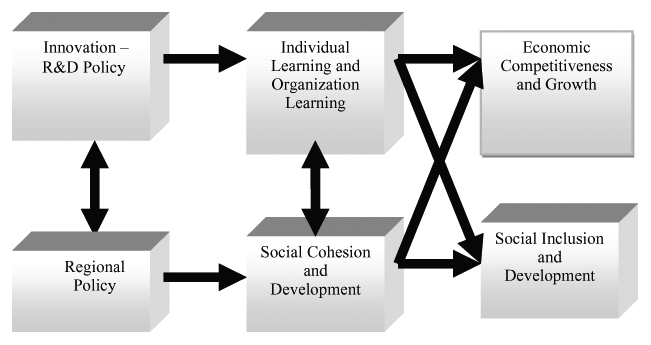
Regional and innovation policies toward the learning economy
The EU is one of the most prosperous economic areas in the world, but the disparities between its member states are striking, even more so if we look at the EU’s various 250 regions. To assess these disparities, we must examine all measure and compare the levels of wealth generated by each country, as determined by their gross domestic product (GDP). For instance, in Greece, Portugal, and Spain, average per capita GDP is only 80% of the Community average. Luxembourg exceeds this average by more than 60% points. The 10 most dynamic regions in the union have a GDP almost 3 times higher than the 10 least developed regions.
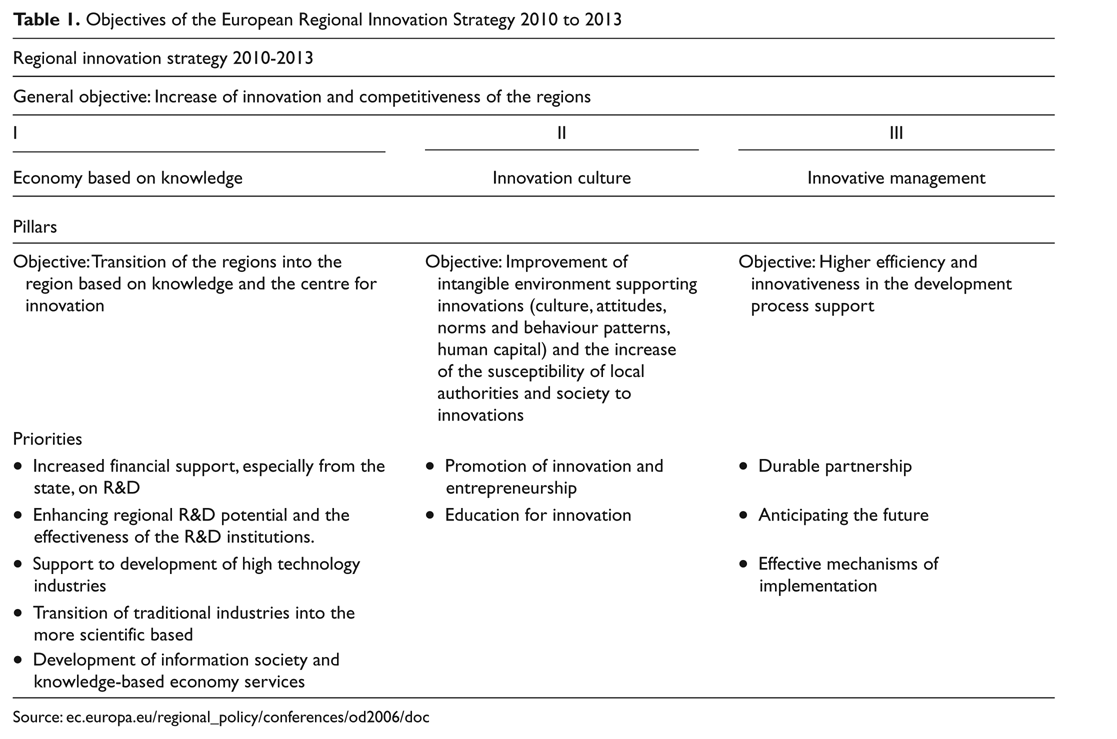
Table 1 illustrates the objectives of the European regional innovation strategy for the period 2010 to 2013. Figure 2 illustrates the links of regional systems of innovation. The EU’s strategy toward regional innovation policy should emphasize in the following points:
Objectives of the European Regional Innovation Strategy 2010 to 2013
enhance the scientific and innovation framework and the related structural changes,
encourage and expand the creation and growth of innovative enterprises, and
improve the key interfaces in the innovation system.
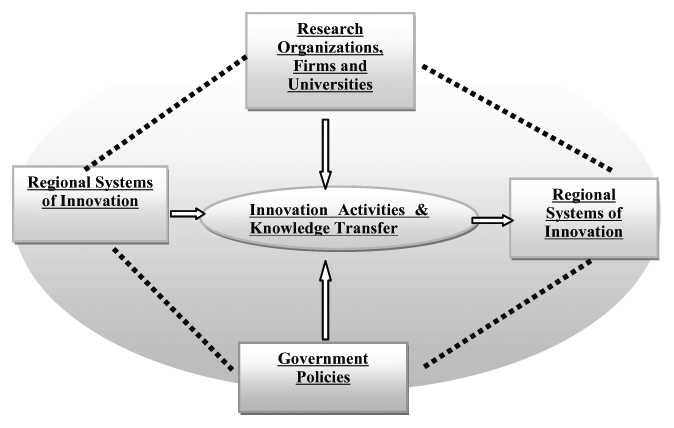
The regional systems of innovation
European Innovation Policy and Regional Cohesion in Europe
During the 1960s, several attempts were made to develop cross-national research groupings. For instance, in 1962, Siemens, Olivetti, Elliott Automation (these later formed the core of International Computer Limited [ICL]), and Bull tried to create a cross-European research grouping. However, this attempt was unsuccessful. In 1969, the Eurodata consortiums (ICL, CII, Philips, AEG, Telefuken, Saab, and Olivetti) established the European Space Research Organisation (ESRO) for computer requirements but this also failed. Until the end of the late 1980s, the Community’s research policy was orientated mainly toward coordination of the national technology policies of member states rather than to pursue a coherent technology policy. Most of the criteria used by the Community research policy were based on quality rather than our needs. However, during 1982 to 1990, a more coherent and clear technology policy began to develop. The European Single Act and the Treaty of Maastricht worked toward this direction. In 1987, things changed; the SEA explicitly legitimized the Community dimension in scientific and technical cooperation within Europe by giving the Community formal power in the fields of research and technology. Articles 130f-130g of SEA embody a research and technology policy that enjoys equal status with other Community areas, such as economic, social, and competition policy. The European Council of Barcelona emphasized the importance of research and innovation by setting the goal of increasing the level of expenditure in research and development to 3% of GDP by 2010. Although investing more in R&D is one part of the equation, another is better coordination of European research. This has been initiated through the creation of the European Research Area (ERA) and related policy actions, such as the “benchmarking of national research policies.” The ERA is the broad heading for a range of linked policies attempting to ensure consistency of European research and facilitate the research policies of individual member states to improve the efficiency of European research potentialities.
The Lisbon strategy becomes all the more important (European Commission, 2003). As decided by the Heads of State and Governments at the Lisbon Summit in 2000, this strategy aims to transfer the European Union (EU) by 2010 into “the most competitive and dynamic knowledge-based economy in the world capable of sustainable economic growth with more and better jobs and greater social cohesion.” The set of measures and decisions taken then, better known as “the Lisbon strategy,” entail reforms in three main dimensions:
further consolidation and unification of the European economic environment;
improvement of the creation, absorption, diffusion, and exploitation of knowledge; and
modernization of the social model.
The European technological policy implemented through research framework programs that aim to strengthen the international competitiveness of European industry in high technology sectors and more specifically as against the United States and Japan (INNOMETRICS, 2009). The objectives of the Community’s framework programs are to (Korres, 2009)
enhance European industrial competitiveness,
set up a vast unified market by promoting standardization and open procurement,
improve the effectiveness of the Community’s scientific and technical cooperation,
promote agricultural competitiveness,
speed up the marketing of new technologies by carrying out programs for the application of information technologies,
help the least favored regions of Community (LFR) obtain access to new technologies, and
encourage small and medium enterprises (SMEs) and continuing education and training.
Table 2 illustrates the emerging technologies for the EU vis-à-vis United States and Japan. Cohesion is strong on the part of both national and supranational political processes in Europe. During the period 1994 to 1999, Structural Funds allocated money to regions on the basis of six “objectives” (Sapir, 2003):
Emerging Technologies

supporting development and structural adjustment of regions whose development is lagging behind. They received 68% of the funds. In 1999, 24.6% of the EU population lived in regions that received Objective 1 funding from the EU;
helping frontier regions or parts of regions seriously affected by industrial decline;
combating long-term unemployment and facilitating the integration into working life of young people and persons exposed to exclusion from the labor market;
facilitating the adaptation of workers to structural change;
speeding up the adjustment of agricultural structures as part of Common Agricultural Policy (CAP) reform (Objective 5a), facilitating the development and structural adjustment of rural areas (Objective 5b);
promoting the development and structural adjustment of regions with low population density (since 1995).
“Europe Strategy 2020” is a 10-year growth strategy proposed by the European Commission in March 2010 for reviving the economy of the EU to become a smart, sustainable, and inclusive economy. The commission identifies three key drivers for growth, to be implemented through concrete actions at EU and national levels:
smart growth (fostering knowledge, innovation, education, and digital society),
sustainable growth (making production more resource efficient while boosting competitiveness), and
inclusive growth (raising participation in the labor market, the acquisition of skills, and the fight against poverty).
Table 3 illustrates the innovation growth leaders for EU, whereas Table 4 illustrates the research and scientific and technological profile of European member states.
The main findings of the European regions can be summarized as follows:
Innovation Growth Leaders

Source: European Innovation Scoreboard, 2010.
R&ST Profile of European Member States

Note. S&E = science and engineering; SSH = second-stage of tertiary education; SME = small and medium enterprises; EPO = European Patent Office.
Source: European Innovation Scoreboard, 2010.
There is considerable diversity in regional innovation performances. The results show that all countries have regions at different levels of performance. The most heterogeneous countries are Spain, Italy, and Czech Republic where innovation performance varies from low to medium high.
The most innovative regions are typically in the most innovative countries. Noord-Brabant in the Netherlands is a high innovating region located in an innovation follower country. Praha in the Czech Republic; Pais Vasco, Comunidad Foral de Navarra, Comunidad de Madrid, and Cataluρa in Spain; Lombardia and Emilia-Romagna in Italy; Oslo og Akershus, Agder og Rogaland, and Vestlandet in Norway are all medium-high innovating regions from moderate innovators. The capital region in Romania, Bucuresti–Ilfov, is a medium-low innovating region in a catching-up country.
Regions have different strengths and weaknesses. There are no straightforward relationships between level of performance and relative strengths; it can be noted that many of the “low innovators” have relative weaknesses in the dimension of innovation enablers that include human resources.
Regional performance appears relatively stable since 2004. Most of the changes are positive and relate to Cataluρa, Comunidad Valenciana, Illes Balears, and Ceuta (Spain); Bassin Parisien, Est, and Sud-Ouest (France); Unterfranken (Germany); Kφzιp-Dunαntl (Hungary); Algarve (Portugal); and Hedmark og Oppland (Norway).
Policy Implications and Conclusions
In the literature, there are various explanations for the slowdown in productivity growth for EU countries. One source of the slowdown may be substantial changes in the industrial composition of output, employment, capital accumulation, and resource utilization. The second source of the slowdown in productivity growth may be that technological opportunities have declined; otherwise, new technologies have been developed but the application of new technologies to production has been less successful. Technological factors act in a long-run way and should not be expected to explain medium-run variations in the growth of GDP and productivity. Most of the efforts of the last 30 years in innovation and R&D activities have been directly linked to the following policies:
in the 1980s, attention toward Japan: technology pouch (Framework Program)
in 2000s, attention toward USA: competitiveness push: (Lisbon Strategy)
today, attention toward importance of Information and Communication Technologies (ICT), sustainability, social innovation, and demand pull measures (Europe 2020).
In the light of these remarks, Community technological policy has to be reinforced and oriented on several fronts:
Establish a coherent technological policy.
Target and concentrate more effectively on the technological capabilities of the small member states. A coordination with the broader Community instruments and resources (CSFs) can create a much more favorable effect on the productive capabilities of these countries.
The traditional industries that are quite an important factor for the weaker states should be supported by appropriate research and technological programs.
The Community could envisage specific programs for technological diffusion in the small member states.
Human capital formation should have a particular position in the Community policies vis-à-vis the smaller countries. The Community’s technological policy aims to enhance the international demand for research activities and consequently to reinforce the weak internal market demand of the small member states. This creates the opportunity to expand activities that otherwise would probably have remained at much lower levels.
Investment in knowledge—research and development expenditure, education, and software—and venture capital investment, for instance, spending patterns in the perspective of the knowledge economy.
Technology policy has been relatively successful in certain fields like telecommunications or traffic control systems. In other fields, like microelectronics and computers, the results have been mixed.
There is considerable diversity in regional innovation performances. The results show that all countries have regions at different levels of performance. This emphasizes the need for policies to reflect regional contexts and for better data to assess regional innovation performances. The most heterogeneous countries are Spain, Italy, and Czech Republic where innovation performance varies from low to medium high.
The most innovative regions are typically in the most innovative countries. Noord-Brabant is a high innovating region located in an “innovation follower” country (the Netherlands).
Praha in the Czech Republic; Pais Vasco, Comunidad Foral de Navarra, Comunidad de Madrid, and Cataluña in Spain; Lombardia and Emilia-Romagna in Italy; Zahodna Slovenija in Slovenia; and Oslo og Akershus, Sør-Østlandet, Agder og Rogaland, Vestlandet, and Trøndelag in Norway are all medium-high innovating regions from moderate innovators and catching-up countries.
The capital regions in Hungary and Slovakia show an innovation level at the EU average but are located in catching-up countries whose overall innovation performance is well below average.
Regional performance appears relatively stable since 2004. The pattern of innovation is quite stable between year 2004 and 2009, with only a few changes in group membership. More specifically, most of the changes are positive and relate to Cataluña, Comunidad Valenciana, Illes Balears, and Ceuta (Spain); Bassin Parisien and Sud-Ouest (France); Unterfranken (Germany); Közép-Dunántúl (Hungary); Algarve (Portugal); and Hedmark og Oppland (Norway). Longer time series data would be needed to analyze the dynamics of regional innovation performance and how this might relate to other factors such as changes in GDP, industrial structure, and public policies.
Footnotes
The author(s) declared no potential conflicts of interest with respect to the research, authorship, and/or publication of this article.
The author(s) received no financial support for the research and/or authorship of this article.