




Abstract
A 63-year-old overweight female prediagnosed of stress urinary incontinence presented with exacerbated events of urine leakage. She was advised a residential lifestyle and behavioral program, primarily consisting of a monitored yoga therapy module, apart from her ongoing anticholinergic medicine, for 21 days. Assessments were based on a frequency volume chart, a bladder diary for the entire duration of treatment, and the International Consultation on Incontinence Modular Questionnaire-Urinary Incontinence Short Form questionnaire on the days of admission and discharge. A total of 1.9 kg of weight loss was observed during her stay. Usage of pad, as reported in her diary, reduced from 3 to 1 per day. Her International Consultation on Incontinence Modular Questionnaire-Urinary Incontinence Short Form score reduced from 16 to 9, indicating better continence. She expressed subjective well-being and confidence in her social interactions. This is probably the first case report demonstrating feasibility of integration of yoga therapy in the management of urinary incontinence.
Introduction
In India, yoga and naturopathy are grouped together as a separate system of medicine, and the Government of India’s Ministry of Health & Family Welfare has constituted a Central Council for Research in Yoga and Naturopathy for its development. 1 Yoga therapy is often prescribed by naturopathy physicians for the management of urinary incontinence as adjunct care without interfering in the mainstream medicinal treatment protocol, if any. Bladder retraining and pelvic floor muscle exercises are first-line treatments for persons without cognitive impairment who present with urge incontinence. 2 Yoga techniques have a lot to offer in this area as well. Literature suggests that yoga has shown to reduce inflammation and might help in reduction of urge incontinence symptoms. 3 Findings from a pilot trial support the feasibility, efficacy and safety of group-based yoga therapy intervention in women (mean age ± standard deviation = 61.4 ± 8.2) in the improvement of urinary incontinence. 4 Reports of integrative use of yoga in urinary incontinence are scarce; here, we report the case of a patient who showed measurable response to a novel protocol of yoga conjunctive to medicine.
Case Report
A 63-year-old overweight female prediagnosed with stress urinary incontinence presented in our lifestyle medicine clinic in March 2014, with exacerbated events of urine leakage several times in a day. She reported embarrassment in socialization and limited activity level. Physical examination ruled out tumor and neurological causes of incontinence. Her medical history revealed use of anticholinergic medication on and off, and she was on fesoterodine fumarate 4 mg daily. She was advised to undergo a residential lifestyle and behavioral program, primarily consisting of a monitored yoga therapy module, apart from her ongoing medication. The total duration of the residential program was 21 days.
An institutionally qualified naturopathy physician with five years of experience administered the yoga therapy. Yoga therapy involved the practice of physical postures (asanas), voluntarily regulated breathing techniques (pranayamas), meditation (dhyana), and a special practice called Ashwini mudra for a total of 3 hours split in to 2 sessions daily (Table 1). Ashwini mudra embraces the contraction as well as the relaxation related to the gluteal muscles, perineum, sphincter, as well as the entire pelvic floor. 5
Description of Yoga Practices Given for the Urinary Incontinence Patient.

aGiven the severity of urinary incontinence, the patient was advised supine postures alone.
Additionally, the patient was kept on a vegetarian diet with restricted fluid intake, especially in the late evenings. She was counselled on the importance of weight management and was encouraged walking and mild to moderate physical activity. She was informed of the possible study and a signed informed consent was obtained. The institutional ethics committee of both the affiliate institutes approved the study.
Evaluation
A detailed case history was taken after our patient consented to participate in the study. After initial counseling, resting blood pressure, heart rate measurements, height, and weight were recorded. Assessments were based on a frequency volume chart, a bladder diary for the entire duration of treatment, and the International Consultation on Incontinence Modular Questionnaire-Urinary Incontinence Short Form 6 questionnaire on the days of admission and discharge. The International Consultation on Incontinence Modular Questionnaire-Urinary Incontinence Short Form consists of 3 scored items and an unscored self-diagnostic item, allowing assessment of prevalence, frequency, and perceived cause of urinary incontinence, and its impact on everyday life. 6 Pretreatment and posttreatment measures are summarized in Table 2. Her medication was not modified with during the 21-day treatment period. On discharge, she was advised to continue few of the yogic practices. One month postdischarge, she was contacted over phone, and she reported minimal associated discomfort and withdrawal of medicine in consultation with her medical physician.
Pretreatment and Posttreatment Results.
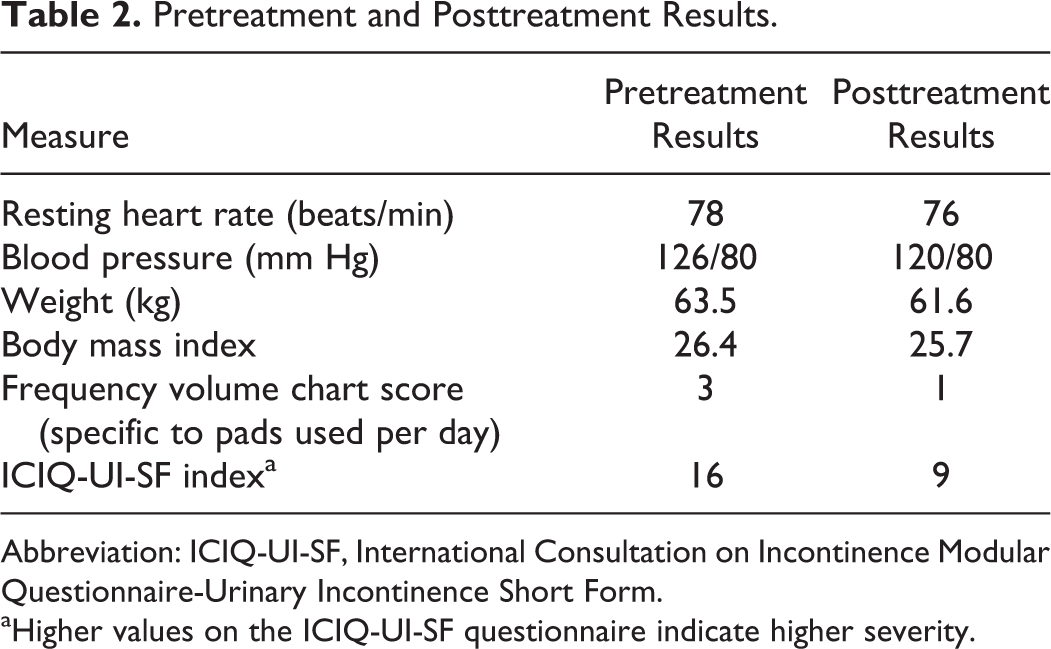
Abbreviation: ICIQ-UI-SF, International Consultation on Incontinence Modular Questionnaire-Urinary Incontinence Short Form.
aHigher values on the ICIQ-UI-SF questionnaire indicate higher severity.
Discussion
Following 21 days of residential treatment with yoga therapy, there was significant reduction in the symptoms of incontinence in our patient. The usage of pad reduced from 3 to 1 per day from the 16th day. Her weight showed a reduction of 1.9 kg over a period of 21 days, with a corresponding decrease of 0.7 units in her body mass index. She expressed subjective well-being and confidence in her social interactions. The effect of yoga can be attributed to the training of perineal muscles helping in maintaining continence. A short-term yoga-based lifestyle intervention has shown significant reduction in the cortisol and interleukin-6 and tumor necrosis factor-α levels suggesting improvement of the clinical profile of patients with chronic diseases in terms of stress and inflammation. 7 Increased mindfulness achieved during yoga practices might be attributed to stress reduction. 8 A short, 6-day yoga and diet residential program has shown to decrease body mass index and total fat-free mass. 9 The reduction in the weight loss of our patient may be attributed to the practice of yoga and a low-fat, high-fiber, vegetarian diet. Even though we measured the body mass index, other physiological changes such as serum cholesterol were not monitored that could have changed due to the changes in the diet and yoga practices. This is a shortcoming of this case report, and it is suggested to take this into account for further studies that might be conducted.
Conclusion
To our knowledge, this is the first case report demonstrating feasibility of integration of yoga therapy in the management of urinary incontinence. This case report furthers the scope for clinical trials to evaluate the efficacy of yoga therapy in the management of urinary incontinence. Yoga therapy is relatively safe and well-tolerated as a therapeutic modality that may be considered as an integrative approach in the management of urinary incontinence.
Footnotes
Authors’ Note
Institution where the case was treated: Holistic Health Home, Swami Vivekananda Yoga Anusandhana Samsthana, Bengaluru, India.
Author Contributions
SAV was involved in designing, selection of participant, recording consent, interpreting results, literature review, and proofreading of the article. DVA was involved in designing, selection of evaluation techniques, literature review, writing of the article, and proofreading.
Declaration of Conflicting Interests
The authors declared no potential conflicts of interest with respect to the research, authorship, and/or publication of this article.
Funding
The authors received no financial support for the research, authorship, and/or publication of this article.
Ethical Approval
Swami Vivekananda Yoga Anusandhana Samsthana ethics committee and the National Institute of Naturopathy review board approved this study.