




Abstract
Constipation in children with bowel movement less than 3 times a week and lasting for more than 3 months is defined as pediatric chronic constipation. According to traditional Persian medicine resources, dryness of food, low nutrition, hotness or dryness of the gastrointestinal tract, intestine sensory loss, excessive urination, increase of evaporation, and sweating because of heavy exercise will together constitute the condition for constipation occurrence. Lifestyle changes considered as premier of medical intervention for constipation. Treatment of constipation in children vastly benefitted from traditional Persian medicine, including simple dietary measures, oil massages, and herbal medicines. This investigation was performed to somewhat help the anxious academics to achieve proper findings in the field of gastroenterology, in pursuit of the traditional Persian medicine advices.
Introduction
Constipation, the condition of having difficulty in bowel movement, is medically referred to as the unintentional postponement in bowel relief in 2 weeks or more. 1 Constipation in children with bowel movement less than 3 times a week and lasting for more than 3 months is defined as pediatric chronic constipation. 2 This issue is a common problem, particularly in developed countries. 3
Almost 15% of the people in the world suffer from constipation. 4 Pediatric constipation, as a common complication, comprises 3% of general pediatric clinics and 10% to 25% of pediatric gastroenterology clinic referrals. 1 In Asia, the rate of chronic constipation is about 14%. 5 The most common type of constipation is functional except during the neonatal period. 6
At present, a number of medical approaches are evaluated for the management of constipation. But the results are not yet satisfactory. 7 Therefore, information and experiences of traditional systems of medicine in the management of constipation might have beneficial points for consideration. Among those, traditional Persian medicine, which is a sum of other traditional medical knowledge as well as their indigenous experiences, 8 has presented various aspects and approaches to constipation.
The establishment of the traditional Persian medicine diagnostic model has been evoked on the diagnosis of imbalance in temperament. 9 Application of such a model by the administration of nutritional schemes and medical remedies will balance the body temperament.
The term, asbab in traditional Persian medicine is a pattern concerning both health promotion and disease causes. Early Persian physicians believed that diminishing the health requirement (asbab-e-salamat) by the domination of the disease causes (asbab-e-maraz) will induce a situation to let the disease appear. According to traditional Persian medicine concepts, the development of constipation is due to a few causes, predominantly when the disease causes overcome the health causes. The balance of temperament and humors constitutes the health status (Table 1).
The Etiology (Asbab) of Constipation in Conventional Medicine and Traditional Persian Medicine.

a Foods with cold temperament comprise dairy products and sour foods such as pickle, beef.
b In this condition, the bowel movements is slower than normal.
c In this condition, the ingested foods lose their wetness more than normal condition and their feces become hard.
d In this condition, the repulsive power of the gastrointestinal tract diminishes and low frequency of bowel habits develops.
The term sue-e-mezaj, called dystemperament, is a condition by which the quality or amount of humors (blood, phlegm, bile, and black bile) goes to imbalance. Simple dystemperament occurs during changes in organ quality. Accordingly, the involved organ has gotten colder, warmer, wetter, or drier than normal state. In dystemperament with matter, the morbid matter or a bad humor is added to the involved organ in addition to an extra quality. Each humor has 2 different qualities that are not contrary to each other. Blood, phlegm, bile, and black bile are warm-wet, cold-wet, warm-dry, and cold-dry in their qualities, respectively. As an example, if the phlegm is more than normal in the body, dystemperament with cold and wet matter would dominate the body. Under certain occasions, individual organ or the whole body may be subjected to dystemperament. As a rule, Persian practitioners mentioned that the dystemperament in gastrointestinal tract results to constipation. 10
The term Setteh-ye-Zarurieah (the 6 essentials), 11 which stands at the frontier of the persisting efforts for sustaining the health, replaces the administration of medicine in case it proves to be ineffective. These essential schemes were mentioned as weather, eating and drinking, body movement and repose, sleeping, retention-release, and awakening as well as mental states. 12
In traditional Persian medicine, eateghal-e-batn refers to constipation and is considered as signs of a certain disease. Temporary constipation, if not accompanied with an intricate situation or by failure of normal functioning of an organ, is attributed to disregard of proper eating routines and can be revealed by administrating nutritional schemes.
Constipation, accompanied by pain and organ dysfunction, is the sign of colitis (Ghulanj), which reveals the status of intestinal disease. Children bearing humid and warm temperament, as their growing ages demand, need accurate observance of health schemes. These schemes should be supplemented by food varieties to help with their gastrointestinal tract prematurity conditions, whereas any neglect in proper observance would result in the emergence of higher constipation incidences. 10 Here, we surveyed to find a definition for constipation in traditional Persian medicine as well as in conventional medicine.
Methods
The method employed in this survey was to review some important traditional Iranian medical sources such as Canon of Medicine, 10 Zakhīrah-i Khvārazm’Shāhī (The Treasure of Khvarazm’Shah), 13 Kholasat-ol-hekmah (Summary of Wisdom), 14 Kholasat-ol-Tajarob (Summery of Experiences), Makhzan-ol-adwiyah (The Storehouse of Medicaments), 15 Tofat-ol-momenin (The Present for the Faithful), 16 Al-aghraz al-tibbia val mabahess al-alaiia (Medical Objectives and Excellent Researches), 17 Tib-e-akbari (Akbar’s Medicine), 18 and Kitab Kamil al-sina'ah al-tibbiyah (The Complete Book of the Medical Art). 19,20
In addition, for all medieval herbal medicaments, an extensive search via scientific databases such as Medline, EMBASE, Scopus, and Science Iranian Database (SID) was performed to find related works concerning “children constipation” and “laxative” herbs.
Limitations
We compare 2 schools with a completely different approach and different tools for diagnosis and treatment. It is clear that we could not match these 2 scientific languages perfectly. We are completely aware of new interventions in the management of constipation in children; however, we are not supposed to review and repeat these successes. The present article has a historical approach and we did not claim that our work comprises all eras and all traditional schools, but is limited to major Persian resources in the medieval era. Some medical recommendations mentioned in the current work may also be found in other schools like traditional Chinese medicine.
Etiology of Constipation in Conventional Medicine
Painful bowel movement, with its reaction by bowel holding, is the result of nonpathogenic functional constipation. 6 In the modern era, industrialization, diet changes, and lack of adequate physical activity would result in higher incidence of constipation. 3 Low-fiber diet could frequently cause constipation. 21 Neurodevelopmental disorders in children can be accompanied with constipation as it is difficult for them to sustain the required bowel habits. 22
Overweight and obesity in 60% of the people in Iran is associated with functional constipation. 23 Families with history of constipation and suffering from stress are also faced with constipation in their children. 24 Children fearing from pain of bowel movement resist the administration of medication and hence continuation of constipation prevails. 24 It is observed that overweight is associated with fecal incontinence. 25 It is also observed that antacids and antibiotics, anticholinergics, antihypertensives, anticonvulsants, diuretics, laxatives, opioids, and muscle relaxant agents can produce constipation. 26
Etiology in Traditional Medicine
According to the findings and perspectives of traditional Persian medicine, constipation is a phenomenon that can be caused by weak repulsion of the stomach. The repulsive action of the stomach may be disrupted due to 3 main reasons. The first reason is the ileus or bowel obstruction caused by inflammation of small intestines, and subsequently polydipsia and fever may occur. Second is the disabled repulsive force that is a result of cold dystemperament of the stomach or ingestion of food with cold temperament. The third factor is the dehydrated stool deposited in the loops of intestine. 27 Dryness of food, low nutrition, hotness or dryness of the gastrointestinal tract, intestine sensory loss, excessive urination, increase of evaporation and sweating (Tahlil), and high temperature and exercise will together constitute the condition for constipation occurrence as the author of Sharh-ol-Asbab believed. 28 On different occasions, in traditional Persian medical manuscripts, stomach is meant as the whole gastrointestinal tract. According to the standpoints of Aghili (the author of Kholasat-ol-hekmat), the temperament of the children is warmer and wetter than that of the adults, and the wetness weakens the children’s gastrointestinal tract, bringing about constipation. 14 A special scheme can be adopted to establish equilibrium between food intake and developing the growth in children, if supplemented by proper parental supervision. Otherwise the risk of gastrointestinal problems in children would increase. Children are in need of different nutritional foods, while contrary to adults the immature gastrointestinal tract is incapable to digest different types of foods. Such behavior can be attributed to the high wetness of their gastrointestinal tract. But at the same time they urgently need very different nutritional foods to grow. Adoption of simple nutritional schemes can prevent the children from undergoing constipation, a frequent cause of gastrointestinal tract malfunction. Colitis (ghulanj) is a disease recognized when constipation occurs as its main symptom. This disease has been divided into 5 groups based on the book Al-Aghraz-ot-Tebbiah authored by Jorjani. 17
These groups were mentioned as hardness of stool (sofli), thick mucus or phlegm trapped in colon and cecum (soddehie), production of condense gas in gastrointestinal tract resulting from inadequate heating (rihi), a result of severe inflammation of intestine and adjunct organs (kidney, bladder, and liver) accompanied by fever, thirst, and palpation (varami), and when a portion of the intestine’s loops twists due to improper body movement (eltevaii). 27 Bowel movements every few days may be accompanied by a kind of Ghulanj, which is affected by neurosensory loss of intestines. 27
Ghulanj of sofli, soddehie, rihi, neurosensory loss, and weak repulsion are the signs of functional constipation in children. Ghulanj of eltevaii and varami are related to the constipation resulting from organic causes. Taken as a whole, Ghulanj was classified by Rhazes and Avicenna similarly.
Treatment in Conventional Medicine
Successful treatment for constipation in children cannot be achieved without diet control and taking continuation medication. Investigation revealed that children having regular diets of high-fiber foods during the medical interventions had better response to the treatment. 29 Studies often proved that the application of paraffin and polyethylene glycol for children suffering from chronic constipation would affect similarly. 30
In spite of the safe administration of such medicaments, children of chronic cases may undergo nausea and fluctuation. 31
According to the observation of some researchers, diets recommended by nutritionists could help the medication in children suffering from constipation. 29 However, the effect of fiber-free diets in children with developing constipation was the finding of Roma et al. 32 Abdominal massage by mothers gives a positive sensation to them as they find the process effective for the relief of constipation. 33 Administration of laxative, as most physicians believe, has significant effect in increasing the frequency of bowel movements as well as elimination of disease symptoms. 34
Four main groups of laxatives, namely, bulk-forming agents, osmotic agents, stool softener, and stimulant laxatives, are frequently prescribed among oral medicines for the management of chronic constipation. No undesirable effects have been observed from bulk-forming administration, while flatulence was the only response to be considered. The investigation also showed that osmotic agents were second-line treatment compared with stool softeners regarding the tolerance effects. Stimulants will stimulate peristalsis and nerve endings by the hydrolyzation process in the intestine. Melanosis coli and neurogenic bowel disorders might be the outcome of long-term administration of the stimulants. Other clinical trials have represented that no advantages of Senna or Cassia, as an example of stimulants, was observed when used instead of osmotic agents. Few adverse effects have been reported with the administration of polyethylene glycol. In this regard, diarrhea may be a cause of its use in chronic cases. 31 Flaxseed, a natural laxative, was found to be effective in the treatment of constipation. 33 Administration of symbiotic agents such as paraffin was found effective in natural therapy for constipation. 35 On the other hand, no side effects were seen in long-term application of polyethylene glycol in children 3 to 30 months of age who had chronic constipation, bearing or not with encopresis. 36
Medical Approaches in Traditional Persian Medicine
Treatment of constipation in children vastly benefitted from traditional Persian medicine, including simple dietary measures, oil massages, and herbal medicines. In that achievement, diagnosis and treatments are arranged for the organ involved and the patient’s temperament (Mezaj). To gain its stability and balance, the impaired organ would be targeted by the physician administering medications and nutritional schemes through the application of this diagnostic model. This model was also applied to gastrointestinal tract problems in constipated patients. Dystemperament (sue-e-mezaj) in the gastrointestinal tract, from the standpoint of traditional medicine, is an imbalance in mezaj of the respective organs malfunctioning partially or totally in a constipated patient.
As mentioned before, the 6 essentials or lifestyle changes are prior to medical treatment in the management of the patients. These are some examples of considering Setteh-ye-Zarurieah (6 essentials) to encounter children with functional constipations.
Weather
Warm seasons and warm places predispose the susceptible children to develop constipation. Children who have warm and dry temperament and in other words are very thin and active develop constipation if they did not observe the nutritional schemes and did not drink enough water. They should not exercise in hot weather and have enough rest. Onerous exercises and inadequate rest exposed them in the risk of developing constipation.
Eating and Drinking
Cold drinks especially just before, after, or with meals cause developing constipation in susceptible children. The ones who have cold temperament and the time of passing chewed morsels from their gastrointestinal tracts are longer than normal have a low tolerance to cold foods like ice cream, pickles, and cold drinks. Heavy meals and the foods that have difficult digestion predispose these children to constipation.
Body Movement and Repose
Rest and activity time is a subject of concern in control of constipation in children. The children with cold and wet temperament (obese) should increase their activities and the children with warm and dry temperament (thin) should decrease their activities particularly in warm climates or use compensatory nutritional schemes to prevent constipation.
Sleeping and Awakening
Obese children should sleep less than normal weight children, and thin ones should sleep more. Sleeping just after a meal and daily rest are not recommended for obese children.
Retention and Release
Children should be taught normal bowel habits. Stool retention causes a vicious cycle of hardening stool and difficult defecation. Soiling is the other complication of stool retention. 10
Some of the most important constipation-related disorders that are mentioned in traditional Persian medical manuscripts are explained below.
Ghulanj-e-sofli can result from food diets of oil grilled egg, dried and stale cheese, stale bread and flour, and also sever physical exercises, excessive sweating or urinating, stool holding, and having intercourse following taking meals. The symptoms of this kind of colitis are delayed defecation, loss of appetite, craving for pickles, abdominal spasm and pain, backache, leg pain, and thirst. Mixture of brown sugar and butter from fresh milk, fig, seedless currant, and cassia are the treatments recommended for this disease. Ghulanj-e-balghami might occur due to the excessive ingestion of wafer, beef and goat meat, milk, and some fresh fruits such as sour apple, sour pear, and squash. The main symptoms of this disease are the heaviness and coldness of the lower parts of the body. Administration of suppositories formulated from bitter cucumber and Tragacantha fasciculifolia (Boiss.) Kuntze (a kind of Tragacanth) was recommended by early Persian physicians. Ghulanj-e-rihi may be an undesirable effect of medicaments such as coriander, pumpkin, and cucumber, especially when cold water is drunk after a heavy meal. For the treatment, garlic is recommended. Refraining from eating for a few days would reduce the symptoms. 14,17
One of the remarked causes of Ghulanj was reported as weakness of repulsive power. The recommended treatment is the administration of a multi-ingredient medicine called Aperient or healthy purgative (Ayaraj-e-fighara) and a kind of pottage (espidbaj). On the contrary, avoidance of pickles should be included. In case of bowel desensitization, the treatment lines can be composed of a medical multi-ingredient oral solution of fennel (Maa-ol-osool), sweet almond oil, or castor oil. Additionally, oral administration of a compound medicament of honey and rose (Golghand), Cassia fistula L. (Cassia), and Descurainia sophia (L.) Webb ex Prantl (Flixweed) as well as topical application of olive oil or castor oil were recommended by medieval Persian practitioners. 10,14,18
The application of Descurainia sophia (L.) Webb ex Prantl (traditionally named as Khobbeh or Khaksheer) was highly recommended by the author of Makhzan-ol-advieh to restore the warmness to the gastrointestinal tract. He also prescribed Tragacanth (traditionally named as katira) for the prevention of headache and as an adjuvant therapy. 15 As a result for the application of flixweed, digestion will improve and appetite will be increased in constipated children. 16
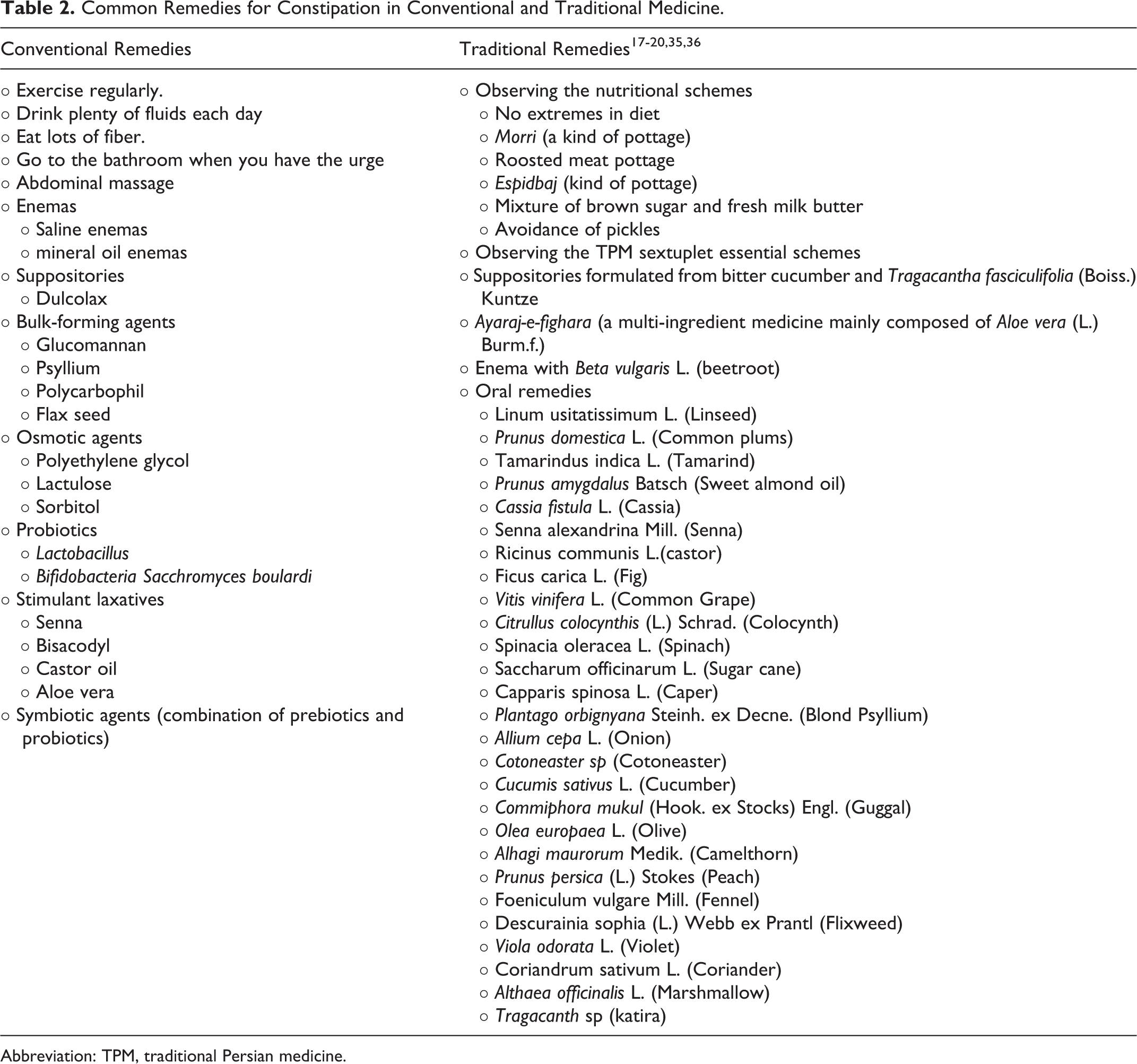
Prunus amygdalus Batsch (Sweet almond), Alhagi maurorum Medik. (Persian mannaplant), Cotoneaster sp (Cotoneaster), and Senna alexandrina Mill were also mentioned as emollients in children’s constipation. 37 Moreover, drinking Morri (a kind of pottage), eating roasted meat pottage, doing exercise and enema with Beta vulgaris L. (beet), Viola odorata L. (Violet), Althaea officinalis L. (Marshmallow), Ficus carica L. (Fig), Coriandrum sativum L. (Coriander), and Cassia fistula L. (Cassia) are other recommended interventions. 28 Application of sweet almond oil with or without butter was also prescribed for abdominal massage. It was also remarked that while massaging, the mother should rub her hands down to the pubic area of her child in order to evoke the sensation of bowel relieving. A poultice of cassia has proved to be beneficial (Table 2). Use of enema and suppositories has been recommended by Aghili as the first line of intervention. However, he indicated oral drug administration as the next line. 14
Common Remedies for Constipation in Conventional and Traditional Medicine.
Abbreviation: TPM, traditional Persian medicine.
Discussion
In recent years, researchers and clinicians have had a great interest toward complementary medicine all over the world. The reason for this concern is the lack of success of the conventional approach for complete treatment of chronic diseases such as diabetes mellitus, cardiovascular diseases, and different types of cancers and community acceptance of natural remedy as a safe alternative to chemical medicines. Research reveals that many people in Western communities use complementary medicine for many common diseases such as depression, diabetes, and cardiovascular disease. 38
Traditional Persian medicine is a medical school based on humeral medicine. The diagnostic model of traditional medicine is not the same as conventional medicine. In this approach, diagnosis and treatment are based on defining the temperament of the patients and turning back to healthy temperament, if the physician assumes that it is out of the healthy temperament’s range. After that, the physician should find the causes of this dystemperament. In conventional medicine, signs and symptoms help the clinicians to get to the true diagnosis, for example, chest pain may be symptom of a cardiac attack. 39 Similar to traditional Chinese medicine and ayurveda, traditional Persian medicine has a holistic approach to the patients. Accordingly, the patient should be treated, but not the disease. For this reason, the physician considers both body and spirit to treat a patient. In spite of physicians of conventional medicine who seek the signs and symptoms of a certain disease to find a medical treatment for them, the physicians of traditional Persian medicine seek to find the predisposing causes of the development of the diseases in patients. These causes are summarized in 6 essentials of the life that are very similar to current lifestyle recommendations. Without considering these 6 essentials, the physicians would not be able to control and treat the disease states.
Concerning the herbal management of pediatric constipation due to medieval manuscripts of traditional Persian medicine, related clinical investigation and experimental evaluations are scant. With reference to Table 2, only few of the reported herbs were found to possess laxative effect. Aqueous and butanol extracts of Violet represented good laxative effect in animal models. 40 Peach leaf aqueous crude extract revealed laxative effect, which is more likely related to cholinergic action. 41 The laxative effects of senna and cassia were also proved in prior investigations. 42,43 On the other hand, castor oil and olive oil have been applied for the management of constipation and there are many documents to confirm their activity. 44,45 However, claims on the laxative effect of most reported medicaments have not yet been confirmed by modern medicine.
Conclusion
Lack of dietary care for children, as Avicenna and his followers believed, has the worst impact on children’s constipation status. Hence, nutritional schemes are recommended at the beginning of the management followed by using simple or monoingredient medicinal herbs, while ensuring no adverse effects. Other than the historical clarification of medical development during the medieval era, the current survey may also be beneficial for further investigation.
The authors of this article do not claim that the conventional approach could be replaced by traditional Persian Medicine, but they recommend that beneficial advises of traditional Persian medicine such as considering the 6 essentials of life in the treatment of constipation are the important subjects that should be examined by interested researchers. Our desire is that the earlier researches performed by us would help the anxious academics to achieve proper findings in the field of gastroenterology, in pursuit of the traditional Persian medicine advices. In the content of Traditional Medicine of Shiraz University of Medical Sciences, a medical team is trying those schemes for treating children suffering from constipation. First, the team began with a popular beverage of Descurainia sophia (L.) Webb ex Prantl and obtained results filled with hope.
Footnotes
Acknowledgments
The study was done in the School of Traditional Medicine, Tehran University of Medical Sciences.
Author Contributions
MN wrote the draft and contributed in data gathering and writing the final version of the article. MMZ rewrote the draft and contributed in data gathering and writing the final version of the article. The other coauthors contributed in the guidance, revision, and correction of the article.
Declaration of Conflicting Interests
The authors declared no potential conflicts of interest with respect to the research, authorship, and/or publication of this article.
Funding
The authors received no financial support for the research, authorship, and/or publication of this article.
Ethical Approval
Ethical approval is not required for this study as no human subjects were involved.