




Abstract
Joshanda is a polyherbal product that is commonly used in the treatment of cold and flu usually accompanied by fever. The present study was designed to scrutinize the antipyretic activity of a decoction of Joshanda and its total saponin and sterol contents in brewer’s yeast induced febrile mice. The results revealed marked attenuation of induced pyrexia by the decoction and its saponin contents during various assessment times (1-5 hours) in a dose-dependent manner, which were not supported by sterol contents. The maximum antihyperthermic effect of the decoction and saponin contents were 75.38% and 81.32%, respectively, at 300 mg/kg i.p. This findings suggested that Joshanda extracts strongly ameliorated induced pyrexia and thus validated it as a useful household remedy for cold and flu accompanied by fever.
Joshanda is a polyherbal formulation of Unani origin (Greco-Arab). It is largely used for the treatment of inflammation of the mucous membranes of the nose and air passages. 1 Joshanda is one of the leading household remedies for upper respiratory infections, catarrh, cold, and flu in Pakistan. Such practices are even more common in the pediatric age group. 2 This polyherbal formulation consists of expectorant, respiratory demulcent, and anticatarrhal herbs, which assist in relieving the enervating cough. It is also recommended for the treatment of premenstrual syndrome. 3 The effect of the drug on the bronchial smooth muscles in isolated tissues has already been explored. 4 The anti-inflammatory activity of Joshanda was strongly supported by its antioxidant activity. 5 Various biological activities, such as antibacterial, antifungal, phytotoxic, cytotoxic, antileishmanial, and antioxidant properties, of the decoction of Joshanda have been investigated. 6,7
The current article deals with the antipyretic activity of the decoction of Joshanda and its subsequent total saponin and sterol contents in yeast-induced hyperthermic mice as inflammatory conditions mostly accompanied by fever.
Methods
Sample Collection
Joshanda (Hamdard Laboratories, Waqf, Pakistan) in a commercial pack was purchased from a herbal medical store in Peshawar. Different plants in each commercial packet of Joshanda are given in Table 1.
Composition of Plants in Each Joshanda Packet.

Sample Preparation
All the materials from the commercial packets were taken out and ground to powder form using a grinding machine. The powdered materials were weighed. The sample was taken in hot water at 70°C for 24 hours to make a decoction. Then it was filtered while hot on a Buckner funnel using a vacuum pump. The filtrate was centrifuged for 40°minutes at 5000 rpm to separate the solid particles. The liquid mixture was concentrated using a vacuum rotary at 70°C. Then it was dried in an oven and finally ground to powder using a mortar and pestle. The percentage yield was calculated as 19.25%.
Extraction of Saponin Contents
Saponin contents of Joshanda were determined using our previously reported method. 8 Briefly, 2 g of test samples were taken in a beaker and 50 mL of petroleum ether was added and heated gently on a water bath to 40°C for 5 minutes with regular shaking. The petroleum ether was filtered and the process repeated twice with 50 mL of petroleum ether. The material obtained was extracted with 4 × 60 mL of methanol on gentle heating. The methanol layer was concentrated to approximately 25 mL on a water bath and 150 mL of dry acetone was added to precipitate the saponins, which was followed by filtration and drying in an oven at 100°C for constant weight.
Extraction of Sterol Contents
Powder sample was extracted with methanol 3 times and was concentrated. Then it was suspended in 5% methanol and filtered. Aqueous extract was exhaustively extracted with hexane. The resulting hexane-soluble extract was evaporated and dried, which accounted for the total sterol content. 6
Experimental Animals
Mice (25-30 g) of both sexes were used in different tests. They were kept under standard laboratory conditions at 25 ± 2°C; the light cycle was maintained as 12 hours dark and 12 hours light. Animals were fed with laboratory diet ad libitum and allowed free access to drinking water. The rules of the Institute of Laboratory Animal Resources, Commission on Life Sciences, National Research Council, were maintained during all the experiments performed. 8
Yeast-Induced Hyperthermia Test
Antipyretic activity of the decoction of Joshanda and its total saponin and sterol contents was scrutinized in yeast-induced hyperthermic mice following our previous reports. 9,10 Body temperature of the animals was recorded with a digital clinical thermometer (Hartmann, Germany) using the rectal route, while the tail was fastened with the help of adhesive tape. Pyrexia was induced in mice by injection of 10 mL/kg s.c. of 15% suspension of Brewer’s yeast (Saccharomyces cerevisiae), and they were kept in their housing cages. Rectal temperature of each mouse was measured again after 19 hours of yeast injection, as described earlier. Animals that developed a minimum increase of 1°C or more in temperature, 19 hours after yeast injection, were selected for the experiment. The prescreened animals were arranged in groups (n = 6) and treated with saline (10 mL/kg) serving as control, extracts (100, 200, and 300 mg/kg), or paracetamol (100 mg/kg), used as a standard drug. After drug treatment, the rectal temperature of each animal was again recorded at 1-hour intervals up to 5 hours. The resulting data were used for the calculation of percentage reduction in rectal temperature.
Percent reduction = B − Cn/B − A × 100
where A is the normal body temperature, B the temperature after 19 hours of yeast injection, and Cn the number of hours.
Statistical Analysis
Results are presented as the mean ± SEM of 6 independent animals. Statistical significance was determined by using one-way ANOVA followed by a post hoc Dunnett’s test for comparisons against vehicle. P < .5 was considered as significant. GraphPad program (GraphPad, San Diego, CA) was used in statistical analysis.
Results
Effect of Decoction in Antipyretic Assay
The effect of the decoction of Joshanda on yeast-induced hyperthermic mice is presented in Table 2. The decoction demonstrated significant antipyretic activity at test doses of 200 and 300 mg/kg i.p. During various assessment times (1-5 hours), the effect was in a dose-dependent manner. Maximum amelioration from hyperthermia (75.38%) was observed at 300 mg/kg i.p. after the fourth hour of administration, as shown in Figure 1.
The Effect of Decoction of Joshanda and Its Saponin and Sterol Contents in Brewer’s Yeast Induced Hyperthermia in Micea.

Abbreviation: PRA, paracetamol.
aValues are reported as mean ± SEM of at least 6 animals. The data were analyzed by ANOVA followed by Dunnett’s test. Asterisks indicated statistically significant values from control.
*P < .05. **P < .01.

Percent inhibition of decoction of Joshanda in brewer’s yeast induced hyperthermia in mice at (A) 100 mg/kg, (B) 200 mg/kg, and (C) 300 mg/kg. Values are reported as mean ± SEM of at least 6 animals.
Effect of Saponin Contents in Antipyretic Assay
The results of antipyretic activity of total saponin contents in yeast-induced hyperthermic mice are demonstrated in Table 2. Marked antihyperthermic effect was shown by saponin contents of Joshanda at test doses during different assessment times (1-5 hours). Even at 100 mg/kg, significant reversal of induced pyrexia was observed after the third and fourth hours of drug administration. However, the effect was significant throughout the assessment time at 200 and 300 mg/kg, with a maximum attenuation of 80.31% at 300 mg/kg i.p. after the fourth hour of administration (Figure 2).
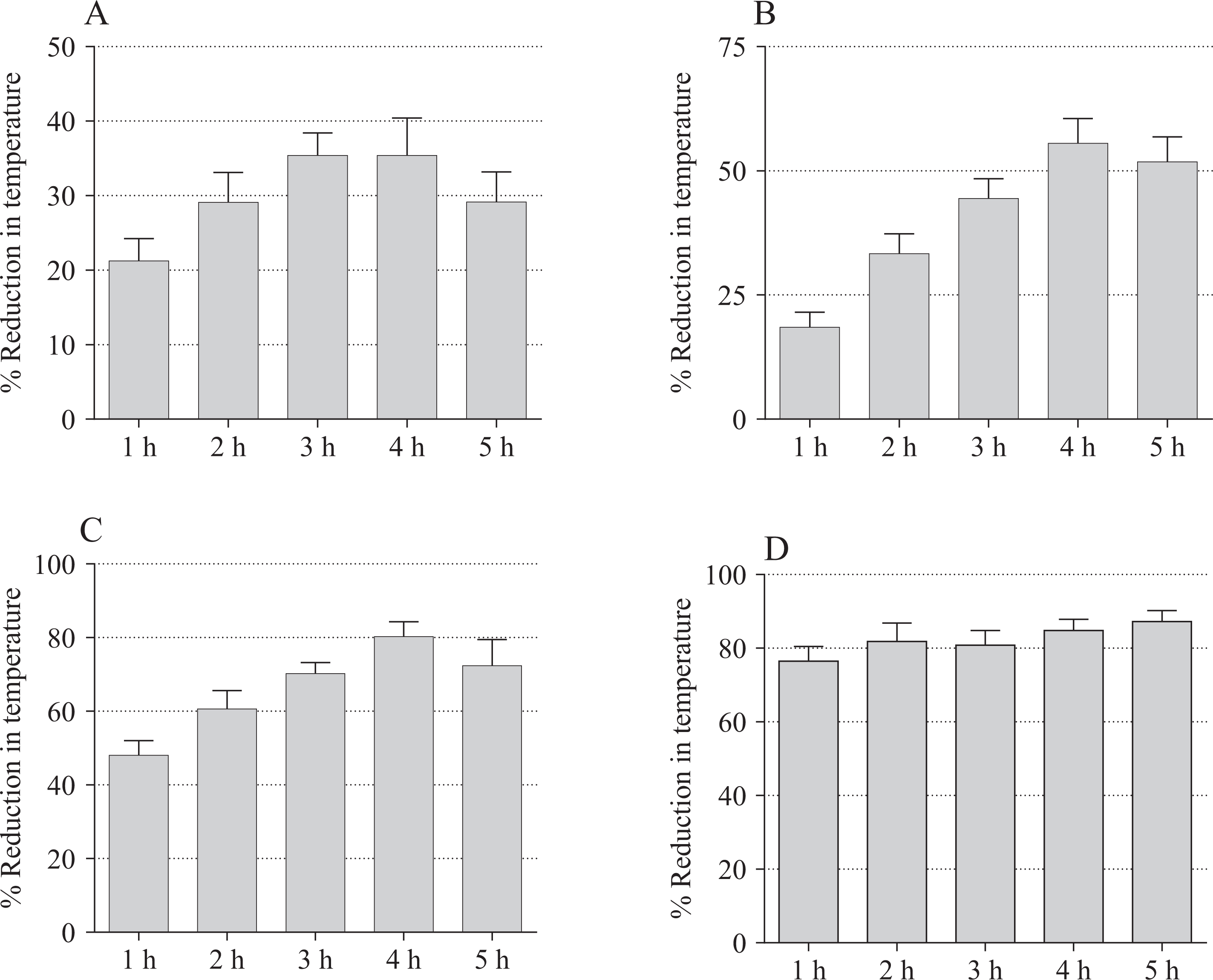
Percent inhibition of saponin content of decoction of Joshanda in brewer’s yeast induced hyperthermia in mice at (A) 100 mg/kg, (B) 200 mg/kg, (C) 300 mg/kg, and (D) paracetamol 100 mg/kg. Values are reported as mean ± SEM of at least 6 animals.
Effect of Sterol Contents in Antipyretic Assay
When total sterol contents of Joshanda were tested against yeast-induced hyperthermia, pyrexia blockage was not significant, as shown in Table 2. The effect was not significant even at the maximum test dose, 300 mg/kg, in all assessment times.
Discussion
Fever has been recognized as a major sign of diseased condition right from the very beginning of human civilization. The febrile response is coordinated by the central nervous system through endocrine, neurological, immunological, and behavioral mechanisms. 9 The initiation, manifestations, and regulation of the febrile response are dependent on the pyrogenic and antipyrogenic properties of various exogenous and endogenous substances. There is a general consensus that fever is caused by a regular rise in body temperature above normal daily fluctuations originating in conjunction with an elevated thermoregulatory set point. 11 –13 These neurons are sensitive not only to changes in blood temperature but also to cold and warm receptors located in skin and muscle and thus maintain an appropriate balance between heat production and loss. 14,15
Based on the results of current study, the decoction of Joshanda and its saponin contents showed prominent antipyretic effects in yeast-induced febrile mice. The antifebrile action of both decoction and saponin contents remained significant up to the fifth hour of treatment. Nevertheless, the effect was most dominant after the fourth hour of treatment during the calculated times (1-5 hours). The study also explained the chemical nature of the constituents that interfered with pyrexia-inducing agents, and it could be primarily saponins in nature because the pyrexia-ameliorated action of saponin contents was most dominant at all test doses. However, further study is required on the isolation of secondary metabolites and testing them in both animal and human subjects to discover molecules of clinical utility.
In conclusion, the decoction of Joshanda and its saponin contents showed marked antipyretic activity in brewer’s yeast induced hyperthermia. The effect of saponin contents of the decoction was most dominant in activity. The current antipyretic activity strongly complemented its anti-inflammatory effect and thus offered a better therapeutic agent as a household remedy in the treatment of cold and flu.
Footnotes
Author Contributions
Haroon Khan did the experimental work and drafted the initial article. Murad Ali Khan was the project supervisor and proofread the article. Ajmal Khan assisted in experimental work. Shafiq Ahmad Tariq and Samreen Pervez prepared the sample and helped in the initial draft of the article.
Declaration of Conflicting Interests
The authors declared no potential conflicts of interest with respect to the research, authorship, and/or publication of this article.
Funding
The authors disclosed receipt of the following financial support for the research, authorship, and/or publication of this article: We are thankful to the Higher Education Commission (HEC) of Pakistan for providing funding for the study.
Ethical Approval
The study was approved by the ethical committee of the University of Karachi, Karachi, Pakistan.