




Abstract
Purpose:
This biomechanical study investigates the optimal number of proximal screws for stable fixation of a 2-part proximal humerus fracture model with a locking plate.
Methods:
Twenty-four proximal humerus fracture models were included in the study. An unstable 2-part fracture was created and fixed by a locking plate. Cyclic loading and load-to-failure tests were used for the following 4 groups based on the number of screws used: 4-screw, 6-screw, 7-screw, and 9-screw groups. Interfragmentary gaps were measured following cyclic loading and compared. Consequently, the load to failure, maximum displacement, stiffness, and mode of failure at failure point were compared.
Results:
The interfragmentary gaps for the 4-screw, 6-screw, 7-screw, and 9-screw groups were significantly reduced by 0.24 ± 0.09 mm, 0.08 ± 0.06 mm, 0.05 ± 0.01 mm, and 0.03 ± 0.01 mm following 1000 cyclic loading, respectively. The loads to failure were significantly different between the groups with the 7-screw group showing the highest load to failure. The stiffness of the 7-screw group was superior compared with the 6-screw, 9-screw, and 4-screw groups. The maximum displacement before failure showed a significant difference between the comparative groups with the 4-screw group having the lowest value. The 7-screw group had the least structural failure rate (33.3%).
Conclusion:
At least 7 screws would be optimal for proximal fragment fixation of proximal humerus fractures with medial comminution to minimize secondary varus collapse or fixation failure.
Level of Evidence:
Basic science study.
Keywords
Introduction
The incidence of proximal humerus fractures is 4%–5% of all fractures. 1,2 With respect to the Neer classification as the most widely used classification system, 2-part surgical neck fractures account for approximately 10%–15% of all proximal humerus fractures. 2 Minimally invasive plate osteosynthesis (MIPO) with a locking plate system is an option for the fixation of 2-part proximal humerus fractures in active elderly patients with concomitant osteoporosis. The premises of MIPO for the management of proximal humerus fractures are to minimize soft tissue disruption, preserve natural biology, and minimize blood loss. 3
MIPO has gained much interest and showed favorable outcomes even for displaced proximal humerus fractures. 3 -8 However, given the risk of axillary nerve injury in MIPO, 3,9 -11 4–6 screws are inserted in the upper portion of the plate in most cases. Thus, medial support using inferomedial calcar screws in the traditional open plating is hardly possible with MIPO. Furthermore, screws inserted only in the proximal portion of the plate without inferomedial calcar screws may cause early failure and not to mention to be more problematic in 3-part or 4-part fractures. 12 -18 Surgeons tend to insert at least 7 screws particularly when using inferomedial calcar screws are contraindicated, which is feasible with open platting. Although the appropriate number of screws for stability in long bone fractures has been studied, questions remained on how many screws are necessary to achieve adequate fixation for proximal humerus fractures without inferomedial support. 19,20 Many studies have investigated the role of inferomedial calcar screws in avoiding secondary varus collapse or reduction loss; nevertheless, there is not enough evidence of the optimal number of screws for stable fixation without inferomedial screws in the setting of MIPO. 12,15,21
This study determines the optimal number of screws in the upper portion of the proximal humeral locking plate for stable fixation without inferomedial screws using proximal humerus fracture models. The null hypothesis was that there are no differences in mechanical properties between 4, 6, 7, and 9 screws for fixation of 2-part proximal humeral fracture models without medial support.
Material and Methods
Fracture Model Preparation
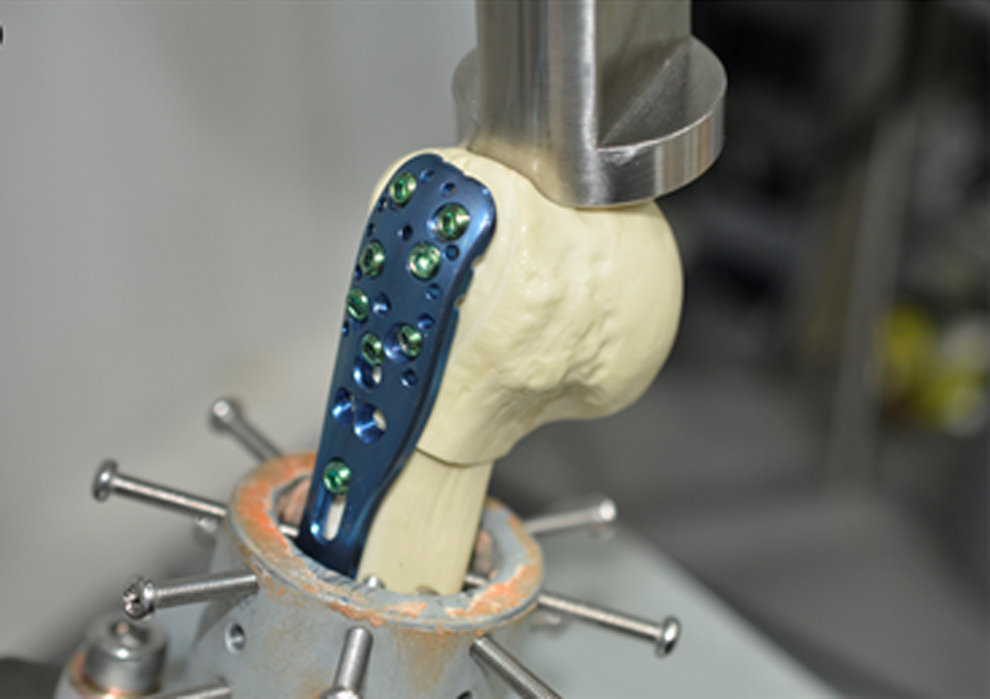
Twenty-four anatomically accurate polyurethane foam/cortical shell humerus models (model 1028; Pacific Research Laboratories, Vashon, WA, USA) were used for mechanical testing. The plastic bone models simulated weak osteoporotic bones with uniform conditions for testing and were used in previous biomechanical studies. 22 The proximal part of each humerus was osteotomized to create a 2-part fracture involving the surgical neck. An additional 10 mm medially based gap osteotomy was made in the inferomedial margin of the humeral head for the simulation of the medial and lateral comminution, which resulted in an unstable fracture (Figure 1). A proximal humeral locking plate, PHILOS plate (DePuy Synthes Companies, Zuchwil, Switzerland), was fixed, according to the manufacturer’s technical guide, 23 10 mm distal to the greater tuberosity and 5 mm lateral from the bicipital groove. Subsequently, 3.5-mm locking screws were inserted bicortically into the 3 distal diaphyseal screw holes. For the insertion of proximal screws, the longest screws needed for the subchondral bone were determined before the study as long as they do not perforate the cartilage (Figure 2). Four comparison groups were set based on the number of screws inserted into the proximal part of the plate, namely, 4-screw, 6-screw, 7-screw, and 9-screw groups (Figure 3). The positions of all constructions were confirmed by an image intensifier before biomechanical testing.

Preparation of the fracture model. Medially based wedge osteotomy was made 1 cm inferior to the articular margin to simulate surgical neck fractures with significant comminution.

The length of the screws was determined using C-arm fluoroscopy, and the same length of screws was inserted for each screw hole in all plastic humerus bone models.

Four groups of fixation model. (A) 4-screw group, (B) 6-screw group, (C) 7-screw group, and (D) 9-screw group.
Biomechanical Testing
Cyclic loading test
The humeral shaft was fixed so that it is slanted 20° from the vertical position. The amount of force applied was determined by the maximal reaction force of a human shoulder, which equals 89% of the body weight at isometric abduction by 90° scapular plane. 24 Based on the average weight of the adult human population, a 62 kg man will have the maximal reaction force of 540.7 N, which was rounded down to 500 N for this biomechanical test. 25 The load was vertically applied using a biaxial servo-hydraulic material testing machine (model E3000; Instron®, High Wycombe, England). Cyclic loading was performed according to a previous biomechanical study, which was 1,000 cycles at 1 Hz. 25. Following cyclic loading, the interfragmentary gap was measured with a digital caliper (model 500-474; Mitutoyo, Kawasaki-Shi, Japan) with a 0.01-mm accuracy. The interfragmentary gaps at the medial side following cyclic loading were recorded and compared between the 4 groups.
Load-to-failure test
The load-to-failure test was conducted following the cyclic loading test. An axial compressive load was applied to the superior aspect of the humeral head, 0.5 cm medial from bicipital groove using a 2-cm-diameter cupped cylinder with a 5 mm/min displacement rate. 26,27 Failure was visually defined as one of the following: (1) gap closure, defined as touching of the medial cortices; (2) fracture around the humeral head or shaft; or (3) implant failure. 13 A video camera was used to record the load-to-failure test to its ultimate failure. During the test, the load data were recorded using a computer at 10 Hz with an integrated software, which will be displayed as load–displacement curves. The load to failure (N) and stiffness (N/mm) were observed from the load–displacement curves. The failure modes for all groups were recorded.
Statistical Analysis
The statistical analysis was performed under the supervision of a biostatistician. The Kolmogorov–Smirnov test was used to determine the normality distribution of all datasets. All descriptive and quantitative analyses were conducted using Statistical Packages for Social Sciences, version 22.0 (IBM Crop., Chicago, IL, USA). The significance level was set at 0.05. One-way analysis of variance (ANOVA) was used to test if there is a difference between the mean values of the tested variables of the 4 groups. Post-hoc analysis was performed with the Bonferroni test to explore which groups differed among each other. The sample size for each group was estimated to be 6 to achieve a power of 0.8. This power allows us to detect the mean of the paired differences of 200% with a 5% type I error rate using one-way ANOVA. 28,29 The anticipated mean of the study group was referred from a previous clinical study. 30
Results
Cyclic Loading Test
Implant failure or fracture was not observed during the cyclic loading test. There was a significant difference in the interfragmentary gap reduction of 0.24 ± 0.09 mm, 0.08 ± 0.06 mm, 0.05 ± 0.01 mm, and 0.03 ± 0.01 mm in the 4-screw, 6-screw, 7-screw, and 9-screw groups, respectively (p < 0.001) (Table 1). The smallest interfragmentary gap reduction was seen in the 7-screw group. Table 2 One-way displays the post-hoc analysis for the cyclic loading test, which showed that the differences occurred between the 4-screw group and 6-screw, 7-screw, and 9-screw groups.
The Result Following Cyclic Loading and Load to Failure Test of 4 Comparative Groups.

All values were expressed by mean and standard deviation.
* ANOVA test, significance level at p < 0.05.
Post-Hoc Analysis for Multiple Comparison Test.

* Bonferroni post hoc test, significance level at p < 0.05.
Load-to-Failure Test
The results of the mechanical properties are as shown in Table 1. All groups showed a significant difference regarding the load to failure (p < 0.001). The 7-screw group had the highest load-to-failure properties at 1635.6 ± 120.2 N. The stiffness in the 7-screw group (308.6 ± 78.3 N/mm) was superior compared to the 6-screw, 9-screw, and 4-screw groups (292.3 ± 25.5 N/mm, 259.4 ± 52.3 N/mm, and 218.9 ± 60.0 N/mm, respectively) (p = 0.062). The maximum displacement before failure showed a significant difference between the comparative groups with the 4-screw group having the lowest value (5.7 ± 1.6 mm) (p = 0.005). Structural failure occurred in all models in the 4-screw group (Figure 4). The 7-screw group had the least structural failure rate (33.3%). Interfragmentary gap closure before structural failure was found in 1 model in the 6-screw group (16.7%), 4 models in the 7-screw group (66.7%), and 3 models in the 9-screw group (50%) (Table 2 and Figure 5). Post-hoc analyses for the load-to-failure test and mode of failure are shown in Table 2.

Structural failure as a failure mode as shown in the 4-screw group.
Interfragmentary gap closure as a failure mode as shown in the 7-screw group.
Discussion
The data presented in this study showed that the initial null hypothesis may be rejected as there were definable and significant differences between the mechanical properties of 4-screw, 6-screw, 7-screw, and 9-screw groups for the fixation of 2-part proximal humeral fracture models without inferomedial calcar support. More specifically, although statistically insignificant, the mechanical properties of the 7-screw group showed superiority regarding load to failure and stiffness compared to other groups. The 9-screw group showed lesser displacement in the cyclic loading test; however, its mechanical properties (load to failure and stiffness) were still inferior to those of the 7-screw group. We postulate that this may have caused the 9-screw configuration to be “overcrowded,” which increases the stressed zone in the bone fixation construct. The more screws applied, the greater stressed zone will be expressed and consequently resulted in uneven stress distribution in the bone fixation construct (Figure 6). Moreover, this study showed that the 7-screw group had the lowest structural failure rate (33.3%) among all comparative groups. This means that the optimal number of screws to be inserted in the upper portion of the proximal humeral locking plate is 7 to provide stable fixation without inferomedial support in 2-part proximal humerus fracture models.

The stress distribution among the comparative groups in a bone plate fixation construct.
In the case when a proximal humerus fracture was comminuted especially seen in patients with osteoporosis, achieving an adequate screw purchasing is difficult. Thus, surgeons tend to use greater numbers of screws in their fixation. There was a scarcity of previously reported data that focus on the essential number of proximal screws necessary for a stable fixation of a proximal humerus fracture. 31,32 Maddah et al. conducted a retrospective investigation on the correlation between screw position and complications observed in 367 patients who underwent proximal humeral fracture fixation with a locking plate. 31 Serial radiographic observations showed that the loss of fixation was observed in 15.8% (58 of 367) of the patients, and among those, cutting out of screws was found in 6.8%. In patients with secondary loss of fixation, an average of 6.7 screws were used to fix the fracture but without significant result from statistical analysis. Nevertheless, this retrospective review was still unable to provide a definite solution regarding the optimal number of proximal screws.
There are several commercially available locking plates for proximal humerus fractures in the market, which varied according to the number of proximal screw holes, screw hole configuration, and locking mechanism. Each locking plate commonly has 5–9 screw holes to fix the proximal fracture fragment, and the decision on the number of proximal screws is still inconclusive. The PHILOS plate (DePuy Synthes Companies, Zuchwil, Switzerland) is equipped with 9 screw holes to secure the proximal fragments and at least 4 proximal screws, and its operative manual recommends that in a poor bone stock, multiple fixation points using all screws are recommended. In addition, if MIPO was used, the surgical guide from the manual instruction advises to apply only the 4 most proximal screw holes to avoid axillary nerve injury. A cadaveric biomechanical study by Donohue et al. supported the use of 6 proximal screws over 3 screws for fixation of 3-part proximal humerus fractures with a locking plate. However, the implant used was only limited to be secured with 6 screws; thus, the results may not be comparable with those from the current study. 33 Other clinical studies have shown that 6 screws are commonly placed into the proximal holes of a PHILOS plate. Nevertheless, a cadaveric biomechanical study recommended that at least 5 screws should be inserted in the proximal holes of a proximal humerus locking plate with a disrupted medial hinge. 32 This means that inconsistency regarding the number of screws used in the proximal part of the plate exists. 34 The most likely reason for such inconsistency is the variability of the study designs regarding the fixation device and variability of the human bone used. In other words, it would be nearly impossible to perform a proper biomechanical analysis at an appropriate power while maintaining justifiable ethical standards and financial cost. Therefore, in the current study, using a standardized proximal humerus model, the risk of having an inconsistent experiment setup can be eliminated.
Studies on the mechanical properties of proximal humerus fractures fixed with locking plates have focused on the role of inferomedial supporting screws to prevent secondary varus collapse. 14 -16,30,35 In cases where the proximal humerus fracture is with medial comminution, the importance of inferomedial calcar supporting screws has been emphasized for fixation stability. This is also supported by the finite element model by Fletcher et al. that emphasized that inferomedial screws should be used as they reduce the fixation failure risk. 36 However, it is indefinite whether the improvement of the fixation strength resulted from the additional inferomedial supporting screw or the increased number of proximal screws. 16 The current study omitted the inferomedial calcar supporting screw setting to recognize the sole biomechanical effect of proximal screws.
This study is not without limitations. First, this biomechanical study used polyurethane proximal humerus bone models. Despite the use of these bone models, this setting was used in previous studies due to its reproducibility and consistency in experiment setups, which will avoid sample variability to ensure reliable experimental outcomes. 12,14,22,37 Second, only varus shear stress on fixation stability was tested in this biomechanical study, while in vivo, the proximal humerus construct is subjected to compressive and tensile forces in the axial, coronal, and sagittal planes. Though this limitation may be regarded as an oversimplification of the clinical setting, the current experimental setup addressed the failure pattern (i.e., varus collapse of the humeral head) that was mostly grounded in the clinical setting. Further studies may be needed to include the compressive and tensile forces in the axial, coronal, and sagittal planes. Third, this study only simulated 2-part proximal humerus fractures with a single design locking plate in the experimental setting; therefore, it may limit the generalization of the results of this study to 3- and 4-part proximal humerus fractures with different implant fixation designs. Fourth, inferomedial calcar screws were not tested in this experimental setup given its limitation in the MIPO setting. However, despite the limitations, the current study provides important knowledge on the optimal number of proximal screws for surgeons performing MIPOs with PHILOS plates. Lastly, the post-hoc analysis did not show that every group differed from each other, which was probably caused by the small sample size. 38
Conclusion
For the fixation of proximal humerus fractures with medial comminution, at least 7 screws at the proximal plate will provide stable fixation to minimize secondary varus collapse and fixation failure.
Footnotes
Acknowledgments
This study is an investigator-initiated trial (IIT) supported by a research grant from Johnson & Johnson Medical. The funding source was not involved in the study design, collection, data analysis, data interpretation, writing of the manuscript, or the decision to submit the manuscript for publication.
Declaration of Conflicting Interests
The author(s) declared no potential conflicts of interest with respect to the research, authorship, and/or publication of this article.
Funding
The author(s) disclosed receipt of the following financial support for the research, authorship, and/or publication of this article: This study is an investigator-initiated trial (IIT) supported by a research grant from Johnson & Johnson Medical. This study was supported by the Asan Institute for Life Sciences, Asan Medical Center, Seoul, Korea (No. 2018OM1062).
