




Abstract
Background:
Osteoarthritis is a degenerative disease that commonly occurs in middle-aged and elderly people. High-quality articles in the field of osteoarthritis rehabilitation have not been studied in detail.
Objective:
To identify and conduct a qualitative and quantitative analysis of the 50 most-cited articles on osteoarthritis rehabilitation and provide valuable scientific information for researchers.
Methods:
Fifty articles related to the rehabilitation of individuals with osteoarthritis were retrieved from the Web of Science Core Collection. Basic information, such as the authors, title, number of citations, year of publication, journal, country/territory, and research type, was extracted. CiteSpace was used to visualize the keywords.
Results:
The average number of citations per article was 244.54. The top 50 articles were published in 27 journals and published by 262 authors. Most of the top 50 articles were published in the United States. The top 50 articles included 23 randomized controlled trials, 21 cohort studies, 2 case series, and 4 expert opinion articles. The most commonly studied topics in osteoarthritis rehabilitation included rehabilitation for pain, gait abnormalities, muscle strength deficiencies, and other functional impairments caused by osteoarthritis in elderly people.
Conclusions:
The top articles in the field of osteoarthritis rehabilitation have a high level of evidence. Collaboration between authors was high for highly-cited articles. Moreover, the eminent articles can provide important information for the education of doctors and therapists specializing in osteoarthritis rehabilitation.
Background
Osteoarthritis is a degenerative disease that commonly occurs in middle-aged and elderly people and can cause joint pain, deformities, and dysfunction. 1 Importantly, there is no effective treatment to prevent its progression. 2 Although surgical treatment, such as arthroplasty, is an effective method for the treatment of osteoarthritis, the risks of surgery and the acceptance of patients need to be considered by clinical staff. 3,4 The management of osteoarthritis should be based on individualized approaches. 5 Clinicians should identify and manage the risk factors that lead to patients’ conditions, which can effectively improve their joint metabolism and biomechanical state to relieve joint pain and delay surgical interventions. 6,7 At present, rehabilitation has become the main means to delay the progression of osteoarthritis, including lifestyle adjustments, physiotherapy, family exercise, and other comprehensive rehabilitation treatments. 8
Bibliometrics refers to the quantitative research and analysis of the literature by statistical methods, which can be used to evaluate the impact of researchers, institutions, and countries on the development of specific fields according to the number of and citation frequency of publications. 9,10 The results of various published studies have contributed greatly to the development of specific fields, which is fully demonstrated by the most-cited papers. Highly cited papers can provide important information about the current understanding of a topic. 11
The Web of Science Core Collection is a comprehensive resource for academic information covering most scientific fields studied worldwide. 12 Using its powerful retrieval function, we can easily and quickly find valuable scientific research information, including the number of publications and citations, source journals, source countries, and other metrics. 12 CiteSpace is a powerful information visualization software that can be used to visualize the relevant information of the literature exported from the Web of Science Core Collection. 13 In this way, the common research topics in this field can be observed intuitively.
Bibliometrics and information visualization have been used to report the most-cited articles in the field of clinical medicine. 13,14 However, high-quality articles in the field of osteoarthritis rehabilitation have not been studied in detail. Therefore, the aim of our study was to identify and conduct a qualitative and quantitative analysis of the 50 most-cited articles in osteoarthritis rehabilitation to help researchers make better use of the existing research resources and have a better understanding of the eminent literature on osteoarthritis rehabilitation, thereby guiding future research.
Materials and Methods
Search Strategy
Literature databases differ in their coverage, emphasis, and tools provided. 15 Scopus and Web of Science are both multidisciplinary databases that provide search and analysis tools for evaluating the scientific and technological impact of articles. 12,15 Scopus only contains articles published after 1966, while the Web of Science indexed and archived records date back to 1900. 12 To conduct a broad search for articles in this field and retrieve international research articles, we utilized a previously published bibliometric methodology. 14,16 The Web of Science Core Collection (Index: SCI-Expanded) was used to select and analyze the articles related to the topic.
The specific search strategy was as follows: Topic = (“osteoarthritis”) and Topic = (“occupational therap*” OR “physical therap*” OR “physical medicine” OR “rehabilitation”). The retrieval time span was from the establishment of the database to 2019. The last search was conducted on January 23, 2020. The search results were ranked in descending order of the number of citations, and when multiple articles had the same total number of citations, the more recently published article was ranked higher.
Inclusion and Exclusion Criteria
Articles related to the rehabilitation of individuals with osteoarthritis were included, such as those on preventive, evaluative, and rehabilitative measures for primary or secondary osteoarthritis. Articles that included osteoarthritis as a keyword but were not related to the rehabilitation of individuals with the disease, such as articles about rehabilitation after anterior cruciate ligament reconstruction or knee arthroplasty to prevent osteoarthritis, were excluded. 17,18
Literature Screening and Data Extraction
According to the inclusion and exclusion criteria for the articles, the initial screening was performed by reading the titles and abstracts. When the eligibility of an article for inclusion could not be determined, the full text was obtained for further screening. Finally, 50 articles with the highest number of citations related to osteoarthritis rehabilitation were identified.
The researchers exported the data on the screened articles and extracted basic information from the articles, including the authors, title, number of citations, year of publication, source journal, source country/territory, source institution, and research type. The journal impact factor (IF) in 2018 was obtained from Journal Citation Reports (https://clarivate.com/webofsciencegroup/solutions/journal-citation-reports/). In addition, the citation density, which is the total number of citations divided by the years since publication, was recorded to comprehensively determine the influence of the 50 articles. 19 Some universities or hospitals may have changed their names since this date, but we used the names reported in the articles in our results.
Moreover, the exported data on the articles were imported into CiteSpace software (version 5.6. R1) so that the keywords could be analyzed; the parameter settings used for CiteSpace were the default values for the system. 20 The keywords, their frequency of use, and their betweenness centrality were recorded. The keywords with high betweenness centrality are usually the key hubs that connect 2 different keywords, and they are regarded as turning points or pivotal points. 21
The above processes were completed independently by 2 researchers. If there were disagreements between the 2 researchers, they resolved them by discussion. If necessary, a third researcher was consulted to reach a consensus. Data used in this study were downloaded from a public database, and no ethical approval was required to conduct this study.
Results
Publications and Citations
A total of 3,297 articles about osteoarthritis rehabilitation were retrieved. Fifty articles were screened according to the inclusion and exclusion criteria and ranked based on the citation density and citation frequency (Online Appendix 1). The articles were published between 1991 and 2016. The first article was published by Fisher, NM et al. in 1991. 22 The most recently published article in the 50 most-cited articles was that published by Christensen, R et al. in 2016. 23 The years in which the most studies were published were 2001 and 2004, with 4 articles being published in each year. Articles published in 1992, from 1995 to 1997, in 2009, from 2001 to 2002, and from 2014 to 2015 were not included in the 50 most-cited articles (Figure 1).

Composite citation count and number published in the 50 most-cited articles over time.
Among the 50 articles, the total citation count was 12,227. After removing self-citations, the citation count was 12,157 in total. The average number of citations per article was 244.54. The article with the highest total number of citations was that by Roos, EM et al. published in 1998, with 1518 citations. 24 The article with the highest citation density was that by Jordan, KM et al. published in 2003, with a citation density of 67.28. 25 The number of citations increased by year and peaked at 947 times in 2013. The number of citations of these articles tended to remain consistent over the past 5 years, with an average of 878.83 citations per year (Figure 1).
Journal Analysis
The top 50 articles were published in 27 different journals. Among them, the journal Archives of Physical Medicine and Rehabilitation published the most articles, with a total of 7 articles in the 50 most-cited articles. The articles published in Annals of the Rheumatic Diseases were cited the most, with a total of 1949 citations. Fifty-four percent of the articles were published in the top 5 journals, while no more than 2 articles were published in other journals.
Authors and Institutions
In total, 262 authors published these 50 highly cited articles. Table 1 shows the top 10 authors who published the most articles and their citation counts. Stucki G was the author with the most published articles, with a count of 4. Doherty M was the author with the largest number of citations, with a citation count of 1,650. Several articles were the result of collaboration among authors. Some authors published multiple articles, but they were not the first authors.
Top 10 Authors With the Most Publications.

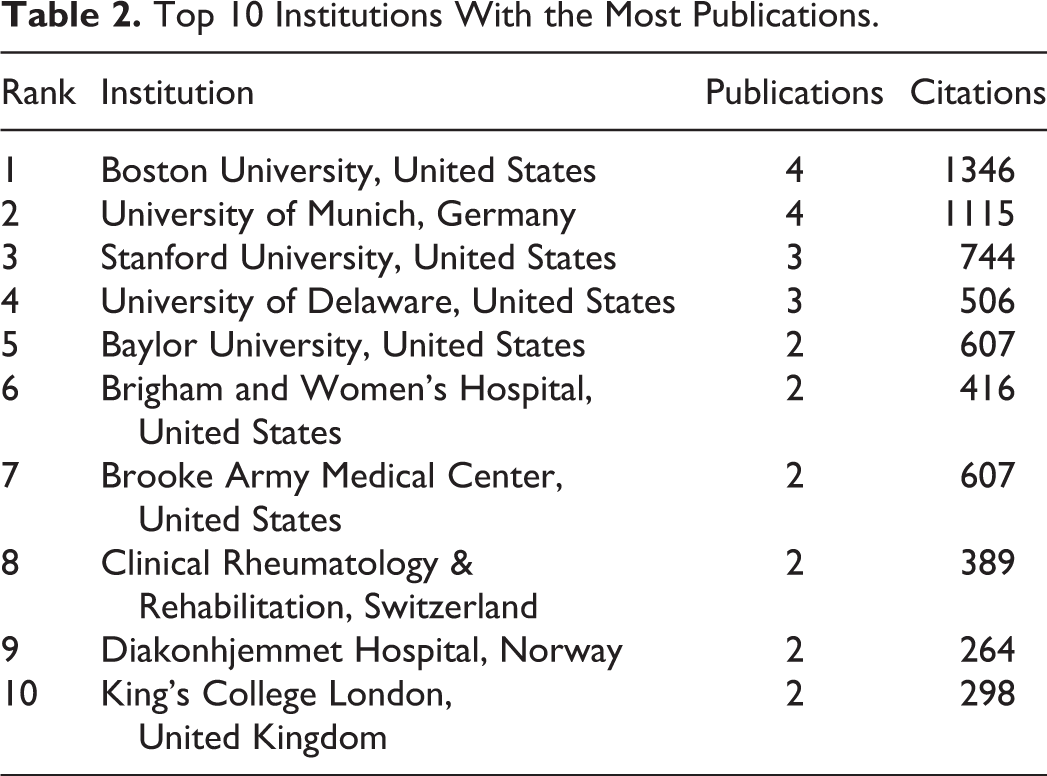
The top 50 articles were conducted at a total of 149 institutions. Table 2 shows the top 10 institutions that contributed to the top 50 articles. Boston University, located in the United States, and the University of Munich, located in Germany, were the top-ranked universities in terms of the number of published articles, which was 4 for both universities, and the citation counts, which were 1,346 and 1,115, respectively.
Top 10 Institutions With the Most Publications.
Countries or Territories
The top 50 articles were conducted in a total of 21 countries or territories. Figure 2A shows the distribution of the highly cited articles by the country or territory of origin. Figure 2B shows the publications for each country or territory. The United States was the main contributor to these 50 articles, accounting for 25 articles and 50% of the articles, and the citation count of the articles was 6,925. Other countries had no more than 10 publications.

Country and territory analysis of the publications in the 50 most-cited articles. A, The percentage of top-cited articles in different countries or territories. B, Publications by countries or territories in which they were conducted.
Level of Evidence
The top 50 articles included 23 randomized controlled trials (RCTs), 21 cohort studies, 2 case series, and 4 expert opinion articles. There were no animal or cell experiments in these articles. Figure 3 shows the distribution of the level of evidence for the articles.

Level of evidence of the publications in the 50 most-cited articles.
Keyword Visualization Analysis
The map of the keyword co-occurrence network was generated via CiteSpace (Figure 4). The keywords were closely related. After certain search terms, such as “knee osteoarthritis,” “rehabilitation” and “physiotherapy,” were excluded, the main keywords found in these 50 articles were “pain,” “knee,” “hip,” “randomized controlled trial,” “program,” “older adult,” “exercise,” “strength,” “proprioception,” “mechanics,” “people,” “exercise therapy,” “gait,” “clinical trial,” “walking,” and “disability.” The most frequently occurring keyword was “pain,” with a frequency of 12 times, and the keyword with the highest degree of centrality was “knee,” with a degree of centrality of 0.43 (Table 3).
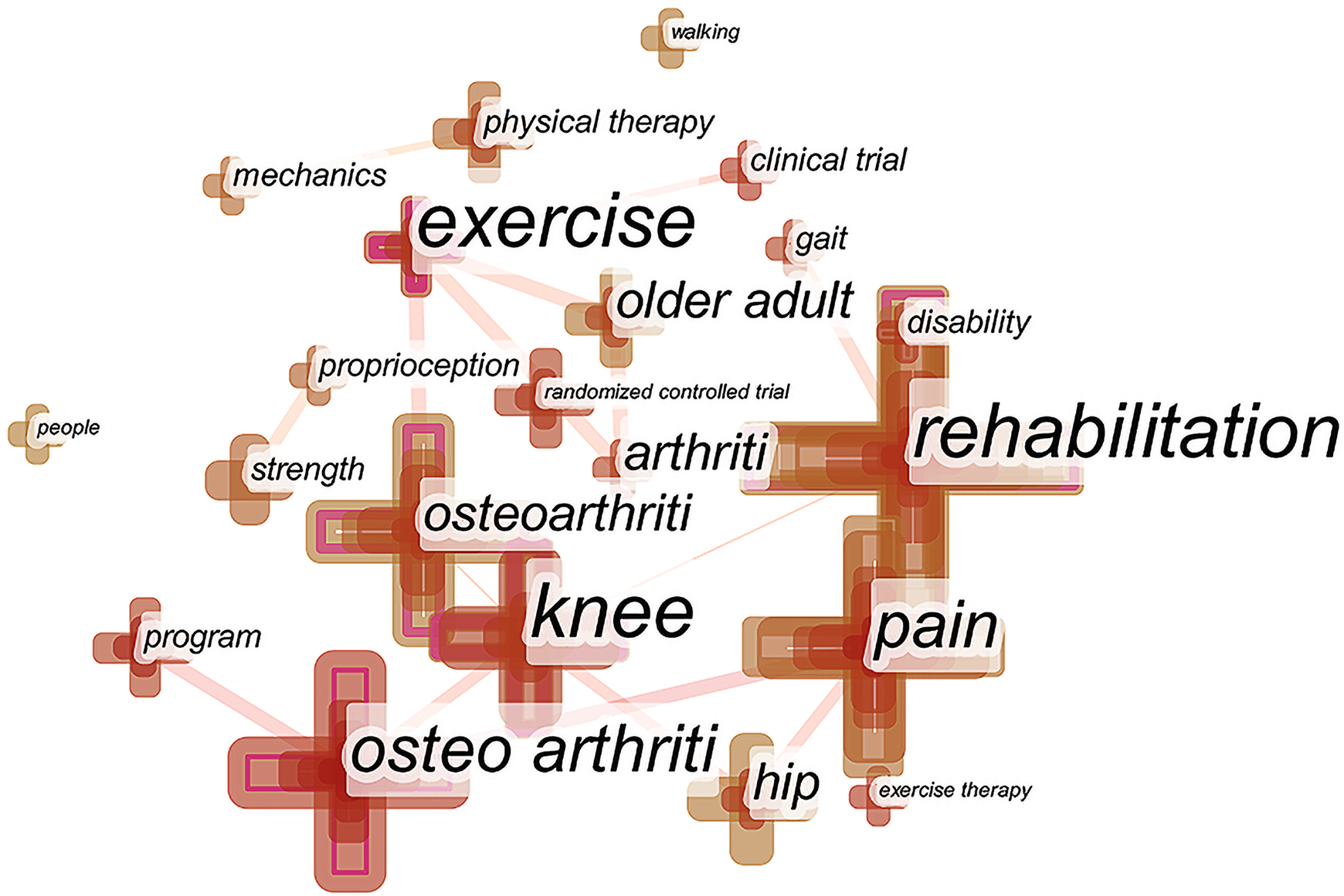
Map of the keyword co-occurrence network. Each cross represents a keyword, and the lines between them represent the co-occurrence relationship between the keywords. The thicker the lines are, the stronger the connection. The more lines there are, the higher the degree of centrality.
Keywords of the Top 50 Articles.

Discussion
In this study, we identified the most important articles on the progression of osteoarthritis and related rehabilitation. The citation count was used as a measure of research quality because it is an important indicator of the influence of an article. 26 The act of citing an article indicates that previous research plays an important role in subsequent research. Reviewing the top 50 articles in the field of osteoarthritis rehabilitation is helpful to understand the historical characteristics of osteoarthritis rehabilitation research and the contribution of influential methods. Moreover, the eminent articles can provide important information for the education of doctors and therapists specializing in osteoarthritis rehabilitation. 27
Most of the top 50 articles were published from 1998 to 2002 and from 2004 to 2008, during which more than 80% of the total articles were published. Articles published after 2016 have not reached the top 50, probably because the time since publication is too short; the citation counts of the articles published more recently were not as high as those published less recently. After all, it takes several years for an article to gain a high number of citations. 28 In addition, the citation counts related to osteoarthritis rehabilitation have gradually stabilized at a high value since 2011, indicating that the top 50 articles still have an important impact in this field.
We ranked the top 50 articles again according to citation density, and we found that the ranking of articles based on citation density was different from that based on citation frequency. However, the article “Knee injury and osteoarthritis outcome score (KOOS)-Development of a self-administered outcome measure” by Roos, EM et al and the article “EULAR Recommendations 2003: an evidence based approach to the management of knee osteoarthritis: Report of a Task Force of the Standing Committee for International Clinical Studies Including Therapeutic Trials (ESCISIT)” by Jordan, KM et al still ranked as top 2 articles with both ranking methods. 24,25 The KOOS developed by Roos, EM et al can be used to evaluate the whole treatment process for knee osteoarthritis, and it is still one of the commonly used clinical evaluation scales. Jordan, KM et al provided evidence-based guidelines for the treatment of osteoarthritis and emphasized the importance of integrated management, such as rehabilitation and health education.
In addition, the RCT “Surgery versus Physical Therapy for a Meniscal Tear and Osteoarthritis” had the highest citation density and illustrated that there were no significant differences between the surgery group and the physical therapy group in terms of functional improvement 6 months after randomization. 29 The RCT “Effectiveness of manual physical therapy and exercise in osteoarthritis of the knee. A randomized, controlled trial” had the highest citation count and suggested that the combination of manual physiotherapy and supervised exercise can improve the function of patients with osteoarthritis and may delay surgical intervention. 30 All these factors provide a strong basis for the importance of osteoarthritis rehabilitation evaluation and treatment. 31,32
Through the journal analysis, we found that more than half of the top 50 articles were published in Archives of Physical Medicine and Rehabilitation (IF = 3.098), Arthritis & Rheumatism-Arthritis Care & Research (IF = 9.586 in Arthritis & Rheumatism and IF = 4.056 in Arthritis Care & Research), Annals of the Rheumatic Diseases (IF = 16.102), Journal of Rheumatology (IF = 3.35), and Physical Therapy (IF = 3.14). The results illustrated that researchers are more likely to cite articles from high-IF journals. Journals with high IFs are considered to be of high quality and have a high degree of influence in this field. 33 However, the volume of publications in a journal, time from submission to publication, indexes of bibliographic databases, and even an imbalance in discipline construction and development in a country affect the IF of a journal. Therefore, the IF is not the most accurate index in determining the quality of a journal and can only be used as a reference for researchers. We also found that high-quality articles in this field were widely distributed in specialty-specific journals related to rheumatic diseases and rehabilitation medicine, which suggests that perhaps the research results published in specialty-specific journals can receive more attention by researchers in this field than those published in comprehensive medical journals. Moreover, where an article is published also depends on the journal requirements for articles and the quality of the article itself.
The author who published the most high-quality articles was not the first author on these articles, and the 50 most-cited articles were mostly written by more than 2 authors. The results illustrate that collaboration between authors was high for highly-cited articles in osteoarthritis rehabilitation. Among the top 50 articles, most of the studies were conducted at institutions in Europe and the United States. The United States accounted for the largest share of published articles, which indicates that the United States does have a strong influence on research related to health science. This conclusion is consistent with those in previous bibliometric studies conducted in other medical fields. 16,34 Most of their articles were related to the rehabilitation of individuals with knee osteoarthritis. The levels of scientific research and academic influence in a country or territory depend on its economy and the cultivation of talent. Moreover, American researchers are more likely to publish and cite papers in American journals, which is also one of the reasons for the large number of highly cited articles in the United States.
In addition, none of the top 50 articles were case-control studies. Systematic reviews or meta-analyses only accounted for 16%, while the remaining articles were original research articles. Most studies were RCTs (38%) and cohort studies (42%) with very high levels of evidence. This result was different from those in previous studies, in which the authors suggested that review articles are usually cited the most frequently. 35 This study showed that Researchers in the field of osteoarthritis rehabilitation may prefer to cite data from clinical studies (i.e. RCTs) rather than data from systematic reviews, meta-analyses, or expert opinion articles, which is consistent with the conclusions of some bibliometric studies conducted in other fields. 36
Through the visualization analysis of the keywords in the top 50 articles, we found that the common research topics were mainly about rehabilitation for pain, gait abnormalities, muscle strength deficiencies, and other functional limitations caused by osteoarthritis in elderly people, and the main rehabilitation methods included exercise and physiotherapy. The main joint addressed in the interventions was the knee, followed by the hip. Only 2 of the top 50 articles described upper limb osteoarthritis, as osteoarthritis mainly occurs in the lower limbs. 37,38 Additionally, researchers in this field paid more attention to the functional improvements in patients with osteoarthritis rather than the structural improvements, aiming to improve their independence in activities of daily living and delay the further degeneration of joints. The above information can help physicians not involved in rehabilitation, especially rheumatologists and surgeons, quickly understand the common research topics of eminent literature on osteoarthritis rehabilitation.
Limitations
There were some limitations in our study. Because the data were retrieved from the Web of Science, some journals and publications that are not indexed may have been left out. 39 The language of the database also limited the number of articles that could be retrieved. The search terms used in this study may not cover all the literature in this field, and there may be false positive or false negative results. The inclusion of only 50 articles may lead to the omission of some eminent articles. Moreover, the potential for several types of bias, such as institutional bias, language biases, and self-citation bias, should also be considered. In addition, the citation count is also a measure of delay. Older articles may have received more citations, while newly published articles cannot be accurately represented. 28 When the search is carried out at different time points, the citation counts of the articles are different, so it is necessary to update the study in the future.
Conclusions
In summary, the top 50 articles summarized in this study can help researchers identify the characteristics of eminent literature in this field, understand the history of osteoarthritis rehabilitation research, and design future research studies. The top articles in the field of osteoarthritis rehabilitation have a high level of evidence and still have an important impact. The research results published in specialty-specific journals may receive more attention than those published in broad-scope medical journals. Collaboration between authors was high for highly-cited articles in osteoarthritis rehabilitation. The United States published most of the top 50 articles. Researchers in the field of osteoarthritis rehabilitation may prefer to cite data from clinical studies (i.e. RCTs) rather than data from systematic reviews, meta-analyses, or expert opinion articles. The common research topics in osteoarthritis rehabilitation were mainly about rehabilitation for pain, gait abnormalities, muscle strength deficiencies, and other functional impairments caused by osteoarthritis in elderly people.
Supplemental Material
Supplemental Material, Appendix_1 - What You Should Know About Osteoarthritis Rehabilitation: A Bibliometric Analysis of the 50 Most-Cited Articles
Supplemental Material, Appendix_1 for What You Should Know About Osteoarthritis Rehabilitation: A Bibliometric Analysis of the 50 Most-Cited Articles by Shi-Qi Wang, Jian-Xiong Wang, Chi Zhang, Fu-Hua Sun, Yu-Jie Xie, Wei Jiang, Xia Ou, Akira Miyamoto and Li Wang in Geriatric Orthopaedic Surgery & Rehabilitation
Supplemental Material
Supplemental Material, Editing_Certificate - What You Should Know About Osteoarthritis Rehabilitation: A Bibliometric Analysis of the 50 Most-Cited Articles
Supplemental Material, Editing_Certificate for What You Should Know About Osteoarthritis Rehabilitation: A Bibliometric Analysis of the 50 Most-Cited Articles by Shi-Qi Wang, Jian-Xiong Wang, Chi Zhang, Fu-Hua Sun, Yu-Jie Xie, Wei Jiang, Xia Ou, Akira Miyamoto and Li Wang in Geriatric Orthopaedic Surgery & Rehabilitation
Footnotes
Declaration of Conflicting Interests
The author(s) declared no potential conflicts of interest with respect to the research, authorship, and/or publication of this article.
Funding
The author(s) disclosed receipt of the following financial support for the research, authorship, and/or publication of this article: This study was supported by grants from the National Natural Science Foundation (grant number 81802246); the Research Fund for the Doctoral Program of Affiliated Hospital of Southwest Medical University (Project Number 2016-QB-4); the Sichuan Medical Association Project Fund (grant number 17106 and 18127); the Sichuan Cadre Health Committee Project Fund (grant number y201903); Southwest Medical University Student Innovation and Entrepreneurship Project Fund (grant number 2019168 and 201816032122) and the Nuclear Medicine and Molecular Imaging Key Laboratory of Sichuan Province (grant number HYX19023 and HYX19005).

Supplemental Material
Supplemental material for this article is available online.
References
Supplementary Material
Please find the following supplemental material available below.
For Open Access articles published under a Creative Commons License, all supplemental material carries the same license as the article it is associated with.
For non-Open Access articles published, all supplemental material carries a non-exclusive license, and permission requests for re-use of supplemental material or any part of supplemental material shall be sent directly to the copyright owner as specified in the copyright notice associated with the article.

