




Abstract
Background:
Breast cancer perception, awareness, knowledge, and attitude, play a crucial role in effective prevention, early detection, and treatment. This systematic review and meta-analysis aims to assess these aspects among different population groups in Ethiopia, providing a comprehensive understanding of the current state and trends. The study seeks to identify gaps in awareness and knowledge, analyze variations in attitudes and perceptions across diverse groups, and evaluate changes over time.
Methods:
To achieve these objectives, studies were systematically reviewed and stratified based on population characteristics. Studies focusing on single groups, such as female teachers, were excluded from the meta-analysis of awareness, knowledge, and attitude measures to ensure broader applicability. The analysis employed a random-effects model to account for heterogeneity, assessed through the I2 statistic and Q-test. Subgroup analyses explored variations based on participant characteristics and study settings. To strengthen the validity of findings, a leave-one-out sensitivity analysis was conducted, and publication bias was evaluated using funnel plots and Egger’s regression test. Additionally, meta-regression analysis examined associations between participant characteristics and outcomes. Statistical significance was determined at P < .05 with 95% confidence intervals.
Results:
Significant gaps in breast cancer awareness were noted over time, with a decline observed in studies published since 2020 onwards (OR: .37, P-value: .040). Knowledge levels varied, with 46% (95% CI: 37%-55%) overall demonstrating a moderate level of knowledge. Attitudes were predominantly positive, with 64% (95% CI: 55%-72%) of participants expressing favorable views toward breast cancer prevention, early detection, and screening practices.
Conclusion:
This review highlights substantial gaps in breast cancer awareness and knowledge across different population groups in Ethiopia, suggesting opportunities for targeted educational and public health efforts to improve early detection and prevention.
PROSPERO Registration Number:
CRD42023494550.
Introduction
Breast cancer presents a significant public health challenge globally, particularly affecting women’s health and wellbeing. It is characterized not only by its high incidence but also by its profound implications for mortality rates among women, especially in less developed regions. 1 The burden of breast cancer extends beyond individuals, affecting families, communities, and healthcare systems. 2 In 2018, breast cancer accounted for a substantial portion of the global cancer burden, with millions of new cases and hundreds of thousands of deaths worldwide. 3
In the sub-Saharan Africa, including Ethiopia, breast cancer presents unique challenges influenced by socio-economic factors, healthcare infrastructure limitations, and cultural perceptions of health and illness. 4 The region exhibits specific epidemiological patterns, with reported incidence and mortality rates revealing disparities compared to global averages. The age-standardized incidence rate of breast cancer in East Africa was 31.9 per 100 000 compared to global incidence of 46.8 per 100 000 women annually. Recent mortality rates of 17.6 per 100 000 women per year were noted in East Africa (2022) compared to global mortality rates (2022) of 12.7 per 100 000 women per year. 5 This indicates the disproportionate burden of breast cancer in East Africa, where mortality rates remain high relative to incidence when compared with global patterns. 6
Ethiopia, representing East Africa, faces these challenges within its healthcare landscape. Breast cancer accounts for 33% cancers in women and 23% of cases registered in Addis Ababa cancer registry making it the leading cancer among women. 7 Addis Ababa, the capital and largest city, has comparatively more developed healthcare infrastructure and resources than other regions. However, access to healthcare services for cancer patients, including cancer screening, diagnosis, and treatment remains unevenly distributed across the country. 8 Cultural beliefs and stigma associated with cancer further delay diagnosis and hinder timely access to medical care, 9 contributing to disparities in breast cancer outcomes.
Addressing breast cancer in Ethiopia requires comprehensive data on perception, awareness, knowledge, and attitudes (PAKA), among different population groups, such as women in the community, patients, students, and health professionals, since their levels of awareness and engagement influence early detection and care-seeking behaviors. Understanding these factors is crucial for designing effective public health strategies that promote early detection, improve treatment outcomes, and ultimately reduce mortality. This systematic review and meta-analysis aim to bridge this gap by synthesizing existing evidence on breast cancer PAKA in Ethiopia. By identifying current trends and areas requiring intervention, this study seeks to inform the development of targeted interventions that can mitigate the impact of breast cancer on Ethiopian communities and improve health outcomes for women.
Methods
Search Strategy
The search strategy utilized a combination of keywords, index/MeSH terms, truncated words, and references from other studies to capture all relevant articles Boolean operators (AND and OR), truncation, and MeSH terms were applied across various databases. Comprehensive bibliographic search was conducted in PubMed, EMBASE, Cochrane CENTRAL, CINAHL, Scopus, and Web of Science. Additionally, grey literature sources were explored including Google Scholar, ClinicalTrials.gov, the World Health Organization (WHO) International Clinical Trials Registry Platform (ICTRP), and the Networked Digital Library of Theses and Dissertations (NDLTD) as well as Dissertations and Theses Global (Supplemental File 1).
Eligibility Criteria
The review considered all available observational (cross-sectional, case-control, cohort) and interventional studies designs. Inclusion criteria were as follows: (1) Studies conducted in any context within Ethiopia that explored perception, awareness, knowledge, and attitude (PAKA) toward breast cancer; (2) Studies that reported quantitative findings (numbers, percentages, or estimates convertible to the proportion of interest) related to the specified outcomes; and (3) Studies published in any language before 30th November 2023.
The four outcome measures were defined as follows:
Perception: The interpretation and organization of sensory information to form a meaningful representation of the world, influenced by past experiences, beliefs, and expectations. 10
Awareness: Knowledge of the existence of something. 11
Knowledge: The accumulation of information acquired through experience or education. 12
Attitudes: A mindset or tendency to act in a certain way based on personal experiences, which can be cognitive (perception and beliefs), affective (likes, dislikes, feelings), or behavioral (based on cognitive or affective responses). 13
Assessment of Methodological Quality
Studies meeting the inclusion criteria were evaluated for methodological quality following the “Preferred Reporting Items for Systematic Reviews and Meta-Analyses (PRISMA)” guidelines. 14 Further, the New-Castel-Ottawa Scale (NOS) for observational studies was used to assess quality of included studies. 15 The protocol for this Systematic Review was registered with the International Prospective Register of Systematic Reviews (PROSPERO). 16
Data Extraction and Procedure
Screening of manuscripts was conducted at the title, abstract, and full-text levels before data extraction commenced. Two reviewers were involved in the screening, quality assessment, and data extraction processes. While two of the reviewers worked independently, a third reviewer was consulted in case of disagreement between the primary reviewers.
Condition and Outcome Measures
The condition studied was individual’s PAKA regarding breast cancer. Accordingly, the review focused on studies addressing the extent of perception awareness, knowledge, and attitude towards breast cancer. The numbers or proportions on the respective outcomes and variables were considered for further analysis.
Meta-Analysis
The R programming software version 4.2 was used in the analysis. 17 Meta-analysis using a random-effect model was conducted on all eligible studies across various categories in the package “meta” using the function “metaprop.” The individual study-level proportions were combined using the weighted average estimator. Heterogeneity was assessed using the I 2 statistic and Q-test. Subgroup analyses were performed based on participant characteristics (patients, teachers, healthy women, and students), and publication date (before 2020 vs 2020 or later). The year 2020 was selected as a cut-off point because the COVID-19 pandemic substantially altered healthcare delivery and public health priorities, including cancer awareness and screening programs. This stratification allowed us to explore potential differences in breast cancer perception, awareness, knowledge, and attitude that may have arisen during and after the pandemic period. Certain studies have also been excluded from inclusion in the meta-analysis because of being sole reports to hold a subgroup. More specifically, a study conducted by Mekuria et al, 18 which focused exclusively on female teachers, was excluded from the meta-analysis on knowledge. Similarly, the study by Tesfaw et al, 9 which focused exclusively on health professionals’ awareness, was excluded from the awareness pooled evaluation. Influence analyses, using the leave-one-out method, evaluated the robustness of the findings by excluding studies with a high risk of bias. Publication bias was assessed using funnel plots and Egger’s regression test. The meta-analysis provided pooled estimates for breast cancer awareness, knowledge, and attitudes, offering a comprehensive synthesis of the evidence and highlighting areas for improvement in breast cancer education and awareness interventions. Reported outcomes on perception were not pooled, as only one study 18 assessed this construct across different facets; instead, an overall proportion was presented to summarize its findings. Statistical significance was set at P < .05 with 95% confidence intervals.
Results
Screening Results
The study screening process began with identifying 243 records from databases (EMBASE = 144, PubMed = 95, EBSCO = 4) and 54 records from a web-based search. Following initial duplicate removal (n = 22) and exclusions by automation tools (n = 184), 37 records were screened by title and abstract, resulting in 11 exclusions and 26 reports sought for retrieval. Of these, 2 reports were not retrievable, leaving 24 reports for eligibility assessment. The web-based search yielded 54 reports for eligibility, with no retrieval issues. Eligibility assessment led to 8 exclusions from the database search (1 duplicate, 7 ineligible) and 5 exclusions from the web-based search (2 duplicates, 3 unrelated to the aim). Ultimately, 33 studies were included in the review, based on 65 evaluated reports (Figure 1). All included studies were found to fulfil the good quality’ based on the New-Castel Ottawa Scale assessment.

PRISMA 2020 flow chart of included studies on perception, awareness, knowledge, and attitude toward breast cancer in Ethiopia.
Characteristics of Included Studies
Perception
A study by Mekuria et al 18 explored 3 different reports (aspects) of perceptions among female teachers in the SNNPR region and found that 43.5% of respondents had a good perception of performing breast self-examination (BSE), while 31.8% had low perceived barriers, and 78.7% were highly motivated to perform BSE (Supplemental Table 1).
Awareness
Awareness of breast cancer and its screening methods varies widely across different Ethiopian regions and populations. Funga et al 19 reported that 40.1% of women in the SNNPR region had heard about breast cancer, while Mehiret et al 20 found that only 20.4% of university students in Amhara were aware of mammography and breast cancer examination. Similarly, Duguma et al 21 reported that only 17% of patients with breast cancer had prior awareness of mammography. Awareness of BSE also varied considerably, ranging from 33.4% among health facility patients as reported by Wondie et al 22 to 87.3% among university students. 23 Overall, these findings indicate substantial disparities in awareness levels across different populations and highlight particularly limited recognition of mammography as a breast cancer screening method in Ethiopia (Supplemental Table 2).
Knowledge
The knowledge of breast cancer and related screening methods also demonstrates variation. For example, Lemlem et al 24 found that 57.8% of health professionals in Addis Ababa were knowledgeable about breast cancer screening methods, while 80.2% of female medical students at a university in Harar were aware of breast cancer risk factors. 23 Meanwhile, other studies, such as Agide et al, 25 reported much lower overall knowledge, with only 11.5% of women in the Hadiya community aware of breast cancer screening (Supplemental Table 3). These results point to gaps in knowledge that may affect early detection practices.
Attitude
The attitude toward breast cancer screening, particularly BSE, was favorable in many studies. For instance, Jadhav and Shinde 26 reported that 81% of university students in Mizan Tepi had a positive attitude toward BSE, while Zeru et al 27 found that 81% of health professionals in Addis Ababa also had a positive attitude (Supplemental Table 4). Similarly, 59.4% of health professionals in Oromia had a favorable attitude towards BSE. 28 These findings suggest that despite varying levels of knowledge and awareness, attitudes toward breast cancer screening are generally positive.
Meta-Analysis Results
Perception
A study involving 239 teachers explored 4 distinct facets of perception related to BSE. 18 The results indicated that 43.5% of participants had a positive perception regarding the performance of BSE. Furthermore, 32% reported a low perceived barrier to engaging in BSE, highlighting a sense of ease in overcoming potential obstacles. Notably, 78.7% expressed a high perceived motivation for conducting BSE, revealing a strong inclination towards self-examination. Overall, 52% (95% CI: 11%-91%) of participants demonstrated a positive perception toward BSE, based on combined measures of motivation and perceived barriers.
Awareness
A total of fifteen studies,19-23,29-38 encompassing 17 reports, were retrieved nationwide and analyzed to assess the level of awareness regarding various aspects of breast cancer among participants nationwide. One subgroup analysis based on the study period revealed interesting trends. For studies reported before 2020, the estimated awareness was 67% (95% CI: 48%-82%). Conversely, studies conducted from 2020 onwards showed a lower pooled awareness estimate of 52% (95% CI: 27%-76%). When all studies were combined, regardless of the period, the overall pooled awareness estimate was 58% (95% CI: 42%-73%; Figure 2).

Extent of awareness toward breast cancer in Ethiopia subgroup based on year of publication.
Over the past decade, the trend in breast cancer awareness has shown a consistent decline, with notable sharp decreases in recent years (Supplemental File 2). An additional subgroup analysis was conducted based on different study populations. Pooled result from 6 studies20,23,31,32,35,36 revealed that the level of breast cancer awareness was 60% (95% CI: 31%-83%) among students, 58% (95% CI: 51%-65%) among women without breast cancer drawn from 6 reports,19,29,30,33,34,38 and 37% (95% CI: 5%-86%) among breast cancer patients derived from 2 studies.21,22 When the subgroup estimates were combined, the overall level of awareness was determined to be 53% (95% CI: 40%-86%; Figure 3).

Extent of awareness toward breast cancer in Ethiopia sub-grouped based on sample populations assessed.
Knowledge
In this domain, 29 articles18,20,22-32,34-38,39-49 comprising 37 reports were retrieved, combined, and analyzed to assess participants’ understanding of breast cancer. When categorized by the year of publication, the pooled estimate for a satisfactory level of knowledge before 2020 was 46% (95% CI: 34%-59%). For studies published in 2020 and beyond, the estimate was slightly lower at 45% (95% CI: 33%-57%). Overall, the combined estimate for breast cancer knowledge across all years was 46% (95% CI: 37%-54%), as depicted in (Figure 4).

Knowledge about breast cancer in Ethiopia based on a subgroup of study years.
On a parallel note, the included studies were further stratified based on the study populations they assessed. The findings revealed that 56% (95% CI: 36%-74%) of health professionals, 49% (95% CI: 35%-64%) of students, 30% (95% CI: 21%-40%) of healthy women, and 58% (95% CI: 38%-75%) of patients demonstrated a satisfactory level of knowledge about breast cancer. The overall combined estimate of this metric was determined to be 46% (95% CI: 37%-55%; Figure 5).
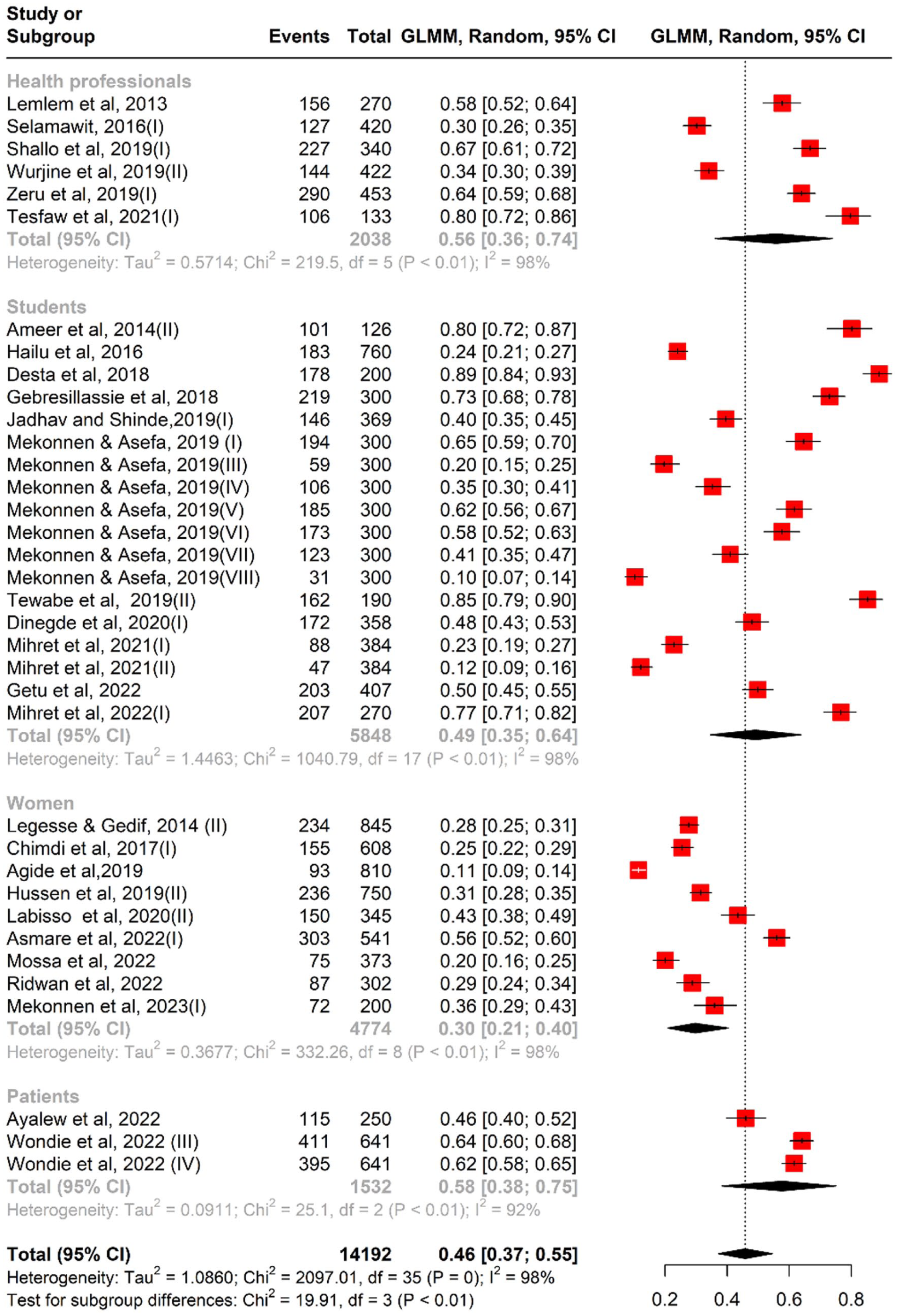
Knowledge about breast cancer in Ethiopia among a subgroup of sample populations considered.
Attitude
In this category, 8 studies26-28,31,40,41,44,45 addressing patients’ attitudes toward breast cancer were consolidated. Since only 1 study was conducted after 2020, a subgroup meta-analysis was conducted based on the study populations rather than by year of publication. The findings indicated that the prevalence of a positive attitude towards breast cancer and its screening and diagnosis methods was 67% (95% CI: 56%-76%) among health professionals, 50% (95% CI: 45%-55%) among healthy women, and 71% (95% CI: 53%-84%) among students. The overall estimate of a positive attitude across all groups was 64% (95% CI: 55%-72%; Figure 6).

Extent of favorable attitude about breast cancer in Ethiopia sub-grouped based on populations assessed.
Meta Regression
A meta-regression analysis was conducted to investigate the relationship between specific participant characteristics and the outcomes of awareness, knowledge, and attitude toward breast cancer. The variables included in the regression were the publication period (2020 or later), residence in Addis Ababa, participant roles (patient, student, health women), and the study settings (community or university). Addis Ababa was considered separately because, as the country’s capital, it has comparatively higher healthcare access, greater exposure to awareness campaigns, and a larger concentration of health professionals, which could influence breast cancer perception, awareness, and knowledge compared to other regions of Ethiopia. Among these variables, only the publication period showed a statistically significant association with awareness. Reports published in 2020 or later were associated with an approximate 63% reduction in breast cancer awareness (Table 1).
Meta-Regression Selected Participant Characteristics with Awareness, Knowledge and Attitude Towards Breast Cancer in Ethiopia.

Statistically significance.
Publication Bias and Influence Analysis
The graphical assessment of publication bias across the entire set of studies (PAKA), awareness, and knowledge revealed a symmetric distribution in the funnel plot (Figure 7). This symmetry suggests the absence of significant publication bias. Additionally, Egger’s test confirmed this, showing no significant publication bias for PAKA (intercept: 3.804; 95% CI: −2.68 to 10.29; P = .25), awareness (intercept: 1.073; 95% CI: −11.8 to 13.94; P = .87), and knowledge (intercept: 5.396; 95% CI: −4.47 to 15.26; P = .29). The influence analysis further revealed that no single study significantly affected the pooled estimates for awareness, knowledge, and attitude. However, the perception measure was notably reduced when the study focused on the perceived motivation of teachers was excluded. 18

Funnel plot of included studies depicting sensitivity analysis.
Discussion
This systematic review and meta-analysis provided a comprehensive overview of breast cancer perception, awareness, knowledge, and attitudes among various population groups in Ethiopia. The findings reveal significant gaps in breast cancer education and healthcare delivery in the country.
Overall, the analysis indicated a moderate level of awareness and knowledge about breast cancer among Ethiopian participants. Health professionals, followed by students, generally exhibited higher levels of knowledge and more positive attitudes. However, disparities were evident across different demographic groups, including students, healthy women, and patients. This aligns with other studies that that found young adults with formal education having better knowledge about cancer signs and symptoms according to a population-based survey in Addis Ababa. 50 Conversely, research from Bangladesh reported misconceptions about breast cancer among women, such as the belief that it only occurs in older age, and lack of awareness about screening and risk factors. 51 Compared with higher-income settings, however, knowledge levels in Ethiopia appear considerably lower. For example, a study among female health sciences students in Malaysia reported that approximately 74% had adequate knowledge of breast self-examination, 52 and a study in Saudi Arabia found mean knowledge scores of about >90% among the general female population. 53 These contrasts, partly, suggest the persistent knowledge gap between low-resource and wealthier contexts.
The present review shows that teachers have generally positive perceptions of BSE, with a significant proportion expressing motivation and perceiving low barriers to performing self-examination. However, the small number of studies on this topic (n = 3) may affect the reliability of these findings. Teachers may benefit from better access to health information and view themselves as role models for positive health behavior. This suggests that educational settings could be effective platforms for promoting BSE practices and early detection. In contrast, a community-based study report not included in the meta-analysis revealed low perceived susceptibility and low self-efficacy among young women in southwest Ethiopia. 48
The observed decline in breast cancer awareness noted in recent years underscores the need for ongoing educational efforts and updated healthcare policies. Factors such as population, sample size, recruitment methods, and outcome definitions may influence these findings. For instance, recent studies with high reported figures often involved students at academic settings.23,31,32 Cultural barriers, communication strategies and socio-economic factors may also contribute to decrease in awareness, particularly community-based studies. Holistic approaches that integrate education with cultural norms, and accessible health services are essential. 4 Additionally, the limited reporting on mammography awareness across the included studies indicates a significant gap in breast cancer screening in Ethiopia. Even in studies that addressed mammography, awareness20,21 and practice 33 levels remained notably low. Mammography services are largely inaccessible outside major urban centers such as Addis Ababa, and community-based awareness programs continue to emphasize breast BSE rather than organized screening. While BSE may promote self-awareness and early help-seeking, it is not a substitute for systematic screening through mammography.
Beyond the Ethiopian context, these findings resonate with broader challenges faced across low- and middle-income countries (LMICs). The coexistence of moderate awareness and knowledge with favorable attitudes but limited behavioral practice suggests that awareness campaigns alone may be insufficient to drive meaningful change. Similar patterns are observed across sub-Saharan Africa, where stigma, cultural misconceptions, and weak healthcare infrastructure continue to hinder early cancer detection. The decline in awareness after 2020 may also reflect disruptions in preventive health services during the COVID-19 pandemic, highlighting the vulnerability of cancer control programs in times of crisis. Additionally, public health campaigns and community outreach efforts faced restrictions or reallocation of resources, which likely impaired awareness-promotion activities. In regions affected by conflict, destruction of health facilities, displacement, and interruption of education may have further exacerbated this decline. Empirical data from campaigns implemented in 2022 (eg, in Adama and Mojo towns) showed that even after awareness interventions, only about half of respondents correctly identified key signs of breast cancer, underscoring how fragile gains in awareness can be in such contexts. 54 While more longitudinal studies are needed, this evidence suggests the magnitude of decrease, though large, is not implausible given the combined impacts of pandemic, conflict, and service interruptions. These findings indicate the importance of building resilient health systems that can maintain cancer education and screening services even during periods of crisis, such as pandemics or conflict. Strengthening cross-sectoral collaboration, particularly between the ministry of health (MoH), education, and communication, will be critical to develop culturally appropriate and sustainable interventions.
Global comparisons reveal similar challenges in breast cancer awareness and outcomes, especially in low-resource settings. For example, internet search-based study in 2021 found a decline in breast cancer-related interest and funding between 2004 and 2020 suggesting the need for new awareness campaigns. 55 Bhagavathula et al 56 reported a negative trend, in Google searches related to breast cancer from 2008 and 2021. These trends highlight broader disparities in healthcare access, infrastructure, and socio-cultural factors affecting health-seeking behavior related to breast cancer.
This systematic review has several strengths. First, it provides a comprehensive synthesis of current data on breast cancer perception, awareness, knowledge, and attitudes among various population groups in Ethiopia, offering valuable insights for stakeholders. Second, the inclusion of a wide range of studies enhance the generalizability of the findings. Third, the use of rigorous methodologies, including random-effects meta-analysis, subgroup analysis, meta-regression, and publication bias assessment, ensure the robustness and reliability of the results. Finally, by identifying gaps and areas that require improvement, the review attempted to reveal critical opportunities for targeted interventions to enhance breast cancer education and healthcare delivery in Ethiopia. However, the study has several limitations including the small number of studies in certain outcome categories, variability in study design, and data collection methods, and reliance on self-reported data, which may introduce response bias. Another important limitation is the lack of age-stratified data across the included studies. Most of the evidence was derived from younger populations, such as university students, whose perceptions, risk awareness, and screening behaviors differ markedly from those of older women. This limits the generalizability of the findings, particularly for age groups in which mammography screening is most relevant.
Conclusion
The systematic review and meta-analysis of this study have provided valuable perception, awareness, knowledge, and attitude towards breast cancer in Ethiopia. The findings revealed both strengths and areas requiring improvement. Teachers demonstrated high positive motivation towards BSE. Patients’ attitudes varied across different populations, indicating the need for targeted educational interventions. The study uncovered a notable decline in breast cancer awareness over the past decade, highlighting the importance of addressing this trend to develop effective strategies for improvement. The analysis of knowledge level showed a moderate overall understanding of breast cancer, with a significant association between the publication period and awareness. The findings suggest that resilient health systems and coordinated, culturally sensitive interventions are needed to sustain breast cancer education and screening in Ethiopia. Multi-sectoral approaches that empower women can serve as a model for other resource-constrained settings seeking to improve cancer awareness and early detection. Future research should deliberately include rural and underrepresented populations to capture the full spectrum of barriers to breast cancer awareness and care. Generating such evidence will be essential for designing inclusive, context-sensitive policies and programs that leave no group behind. Since breast cancer risk increases with age, future research should also prioritize age-disaggregated analyses to identify gaps and tailor awareness and screening interventions appropriately.
Implications for Practice, Policy, and Research
The review’s findings indicate several implications for practice, policy, and research. Practically, there is an urgent need for healthcare providers to engage in more comprehensive breast cancer education initiatives, particularly among women with limited access to reliable information. Policymakers, especially the MoH should consider allocating resources to develop culturally sensitive and accessible awareness campaigns, emphasizing early detection practices such as BSE and mammography. Additionally, integrating breast cancer awareness into educational curricula could foster proactive attitudes from an early age. For future research, studies focusing on rural and underrepresented groups are essential to uncover specific barriers and inform strategies tailored to these populations. Further, research evaluating the effectiveness of awareness interventions over time could provide insights to refine and adapt policies for sustained impact.
Supplemental Material
sj-docx-1-jpc-10.1177_21501319251396797 – Supplemental material for Perception, Awareness, Knowledge, and Attitude (PAKA) Towards Breast Cancer in Ethiopia: A Systematic Review and Meta-Analysis
Supplemental material, sj-docx-1-jpc-10.1177_21501319251396797 for Perception, Awareness, Knowledge, and Attitude (PAKA) Towards Breast Cancer in Ethiopia: A Systematic Review and Meta-Analysis by Tariku Shimels, Arebu Issa Billal, Atalay Mulu Fentie, Teferi Gedif Fenta and Tsige Gebre-Mariam in Journal of Primary Care & Community Health
Supplemental Material
sj-docx-2-jpc-10.1177_21501319251396797 – Supplemental material for Perception, Awareness, Knowledge, and Attitude (PAKA) Towards Breast Cancer in Ethiopia: A Systematic Review and Meta-Analysis
Supplemental material, sj-docx-2-jpc-10.1177_21501319251396797 for Perception, Awareness, Knowledge, and Attitude (PAKA) Towards Breast Cancer in Ethiopia: A Systematic Review and Meta-Analysis by Tariku Shimels, Arebu Issa Billal, Atalay Mulu Fentie, Teferi Gedif Fenta and Tsige Gebre-Mariam in Journal of Primary Care & Community Health
Supplemental Material
sj-docx-3-jpc-10.1177_21501319251396797 – Supplemental material for Perception, Awareness, Knowledge, and Attitude (PAKA) Towards Breast Cancer in Ethiopia: A Systematic Review and Meta-Analysis
Supplemental material, sj-docx-3-jpc-10.1177_21501319251396797 for Perception, Awareness, Knowledge, and Attitude (PAKA) Towards Breast Cancer in Ethiopia: A Systematic Review and Meta-Analysis by Tariku Shimels, Arebu Issa Billal, Atalay Mulu Fentie, Teferi Gedif Fenta and Tsige Gebre-Mariam in Journal of Primary Care & Community Health
Supplemental Material
sj-docx-4-jpc-10.1177_21501319251396797 – Supplemental material for Perception, Awareness, Knowledge, and Attitude (PAKA) Towards Breast Cancer in Ethiopia: A Systematic Review and Meta-Analysis
Supplemental material, sj-docx-4-jpc-10.1177_21501319251396797 for Perception, Awareness, Knowledge, and Attitude (PAKA) Towards Breast Cancer in Ethiopia: A Systematic Review and Meta-Analysis by Tariku Shimels, Arebu Issa Billal, Atalay Mulu Fentie, Teferi Gedif Fenta and Tsige Gebre-Mariam in Journal of Primary Care & Community Health
Supplemental Material
sj-docx-5-jpc-10.1177_21501319251396797 – Supplemental material for Perception, Awareness, Knowledge, and Attitude (PAKA) Towards Breast Cancer in Ethiopia: A Systematic Review and Meta-Analysis
Supplemental material, sj-docx-5-jpc-10.1177_21501319251396797 for Perception, Awareness, Knowledge, and Attitude (PAKA) Towards Breast Cancer in Ethiopia: A Systematic Review and Meta-Analysis by Tariku Shimels, Arebu Issa Billal, Atalay Mulu Fentie, Teferi Gedif Fenta and Tsige Gebre-Mariam in Journal of Primary Care & Community Health
Supplemental Material
sj-docx-6-jpc-10.1177_21501319251396797 – Supplemental material for Perception, Awareness, Knowledge, and Attitude (PAKA) Towards Breast Cancer in Ethiopia: A Systematic Review and Meta-Analysis
Supplemental material, sj-docx-6-jpc-10.1177_21501319251396797 for Perception, Awareness, Knowledge, and Attitude (PAKA) Towards Breast Cancer in Ethiopia: A Systematic Review and Meta-Analysis by Tariku Shimels, Arebu Issa Billal, Atalay Mulu Fentie, Teferi Gedif Fenta and Tsige Gebre-Mariam in Journal of Primary Care & Community Health
Footnotes
Acknowledgements
The authors wish to acknowledge the patients who participated in the primary studies, as well as the original study authors whose work contributed to this review. We also extend our gratitude to the Zewditu Getachew Foundation (ZGF) for initiating this review project and for its valuable technical support. Finally, we thank the peer reviewers for their insightful feedback, which helped enhance the quality of this article.

Funding
The authors received no financial support for the research, authorship, and/or publication of this article.
Declaration of Conflicting Interests
The authors declared no potential conflicts of interest with respect to the research, authorship, and/or publication of this article.
Data Availability Statement
All relevant data are within the article and its supplemental files.
Supplemental Material
Supplemental material for this article is available online.
References
Supplementary Material
Please find the following supplemental material available below.
For Open Access articles published under a Creative Commons License, all supplemental material carries the same license as the article it is associated with.
For non-Open Access articles published, all supplemental material carries a non-exclusive license, and permission requests for re-use of supplemental material or any part of supplemental material shall be sent directly to the copyright owner as specified in the copyright notice associated with the article.
