




Abstract
Background:
Effective management of type 2 diabetes (T2DM) is critical, especially in regions with high social inequalities, such as Amazonas, Brazil. This study aimed to evaluate the impact of T2DM management activities offered by primary care settings on health behaviors.
Methods:
This is a cross-sectional study conducted in 10 cities of the Amazonas state in Brazil (n = 965). The study included individuals with T2DM who participate in activities on disease management offered by primary care settings. The health behaviors assessed included medication adherence, physical activity, and food and vegetable consumption.
Results:
There was a positive association between activity participation and medication adherence (OR = 0.51; 95% CI = 0.36-0.71). However, there was no association between participation and physical activity level, both for moderate (OR = 0.84; 95% CI = 0.58-1.22) or high levels (OR = 1.60; 95%; CI = 0.99-2.59) or daily fruit and vegetable consumption (OR = 0.61; 95% CI = 0.30-1.22).
Conclusion:
In conclusion, participation in activities offered in primary care positively impacts medication adherence. However, although participants received guidance on adhering to physical activity and healthy eating practices, no impact was observed in behavior changes in people diagnosed with T2DM.
Introduction
Type 2 Diabetes Mellitus (T2DM) is a significant global public health issue and is among the top 10 leading causes of death. Projections indicate that its prevalence will increase by 2050.1,2 Currently, only 45% of people with T2DM worldwide receive treatment, and only 22% have achieved their target glycemic levels. 3 Treatment for T2DM involves pharmacological and non-pharmacological approaches to control the disease, prevent complications, and improve quality of life.4,5
The pharmacological approach requires patients to adhere to their prescribed medication regimen.6 -10 However, non-adherence to medication is a significant barrier to achieving optimal health outcomes11,12 and can occur even in settings where there is full access to medications.12,13 In non-pharmacological approaches, practicing regular physical activity (PA) and maintaining a healthy diet are strategies to reduce and control blood glucose levels and body weight.14 -16 Engaging in PA can reduce glycated hemoglobin (HbA1c) levels by up to 0.7% and improve physical fitness. 17 Regarding nutrition, HbA1c can be reduced by 1.0% to 2.0%, and body weight can decrease by 5.0% to 10.0% in overweight or obese individuals.15,18,19 A well-structured dietary plan supports healthy eating patterns and considers personal and cultural factors.14,15,18,20 -22
In this context, implementing activities that include those approaches in Primary Health Care (PHC) is crucial in providing person-centered care and promoting community involvement to provide comprehensive and integrated services. 23 It also supports long-term adherence to treatments, ensuring their ongoing effectiveness. 14 Several guidelines are recommended for professionals’ clinical practice in this setting.14,15,17,22,24 -27 In Brazil, under the Unified Health System (SUS), all T2DM treatments are free through PHC based on Clinical Protocol and Therapeutic Guidelines. 24
PHC is the leading health service provider, especially in remote areas like Amazonas State, Brazil. 28 Amazonas is characterized by its vast expanse of the Brazilian Amazon rainforest and the world’s largest river basin, which can make physical access challenging due to geographical barriers. In some areas, the aquatic environment is the primary means of transportation, further complicating access to services. 29 Given the unique challenges and barriers in rural areas of Amazonas, the lack of research specifically addressing T2DM management in this context remains limited due to geographical constraints. 29 A previous study developed in our group found 17 different types of T2DM management activities currently implemented in Primary care settings. Activities were based on traditional health education practices such as lectures. The evaluation showed that 58.8% of PHC activities included physical activity and nutritional behavior as part of their goals, while 11.7% focused on medication adherence for T2DM. 30 Based on these previous results, this study aimed to evaluate the influence of T2DM management activities offered by primary care settings on health behaviors.
Methods
Setting
This cross-sectional study was conducted in 10 cities in Amazonas, Brazil, as part of the Study of Health in Primary Care of the Amazon Population (SAPPA). 31 Data collection took place between October 2020 and March 2023.
Population
A sample of 34 health units, representing 955 patients, was sorted from 142 units across urban and rural areas, using a 5% margin of error and a 95% confidence level. Proportional stratified sampling determined the number of interviews per city, while individuals and units were chosen through simple random sampling. 32
The inclusion criterion was individuals diagnosed with T2DM whose PHC had been monitored for 6 months or more. The exclusion criterion was the presence of cognitive impairment.
Instruments
Sociodemographic and Health Information
Respondents provided information regarding their sex (female/male), age group (<50/50-59/≥60 years), race/color (brown/other), marital status (married/single/divorced/widowed), education level (illiterate/literate), years of education, duration of T2DM (in years), use of medication for T2DM (yes/no), and whether they received guidance for physical activity (yes/no) and nutrition (yes/no).
Participants answered a (yes/no) question regarding the availability of such activities for managing diabetes to assess the control activities offered by PHC. The focus was on three dependent variables of interest: physical activity level, food consumption, and medication adherence. Participants were also asked about the type of activities, duration, and perception of their effects, which were recorded as (yes/no) responses.
Physical Activity Level
Physical activity was assessed using the Brazilian version of the International Physical Activity Questionnaire (IPAQ—short version) and classified according to Matsudo (2001). 33
Food Consumption
Food consumption was assessed by asking participants about the frequency of their daily intake of fruits and vegetables. Consumption was classified as regular if participants reported eating five or more portions of fruits and vegetables on the same day at least five days per week. It was considered irregular if the frequency was lower than the said threshold. 34
Medication Adherence
Medication adherence was assessed only among participants taking medication to control T2DM. A threshold of missing medication for up to one day per week was established for classification. Participants who reported missing their medication for two or more days per week were classified as non-adherent.
Procedures
The project was initially presented to the State Department of Health of Amazonas (SUSAM) for approval, followed by similar presentations to the municipal health secretariats of each participating city, where further authorization was granted. Health coordinators worked with each PHC manager and community health worker to determine the best approach for reaching patients with T2DM through home visits or PHC visits to present the study and obtain informed consent. Data was collected individually, with questionnaires entered electronically on a tablet and sent to an online server for integration into the database. Collected variables included physical activity level, food consumption, medication adherence, sociodemographic and health data, and participation in T2DM management activities offered by PHC.
Analysis
Descriptive statistics were provided for all variables in this study. Data are presented as absolute and relative frequencies for nominal variables and mean and standard deviations for continuous variables. Bivariate analysis was conducted using the Chi-square and Fisher’s exact test for independent samples to assess associations between categorical variables. For continuous variables, the Student’s t-test was employed. A significant level of 5% was considered for all tests.
Different models were created for the logistic regression analysis. Each variable of interest was treated as the dependent variable and participation in management activities as the independent variable. A specific model was developed for each outcome variable, incorporating sex, years of education, and duration of T2DM to control for confounding factors. The effect size was estimated using odds ratios (OR) and 95% confidence intervals (95% CI). A significance level of 5% was used for all tests. Data were analyzed using the Jamovi® statistical program, version 2.4.1.
Results
The characteristics of the participants (n = 965) are summarized in Table 1. More than half of the participants were women (67.7%), and the majority were aged over 60 (60.8%) and married (57.5%). Most participants were literate (62.8%), with an average of 5.05 (±5.18) years of education. The average duration since T2DM diagnosis was 8.05 (±7.26) years, and only 27.35% reported participating in T2DM management activities offered by PHC. Most participants in these activities received guidance on physical activity and nutrition (57.6% for physical activity and 73.5% for nutrition). Concerning nutritional assessment, the majority were classified as low (67.3%). Daily consumption of fruits and vegetables was predominantly classified as irregular (93.4%). Most participants demonstrated medication adherence (74.9%).
Characteristics of Participants (n = 965).

Abbreviations: PA, physical activity; PHC, primary health care; SD, standard deviation.
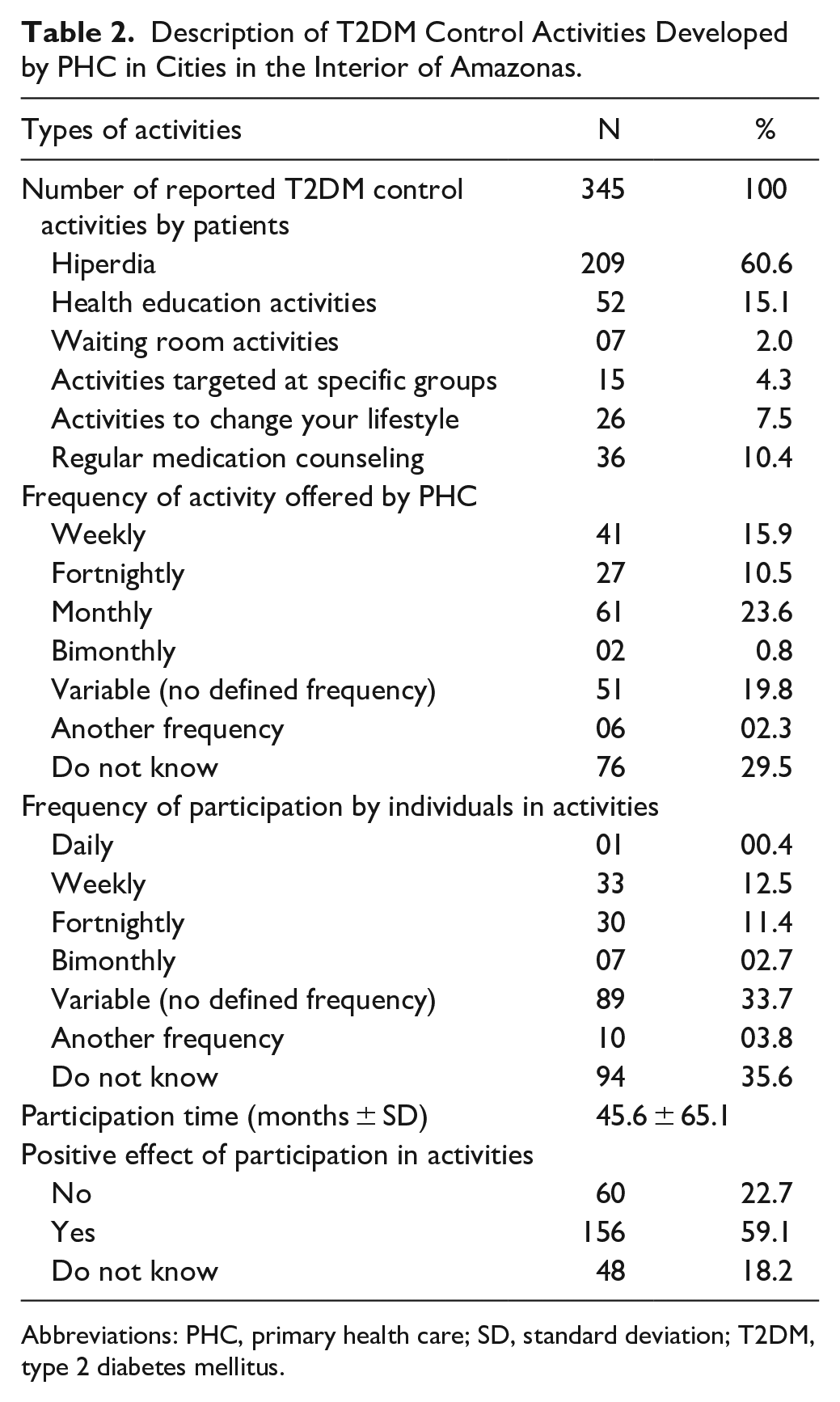
In the bivariate analyses, significant associations with participation in the activities were found for the variables related to guidance for physical activity (P = .008), nutrition guidance (P = .004), and medication adherence (P = .001; see Table 1). Participants in this study reported six different T2DM management activities (see Table 2). Among these, the HIPERDIA program and health education activities were the most frequently cited, representing 60.6% and 15.1% of responses, respectively.
Description of T2DM Control Activities Developed by PHC in Cities in the Interior of Amazonas.
Abbreviations: PHC, primary health care; SD, standard deviation; T2DM, type 2 diabetes mellitus.
Regarding activity occurrence frequency, 29.5% of patients who participated in at least one management action offered by APS were unaware of the frequency. Among respondents 19.3% declared participate monthly in the activities offered by PHC, while 33.7% reported that their participation in these activities presented lack of regularity. Despite the variety of participation’frequency, patients with T2DM recognized the positive effects of their involvement, with 59.1% acknowledging those benefits.
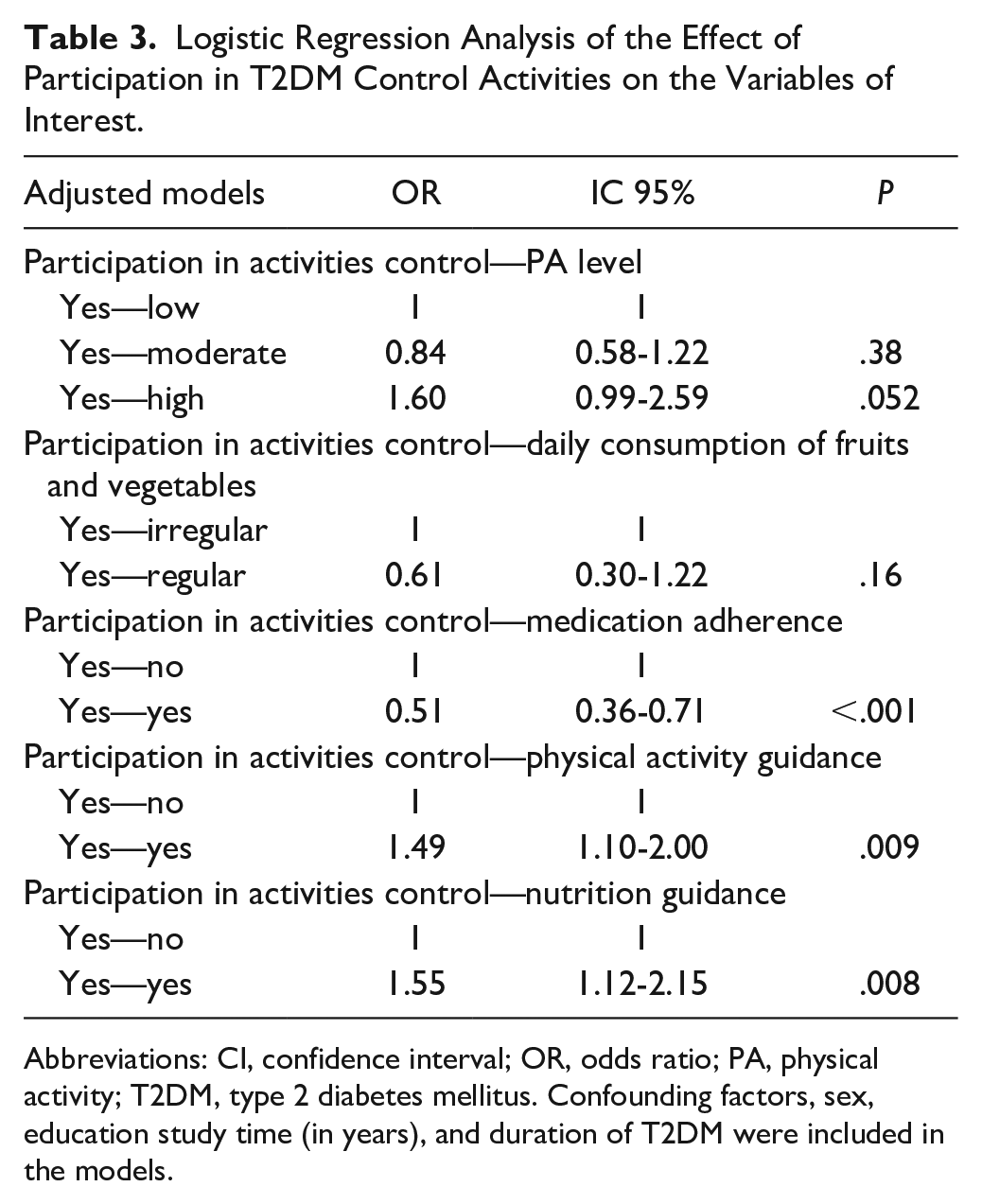
Logistic regression analyses (see Table 3) were conducted to investigate the association between participation in management activities offered by PHC and the following variables: physical activity level, daily consumption of fruits and vegetables, and medication adherence. The results revealed that participation in management activities at PHC was not significantly associated with moderate physical activity levels (OR = 0.84; 95% CI = 0.58-1.22; P = .38) or high physical activity levels (OR = 1.60; 95% CI = 0.99-2.59; P = .05). Additionally, no significant association was found with daily consumption of fruits and vegetables (OR = 0.61; 95% CI = 0.30-1.22; P = .16).
Logistic Regression Analysis of the Effect of Participation in T2DM Control Activities on the Variables of Interest.
Abbreviations: CI, confidence interval; OR, odds ratio; PA, physical activity; T2DM, type 2 diabetes mellitus. Confounding factors, sex, education study time (in years), and duration of T2DM were included in the models.
However, there was a significant association between the management activities offered by PHC and medication adherence (OR = 0.51; 95% CI = 0.36-0.71; P < .001), indicating that those who participated in the activities were less likely to adhere to their medication regimen. Additionally, associations were observed between the management activities and guidance related to physical activity (OR = 1.49; 95% CI = 1.10-2.00; P = .009) as well as nutrition (OR = 1.55; 95% CI = 1.12-2.15; P = .008). The results indicated that participants in T2DM management activities were more likely to receive guidance on physical activity and nutrition (see Table 3).
Discussion
Historically, the prevalence of diabetes mellitus (DM) has shown a significant increase over the years, and projections indicate that that trend will continue. 4 Despite a high level of individual awareness and treatment options, management of the disease remains inadequate, resulting in diabetes becoming a global public health issue. 5 Therefore, understanding and adapting management activities to accommodate different cultural contexts is crucial for effectively reaching individuals with DM. That underscores the importance of PHC, as highlighted in recent studies.14 -18,21,27,35
To evaluate the association between participation in T2DM management activities and their possible effects on food consumption, physical activity levels, and medication adherence among PHC patients in rural cities of Amazonas, it is essential to not only identify the management activities for T2DM being delivered in PHC (with patients mentioning six types of activities related to physical activity, dietary behavior, and medication adherence) but also to understand individuals’ perceptions of their participation. Notably, the participation rate was low, with most participants reporting irregular involvement (33.7%), while 59.1% indicated that they perceived positive effects from participating in these activities. Furthermore, it is crucial to identify the variables associated with the activities delivered that improve physical activity levels, dietary intake, and medication adherence, as investigated in this research.
When analyzing participation in management activities, which showed significant and positive associations with an orientation toward physical activity and nutrition, the findings of this study align with the recommendations of all T2DM management guidelines, which establish counseling on PA and healthy eating as fundamental activities.14 -18,21,35,36 That result suggests the activities developed in PHC effectively inform patients about relevant information and guidance. However, this effectiveness does not translate into better indicators of PA level and food consumption, highlighting that the predominantly theoretical methodology used in delivering these activities may influence its lack of effectiveness. 30 Based on that, further research is needed to investigate the implementation of science-based programs aimed at lifestyle changes to improve physical activity levels and healthy nutritional habits among Amazonians with T2DM.
Another significant finding was the negative association between activity participation and medication adherence. In this case, those who participated in T2DM management activities were less likely to adhere to the prescribed drug treatment. Similar results have been found in other states in Brazil. For example, a study conducted in Paraná revealed that participants with T2DM who did not participate in health education activities were 2.83 times more likely to adhere to medical treatment. 37 Another study in the capital of Rondônia identified barriers to medication adherence, such as difficulty accessing medications, experiencing side effects, and forgetfulness. 13 Those findings may also apply to the present study. However, other hypotheses can be considered. It is conceivable that participants might increase their flexibility in managing their condition since they are engaged in management activities, or they could be more participative in those activities precisely because of their non-adherence to medication treatment. Given these findings’ complexity and potential controversy, more profound studies, including qualitative methods, are needed to comprehend that phenomenon fully.
When analyzing the relationship between participation in management activities and PA level, there was a tendency toward a positive association with a high level of physical activity (P = .052). Those results suggest that participation in the activities may be related to a greater probability of adopting a higher level of PA, which is beneficial for the management of T2DM, given its positive impact on glycemic management and the reduction of disease complications. 38
However, the lack of significance demonstrates that activities aimed at promoting PA still do not result in good levels of PA despite the positive trend. That may be associated with the lack of practical activities and the limited involvement of kinesiologists (or similar professionals). A previous study found that 100% of these activities were conducted through expository and entirely theoretical lectures. Only 4% were led by physical education professionals. 30 Moreover, in Brazil, according to the National Primary Care Policy, 39 kinesiologists (or other similar professionals) are not included as part of the minimum team, hindering the offer of supervised physical activities. 39
Concerning the daily consumption of fruits and vegetables, which is part of food and diet plans with good results in T2DM management,14,15,18,20,40 participation in the activities did not show a significant association with regular consumption. As with physical activity levels, the results indicate that the management activities offered in PHC do not effectively promote positive changes in participants’ food consumption. The guidelines emphasize that there is no 1-size-fits-all recommendation for people with T2DM, which requires individualized assessment and planning with a nutritionist;14,15,18 However, in PHC contexts, that specialist may not be available, like the situation with kinesiologists under the National Primary Care Policy. 39 A previous study identified that 310 health professionals were involved in T2DM prevention and management activities in PHC in Amazonas, and only 3 were nutritionists. 30 Therefore, the efforts of professionals involved in this care must focus on evidence-based practice guidelines that empower patients in their decision-making. 14
When interpreting the results of the present study, it is crucial to consider access to health services in the context of rural/non-metropolitan Amazonas. Unlike urban areas, rural regions of that state face a lack of continuous health service provision due to the vast Amazon rainforest and extensive rivers that pose significant geographic challenges in providing even the most fundamental health services, such as PHC.29,41 These findings may primarily contribute to improving the quality of services provided to the Amazonian population, one of the main objectives of the SAPPA study. Furthermore, studies developed in Amazonas are essential for other regions with similar challenges, allowing managers and public health policies to tailor programs according to the specific realities of each context.
One of this study’s limitations is using questionnaires as an assessment tool, which rely on self-reports and may be susceptible to information and memory biases. Additionally, the study’s cross-sectional nature restricts its ability to establish causal relationships, allowing only the identification of associations between variables. However, there are several strengths to highlight. The study overcame the sample calculation, enabling a solid and robust analysis representation. Moreover, it is the first study to evaluate the potential effects of participation in T2DM management activities in Amazonas.
Conclusion
In this study, participation in activities offered in primary care positively impacts medication adherence. However, although participants received guidance on adhering to physical activity and healthy eating practices, no impact was observed in behavior changes in people diagnosed with type 2. Moreover, the management activities were associated with an orientation toward physical activity and nutrition but not with improvements in PA levels and healthy eating practices.
Also, participants recognized the management activities for T2DM offered by PHC and their positive effect on managing T2DM. However, the low or infrequent participation rate indicates the necessity for more effort in the activities delivered, and the lack of significance in some associations reveals the need for intensified efforts and the creation of new intervention strategies.
In the challenging context of the rural Amazon, these findings guide improvements in the care provided to PHC patients with T2DM residing in cities away from the capital in Amazonas and help ensure the practices being developed to improve the service are based on the local realities. That demonstrates the need for implementing health programs grounded in scientific evidence within a real-world context.
Footnotes
Declaration of Conflicting Interests
The author(s) declared no potential conflicts of interest with respect to the research, authorship, and/or publication of this article.
Funding
The author(s) disclosed receipt of the following financial support for the research, authorship, and/or publication of this article: This study was supported by the Fundação de Amparo à Pesquisa do Amazonas (FAPEAM) through the Edital Universal 2018, the Coordenação de Aperfeiçoamento de Pessoal de Nível Superior (CAPES)—Finance Code 001, and the Conselho Nacional de Pesquisa (CNPq).
Ethical Approval
Ethical approval was obtained from the Human Research Ethics Committee of the Federal University of Amazonas (registration: 3,937,812) in October 2020.
Consent to Participate
Verbal.
