




Abstract
Physicians who know their patients’ needs can better serve these patients. In today’s primary care setting, it is important to be aware of the needs of each patient population so that health care personnel and dollars can be utilized in a deliberate and efficient manner. A sustainable practice of medicine depends heavily on business expertise. How many primary care physicians identify where investment is needed before they delegate materials and workforce? This study outlines medical students’ efforts to investigate the needs of a local patient population. This study has benefited health care delivery to the local community and has educated medical students about the administrative and financial aspects of managing a primary care clinic. In a country aiming to graduate more primary care physicians and produce more access to primary care, projects such as this one will become paramount.
Clinica Esperanza
Census data show that the Hispanic population of Memphis increased from 3% to 6.5% from 2000 to 2010.1,2 This growth makes Memphis home to the fourth-fastest-growing urban Hispanic population in the country. In 2004, the Mexican-born population in Tennessee was growing faster than that of any other state in the country. 3 To serve this increasing Hispanic population, medical students with faculty sponsor Alicia McClary at the University of Tennessee Health Science Center (UTHSC) began Clinica Esperanza (Clinic Hope) in 2005. The clinic is open on Wednesday evenings at the donated facility of Christ Community Health Center on Broad Avenue in Memphis, Tennessee. Patients are seen on a walk-in basis, and medical records are kept on each individual. Currently, patients are accepted without discrimination if they are uninsured, exceed the age of 12, and are not a patient at Christ Community Health Center. Before 2006, all ages were accepted at the clinic. The clinic is managed and maintained by UTHSC medical students, volunteer interpreters, and volunteer phlebotomists. Each week, at least 1 UTHSC attending physician sees patients with the medical students. Recently, medical students began the clinic’s first fund-raiser to provide pharmaceuticals, medical equipment, and general sustainability for the clinic. To determine how to allocate these resources, medical students performed the following analysis of chief complaints and patient demographics.
Methods
A retrospective chart review of patient files from 2005 through 2010 was undertaken, as approved by UTHSC’s Institutional Review Board. From each patient’s chart, the following information was extracted and analyzed: chief complaint, total number of visits per year, sex, age, marital status, length of follow-up, country of origin, time in Memphis, educational background, and occupation.
Results
Patient Visits
From 2005 through 2010, Clinica Esperanza fielded 2551 patient visits, consisting of 951 unique patients. In 2005, there were 279 patient visits; in 2006, 565; in 2007, 489; in 2008, 536; in 2009, 426; and in 2010, 256.
Age, Sex, and Marital Status
Of the 951 total patients, 609 were females and 342 males. Patient age ranged from 1 month to 82 years, with a mean age of 34 ± 12 years. Of the 72% of patients who reported marital status, 61% were married and 36% were single.
Chief Complaints
The top 10 chief complaints from 2005 to 2010 were as follows: Pap smear with 221, abdominal pain with 202, lab results with 188, headache with 159, rash with 118, medication refill with 94, hypertension with 89, back pain with 86, chest pain with 79, and diabetes with 79. Overall, women’s health accounted for 19% of patient visits, followed by 14.5% for head, eyes, ears, nose, and throat; 12% for health maintenance; 9.5% for gastrointestinal; and 9.2% for musculoskeletal complaints. The top 3 chief complaints in a variety of medical specialties were recorded as well (Figure 1).
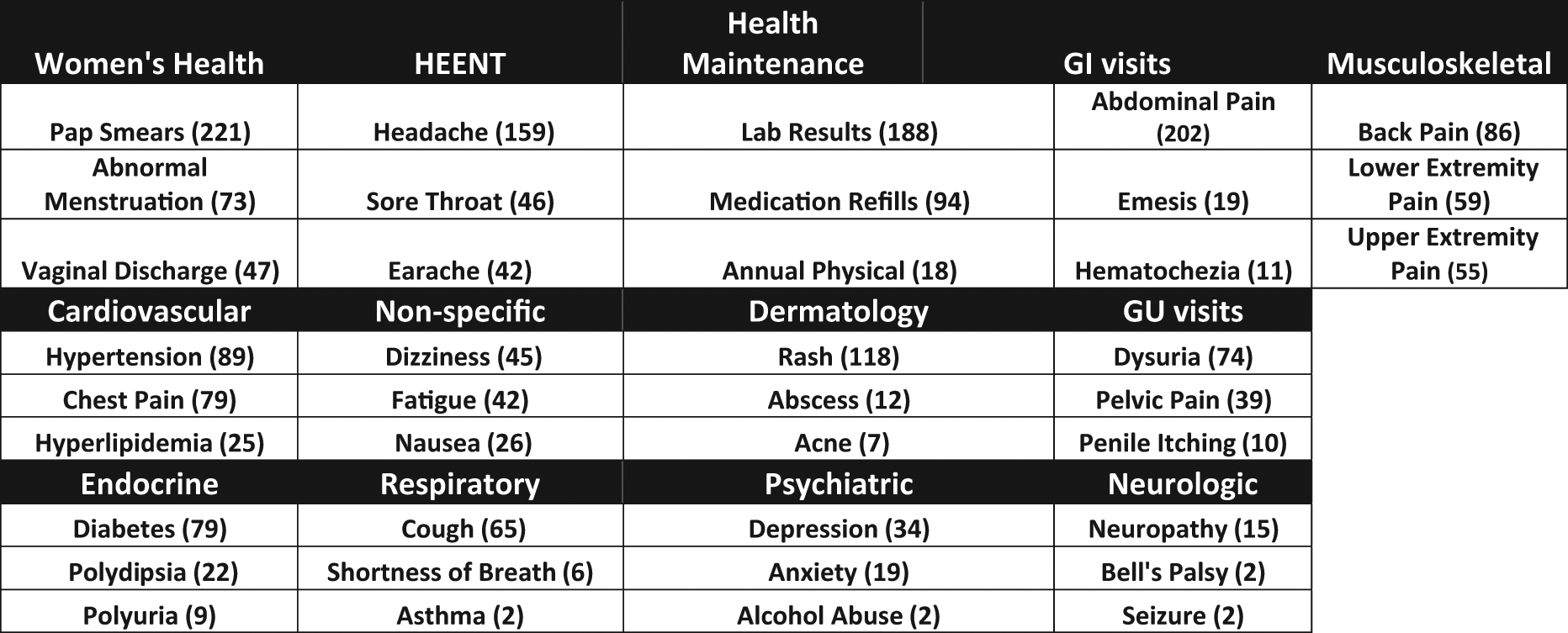
Top 3 chief complaints in each specialty with categories in order of decreasing prevalence.
Patient Continuity
Of the 951 total patients who visited Clinica Esperanza between 2005 and 2010, 60% presented once and never returned; 13% of the patients followed up for 1 year, 9% for 2 years, 6% for 3 years, and 6% for 4 years. Four percent of the patients have been visiting Clinica Esperanza for 5 years and continue to come.
Patient Geography
Sixty-five percent of the patients reported the length of time they have been living in Memphis: 14% had lived in Memphis less than 1 year, 8% for 1 year, 13% for 2 years, 13% for 3 years, 12% for 4 years, 10% for 5 years, and 32% for more than 5 years. Seventy-three percent of the patients reported their country of origin: 70% were from Mexico, 11% from Honduras, 8% from Guatemala, and 5% from El Salvador. A total of 14 countries are represented at the clinic.
Patient Education and Occupation
Of the 24% of patients who reported educational attainment, 19% attended elementary school, 27% middle school, 49% high school, and 6% college. Of the 50% of patients who reported occupation, 31% worked in construction and landscaping, 28% in factories and warehouses, and 16% in cleaning and housekeeping. Other occupations that were reported include homemaker, student, cook, and waitress.
Discussion
Over 110 student-run clinics exist in America, each serving a unique patient population. 4 In 2009, Meah et al described such clinics by saying that “students place themselves at the forefront of problem solving and system navigation to effectively care for severely disadvantaged populations.” 4 Hemba and Plumb of Jefferson College of Medicine’s JeffHope student-run clinic suggested that medical students gather “data to evaluate the number and type of patient encounters, patient demographics, and breadth of pathology encountered.” 5 We have fulfilled that direction and used the data to shape the management of Clinica Esperanza.
We detected a drop in patient visits in 2010, the year with lowest patient visits. During 2010, faculty sponsorship for the clinic shifted due to personal circumstances, causing unexpected and extended clinic closings. After making this connection, the medical students made deliberate decisions to improve the number of patient visits. In 2011, the clinic remained open every week, closing only during major holidays.
Our main focus has been to address the top 10 chief complaints. Pap smears are the most common chief complaint. We have improved medical student preparedness by reiterating proper technique and ensuring optimal supervision during examinations, as well as allocating funds toward speculums and related lab material. The second chief complaint is abdominal pain. We now have a gastrointestinal attending participate and aid in deciding which patients with abdominal pain should be referred for specialized or emergent care. Follow-up for lab results is the third most common chief complaint. Many patients expend great effort to get to the clinic, some traveling with children at night via public transportation only to discover they have normal lab results. The clinic has since attempted to simplify the delivery of lab results with regular phone calls and documentation of information delivery. Headache and rash are the next most frequent chief complaints. Since it was felt that the primary care staff and medical students adequately address these complaints, no changes are being made at this time.
Medication refills, hypertension, and diabetes are also top chief complaints. Due to the high number of visits for medication refills, especially for these 2 chronic diseases, we seek to provide on-site pharmacy with the help of the UTHSC School of Pharmacy. This goal is a priority, especially when considering that at least 79% of student-run clinics in the country dispense medications on-site. 6 Already, a clinical pharmacist assists each week. We have addressed the chief complaints of chest pain and back pain. For the former, we use an on-site electrocardiogram machine in an attempt to improve our ability to immediately assess for emergent pathology. For the latter, we have collaborated with the UTHSC School of Physical Therapy to address musculoskeletal complaints.
Most patients are from Mexico and Central America. In concordance with studies that have shown improvement with patient follow-up and patient-physician “bonding” in the setting of same-language communication, 7 medical student volunteers created 10 online medical Spanish modules to further improve the language proficiency of students.
Conclusions
Clinica Esperanza will improve services to the Hispanic patient population in the future due to greater awareness of patient issues. Improvements include better patient continuity, emphasis on top 10 chief complaints, and provider education in medical Spanish. To achieve these goals, a medical Spanish elective has been created. The clinic was open for the entirety of 2011 and will remain open except during major holidays. Future plans for on-site pharmacy will be pursued in hopes of providing fully compensated medications to address the most common patient complaints. Future goals include smoother referrals and initiating similar clinics on UTHSC’s other campuses in Chattanooga and Knoxville. Training more medical students to invest in the resources necessary to manage a primary care clinic in an intentional and goal-directed manner will prepare future physicians to handle the economic and entrepreneurial challenges of running a medical practice that meets patients’ needs in a sustainable manner.
Footnotes
Acknowledgements
We would like to acknowledge Dr Alicia McClary, for her dedication to Clinica Esperanza, as the clinic would not have been created or sustained without her support. We acknowledge the generosity of Christ Community Health Center in Memphis, Tennessee, as it continues to volunteer its facility for our use.
Declaration of Conflicting Interests
The author(s) declared no potential conflicts of interest with respect to the research, authorship, and/or publication of this article.
Funding
The author(s) received no financial support for the research, authorship, and/or publication of this article. Institutional review board approval was sought for this study, and no financial support of grant funding was sought or required.