




Abstract
A number of events in China in recent years have been characterized by tensions or controversies between scientists and the public, such as the p-Xylene chemical project in Xiamen, nuclear energy projects, and genetic engineering. Scientists tend to attribute such conflict to inadequate public knowledge of science, leading to misunderstandings about it. However, that view ignores the influence on public perceptions of news reports and online discussions about controversial technologies in new media. Social media reporting affects the audience's perception of the risks posed by controversial technologies and can cause people to lose confidence in the scientific community and damage their trust in government. Thus, the public opposes these technologies. In this context, this study explores the relationship between the public's trust in the scientific community and the government on the one hand and its attitude towards controversial technologies on the other. I surveyed 1,235 people using a national online probability sampling strategy. I found that people's use of new media was significantly related to the extent of their knowledge of specific controversial technologies and was associated with other people's opinions about those technologies. The more attention people paid to WeChat coverage of genetically modified organisms (GMOs), the more supportive they were of them. Thus, the public's use of new media is a key factor in predicting its positive attitude to GMOs. Scientific literacy also significantly affects public attitudes to GMOs, directly as well as indirectly.
Introduction
The internet has promoted formal and informal communication about science that allows the public to directly discuss the development of new technologies. However, such controversial issues in China in recent years as a planned p-Xylene plant in Xiamen, nuclear power and waste incineration have led to conflicts between science and public opinion.
This exemplifies the idea of the ‘science literacy/knowledge deficit model’ in science communication, which involves enhancing the public's understanding and acceptance of science by improving its scientific literacy. China's efforts to promote knowledge of science and technology have intensified in recent years. According to the 2015 National Science Popularization Statistics of China, more than two million people have been engaged in activities to promote scientific knowledge nationwide. A total of 161,100 science and technology exhibitions have attracted more than 249 million visitors (Ministry of Science and Technology, 2015).
China's 13th Five-Year Plan notes the need to promote scientific knowledge and includes an annually increasing budget for improving overall national scientific literacy. Specifically, for example, in 2016, the Action Plan for the Outline of the National Scheme for Scientific Literacy (2016–2020) was launched.
Although large investments have already been made to promote science popularization in China, it is difficult to see the effects in the short term. Even if the number of annual activities to promote scientific knowledge increases drastically, the public's acceptance of new technologies will not increase at a corresponding rate. Of all public debates related to new technologies, the controversy on genetically modified organisms (GMOs) has been the most intense. Although many measures have been taken to increase the public's knowledge of GMOs, the impact of those measures in improving public attitudes cannot offset the negative impact of rumours and stigma. In recent years, a growing volume of fake news and information about GMOs has appeared on the internet.
The public's understanding of scientific knowledge affects its attitudes to science (Brossard and Nisbet, 2007). However, few studies have analysed differences in scientific knowledge among members of the public. Perceptions and understanding of GMO technology differ among groups, such as doctoral students, middle school students, art students, science students, and rural and urban residents. The factors influencing public support for controversial technologies are diverse and complex. Therefore, personalized methods for the popularization of science should be used to target different segments of the population.
In addition, the following three questions should be answered before planning activities to promote scientific knowledge on GMO technology:
How do social media influence public scientific knowledge of controversial technologies?
How do different segments of the population differ in their understanding of science?
How do psychographic variables affect the public's attitudes?
By answering these questions, we can understand how the public forms opinions in the Information Age to construct its own understanding of GMOs.
Public science policy is complex and difficult for non-scientists to grasp. Understanding it requires time and close attention, so it is nearly impossible for the public to be well informed about all issues related to scientific policy; therefore, people need to find shortcuts to process this information and make judgments about complex controversies in scientific policy (Popkin, 1991; Brossard and Nisbet, 2007). The fact that the public may be relatively ignorant of controversial technological discussions does not mean that it cannot make judgements about controversial technologies (Scheufele and Lewenstein, 2005; Brossard and Nisbet, 2007). Scheufele and Lewenstein (2005) claimed that people form opinions and attitudes even in the absence of relevant scientific or policy-related information.
Recent studies have shown that, with the development of the internet, the content of new media channels has come to affect the public's understanding of controversial technologies and its risk perceptions, including about nanotechnology (Scheufele and Lewenstein, 2005), agricultural biotechnology (Brossard and Nisbet, 2007), GMOs (Lee and Kim, 2018), climate change (Wang, 2017), and vaccines (Dunwoody and Kohl, 2017).
The factors influencing public support for controversial technologies are diverse and complex. Recent studies have also shown that the relevant variables do not affect attitudes in only one way, and different variables affect public opinion in direct and indirect ways. I thus explore both the direct and the indirect effects of particular variables on public attitudes, including scientific knowledge, the use of new media, trust in science and risk perception.
Of the models that consider the relationship between knowledge and resulting attitudes towards issues, the stimulus–response (S-R) model and the knowledge–attitude–practice (KAP) model in psychology have received the most attention. However, the KAP model ignores the influence of the environment on knowledge and attitudes. Because the public's attitudes to genetically modified (GM) food are influenced by many factors other than scientific knowledge, the S-R model is more suitable as the basic framework for studying the knowledge–attitude relationship.
The most suitable theoretical model for basic psychological concepts is the S-O-R (stimulus–organism–response) model, which is an extension of the behaviouristic S-R formulation proposed by Woodworth in 1958 (Royce and Mos, 1984). In psychology, the S-R model has long been used to study changes in public attitudes, and the S-O-R model proposed by Woodworth (Woodworth and Schlosberg, 1965) is the most widely used.
The S-O-R model posits that stimulation and human behaviour (reaction, action) are linked by an organismic component. The model differs from the traditional S-R model mainly in two aspects:
It emphasizes that stimulation (S) does not directly respond to the behaviour of the public (R).
The behaviour of the public is based on consciousness as a mediator.
Mehrabian and Russell (1974) improved the model to produce the O-S-O-R (orientation–stimulus–orientation–response) model, which is the best summary of the general pattern of public behaviour. O1 in the model represents the basic characteristics of the individual in terms of structure, culture, cognition, and motivation, including demographic background and location of residence. S represents the stimulus, and, in communication, the consumption of information through mass media and social networks among people are regarded as sources of stimulation. O1 and S jointly influence O2, which represents knowledge and risk perception, which eventually help form the attitude and behaviour of the public (R).
The S-O-R and O-S-O-R models assume that the attitude of the public is triggered by external sources of stimulation that directly or indirectly affect its physical and psychological states. When faced with various stimulations, people generate specific motivations and behavioural intentions and make decisions about whether to buy certain products.
Brossard and Nisbet (2007) used the O-S-O-R model to discuss factors that influence the attitudes of the American public to agricultural biotechnology. As conceptualized, O1 represents long-term social predispositions. S represents the stimulus of media consumption and attention across types of news outlets and other information sources. O2 signifies intervening orientations or behaviours between stimulus and outcome, such as knowledge and trust or generalized reservations about science. R represents the final outcomes of both sets of orientations and the communication stimuli—in that case, public views about agricultural biotechnology. According to Brossard and Nisbet, these variables are typically classified as ‘endogenous’ variables, and the primary emphasis is on analysing the inter-relationships among them and their direct and indirect effects on the response or dependent variables of interest. They found that the level of knowledge of agricultural biotechnology was positively correlated with the attitudes of the public. The factors influencing its attitudes are diverse and complex, so it is not sufficient to examine only the linear relationship between specific variables.
From Brossard and Nisbet's examination of the structural relationship between variables, we learn that it is necessary to consider the impact of the environment, in addition to knowledge variables, on the construction of knowledge. Therefore, to examine the factors affecting the public's attitudes and behaviours regarding GMO technology, my study refers to the O-S-O-R model: O1 is the demographic variable of the individual; S is the source of new media exposure; O2 consists of trust, perceived risk and scientific knowledge. That is how the attitudes and behaviour of the public (R) are formed. The variables are listed in Table 1 and elaborated in subsequent sections of this paper.
An O-S-O-R model explaining support for controversial technology
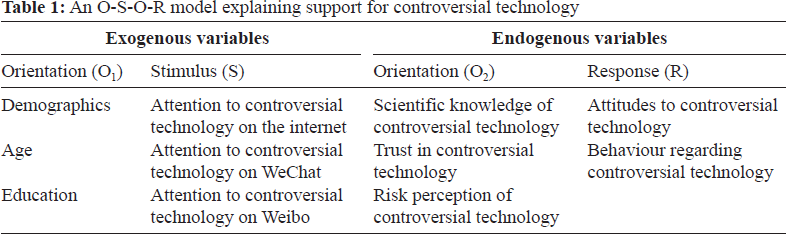
In the Information Age, new media channels are important sources through which people acquire information easily when faced with a new scientific concept, such as GMO technology. The use of new media is a major factor influencing the public's attitudes to GMO technology (Brossard and Nisbet, 2007). Past research has shown that new media content (such as online news, WeChat information and Weibo posts) influences public knowledge and risk perceptions of science (Nisbet and Lewenstein, 2002; Agha, 2003; Wang, 2017). New media channels can not only be used to communicate scientific knowledge but also as a platform for online rumours. A variety of comments and opinions on GMO technology can be found online. Scientists, organic food companies, and online opinion leaders want to influence the public's understanding of GMO technology and thereby gradually affect its attitude to GM food and its behaviour.
Most initial discussions about GMO technology took place on online bulletin boards, but interest was not high. Only about 36% of users discussed GMO-related issues on bulletin boards (Triunfol and Hines, 2004). Even so, those online discussions did help form the public's initial impressions and perceptions of GMO technology. In China, the 2012 ‘golden rice’ event marked the arrival of wide discussion about GM food among the public. Golden rice is genetically engineered to be high in vitamin A. As Fan et al. (2013) noted, netizens often paid attention only to opinions with which they agreed when discussing the trial of golden rice on children in Hunan; there was a distinct ‘echo chamber’ effect.
Internet platforms such as Sina Weibo brought GMO technology to the public's attention, but the complexity of the issue made it difficult for people to distinguish between correct and incorrect information. Using a website quality assessment tool, McInerney et al. (2004) found that only a third of 100 GMO-related websites had good-quality content.
The popularization of science through new media has become an important aim for various countries in promoting GMO technology and its products, but the popularization of GMO-related science entails far more than simply setting up a science communication website. According to a study by Wang and Waters (2012), the websites of American and German agricultural associations publish only regular agricultural scientific knowledge without interactive functions, and the effect of such communication is limited. This problem has also been observed on GMO-related websites in China. Overall, past studies have found that the potential of new media in the dissemination of GMO-related knowledge has not been well developed (Wang and Waters, 2012).
The internet has become an important tool for people seeking to acquire scientific knowledge (Jin et al., 2017), but it is necessary to clarify the following questions:
How does the public use different channels of new media to acquire information about GMO-related issues when faced with a large amount of information?
How do various new media channels affect the public's access to GMO-related knowledge?
How does the content of new media affect the public's understanding and risk perception of GMOs, and how does the public ultimately form an attitude?
This study addresses these questions by examining the public's interest in GMO-related content in new media.
The development and industrialization of GM food require the support of the public, so people's acceptance of GM food has become a focus of research in recent years. The earliest study on the relationship between knowledge of and attitudes to GM food was conducted by Frewer et al. (1994) based on an experiment. Two packages labelled ‘GM food’ and ‘non-GM food’ were used to wrap products, and the advantages of each were explained to test the public's purchasing attitudes. Frewer et al. found that, owing to the public's limited understanding of GM food, it was difficult for people to determine whether it posed risks to their health. Thus, they needed to turn to other credible sources of information for help.
With the development of GMO technology, more people have begun eating GM foods. ‘GMO’ is no longer an unfamiliar term to the public. An increasing number of studies have tested and attempted to explain the influence of GMO-related knowledge on public attitudes. Different theories have been developed using varying assumptions about the influence of scientific knowledge on public attitudes. In science communication, researchers consider scientific knowledge to be a key factor influencing public attitudes. The assumption is that improving the scientific knowledge of the public has positive effects on people's attitudes to new technologies (Miller, 1983). The Foreign Citizen Science Literacy Survey Report found that the public's scientific knowledge is correlated with its support for new technologies (Alum et al, 2008). A number of studies have found that the public's knowledge of GM food affects people's attitude to it: the higher the public's level of knowledge, the more positive are its attitudes to GMO technology (Hoban et al., 1992; Hallman et al., 2002; Hallman et al., 2003). That conclusion has also been drawn by some Chinese scholars (Huang et al., 2006; Tang, 2015). According to the 2015 National Science Literacy Survey, the higher the public's scientific literacy, the higher its support for the application of GMO technology (Ren et al., 2016).
In the field of risk communication, however, researchers have different opinions on the influence of scientific knowledge. They argue that the public's risk perception is the key variable affecting its attitudes to controversial technologies and that its level of scientific knowledge does not determine its acceptance of GMOs (Fan and Jia, 2015). Thus, from the perspective of risk communication, the relationship between scientific knowledge and public attitudes involves risk perception as a mediating factor. The impact of knowledge on public attitudes is indirect rather than direct. For example, in Bredahl's (2001) research on attitudes to GM yogurt and GM beer in Denmark, Germany, Italy and the United Kingdom, scientific knowledge was used only as an exogenous variable to study the impact of perceived risks and benefits on attitudes when designing the survey model. That study found that only with perceived risks and benefits does scientific knowledge have a significant negative impact on the public's attitudes.
Verdurme and Viaene (2003) modified Bredahl's model. In addition to retaining the original variables, they added such variables as culture and socio-economic status to further study their impact on public attitudes. The results confirmed Bredahl's conclusion that scientific knowledge can indirectly influence attitudes through risk perception. But some studies have also concluded that scientific knowledge has no influence on risk perception and that there is no correlation between scientific knowledge and risk perception (Sjoberg, 2001; Jia et al., 2015).
From the above literature, it is clear that, in risk communication, most studies classify knowledge as a factor that requires intermediaries to influence attitudes and have rarely focused on the direct impact of knowledge on attitudes (Bredahl, 2001; Sjoberg, 2001; Verdurme and Viaene, 2003).
Scientific knowledge causes science communication and risk communication to intersect in research. Although opinions on the relationship between scientific knowledge and attitudes differ, it is undeniable that scientific knowledge has an important position in both types of research.
Scientific literacy and the measurement of GMO-related knowledge (O2)
As discussed above, science communication and risk communication are highly correlated due to scientific knowledge. However, some scholars have noted that scientific knowledge varies owing to different issues (Alum et al., 2008). Therefore, general scientific principles cannot be applied directly to the public's level of GMO-related knowledge.
Scientific literacy, which refers to the public's understanding of science (Jin, 2002), has an important position in knowledge measurement. The most fruitful scientific literacy scale, proposed by Miller (1983), measures whether a person has:
a vocabulary of basic scientific constructs sufficient to read competing views in a newspaper or magazine
an understanding of the process or nature of scientific inquiry
some level of understanding of the impact of science and technology on individuals and society.
The first study on the public's GMO-related knowledge was a survey by Kamaldeen and Powell (2000) when GM food was first launched in Brazil. In China, a similar study was conducted by Zhong et al. (2002). The results showed that most Chinese people had little knowledge of GM food, and more than 50% of urban residents had never heard of it. However, as GMO technology has been more widely discussed at home and abroad in recent years, the public has become more familiar with GMO science. Research by Tang (2015) indicates that 90.9% of the public knows the term ‘GMO science’, even though people's knowledge of GMO science remains limited.
Past related studies in China show that knowledge of GMO technology has an impact on the public's attitudes (Xiang et al., 2005; Liu, 2010; Tang, 2015). However, people are most commonly asked whether they ‘know’ the term ‘GMO technology’. For example, in a study by Tang (2015), respondents were asked how much they knew about GMO technology and were given options for answers ranging from ‘don't know’ to ‘expert’. However, those options can be used only to assess their own assessments of their GMO-related knowledge but not to measure their GMO-related knowledge. Even if two people had possessed the same level of knowledge, their answers might still have been different because of different assessments of their own judgements.
Measuring the scientific literacy of the public simply by asking people whether they have ever heard of GMO technology is inaccurate. Frewer et al. (1997) and Bredahl (2001) proposed additional questions. For example, they asked respondents whether all processed foods are made from GM products. In their survey, Xiang et al. (2005) developed a new question about whether traditional soybeans and GM soybeans all possess genes. Only 49.3% of the respondents answered correctly.
No mature theory or scale is available to measure GMO-related knowledge, and such a scale is needed to study the relationship between knowledge and public attitudes to GMOs. Based on Miller's scientific literacy scale, and combined with scientific knowledge of GMOs, I designed such a scale consisting of three dimensions:
scientific principles (understanding the scientific approach)
GMO development (understanding basic GMO science)
social impact (understanding science policy issues).
Based on this scale, I discuss the impact of GMO-related knowledge on attitudes and the core problem: how does GMO-related knowledge (scientific principles, GMO development and social impact) affect the attitudes and behaviours of the public?
Public opposition to a controversial technology is often fuelled by perceived risks. Past research has shown that perceived risks and benefits act as key predictors of public attitude to a controversial technology (Alhakami and Slovic, 1994; Arning et al., 2019). Risk perception refers to beliefs about potential harm or the possibility of a loss. It is a subjective judgement that people make about the perceived probability and negative outcome of an adverse event (Slovic, 1987).
Most of the public uses trust to evaluate risk (Freudenburg, 1993). The role of trust in explaining public acceptance of controversial technologies has been studied at length. Brossard and Nisbet (2007) claimed that trust enables the public to act without knowledge of the technical nature of the relevant risks. As a substitute for information about a vast array of possible threats in everyday life, people are forced to rely heavily on the endorsement of regulators, officials, industry, scientists and other experts (Priest et al., 2003; Brossard and Nisbet, 2007). Slovic (1999) claimed that, if trust in the government is high, the public is less likely to worry about the unforeseen risks posed by a controversial technology. In addition, trust in institutions directly influences risk perception and fear, which in turn affect the acceptance of biotechnology (Brossard and Shanahan, 2003). Hence, in this case, I return to aspects of the conceptualization and measurement of institutional trust, perceived risk and scientific literacy as key variables in my model.
Methods
Research questions
This study focuses on how the public supports GMO technology in China and poses the following three research questions:
RQ 1: How does new media content (online news, WeChat information, Weibo posts) directly and indirectly influence public attitudes?
RQ 2: How does scientific knowledge directly and indirectly affect public attitudes?
RQ 3: How do risk perception, institutional trust and trust in scientists influence public attitudes and behaviours?
The data for this study were collected in 2016. The survey was conducted by the Media Survey Laboratory at the School of Journalism and Communication of Tsinghua University. I obtained 1,235 valid cases from an online panel with more than 200,000 registered users. Using a non-probability sampling method, the respondents were sampled based on their gender, education and geographical location. Such a sampling design enhances the representativeness of the sample. The sample featured males (n = 662) and females (n = 573) with varying levels of education: elementary school and below (n = 173), junior high school (n = 452), high school (n = 358), junior college (n = 102), bachelor's degree (n = 115), master's degree (n = 28), and doctorate (n = 7). The geographical regions represented were north China (n = 169), north-east China (n = 102), east China (n = 397), south China (n = 180), central China (n = 159), south-west China (n = 142), and north-west China (n = 86). The sample had roughly the same distributions as the gender, education and geographical distributions published by the China Internet Network Information Center. Despite the carefully constructed quota, however, the use of non-probability sampling limited the generalizability of the findings.
Measurement
The survey contained questions on a five-point scale, including questions about new media use, institutional trust, perceived risk, scientific literacy, attitudes to GMOs and consumer behaviour. Questions on demographic information, such as education, age and gender, were also included. Analyses of variance were run for comparisons. ‘Don't know’ responses were removed from the analyses.
New media use
The respondents were asked to score the following statements about how they acquired information by using new media (1 = strongly disagree; 5 = strongly agree; M denotes ‘mean’ and SD denotes ‘standard deviation’):
‘I am following GMO-related information on the internet.’ (M = 3.07, SD = 1.2)
‘I am following GMO-related information on Weibo.’ (M = 2.75, SD = 1.23)
‘I am following GMO-related information on WeChat.’ (M = 2.85, SD = 1.27)
Trust has two dimensions: institutional trust and trust in scientists. The respondents were asked how strongly they agreed or disagreed with each of the following statements (1 = strongly disagree; 3 = neutral; 5 = strongly agree):
‘In formulating policy on GM foods, the government will establish complete regulations.’ (M = 3.48; SD = 1.19)
‘The government has the ability to oversee the safe management of GM foods, and can set standards concerning them.’ (M = 3.46; SD = 1.21)
‘The government can ensure the safety of GM foods.’ (M = 3.11; SD = 1.25)
‘The first consideration for the government to develop GM foods is food safety.’ (M = 3.33; SD = 1.24)
‘The government does not tend to target specific groups during the testing of GM foods.’ (M = 3.24; SD = 1.26)
‘Domestic GM foods companies will comply with government regulations.’ (M = 3.03; SD = 1.25)
‘The government will severely punish violations by companies making GM foods.’ (M = 3.29; SD = 1.22)
To measure trust in scientists, the respondents were asked to verify the following statement:
‘In research on and development of GM food, Chinese scientists are trustworthy.’ (M = 3.26; SD = 1.23)
To measure perceived risk, the respondents were asked to answer the following questions, and their responses were scored on a five-point scale (1 = benefits strongly outweigh risks; 5 = risks strongly outweigh benefits):
‘Do you think the risks of GMOs for the environment outweigh their benefits?’ (M = 3.11; SD = 1.16)
‘As long as GM products are listed through national security certification, is food safety guaranteed?’ (M = 3.17; SD = 1.12)
I measured the public's ability to understand scientific research, its comprehension of selected constructs, and people's understanding of contemporary political issues that involve science and technology (Miller, 1983). Scientific literacy has three dimensions: understanding the scientific approach, understanding basic scientific constructs, and understanding science policy issues (Miller, 1983).
To measure GMO-related knowledge, the respondents were asked to quantify how much they had heard about a certain issue (1 = never, 2 = seldom, 3 = occasionally, 4 = often, 5 = very often):
plant breeding (M = 3.35, SD = 1.16)
GMOs (M = 3.37, SD = 1.14)
agricultural biotechnology (M = 3.06, SD = 1.22)
GM foods (M = 3.42, SD = 1.18).
To measure people's understanding of the scientific approach, their factual knowledge was measured using answers to the following 10 dichotomous (true/false) questions (Kamaldeen and Powell, 2000; Chern and Rickertsen, 2003; Zhong et al., 2002; Brossard and Nisbet, 2007):
‘The child's sex is determined by the father's genes.’ (True)
‘Human and gorilla genomes are 98% similar.’ (True)
‘All creatures are composed of cells.’ (True)
‘Transgenic technology is the introduction of known high-quality genes to the genome of the organism.’ (True)
‘The risk posed by licensed transgenic crops is no greater than that posed by traditional breeding crops.’ (True)
‘Transgenic crops and traditional crosses are all bred through genetic changes.’ (True)
‘GM tomatoes contain genes but ordinary tomatoes do not.’ (False)
‘If a person eats GM food, his/her genes will change.’ (False)
‘It is not possible to transfer animal genes into plants.’ (False)
‘Transgenic tomatoes with transduced fish genes taste like fish.’ (False)
The number of correct answers ranged between zero and 10 among respondents. The answers were summed up in a single index (M = 5.60, SD = 2.28).
To measure people's understanding of basic scientific constructs, the respondents were asked two questions:
‘As far as you know, does China allow GM food to be imported from other countries?’ (Yes)
‘Do GM foods sold in China need to be labelled?’ (Yes)
This study measured the understanding of science policy issues by scoring the responses on a five-point scale (1 = strongly disagree; 3 = neutral; 5 = strongly agree) to the following questions:
‘GMOs can help reduce the use of pesticides.’ (True)
‘GMOs can help raise the nutrient content of the crop.’ (True)
‘GMOs can raise crop yields.’ (True)
‘GM food licensed by the state may contain hazardous substances.’ (False, reverse coded)
‘GM food can reduce production costs.’ (True)
‘GM food can help reduce environmental pollution.’ (True)
‘GM food licensed by the state may undermine biodiversity.’ (False, reverse coded)
‘GM food licensed by the state may damage the soil.’ (False, reverse coded)
These eight measures were combined into a single index (M = 25.39, SD = 6.48, α =0.81), in which higher scores indicated greater knowledge.
The respondents were asked how strongly they agreed or disagreed with each of the following statements (1 = strongly oppose; 3 = neutral; 5 = strongly support):
‘Do you support the development of GMOs in China?’ (M = 3.33, SD = 1.22)
‘Do you support the commercialization of GMOs?’ (M = 3.12, SD = 1.20)
‘Do you support the application of GMOs to biomedical technology?’ (M = 3.42, SD = 1.20)
This study was based on GM-related products certified by the government and did not examine other products that are being developed or have not been certified. Consumer behaviour towards GM food was measured using eight items. The respondents were asked whether they would buy the following GM products that had passed national safety certification (1 = strongly disagree; 3 = neutral; 5 = strongly agree):
high-fibre foods processed with disease- and pest-resistant wheat (M = 2.90, SD = 1.23)
disease- and pest-resistant rice (M = 2.96, SD = 1.26)
healthier varieties of rice (M = 3.07, SD = 1.27)
GM fruits or vegetables resistant to pests and diseases (M = 2.96, SD = 1.21)
GM fruits or vegetables stored for a long time (M = 2.82, SD = 1.26)
soybean oil processed from GM soybeans (M = 2.89, SD = 1.27)
tofu processed from GM soybeans (M = 2.75, SD = 1.27)
livestock products that use GM corn as feed (M = 2.95, SD = 1.25).
In statistics, confirmatory factor analysis (CFA) is a special form of factor analysis most commonly used in social research. It is used to test whether measures of a construct are consistent with a researcher's understanding of the nature of that construct (or factor). I assumed that factors affecting public attitudes to GMOs feature multilayered characteristics. To better understand the relationship between the variables, I used structural equation model (SEM) analysis. Two model components were distinguished in SEM: a structural model showed potential causal dependencies between endogenous and exogenous variables, and a measurement model showed the relations between latent variables and their indicators. Models of exploratory and confirmatory factor analyses, for example, contain only the measurement part, while path diagrams can be viewed as SEMs that contain only the structural part. Therefore, the objective of CFA is to test whether the data fit a hypothesized measurement model.
In this study, scientific knowledge, public attitudes and behaviours were used as latent variables; age and education were used as exogenous variables; and new media use, perceived risk, institutional trust, trust in scientists, scientific knowledge, attitudes and behaviour were used as endogenous variables in the model. The data in the final model fitted exceptionally well. The root mean-square error of approximation was 0.042; the goodness-of-fit index was 0.960; and the adjusted goodness-of-fit index, controlled for multivariate non-normality, was 0.944 (P-value = 0.000, degrees of freedom = 181, chi-square = 581.077, chi-square/degree of freedom = 3.210).
Of the endogenous variables shown in Figure 1, the three dimensions of new media had different degrees of influence on public attitudes and behaviours.
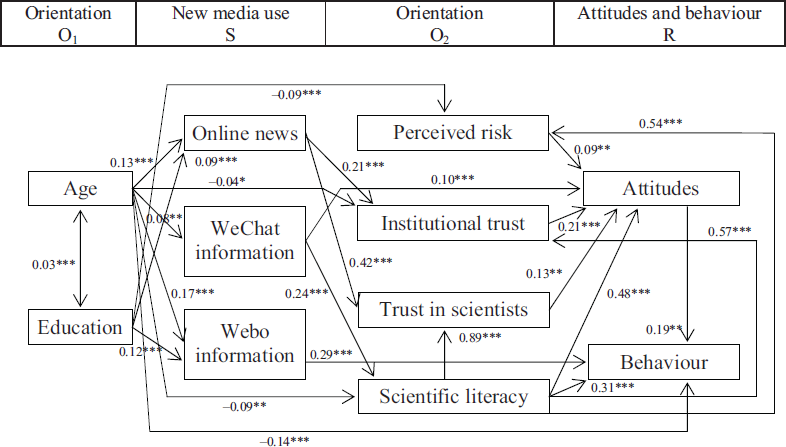
Relationships among endogenous variables
Online news did not directly influence the public's attitudes and behaviour but did indirectly affect them through ‘institutional trust’ and ‘trust in scientists’.
WeChat information had a positive impact on public attitudes (β = 0.10) and indirectly affected them through scientific literacy.
Weibo played a central role as an information shortcut for the public in reaching judgements about GMO technology and had a positive impact on people's behaviours (β = 0.29).
Public focus on Weibo information increased scientific literacy, which directly influenced the public's attitudes (β = 0.48) and behaviours (β = 0.31). It also indirectly affected people's attitudes through ‘perceived risk’, ‘institutional trust’ and ‘trust in scientists’. Perceived risk (β = 0.09), institutional trust (β = 0.21) and trust in scientists (β = 0.13) had a positive impact on public attitudes to GMOs. Age and education were used as exogenous variables, and had a negative impact on some variables:
Age had a negative impact on public behaviours (β = -0.14).
Age had a negative impact on scientific literacy (β = -0.09).
Education had a negative impact on perceived risk (β = -0.09).
The goal of this study was to outline a theoretical account that integrates key variables and reason from past research into a simple model that can explain opinion formation by using the contemporary debate over GMOs as a test case. The model serves as a basis for future research to explain opinion formation in the context of other science and technology debates by providing guidance for researchers in conceptualizing, specifying and testing the relationships among variables.
Scientific knowledge and public attitudes
In research on science communication and risk communication, the relationship between knowledge and attitudes has always been an important issue. This study combined the concepts of scientific literacy from science communication and transgenic cognition from risk communication to develop a GMO-related knowledge scale. By analysing data from a national survey in China, I examined whether scientific literacy and attitudes are correlated.
Having examined the relationship between knowledge-related variables and other variables by SEM, I found that knowledge had a positive overall relationship with public attitudes and behaviour. The results of this study indicate that the dimensions of scientific literacy have a positive impact on public attitudes and behaviour. Therefore, the government can improve public support for controversial technologies through the popularization of science.
Scientific literacy has a positive impact on perceived risk, institutional trust and trust in scientists. When the public is more scientifically literate, it has greater trust in scientists and higher perceived risk and institutional trust. Public trust in the government and scientists contributes to the development of new technologies and the promotion of science policy.
The results of this study show the impact of scientific knowledge on attitudes in science communication and risk communication. In science communication today, a greater emphasis is placed on the scientific principles of genetic modification and its impact on society. The findings of this study are in line with those of previous studies (Hoban et al., 1992; Hallman et al., 2002; Hallman et al., 2003).
Past research on risk communication claimed that knowledge does not directly affect public attitudes but influences them only through intermediate variables, such as risk perception, risk return and trust (Bredahl, 2001; Sjoberg, 2001; Verdurme and Viaene, 2003; Fan and Jia, 2015). Therefore, from the perspective of risk communication, scientific literacy can negatively affect public attitudes and behaviours (Bredahl, 2001). My study confirmed this result. As a way to integrate and think systematically about these variables, I applied the O–S–O–R model developed in recent psychological studies.
The impact of new media use on scientific literacy
Most consumers lack the time, ability or motivation to be fully informed about science issues and instead rely heavily on new media. As data in this study indicate, it is likely that media coverage plays an important indirect role in forming public attitudes, serving as a central mediator for informally learning about new technologies such as GMOs. According to the data, the more attention people paid to WeChat coverage of GMOs, the greater their GMO-related knowledge was. However, online news and Weibo information did not affect the public's knowledge. The higher the GMO-related knowledge of the public, the higher was its support for this technology.
The government's promotion of GMOs depends on the support of the public. If the market does not accept this technology, there is no need for extensive development. To accelerate the industrialization of GM foods, it is necessary to increase the public's scientific knowledge. However, before planning activities to promote GMO-related knowledge, we need to consider differences in the knowledge received by different groups and understand aspects of it that can effectively influence public behaviour. We should start with the following to improve the public's support for GMO technology:
As shown in Figure 1, scientific literacy can have varying impacts on public purchasing behaviour. Thus, faced with different consumer groups, we must communicate in different ways and convey GMO-related knowledge in language that the audience can understand. China invests a large amount of resources every year in popular science activities, but the effect is not satisfactory. The most important reason for this is that scientists do not understand ‘science communication’. Sometimes, scientists disseminate only scientific knowledge but ignore the different modes of understanding of it by different groups. Moreover, scientists often lack the ability to promote difficult scientific knowledge in a way comprehensible to the public.
In China, scientists believe that the public generally does not understand science, especially GMOs. They spend a lot of time and money explaining the technology to the public, but the public still does not believe in the safety of GMOs. The public believes that scientists spread GMO-related knowledge only for their own benefit. Science communication should consider the level of education, living environment and differences in media usage among different groups in China.
Chinese people interact on WeChat every day. This study found that the public's attention to WeChat can improve its knowledge of GMO technology. However, WeChat can also help spread false news and information related to GMOs. Therefore, scientists should consider clarifying rumours in science communication.
A number of studies in the past have confirmed that strengthening the public's understanding of scientific knowledge can help enhance its support for and behaviour towards GMO technology (Xiang et al., 2005; Liu, 2010; Tang, 2015; Brossard and Shanahan, 2003; Brossard and Nisbet, 2007; Mielby et al., 2013). If the government wants to change the public's attitudes to GMOs, it should focus first on the relevant knowledge needed to understand the basic scientific constructs and science policy issues.
The public has changed its attitudes to GMOs and started to support their use. The focus can now be further directed to helping people to understand the scientific approach and science policy issues in order to improve their willingness to purchase GM products.
My study shows that knowledge might not always lead to greater public support for science. At the same time, it is unlikely that a lack of knowledge always translates into reduced support. If we want to change public attitudes to and behaviour towards GMOs, the focus of knowledge publicity ought to be different. Only by letting the public correctly understand the advantages and disadvantages of GMO technology can GM foods be popularized.
Funding
The study was supported by the Science Popularization and Risk Communication of Transgenic Biotechnologies project (grant ID: 2016ZX08015002).
Footnotes
Author biography
Chunhui You is an assistant professor at the School of Humanities of Zhejiang University of Technology. Her research interests include science communication, social media analysis, text analysis and media effect.