




Abstract
Purpose
This study aims to investigate the different types of South–South higher education (HE) interactions in the context of “triple disruptions,” using the conceptual perspectives of Southern epistemologies and the typology of “inward- and outward-oriented” HE internationalization.
Design/Approach/Methods
This study analyzed a range of selected documents, including academic literature, national strategies and legislation, and public reports issued by states, institutions, and other stakeholders that focused on South–South HE interactions. The analysis centered on the rationales and strategies of different South–South HE interaction models.
Findings
The findings suggest that South–South HE interactions generally occur through a mix of approaches with a preference for inward-oriented expansion diffusion. Given the “triple disruptions,” regional cooperation based on advantages and characteristics remains the most promising form of South–South HE interactions. Additionally, the notion of new types of colonialism serves as a wake-up call for Southern countries’ outward-oriented HE internationalization through relocation diffusion for soft power enhancement.
Originality/Value
This study contributes to the critical examination of the Western-centric theoretical monopoly on internationalization in HE by clarifying the principles and positions of South–South HE cooperation through epistemological exploration. It draws patterns from the complex practices of existing South–South cooperation in HE based on a typology and attempts to provide theoretical contributions in the context of the “triple disruptions.”
Introduction
Over the last decade, various emerging technologies have significantly impacted major sectors, such as industry, economy, and education, leading to changes in people's lifestyles, learning methods, and ways of thinking. Automation, in particular, has triggered profound changes in educational practices and student development, while the global pandemic has “given rise to educational disruption which unveils shortfalls in the preparedness of various levels of education to such crisis” (Tang, 2023, p. 57). According to the World Economic Forum (2020), automation combined with the recession creates a “double-disruption” scenario (p. 5). Such “double disruptions” have resulted in an increasing gap between emerging economies and the developed world, exacerbating global inequality and the risk of division. This represents the third of the “triple disruptions” that are shaping the macro-context of higher education (HE).
The center-periphery divide in the internationalization of HE poses significant challenges for institutions in the Global South. Middle-income and developing countries, as well as some industrialized countries, face major challenges in determining the mechanisms that enable universities to participate effectively in the global knowledge network on an equal footing with the world's leading academic institutions (Altbach & Salmi, 2011). However, recent diplomatic and economic successes of several important countries in the Global South have led to increased discussion and consideration of developing alternatives to the hegemonic and colonial politics of the Global North (Gray & Gills, 2016). HE is increasingly being used as a key tool to enhance national competitiveness and the overall global influence of countries in the Global South. With the ongoing process of globalization, a growing number of new actors, including flagship universities in developing countries, are actively participating in international HE (Sanders, 2020). New paradigms and research approaches are needed to ensure inclusive and truly global participation in HE.
Given the complex global context, HE systems in the Global South, historically influenced by the dominance of Western knowledge, seek to establish strong, long-lasting partnerships to promote shared growth and maintain the balance of the global HE landscape. Some scholars argue that South–South partnerships in HE enable institutions in the developing world to leverage their individual strengths for mutual benefit and promote the endogenous development of HE (Hagenmeier, 2020). For this research, the following questions were asked: How does HE interact with the Global South? How does the current global context present challenges and opportunities for HE interactions among countries/regions in the Global South? What is the new development trend of South–South interaction in HE against the backdrop of the “triple disruptions”?
HE internationalization in the Global South under “triple disruptions”: A conceptual lens
Over the years, research on HE internationalization has been dominated by institutions and scholars from the developed world. This has perpetuated the notion that HE internationalization is a modern trend driven primarily by Western countries. Elite models of provision, frequently delivered in English, have been considered to influence global practices (Tight, 2022). This Western centralist paradigm of knowledge, which reproduces global hierarchy in HE, can be attributed to three interrelated factors: the global spread of neo-liberal norms and policies, the social-cultural continuation of “white supremacy,” and the linguistic-cultural monoculture of knowledge (Marginson, 2022b). This has resulted in an imbalance between global knowledge systems and international academic relations. On the one hand, the hegemonic Global North, with its civilizational project of modernity and privileging Western sciences as the primary form of reasoning and catalyst of progress, has historically and recently shaped the HE sector in the Global South (Araya & Marber, 2013). On the other hand, there has been an asymmetrical flow of students, faculty, institutional practices, intellectual paradigms, and ideological influences from the Global North to the Global South (Zeleza, 2016).
As per the comprehensive analysis of Robertson and Komljenovic (2016), while the Global North primarily comprises Europe and North America, the definition of the Global South is multifaceted and varies depending on the context of its usage. One definition characterizes the Global South as a relational concept encompassing a wide group of geographically dispersed nations in Asia, Central and South Americas, and Africa that face economic and developmental challenges. However, the term can also include communities or populations whose economic, cultural, political, or technical status is significantly marginalized within their region, including individuals and communities in developed countries. The Global South also serves as a political metaphor, which entails two complementary conceptualizations with distinct ontological and epistemological foundations and spatial articulations rather than a strictly geographical denominator (Berger, 2021). The Global South refers more to an “epistemological community” of scholars attempting to comprehend Euromodernity, coloniality, and marginality in the context of global knowledge production. (Hlatshwayo & Shawa, 2020). Finally, the Global South, as stated in the Declaration of Foz do Iguazu (2015), has a regional rather than a global emphasis.
In this study, we adopted the first definition of the Global South as a social and geopolitical concept to examine the practices, strategies, logic, and markets of international HE in the context of South–South interactions (Robertson & Komljenovic, 2016). However, historically, the Global South has been portrayed as a place of raw data, parochial wisdom, antiquarian traditions, and exotic ways and means because Western Enlightenment thought has always positioned itself as the source of universal learning, science, and philosophy (Comaroff & Comaroff, 2012). Moreover, some scholars have highlighted the growing divide between poor versus rich South, first versus second South, or the two poles of a “two-track” South (Acharya, 2014), which underscores the importance of understanding the Global South as part of a duality that is always in reference to the Global North. Therefore, it is critical to examine a range of empirical sources that reflect South-related phenomena, including but not limited to the so-called rising or emerging powers from the Global South (Haug et al., 2021). This research aimed to address existing global imbalances and inequities in the world HE system by facilitating interactions and collaborations between Southern countries. To achieve this goal, it is necessary to adopt appropriate theories to guide internationalization practices in HE.
The extractivist approach, which characterizes the dominant paradigm of the Global North, is deeply entrenched in modern universities. To decolonize universities, it is necessary not only to question the curricula but also to challenge the global economy of knowledge that relies on abysmal thinking and the exploitation of knowledge as raw materials, as argued by Santos and Meneses (2019). In the context of South–South HE interactions, epistemologies of the South offer a liberating perspective. Epistemologies of the South and the Southern Theory offer alternative perspectives for comprehending South–South interactions in HE. The development of the Global South as a political category owes much to the insights provided by these epistemologies. The Southern theory proposes a radical rethinking of social sciences and their global connections to knowledge, power, and democracy, as argued by Connell (2007). Santos (2014) advocates for global cognitive justice as a necessary precondition for achieving global social justice. He asserts that the previously existing epistemologies and wisdom of the Global South have been marginalized or subordinated by the Western-dominated knowledge system (Santos, 2014). He calls for the rediscovery and recognition of diverse non-Western epistemologies and the democratization of knowledge (Santos, 2014). The epistemologies of the Global South as a form of bottom-up cosmopolitanism prioritize conviviality, solidarity, and life over market-driven individualism. They embrace diversity without relativism, offering a large panorama of post-abyssal knowledge, methodologies, and pedagogy (Santos, 2018). They also seek to challenge power structures that arise from differences and promote the abolition of such structures rather than eliminate differences by themselves (Santos & Meneses, 2019). Overall, the epistemologies of the Global South provide an intellectual foundation for the global struggle toward cognitive and social justice.
To operationalize these epistemologies, new theories are needed to serve as analytical frameworks. Based on the diffusion of innovation, Wu and Zha (2018) propose a typology that identifies two directions or tendencies of HE internationalization: inward and outward. The former involves learning from foreign innovations, such as knowledge, culture, HE models, and norms, during the internationalization process, whereas the latter involves exporting domestic innovations to the world, primarily for soft power purposes and status enhancement (Wu & Zha, 2018). They further distinguish HE internationalization into four categories based on both directions/tendencies and the forms of transnational/transcultural innovation diffusion, namely, inward-/outward-oriented relocation diffusion and inward-/outward-oriented expansion diffusion of innovation through internationalization (Wu & Zha, 2018). The “expansion diffusion” suggests that HE systems “may spontaneously learn from foreign knowledge and cultures due to their attractiveness, or follow foreign HE models and norms for capacity building” (Wu & Zha, 2018, pp. 264–265). For “‘relocation diffusion,’ a source HE system may […] export its innovations through “implement[ing] HE-related […] programs overseas and recruit international students to enhance […] international status” (Wu & Zha, 2018, pp. 264–265). Overall, this typology provides a useful framework for understanding the current South–South HE interactions and inspires the analysis in this investigation.
Method
As mentioned above, this study aims to explore the dynamics and challenges of South–South interactions in HE in the context of “triple disruptions,” particularly in light of the widening gap between emerging economies and the developed world. The geographical scope of this study covers three regions of the Global South: Africa, Asia, and South America. Documentary analysis was adopted as the main method. The documents collected consisted of various types of primary sources that reflected the current state and trends of South–South HE cooperation programs. These include official policies, notices, reports, and strategic plans issued by governments, universities, and other stakeholders from more than 20 countries in the Global South, as well as statistical data on international student mobility collected and published by UNESCO and other international organizations. These primary sources are essential for understanding the reality of South–South cooperation (SSC) in HE, such as the motivations, objectives, mechanisms, and outcomes of the different programs. Owing to space constraints, these primary sources cannot be fully presented and discussed in the text. Therefore, we selected a few representative cases from different regions and types of programs and incorporated relevant primary sources into the case analyses. In addition, we draw on secondary sources such as research literature and third-party reviews to complement the primary sources. These secondary sources provide theoretical perspectives and empirical assessments of collaborative programs and projects that help enrich and support the views of the study. Table 1 summarizes the documents selected for this study.
Types and purposes of document selection for this research.
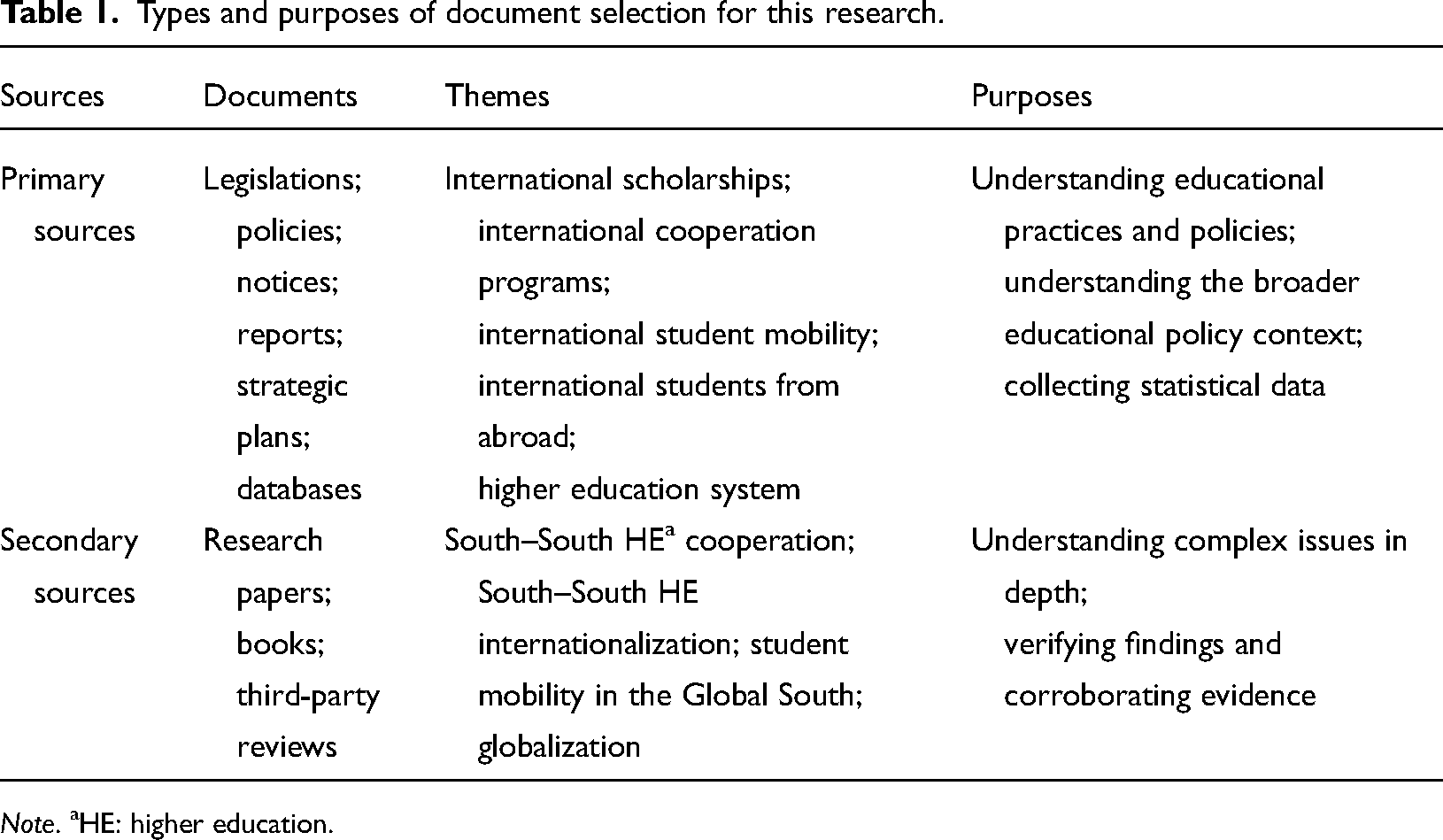
Note. aHE: higher education.
Existing HE interactions between countries/regions in the Global South
As mentioned, we use Wu and Zha's (2018) typology of HE internationalization to explore the diverse HE interactions between nations situated in the Global South. By analyzing a range of cases, the present study endeavors to scrutinize the applicability of this typology in this context, thereby evaluating the extent to which a comprehensive ecosystem of HE interactions exists within this region. In most Southern countries, the predominant mode of HE internationalization is inward-oriented, which is primarily achieved through the expansion diffusion of innovations. For instance, Sehoole and Lee's (2021) survey of respondents from South Africa, Uganda, and Kenya confirms the prevalence of regional mobility among African nations. The majority of students undertaking this regional mobility are from countries that share borders with their host countries (Sehoole & Lee, 2021). A concrete example is cooperation in HE between Ghana and Nigeria. Records available from the UNESCO Institute of Statistics show that Ghanaian universities have been destinations for students from other African countries such as Nigeria, Cameroon, Côte d'Ivoire, Gabon, and Congo. In several universities in Ghana, the largest number of international students are from Nigeria. The majority of Nigerian students choose to study in Ghana to advance their careers, be closer to their families, and avoid political, educational, and infrastructural insecurity in Nigeria (Gyamera & Asare, 2023). In general, the key drivers of intra-African student mobility include improved job prospects, political stability and security, a low cost of living in host countries, and the desire to enhance proficiency in English (Sehoole & Lee, 2021). Intra-African HE cooperation also relies on the support of several important networks, such as the Association of African Universities and the African Research Universities Alliance.
Another noteworthy example of HE cooperation in the Global South is the partnership between Vietnam and the Philippines. Spearheaded by Vietnam's strategic regional universities, this partnership connects universities in the rural and semi-rural areas of the Philippines, Thailand, Indonesia, and Laos to foster HE internationalization. This demonstrates the emergence of new norms, practices, and goals in the Global South, which are perceived to be sustainable (Phan, 2018). Myanmar's engagement with its neighboring countries in HE presents another example of regional collaboration. China's HE system is currently lagging behind its regional counterparts in terms of investment, research output, knowledge-economy indices, and enrollment ratios (Howson & Lall, 2020). To bridge this gap, Myanmar “wishes to align its HE system with its neighbors in the region,” using ASEAN standards as a guiding framework for its own reform initiatives, and seeks to develop a top-tier HE system that can compete in international university rankings (Howson & Lall, 2020, p. 116). Notably, there is no clear leading country for such regional collaborations, and both inward- and outward-oriented interactions frequently occur simultaneously. However, these interactions are classified as inward-oriented because of their major focus on learning from foreign experiences and improving the internationalization of domestic faculty and students rather than enhancing global reputation and the influence of domestic HE systems. Regional cooperation is often facilitated by geographical proximity, language, cultural similarities, and economic ties. Related projects, such as grants, scholarships, and exchange programs, can be considered supplementary to each country's initiatives.
Inward-oriented HE internationalization within the Global South also involves relocation diffusion, primarily driven by the mobility of programs and providers (Wu & Zha, 2018). For example, the Zimbabwean government established a partnership with the University of South Africa to provide scholarships for exceptional students who cannot afford HE in Zimbabwe but require further education. Since 1995, the program has sent over 30,000 undergraduate, master's, and doctoral students to 15 South African universities. Collaborating with South Africa in HE not only helps address the urgent educational needs of students but also offers them access to an international and diverse learning environment (Promise, 2014). Mauritius, which “increases access of local students to tertiary education through international program and provider mobility,” can be regarded as another example (Knight & Motala, 2021). This partnership reflects a growing trend of relocation innovation diffusion through internationalization, with Southern countries collaborating with other (Southern) countries that have relatively developed educational systems through programs aimed at advancing their own HE systems and increasing HE opportunities for their citizens.
Conversely, the increasing power of countries in the Global South has led to an increase in outward-oriented interactions, with the relocation and diffusion of innovations being a prominent strategy. For instance, the Program for Partner Undergraduate Students (PEC-G) and the Program for Partner Graduate Students (PEC-PG) in Brazil aim to promote staff and student mobility from other Southern countries and have enabled a significant proportion of students to benefit from this initiative, with Angola, Cape Verde, and Guinea-Bissau being the primary beneficiaries (Guilherme et al., 2018). To further diplomatic interests, the Lula administration has taken action to facilitate cultural and knowledge exchanges with African and Southern Cone countries, particularly within the framework of the Southern Common Market (Mercosur). To cater to the Global South and to promote the integration of Latin America, four new public universities, that is, UNILAB, UNILA, UFFS, and UFOPA, 1 have been established, with UNILAB specifically targeting neighboring nations with a large Portuguese-speaking population (Leite, 2010).
In Malaysia, the establishment of international branch campuses has been prioritized to enhance the country's competitiveness in a knowledge-based economy by offering foreign degrees to local and international (primarily Asian) students at a lower cost (Ahmad & Buchanan, 2016). Malaysia is also active in providing scholarships, including the Malaysia International Scholarship and the Malaysian Technical Cooperation Program, primarily for students from countries in the Global South, to promote SSC in line with Malaysia's aspiration to become a global center of academic excellence. India continues to strive to become the regional educational hub in South Asia. Each year, the Indian Council for Cultural Relations administers several scholarship programs, awarding approximately 3,000 scholarships to foreign students from approximately 180 countries under 21 different schemes. Most international students in India are from neighboring Asian countries. China has also adopted an “outward-oriented” strategy for HE internationalization to improve its global influence and international status, which includes cultural diplomacy initiatives such as the Confucius Institute program, HE-related international aid to developing nations, and initiatives to attract international students (Wu, 2019). Furthermore, the implementation of the Belt and Road Initiative (BRI) by the Chinese government has provided a platform for enhancing outward-oriented interactions, particularly through HE-related initiatives. HE-related projects, such as the establishment of joint research centers, scholarships, and exchange programs for students and scholars from BRI countries, are being increasingly included in the BRI.
Cuba's HE system focused on creating cooperative relationships with strategic partners, initially African countries and later regional partners in the Caribbean and Latin America (Hickling-Hudson et al., 2012). Cuba has been engaging in SSC for many years, particularly in the fully subsidized training of foreign students in its HE system, primarily in the medical field. Its initiatives are based on a political framework that aims to achieve independence of the South from Northern donors through collaboration and solidarity. However, reintegrating graduates of Cuba's educational system into local governance, employment, and service delivery structures has been challenging because of a lack of funding, preparation, and political will. Even though the South–South paradigm challenges the notion that labor migration occurs only from the Global South to the North, various factors can hinder the effective integration of Cuban-trained students into jobs or leadership positions in their home countries, as noted by Darnell and Huish (2017). In addition to governments, non-government actors are actively involved in leading HE cooperation among countries in the Global South to enhance the reputation of their home countries. The International Education Association of South Africa, for instance, is a nonprofit organization that actively promotes the internationalization of HE in developing countries through scholarships and projects, addresses challenges, and develops strategic opportunities in international education in South Africa and across the African continent.
Compared to the outward-oriented relocation diffusion of innovations during HE interactions, outward-oriented expansion diffusion is less prevalent in South–South HE cooperation. However, this phenomenon is relatively common in countries with similar colonial histories but varying levels of development. For example, Brazil and other Portuguese-speaking Latin African countries have a social and cultural affinity that has created the groundwork for cooperation (Cesarino, 2017). However, promoting this type of HE interaction requires specific projects that typically occur in conjunction with relocation discussions. Another form of expansion diffusion occurs between rapidly rising powers in the Global South and countries with deep historical or political ties to them. For example, China can be viewed as a typical source country for outward-oriented expansion diffusion during its interactions with Southern countries. Presently, the Chinese HE system has become globally competitive, and initiatives such as the China-Pakistan Economic Corridor have allowed China to employ a range of instruments, including hosting international students, providing funds and equipment to foreign universities, building regional academic networks, establishing centers for collaborative research, and launching Confucius Institutes and Chinese-language classes (Nitza-Makowska, 2022). It seems that this type of interaction cannot be considered pure expansion diffusion, as it relies primarily on the material process of HE internationalization. In addition, the source country's language and knowledge do not hold a dominant position in the recipient country. However, the HE interactions between China and Pakistan have progressed from early-stage projects to spontaneous expansion diffusion.
Based on Wu and Zha's (2018) typology, it is evident that South–South HE interactions typically involve a combination of different approaches, with a strong preference for the inward-oriented expansion diffusion of innovations. This preference can be attributed to cultural similarities, shared histories, and geographical proximity. As noted by Vögtle and Windzio (2022), “particularly for countries in the Global South, cultural similarity is important for the intensity and direction of exchange within the global network of transnational student mobility” (p. 1). HE interactions driven by cultural recognition tend to be less program-dependent and more spontaneous. Emerging economies primarily engage in outward-oriented HE internationalization through relocation diffusion to strengthen their soft power and enhance their global influence. Compared with developed countries, they may not be able to influence other Southern countries in the short term through the spontaneous emulation of their academic language and research paradigms. For other less-developed Southern countries, inward-oriented HE internationalization through relocation diffusion is primarily aimed at increasing access to universities for local students, which happens less often because of the increase in South–South education aid projects provided by the previously mentioned emerging economies. Using Wu and Zha's (2018) typology as a lens, it becomes apparent that outward-oriented expansion diffusion represents the most potent form of HE internationalization, whereas inward-oriented relocation diffusion characterizes the weak position of the state in cross-national HE interactions. Hence, it can be inferred that South–South HE interactions have avoided two extreme scenarios and, instead, have chosen a type of eclecticism. This finding has implications for the future of South–South interactions in HE.
Challenges and future trends of South–South HE interactions under the “triple disruptions”
Recent advancements in digital technology have resulted in significant progress in the field of education. Today, automation and AI are being recognized as powerful tools in HE. However, their implementation requires careful consideration due to their complexity, unpredictability, and risk, as well as their unexplored pedagogical and technological practices (Gallagher & Breines, 2021). The unprecedented and far-reaching impact of the global pandemic has also presented numerous challenges to the HE sector and everyone involved, including students, instructors, policymakers, and society at large (Bhagat & Kim, 2020). Consequently, the challenges and future trends of internationalizing HE in the post-pandemic era have become a frequent topic of discussion.
Challenges to HE internationalization/interactions in the Global South under “triple disruptions”
The “triple disruptions” mentioned above have posed significant challenges for HE in the Global South. First, the pandemic has exacerbated the existing learning crisis, leading to a surge in learning poverty and exacerbating inequalities in HE. Developed countries are better equipped to adapt to virtual learning and mitigate the negative consequences of the pandemic, whereas underdeveloped countries face more challenging scenarios due to their lack of technological infrastructure and limited access to low-cost networking options (Treve, 2021). For instance, the pandemic negatively affected private HE institutions (HEIs) in Ethiopia “by dwindling their sources of income, reducing the productivity of their employees, and constraining institutional capacity to cover key costs such as salary and rent” (Tamrat, 2021, p. 59). Similarly, HEIs in southeast Nigeria were largely unprepared to use e-learning methodologies during the lockdown period (Ogunji et al., 2022). In Nepal, social inequalities in access to and participation in online and distance education persist, particularly for students from rural areas, who are underrepresented in socioeconomic and gendered groups, and those with limited technological and English-language proficiency. As such, the reduction of social inequality and the prevention of its reinforcement through the unequal provision of online teaching and learning are key challenges for HE in Nepal (Devkota, 2021). Furthermore, “while remote online teaching, learning, and assessment are novel experiences for many higher education institutions, developing countries are incessantly presented with many challenges, particularly when safeguarding academic integrity” (Mutongoza & Olawale, 2022, p. 234). Addressing these challenges and ensuring equitable access to (higher) education is critical for the Global South to build a more sustainable and inclusive future.
The second challenge relates to automation and the digital revolution. The discourse of technology-fueled liberation, as Gallagher and Breines (2021) highlight, tends to “seek an active break with local contexts, often ushering in a narrative of disruption and revolution designed to supplant ‘broken’ educational practices at the university level through new innovations” (p. 78). Despite the potential benefits, evidence suggests that most people in the Global South do not necessarily share the dividends of the digital age, which has further exacerbated existing inequalities (World Bank, 2016). In a case study, Tan et al. (2020) offer a detailed analysis of the role of digital technologies during HE globalization in a Global South country. The study highlights the digital divide and the challenges faced by a university in a developing country that they were “globally disadvantaged as [… having] little choice in embracing digital technology while experiencing limited options for what this could achieve” (Tan et al., 2020, p. 176). In South Africa, for instance, inequitable access to electricity, the Internet, and information technologies has significantly hampered online learning at the HE level. Providing strong support systems for students susceptible to such environments is critical for ensuring effective online teaching and learning (Fouche & Andrews, 2022). Furthermore, traditional brick-and-mortar HEIs in countries such as India have failed to meet educational needs. Some researchers have suggested a new HE ecosystem in the Global South that includes traditional university courses, high-quality online courses provided by top universities, and independent groups that reuse publicly available information from universities worldwide (Alcorn et al., 2015). The goal of achieving HE in the Global South is to bridge the digital divide, leverage digital technologies to enhance learning outcomes and reduce existing inequalities. Moreover, the already weak status of HE in the Global South is being further reinforced by the growing prevalence of university rankings worldwide. The current tumultuous international political context also poses significant challenges to the internationalization of HE in the Global South. These challenges have been exacerbated by issues such as limited funding, inadequate infrastructure, and insufficient support for research and development, which have hindered institutions in the Global South from competing on a global scale.
In addition to the challenges faced within Southern countries, HE internationalization in the Global South is being affected by “triple disruptions.” The challenges of technological factors primarily refer to “technological and infrastructural constraints in underdeveloped regions of developing countries,” which “may impede the effectiveness of higher education cooperation” (Zhu & Chikwa, 2021, p. 14). The pandemic is “leaving deep marks in the Global South, which has impacted higher education and the internationalization of higher education” (Woicolesco et al., 2022, p. 438). The impact of the pandemic on South–South HE interactions varies. One of the most significant effects is on academic mobility. While China remains an attractive study destination, many students are unsure whether to cancel or modify their plans to study abroad, and academic mobility among geographically distant countries in the Global South is impeded. This “limits the ways in which Latin American countries can provide overseas opportunities to these students, as there is a lack of interest in the region due to an inability to travel” (Ahmed et al., 2021, p. 53). Concerning Brazil and other Latin American countries’ HE internationalization, the pandemic has led to a decrease in public resources for financing education, which may also reduce international academic mobility (Woicolesco et al., 2022). Being the third aspect of the “triple disruptions,” the Global South-North inequality marked by English as the dominant intercultural communication medium also affects South–South HE interaction. The dominance of English and Chinese in “advanced digital communication technologies only serves to privilege those speaking English and Chinese but marginalize speakers of other languages” (Li et al., 2020, p. 537). Overall, addressing these challenges requires a multifaceted approach that considers the complex and interconnected nature of these issues.
New trends of South–South HE interactions under “triple disruptions”
Internationalization has been a significant trend in HE development over the past few decades, facilitating communication, the exchange of ideas, and the flow of information across national borders. However, there are flaws associated with this approach, including capitalist logic and neglecting cultural missions, which have become more concerning given the current circumstances (Gao & Liu, 2023). In response to the challenges brought about by the “triple disruptions,” countries in the Global South have reformed their HE systems, resulting in new trends in South–South HE interaction. Emerging economies are experimenting with their own concepts of HEIs, creating a different context for South–South HE cooperation than under Western hegemony. For instance, South Africa acknowledges that the complexities of a post-apartheid society and its transformational needs and priorities in HE make it inappropriate to use definitions and approaches of internationalization that were developed in the Global North. As South African scholars Heleta and Chasi (2023) argue, HE internationalization “is a critical and comparative process of the study of the world and its complexities, past and present inequalities and injustices, and possibilities for a more equitable and just future for all” (p. 9). They anticipate that “through teaching, learning, research and engagement, internationalization fosters epistemic plurality and integrates critical, anti-racist and anti-hegemonic learning about the world from diverse global perspectives to enhance the quality and relevance of education” (Heleta & Chasi, 2023, p. 10). The Chinese discourse on HE internationalization is distinct from the Western-led discourse, with different goals, approaches, and obstacles influenced by varying national interests, governance structures, and stages of development (Liu, 2021). It sees “internationalization at home” as a useful approach to address the crises toward HE internationalization. However, in the digital age, developing countries are becoming increasingly wary of digital colonization. Kwet (2019) concludes that U.S. technological and conceptual dominance in South Africa constitutes digital colonialism. Furthermore, Williamson et al. (2023) argue that decolonial ethical frameworks for AI are necessary to decolonize HE, as new technologies may replicate past racial and colonial formations. Therefore, it is essential to develop a decolonial approach to digitalization to ensure that the South benefits without losing its autonomy.
Countries in the Global South are increasingly exploring regional cooperation to achieve specific benefits. For universities in the Global South, the evolving regional mission and relevance present a strategic opportunity to create a unique institutional profile. Klemenčič (2017) suggests that one of the top priorities for peripheral HEIs should be to identify a distinct niche and refine their institutional profile by reorienting existing resources and cooperation strategies toward particular areas of teaching, research, and the third mission. Regional collaborations with institutions in neighboring countries can facilitate progress in internationalization by strengthening the regional relevance and international visibility of HEIs and helping them develop a distinctive international profile. For instance, current South America “exhibits a diversity of indicators of regionalization of higher education (RoHE) […] through Jane Knight's (2013) functional, organizational, and political approaches model's lens, we can see a considerable progress of Mercosur in all three dimensions […] From the functional point of view, the most advanced policy is the creation of a Mercosur regional stamp for university programs to create a common educational area” (Batista, 2021, p. 488). Notably, “Mercosur promotes the RoHE through functional, organizational, and political approaches,” while “stakeholders cited three main challenges of the educational sector: the asymmetry, the dependence on Brazil, and the lack of funding” (Batista, 2021, p. 489). However, regional collaboration is not without its challenges, which may be due to preexisting power relations and the complex character of the region. This also inspires us that equality is the eternal pursuit of most regional partners.
Moreover, virtual internationalization/mobility offers a new opportunity for South–South HE interactions in the context of the pandemic. Virtual internationalization is defined as “the process of introducing an international, intercultural, or global dimension into the delivery, purpose, or functions of higher education with the help of information and communications technology,” and it “complements existing conceptualizations of internationalization in light of the importance which digitalization plays for the [HE] internationalization field” (Bruhn-Zass, 2022, p. 242). In the current context, “it is more important than ever to learn from other institutions, especially those in Asia, on how to handle the transition to virtual opportunities. In China, for example, Zhejiang University moved more than 5,000 courses online in two weeks, offering a valuable opportunity to bridge the geographic gap between Asia and Latin America and utilize the findings from these studies to create an exchange program. Virtual global exchange programs might be attractive since students are still looking for extracurricular opportunities and attempting to boost their resume” (Ahmed et al., 2021, p. 45).
Conclusion and further discussions
According to Jooste and Heleta (2017), in the context of HE in the Global South, a critical methodology is essential for research on HE internationalization. This approach challenges established frameworks, paradigms, power structures, worldviews, and modes of thought to draw attention to and address inequalities and injustices. Such critical reflection ultimately leads to improvements in the present and future paradigms and practices. In the context of HE in the Global South, where knowledge hegemony has long silenced the academic community, the epistemologies of the Global South offer a liberating perspective and emphasize cognitive justice. This perspective prompts reflection on the unequal world knowledge system, which affects both the Global North and the Global South. While much debate exists over whether elites of the Global South and “rising powers” intend to challenge the dominant structures of global capitalist development or merely seek to support and reproduce them while increasing their influence, it is crucial to emphasize critical paradigms and challenge existing power structures for meaningful change to occur (Gray & Gills, 2016). This study used Wu and Zha's (2018) typology as an analytical framework to provide a more comprehensive description of HE interactions within the Global South. In comparison to the worldwide situation of HE internationalization, it presents two major forms: outward-oriented relocation diffusion and inward-oriented expansion diffusion of innovations. The former is closely linked to the desire of emerging countries to increase their soft power through HE development and internationalization, whereas the latter is closely associated with regional cooperation. In general, HE interactions in the Global South have adopted a hybrid approach that combines elements of different forms under this typology.
HE in the Global South faces challenges related to the “triple disruptions,” including ineffective use of digital resources and inequity within the HE system, which hampers efforts to improve global HE. To overcome these challenges, the Global South is exploring the concept of HE internationalization/globalization at the conceptual level, recognizing the risk of digital colonization in HE development. The notion of new forms of colonialism also serves as a wake-up call for outward-oriented HE internationalization in the Global South through relocation diffusion for soft power enhancement. As Marginson (2022a) argues, in today's environment of networked communications, “each local and national variation becomes universally visible” (p. 422). He highlights that power relations are not fixed and that multiple positionality, mutual respect, and unity in diversity are possible in global HE (Marginson, 2022a). Theories with values including mutual benefit, compromise, and understanding, such as the knowledge diplomacy proposed by Knight (2018), are enlightening for revising the power paradigm represented by the soft power theory. In light of the “triple disruptions,” strength-based regional cooperation remains the most promising form of South–South HE interactions. Countries in the Global South can leverage intra-regional inward-oriented HE internationalization to increase the potential of the region as a whole and, thus, enhance the overall capacity for outward-oriented HE internationalization. By focusing on regional cooperation and utilizing their unique regional advantages and characteristics, HEIs in the Global South can create a distinctive international profile and advance particular areas of teaching, research, and social services. Moreover, such collaborations can facilitate progress in internationalization by enhancing the regional relevance and international visibility of HEIs. Therefore, countries in the Global South must prioritize identifying a distinct niche and sharpening their institutional profile by realigning existing resources and cooperation strategies. This approach can foster mutual benefits, compromise, and understanding, ultimately leading to the development of a more equitable and inclusive global HE system.
Footnotes
Acknowledgments
The authors appreciate the constructive comments and suggestions of Dr. Xiujuan Sun, then a post-doctoral fellow under the supervision of the corresponding author at the College of Education, Zhejiang University.
Contributorship
Jingji Zhang and Hantian Wu contributed to the conception and design of the study. Jingji Zhang performed the preliminary analysis and wrote the first draft. Hantian Wu improved the analysis and the overall structure and worked on the revision of the manuscript. Jingji Zhang and Hantian Wu jointly reviewed the submitted document.
Declaration of conflicting interests
The authors declared no potential conflicts of interest with respect to the research, authorship, and/or publication of this article.
Funding
The authors disclosed receipt of the following financial support for the research, authorship, and/or publication of this article: This work was supported by the National Social Science Fund of China (Education) [grant number CIA210277].
