




Abstract
Purpose:
Informed by social imaginary, Canadian exceptionalism, and social inclusion, this study explores how teacher candidates experience and interpret internationalization at home at one university in Canada.
Design/Approach/Methods:
Data were collected from three sources: (a) policy analyses of public documents related to internationalization in Canada and at the university; (b) a student survey on the internationalization of higher education; and (c) individual interviews with 12 teacher candidates. Eight interviewees were local, four White and four racialized minorities, and four were international.
Findings:
Findings indicate that most participants relate internationalization to student mobility. They present the Canadian society and themselves as open, tolerant, and accepting. Such an imaginary of Canadian exceptionalism does not necessarily coincide with everyday realities of international and racialized teacher candidates. They reported that they experienced Eurocentric curricula, different forms of exclusion, and racism. Some participants enacted agency to disrupt the dominance of White perspectives.
Originality/Value:
This research addresses knowledge gaps related to internationalization policy as teacher candidates’ voices are not often heard in internationalization initiatives. The study suggests that the internationalization of teacher education requires decolonization of curriculum, bridging with anti-racism education, and the internationalization of teacher educators.
Introduction
Internationalization has become a key focus area for many Canadian institutions. A 2014 survey of Canadian universities reported that 95% of responding institutions identify internationalization as part of their strategic plan, and 82% consider it among one of their top five priorities (Universities Canada, 2014). Teacher education is “no exception to this trend” (Larsen, 2016, p. 396). In 2014, the Association of Canadian Deans of Education released the Accord on Internationalization of Education, which foregrounded internationalization in teacher education in Canada. Across the country, many teacher education programs offer teaching abroad, traveling to many parts of the world to volunteer teach, as part of international practicum placements for their Bachelor of Education degree requirements. However, only 11% of Canadian undergraduate students have international experiences (Study Group on Global Education, 2017). Little is known about teacher candidates’ experience of internationalization at home (IaH). This study aims to address this gap by exploring how teacher candidates experience and interpret IaH at one university in Canada. Two research questions guided the study: (1) How do teacher candidates understand internationalization? (2) How do they view their experiences of IaH at the participating university?
Theoretical framework
The study was based on three constructs: (a) social imaginary, (b) Canadian exceptionalism, and (c) social inclusion.
Social imaginary
Canadian philosopher Charles Taylor (2002, 2004, 2007) discussed social coordination under the rubric of the “social imaginary.” A social imaginary may originate among political or intellectual elite, but by definition, it is a “common understanding that makes possible common practices and a widely shared sense of legitimacy” (2004, p. 23). Members of a community in which a given social imaginary holds sway are not helpless dupes of its positive manifestations. A social imaginary is normative, meaning that those who operate under its regime are active in their “ability to identify what would constitute a foul” (p. 172). They can, in other words, articulate both the shape of the imaginary and evaluate its flaws and failures.
Canadian exceptionalism
A social imaginary can emerge in myriad forms, but for our purposes, we propose that our teacher candidates’ accounts of IaH align with what Fleras (2018) called the “Canadian exceptionalism” (p. 301). Such an imaginary, he holds, constructs Canada as a “Just Society” and Canadians, in contrast to the U.S. and Europe, as “fair, open, and tolerant people; challenged notions of prejudice, discrimination, and exclusion” (p. 319). Canada is sometimes seen by the outside world as an exemplar of how people from different backgrounds might live together because Canada was the first nation to have official multiculturalism policy (Watt, 2016). Henry (2017) called it as “the mythical Canadian narrative of inclusivity and diversity. Canadians widely believe their country to be a peaceful, multicultural country without racism” (n.p.). Critical scholars challenge the Canadian exceptionalist discourse by exploring the deeply racialized roots of tolerance and pluralism (Satzewich & Liodakis, 2013; Thobani, 2007).
Social inclusion
Social inclusion means that all people are able to participate as valued, respected, and contributing members of society. There are five key dimensions of social inclusion: (a) valued recognition and respect for individuals and groups; (b) opportunity for human development, nurturing the talents and skills of children; (c) involvement and engagement, having the right and the necessary support to be involved in decisions affecting oneself and community; (d) proximity, sharing physical and social spaces to provide opportunities for interactions and to reduce social distances between people; and (e) material well-being (Freiler, 2001). This framework supports the exploration of international and intercultural perspectives and how teachers are prepared to create social inclusion within the school system. All the three constructs are complementary to each other and appropriate to the study because participants’ self-perceptions construct an imaginary of Canada as a welcoming and inclusive society, but in reality international and racialized teacher candidates’ experiences of social exclusion challenge Canadian exceptionalism.
Review of literature
Defining internationalization
Internationalization is a contested term. For some, it means a series of international activities (e.g., academic mobility of students and faculty), international linkages and partnerships, and new international academic programs and research initiatives (Knight, 2004). Critical scholars see internationalization as a reflection of “a complex, chaotic and unpredictable edubusiness, whose prioritization of the financial ‘bottom line’ has supplanted clear normative educational and, indeed, overtly ideological intents” (Luke, 2010, p. 44). The literature on the internationalization of higher education presents two major discourses: market-driven (i.e., related to fostering economic performance and competiveness) and ethically driven (i.e., related to charitable concerns for enhancing the quality of life of disadvantaged students) discourses (Khoo, 2011). Financial crises are driving profit-seeking policies of internationalization in higher education. Ethically driven discourses of internationalization engage with alternative agendas such as human rights and building a global civil society (Kaldor, 2003). Recent literature, driven by critical scholars such as Abdi and Shultz (2008) and Andreotti (2013), also indicates that concepts expressed in internationalization policies and initiatives such as governments’ and institutions’ social responsibility, transnational mobility of students, and students’ interculturality that are associated with global citizenship have come to combine both market and ethical influences.
Knight defines internationalization of higher education as “the process of integrating an international, intercultural or global dimension into the purpose, functions or delivery of post-secondary education” (Knight, 2004, p. 11). This definition recognizes internationalization being carried out at the national as well as the institutional level. It acknowledges the relationship between and among nations, cultures, or countries and conveys that internationalization is an ongoing effort by government to make universities “more responsive to the challenges of the globalization of the economy and society” (Elliott, 1998, p. 32). The three concepts—purpose, function, and delivery—are carefully chosen to describe the overall role and objectives of institutional internationalization around teaching, research and scholarly activities, service, and provision of education courses and programs. A recent study published by the European Parliament (de Wit et al., 2015, p. 29) revised Knight’s widely cited definition of internationalization (Knight, 2004). The new definition reads as follows, with modifications shown in bold: [Internationalization is] the
This revised definition places a focus on intentionality and broadens internationalization from mobility to include curriculum, learning outcomes, and IaH.
Internationalization at home
IaH moves beyond the mobility of persons to internationalize the education of students who would never leave their home country and there is “a strong emphasis on the teaching and learning in a culturally diverse setting” (Wächter, 2003, p. 6). IaH has been recently defined as the “purposeful integration of international and intercultural dimension into the formal and informal curriculum for all students within domestic environments” (Beelen & Jones, 2015, p. 69). Formal curriculum refers to the syllabus as well as the planned activities that students must undertake to fulfill their degree program (Leask, 2015). Informal curriculum refers to the various support services and activities organized by the university that are not formally assessed but may support learning (Leask, 2015). Internationalization of the curriculum aims for “the incorporation of international, intercultural, and/or global dimensions into the content of the curriculum as well as the learning outcomes, assessment tasks, teaching methods, and support services of a program of study” (Leask, 2015, p. 9). Robson et al.’s (2018) study showed that administrators in two universities in the U.K. and Portugal perceived IaH as a means to improve their universities’ global ranking rather than the international aspects of the curriculum, teaching practices, and student experiences. Almeida et al.’s (2019) study revealed that faculty staff in one university in Brazil stated that even though their curriculum is localized, they “have an academic culture that is Euro- and ethno-centred” (p. 211). Most relevant research has focused on faculty’s and administrators’ perspectives in European contexts (Almeida et al., 2019; Robson et al., 2018) and the U.S. (Agnew & Kahn, 2014; Soria & Troisi, 2014), but insufficient attention has been paid to Canada, where IaH has grown rapidly. Furthermore, few studies on IaH in Canada (Bond et al., 2003; Fuller & Liu, 2009) have investigated students’ actual experiences of IaH. This study aims to address this gap by exploring how teacher candidates experience and interpret IaH at one university in Canada.
Internationalization in teacher education
It is important to note that there is no federal ministry of education that oversees a national approach to postsecondary education in Canada. Education is under provincial jurisdiction. There are 10 self-governing provinces and 3 autonomous territories with 51 teacher education programs in Canada (Larsen, 2016). Each of these provinces and territories has different teacher education programs differing in terms of the curriculum and the pedagogy. This study reported findings from one teacher education program. The findings from this study are not intended to generalize the experience of all teacher candidates in Canada, but rather to provide insights into the complex IaH issues that were salient for these particular participants.
In 2014, the Association of Canadian Deans of Education released the Accord on Internationalization of Education, which provided policy guidelines for internationalization in teacher education in Canada. The Accord promoted socially accountable international mobility experiences, ethical and reciprocal teaching and research partnerships, and the internationalization of Canadian curriculum. Two main factors may account for the internationalization of teacher education in Canada: immigration and increasing enrollment of international students at the elementary and secondary schools. According to the 2016 Census, almost 21.9% of the Canadian population was born outside the country (Statistics Canada, 2017). In 2016, 37.5% of all Canadians under the age of 15 had at least one foreign-born parent (Statistics Canada, 2018). As of 2017, the number of international students attending elementary and secondary schools in Canada reached 71,350 (Canadian Bureau of International Education, 2018). These figures suggest that the student population in Canadian schools is increasingly diverse. Thus, the preparation of teachers for diverse school populations is a key issue facing teacher educators (Guo et al., 2009). Educational institutions are a primary vehicle for fostering attitudes and behaviors, which either enhance or pose barriers for social inclusion.
The internationalization of teacher education in Canada varied from one program to another. Some programs offered global citizenship education courses to teacher candidates such as the University of Alberta and the University of Prince Edward Island. Some programs offered an international education specialization to teacher candidates such as the University of Western Ontario. Across the country, many teacher education programs offered teaching abroad options. Teaching abroad was generally short-term (e.g., one semester), and teacher candidates traveled to other countries to volunteer to teach English in elementary or secondary schools. Research about teaching abroad indicated that teacher candidates gained personal and professional benefits in their experiences abroad (Grierson & Denton, 2013; Maynes et al., 2013). Trilokekar and Masri’s (2019) study found, despite the fact that there was a provincial commitment to international education in Ontario, faculty members felt that “internationalization is not all a priority that has penetrated our teacher education classes” (p. 114). Little is known about teacher candidates’ actual experiences of IaH. This study aims to address this gap by exploring how teacher candidates experience and interpret IaH at one university in Canada.
Methodology
Context
Forest University (pseudonym) is located in Canada’s fourth largest destination city for immigrants. Forest launched the International Strategy in March 2013. Internationalization formed one of the priorities in the university’s long-term strategic policy visions 1 . The internationalization strategy document points to several rationales that can be summarized in three overarching themes: impact the world, leverage and legitimize the work of the university, and raise the institution’s reputation. Another stated rationale for internationalization was to produce “graduates, both domestic and international, who have a global orientation, are competitive in a global marketplace, and who can adapt to diverse cultural, economic, and governmental environments.” The province where Forest University is located also suffers from a shortage of professionals and skilled labor, and the recruitment of international students is used as one of the strategies to attract skilled workers. Internationalization is framed in narrowly instrumental terms in the institutional policies (Rhoads & Szelényi, 2011), thus representing the neoliberal market imperatives of employability, mobility, and competitiveness (Stein et al., 2016).
A key target of internationalization goals was to produce graduates who have strong cross-cultural competencies that allow them to function effectively in diverse settings of companies and government and nongovernment organizations. Forest University placed value on the creation of a more diverse campus culture by increasing international representation among the student body, seeing this as a benefit to all. In addition to attracting high-quality international students, Forest University also aimed that 50% of the domestic students have an international experience such as study abroad, build international networks, and collaborate internationally to research to solve problems.
Research design and data source
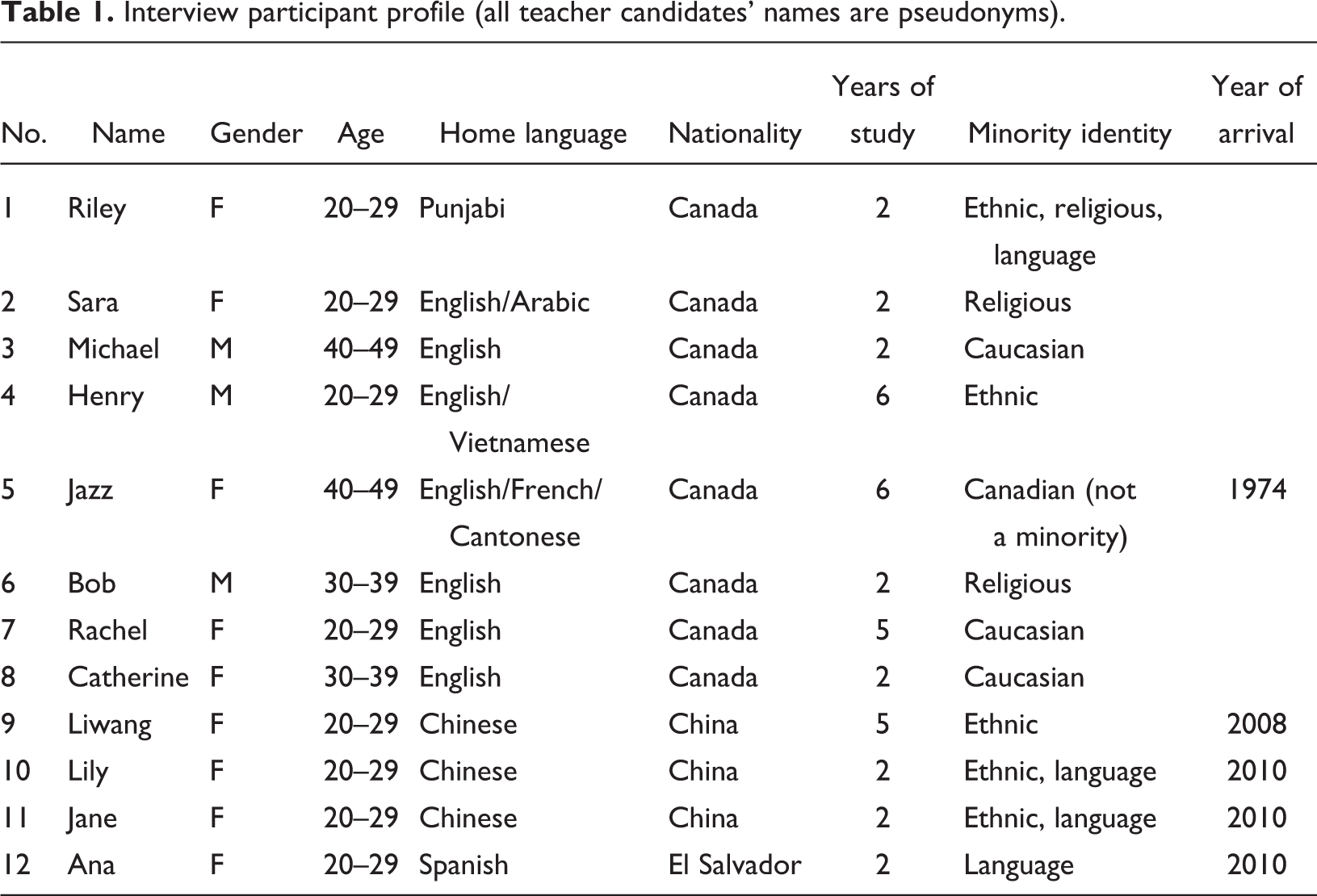
Data for this study were collected from three sources: (a) policy analyses of public documents related to internationalization in Canada and at the university, (b) a student survey on the internationalization of higher education (N = 161), and (c) individual interviews with 12 teacher candidates studying at Forest University. The teacher candidates were recruited for this study through the Faculty of Education’s undergraduate listserv and snowball samplings. Eight interviewees were local, four White and four racialized minorities speaking Arabic, Chinese, Punjabi, and Vietnamese as their first languages. Four interviewees were international, with three from China and one from El Salvador. Their age ranged from 20 to 49 years, with nine females and three males (see Table 1). The participants were teacher candidates at the 2-year post-degree bachelor of education program. Most of the teacher candidates who participated in the survey were representative of the nation’s teaching force, mostly White and female. The teacher education program is known as inquiry-based learning, a field-oriented approach, and learner-focused. Inquiry refers to a way of learning that requires the student to explore theories and issues through real-life cases, actively question, conduct research, and interpret a wide range of materials. This program is unique because campus and field experiences are interwoven throughout the 2 years.
Interview participant profile (all teacher candidates’ names are pseudonyms).
Semi-structured interviews were conducted. Twelve interviews were conducted, and each interview lasted approximately 60 min. The interviews were audio-recorded, transcribed, and then analyzed by developing a list of thematic codes (Patton, 2015). We employed an inductive analysis strategy to analyze the interviews and policy documents (McMillan & Schumacher, 2001) by searching for domains that emerged from the data rather than imposing them on data prior to collection. Domains are large cultural categories that contain smaller subcategories and whose relationships are linked by a semantic relationship (Spradley, 1980). A four-stage process was developed for data analysis: identifying main points, searching for salient themes and recurring patterns, grouping common themes and patterns into related categories, and comparing all major categories with reference to the major theories in the field to form new perspectives (Guba & Lincoln, 2005). Policy documents and interviews were initially coded and analyzed separately. This article reports findings mainly from individual interviews with teacher candidates. It also draws from findings from the survey with 161 teacher candidates as part of a larger project Ethical Internationalization in Higher Education across 22 universities for a total number of 4,522 responses, particularly teacher candidates’ responses to the four open-ended questions: (1) How does internationalization affect society generally? (2) How do you imagine global citizens should think, relate, and/or act in the world? (3) Do international students face challenges in your university apart from language difficulties? (4) Can diversity enrich your university experience? We used the theoretical framework to guide our analysis of the survey, examining how Canadian exceptionalism was being reproduced in responses of teacher candidates to the survey, their perceptions that IaH increased diversity on campus, and their views on curriculum internationalization. Survey findings were used to supplement interview findings as a method of triangulation (Creswell & Creswell, 2018). After major themes from interviews and the survey were identified, we brought in policy document analysis for comparisons with the experience of teacher candidates. Discrepancies between internationalization policies and teacher candidates’ experiences of learning in the teacher education program at Forest University were then identified and analyzed.
Findings
Four major themes emerged from the data: (a) teacher candidates perceived that internationalization increases diversity, openness, and inclusivity; (b) exclusion and racism facing international and racialized teacher candidates; (c) Eurocentric curriculum; and (d) teacher candidates enacting ethical internationalization. We used pseudonyms to refer to teacher candidates in the interviews and numbers (e.g., TC07 = teacher candidate #7) to refer to teacher candidates in the survey.
Internationalization increases diversity, openness, and inclusivity
In the interviews, most participants referred to internationalization as student mobility in Canadian institutions of higher education. For example, participants said internationalization means: Students from different countries, different ethnic groups, who speak different languages all come together to study at one institute. (Riley) Bringing people into Canada or people leaving Canada to go to other places for education. (Bob) I don’t know if we have international students in the X program. (Rachel) I hardly see them [international students] in my program. (TC17) In the faculty, I can’t tell one international student…I haven’t heard any…I’m not always differentiating between international students and culturally diverse students. (Catherine) Internationalization means to be able to go and explore different cultures and to gain more experience as a human being…like I studied in New York and in England…I think internationalizing my degree has definitely helped me become more of an outgoing person and becoming more independent. (Rachel) I’d say internationalization means having intercultural exchanges and hopefully sharing a different language and customs and traditions not only for a goal to achieve educational purposes but to learn about people and society that might not be your own…So internationalization…should be more than just visit somewhere…it has dual benefits for both parties that get involved because people can see things from other angles, from different society’s viewpoints. (Michael) More diversity and opportunity to learn from different cultures. (TC03) It has resulted in a possible multicultural environment. (TC07) Internationalization leads to increased sharing of diverse ideas and awareness of global issues. (TC22) Internationalization can benefit people as it is important to learn from different cultures and people. (TC78) It promotes global connectedness, thus creating better understanding of each other. This better understanding breaks down stereotypes. (TC23) Internationalization can help to cultivate respect for diversity in our society. (TC25) The opportunity to practice working with people from other cultures will lead to a more tolerant and respectful society. (TC29) I believe it is positive for society to become aware of other cultures, beliefs, values, and ideas because awareness can lead to a greater understanding and hopefully tolerance. (TC39) I believe internationalization promotes openness and social change…it also helps students to understand and welcome differences, making discrimination decrease. (TC49) This is Canada. We try to accommodate. (TC10) A multicultural university, welcoming faces and a lot of helping hands. (TC18) I think that this university is open and welcoming to everyone no matter what background. There are resources to help everyone succeed. (TC03) One student from Greece once called her experience at the Forest University an experience in being a part of the United Nations. (TC48) I love people, all shapes, sizes, colors, and abilities. (TC28)
Exclusion and racism facing international and racialized teacher candidates
In the aforementioned examples, teacher candidates perceived that internationalization increases diversity, openness, tolerance, and inclusivity in the university. In reality, feelings of hurt were exacerbated in classrooms where international teacher candidates felt excluded or ignored by other teacher candidates, illustrated in the following quote by Liwang who felt she was left out of teacher candidates’ study groups: The instructor was passing the paper to let us sign up. Everybody was taking turns according to where they sat. They put their names down,…Nobody knew each other at that time. A student sitting beside me got the paper first. He signed his name on the paper and he knew that if he passed the paper to me, I would be in the same group. There was only one spot left in that group…He passed the paper to another person…I was so hurt. (Liwang, China) Maybe before you start talking with them, they already have assumptions in their mind that you couldn’t speak good English. They don’t pay attention to what you say…even you see something more important. They just think because of your accent, your English, they don’t take me seriously. (Lily, China)
Like international teacher candidates, Riley, a second-generation teacher candidate whose parents immigrated to Canada from India, felt excluded based on race: When I do work in different groups, I do feel what I have to say isn’t important, or what I’m saying doesn’t really matter. And when people ask you, oh, where are you from? That puts a barrier like you are not from here, you don’t belong. (Riley) One day, I almost hit somebody, I pressed the brakes, and I scared him. He looked at me and he hang over my car, ‘you are a Chinc’, and I was angry, I felt so bad at first, but now you are calling me a Chinc, so I pulled my car over, parked, I went in and found him. I walked straight up to him. He’s 6 feet tall, I’m 5 feet 3, and looked straight at him, I said, ‘you know I felt really bad for almost hitting you and I was really sorry, but now I wish I did hit you for calling me that’. Even in a higher educational institution, I definitely see racism and discrimination around me. (TC02) As much as we don’t like to admit it, there is racial prejudice in our society. (TC72) Likely racism even if not explicit. (TC58) Discrimination still exists. (TC80) There will always be discrimination, we have to work to lessen it as much as possible. (TC89)
Eurocentric curriculum
At the policy level, the university emphasized the internationalization of the curriculum and enhanced “teaching and learning resources to optimize the educational experiences of international students.” In practice, however, international teacher candidates reported that they felt there were few teaching and learning resources that were related to their experiences: It is more like I need to adapt myself to fit into the program. I feel like there is less understanding. (Liwang, China) I don’t see there are many materials on my international experience. They [instructors] seldom talk about things happening in China. I think only in X course I experienced a lot because the instructor is from the similar background. (Jane, China) Everything else is very North American-centered, very androcentric…X courses kind of focus heavily on X program of studies which I believe is also very Canadian-centered. And by Canadian-centered I mean European-white-society-centered. (Michael) The curriculum teaches Canadian history, but only Canadian history that is seen by the victors, the British…But when you talk about other cultures in Canada, there has been many cultures, but they don’t name them. They are not part of them in the history books. And kind of a token focus on other viewpoints or other places…we’re actually learning that here are different worldviews for Aboriginal perspectives at this moment in education. And one of the points they [instructors] make is that we often look at Aboriginal issues through Western eyes. Like we would study their issues using Western terms and create solutions using Western methods. I think the same approach is often made towards the rest of the world. Eurocentric perspectives in academia. (TC45) English European program. (TC36) European students will always be valued over non-European students. Universities are White, colonial, and Eurocentric, so students with a diverse background suffer accordingly. (TC61)
Teacher candidates enacting ethical internationalization
In the aforementioned examples, teacher candidates perceived that the curriculum in the teacher education program was Eurocentric. Some participants enacted agency to disrupt the dominance of White perspectives. For example, Riley described how she did an inquiry project in order to gain a better understanding of immigrant parents’ perceptions on education: That was because most of the people that live here at the moment are from India, and we want to know what their struggles were, and especially in the X there are a lot people that are from India. We just want to know how they felt being in a classroom, or how they would interact with the teacher, and it was clear that some of them really feel uncomfortable because they did not speak English, and I feel part of the reason may also be that, they felt uncomfortable because the teacher did not get to know the parents or the students right? So I feel it’s very important for a teacher to get to know the students. (Riley)
From their inquiry project, they also found that according to a parent’s personal experience, her child’s teacher had a problem with her speaking Punjabi at home with her child. The parent felt that the teacher believed Punjabi became a barrier in her child’s English learning. Riley also felt that her partner teachers “encourage students speak English, and not so much the home language” in her practicum school. She felt that there was an implicit English-only policy in the classroom. Riley used her language skill to disrupt the dominance of monolingualism in her practicum: For example, there was a student who did not really know English, and we were working on assignment he didn’t really understand, so I explained it in my language, in Punjabi, and he understood it. (Riley) In another practicum…there were a group of students from Iran who were doing a presentation in Grade 4, something about the nuclear…They had opinions which a lot of North Americans wouldn’t agree with…it is just not to have close-minded North American perspective on the world…I think it’s important to allow every student the opportunity to voice their opinions. Not correct them and say, ‘no, that’s not right’ because it’s not North American. I think it’s good to have an open-minded perspective of the world. I do a lot of volunteering at mosque where a bulk of my experience come from, volunteering with the youth of the mosque who experience, you know, I don’t necessarily think I’ve experienced a huge deal of identity crisis, but I know a lot of the generation, the younger generation, they do experience this sort of identity crisis, so I use my experiences to help them get through theirs. (Sara)
Discussion
Most teacher candidates in the study referred to internationalization as student mobility. Few participants went beyond mobility to highlight the importance of developing an intercultural understanding. Most participants perceived internationalization enhances diversity, consistent with the institutional policy that internationalization increases campus diversity. Marshall (2002) defines diversity as “distinctions in the lived experiences, and the related perception of and reactions to those experiences that serve to differentiate collective populations from one another” (p. 7). Participants in the study seem to associate diversity with international students. Some reported a lack of knowledge about international students in the teacher education program and their struggle to distinguish international students from culturally diverse students. International teacher candidates become invisible to their peers in the program.
Contradictions between Canadian exceptionalism and experiences of racialized and international teacher candidates
Most participants perceived Canada and Forest University as welcoming, open, and tolerant, illustrated in their comments such as “This is Canada. We try to accommodate” and “A multicultural university, welcoming faces and a lot of helping hands.” This finding confirms what Fleras (2018) called the “Canadian exceptionalism” (p. 301). Some participants in the study uncritically accept the discourse of Canadian exceptionalism (Frideres et al., 2019).
Such an imaginary of Canadian exceptionalism does not necessarily coincide with everyday realities of international and racialized teacher candidates. International and racialized teacher candidates in the study reported that they experienced different forms of exclusion and racism. In the teacher education program, they were required to do much group work as part of assignments. Some international teacher candidates who speak English with an accent, different from the so-called standard Canadian accent, felt they were perceived as unintelligent and were left out of group. These international teacher candidates experienced visible exclusion. Similarly, in the studies by Y. Guo (2009) and Creese (2010), participants were discriminated based on their accent, while Leask’s (2009, p. 215) study corroborated the finding of alienation and discrimination as international students felt that “domestic students often avoided working with them in class and interacted with them very rarely if at all outside class.”
Contrary to the social imaginary of Canada as open, tolerant, and free of racism (Thobani, 2007), some racialized teacher candidates shared their own personal experiences and feelings of frustration, exclusion, and marginalization. For example, Jazz had to deal with deep-rooted racism from people in the local community in the form of verbal attacks. Riley routinely endured questions such as “where are you from” from her peers. This made her feel she does not belong to Canada even though she was born in Canada. Such a question contributes to “banal racism, a kind of racism which is routinized and inconspicuous” (Zhu & Li, 2016, p. 450). Markus and Moya (2010, p. x) argue that “race is not something that people have or are, but rather a set of actions that people do…Doing race always involves creating groups based on perceived physical and behavioural characteristics, associating differential power and privilege with these characteristics, and then justifying the resulting inequalities.” Racialized teacher candidates felt they were seen as “an ‘interloper’—someone who is not wanted or considered not to belong” (Zhu & Li, 2016, p. 467). This finding is consistent with the literature on how racialized participants were marginalized and “seen as the Other or a permanent outsider” in their own country (Merryfield, 2000, p. 439).
Some international and racialized teacher candidates also experienced other forms of invisible exclusion or included exclusion. They felt that even though they were included in a group physically, their opinions were not taken seriously by their peers in the group, illustrated in the statement “what I’m saying doesn’t really matter.” For example, both Lily, the international teacher candidate, and Riley, the racialized teacher candidate, felt their knowledge was easily discounted and devalued by their peers. This finding seems to confirm that knowledge is socially constructed, culturally mediated, and historically situated (McLaren, 2003). The nature of knowledge as social relations raise important questions: “What counts as legitimate knowledge? Whose knowledge is considered valuable? Whose knowledge is silenced? Is knowledge racialized?” (S. Guo, 2009, p. 47).
Contradictions between the internationalization of the curriculum across policy and practice
The results of the study also show the discrepancies between the internationalization of the curriculum policy and the experiences of teacher candidates. At the national policy level, the Accord on Internationalization of Education (Association of Canadian Deans of Education, 2014) promotes “the internationalization of Canadian curriculum” (p. 4) in teacher education. At the institutional level, the university also includes internationalizing the curriculum as one of its internationalization strategies. In practice, from the international teacher candidates’ perspectives, there was little internationalization of the curriculum in the teacher education program in which they studied, consistent with findings from another study on international students’ experiences of internationalization in Canadian higher education (Guo & Guo, 2017). For example, our findings revealed that international teacher candidates rarely encountered materials that reflected their experiences. All interviewees perceived that the curriculum in the program was Eurocentric and androcentric. Even though there was an initiative to indigenize curriculum in the program, participants felt that a tokenistic approach was used to cover indigenous perspectives because indigenous issues were examined from “Western eyes.” Critical educators argue that Canadian curriculum needs to be analyzed in light of the role by colonialism and European settler domination (Neeganagwedgin, 2011). Many Canadian universities are colonial in curriculum (Dei, 2016). Haigh (2009) argues, “today, although many classes emerge as a cosmopolitan mix, curricula remain Western” (p. 272). These findings provide evidence for Leask’s (2015) critique that “one common misconception about internationalization of the curriculum is that the recruitment of international students will result in an internationalized curriculum for all students” (p. 11).
Teacher candidates’ agency for social inclusion and equity
Facing social exclusion and Eurocentric curriculum, teacher candidates in the study enacted agency to disrupt the dominance of White perspectives in the curriculum. For example, Riley noticed the absence of perspectives of immigrant parents on education in the contents of most courses she had taken. Reflecting on her practicum experience, she realized that many teachers appeared to lack an understanding of the knowledge immigrants hold about their children. Through her inquiry project, she introduced unique ways that immigrant parents engaged in their children’s learning such as teaching science in their first language. This challenged the traditional models of parent involvement that privilege White, middle-class parents. This finding is consistent with the literature on the inclusion of epistemic pluralism, particularly immigrant parent knowledge, within teacher education (Abdi, 2009; Y. Guo, 2012; Kelly et al., 2009). Elsewhere (Y. Guo, 2018), we discussed immigrant parent knowledge as transcultural knowledge construction where individuals in immigrant societies of the new world change themselves by integrating diverse cultural lifeways into dynamic new ones. It draws from their own educational backgrounds, their professional and personal experiences of interacting with schools in their countries of origin as well as their current understanding of the host country’s education system, their own struggles as immigrant parents, and their future aspirations for their children. Riley and her peer’s agentic action of introducing immigrant parent knowledge to teacher education exemplifies a decolonial approach to the ethics of curriculum internationalization in a need to “make institutions into spaces of true epistemic pluralism, given the tendency to suppress knowledge systems that challenge not only Western epistemic hegemony but also dominant modes of ecological, relational, and economic organization” (Stein et al., 2019, p. 36).
The other agentic action participants took was to disrupt the dominance of monolingual practices in their practicum schools. Even though Canadian schools are becoming increasingly linguistically diverse, some participants noticed that there was an implicit English-only policy in the classroom. They reported that some parents felt their children’s teachers believe that parents’ first-language interaction with their children interferes with second-language learning. This finding is consistent with our earlier studies (Y. Guo, 2006). In the Alberta context, currently 25% of the student population are multilingual and multicultural learners (some school jurisdictions have 60%) (CBC, 2018). It is important that their learning needs are addressed. Despite multilingual realities of student populations, many Canadian schools are monolingual in orientation (Cummins, 2007). In sociocultural learning theories, Vygostsky considered the first language as seminal in learning. He argued, “language mediates cognitively complex thinking, and the first language is the most powerful tool for doing so” (as cited in Swain & Lapkin, 2013, p. 113). The multilingual learners draw all their linguistic repertories to make meaning and solve problems (García, 2009; García & Li, 2014). They appropriate knowledge by mediating their own and each other’s learning within and across languages. Translanguaging, using two or more languages simultaneously, is the discursive norm in bilingual families and communities throughout the world (Zhang & Guo, 2017; May, 2014). Gramling (2022, p. 2) critiqued “the strident, unapologetic monolingualization of international education.” We would argue that multilingualism seems to be absent from the current discussion of IaH. Some participants in the study took actions to create space for multilingual students to legitimize their translanguaging practices in the classroom.
Another agentic action that participants took was to support racialized youth to foster transcultural identities. One Muslim youth was struggling with his identity. One of the main factors to account for this is the fact that public education in Canada follows a fundamentalist Christian curriculum with its calendar specifically fitting the needs of Christians (Karmani & Pennycook, 2005; Spinner-Halev, 2000). The Eurocentric nature of public schools in general means that religious minority youth need to constantly negotiate parameters for their involvement in school curricula and activities (Zine, 2001). This negotiation is particularly challenging for Muslim youth. Islam is often portrayed as an inherently violent religion, and Muslims are seen as threatening the peace and security of Western nations (McDonough & Hoodfar, 2005), particularly after the events of September 11, 2001. The Muslim youth may encounter “psychic and spiritual violence” (Kitossa, in press) and experience identity crisis. Over the years, the teacher candidate Sara supported this Muslim youth to foster transcultural identities and multiple attachments (Hébert et al., 2008). Such understanding of mobile identities would create among students “an openness to others…so as to be able to imagine oneself as another, to take up new belongings, and to move across cultural, linguistic, religious, ethnic, racial spaces of interaction and boundaries” (Hébert et al., 2008, p. 51).
Conclusion and implications
This study investigated how teacher candidates experienced and interpreted IaH at one university in Canada. The results of the study reveal that there are contradictions between the discourse of Canadian exceptionalism and experiences of racialized and international teacher candidates. Despite the focus on equity, diversity, and inclusion in the institutional policy, racialized and international teacher candidates experienced different forms of exclusion and racism. The results of the study also show the discrepancies between the internationalization of the curriculum policy and the experiences of teacher candidates. From the participants’ perspectives, the Eurocentric perspectives dominated curricula in the teacher education program in which they studied. Some teacher candidates took agentic actions to disrupt the dominance of the Eurocentric curriculum, the dominance of monolingual practices in their practicum schools, and to support racialized youth to foster transcultural identities.
This study suggests that teacher education institutions need to be cognizant of how they put the internationalized curriculum into action. Stein et al. (2019) identify three approaches to the ethics of curriculum internationalization: liberal, critical, and decolonial. The liberal approach focuses on “incorporating international content, international perspectives, and an emphasis on intercultural engagement” (p. 35). For example, teacher educators can encourage international teacher candidates to share their knowledge in the classroom. This is perhaps the most popular approach to the internationalization of the curriculum (Foster & Anderson, 2015; Harrison, 2015). However, this approach does not challenge the unequal power relations in cross-cultural learning and the claim of universality of Western knowledge production. The critical approach decenters Western knowledge (Breit et al., 2013), legitimizes and values marginalized knowledge, including not only knowledge produced in developing countries but also knowledge produced by racialized people within the West (Roshanravan, 2012). For the critical approach, an internationalized curriculum demands that teacher educators view international and racialized teacher candidates not only as knowledge consumers but also as knowledge producers. This means that the knowledge and linguistic resources that international and racialized teacher candidates bring need to be valued, and the internationalized curriculum needs to be connected to international and racialized teacher candidates’ lived experiences. For the decolonial approach, simply adding (liberal) and supporting (critical) more diverse knowledge is insufficient, it requires “reframing different knowledge systems as contextually relevant interventions” (Stein et al., 2019, p. 36) and “redistribution of material, social, political, cultural, and symbolic resources” that have historically been used to naturalize Western domination (Santos, 2007, p. 64). Dei (2016) stated that “decolonizing is about reframing and decolonizing the curriculum and entire approach to schooling and education…‘Decolonizing Education’ teaches and engages students in the discourses of colonialism, Indigeneity, anti-racism, social oppressions, ableism, heteronormativity and patriarchy” (p. 37).
Teacher education must be reconceptualized to address what it means to teach in multilingual and multicultural schools. Presently, the discourse of internationalizing teacher education focuses on developing teacher candidates’ global and intercultural competencies, but it is separate from addressing racism, cultural, and linguistic exclusion. Further to the development of interlinguistic and intercultural competence we argued elsewhere (Guo et al., 2009), it is necessary to bridge the internationalization of teacher education with anti-racism education in teacher education so as to examine what it really means by inclusion. As Dei (2016) put it, “inclusion is not bringing people into what already exists; it is making a new space, a better space for everyone” (p. 36). The creation of such space needs to address “structural inequalities, unequal power relations and discrimination” (James, 2008, p. 13).
The internationalization of teacher education requires the internationalization of teacher educators (Bond et al., 2003; Goodwin, 2012). Unfortunately, the reality is that the majority of teacher educators are “White, middle class,” which begs the question “how can teacher educators, who have never examined their own privilege or who have no personalized learning of what it feels like to live as the Other prepare K-12 teachers to teach for diversity, equity and interconnectedness?” (Merryfield, 2000, p. 441).
This research addresses knowledge gaps related to internationalization policy as teacher candidates’ voices are not often heard in internationalization initiatives. The results of the research will provide useful insights into universities’ internationalization practices. The results will also further the discussions on ethical protocols for international engagement and inform internationalization policy in teacher education. The findings suggest that teacher educators must make more purposeful attempts at the internationalization of research, curricula, and pedagogy that would meet diverse needs of local and international teacher candidates.
This research can inform IaH policy in China. The internationalization of Chinese higher education is accelerating at a rapid pace over the past 40 years (Yang, 2016; Zha et al., 2019). Through the powerful presence of the West, Yang (2016) argues, Western knowledge has been systematically institutionalized in the school curriculum, university disciplines, official ideology, and even daily discourses. Our recent study (Guo et al., 2022) about Chinese university students’ perceptions of IaH found that students question Englishization equals internationalization ideology that promotes the superiority of Western knowledge, leading to the devaluation of Chinese knowledge. That study calls for an approach to internationalization that aims to de-Westernize the ideological underpinnings of colonial relations of rule, especially in terms of its privileging of Eurocentric thought and education and Eurocentrism as normative processes of knowledge production, and to value Chinese language and epistemology.
Footnotes
Contributorship
The two authors jointly conducted the study while Yan Guo was responsible for the research methodology, findings, discussion, and conclusion, and Shibao Guo contributed to the introduction, theoretical framework, and the literature review.
Declaration of conflicting interests
The authors declared no potential conflicts of interest with respect to the research, authorship, and/or publication of this article.
Funding
The authors received no financial support for the research, authorship, and/or publication of this article.