




Abstract
Purpose
This critical policy analysis aims to comprehensively examine the second round of China's first-class discipline development project, commonly known as the Double First-Class Initiative (DFC Initiative or Shuang Yiliu Jianshe).
Design/Approach/Methods
We conducted desk research between May 2022 and December 2023 using relevant policy documents, academic literature, news sources, and commentaries that specifically focused on the second round of the DFC Initiative in China. Employing a critical policy analysis approach, we analyzed the gathered data from three key perspectives: policy as text, policy as discourse, and policy effects (including both first- and second-order effects).
Findings
The second round of the DFC Initiative was implemented within the context of strengthened state regulation, prevalent managerialism, and an emphasis on promoting education equality in China's higher education development. A notable shift in structural dynamics occurred between the first and second round. These include the possibility of universities being added to or removed from the official list, increased academic autonomy for selected universities, and the promotion of interdisciplinary research within specific institutions. The implementation of the second round of the DFC Initiative reflects China's commitment to developing an internationalization strategy with Chinese characteristics. This strategy aims to align with China's national strategic needs and position the country as a cooperative partner, promoter, competitor, and potential leader in global scholarship.
Originality/Value
By employing a critical policy analysis approach, this study offers a comprehensive examination of the second round of the DFC Initiative in China, contributing to existing knowledge on the development of world-class university policies in the country.
Keywords
Introduction
Since the reform and opening-up policy was initiated in 1978, China's government has been using a university strategy to develop and internationalize the Chinese higher education system. In continuation of Project 211 and Project 985, China launched the First-Class Universities and First-Class Disciplines Development Project, referred to as the Double First-Class Initiative (Shuang Yiliu Jianshe) (hereinafter DFC Initiative), as a new university strategy in 2015. The project is a reform-based, performance-linked effort to help universities optimize their disciplinary structures and governance (Peters & Besley, 2018). The ultimate goal of the project is to make China a leading player in the global higher education system by 2050 through the development of world-class universities and disciplines (Liu, 2018).
The first round of the DFC Initiative, implemented from 2016 to 2020, received mixed feedback from Chinese academia. One of the short-term goals of the project was that, by 2020, a number of universities and groups of disciplines would meet world-class standards and that a number of disciplines would be in leading positions (Liu, 2018). However, a quality assessment report by the Ministry of Education of the People's Republic of China (MOE) noted that only Tsinghua University has declared itself as world-class, while the rest of the project universities have only partially fulfilled their developmental goals of becoming world-class (Tencent News, 2020).
On the one hand, scholars view the project as a booster for the internationalization and research productivity of selected universities, especially the top research universities (Gao & Li, 2020; Zhong et al., 2023). It has also been observed that China has overtaken the United States and become the largest source of research articles (Tollefson, 2018). However, Kim et al. (2018), based on interviews with 24 academics at Peking and Tsinghua universities regarding their perceptions of the development of world-class universities in China, found that the Chinese professors believe that Chinese government's “interpretation of world-class university” might be too narrow, thereby making their recognition in the university world rankings simplified. In addition, researchers have pointed out that the project has increased competition among Chinese universities and deepened inequality in regional development (Gao & Li, 2020). In fact, since the launch of the project, inequality in resource distribution, overemphasis on external quality assessment by the state, and tensions between project compliance pressure and university autonomy have been the major concerns associated with the project and have also been the subject of intense discussion within Chinese academia (Liu, 2018).
In this context, the MOE issued important government guidelines on the further development of first-class universities and disciplines in February 2022 (MOE, 2022a), initiating the second round of the DFC Initiative, which attracted widespread attention in China and differs from the first round in a number of important aspects. These include, but are not limited to, the inclusion of additional universities, the removal of the categorization of selected universities (such as Categories A and B from the first round), and no separate list of first-class disciplines. Moreover, the MOE has also identified “non-eligible” disciplines from their quality assessment of selected disciplines in the first round, which has raised alarm among some universities.
One major concern emerging is how the second round of the DFC Initiative has influenced China's internationalization strategy for higher education, possibly even driving it toward a national rather than an international focus. Soon after the launch of the second round of the DFC Initiative, several Chinese universities (e.g., Renmin University) in the selection list announced that instead of actively participating in global rankings, they intended to place more emphasis on national quality assessment and university rankings within China. Although it cannot be confirmed that the two events are related, there is widespread concern that the second round of the DFC Initiative influenced their decisions.
To date, most studies on China's world-class university strategy have focused on the first round of the DFC Initiative, and little attention has been paid to the second round (Wang et al., 2023; Wang & Lin, 2022; Xiong, 2022). Xiong (2022) was the first to draw attention to key changes in the second round of the DFC Initiative, such as the removal of the list of first-class disciplinary subjects, expanded institutional autonomy at Tsinghua University and Peking University, and the warning list of ineligible disciplinary subjects in selected universities from the first round. Wang and Lin (2022) noticed the emphasis on interdisciplinary research development in the second round of the DFC Initiative and shared their vision of and possible pathways for promoting interdisciplinary research. Very recently, Wang et al. (2023) compared the implementation of the first and second rounds of the DFC Initiative and revealed more structural changes, achievements, and limitations in moving from the first to the second round.
In another study not specifically focused on the second round, Yang et al. (2021) reviewed the strategic plans of 41 research-intensive Chinese universities aiming at achieving world-class status and gave an insight into the operational dynamics of Chinese universities within the framework of the DFC Initiative. Their investigation revealed a dual reality in which Chinese universities actively engage in global higher education and international partnerships while simultaneously grappling with the imperative of addressing domestic contextual factors. Song (2018), for example, studied one research university's personnel reform carried out to comply with the DFC Initiative assessment and highlighted the disadvantages that humanities departments suffer in such quality assessments. While all these studies are written in Chinese and target a Chinese audience, and though no empirical research has been yet conducted on the actual implementation of the second round of the DFC Initiative, these studies have brought to light some of the impact the second round of the DFC Initiative has had on the domestic development of higher education in China. Given that the DFC Initiative represents a key internationalization strategy to enable China to join the world-class global scholarship league, which may, in turn, affect the development of global leadership, a systematic analysis of the second round of the DFC Initiative is imperative. This analysis should include its intentions, the context in which it is being proposed, and the potential effects on Chinese higher education development at home and beyond.
Previous studies of the first round of the DFC Initiative have contributed to our overall understanding of this project. First, they show that, while ensuring an alignment with the global trend of using world-class university policies to meet national strategic demands (Rhoads et al., 2014), China's world-class university policy has emphasized the development of a higher education system with distinctly Chinese characteristics. Huang (2015) views the idea of “Chinese characteristics” as a top-down policy, a means to direct intensive funding from both the national government and local authorities to a few elite universities. Second, researchers have scrutinized the first round of the DFC Initiative and discussed the enforcement of performance-based management, which is embedded in the project (Gao & Li, 2020; Liu, 2018; Liu & Lu, 2022). Specifically, Liu (2018) anticipates that performance-based management could increase the unequal distribution of resources among regions, leading to a reliance on external quality assessments by the state and shrinking university autonomy. Third, a handful of studies examining the impact of the implementation of the first round of the project (Liu et al., 2023; Lu, 2020; Song, 2018; Zhong et al., 2023) have noted that while some expected outcomes have been achieved, such as an increase in international collaboration and innovation productivity (Zhong et al., 2023) and the promotion of international influences by Chinese universities (Liu et al., 2023), some unexpected outcomes have also surfaced, particularly the unequal distribution of resources (Song, 2018) predicted by Liu (2018).
Recent changes in the internationalization of higher education in China and beyond have manifested the complexity of the global context in which the DFC Initiative is taking place. As mentioned earlier, China overtook the United States in 2018 to become the world's largest producer of academic publications (Tollefson, 2018). Along with its rapid growth in global scholarship, debates have arisen over whether China will challenge the dominance of Anglo-Saxon countries and become the new global leader. As a result of this potential challenge, as well as geopolitical tensions, the Trump administration launched the China Initiative in 2018, creating fears and anxieties among scientists of Chinese origin working in the United States (Xie et al., 2022).
Unlike politicians, academia in the United States doubts the possibility of China's challenge for global academic leadership. Altbach (2022) indicates that although the top Chinese universities performed well in world rankings, China still faces multiple challenges in claiming global leadership in academia. Similarly, reflecting on the heated discussion on the possibility of Chinese as a new lingua franca, De Wit (2022) and Altbach (2022) believe that the dominant role of English as the global medium for science will not be challenged in the foreseeable future. However, Marginson (2019) pointed out that, owing to China's and the West's different conceptualizations of the state, society, and global world (Tianxia), China is taking a different pathway in higher education. In previous international cooperation between China and the West (e.g., especially the United States), China has learned dramatically and rapidly from the West, while its Western counterparts have not done the same or have not even realized that there is anything to learn (Marginson, 2019). Influenced by both East Asian and Western academic traditions, Chinese universities have the potential to integrate both types of knowledge into the development of global scholarship (Yang, 2019), and China's English-medium academic journals could be the testing ground for this integration (Li & Yang, 2023).
All this is occurring at a time when China's economy has transitioned from a high-speed growth stage to a high-quality development phase, with innovation as the driving force (MOE, 2022c). In response to national strategic demands for cutting-edge scientific research, innovation, and the cultivation of exceptional talent (MOE, 2022d), higher education institutions are being called upon to proactively engage and align their efforts with national development. In such international and national environments, the second round of the DFC Initiative was launched in China to continue supporting China's effort to become a leading player in global scholarship by 2050. But how does this work? To what extent can it enable China to do so? What would its short- and long-term impacts be? These questions must be answered if we are to understand China's current role in global scholarship and its vision of future internationalization.
Therefore, this study aims to provide a critical policy analysis (CPA) of the second round of the DFC Initiative and its potential effects on the development of higher education in China. In doing so, this article tries to answer the following research question: How will the launch of the second round of the DFC Initiative contribute to Chinese higher education development at home and internationally?
This policy review is based on desk research carried out from May 2022 to December 2023, using policy documents, academic literature, news, and commentary articles related to the second round of the DFC Initiative. In what follows, we briefly describe the research approach and analytical framework employed in this study and then present the results arising from that analysis. Finally, we discuss the possible implications of our policy review for future research.
Research approach
Using the CNKI dataset provided by the co-authors’ university libraries and databases accessed using the Google and Bing search engines, we searched and collected relevant literature and documents for this study. Keywords such as “DFC Initiative” (in Chinese: Shuang Yiliu Jianshe), “New round of the DFC Initiative” (in Chinese: Xin Yi Lun Shuang Yiliu Jianshe), and “The second round of the DFC Initiative” (in Chinese: Di Er Lun Shuang Yiliu Jianshe) were used to search for relevant documents. The final dataset for this study comprised all government reports, news stories, commentary articles, and journal articles related to the second round of the DFC Initiative, in both Chinese and English, that we were able to locate. Being aware of the limitations of desk research, the two co-authors utilized the tactic of investigators’ triangulation, analyzing the data and holding frequent online co-authoring meetings to discuss and synergize the analysis results during the data analysis and reporting process.
To gain an in-depth understanding of “the contexts in which participants in a study address a problem” (Creswell, 2013), our research strategy employed CPA to analyze the second round of the DFC Initiative and the associated impacts. Given its nature, CPA is often used by researchers adopting a qualitative approach (Young & Diem, 2018).
CPA is an emerging research paradigm increasingly used in educational research owing to its effectiveness in exploring and questioning the roots and development of educational policy as well as the context in which the policy is drawn up and implemented (Young & Diem, 2018). CPA researchers believe that policy development is not a linear process that can be simply planned and managed (Apple, 2012). Policies are “representations which are encoded in complex ways (via struggles, compromises, authoritative public interpretations, and reinterpretations) and decoded in complex ways (via actors’ interpretations and meanings in relation to their history, experiences, skills, resources, and context)” (Ball, 1993, p. 11). The CPA research paradigm can be used in different situations when researchers are engaged in any of the following (Young & Diem, 2018): Situation 1: Interrogating the roots and development of educational policy Situation 2: Probing the difference between policy rhetoric and practical reality Situation 3: Examining the distribution of power, resources, and knowledge and the creation of “winners” and “losers” Situation 4: Scrutinizing the complex systems and environments in which policies are created and implemented Situation 5: Exploring social stratification and the impact of policy on the relationship between privileges and inequality Situation 6: Revealing the nature of the resistance to or engagement in policy by members of historically underrepresented groups
In this article, we explore the second round of the DFC Initiative and its impact on the relationships of universities both within China and between China and the outside world. As this clearly falls under the scope of Situations 4 and 5 above, CPA is a suitable research strategy for fulfilling our research purposes.
In terms of CPA's conceptual framework, Ball (1993) suggested that three conceptualizations of policies should be closely examined, “policy as text,” “policy as discourse,” and “policy effects.” By conceptualizing policy as text, policies are “textual interventions into practice” (Ball, 1993, p. 12). Thus, interpreting policy as text is to analyze the meaning and intentions of policy. By viewing policy as a discourse, it becomes a system of practice and a set of values and ethics to which we are subject when creating policies (Ball, 1993). In line with this thinking, we need to analyze the ways in which policy develops. Lastly, the conceptualization of “policy effects” includes both first-order and second-order effects (Ball, 2015). First-order effects refer to changes in practice or structure due to policy implementation in the short term, while second-order effects refer to the impact of these changes on patterns of social equality and justice in the long run (Ball, 2015).
Guided by this conceptual framework (Ball, 1993, 2015), when analyzing the second round of the DFC Initiative in China, we focused on exploring the representations and intentions in the policy documents regarding the project, the ways the second round of the DFC Initiative in China was constructed and launched, the short-term changes in the structure and practices of the DFC Initiative, and its possible long-term effects on the internationalization of higher education inside China and its relationship with the outside world. Table 1 summarizes the analytical framework used in this study.
CPA analytical framework for the second round of the DFC Initiative in China.
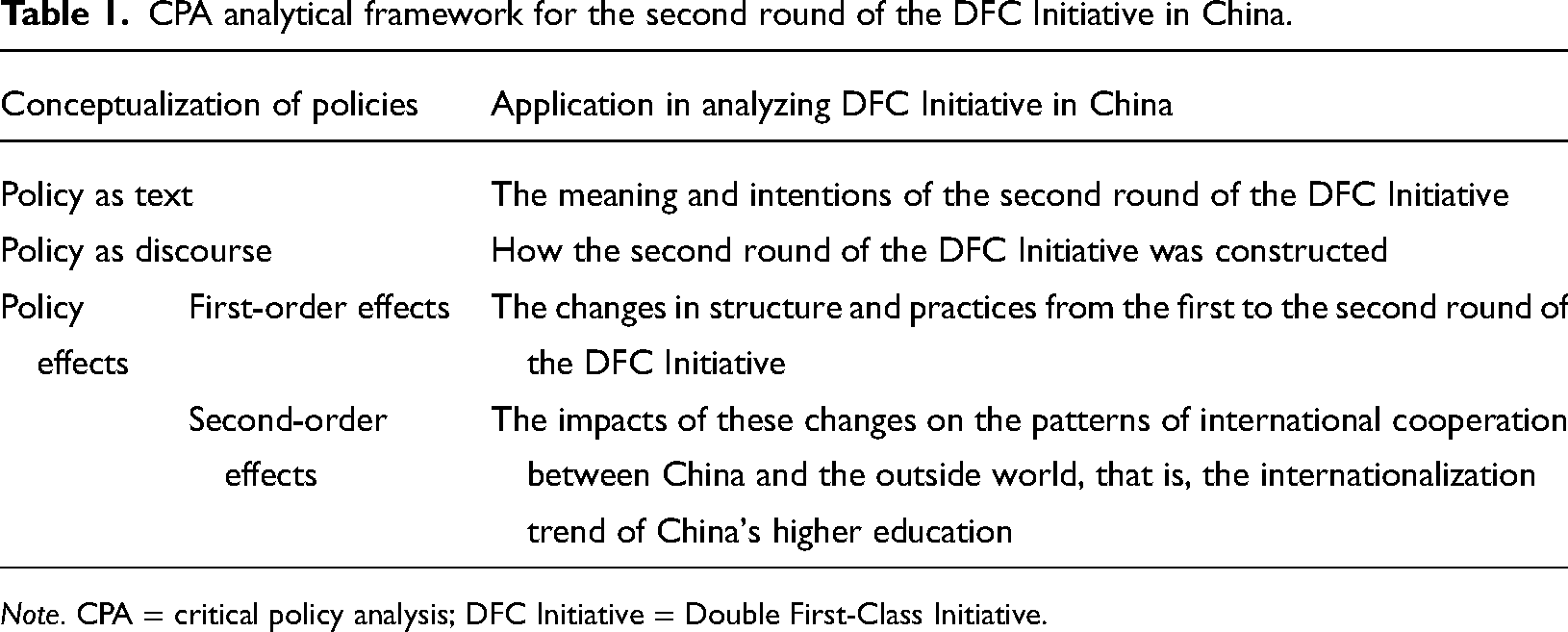
Note. CPA = critical policy analysis; DFC Initiative = Double First-Class Initiative.
Following the CPA analytical framework, we conducted on-desk research from May to December 2023 on the policy for the second round of the DFC Initiative. The research data were collected by gathering documentation in the form of policy documents from the MOE in China in the first and second rounds of the DFC Initiative, academic literature in Chinese and English on the DFC Initiative, relevant news stories, and commentaries on social media. After collecting and sorting the documents, we analyzed the data following the analytical framework (see Table 1) using thematic and discourse analysis techniques. We report the policy analysis results in the following section under four headings.
Analysis
Policy as text: Mission and meaning of the second round of the DFC Initiative
The analysis of the policy documents relating to the second round of the DFC Initiative as text yielded information on three core issues: the mission of the project's second round, the universities included in the project, and those omitted.
The first issue is “why” these universities are included. According to the MOE, the overall goal of the DFC Initiative is that by 2030, more universities and disciplines will join the “world-class” category, and China will develop into an educational powerhouse by 2035 (MOE, 2022a). Its underlying mission is to cultivate high-level talent that serves China's national strategic goals and develop a world-class higher education system (MOE, 2022a). To achieve this goal, five principles were proposed in the second round (MOE, 2022b). First, the listed universities/departments should adhere to socialism and prioritize the cultivation of future developers of socialism. Second, aiming for excellence, the second round of the DFC Initiative intends to improve the overall quality of higher education in China, thereby enabling China to become a global higher education powerhouse by 2050. Third, through adherence to the “Talents Empowering State” (Rencai Qiangguo) strategy, the second round of the DFC Initiative stresses that listed universities should improve their capacity for high-quality education and cultivate high-level talents for the nation. Fourth, the project emphasizes that the construction of world-class universities should be rooted in China's context and appropriate to national strategic development and interests. Lastly, as all listed universities are research universities, the second round of the DFC Initiative highlights the importance of scientific research and encourages the selected universities to develop their research activities forcefully to bring about change in both the global and the local communities. These five principles outline the mission of the selected universities in the political and academic dimensions. By realizing these missions or principles, more Chinese universities are expected to join the world-class university league and China will become a global leader in higher education in the future.
A second core message, and possibly the one of most interest to universities in China, is who are the “winners” included in the project. As Table 2 shows, 147 universities were selected, most of which are from developed regions such as Beijing (34), Jiangsu (16), and Shanghai (15) (MOE, 2022c). In terms of disciplinary subjects, the list covers 443 academic programs, termed “disciplinary subjects” in China, in selected universities (excluding Tsinghua University and Peking University). These include 59 academic programs related to natural science (mathematics, physics, biology, chemistry), 180 related to engineering, and 92 related to social science and humanities (Wang & Lin, 2022). In China, academic programs in universities are developed based on two layers of discipline categories, with the overarching discipline as the first-level structure and the related disciplinary subjects as the second-level structure, as approved by the MOE. Among all selected disciplinary subjects in the universities, the most popular subjects were materials science and engineering (30 universities), chemistry (22 universities), and biology (13 universities) (MOE, 2022c).
Universities and disciplinary subjects by region selected in the second round of the DFC Initiative.
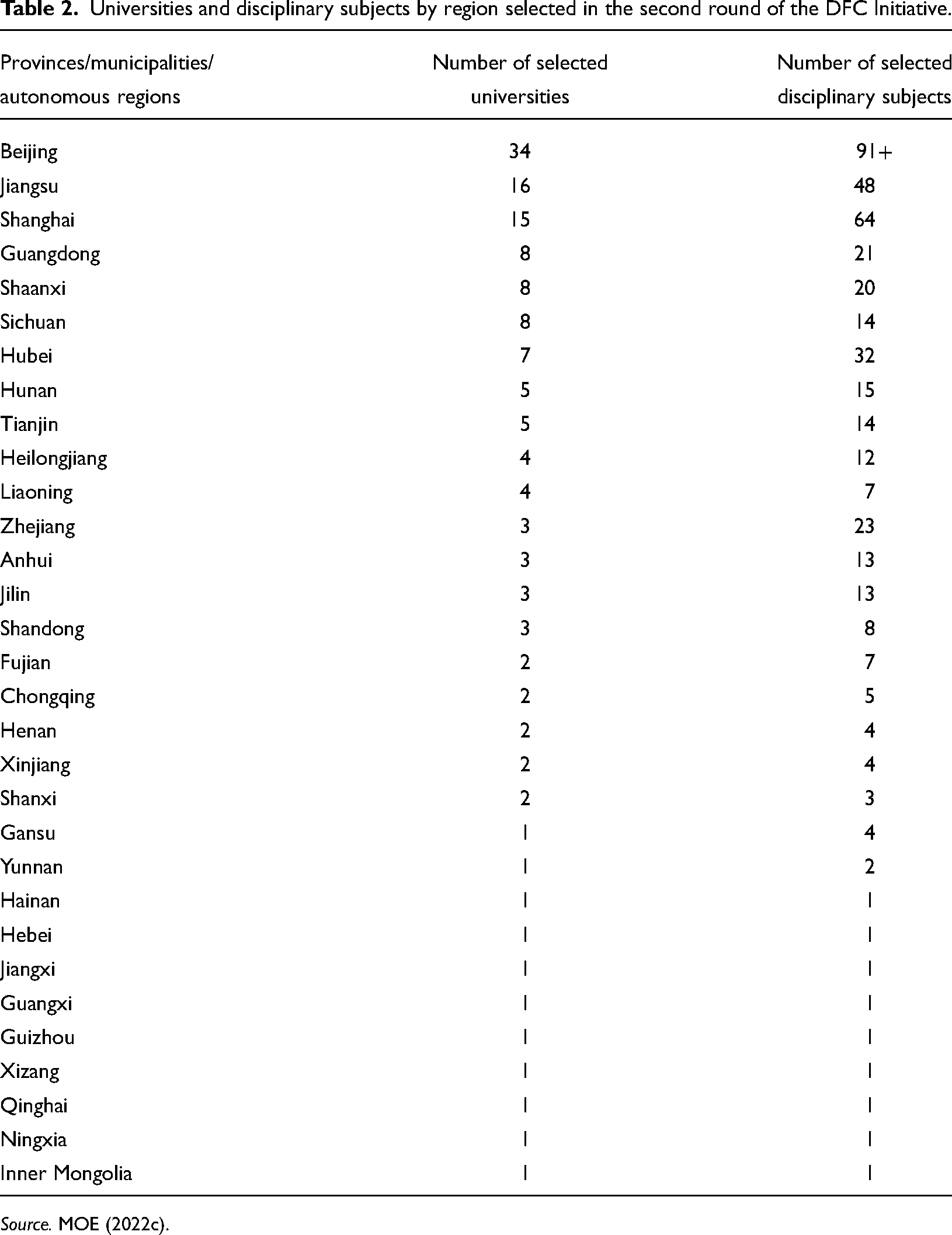
Source. MOE (2022c).
The third issue, and a source of alarm for Chinese universities, is that there might be “losers” dropping out of the project. In the second round, the MOE released a selection list accompanied by a warning list. This list includes 16 disciplines from 15 universities that are publicly warned and revoked following the first round of discipline quality assessment (MOE, 2022c). This is a message to all universities that, unlike Project 985 or Project 211, dynamic adjustment of the selected universities was introduced in the DFC Initiative. The good old days of “once in, always in” are gone, and the selected universities have to keep up with the government's set standards and principles to stay on the list. This has undoubtedly led to increased compliance pressure among universities. This adjustment mechanism presents a potential opportunity for universities that may not have previously held a privileged status but have a strong history of discipline development. One example would be Xiangtan University in Hunan Province, where mathematics has recently gained recognition as a first-class discipline in the latest rounds of evaluations.
Policy as discourse: The ways the second round of the DFC Initiative in China was constructed
When analyzing policy as discourse, this section examines how the context within which the second round of the DFC Initiative was constructed, as well as the contextual elements or underlying forces, contributed to the launch of the second round of the DFC Initiative. The analysis of policy documents and relevant literature reveals that the second round of the DFC Initiative was developed in the context of strengthening state enforcement, through which new public managerialism and values of educational equality co-influenced the development of the second round of the DFC Initiative.
Toward the end of the first round of the DFC Initiative, Xi Jinping, general secretary of the Communist Party of China Central Committee, proposed a New Developmental Landscape for the country (Xin Fazhan Geju). The development of the DFC Initiative should, therefore, be viewed in the context of that proposal. The new economic mode for China, namely the “Dual Developmental Mode Strategy” (Shuang Xunhuan), explained as the national internal circle as a main body and external international circle as a co-contributor. Although the dual circular developmental mode was proposed in economic terms, it laid out the socioeconomic context in which the second round of the DFC Initiative will play out (Wang et al., 2023). Higher education is embedded in such a dual circular developmental model, with the domestic level assuming a leading role and the international level acting as an extension in a supplemental role. Universities should empower the national innovation system and address bottlenecking problems at the frontier of scientific research (Wang et al., 2023). In this socioeconomic context, Qu (2022), the former chair of the China Association of Higher Education, mentioned at the launch of the second round of the DFC Initiative that selection in the project not only represents state recognition of a university's overall strength but also tasks the university with high-level talent cultivation and advanced scientific research and knowledge production to meet China's national strategic development. Policy guidelines/recommendations, financial incentives, and external quality assessments—the three commonly used regulative enforcement mechanisms in higher education reforms (Kivistö et al., 2017)—have all been adopted in the development of the second round of the DFC Initiative. Influenced by this idea, the higher education landscape promoted by the project places more emphasis on domestic development than international extensions or connections.
An examination of those universities listed in the second round, selected on foot of the government's quality assessment results, yields information about the impact of new public management. This has also been linked to increased compliance pressure on the other universities, particularly the new type of research universities (referred to as “neo-type research universities”) (Xinxing Yanjiuxing Daxue). In the second round, the Southern University of Science and Technology (SUSTech) and ShanghaiTech University, two representatives of these neo-type research universities, were included in the project for the first time. SUSTech, ShanghaiTech, and other neotype research universities have typically been the testing grounds for Chinese higher education reforms. They have escaped the bondage of the “cage” (Yang et al., 2007) and have largely achieved their original goals of organizational innovation with high autonomy (Ma & Cai, 2021). Given these neo-type research universities’ original innovation goals, their inclusion in the second round of the DFC Initiative suggests that the universities will have to make more compromises and comply with performance-based management as supported by state regulations.
Enhancing educational equity is another issue of significance in the launch of the second round. Chinese universities consider being listed as an honor that comes with resource benefits. In the first round of the project, this led to intense competition among universities, especially regional universities (Gao & Li, 2020). In the face of severe competition, some regional universities “strategically” concentrated their limited resources on one- or two-star disciplines to be featured on the project's list, resulting in unbalanced and unsustainable development of disciplines (Liu, 2018). Taking cognizance of these problems, the second round of the DFC Initiative dropped the list of first-class disciplines and only published a list of potential first-class universities. It seems clear that the second round of the DFC Initiative intends to continue in the same direction as the first round in terms of addressing inequality in China's higher education system. In addition, two universities (Shanxi University and Xiangtan University) from hitherto unrepresented regions were added in the second round.
Policy effects
Policy first-order effects: Changes in structures and practices from the first round to the second round
In terms of changes in structures and practices, the Chinese government is paving the way for greater academic autonomy in select universities and more interdisciplinary research.
In the second round, the government allowed Tsinghua University and Peking University to define their own first-class disciplines, an indication of the project's intention to grant more academic autonomy to some universities. This also suggests that they have been recognized by the Chinese government as world-class universities as a result of the first round of quality assessment. The MOE has indicated that the list of universities with “full autonomy to define world-class disciplines” will be expanded in the future as the state intends to grant more universities the authority to develop their disciplines autonomously (MOE, 2022b). Considering the international reputations of the two universities and their current QS rankings (Peking University at #12 and Tsinghua University at #14) (QS, 2023), this is not surprising. It is likely that more universities, such as Zhejiang University, Shanghai Jiaotong University, and Fudan University, will also be recognized. While Yang et al. (2007) compared academic autonomy in Chinese universities to “dancing in a cage,” the listed universities in the second round of the DFC Initiative seem to suggest that the “cages” for different universities might be further differentiated.
The promotion of interdisciplinary research and postgraduate education is another major practical change in the second round of the DFC Initiative. In recent years, interdisciplinary and multidisciplinary research has become a heated topic of discussion in the development of Chinese higher education. In 2021, before the official launch of the second round of the DFC Initiative, the National Academic Board under the MOE of China published a tentative guideline on conferring master's and doctorate degrees in multiple disciplines, in which the term “inter-discipline” was added as a sub-category for the first time. This was considered an important signal to promote interdisciplinary research from an MOE perspective. Then, in the second round of the DFC Initiative, several universities on the list, including Fudan University and Tongji University, cited interdisciplinary research subjects as advanced disciplines for development (Liu & Lu, 2022). A few months after the launch of the second round, in September 2022, the National Academic Board officially released the list of academic disciplines, including interdisciplines, for postgraduate education, which complements the implementation of the second round of the DFC Initiative. According to Carayannis and Campbell (2012), top/world-class universities across the globe have already prioritized Mode 3 knowledge production, that is, “a co-existence, co-evolution, and co-specialization of different knowledge paradigms and different knowledge modes of knowledge production and knowledge use as well as their co-specialization as a result” (p. 4). By promoting interdisciplinary research via this project, China aims to integrate different knowledge paradigms and modes and thus provide strong support for the development of world-class universities.
Policy second-order effects: Impacts of the role of China in the internationalization of higher education
Regarding second-order policy effects, this section examines the long-term impacts of the second round of the DFC Initiative on the relationship between China and the outside world, as well as China's role in global scholarship.
The analysis of the second round shows that China will further promote internationalization but with more focus on China's needs and characteristics. This not only means that the internationalization approach was developed to fit the needs of China's national strategy, as revealed in the policy discourse analysis in Section “Policy as discourse: The ways the second round of the DFC Initiative in China was constructed,” but also exhibits awareness of the possibility of an alternative non-Western path to achieve internationalization. Since its launch, the DFC Initiative has been closely associated with world university rankings, used by both governments and universities as reference tools to benchmark the global positions of Chinese universities (Shen, Zha et al., 2023). In the second round, however, unlike the first round's emphasis on the metrics of global university rankings (Yang et al., 2021), China's MOE now clearly states that the evaluation of a world-class university standard should not rely solely on university rankings (MOE, 2022d). This message introduced a shift in the attitude of some universities toward global rankings, and more universities are likely to follow suit in the future to comply with the implications of this new MOE attitude.
A similar effect can be seen in the call for a new research evaluation system in China, moving away from the focus on Web of Science-based indicators as the key benchmark and giving more weight to relevant research in China (Zhang & Sivertsen, 2020). This message also suggests that instead of blindly following global trends, China is determined to build world-class universities in its own way or with Chinese characteristics, as proposed in the first round by, for instance, building world-class disciplines (Yang et al., 2021). Such a focus on internationalization with Chinese characteristics echoes previous awareness (Li & Yang, 2020) by the Chinese government and academia of Western hegemony in global knowledge production and their efforts to have voices from the non-Western periphery heard. However, it should also be noted that insisting on Chinese characteristics in internationalization raises the risk of introducing the issue of nationalism, as well as the possible segregation of academia in China and the West, as evidenced by the struggles to integrate Chinese and Western knowledge in global scholarship production in English-language academic journals in China (Li & Yang, 2020).
The fact that the second round of the DFC Initiative was only recently launched makes finding empirical evidence to ascertain its second-order impact on the internationalization of higher education difficult. Nevertheless, the analysis of government documents and related literature in the second round suggests that, against the backdrop of the New Developmental Landscape, China may play a hybrid role of cooperator, promoter, competitor, and potential leader in future global scholarship and in the general context of global higher education.
Regarding international scholarship and cross-cultural research collaboration, China will remain an active co-operator and a firm supporter of the internationalization agenda of higher education. The project clearly states that one of its nine strategic goals is to advance the internationalization of education and scientific research in China (MOE, 2022b). This entails several sub-goals, such as “to increase the universities’ international cooperation and communication, to explore new mechanisms to promote bi-directional mobility of students between Chinese universities and world-class universities in the world, to enhance Chinese talents’ international competitiveness, to be deeply involved in the development of a global innovation network, and to tackle the common challenges in science and education faced by human beings for joint survival and development” (MOE, 2022b).
At the same time, instead of simply playing catch-up with international academia as before (Enders & Musselin, 2008), China has been endeavoring, through the DFC Initiative and other earlier university policies, to enhance its competitiveness and eventually join the leading league of international academia. An earlier study reported that a global competition mindset is embedded in the DFC Initiative, which encourages competition among universities both within and beyond China (Yang et al., 2021). Moreover, the MOE's guidelines suggest that the project should be constructed in tandem with the Belt and Road Initiative (MOE, 2022b), giving the potential to transform a global higher education landscape currently dominated by the United States and the United Kingdom by adding multiple players and leaders, such as China and continental European countries (Cai & Zheng, 2020). All these efforts seem to be directed toward the ultimate goal of the DFC Initiative: to place China in the leading league of global higher education by 2050. In this sense, the project aims to transform China into a leader in the context of a future globalized higher education sector with significantly more leading players.
Conclusion
This study makes an important contribution to the body of research on world-class university policy with new evidence from the second round of China's DFC Initiative. Through desk research, from May 2022 to December 2023, of the policy documents and academic literature related to the DFC Initiative, this study critically analyzed the second round of the DFC Initiative and outlined its mission, policy process, structural changes, and the potential impacts on the role of China in the internationalization of higher education. The results show that through the launch of the second round of the DFC Initiative, the Chinese government intends to further address educational inequality in Chinese higher education, promote interdisciplinary research, and decentralize its hold over some universities to grant more autonomy, while simultaneously tightening its control over the overall higher education system. Meanwhile, with the help of the project, China is adopting an internationalization strategy with Chinese characteristics within the domain of higher education, a domain in which China considers itself an active collaborator and promoter and hopes to establish itself as a potential global leader.
The results have three major implications for the development of world-class universities in China and for global higher education in general. First, while supporting the development of domestic characteristics in the course of the internationalization of higher education, the tension between local and global needs in the future development of world-class universities in China calls for more attention. Several previous studies of experiences in China have already found that coordinating “world-class universities” and “Chinese characteristics” has proven challenging (Li & Xue, 2021; Song, 2018). Alternatively, by serving as a bridge to connect multiple actors in transnational university-industry co-innovation networks (Cai, 2023), universities can contribute to trust building, knowledge exchange, and co-creation between actors in the international community (Cai et al., 2020). Hence, in the new socioeconomic context of the “Dual Developmental Mode” (Shuang Xunhuan), the development of world-class universities in China would need to maintain the internationality of universities inside China, address the international community's concerns regarding the growth of nationalism and bridge the communication gap between the international and the domestic.
Second, as previous research indicates that establishing world-class research universities has been viewed as an investment in the global future of the nation (Rhoads et al., 2014), China's experiences could be relevant for countries catching up in Asia and Latin America endeavoring to elevate their universities to world-class status (Luo, 2013). The changes from the first to the second round of the DFC Initiative highlight the fact that realizing the goal of developing world-class universities needs to be balanced with the need to ensure equality and quality throughout a higher education system, not just selected universities. There is also the issue that compliance pressure from the DFC Initiative quality assessment may have spillover effects on both listed and non-listed universities in China. To address this, as proposed by Han et al. (2023), it is imperative to establish a more diversified higher education system that can realize the envisioned diversity, equality, and efficiency of education. Such diversity should encompass not only institutional autonomy but also the efficient allocation and management of human and financial resources at both local and national levels.
Third, the results add to the academic discussion on China's model of higher education development by interpreting the changes in the DFC Initiative in relation to support for disciplines and the Chinese characteristics of the internationalization strategy in higher education. This is not the first time that China has proposed developing world-class universities with Chinese characteristics. Previous research has frequently discussed whether a Chinese model of a world-class university exists (Li, 2012, 2019; Marginson, 2017). If it does, what would be the major features of such a model? Marginson (2017) suggested that one possible way for China's model of a world-class university to differ from the U.S. and U.K. models is to develop more comprehensive world-class universities empowering the development of social sciences and humanities. Yang and his co-authors (Yang, 2017; Yang et al., 2019) also argued that through the institutionalization and indigenization of social sciences in Chinese universities, the integration of Chinese intellectual traditions and Western knowledge in the formation of the cultural mission of elite Chinese universities could be a new and important perspective for understanding China's model of higher education. The changes from the first to the second round of the DFC Initiative are clear evidence that the Chinese government intends to place more emphasis on the balanced development of disciplines and create more space for the social sciences and humanities, despite natural sciences and engineering remaining the main focus. Furthermore, while China positions itself in a hybrid role of co-operator, promoter, competitor, and potential leader in a global higher education context involving multiple leading players, this does entail the Chinese intellectual thinking of promoting “the great harmony” of the world by Fei Xiaotong, which considers the world as the harmonious coexistence of diverse cultures in modern globalization rather than a subject–object dichotomy (Shen, Yang, et al., 2023). In this sense, China's model of developing world-class universities, if shaped as a model one day, could contribute to global higher education development by integrating Eastern and Western knowledge and promoting intellectual diversity.
This study has some limitations. First, we note the limitations of a desk research approach. Because the study was based on relevant documentary data available from May 2022 to December 2023, in-depth research and analysis to discover the impacts of policy changes in actual practices or in a longitudinal manner was not possible. Second, as we collected the documentary data by searching within the CNKI database and on search engines such as Google and Bing, which are available through our universities’ library databases, we may well have missed some relevant sources that could have contributed to the study. Third, the study could have included the listed universities’ strategic plans for a more in-depth analysis of policy impacts at the institutional level, but as most documents related to strategic plans in Chinese universities are not accessible to the public, this was not possible.
We propose three research avenues for future research on the DFC Initiative. First, given the macro-level nature of this study's analysis, it is crucial to delve into the institutional reactions of Chinese universities in response to the policy changes. One intriguing avenue of investigation would be to examine how the DFC Initiative might influence distinct sets of stakeholders, including students, faculty, and researchers, and whether there are any unforeseen repercussions or tradeoffs for these groups. We assume that different universities may have adopted different institutional response strategies to deal with the state's compliance pressure. Therefore, it would be worthwhile to examine the conditions under which Chinese institutions comply with policy requirements and the extent to which they do so. Furthermore, it would be particularly interesting to determine how the top two universities utilize the autonomy and resources granted to them to develop their first-class disciplines. Second, more investigations are needed to understand the actual impacts of the project on the internationalization strategies of Chinese universities. This can be achieved, for example, by interviewing key stakeholders in universities’ international offices and strategic development offices and by examining their practices for international cooperation with universities. Third, further theoretical research should be conducted on China's new method of developing world-class universities. This would advance our understanding of higher education development in China, both theoretically and empirically.
Footnotes
Contributorship
Gaoming Zheng has contributed to the conceptualization, data collection, data analysis, funding acquisition, administration, and supervision of the research process, and the writing (of the sections: Introduction, Research approach, Analysis of policy as discourse, Analysis of policy effects, Conclusion) and the revisions of the article. Weiwei Li has contributed to the conceptualization, data collection, data analysis, data and literature management, administration of the research, communication with the journal, and the writing (of the sections: Abstract, Introduction, Analysis of policy as text, Analysis of policy as discourse, Analysis of policy effects) and the revisions of the article.
Declaration of conflicting interests
The authors declared no potential conflicts of interest with respect to the research, authorship, and/or publication of this article.
Funding
The authors disclosed receipt of the following financial support for the research, authorship, and/or publication of this article: This work was supported by China's National Education Scientific Planning Project (CGA230337).
