




Abstract
Purpose
This paper aims to examine the participation experiences of a sample of Chinese teacher trainees and their Finnish teacher trainer on an in-service teacher training program exported from Finland to Beijing, China.
Design/Approach/Methods
Six science teachers from Beijing and their Finnish teacher trainer participated in semi-structured interviews. From the ideological perspective of international education, a total of eight semi-structured interviews were analyzed through qualitative content analysis.
Findings
The results show that all interviewees were highly motivated to learn from the Other's education system and culture. Some participants benefited from a broader understanding of the Self's and the Other's education systems, while others did not. The interviewees also described some participation challenges, such as language barriers and practices that adapted learner-centered teaching approaches in Beijing schools. Furthermore, the interviewees mentioned future expectations of more in-depth communication between Finland and China.
Originality/Value
Some recommendations for better training outcomes, improving the quality of participation experiences, and reaching more mutual understandings were discussed at the end of this study.
Keywords
Introduction
The Finnish education system is globally renowned for “equality, playful learning and wellbeing” (Liu & Dervin, 2017, p. 530). Consequently, since the early 2010s, Finland has engaged in education export (Koulutusvienti) with a view to commercializing the whole Finnish education system for foreign authorities, employers, and individuals, and exporting in-service teacher training programs is one of the national priorities (Opetushallitus, 2020). Unlike traditional Anglophone education exporters (e.g., the UK), Finland mainly exports the Finnish basic education system instead of university degree provisions and has had a long tradition of avoiding educational marketization (Schatz, 2016b). Because of this inexperience and the difficulty of learning from other experienced education exporters, the implementation process of Finnish education export is inefficient and estimated to remain that way until 2030 (ibid.). Although the Finnish government publishes national guidelines for education export every four years (e.g., Opetushallitus, 2020), the implementation process has become more complicated due to the lack of a clear definition of education export, the inaccessibility of national statistics (Juusola, 2020, p. 23), insufficient research results (Juusola & Nokkala, 2019), low motivation and poor marketing knowledge (Cai et al., 2013, as cited in Cai et al., 2013), and the difficulty of recruiting and retaining competent education specialists, among other factors. Because of discrepant sociocultural conditions and education systems, China is attractive but difficult for practitioners of Finnish education export. With this said, how Finnish education programs exported to Chinese teachers are implemented is under-researched.
Over the past three decades, to dismantle the traditional teacher-led pedagogy that deviates from pupils’ needs for whole-person development, lifelong learning, and well-being, the Chinese government and local authorities have increased their investments in the importing of foreign training programs for teachers (Malinen, 2013; Wang et al., 2023). Many Chinese education administrators, researchers, parents, and teachers view the Finnish education system as an exemplar. However, the implementation of in-service teacher training programs exported from Finland to China is underexplored.
To fill this knowledge gap, the current study intends to examine individual participants’ experiences on a Finnish in-service teacher training program exported to a cohort of Beijing science teachers. We semi-structurally interviewed Chinese teacher trainees and their Finnish teacher trainer, who was charged with delivering the program. To generate a solid analysis, the following section presents previous studies on teachers’ experiences of international in-service teacher education.
Literature review: Teachers’ participation experiences in international in-service teacher education
Motivations for participation
In the sphere of teacher education, most earlier works have investigated teacher candidates’ experiences of initial teacher education abroad (e.g., Jackson & Han, 2016) or in another education system in the same country, but studies on international in-service teacher education remain scant. Compared with teacher candidates, in-service teachers have different motivations for participating in international in-service teacher education. For example, teacher candidates usually expect broader-crossing experiences to help with the construction of cross-cultural and teacher identities, personal growth, and enhanced employability (Jackson & Han, 2016), but they are inexperienced when it comes to classroom teaching. By contrast, recent studies have reported that in-service teachers are more goal-oriented regarding international professional development, and can critically reflect on, especially through cross-system comparisons, the applicability of already- or newly-learned pedagogical approaches to their teaching that nurture their learners (Baecher & Chung, 2020; Gleeson & Tait, 2012; He et al., 2017; Lai et al., 2016; Wang et al., 2023). However, in-service teachers are also confused by discrepancies between different education systems, sociocultural contexts, classroom environments, and available resources when applying newly-learned teaching approaches (ibid.).
Nonetheless, teachers are not always intrinsically motivated to learn from internationalization activities, such as fulfilling the institution's interest in income generation (Smith, 2014) and passing the required examinations (Gleeson & Tait, 2012, p. 1149) that might exclude deeper personal and professional development and transformation.
Divergent participation experiences and training outcomes
Unlike international initial teacher education, which is mainly formal and degree-awarding, international in-service teacher education is usually short-term and non-/informal, because of the inflexibility of teachers’ work schedules (He et al., 2017, p. 148). This kind of education includes, for instance, study tours (Patterson, 2015), teacher exchange (Biasutti et al., 2021), teaching abroad and commissioned degree programs (Juusola & Räihä, 2018), immersion programs (Gong et al., 2022), and short-term study modules (Wang et al., 2023), among others. That is, inconsistent categorization and nomenclature create “chaos” in international education research (Knight, 2016). The aforementioned situation is more complicated when it comes to Finnish education export, because many exported in-service teacher training programs are short-term, tailor-made, and untraceable, catering to foreign clients’ needs and requirements. Consequently, the results of previous studies on participants’ experiences of international in-service teacher education show that they have difficulty communicating with each other because of differing program content, research participants’ backgrounds, analytical lenses, and research design. Indeed, these research results on participants’ experiences of in-service teacher education remain too divergent and inconclusive for a consensual understanding, because they are not always positive or depoliticized. For example:
Special support needed? Teachers on a short-term overseas training program encounter challenges such as learning difficulties and everyday disorientations due to language barriers, with the latter also boosting language learning (Gleeson & Tait, 2012, p. 1149). By contrast, sufficient (peer) support could ease those struggles in a two-year teacher exchange project (Biasutti et al., 2021). Transformation or reinforcement? It was found, through critical reflections on prior experience, knowledge, and beliefs, that transformative learning was achieved by teachers when teaching (Juusola & Räihä, 2018) and learning (He et al., 2017) abroad. However, some teachers on a study tour reinforced their already-held orientalist prejudice when their experiences were analyzed through postcolonial lenses (Patterson, 2015). Adaption or transfer? During a training workshop, some teachers were agentic in critically selecting and adapting newly learned teaching methods to improve their teaching (Wang et al., 2023), while others, after studying abroad, saw their home environment more as a constraint when it came to transferring those methods (Gleeson & Tait, 2012, p. 1149). Complexification or oversimplification? It was discovered that teachers could have more shared understandings of both the Self's and the Other's education systems and sociocultural conditions (Wang et al., 2023), but some teachers’ simplistic self-othering statements were also found, since they overgeneralized the notion that the foreign country seemed better than home (Gleeson & Tait, 2012, p. 1148), which is inaudible, because the authors’ analytical framework is Communities of Practice.
Only one master's thesis has reported on teachers’ experiences when completing a Finnish in-service teacher training program exported to Chinese teachers (Cao, 2020). The aforementioned study concludes that the Chinese teachers could benefit from the training because of greater cultural awareness and self-understanding, but both the Chinese teacher trainees and the Finnish trainer felt challenged by cultural differences and language barriers. However, the participants’ learning experiences in teacher development were not analyzed.
The analytical frameworks of these earlier works encompass teacher education, such as teacher agency (Wang et al., 2023), and international and intercultural relations, such as intercultural competence (Cao, 2020), but none of them combine both realms. Therefore, future studies should adopt a more comprehensive framework that intersects these two domains, so as to analyze teachers’ experiences of international in-service teacher education. To add this knowledge, alongside the literature review, we employed Stier's framework for our investigation, which has been applied to analyze Korean teacher candidates’ motivations for, and experiences of, China's initial teacher education (Jackson & Han, 2016), but not in the realm of in-service teacher training. This framework is presented in the following section.
Based on the abovementioned earlier works, our research questions are as follows:
Analytical lens: Ideological perspectives on international education
Without problematizing “Whose interests are being served … whose material and ideological interests are at play” (Luke, 2010, p. 16), the common sense of international education is overwhelmingly positive and depoliticized, but it is incompatible with the study results presented in our literature review. Indeed, international education is not neutral but instead shaped by “a set of principles, underpinnings, goals, and strategies which structure and permeate the actions and beliefs of educators, groups, organisations or societies” (Stier, 2010, p. 340). For Stier (2004, 2006, 2010), instrumentalism, educationalism, and idealism are three typical, divergent but interdependent ideologies that shape stakeholders’ assumptions and perceived importance of international education, which is taken for granted, somewhat or fully consciously. These ideological perspectives help foreground the benefits and criticism of international education, as discussed below.
Instrumentalism
Instrumentalists emphasize usefulness, because internationalization benefits noneducational goals, which can usually be measured quantitatively (Jackson & Han, 2016). At many universities where internationalization takes place, internationalization is considered a “means to maximise profit, to ensure economic growth and sustainable development, or to transmit desirable ideologies of governments, transnational corporations, interest groups, or supranational regimes” (Stier, 2004, p. 90). At the personal level, enhancing employability (Larsen, 2016) and income generation (Smith, 2014) are two examples of teachers’ instrumentalist outlooks for undertaking international education.
In many cases, instrumentalism is too pragmatic and goal-oriented for internationalization “instead of as a means to an end: enhancing the quality of education, research, and service to society” (Altbach & de Wit, 2015, p. 31). In education export activities, instrumentalism limits its application with a neoliberal rationale of competitiveness but ignores the far-reaching noneconomic significance of international education at the global, local, and personal levels (Besley, 2011). Consequently, ethicality, reciprocity, and responsibility for global sustainability are challenged in internationalization processes. Thus, instrumentalism has been criticized for continuing with existing uneven geopolitical frameworks. Moreover, intrinsic motivations for education and enrichment of quality teaching, learning, and research will not be valued if they are incompatible with “global capitalist economic production and market integration” (Jackson & Han, 2016, p. 101). The excessive concern regarding the competition of instrumentalism results in a poor alignment between internationalization and lifelong learning, inclusiveness, and global solidarity (Stier, 2006, p. 4).
Educationalism
Educationalists recognize “the personal or societal value of learning itself” (Stier, 2006, p. 5). The learning process in international education promotes transformational academic and personal growth, as well as reflective self-awareness, in today's increasingly globalized world. The learning process usually includes international and intercultural exposures, exchanges, and reciprocal dialogues, which result from encountering unfamiliarity and differentness. The learning process equips individuals with readiness for diversity and social justice in times of omnipresent global interconnectedness, but individuals may experience disorientation, challenges, discomfort, and frustrations due to cultural differences (Jackson & Han, 2016, p. 101; Stier, 2004, p. 92), requiring necessary support, guidance, and early interventions from mentors and peers.
Educationalism is not flawless, due to the potential injustice of learning. The benefits of international education are merely taken-for-granted assumptions because post-sojourners’ stereotypes and prejudices toward the Other can be reinforced (Dervin, 2016b). In other words, learners may reinforce ethnocentrism and an incomplete understanding through superficial cross-national comparisons. For example, the locals may hold “a conviction that “our” methods of teaching, research, and degrees are better than those of other countries” (Stier, 2004, p. 93). Without seeing the complexity of the “difference within difference” (Luke, 2010) of every population group or the “diverse diversities” (Dervin, 2016a) of every individual, mutual learning is misconceptualized as nonreciprocal “Educating the Other” (Luke, 2010); being an “outsider” may only trigger analyses of the Other, but results in a lack of self-awareness and reflexivity (Stier, 2006, p. 5).
Idealism
Idealism is “a normative assumption that internationalisation is good per se” (Stier, 2006, p. 3), meaning that even all internationalization activities will certainly create “a more democratic, fair and equal world” (Stier, 2004, p. 88). It is hoped that internationalization will disseminate values of universal cosmopolitanism, sentiments of global citizenship, and solidarity between all human beings by promoting tolerance, mutual understanding, respect, peace, empathy, and redistributed human welfare (Jackson & Han, 2016; Stier, 2004). Therefore, idealistic claims are usually ambitious when it comes to creating an emancipatory future world; internationalization unquestionably means global development.
However, the overambitious claims of the social and global responsibility of idealism conceal all potential negativities through global convergence (Stier, 2004, p. 88). The overprivileged globalist sentiment may mute other value systems because it “is approached within the realms of the ‘rich world's’ value systems and ethnocentrism” (Stier, 2004, p. 89). In particular, internationalization in the idealistic scenario is overwhelmingly positive and depoliticized but can operate within the existing colonial and modernist structures without problematizing “Who will take up social responsibility, for whom, and to what ends?” (Beck, 2021, p. 136). The universalistic tone of idealism can be manifested by one-way flow of the “continuing dominance of Western models and systems of higher education, the influence of the English language, the impact of foreign training, the dominance of Western scientific products, ideas, and structures” (Altbach & de Wit, 2015, p. 7). Thus, idealism seems not that ideal when indigenous knowledge and diversity are mistreated as “ignorance of the experiences of disadvantaged players in the global system” by one-size-fits-all hegemony (Jackson & Han, 2016, p. 100).
Context
The training program
The exported in-service teacher training program was intended for training primary science teachers in Beijing. To date, three onsite training courses have been convened in Beijing, and several online webinars were offered for fewer trainees. The topics of the training program covered the Finnish education system and inquiry-based science didactics in Finnish primary schools. The program is jointly planned and offered by a Finnish teacher trainer from UA (pseudonym, a Finnish university) and a professor from UB (pseudonym, a Chinese institution). UA offers teacher education, while UB provides in-service training to registered teachers, especially expert teachers and school leaders at Beijing schools. Both UA and UB are higher education institutions that offer training programs for in-service teachers.
The teacher trainees were 40 expert primary science teachers from Beijing, UB, and member teachers from a pedagogical research group led by a professor. Here, expert teachers were not only frontline teachers at primary schools but also teaching researchers (教研员; experienced teachers appointed to lead other teachers in pedagogical research, reform, and professional learning in their school areas). These expert teachers were selected from primary schools and teacher-training institutions in Beijing, and the selection criteria were based on their teaching merits. The number of participants in each training session was unknown because of flexibility in participation, and trainees were permitted to invite 1–2 novice teachers from their schools to the training.
The interviewees
After contacting UB, the first author employed purposive sampling to recruit interviewees from Beijing. Between January and May 2021, the first author distributed an online form to recruit interviewees from teacher trainees in Beijing. The form required trainees to fill in their demographic information (name, school name, years of teaching, topics of training in which they participated, and the length of their training participation; see Appendix 2). The first author contacted trainees who were accessible online via WeChat. After sending out information sheets and asking for consent, six (n = 6) trainees from Beijing agreed to be interviewed, and all interviews were conducted via WeChat in 2021. After providing consent, the Finnish teacher trainer was interviewed twice via Microsoft Teams and Zoom. FT was also interviewed because her perspective served to achieve data triangulation so as “to contribute towards new or richer knowledge about a phenomenon” (Jentoft & Olsen, 2019, p. 179).
Table 1 describes each interviewee's pseudonymized demographic information. Most of the trainees had participated in at least two training sessions, so they had sufficient knowledge regarding the training program.
The interviewees’ demographic information.
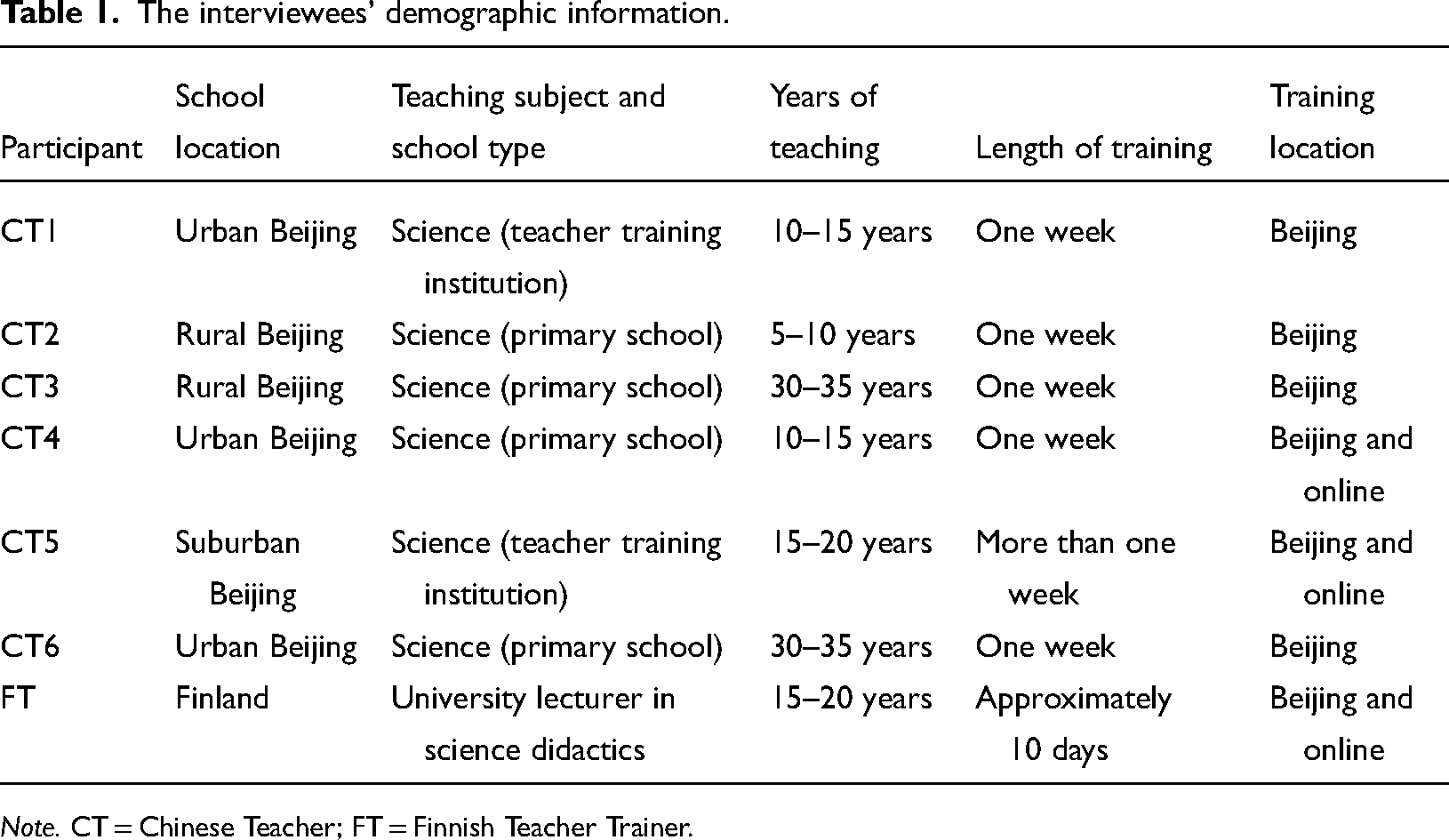
Note. CT = Chinese Teacher; FT = Finnish Teacher Trainer.
Data generation, analysis, and research ethics
All one-to-one semi-structured interviews were conducted online and video/audio-taped by the first author in 2021. Each interview lasted between 30 and 60 min. The interview guide covered the reasons for participation, participation experiences, and future expectations (see Appendix 1). To better prepare the interviewees with sufficient foreknowledge of the interview subject (Cohen et al., 2018, p. 518), the interviewer read published online information pertaining to the training program and required them to fill in three 5-point Likert scales (see Appendix 2) to describe their motivation for participation, satisfaction with the program, and training effectiveness. To capture each interviewee's perceptions and experiences, every interview was open-ended; this involved following the interview guide loosely, listening actively, and asking the necessary probing questions (e.g., “Could you tell me more about that?”). The interviews were conducted, transcribed, and analyzed in each interview's original language (English/Chinese) by the first author, who was proficient in both languages. All excerpts from the transcripts have been presented in English in this paper.
The interviews and transcription processes were conducted concurrently. After completing the last two interviews with CT5 and CT6, the interviewer confirmed that no new theme had emerged. The transcripts were analyzed by employing the conventional approach of qualitative content analysis (Hsieh & Shannon, 2005) abductively because the analytical framework was selected for data interpretation. The recordings and transcripts were managed, coded, and analyzed using ATLAS.ti 9. To enhance the trustworthiness of the results, consensual validation was applied by the authors for each data interpretation (Patton, 2015), especially because the co-authors have similar experiences in training teachers in Beijing.
In Finland, all researchers adhere to Finnish National Research Integrity in Human Sciences (TENK, 2019). After examining these guidelines, it was clear that an ethical review was not mandatory, because this study was neither involuntary nor deviating from informed consent (ibid., p. 19). The first author's university offered templates to formulate the information sheet and consent form before obtaining each interviewee's consent, either with signatures or via email or WeChat. Microsoft Teams, Zoom, and WeChat were used for the online interviews because they comply with local laws in Finland and China. For confidentiality, an online form gathered Beijing teachers’ contact information without the need for appointing any third person.
Results
Motivations: Learning from differentness and through comparisons
All seven interviewees mentioned that they were motivated by high expectations for learning from international exposure and differences, thus suggesting their intrinsic motivations for educationalism and a high level of openness to new experiences and professional development.
Regarding the trainees, the trainer concluded that “the teachers were very motivated and … they asked a lot [of questions]” (FT) when comparing them with those in the other training programs she had experienced in China. For example, despite the fact that the keyword “learning” was mentioned by CT1, CT2, CT3, and CT4, learning was also synonymous with “opportunity” and “eye-opening” (CT1), as well as “improvement” (CT2, CT3, and CT6). For CT1 and CT2, the training was especially appealing because of their curiosity for learning, since it was their first foreign or Finnish training program, and their personal values or eagerness to take part in the training connected with their prior experiences. It is noteworthy that CT1 was also motivated by “stepping out from the comfort zone,” thus suggesting his willingness to experience any likely discomfort and new challenges in international education (Stier, 2004, p. 92).
Positivist logic was also salient when some of the trainees justified their motivations for participating in the training, and such logic intertwined educationalism with idealistic imaginaries of education abroad. For example, CT5 wanted to learn if “Foreign monks will recite and chant scriptures (外来的和尚会念经; Foreign practices are better than the local ones),” with CT5 indeed suggesting that the exported training program should be better than those from home. Likewise, two other trainees were motivated because they assumed that foreign education (CT2) or Finnish science education (CT6) was better, which resonates with the global discourse describing the Finnish education system as “utopia” (Itkonen et al., 2017) promoted by global neoliberal benchmarking (Chung, 2019). For example: In Finland, science education is always at a high level. We want to understand the excellence of science education in Finland and why it is one of the best in the world (CT6).
For the Finnish teacher trainer, China has been an important partner country of UA; she volunteered to train Chinese teachers because of her initial motivation and openness to learning more about China (educationalism), especially when she had no prior experience in training Chinese teachers. According to her perception, China was described as being “very very different” in order “to get to know the new culture” (FT). In addition, her non-Finnish personal background motivated her to participate and she believed that different countries had different teaching methods. Indeed, the following quote demonstrates such curiosity and personal beliefs, rather than instrumentalist considerations: “The salary I get from the international trainings is even lower than that from courses I give in Finland. So, it's definitely not [because of] the money” (FT).
Experiences
Whether or not broader understandings of self and other through comparisons
Just like teachers in other exported teacher education programs (e.g., Gleeson & Tait, 2012; Juusola & Räihä, 2018), the interviewees compared their participation experiences with their earlier experiences, especially their education systems and home environment. According to the interviews, comparisons especially between Finland and China were made on pedagogies and/or education systems (FT, CT1, CT2, CT3, CT4, and CT5), training periods of the program (FT and CT4), earlier experiences on other training programs (FT, CT1, CT5, and CT6), national curricula (CT2, CT4, and CT6), and textbooks (CT3 and CT6).
The program was based on the trainer's expertise, because “No meaning to go training in a topic you don’t know” (FT), and the trainees noticed many differences through comparisons designed to characterize the program, mostly based on their descriptions of positive feedback, benefits, enrichment, and self-transformation that trigger critical reflections and greater self-awareness. For CT1, CT2, and CT5, learner-centeredness featured this program in its (hidden) curriculum, and they learned how to implement it in their teaching, which has changed their teacher-led teaching. For example: When the trainer was teaching … we teachers could be engaged in … and experience [the learning activities] (CT2). Now, we have made a big difference [in teaching] … We have paid much attention to knowing [before], but now we focus more on students’ doing. Let the students think when doing (CT5).
However, the two trainees’ (CT2, CT3) comparisons appeared to overgeneralize China and Finland, suggesting an incomprehensive understanding of the Self's and the Other's education systems. CT2 concluded that all training programs in China were the same; moreover, CT3 overgeneralized stating that all Finnish teachers were class teachers, while Chinese teachers were subject teachers: Because there are some exchanges between [Chinese] cities, there are some differences in teaching, but they are all almost the same (CT2). Teachers [in Finland] are excellent. Unlike us [in China], a teacher is just a subject teacher … [Finnish teachers] can teach all the subjects comprehensively (CT3).
Unlike the other trainees, who highlighted the differences between Finland and China, CT4 was the only trainee who could describe the global and domestic trends of science education and similarities between education systems, suggesting a more complex understanding of the subject: Science curricula are likely similar between countries and have no substantial differences (CT4). In Beijing, China, we also use group work in teaching and learning, and there are more and more inquiry-based approaches to [students’] learning (CT4).
When compared with textbooks, one trainee described mutual learning between Finland and China, rather than an idealistic nonreciprocal transfer from Finland: Our textbook is quite good. It is very structured, perhaps because it is more suitable for our children. Nowadays, students are developing, so I think we should also make a difference, and it is a process of mutual development [between Finland and China] (CT3).
Following comparisons and critical reflections, as presented above, transformative learning was evident, because the trainees described “inspiration” (CT1, CT4), “better ways of thinking” (CT2), “refreshing” and “change” (CT5), “transforming perspectives” (CT4), and “different perspectives” (CT6). CT5 explained that high-quality teaching and learning assured the transformative outcome: I am also very grateful to UB … This [Finnish] training was different from others because it focuses much on what we teachers learn, and not like other [foreign] training focusing only on reputation, making a big show … and doing promotions (CT5).
In sum, the learning outcomes of the training program varied. There are signs that the trainees started to critically reflect on the traditional teacher-led pedagogy of knowledge transmission, but incomplete understanding of the Self, the Other, and the globe was also found.
Language barriers and culture shock: The need for additional support
Except for CT1, CT2, and CT4, all interviewees experienced language barriers. One assumption is that there was no entry requirement, except for teaching merits, when it came to participating in the training program, and the participants’ language proficiency in English and Chinese varied. For example, unlike the trainees, who learned much through Sino-Finnish comparisons, the trainer mentioned far fewer comparisons during the interview, because of language barriers: So, comparing between Finland and China is not possible for me, because I don't know the [Chinese] language (FT).
Unlike CT1, who mentioned that he could use English to communicate with the trainer, low English language proficiency challenged some trainees (CT3, CT5, and CT6). CT3 mentioned that she could hardly overcome it because of her old age, whereas CT5 and CT6 had their own strategies. CT5 managed to use his limited English proficiency for comprehension, while CT6 relied mostly on the interpreter and peer support, but felt that paraphrases might distort the original messages: Although there was an interpreter, when I was listening to it [in English], I felt [increasingly] familiar with some of the words the trainer said, so I gradually got used to it (CT5). The interpreter was also good and fun. S/he would often say some of her/his own [words], not the original words … Although I was only there for a few days, it was good, and I’ve learned a lot. There were language barriers; however, you could communicate with each other. At the end of the day, you could understand what was taught (CT6).
In terms of practicality, some trainees also mentioned other challenges, including too many theories instead of practices (CT1), tight schedules (CT1 and CT3), being away from work (which was overcome thanks to support from colleagues and school leaders) (CT5), expensiveness and uncertainty of receiving external funds for UB (CT6), and differences between national curricula that challenge implementation in teaching (CT6).
Similarly, in addition to language barriers, because an interpreter was always needed, there were challenges due to the lack of effective communication. The trainer mentioned an incident that took place just before a training: But then [for the third training], as I went there, they told me, “OK, it will be training.” … It was very confusing for me because I didn’t prepare for [the] training… But anyway, [it was] a lot of fun and teachers were very interested in that (FT).
The trainer was also aware of her assumed cultural differences, because the training seemed different from the peer-group mentoring system (verme) in the Finnish teacher education system (Tynjälä et al., 2021), which is different from the traditional lecture-based approach to teacher development. Usually, sojourners describe cultural differences when encountering unfamiliarity, challenges, and disorientations abroad (Jackson, 2018, p. 43), and the trainer decided to communicate with her collaborator to achieve more shared understandings: Probably differences in culture … If I am the trainer … I am the only one who opens my mouth and speaks … [But] In Finland, teachers can learn most from each other, not from the trainers … It's kind of peer support … Probably it's the thing that we [FT and the professor] need to discuss more (FT).
Although all interviewees mentioned some challenges because of perceived differences between Finland and China, all of them described the benefits of the training program, as discussed in the earlier subsection. Compared to the trainees who described much self-transformation through the Sino-Finnish comparison, the trainer also valued the expanded professional community and cross-national friendship that enable mutual learning: As I told, very nice people and new friends. Very valuable. To recognize differences between Finland and China about teachers, methodologies and cultures are different, so it's very interesting to recognise that. Teachers in Finland are really the same. Like teachers and friendships in China is [are] very valuable (FT).
Overall, the teacher trainees could somewhat support each other when facing challenges, whereas the trainer received limited support, especially when working alone. Therefore, better support should be provided to all participants.
To transfer or to (mis)translate
The trainer mentioned that it was confusing when some of her trainees told her how they adopted the teaching methods. All interviewees shared their thoughts on how the teaching methods were practiced and translated into real school settings in Beijing. Overall, their practices included considerations of enabling conditions (CT3 and CT4) and constraints (CT1, CT2, CT3, CT4, CT5, and CT6). The enabling conditions included small class size (CT3), similarities between the education systems discussed earlier (CT4), and peer-group learning and creativity (CT4): We had 25 pupils in each classroom, which is a good size for inquiry-based learning (CT3). After she [the trainer] left, some of us integrated the content into our curricula … we observed and discussed it between us (CT4).
However, the trainees experienced more difficulties when applying the teaching methods in their teaching because of the trainer's lack of observation of school teaching in Beijing (CT1), incomplete comprehension of theories (CT2, CT3, and CT5), insufficient time for each class (CT3), large classroom size (CT4), difficulties in lesson planning based on textbooks (CT5), and different national curricula between Finland and China (CT6). Consequently, some of the trainees discussed how they critically adapted and translated the newly learned teaching methods in their teaching, which bridged the gap between theory and practice and avoided the pitfall of “Uncritical International Transfer” (Chung, 2019, p. 194), the latter of which undermines educational improvement. For example: We must use the Chinese curriculum as a standard because we have to follow the Chinese curriculum in our lessons. Therefore, we consider what we need (CT6).
In addition to the limited funds and timeframe for additional content, it is also vital to take into account each trainee's—as mentioned earlier—varied prior experience and knowledge, English language proficiency, and the unknown quality of English–Chinese interpretations. With all of this in mind, it seems impossible to assess the extent to which each trainee could correctly comprehend the knowledge learned on the program. Thus, it was likely that the program content would be misinterpreted/mistranslated by the interpreter or the trainees. Therefore, CT1 and CT2 thought that classroom observations could solve the potential problems of inaccuracy. For example: Actually, we’d like to observe how they [Finnish teachers] apply it [theory] in the classroom. Because after we learn, digest, and apply it to our teaching, there are many differences (CT2).
Therefore, in subsequent paragraphs, all seven interviewees described their future expectations of more in-depth communication, especially through school visits and classroom observations between Finnish and Chinese schools.
Future expectations for more in-depth communication
Most interviewees (except for CT5) mentioned the importance of more in-depth communication. For the trainer, in addition to her stay in Beijing, visiting other locations in China could enable her to know more about the country itself, and about “difference within difference” (Luke, 2010): Because now I am only involved in only one district, [did] not see any [other] parts [or] any [other] teachers. To go to other cities [and] to meet other teachers will be very interesting because I think [the district of] Beijing is like a “city in a city” (FT).
For more shared understandings, it was highly expected that conditions for observing each other's classroom teaching would be created through exchanges between Finland and China (CT1, CT2, and CT4), or simply visiting Finnish schools to bridge the gap between theory and practice (CT3 and CT6). For example, CT6 described how reciprocal exchanges could deepen the understanding of the differences and connections between the Finnish and Chinese school systems: Chinese teachers can design lessons and Finnish teachers can design another one. [We] can compare how they are designed and how they differ and relate to each other (CT6).
However, the budget was uncertain in terms of affording more training and exchanges: But I would like to have more opportunities for training and exchanges with Finland … Because UB needs much money for this program; the training is not easy (CT6).
Like the other trainees, in addition to their positive experiences on the program, CT5 also felt that more teachers should benefit from the training program because trainees were the elites from Beijing, which resonates well with international education usually belonging to the elites (de Wit, 2020); his perception also indicates the idealistic assumption that international education is always good (Stier, 2004): Only a few urban backbone teachers were selected to participate. Perhaps this kind of opportunity is quite rare … I think it would be more meaningful for more teachers to participate (CT5).
Discussion
Based on the seven interviews with the six Chinese teacher trainees and their Finnish teacher trainer, the current study examined those informants’ participation experiences on an exported in-service teacher training program.
Reflections on motivations for participation
The interviewees’ motivations for participation in the program were mostly educationalist, that is, learning from differences through cross-national comparisons. This was especially evident when the trainer denied her instrumentalist motivation for income generation, which deviated from the goal of economic growth in Finnish education export (Opetushallitus, 2020), and from the findings of earlier works (e.g., Smith, 2014). However, instrumentalist motivations should not be ignored because they concern basic human needs and well-being, both of which ensure intrinsic motivation for learning, personal and professional growth, and altruism (Maslow, 1998). Conversely, instrumentalism should not be overemphasized, because it prioritizes quantity over quality (in terms of participation experiences), ethicality in international education, and better learning outcomes. This point has been warned against by scholars in earlier work on Finnish education export, because of insufficient support and human resources (Juusola & Räihä, 2018) and other international in-service teacher training programs when certain teachers want to pass examinations (e.g., Gleeson & Tait, 2012). Fortunately, the interviewees were highly motivated to learn from differences in the international Other's culture, teaching, and school system, about which they had little knowledge before the training; indeed, this is consistent with existing findings in the literature on participants’ experiences of Finnish education export (Juusola & Räihä, 2018) and elsewhere (e.g, Gleeson & Tait, 2012).
In line with earlier work on teaching staff's experiences in Finnish education export (Juusola & Räihä, 2018), our interviewees’ motivations for participation also reflected their personal values and relevance, including appreciation of cross-national experiences because of non-Finn background (FT), and the learning opportunities of the training program (all the interviewees). What goes beyond the findings of earlier works is that the global discourse of Finland as the top performer in education was articulated by one interviewee when they justified motivations for participation (CT6), but it was surprisingly not that significant; CT2 and CT5 assumed that other educational systems were better. Without deconstructing this neoliberal discourse of betterness, tendencies for “Educating the Other” (Luke, 2010) trigger “Uncritical International Transfer,” albeit the Finnish education system has both strengths and weaknesses (Chung, 2019), like any other education system in the world.
Reflections on participation experiences
The interviewees described how their experiences of the training program were beneficial when they compared with the Self's education system. According to the trainees’ statements regarding multifaceted cross-national comparisons, the training program triggered their transformative learning through critical reflections on, and introspections of, their prior (pedagogical) knowledge and beliefs, teacher identities, and earlier training experiences. In particular, they critically reflected on their already-held teacher-led teaching approach and benefited from the newly acquired learner-centered approach. This is consistent with Chinese teachers’ reflections on their learning experiences in another foreign training program that broadened their understanding of the Self's and the Other's teaching approach (Wang et al., 2023). Therefore, transformational learning outcomes of the training program were found in their experiences. Perhaps due to different roles in the program and language barriers, for the trainer, similar transformative learning experiences through comparisons were rarely found. Instead, the element of the program which benefited the trainer was situated learning from her experiences of different training programs with different collaborators in Beijing, new professional contacts, and potential long-term collaborations with UB.
When considering “difference within difference” (Luke, 2010) and “diverse diversities” (Dervin, 2016a), what needs to be improved is some trainees’ incomprehensive understanding of the Self's, the Other's, and global trends in science education. For example, only one trainee (CT4) could critically evaluate the global trend of science education, the similarities between science education systems in different countries, and science education systems in China. When other trainees juxtaposed and compared the Finnish and Chinese education systems, Us–Them boundaries were sharply marked by oversimplification (Holliday et al., 2010, p. 80). For example, one trainee mentioned that all Finnish teachers taught all subjects, whereas all Chinese teachers were subject teachers (CT3). In fact, both Finland and China have subject and class teachers.
As was the case in an earlier study on teachers’ experiences of education export programs in Finland (e.g., Cao, 2020; Juusola & Räihä, 2018) and elsewhere (e.g., Gleeson & Tait, 2012), culture- and language-related challenges were also mentioned by the interviewees. However, hiring an interpreter is not enough. Although these challenges were overcome via different strategies employed by the interviewees, it was nevertheless stated that additional support and communication were needed, not only from peer participants but also from other professionals and stakeholders to improve their quality of participation experiences, such as school leaders (CT5); indeed, this was not mentioned in earlier works (e.g., Gleeson & Tait, 2012). Unlike the trainees, the trainer had very limited peer support when encountering unfamiliarity and differences; the lack of the required level of English proficiency meant that some trainees were challenged when the language of instruction was English (CT3, CT5, and CT6). In addition, the trainer has planned for more discussions on how to mitigate tensions of competing understandings of preferred student–teacher relationships and learning approaches (cf. Smith, 2017), such as the lack of a shared understanding of peer-group mentoring in the Finnish teacher education system.
In line with Wang et al. (2023), the enactment of teacher agency for transcontextual adaption of learner-centered teaching approaches in Chinese schools was also found in this study. In response to the trainer's confusion when discussing the trainees’ practicing of the teaching methods learned from the program, contextualist and principle-based adaptations were critically implemented by some of the trainees in real school settings, instead of relying on idealized best-practice orthodoxy, which is ideological but perspective- and context-free (Patton, 2015, p. 298). However, the trainer should learn more about the trainees’ rationales to adapt the teaching methods. Fortunately, there is a positive sign, that is, all interviewees want to continue with more in-depth communication for comprehensive internationalization, including pedagogical visits and exchanges, if the financial budget allowed. However, explaining why to each other seems more rewarding than observing what or how from each other in future communication.
Overall, a fundamental question revolves around how to develop a more effective support system for all participants so as to produce quality participation experiences, better training outcomes for a broader understanding of the Self, the Other, and the globe, and more in-depth communication for more shared understanding between the trainer and trainees. However, it is also important to be realistic because time and budget seem to be the two biggest challenges, especially when most similar education export programs are characterized by ad hoc internationalization over certain limited time periods.
Significance, limitations, and future research
This paper offers insights into individual participants’ experiences of a Finnish in-service teacher training program exported to China from the perspectives of teacher trainees and their teacher trainer. The prime significance of this study is that it adds new analyses and data regarding participants’ experiences on an in-service teacher training program exported from Finland to China, which not only covers the dimension of cultural differences perceived by the participants from earlier work (Cao, 2020) but also analyzes training outcomes, participation challenges, and teachers’ readaptation practices at Beijing schools. To our knowledge, similar findings have not been reported in earlier studies on Finnish education export activities related to China (see Juusola & Nokkala, 2019), so the current work provides new references for practitioners.
However, this study had certain limitations. The replicability of the results seems limited since in-service teacher training programs exported from Finland to China can differ from each other because a “strong regulative framework” is absent in Finnish education export (Schatz, 2016a, p. 393). During the interview with the Finnish teacher trainer, English was the interview language but not the mother tongue of the interviewer or the interviewees, which might have affected the interview quality. During online interviews, it is difficult to observe how the presence of the researcher causes social desirability bias in interview studies (Cohen et al., 2018), which might negatively influence interviewees’ openness. Fortunately, the storylines of all interviews were very similar.
To delimit, future research should include multiple similar training programs to better understand the Sino-Finnish intersection in in-service teacher training. Researchers who speak Chinese and Finnish as their mother tongues are welcome to conduct studies in any Sino-Finnish cases. Participatory observations and ethnography are also valuable for gathering first-hand data to overcome social desirability biases in interview studies. Furthermore, studies on Finnish teacher trainers’ experiences are relevant in the research field, because the number of Finnish teacher trainers is much lower than that of their trainees in each program.
Footnotes
Acknowledgments
The authors thank the Finnish National Agency for Education (OPH) for funding this study. The authors thank all interviewees for their participation in this study. The authors thank international coordinators from Finnish and Chinese institutions for granting access to the training program. The authors thank Dr. Olli-Pekka Malinen from the University of Helsinki for his valuable comments on the early draft of the manuscript and his insightful information related to the research topic. Lastly, the authors would also like to thank the editors’ and reviewers’ comments on the manuscript.
Contributorship
Suhao Peng was mainly responsible for ideating and conceptualizing this research, conducting a literature review, writing all parts of the manuscript, gathering, transcribing, and analyzing the interview data, submitting the manuscript, and responding to the reviewers’ and editors’ comments. Ritva Kantelinen and Pekka Räihä supervised and supported the entire research process, critically reviewed and left commentaries on all versions of the manuscript, discussed all parts of the manuscript with Suhao Peng, approved the submission of the manuscript, and supported funding acquisition.
Declaration of conflicting interests
The authors declared no potential conflicts of interest with respect to the research, authorship, and/or publication of this article.
Ethical statement
In Finland, all researchers adhere to Finnish National Research Integrity in Human Sciences (TENK, 2019). After examining these guidelines, it was clear that an ethical review was not mandatory, because this study was neither involuntary nor deviating from informed consent (ibid., p. 19). The first author's university offered templates to formulate the information sheet and consent form before obtaining each interviewee's consent, either with signatures or via email or WeChat. Microsoft Teams, Zoom, and WeChat were used for the online interviews because they comply with local laws in Finland and China. For confidentiality, an online form gathered Beijing teachers' contact information without the need for appointing any third person.
Funding
The authors disclosed receipt of the following financial support for the research, authorship, and/or publication of this article: This research was supported by the EDUFI Fellowship [decision number: OPH-645-2021] and Finnish National Agency for Education (Opetushallitus).
