




Abstract
Purpose
In the past few decades, dialogic pedagogy has been highly valued and promoted in classrooms globally. Although studies examining dialogue-based pedagogical practices in China are still limited, recent studies have indicated that dialogue-based teaching interventions can be successfully implemented in China, countering stereotypes that view Chinese classrooms as authoritative and full of rote learning. This review examined the dialogue-based teaching interventions conducted in Chinese elementary and secondary schools.
Design/Approach/Methods
Twenty-six empirical studies were selected following two rounds of screening and referential backtracking. A systematic analysis of these studies was framed around three themes: disciplinary fields, effects on students, and factors that contribute to the effects.
Findings
Dialogue-based teaching interventions conducted in Chinese classrooms were mostly integrated with school subject fields. These interventions exert both cognitive and noncognitive effects on Chinese students, with the greatest cognitive effect involving higher-order thinking skills, and the greatest non-cognitive effect involving student engagement in classroom learning.
Originality/Value
This review adopts the term “dialogue-based teaching” to integrate seemingly disparate sociocultural instructional approaches and intervention studies conducted in China. Our goal is to provide more relevant references for future researchers to carry out teacher professional development programs, thereby holding the potential to scale up dialogue-based teaching in China.
Introduction
To transform classroom teaching from the traditional expository or initiation-response-evaluation/feedback (IRE/IRF) approach into dialogue-based teaching has become a global trend over the past two decades (e.g., Cui & Teo, 2020; Howe & Abedin, 2013; Rapanta & Felton, 2021). It has been widely documented that dialogue-based teaching interventions can improve individual performance on various academic measures, including enhanced reasoning in novel contexts (Alexander, 2008; Kuhn & Udell, 2003; Mercer, 2008; Mercer et al., 1999; Sprod, 1998), greater inferential comprehension of texts (Murphy et al., 2009), enhanced quality of post-intervention argumentative writing (Applebee et al., 2003; Reznitskaya et al., 2001), improved critical-thinking skills and increased classroom engagement (Frijters et al., 2008). Considering these benefits, teachers around the world have been encouraged to value and implement these dialogue-based approaches in their educational practices.
In contrast to the situation in Western countries (e.g., the U.S. or the U.K.), these intervention studies are relatively rare in China. This may be due to the East Asian cultural context, namely, the Confucian heritage culture (Dong et al., 2008). The Western consensus holds that students from Asian countries are raised in a restrictive learning environment premised on a passive, uncritical, and reproductive mode of learning (Biggs, 1998). Indeed, Western observers typically perceive teaching in China as involving examination-oriented rote learning in a highly authoritative climate (Li et al., 2012; Li & Wegerif, 2014; Tan, 2015, 2017), hindering the promises and values of dialogue-based teaching interventions. However, a series of recent studies conducted in China indicate that dialogue-based teaching interventions can be successfully implemented in Chinese classrooms to yield cognitive and non-cognitive benefits comparable to those of Western students (Ding et al., 2016; Dong et al., 2008; Sun et al., 2020).
This review focuses on dialogue-based teaching interventions conducted in Chinese primary and secondary classrooms. More specifically, this review examines the integration of dialogue-based teaching interventions with school subject fields, their cognitive and noncognitive effects on students, and potential factors that may influence their successful implementations. A novel feature of this study is that it integrates intervention studies following different research paradigms to help future researchers carry out teacher professional development training projects related to dialogic pedagogy, thereby expanding the adoption of dialogue-based interventions in China.
Literature review
Dialogue-based teaching
Dialogue-based teaching is an umbrella term encompassing a diverse array of instructional methods. One of the crucial contributions of this review is to bring these seemingly disparate approaches together to form a more coherent and unified understanding of the pedagogy. To achieve this goal, this study adopts the term “dialogue-based teaching” to integrate approaches that mostly follow the socio-cultural account, including Dialogic Teaching (Alexander, 2006), Accountable Talk (Michaels et al., 2008), Dialogue-Based Argument Curriculum (Felton & Kuhn, 2001; Kuhn, 1991, 1993; Osborne et al., 2004), Collaborative Reasoning (Waggoner et al., 1995), Exploratory Talk (Barnes, 2008; Mercer, 2008; Mercer et al., 2004; Wegerif, 2008), and Quality Talk (Murphy & Firetto, 2017; Wilkinson et al., 2010).
These pedagogical approaches are all premised on the theoretical assumption that individual cognition shapes and is shaped by social interaction (Linell, 1998; Vygotsky, 1981), underscoring the importance of participation in classroom talk at the social level for individual learning to occur. From the lens of sociocultural theory, language and thought are closely related, and learning is situated in the context of meaningful talk, tasks, and activities through social interactions (Vygotsky, 1978). Based on this premise, dialogue-based teaching signals a clear departure from traditional classroom discussion, which typically relies on the transmission of knowledge from teachers to students and focuses on the memorization of facts. These teaching approaches encourage learners to bring their current experience-based knowledge into school-sanctioned classroom contexts, allowing multiple answers to a question (Scott et al., 2006), and valuing context and culture in classroom conversations (Boyd & Markarian, 2011, 2015). Given such features, dialogue-based teaching is widely regarded as holding the potential to alter authoritative monologic teaching—a prevalent form of classroom discourse dominated by recitation or the IRE/IRF exchange structure (Mehan, 1979).
Dialogue-based teaching approaches work for different organizational formats. Some of these approaches are used for whole-class conversations, such as Dialogic Teaching (Michaels et al., 2008) and Accountable Talk (Alexander, 2006), which tend to involve teacher-led interaction with students, highlighting the role of teachers in helping children develop new ways of describing and conceptualizing experiences. Other approaches are intended for group discussions, such as Exploratory Talk (Wegerif, 2008), Collaborative Reasoning (Anderson et al., 2001), Quality Talk (Murphy et al., 2018), and Dialogue-Based Argument Curriculum (Kuhn et al., 2016; Shi, 2019).
Dialogue-based teaching in China
In contrast to the various dialogue-based teaching approaches proposed and implemented in the Western context, limited evidence to date has documented how well Chinese teachers and students could potentially adapt to this type of innovative pedagogy. Existing studies on classroom talk in Chinese elementary and secondary schools have primarily examined teacher and student talk in naturalistic contexts (Song, 2022; Yang & Wang, 2022; Zhou et al., 2021), as opposed to implementing dialogue-based interventions to observe changes in the patterns and functions of classroom talk.
We argue that stereotypes regarding Chinese classrooms, particularly those that portray Chinese teachers as always assuming an authoritative role and Chinese students as engaging only in teacher-directed, examination-oriented rote learning of content materials (Biggs, 1998; Li et al., 2012; Li & Ni, 2011; Li & Wegerif, 2014; Tan, 2015, 2017), are more likely rooted in bias than facts. Such stereotypes are outdated and do not reflect actual changes taking place in Chinese classrooms over the past few decades. In fact, recent dialogue-based teaching interventions conducted in Chinese primary and secondary classrooms have yielded convincing empirical results, which converge to show that Chinese teachers and students can successfully apply these innovative approaches, suggesting that Confucianism does not necessarily hinder the implementation of dialogue-based pedagogy (Ding et al., 2016; Dong et al., 2008, 2009; Kutnick et al., 2016; Shi et al., 2022; Song, 2019).
Although Confucian beliefs, such as Li (ritual) and Chi (shame), might exert some influence on Chinese students’ understanding of the ground rules of dialogue, there is a positive correlation between the establishment of these ground rules and students’ demonstration of critical-thinking skills (Fung, 2014b). However, these studies used disparate terms and labels across different school subjects, resulting in their being disconnected. Therefore, a holistic review of these empirical studies is necessary to obtain an integrated understanding of the current status of carrying out dialogue-based teaching in China.
The present study
In the past few years, the transformation of classroom teaching paradigm has become the main direction of China's curriculum reform in elementary and secondary schools. However, the essential nature of rote learning and teacher-centered lecturing in Chinese traditional classrooms remain largely unchanged in teachers’ everyday practice (Tan, 2017; Zhao, 2020). Given this larger context, it is necessary to review intervention studies, usually conducted on a small scale, that focus on dialogue-based teaching in the Chinese context. Such a review would help to evaluate the effectiveness of these studies and hold the potential to offer suggestions for future professional development training to transform the pedagogical paradigm on a larger scale.
Therefore, the present review did not intend to form a holistic theoretical framework for dialogue-based education, as this has received extensive attention in prior research, but to glean a more detailed and comprehensive understanding of the general direction and principles to carry out dialogue-based teaching interventions in different school subjects, their possible effects on students, and the prerequisites for their successful implementation. Specifically, the present study sought to answer the following questions:
To what extent were dialogue-based teaching interventions integrated across different school subjects in Chinese elementary and secondary classrooms? What cognitive and noncognitive effects did these dialogue-based teaching interventions have on participating students? What factors influenced the successful implementation of dialogue-based teaching interventions in Chinese elementary and secondary classrooms?
Method
Literature search and selection process
As a first step, on October 10, 2022, we searched for journal articles indexed in four major academic databases in social science research: Web of Science, PsycINFO, ERIC, and ENKI. More specifically, Web of Science (core collection database) was consulted with Boolean search term “(TS = (dialogic teaching) OR TS = (dialogic inquiry) OR TS = (collaborative reasoning) OR TS = (collaborative discussion) OR TS = (quality talk) OR TS = (accountable talk) OR TS = (exploratory talk) OR TS = argumentation) AND AB = (classroom) AND AB = (China OR Chinese OR Hong Kong OR Taiwan OR Macau).” This search yielded 86 hits. We then searched ERIC and PsycINFO via the EBSCO search engine, using the term “(SU = (dialogic teaching) OR SU = (collaborative reasoning) OR SU = (quality talk) OR SU = (accountable talk) OR SU = (exploratory talk) OR SU = (argumentation)) AND (AB = classroom) AND AB = (China OR Chinese OR Hong Kong OR Taiwan OR Macau).” This search resulted in 106 hits. ENKI was searched using the term (SU = “classroom” * “dialogue”) AND (TKA = “dialogic teaching” + “argumentation” + “collaborative reasoning” + “exploratory talk” + “quality talk” + “accountable talk”). This search resulted in 485 hits. Overall, the initial search generated 677 records.
After removing 113 duplicates, we screened the sources, titles, and abstracts of the remaining 564 records and selected all studies that met the following inclusion criteria: (a) published in peer-reviewed journals, (b) contained empirical research (including qualitative, quantitative, or mixed methods), (c) focused on primary/junior/high school classrooms in China, (d) the research focus was dialogue-based teaching interventions; and (e) were published either in English or Chinese.
The screening process occurred over two phases. In the first phase, studies were excluded if they were not published in peer-reviewed journals (e.g., book chapters or reports) and/or not relevant to classroom talk and dialogue-based teaching. After the first round of exclusion, 399 references remained for further screening. In the second phase, studies were excluded if they did not report an empirical study (e.g., reviews, research proposals, conceptual papers), were not conducted in primary or secondary classrooms in China (e.g., higher education, online education), did not focus on dialogue-based teaching intervention (e.g., teacher-centered interventions, argumentative writing interventions, dialogic problem-solving tests without teaching), or were published in languages besides English or Chinese. When the two phases were completed, 20 references remained. In addition to the electronic database search, referential backtracking was conducted to identify additional articles (Alexander, 2020). Six studies met the inclusion criteria, resulting in a final set of 26 articles included in the present review. Figure 1 summarizes the literature search and selection process.
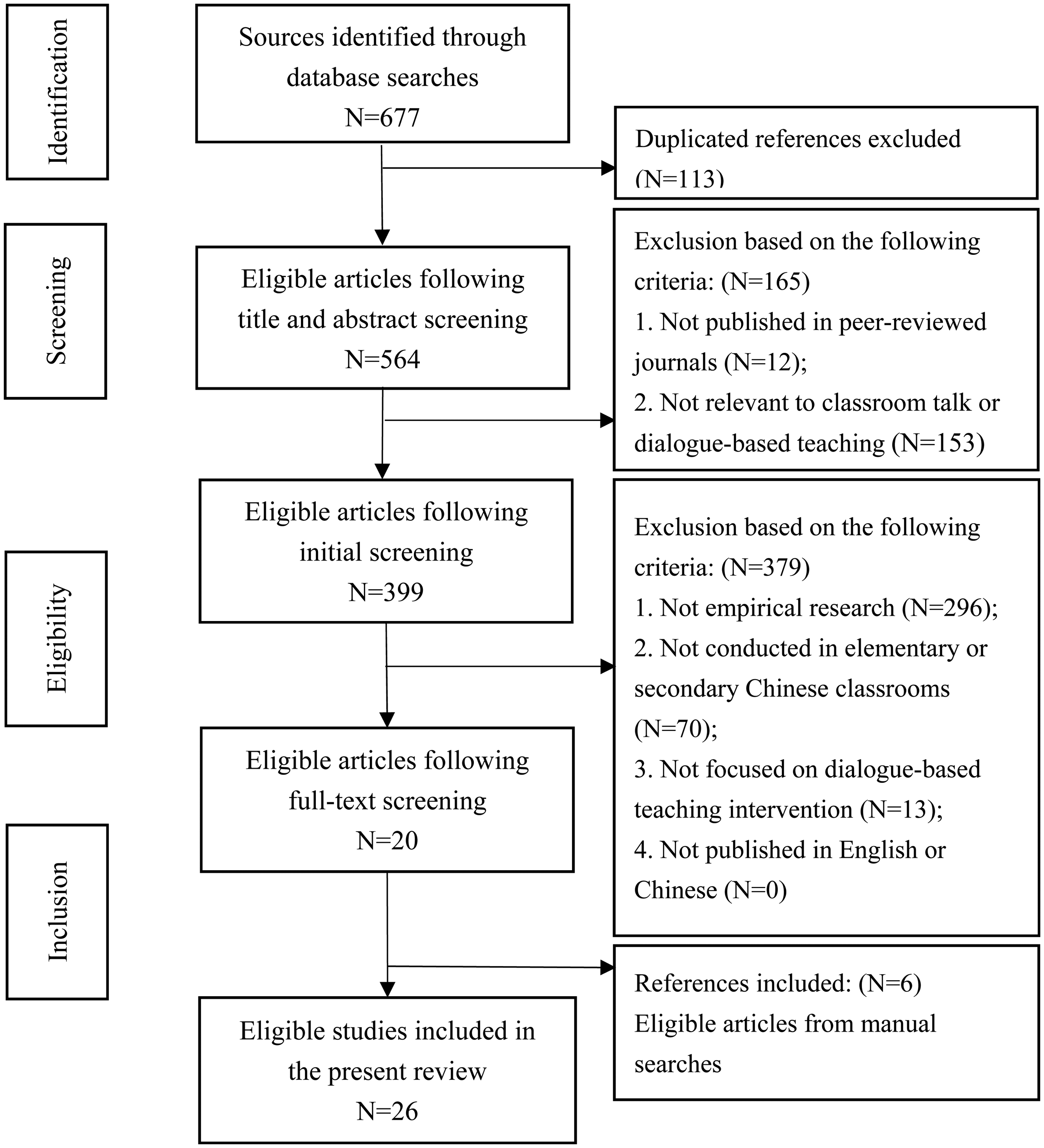
PRISMA flow diagram of literature search and selection.
Data analysis
In the process of generating codes, we mainly followed the thematic analysis approach, a method for identifying, analyzing, and reporting patterns within data (Braun & Clarke, 2006). Among the two primary approaches in thematic analysis, we followed the more inductive approach, that is, we coded the data without trying to fit it into a preexisting coding frame. The data analysis comprised the following five steps:
First, the first author read all of the 26 studies, jotting down initial ideas about each article and abstracting the following characteristics from each study: (a) publication year, (b) author(s), (c) geographical context, (d) number of participants, (e) duration of the intervention, (f) school level and academic grade of participants, (g) school subject, (h) organizational form to conduct dialogue, and (i) implementer(s) of the intervention. This step led to a descriptive overview of the selected studies.
Second, two authors collated initial ideas of each study into potential themes together, inducting three a priori themes: school subjects, effects on students, and influencing factors. For effects on students, both cognitive and non-cognitive sub-themes were included, both of which were reported to play a crucial role in ensuring students’ later success in academic, occupational, and personal life (Diamond, 2010; Heckman, 2008).
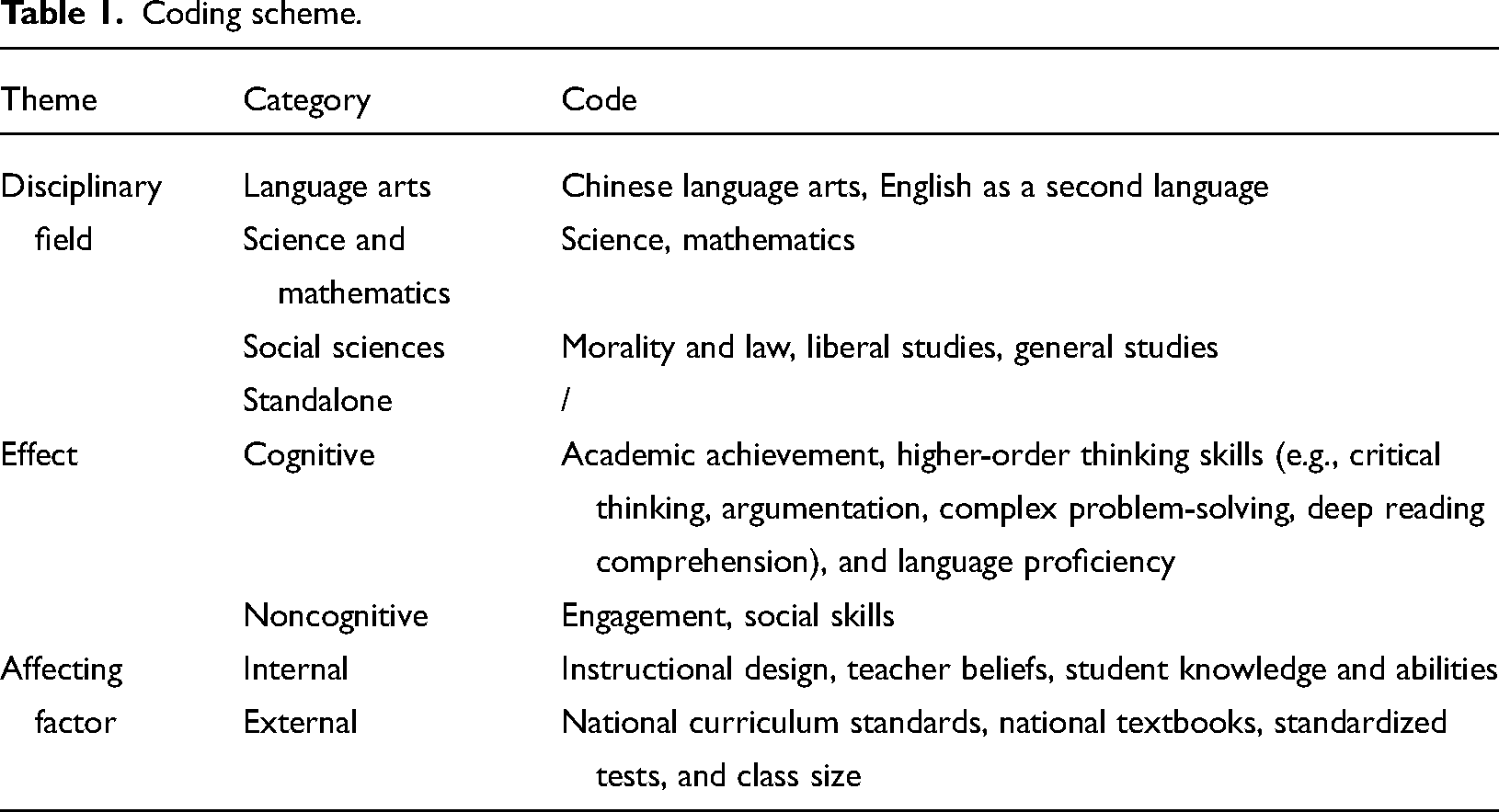
Third, the studies under each theme were examined and organized into eight categories based on their research focus. Based on these categories, we generated a more detailed thematic “map” of the analysis. For each category, a variety of codes were identified and named during close reading. Table 1 presents the identified themes, categories, and codes.
Coding scheme.
Fourth, the first and second authors selected and coded 20% of the data set to check for inter-rater reliability, achieving a nearly perfect inter-rater agreement.
Finally, the findings of each source were summarized in terms of the themes and categories to discern the degree of integration within each school subject, cognitive and non-cognitive effects on students, and potential factors influencing the successful implementation of dialogue-based teaching interventions conducted in Chinese elementary and secondary classrooms.
Results
Descriptive overview
The final set comprised 26 articles published between 2006 and 2022. The selected studies evidenced the emergent focus on dialogue-based teaching interventions across diverse geographical contexts in China, including Hong Kong (n = 10), Beijing (n = 6), Shanghai (n = 2), and Anhui (n = 2). However, as Table 2 shows, studies were primarily conducted in eastern China (n = 25), while only one study was conducted in western China. More research was conducted in elementary schools (n = 16) than secondary schools (n = 10). Among them, dialogue-based teaching intervention studies were most frequently employed in fourth- (n = 9) and fifth-grade (n = 6) classrooms. Class size varied widely, with the smallest comprising 24 students and the largest 63. Class size was 30 or less in 11 studies, and above 50 in two studies, indicating that class size may be a significant challenge for Chinese teachers to successfully implement dialogue-based teaching in classrooms.
Characteristics of the selected studies.
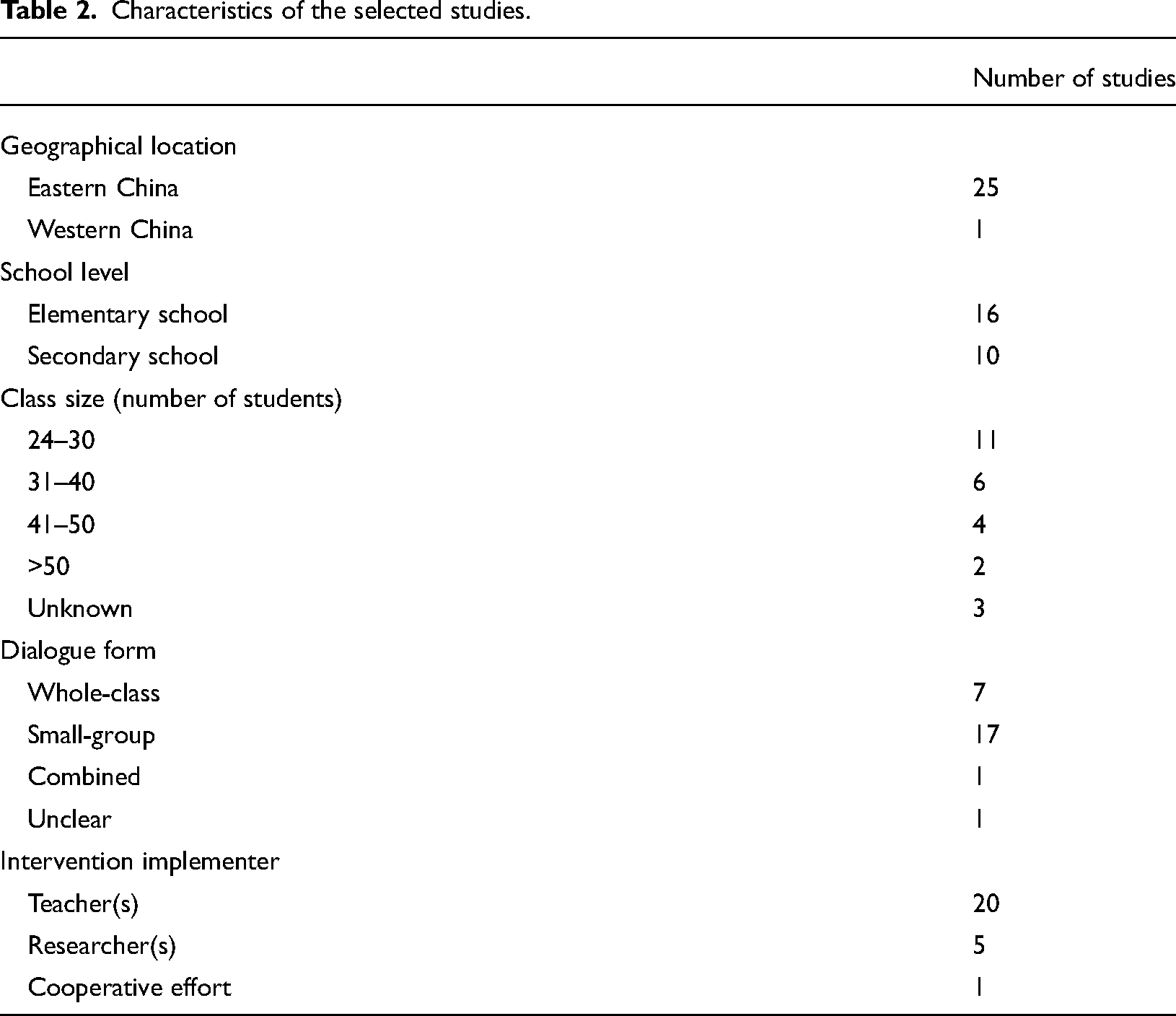
The majority of selected intervention studies (n = 17) focused on small-group dialogues, with only seven studies examining whole-class dialogues and one study investigating both small-group and whole-class dialogues. In addition, in the majority of studies (n = 20), regular classroom teachers were in charge of facilitating classroom dialogues, while the researchers were responsible for providing relevant learning materials and professional training for teachers. The researchers were in charge of leading classroom dialogues in a few studies (n = 5), and only one study allowed both researchers and teachers to intervene in classroom dialogues.
Integration of dialogue-based teaching interventions and school subjects
Dialogue-based teaching interventions conducted in Chinese classrooms mostly involved one of four school subjects: language arts (n = 8), social science (n = 6), and science or mathematics (n = 7). A few studies (n = 5) implemented dialogue-based teaching as a standalone course.
Interventions in language arts classroom
Eight studies involving dialogue-based teaching were conducted in language arts classrooms. Half of them were conducted in Chinese language arts classrooms and the other half in English-as-a-Second-Language (ESL) classrooms. Reading materials used for discussion involved three categories: (a) faithful orientation that draws on national textbooks; (b) generative orientation that uses teacher-selected materials; and (c) compromise orientation, which adds some new content on the basis of existing textbooks.
With respect to the faithful orientation, Xing (2006) drew on national textbooks and indicated that the “big question” should come from learners’ holistic feelings toward the text. Generally speaking, teachers could take either the relatively concentrated questions raised by most students or the unique understanding of one individual student as the “big question” in dialogic discussions. Similarly, Wei et al. (2020) noted that aligning texts for discussion with the existing curriculum was a successful practice to implement student-centered, small-group Quality Talk (QT) in large English-as-a-Second-Language classrooms in China.
In contrast to the faithful orientation, some researchers selected and introduced novel reading materials, altering the conventional content of the subject of language arts. As a representative of generative orientation, Collaborative Reasoning (CR) demonstrated its potential to improve students’ high-level reading comprehension skills. During CR, researchers usually introduce multiple-source teaching materials to the classroom (Cheng et al., 2015; Ding et al., 2016; Sun et al., 2020). These materials often involved stories describing dilemmas faced by the protagonists, creating contexts for the consideration of topics such as friendship, fairness, honesty, integrity, winning or losing, and public policy. In ESL classrooms, Liang and Fung (2020a) examined the potential effects of WebQuests, a researcher-designed website, on critical-thinking development and used it as a tool to implement exploratory talk. WebQuests posed an ill-defined problem and assigned two group activities. The first activity involved the exploration of various versions of the Cinderella story from around the world and an appreciation of Hong Kong culture, while the second required students to write scripts for a Hong Kong-based Cinderella play and an essay explaining why their play would be attractive to Hong Kong audiences.
Last but not least, in terms of the compromise orientation, some researchers enriched the reading text by adding extra materials related to textbook content. This is aptly illustrated by Chow et al.'s (2021) 12-week intervention, which examined the effects of dialogic teaching on young Chinese students in ESL classrooms. Although the teaching and learning materials for interactive dialogue and creative activities differed from existing teaching materials, the discussion topics aligned with the national textbook content.
Interventions in science or mathematics classrooms
Of the seven studies concerning interventions in the subjects of science (n = 4) or mathematics (n = 3), three features of the interventions were identified: (a) the instructional design was aligned with the subject matter knowledge and national curriculum standards of China, (b) an argumentation approach was preferred in science classrooms, and (c) the intervention emphasized the reasoning process based on empirical evidence.
Regarding the first feature, science or mathematics teachers tended to value and stick to subject matter knowledge highly because they held the epistemological view that the facts, concepts, and laws in natural science are solid, stable, and systematic. Taking the implementation of scientific argumentation as an example, most argumentation tasks were preset according to specific subject area contents. Wang and Buck (2015) focused on the topic of light and emphasized the use of national physics textbooks. Mi et al. (2018) chose momentum conservation from the national textbook of physics. Song (2019) designed an intervention based on the sixth-grade Oxford edition science textbook. Even in Yang et al.'s (2021) study, which involved an innovative technology-based learning environment called WISE, the teachers and researchers modified the socio-scientific issue (SSI) unit to align it with the Chinese biology curriculum. The same goes for mathematics. Both Ng et al. (2020) and Ni et al. (2021) reported that all topics taught by the participant teachers were consistent with the school's existing mathematics curriculum that followed the national mathematics curriculum.
Second, in four studies, argumentation was applied to promote dialogue-based pedagogy in science classrooms. It is generally held that science education should prioritize argument as scientific argumentation underpins scientific thinking (Driver et al., 2000). In most cases, a question for argumentation was presented to students after they had learned a new topic, and the questions were contextualized in real-life scenarios with open-ended answers. In addition, students in Wang and Buck's (2015) study received explicit instruction on argumentation at the beginning of the study, and engaged in a role-play class debate at the end.
Third, most interventions in science or mathematics classrooms emphasized evidence-based reasoning. Song (2019) encouraged students to defend their arguments and refute those of other students by providing various forms of evidence from life experiences, graphs, or established scientific concepts. Yang et al. (2021) insisted that a valid argument must include claim, warrant, and data. They also proposed a rubric to evaluate the quality of arguments according to the number of argument components included: The simplest argument only includes one claim, while the most complex has all of the components (i.e., claim, data, counterargument, and rebuttal). Specifically, the three-level argument rubric comprised the following: (a) simple claims without justification, (b) claims with reliable justification, and (c) claims made from multiple perspectives.
Interventions in social science classrooms
Six of the selected studies were conducted in social science classrooms. The school subjects included Morality and Law (n = 2), General Studies (n = 1), and Liberal Studies (n = 3). The main feature of dialogue-based teaching intervention in social science classrooms was talking to negotiate and tackling controversial issues. In the subject of Liberal Studies, Fung and Howe (2012, 2014; Fung, 2014b) presented a secondary Liberal Studies curriculum intervention schedule that introduced Kuhn's (1991) model and included relevant problem-solving activities. During each session, the teacher put forward a sample question for students to discuss. When discussing or debating, students were asked to write down their reasons for addressing and responding to the issues and challenges raised by the opposing side, as well as to provide feedback to other group members. In the subject of General Studies, Fung's (2014a) intervention was conducted in relevant lessons in two primary schools in Hong Kong. More specifically, the intervention granted students the opportunity to operate in a collaborative group setting and engage in critical discussions based on content-specific questions. In the subject of Morality and Law, Shi et al.'s (2021) intervention emphasized the value of controversial public issues. In their intervention in a Chinese seventh-grade Morality and Law class, the researchers used a popular Chinese movie, Dying to Survive, to promote the dialogic teaching of controversial public issues.
Interventions as a stand-alone course
Five interventions were conducted as stand-alone courses. Among these, four applied the CR approach and one involved dialogue-based argumentation based on Kuhn's (1991) model. While the regular classroom teachers played a significant role in leading discussions in interventions integrated with school subjects, in interventions as a stand-alone course, researchers were often responsible for leading these discussions. In the study of Dong et al. (2008), students in the experimental groups held four CR discussions conducted by one of the researchers in a separate room, while their counterparts in the control groups received language arts instruction from their regular teachers. Sun et al. (2017) conducted a 1-month CR intervention in two fifth-grade classes. In this case, the researchers were responsible for introducing the procedures and norms for CR discussions, serving as the facilitator of five CR discussions, and leading a whole-class debriefing session at the end of the class. Shi (2019) implemented Kuhn's dialogue-based argument curriculum in a seventh-grade classroom in China and engaged students in peer-to-peer argumentative dialogue on controversial societal issues; three class periods per week were devoted to this purpose, for a total of 30 class periods.
The effects of dialogue-based teaching interventions on students
To examine the effects of dialogue-based teaching interventions on students, our analyses focused on both cognitive and non-cognitive effects. A total of 23 studies documented a wide range of effects on students when they participated in dialogue-based interventions. Among them, 17 studies reported the development of higher-order thinking skills, three studies reported improvement on academic achievement, and one study examined changes in language proficiency. For non-cognitive effects, 11 studies focused on changes in student engagement and one study investigated outcomes related to students’ social skills.
Cognitive effects
Academic achievement
Although three of the selected studies investigated students’ academic outcomes following the interventions, only one study definitively suggested a visible correlation between the two. Kutnick et al. (2016) conducted a relational-oriented collaborative discussion intervention program in 10 primary schools in Hong Kong; the intervention involved a total of 504 mathematics pupils and 20 teachers, and lasted over 7 months. Results showed that collaborative discussions evidenced the potential to boost academic achievement via enhanced child-peer-teacher interaction, even in Confucian heritage classrooms characterized by collectivist learning.
Xing (2006) conducted an experimental study to investigate the relationship between students’ learning outcomes and dialogue-based learning strategies in Chinese mainland's primary schools. Xing (2006) found that following the dialogue-based teaching intervention, students in the experimental class significantly improved their learning skills, which were conducive to the improvement of their academic performance in the long term.
In contrast to these positive findings, another study showed little statistical evidence to suggest a direct linear relationship between dialogue-based teaching interventions and students’ academic achievement. Wang and Buck (2015) utilized a sequential explanatory mixed methods design to explore the relationship between secondary students’ argumentation and subject matter knowledge (SMK) achievement in two physics classrooms. The researchers found no evidence that the argumentation-integrated research interventions significantly promoted students’ SMK achievements over their 6-week intervention program.
Higher-order thinking skills
Of the selected studies, 17 presented results showing that dialogue-based teaching supported students’ higher-order thinking skills, including critical thinking (CT) (n = 5), argumentation (n = 9), problem-solving (n = 2) (Lin et al., 2019; Sun et al., 2017) and deep reading comprehension (n = 1) (Cheng et al., 2015). Five studies explored the effectiveness of dialogue-based instructional interventions in promoting students’ critical-thinking skills. In Fung and Howe (2012), teenage students who employed a collaborative group learning approach showed higher CT skills on post-tests than those who learned using a traditional teacher-centered teaching approach. Fung (2014a) extended these findings to primary schools in Hong Kong, showing that students who participated in group work with effective strategies made greater advancements in their capacity to identify the problems in questions, support their claims with greater reasoning, and weigh evidence in a dilemma.
Two recent studies shed light on the cultivation of CT in students through technology-supported dialogic inquiry. Liang and Fung (2020a, 2020b) reported that students used exploratory talk as a dialogic tool to exercise CT when discussing specific issues. As Liang and Fung (2020b) argued, students were capable of justifying their ideas with supporting details, which helped them deepen their thinking and opened up a dialogic space for interpersonal engagement using exploratory talk.
Six studies reported that dialogue-based teaching interventions can improve students’ oral argumentation ability in various school subjects. Dong and his colleagues (2009) found a core sequence of rhetorical moves characteristic of argumentation emerged in children's talk after a 2-week intervention involving CR. Yang et al. (2021) indicated that students’ overall oral argumentation performance improved significantly both in adversarial and in parallel argumentation designs. Song (2019) found that students’ discourse transformed from cumulative talk to exploratory talk and from experience-based judgment to evidence-based reasoning.
Five studies provided evidence that dialogue-based interventions can improve the quality of students’ argumentative writing. Dong and his colleagues (2008, 2009) demonstrated that gains in students’ oral argumentation skills gained through participation in CR discussions transferred to their independent argumentative writing. Shi (2019) implemented a dialogue-based argument curriculum in a middle school in a large city in Chinese mainland to explore the impacts of the intervention. Students in the pilot class showed significant gains in post-intervention essays on both curriculum-based topics and new ones.
Language proficiency
One study demonstrated the benefits of dialogue-based teaching interventions on students’ language proficiency. Chow et al. (2021) conducted a 12-week teaching intervention to explore whether dialogic teaching could enhance vocabulary knowledge and phonological awareness among Chinese ESL students in two Hong Kong primary schools. The results showed that dialogic teaching in ESL classrooms enhances English language development in young ESL learners. Compared to the control group, students in the experimental condition with dialogic teaching exhibited significantly greater growth in expressive vocabulary knowledge on textbook items in both low- and high-vocabulary groups, with the latter also evidencing greater gains in phonological awareness.
Noncognitive effects
Engagement
Of the 26 studies selected for this review, increasing participation in classrooms was the major non-cognitive impact of dialogue-based teaching interventions (n = 11). Five studies showed that teaching interventions in the form of whole-class dialogue could increase student engagement in the classroom. Xing (2006) reported that students’ interest in learning Chinese Language Arts increased significantly with the use of a dialogue-based learning strategy, with more than 80% of the students claiming that instructional time passed quickly and the class was more enjoyable. Song (2019) conducted a scientific argumentative activity with 36 sixth-graders to explore the effectiveness of the intervention. Results showed that the ratio of teachers to students’ discourse frequency was relatively stable, and students were more actively engaged in classroom talk than usual. Ni et al. (2021) drew the similar conclusion that the dialogic moves observed in the intervention teachers appeared to have increased the total amount of student talk and length of student talk, and thus led to students’ enhanced engagement in classroom discussion. Meanwhile, in Shi et al. (2021), participating students talked as often as their teacher did when addressing controversial public issues, frequently justifying, elaborating on, and occasionally challenging the claims of others. This finding indicates a high level of student engagement during whole-class dialogic discussions.
Apart from whole-class dialogues, six studies demonstrated that interventions in the form of small-group dialogues can also promote student engagement in classroom discussions. Implementing CR in primary classrooms, Dong and his team (2008) found that students adapted to the new discussion format quickly and smoothly, were highly engaged, and were able to manage the discussions themselves. A year later, Dong and his team (2009) conducted a similar study in two larger primary classrooms, showing that students were similarly positive toward small-group discussions and enjoyed reasoning together as a team. Similar findings were reported in classrooms promoting argumentation (Shi, 2019; Wang & Buck, 2015) or Quality Talk (QT). In a recent study conducted by Wei et al. (2020), the participant teacher observed students’ transformation from being unwilling to express their thoughts to deeply engaging in classroom discussions, and finally to enjoying English reading as a result of engaging in QT.
Social skills
In addition to gains in cognitive ability, the use of dialogue-based teaching has also been found to significantly improve students’ social skills, including leadership and cooperation skills. Sun et al. (2017) found that effective leadership moves were observed more often in problem-solving groups comprising students with experience of CR discussions. Moreover, emergent leaders usually tried to include others, spoke to others in a polite way, and generally seemed to adapt to the changing needs of their groups in response to the demands of problems. Sun et al. (2017) attributed this to students’ acquiring transferable social abilities in the CR intervention. In this regard, participants were supposed to honor several norms of CR discussion, including appropriate timing, inclusive tone, respectful attitude, and an open mind. Sun et al. (2017) also argued that children could improve their interpersonal and group management skills through participation in CR discussions, even with limited explicit training.
Factors affecting implementation of dialogue-based teaching interventions
As the analyses indicated, these selected studies demonstrated promising cognitive and non-cognitive effects of the dialogue-based teaching intervention. To ensure the sustainability and scalability of these interventions, the next step is to analyze factors that support or hinder the successful implementation of dialogue-based teaching. Of the selected studies, 16 of them addressed factors affecting the successful implementation of the dialogue-based teaching intervention, and we divided these factors into internal and external factors.
Internal factors
Internal factors included factors taking place within the classrooms that might influence the successful implementation of the dialogue-based teaching intervention.
Instructional design
Four studies indicated that the instructional design plays a crucial role in the implementation of dialogue-based teaching. First, the inclusion of a certain amount of teacher support in instructional design may scaffold student discussions, leading to more productive intervention outcomes. In a 1-year longitudinal study, Fung and Howe (2012, 2014) divided their experimental group into two conditions: In one group, the teacher participated in guiding student discussion and facilitating their dialogic interaction; in the other group, students self-directed the discussion. Results showed that students made greater progress in the teacher-supported work than in the self-directed group.
Second, setting up the ground rules at the beginning of a discussion helps to ensure the smooth progression of subsequent talk. Although some scholars have critiqued the use of ground rules in classroom talk, Fung (2014b) argued that ground rules associated with effective talk in the classroom have positive effects on students’ engagement in group activities. The establishment of these ground rules was positively correlated with students’ demonstration of critical thinking skills.
Teacher beliefs
Three studies documented how teacher beliefs can influence the outcomes of dialogue-based teaching interventions and determine teachers’ willingness to continue using these innovative approaches in their daily teaching practices. Zhou et al. (2021) showed that teachers’ perceptions of dialogue-based teaching may impact students’ opportunities to engage in argumentation. Sun et al. (2020) reached a similar conclusion, noting that teacher beliefs and motivations played a key role in how they perceived the benefits and challenges of dialogue-based teaching and how they responded to uncertainties and difficulties that arose in the teaching process. In particular, teachers with performance-oriented motivation were more likely to feel a sense of failure when losing control over student performance, while teachers with mastery-oriented motivation were more open to embracing the challenges and uncertainties they encountered.
Mi et al. (2018) showed that teachers’ role positioning may influence students’ argumentation performance. More specifically, when teachers used a variety of questioning strategies, students showed a higher level of verbal argumentation performance. Although the role of the teacher as “participant” was found to be the most effective in improving students’ oral argumentation performance, the researchers noted that the role of “transmitter” had an important function through which teachers could help students understand specific concepts. Therefore, rather than sticking with the single role of questioning, teachers need to be flexible in using different roles to coordinate classroom discourse.
Student knowledge and abilities
In a study involving 72 Chinese first graders in primary schools, Chow et al. (2021) argued that when assessing the effectiveness of dialogic teaching in the context of early second language classrooms, it is important to consider its differential effects on children with diverse vocabulary levels. After experiencing the same teaching intervention, students in the high-vocabulary group showed greater gains in both expressive vocabulary knowledge and phonological awareness, while students in the low-vocabulary group only improved in the former aspect.
However, scholars have also noted that having a higher level of subject knowledge does not necessarily mean that students will perform better and/or benefit the most in classroom conversations. As Wang and Buck (2015) found, medium-subject matter knowledge (SMK) students have greater potential than high-SMK students in argumentation. Students in the high-SMK group were most eager to know the correct answer to the questions delivered by an authority figure because they were uncomfortable with argumentation that yielded equivocal conclusions. In contrast, medium-SMK students did not want the involvement of authority as much as high-SMK students did. They also cited knowledge from other resources, including empirical knowledge, more than other students. This finding suggests that medium-SMK students were most engaged in argumentation practices and most likely to be spontaneous learners.
Nonetheless, students’ background knowledge remains crucial for argumentation. Wang and Buck (2015) showed that low-SMK students were less capable than the other two groups in argumentation quality, which was assessed from engagement in argumentation, argumentation structure, and argumentation content. This provides strong evidence to support the idea that sufficient a priori knowledge makes a good argument. In particular, students need basic SMK to support classroom conversations or provide evidence for arguments.
Apart from student knowledge, students’ skills and abilities, especially language proficiency, may also affect their performance in classroom dialogues (Liang & Fung, 2020b). Through a 6-week exploratory talk intervention conducted in Hong Kong involving 125 participants, Liang and Fung (2020b) observed that students reverted to their native Cantonese in group discussions. In other words, the students were thinking in their first language (i.e., Cantonese) rather than in their second language (i.e., English). These findings indicate that students’ lack of English proficiency likely posed a formidable challenge to their use of English in group discussions.
External factors
In contrast to internal factors, external factors refer to influences that stem from outside of a classroom and thus could not be easily altered by participants within a classroom. Five studies documented external factors that pertained to national curriculum standards, national textbooks, standardized tests, and class size. Wei et al. (2020) surveyed the implementation of QT intervention involving an experienced English teacher and 82 students in Beijing. The results showed that the implementation of QT would be better accepted if the content of the teaching intervention was better aligned with the educational objectives at the national level. According to Xing (2006), textbooks used in Chinese schools were mostly not arranged according to the dialogue-based format, hindering the implementation of dialogue-based teaching interventions. To conquer this challenge, teachers are expected to reorganize or reintegrate textbook contents in order to implement dialogue-based teaching; however, doing so requires a considerable degree of teacher competence and autonomy.
Other studies noted that the undue emphasis on standardized tests in China likely exerted some negative impact on the wide adoption of dialogue-based teaching. Wang and Buck (2015) argued that under the pressure of nationwide standardized exams, educational innovations involving classroom dialogues were unlikely to be widely embraced unless there was robust evidence suggesting their efficacy in promoting students’ achievements in standardized tests.
Lastly, the prevalence of large class sizes in China may also pose a threat to dialogue-based teaching interventions or limit their positive effects on students. Although group work has been found to be more effective than whole-class instruction in developing students’ critical-thinking skills (Fung & Howe, 2014), it is impossible for the teacher to participate in the discussion of every group at the same time as a dialogue facilitator. Examining the effect of QT on Chinese-speaking students, Wei et al. (2020) found a possible solution to this challenge: cultivating peer discussion leaders to help facilitate small-group discussions. By doing so, teachers can select and train discussion leaders to facilitate QT discussions, and these leaders will in turn encourage each group member to participate in discussion effectively and frequently.
Discussion and implications
In this review, we examined and synthesized intervention studies that involved dialogue-based interventions in Chinese elementary or secondary schools. The selected studies cut across different school subjects and geographical regions in China. In this section, we will discuss our major findings, followed by implications for improving the sustainability and scalability of dialogue-based teaching in Chinese elementary and secondary schools.
Discussion of major findings
This review demonstrated that the existing dialogue-based teaching interventions conducted in Chinese classrooms were mostly integrated with school subjects, including Chinese Language Arts or English as a Second Language (ESL), science, mathematics, and social sciences, with only 20% of interventions implemented as stand-alone courses. Given the successful implementation of these interventions, the present review argues that these dialogue-based teaching approaches are not unique to researcher-led stand-alone courses, with classroom teachers in China able to choose appropriate methods to incorporate dialogue-based teaching into their customary pedagogical practices. This finding suggests that more attention should be paid to the role of teachers in the study of dialogue-based intervention studies, rather than regarding researchers as playing a central role in the design and implementation of these interventions. Therefore, an increasing number of empirical studies now focus on providing teachers with professional development trainings, both prior to and throughout the interventions, to support teachers to plan for and carry out dialogue-based teaching with greater autonomy, agency, and competence (Hardman, 2019; Sedova et al., 2016; Vrikki et al., 2018).
This review identified cross-disciplinary differences in these dialogue-based teaching interventions conducted in China: Interventions in language arts classrooms tended to emphasize literature-based discussion; interventions in science or mathematics classrooms tended to promote evidence-based reasoning; interventions in social science classrooms tended to advocate discussion based on open-ended, controversial issues. These findings were in line with prior research reporting that teachers from different subject areas understand and practice dialogue-based teaching in discipline-specific ways (van de Pol et al., 2017; Yang, 2007).
In addition, our findings pointed to cognitive and non-cognitive benefits of dialogue-based teaching interventions on Chinese elementary and secondary school students. The greatest cognitive effect involved students’ higher-order thinking skills, including critical thinking, argumentation, problem-solving, and deep reading comprehensions. The greatest non-cognitive effect involved student engagement. These findings were consistent with post-intervention gains reported in studies conducted in Western contexts (Applebee et al., 2003; Frijters et al., 2008; Lindstrom, 2019; Murphy et al., 2009; Reznitskaya et al., 2001). In short, the present review suggested that a Confucius cultural background did not necessarily pose a threat to the successful implementation of dialogue-based teaching, although Confucius beliefs might influence Chinese students’ understanding of ground rules of dialogues (Fung, 2014b).
Regarding intervention students’ academic performance, the selected studies showed contradictory findings. One suggested a positive correlation between participation in the intervention and gains in students’ academic performance (Kutnick et al., 2016), while the other provided contrary results (Wang & Buck, 2015). Notably, these contradictory findings were also present in studies conducted in Western contexts. Specifically, although most studies demonstrated that dialogue-based teaching promoted student achievement in school subjects such as English Language Arts, mathematics, and science (Alexander, 2018; Tabach et al., 2020), other studies reported an absence of student improvement in academic performance (Ruthven et al., 2017). Given that students’ academic performance remains the greatest concern for teachers and school administrators, we speculate that prolonged engagement in dialogue-based teaching might lead to more positive academic outcomes, although more studies are called for to test out this hypothesis.
Lastly, the present review investigated internal and external factors that might influence the successful implementation of dialogue-based interventions. The findings suggested that teachers play a critical role in the implementation of dialogue-based teaching and their practices are amenable to changes through professional development efforts. For instance, teachers could reflect on their deeply held beliefs (Zhou et al., 2021), be more prepared in terms of instructional design (Fung, 2014b; Yang et al., 2021), provide students with complex learning materials closely aligned with their daily lives (Shi et al., 2021) as well as beyond their everyday experiences (Song, 2019). However, it's not enough to merely ask teachers to make these changes on their own. Instead, systematic and continued professional support is required to enable teachers to successfully transition from teacher-centered, monologic teaching to student-centered, dialogic teaching.
Implications for practice and future research
Based on these findings, the present review argues that to successfully implement dialogue-based teaching, teachers need more explicit guidance and professional support from teacher educators, researchers, school leaders, and education policymakers alike, to facilitate teachers’ transition into dialogic practices. In what follows, we will explicate the implications of the present review for future educational practices.
First, the establishment of researcher-practitioner collaboration is crucial. Designing and providing professional development programs for teachers is necessary to facilitate their capabilities in implementing dialogue-based teaching. Researchers could equip teachers with appropriate dialogic pedagogical strategies and skills to mitigate the challenges teachers face in opening up their classrooms and encouraging student talk. At the same time, researchers could design and provide teachers with resources to save teachers’ time and efforts (Shi et al., 2021; Song, 2019), although teachers are expected to gradually form the abilities to develop these materials on their own.
Second, apart from researcher-practitioner collaboration, communication and collaboration among teachers across school subjects are also important. Teachers are expected to establish professional communities, in which individual teachers are able to draw on multiple sources of knowledge, diverse perspectives on the same content, and teaching strategies from their peers, in order to incorporate dialogue-based teaching into their daily pedagogical practice.
Third, more attention needs to be devoted to transform curriculum standards and textbooks to make them more amenable to support dialogue-based teaching. In addition to identifying dialogue-based teaching as a goal in the national curriculum standards (Fisher, 2011), national textbooks used across China could also be rearranged in a format that facilitates teachers’ implementation of dialogue-based teaching (Xing, 2006). Meanwhile, changes in assessment methods, such as reduced emphasis on standardized exams (Wang & Buck, 2015) and increased emphasis on diversified assessment forms, such as formative assessment or performance-based assessment, might leave teachers with more room to carry out dialogue-based teaching in their daily practices.
Last but not least, although our selected studies pointed to successes in carrying out dialogue-based teaching in the Chinese school context, it's worthwhile for future researchers to investigate the nuanced cultural differences when designing and implementing dialogue-based teaching, so that more specific and contextualized professional support can be designed and made accessible to teachers, thereby improving the sustainability and scalability of dialogue-based teaching in China.
Footnotes
Contributorship
Yixuan Zheng contributed to the conceptualization, research design, data collection, data analysis, draft writing, and the revision of the final manuscript. Yuchen Shi was involved in the conceptualization, coding for data analysis, reviewing and editing the draft, providing supervision, and co-revising the final manuscript for submission and publication.
Declaration of conflicting interests
The authors declared no potential conflicts of interest with respect to the research, authorship, and/or publication of this article.
Funding
The authors received no financial support for the research, authorship, and/or publication of this article.
