




Abstract
Purpose:
This article provides an overview of the composition and evolution of China’s high-level talent programs in higher education.
Design/Approach/Methods:
This article reviews key talent policies adopted by the Chinese government since the 1990s, using content analysis methods to identify policy characteristics and reform trends.
Findings:
Talent programs in China operate at four levels: the national level, provincial level, city level, and institutional level. The main objectives of China’s high-level talent programs are to support and promote the development of young talent and to encourage overseas scholars to return to China. China’s high-level talent programs have undergone various changes since 1993. The evolution is characterized by the following five major aspects: individual program optimization; replacement, integration, and separation; preventing overlapping funding; mitigating the unbalanced impact the programs have on higher education institutions across regions; and strengthening risk assessment for programs focused on attracting overseas talent.
Originality/Value:
This article offers a comprehensive assessment of the talent programs implemented by Chinese universities and explores the key trends and content of recent policy changes.
In 1995, the Chinese government proposed the strategy of “Reinvigorating China Through Science and Education.” The aim of the strategy was to facilitate the transition from extensive to intensive economic growth by promoting technological advancement and improvements in labor quality. In connection with this initiative, the government launched two main projects designed to accelerate the development of the nation’s higher education system. Project 211, initiated in 1995, targeted construction of approximately 100 key higher education institutions and a number of key disciplines for the 21st century. In 1998, Project 985 was put into action with the aim of enhancing the competitiveness of China’s top universities toward world-class–level institutions. Project 211 and Project 985 each emphasized the need for faculty training and development, as a first-class teaching faculty was considered the foundation for any high-level university. Since the 1990s, the Chinese government has launched a series of high-level talent programs. These programs have exerted a widespread and profound influence on the construction of teaching faculties in China’s institutions of higher education.
Composition of China’s high-level talent programs in higher education
Talent programs geared toward the development of teaching faculties in China’s higher education institutions operate at four levels: the national level, provincial level (including autonomous regions and direct-controlled municipalities), city level, and institutional level. On the national level, the high-level talent system mainly consists of programs focused on the development, introduction, and utilization of high-level talent across domestic institutions of higher education. These programs, launched by national ministries and commissions, not only serve an important macro-level role in the overall design of talent policies in higher education but also help shape the formation of talent policies on a more local level. That is, local governments typically refer to the national programs in formulating their own talent recruitment initiative, especially with respect to programs targeting overseas talent (Zhu & Shen, 2013). At the institutional level, colleges and universities establish individual programs designed to accommodate their own orientations and objectives; such programs are marked by significant cross-institutional differences.
Table 1 shows the composition of China’s high-level talent programs in higher education. In the early 1990s, as the strategy of Reinvigorating China Through Science and Education and Project 211 were taking shape, the government launched a series of talent programs as part of its overall strategy package.
Composition of China’s high-level talent programs in higher education.
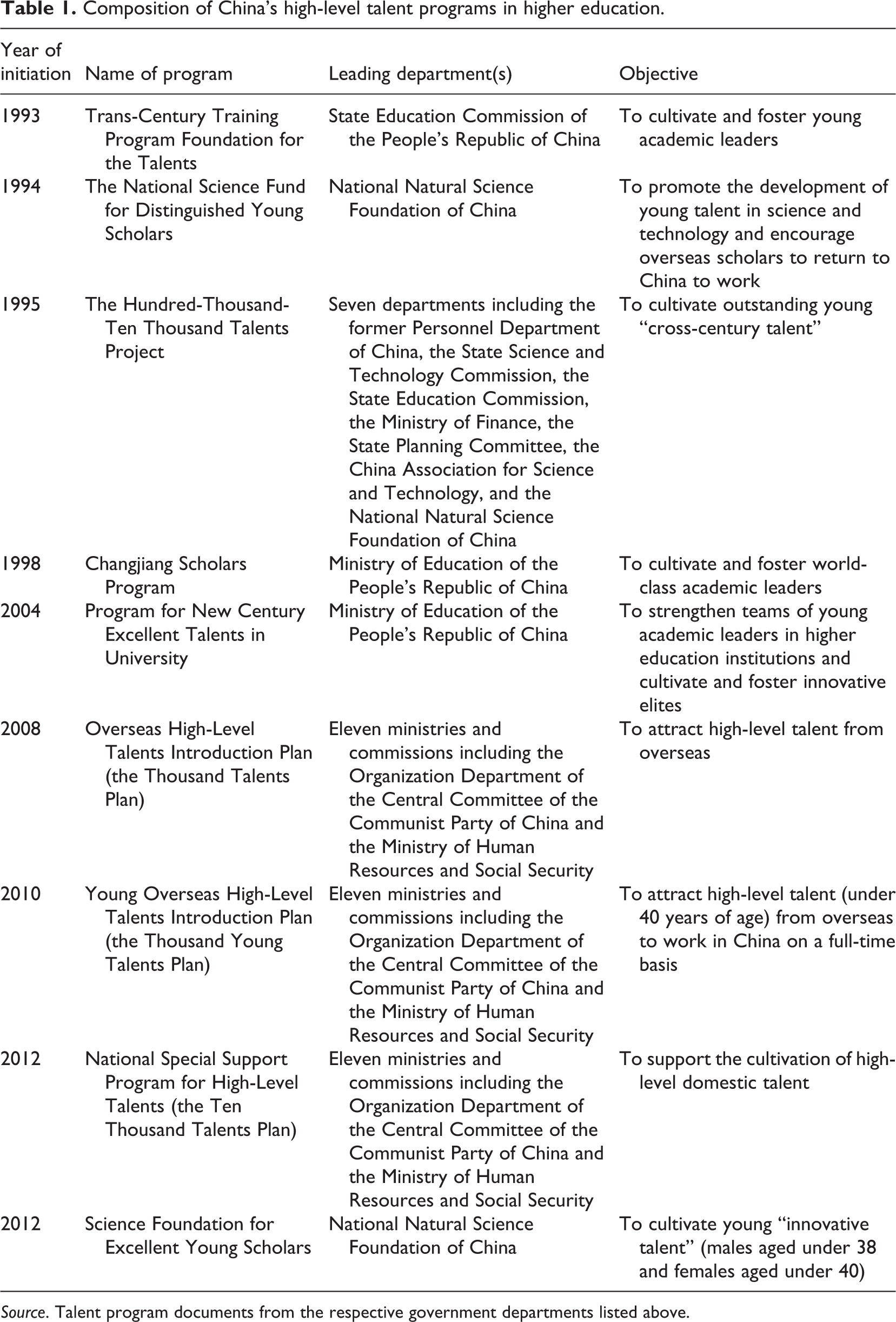
Source. Talent program documents from the respective government departments listed above.
The high-level talent programs in the 1990s were mainly formulated by the former State Education Commission of the People’s Republic of China, 1 the National Natural Science Foundation of China, and the former Personnel Department of the People’s Republic of China. Coordination among the different talent programs has strengthened over the last decade or so, especially following the establishment of the Central Coordination Group for Talent Work in 2003.
The main objectives of the high-level talent programs are to support and promote the development of young talent, to encourage overseas scholars to return to China to work, and to cultivate world-class academic leaders. These programs mainly target young professionals in fields of science and technology and leading academics under the age of 45. This approach was designed to address one of the fundamental problems facing China’s higher education institutions in the 1990s: a shortage of new talent to replace the older generation and a lack of academic leaders and young “backbone” talent.
While placing a premium on the recruitment of overseas scholars, early high-level talent programs also underscored the importance of cultivating domestic talent. After 2008, the Thousand Talents Plan and the Thousand Young Talents Plan were launched specially to attract high-level talent from overseas. Afterward, the National Special Support Program was formulated and implemented in conjunction with the Thousand Talents Plan, with a specific focus on cultivating domestic high-level talent in the fields of innovation and entrepreneurship.
Evolution of China’s high-level talent programs in higher education
The quarter century since 1993 has witnessed various changes in China’s high-level talent programs. While certain programs have remained in effect (with periodic amendment and refinement), others have either been terminated after achieving their goals or merged into new programs. This evolution can be characterized by the following five major traits.
Optimization of individual programs
The Changjiang Scholars Program is a case in point. Since its inception in 1998, the program has undergone four major amendments (in 1999, 2004, 2011, and 2018). While maintaining a consistent objective—“to attract and select young and middle-aged outstanding individuals and cultivate and foster a group of world-class academic leaders” (Ministry of Education of the People’s Republic of China, 1998)—the program’s standards for talent selection, grantee responsibilities, allowances and subsidies, regional balance, withdrawal mechanisms, 2 and other aspects have been updated in accordance with the changing landscape. Established in 1994, the National Science Fund for Distinguished Young Scholars has been in effect for nearly 25 years. Its initial objectives were to promote the development of young talent in science and technology, to encourage overseas scholars to return to China to work, and to accelerate the cultivation of outstanding field specialists capable of competing with their international peers in science and technology (National Natural Science Foundation of China, 1995b). Among the initial 49 recipients, 26 were from higher education institutions (National Natural Science Foundation of China, 1995a). The scale and intensity of the program’s funding and management, among other aspects, have been periodically adjusted, including through four rounds of amendments in 1997, 2002, 2009, and 2015.
Replacement, integration, and separation
China’s high-level talent programs have undergone an array of structural changes. For instance, the Trans-Century Training Program Foundation for the Talents implemented in 1993 was replaced by the Program for New Century Excellent Talents in University in 2004, which, in turn, was incorporated into the Young Changjiang Scholars Program in 2015. The Hundred-Thousand-Ten Thousand Talents Project implemented in 1995 was integrated into the National Special Support Program for High-Level Talents (also known as the Ten Thousand Talents Plan) as a subprogram in 2012 (Eleven ministries and commissions including the Organization Department of the Central Committee of the Communist Party of China and the Ministry of Human Resources and Social Security, 2012). Likewise, the Young Elites Program was specifically established as a part of the Ten Thousand Talents Plan in 2011. Currently, the Young Elites Program, the Young Changjiang Scholars Program, the Excellent Young Talents Program, and the Thousand Young Talents Plan are collectively referred to as “the four youth-talent programs.”
Preventing overlapping funding from talent programs
In recent years, there has been widespread criticism of scholars receiving overlapping funding from talent programs at the same level. This problem has been exacerbated by a lack of policy consistency and communication among different administrative departments. Many talent programs have now adopted measures to address this issue. For example, the 2018 revised version of Administrative Measures for the Changjiang Scholars Program explicitly states that “talent selection and cultivation should be coordinated to avoid overlapping with the support granted by other talent programs at the same level” (Ministry of Education of the People’s Republic of China, 2018). The 2018 application announcement of the Ten Thousand Talents Plan stipulates that recipients of the Young Changjiang Scholars Program and Science Foundation for Excellent Young Scholars may not apply for the Young Elites Program under the Ten Thousand Talents Plan during the funding period.
Unbalanced impact on higher education institutions across regions
Due to regional disparities in China’s economic growth, there is an ongoing flow of high-level talent from higher education institutions in the country’s central and western regions to the more developed regions in the east. This has resulted in a decline in the competitiveness of institutions of higher education in the central and western regions. In recent years, the government has responded to this problem by loosening the talent program application requirements for applicants from central and western institutions, helping to reverse the flow of high-level talent from the central and western regions and preventing institutions in the east from “poaching” talent from the west. This trend in policy amendment is currently shared among all high-level talent programs.
Strengthened risk assessment for programs focused on attracting overseas talent
Although China’s high-level talent programs are government funded, the actual applicants and users of the funds are institutions. While recruiting overseas talent over the past several years, a number of higher education institutions had an inadequate understanding of policies relating to intellectual property rights, confidentiality agreements, and noncompete agreements. This led to certain misunderstandings and conflicts of interests. This problem, however, has since been brought to public attention, and preventive measures have been adopted. For instance, the application procedures for all talent programs under the Thousand Talents Plan in 2018 include a requirement to incorporate risk assessments, which involve a comprehensive evaluation and review of the applicants’ undertakings at their prior overseas workplaces, including an analysis of intellectual property rights, confidentiality agreements, and noncompete agreements.
Problems in China’s high-level talent programs in higher education and trends in program reform
Since the 1990s, with support from high-level talent programs such as the Changjiang Scholars Program, higher education institutions in China have assembled a talented group of young and middle-aged scholars. As of 2017, the Changjiang Scholars Program had supported a total of 3,249 awardees, among which 2,298 were distinguished professors and 951 were chair professors 3 ; the National Science Fund for Distinguished Young Scholars had funded 3,796 recipients. 4 With the deepening of policy implementation, however, certain negative impacts of these programs have also become gradually noticeable, as manifested in the following aspects:
Firstly, the original purpose of national “talent programs” (supporting the career development of high-achieving candidates) has been diverted, and these programs have gradually become mere labels of academic success. Being selected into a national talent program has become a symbol of academic achievement and a successful academic career. This drives scholars to invest time and effort into competing for a position in the talent programs at the expense of their teaching and scientific research. Secondly, successful candidates receive a substantial allowance and subsidy/grant for scientific research from the government, while enjoying benefits from specific institution-based supporting policies with respect to remuneration and welfare packages. Thus, selection into a talent program serves as “leverage” in salary negotiations within the academic labor market. Higher education institutions irrationally compete in “employee poaching” by offering higher salaries to lure the recipients of talent program awards. In addition, the structure of talent programs has resulted in the creation of a hierarchy among teaching faculty at higher education institutions based on the ranking of talent programs, which has widened the disparities in their status and income. Thirdly, policy coordination among different talent programs still has room for improvement. Due to the segregation of department duties, specific application procedures, and various administrative factors, many talent programs remain separated despite an increase in integration between certain programs. A viable, broad-reaching solution is necessary for talent programs where shared objectives and regulations are lacking. Fourthly, although the risks involved in the recruitment of overseas talent have been brought to attention, an effective, comprehensive risk prevention mechanism has yet to be established.
Future reforms addressing China’s high-level talent programs are likely to advance on three main fronts. The first is a move toward further streamlining and integration by substantially reducing the number of talent programs and by avoiding the launch of redundant programs from different departments that may result in wasteful, overlapping funding. The second is to eliminate the Matthew effect through which candidates of talent programs leverage their successful applications to obtain academic resources and to rectify the “academic hierarchy” that has been created by the talent program system. The third is to strengthen the protection of intellectual property rights and contractual obligations in connection with the recruitment of overseas talent. Given the increasingly globalized landscape, it is certain that a future direction will be to gain a better understanding of the systems of talent utilization policies across different countries while avoiding the risks involved in talent introduction. To reduce flexible talent introduction and enhance recruitment on a full-time basis will also become one of the main trends in the future.
Footnotes
Declaration of conflicting interests
The author(s) declared no potential conflicts of interest with respect to the research, authorship, and/or publication of this article.
Funding
The author(s) disclosed receipt of the following financial support for the research, authorship, and/or publication of this article: This work was supported by the National Education Science Foundation of China (No. BIA160116).