




Abstract
Purpose
The aim of this research is to determine the impact of hands-on science activities on preschool children's motivation for science.
Design/Approach/Methods
The study group of the research, in which the quasi-experimental design with pretest–posttest control group was used, consists of 25 children aged 60–72 months who are continuing their preschool education. While the experimental group implemented hands-on science activities, the control group continued with the regular preschool education program. Science Motivation Scale for Preschool Children was used as a data collection tool. In the analysis of the data, independent samples t-test, Mann–Whitney U test, and Wilcoxon signed-rank test were used.
Findings
Within the scope of the research, it was concluded that science activities based on hands-on activities were effective in increasing children's science motivation. In addition, it was observed that science motivation did not differ according to gender, and there was an increase in the science motivation of both girls and boys in the experimental group.
Originality/Value
The results obtained from the study show that children's science motivation can be shaped through hands-on activities.
Introduction
It is known that what is learned and acquired in the first 7 years of life maintains its continuity throughout life (Dağlıoğlu, 2015). Considering that children always discover new information thanks to their sense of curiosity (Jirout & Klahr, 2012; Zimmerman, 2007), it can be said that acquiring basic thinking skills and scientific skills at early ages is important for later periods of life (Fusaro & Smith, 2018; Hsin & Wu, 2011; Samarapungavan et al., 2008). In this direction, it is essential to give children opportunities to keep their curiosity alive, establish cause–effect relationships, and make predictions by putting forward various ideas (Uğraş et al., 2013). Preschool science activities are one of the elements that allow these opportunities to be presented.
Preschool science activities support the development of children in many different areas. Science education, which is offered in the early period, helps the child to gain awareness of the facts about the world, experimental criteria, logical thinking, and continuous questioning (Ölçer & Güngör Aytar, 2019). Thus, science education not only supports children's cognitive progress, but also enables the development of their scientific processes (Babaroğlu & Okur Metwalley, 2018). Through science education, children are provided with thinking skills and scientific process skills such as observation, classification, measurement, estimation, and inference (Nuhoğlu & Ceylan, 2012), the opportunity to examine the world they live in, research and develop positive attitudes toward science (Güneş, 2018). In this period, with the acquisition of scientific process skills, various ways of solving problems can be produced and the basis for problem-solving is prepared (Aktamış & Ergin, 2007).
Science experiences that children accumulate before they start primary school shape children's perceptions of science (Eshach & Fried, 2005). In addition, preschool children's early motivational beliefs about science predict their participation in primary school and their future academic interests (Leibham et al., 2013). Hence, the levels of enjoyment and self-confidence, which are considered to be the two main components of learning and achievement motivation in a particular subject, largely depend on children's previous experiences with the subject (Oppermann et al., 2019). Therefore, the behaviors, interests, and attitudes that children develop in early childhood regarding science are considered very important for the later stages of life and are considered to be the determinants of scientific and academic achievements in the upper classes (Dilek et al., 2020; Oppermann et al., 2019). It is remarkable that starting from primary school, children generally use the word “difficult” when describing science and that children with this idea are gradually moving away from science (Oppermann et al., 2018). The lack of experience related to the concept in the educational process can strengthen children's perception of difficulty (Beydoğan, 2023). The perception of concepts as abstract due to the lack or absence of experience in the learning process can also reinforce the perception of difficulty (Güzel & Yılmaz, 2021). As a matter of fact, the reason for these characterizations is that primary school children do not have enough experience in learning science until then (Mantzicopoulos et al., 2008). Young children have little or no opportunity to learn science in the early years of education compared to other areas of development, so the foundations of scientific thinking and learning, which are cognitive skills, can be neglected in the early years (Saçkes et al., 2012). Hands-on experience plays a crucial role in children's learning and understanding of scientific concepts. Limited exposure to scientific phenomena can make it difficult for children to relate new information to their existing knowledge base. Children's motivation to engage with science can be nurtured by creating a learning environment that combines hands-on activities, meaningful experiences, and open-ended exploration. In early childhood education, it's essential to provide opportunities for children to explore the natural world, conduct simple experiments, and make discoveries through their senses. By incorporating sensory-rich experiences, educators can tap into children's natural curiosity and encourage them to ask questions and seek answers through scientific inquiry (Dejonckheere et al., 2016; Jirout, 2020). In other words, it is thought that the motivation of children who cannot find enough opportunities to learn science and perform scientific activities in the preschool period negatively affects their further motivation.
Since the evolution of children's beliefs about a particular subject area at an early age is based on their experiences in this area (Mantzicopoulos et al., 2008), children actively participate in the process by seeing, touching, feeling, doing, and experiencing (Balat & Önkol, 2017). Therefore, hands-on activities that develop children's scientific process skills are considered crucial in preschool education. By means of hands-on experiences, it is possible for children to develop a sense of independence and self-confidence, and the skills of asking questions and discovering. Moreover, via the hands-on experiences in science activities, children would put themselves in researchers’ place, and thus it contributes to children's permanent learning about the research subject (Şahin, 2016). In addition, the hands-on activities carry children's attention and observation skills to a higher point (Doğan & Ünüsan, 2015), provide concrete experiences in order to learn science concepts, and allow the development of problem-solving skills (Ünal & Aral, 2014).
Nowadays, exponentially increasing knowledge and learning fields give preschool teachers more responsibility to upskill children and gain extensive knowledge of them (Yavuz & Ahmetoğlu, 2019). It is possible for children to gain an idea about science concepts that are abstract for them through concrete experiences and to find an application area for knowledge and skills in these areas through learning-by-doing experiences (Fleer, 2022; Martinez & Stager, 2013). In this direction, quality preschool education involves the teacher supporting children's acquisition of scientific concepts and skills and providing materials that are suitable for children's development in this direction (Saçkes et al., 2011). It is important that the teacher encourages child-centered learning-by-doing practices in this qualified learning environment by organizing a learning environment where materials for science education are presented (Alisinanoğlu et al., 2012; Gerde et al., 2013). In addition, preschool teachers enable children, who are on voyage of discovery at the early life stage, to recognize and reflect on the key elements in various perceived phenomena (Kefi et al., 2013) so that teachers play an active role in children's richer knowledge acquisition and cognitive learning. Therefore, it is possible to say that the way teachers implement science activities and the methods they use are important for children to have the maximum level of achievement. Making science activities enjoyable for children, and targeting their developing interests, expectations, and needs beyond standard knowledge would ensure that science education is significant for children and would affect their positive tendencies toward science in the future (Parlakyıldız & Aydın, 2011). In addition, to understand the science motivation profiles of children in the preschool period, that is, to reveal their perceived proficiency for science and their level of liking for science is important in terms of identifying the factors that make them adapt and not get used to scientific subjects (Patrick et al., 2008). Determining the children's motivations of science helps them to discover the paths to their choices, to create and develop their expectations, and besides, it creates an idea about how children's career choices will be in the future (Patrick et al., 2009).
According to the relevant literature review, there are limited studies on the effectiveness of the hands-on activities in preschool education. In a study conducted by Ünal and Aral (2014), the impact of the hands-on activities education program on children's problem-solving skills was examined. In another study conducted by Çalışandemir and Bayhan (2011), the effect of the hands-on activities on the development of multiple intelligence areas of preschool children was examined. Furthermore, significant results were obtained in favor of the experimental group in both studies. In another study comparing the hands-on activities and the traditional approach, it was proven that children's comprehension, estimation, causality, and thinking skills improved in activities based on the hands-on activities (Christidou et al., 2009). According to a study conducted by Kos et al. (2021), it was concluded that the hands-on activities reduce negative attitudes toward animals in science activities related to animals.
In addition to the limited number of studies related to the hands-on activities in the preschool period in the literature, there are more studies on the constructivist approach covering the hands-on activities and activities based on research, examination, and inquiry-based approaches. As one of them, in the study conducted by Büyüktaşkapu (2010), it is intended for trying to reveal whether the science teaching program based on the constructivist approach affects the science process skills of 6-year-old children. Besides, in the study, an experimental design with a pretest–posttest control group was used. The science teaching program based on a constructivist approach and supporting scientific process skills has created more permanence than the current program. Through the constructivist science curriculum, it has been observed that children's skills in classifying, measuring, estimating, recording data, and drawing conclusions have improved. In a study conducted by Günşen et al. (2018), it was revealed that the science curriculum based on the constructivist approach improved the science process skills of 5-year-old children. Another study, examining the effect of constructivist science education program on children's scientific process skills by using a pretest–posttest experimental model with a control group, proved that the constructivist science curriculum is effective in gaining scientific process skills (Büyüktaşkapu et al., 2012).
In a study conducted by Samarapungavan et al. (2011), the effect of an inquiry-based science education program that preschool children attend for a year on children's science learning and motivation was examined. As a result of the research, it was determined that the scores of all science learning scales have been increased in the experimental group. Moreover, Patrick et al. (2008) revealed that children who participated in an inquiry-based science program were more motivated for science than those who did not participate. Additionally, project-based education practices, which is another approach based on research and examination, also include empirical activities (Baran & Maskan, 2009; Şahin et al., 2011; Yılmaz et al., 2006). According to the studies, it has been concluded that the project approach improves the problem-solving skills (Oğuz, 2012) and scientific process skills (Şahin et al., 2011) of children in the preschool period.
It's an obvious fact that research, examination, questioning, constructivist, and project approaches support children's various skills. The hands-on activities are included in these approaches, and thus, it can give some idea about the achievements that children would achieve in science activities. Despite this, it is obvious that more research studies about the hands-on activities in science activities in kindergartens should be done in order to reveal clear ideas. Furthermore, the positive contributions of the hands-on activities used in science lessons on students have been revealed in various studies (Aydoğdu & Ergin, 2008, 2010; Bayrakçı & Ünal, 2021; Demirkıran, 2016; Duran & Dökme, 2018; Freedman, 1997; Glasson, 1989; Koç & Böyük, 2012; Milner et al., 2011; Olubu, 2015). However, these are studies covering the period from early childhood to later periods. It is seen that there has been limited and insufficient research on the effects of hands-on activities in the preschool period. Therefore, there is a need to examine various aspects of experimental activities and practices in early childhood.
Purpose of the research
The aim of this research is to determine the impact of hands-on science experiments on 60- to 72-month-old preschool children's science motivation. The aims of the research were determined as follows:
What significant differences are there between pre- and post-science motivations in an experimental method intervention group and a control group? Do the science motivations of the children participating in the study differ according to gender?
Method
Research design
In this study, it was aimed to reveal how the science motivation of 60- to 72-month-old children is affected by hands-on science experiments. For this purpose, the quasi-experimental research method, one of the quantitative research methods, was used. Quasi-experimental studies are conducted to test the effect of the differences created by the researcher on the dependent variable (Büyüköztürk et al., 2020). Additionally, while examining causality, it is a type of experimental research that is preferred when there is no possibility of random assignment or homogeneous selection (Hocaoğlu & Akkaş Baysal, 2019).
In the study, a quasi-experimental design with pretest–posttest control group was applied. One of the two groups created in this design represents the experimental group and the other represents the control group (Büyüköztürk et al., 2020). While the implementation process was started after the pretest with the experimental group, the implementation of the current program was continued in the control group.
Study group
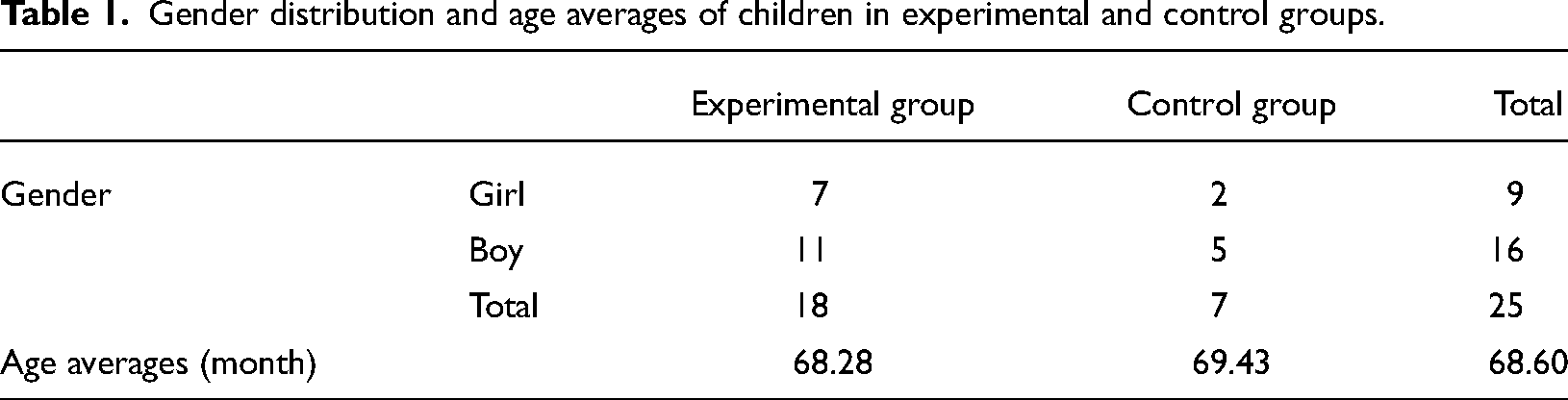
This study was conducted with the participation of 60- to 72-month-old children attending preschool education in the academic year 2020–2021. The data were collected from 30 children in a school in Adana, a city in southern Turkey that has experienced a significant migration of refugees from Syria. As a result of this migration, Syrian children who do not speak Turkish attend the school. In order to reach children who are familiar with Turkish and therefore with science concepts that may be relatively less used in everyday life, convenience sampling was used in this study. In addition, due to the effects of the pandemic, the number of children attending preschool educational institutions was quite low. Therefore, in order to reach children within these two limiting criteria, convenience sampling was used to reach the study group. In this context, 19 of the 60- to 72-month-old children in the sample group were boys and 11 were girls. The written consent of the parents and voluntary participation of the children were taken into consideration for participation in the study. Two of the three ongoing classes were randomized to the experimental group and the other to the control group. There were 20 children in the experimental group and 10 children in the control group. However, due to the pandemic, there was a loss in the study group and a sample of 25 children was formed. In the final form, there were 18 children in the experimental group and seven children in the control group. Eleven of the 18 children in the experimental group were boys and seven were girls; five of the seven children in the control group were boys and two were girls, making a total of 16 boys and nine girls in the sample. The gender and age averages of the children in the study group are presented in Table 1.
Gender distribution and age averages of children in experimental and control groups.
Data collection tool
In this study, the Preschool Children's Science Motivation Scale, which was applied to children aged 60–72 months, was used for data collection. This scale was developed in Germany by Oppermann et al. (2018) and adapted for Turkey by Yilmaz and Sigirtmac (2021). The scale consists of two subdimensions: Self-Confidence in science and Enjoyment of science. The scale consists of 28 items; self-confidence in life sciences consists of eight items, self-confidence in physical sciences consists of seven items, enjoyment of life sciences consists of seven items, and enjoyment of physical sciences consists of six items. The factor loading values for the 15 items in the Self-Confidence subdimension of the scale ranged between .43 and .67, while the values for the 13 items in the Enjoyment subdimension ranged between .33 and .68. In the original form of the scale, Cronbach's α internal consistency coefficients were determined as .87 for the Self-Confidence dimension and .86 for the Enjoyment dimension (Oppermann et al., 2018). In the adaptation form used in this study, these coefficients were .86 for the Self-Confidence dimension and .85 for the Enjoyment dimension. The scale is applied to each child individually (Yilmaz & Sigirtmac, 2021). An example item on the scale is as follows: Have you ever looked at plants in detail? For example, at a leaf, a blossom or a root? Kora/Momo already knows a lot about plants. Kiki/Bodo does not yet know much about plants. How about you? Please show me how much you already know about plants. Do you know very much, quite a lot, not that much or very little?
Procedure
In the process of designing the applied activity plans, the researchers reviewed the literature on the development of science concepts in early childhood, applied activities, science motivation, and factors affecting science motivation. The activity plans designed by the researchers were presented to the expert panel before the implementation and finalized by making the suggested arrangements. In order to obtain the pretest data of the study, the Science Motivation Scale for Preschool Children was applied to 30 children in the experimental and control groups. The one-to-one applications with each child lasted 20–30 min. After the pretest data were collected, the applications were started. Fifteen hands-on science activities were implemented by the second researcher 3 days a week for 5 weeks. The hands-on activities were implemented separately in the two classes of the experimental group. No hands-on activities were carried out by the researchers or the teacher in the classrooms of the children in the control group.
It is a fact that open-ended experiments and hypothesis experiments improve scientific process skills more than closed-ended experiments (Aydoğdu & Ergin, 2008; Karakuyu et al., 2013). Based on this information, open-ended experiments were preferred in the designed hands-on experimental activities. In the implementation process, since sharing observations about the experiments is effective in developing positive attitudes toward science (Davies et al., 2014), each child was allowed to express his or her observations after the experiments. The scientific reasoning cycle (French, 2004; Kefi, 2015), which includes the steps of thinking and asking, planning and predicting, applying and observing, reporting and expressing, was followed during the experimental activities.
After 15 hands-on activities were completed, the measurement tool was administered again as a posttest. Five of the children left the school one week before the posttest. Therefore, the posttest was not administered to 30 children as in the pretest, but to 25 children. Two of these five children were in the experimental group and three in the control group.
Data analysis
The data collected in line with the purpose of the research were analyzed with the SPSS 20.0 Package Program. Descriptive characteristics of the children included in the study, such as gender, were presented as frequency. Whether the data showed normal distribution or not was examined with the Shapiro–Wilk test. The Shapiro–Wilk test is one of the commonly preferred normality tests when the sample size is less than 50 (Büyüköztürk, 2020).
According to the Shapiro–Wilk test results of the pretest mean scores of the children from the Science Motivation Scale for Preschool Children and the pretest mean scores of the Self-Confidence subdimension and the Enjoyment subdimension, the experimental and control groups showed a normal distribution (p > .05). In addition, deviations from normal were observed in the posttest mean scores (p < .05). Accordingly, the comparison of the pretest scores in the experimental and control groups was made with the t-test for Independent Groups, one of the parametric tests. Comparisons of the posttest scores of the experimental and control groups were made with the Mann–Whitney U test, which is one of the non-parametric tests. Wilcoxon signed-rank test was used to determine the differences between the pretest and posttest mean scores in the experimental and control groups.
Findings
The findings regarding the effect of the experimental activities carried out within the scope of the study on the experimental and control groups are presented below.
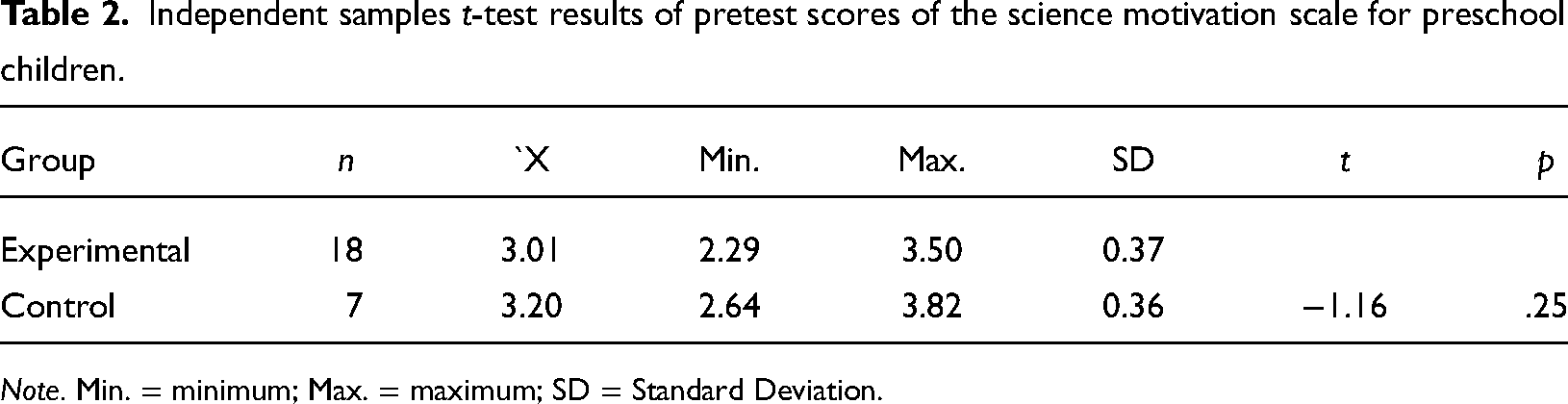
In the study, independent samples t-test was made primarily to test the equivalence of the pretest scores of the experimental and control groups, and the results are presented in Table 2.
Independent samples t-test results of pretest scores of the science motivation scale for preschool children.
Note. Min. = minimum; Max. = maximum; SD = Standard Deviation.
According to Table 2, there was no significant difference between the pretest mean scores of the groups in the Science Motivation Scale for Preschool Children (p > .05). These data also show that the experimental and control groups were homogeneously distributed.
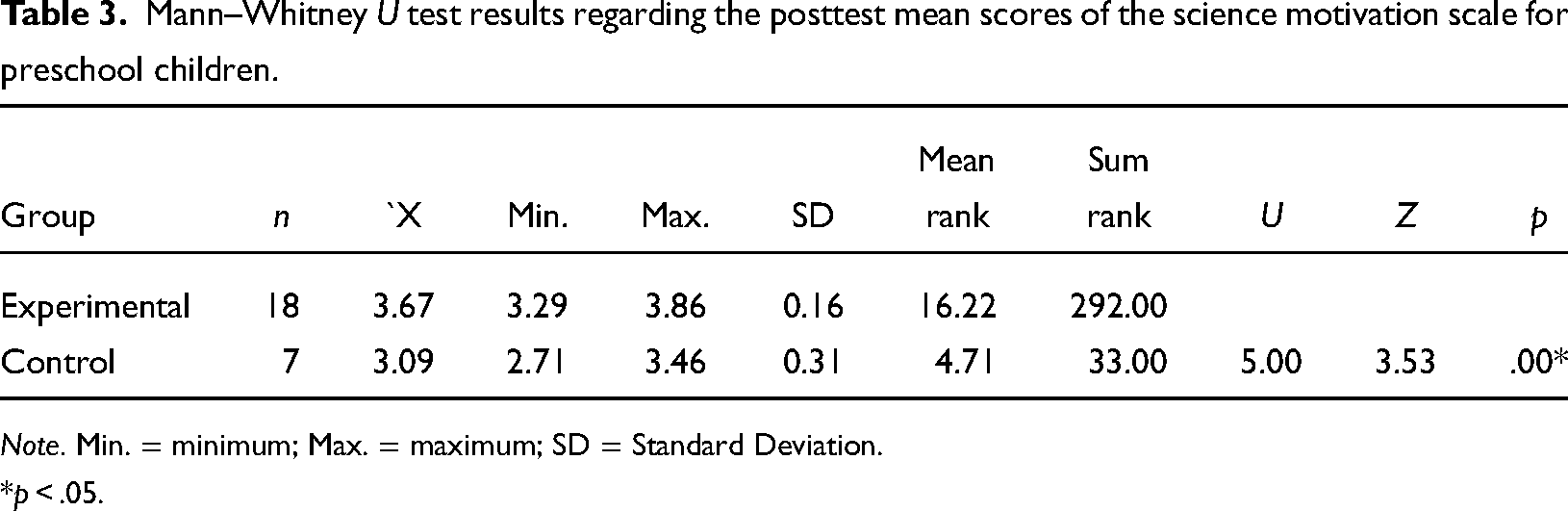
Within the scope of the research, Mann–Whitney U test was used to test the effect of the experimental application process on the posttest scores of the experimental and control groups. Analysis results are given in Table 3.
Mann–Whitney U test results regarding the posttest mean scores of the science motivation scale for preschool children.
Note. Min. = minimum; Max. = maximum; SD = Standard Deviation.
*p < .05.
As seen in Table 3, it was determined that the posttest mean scores of the children in the experimental group for the Science Motivation Scale for Preschool Children were 3.67 in the experimental group and 3.09 in the control group. As a result of the analysis, it is seen that there is a statistically significant difference between the posttest scores of the Science Motivation Scale for Preschool Children (p < .05).
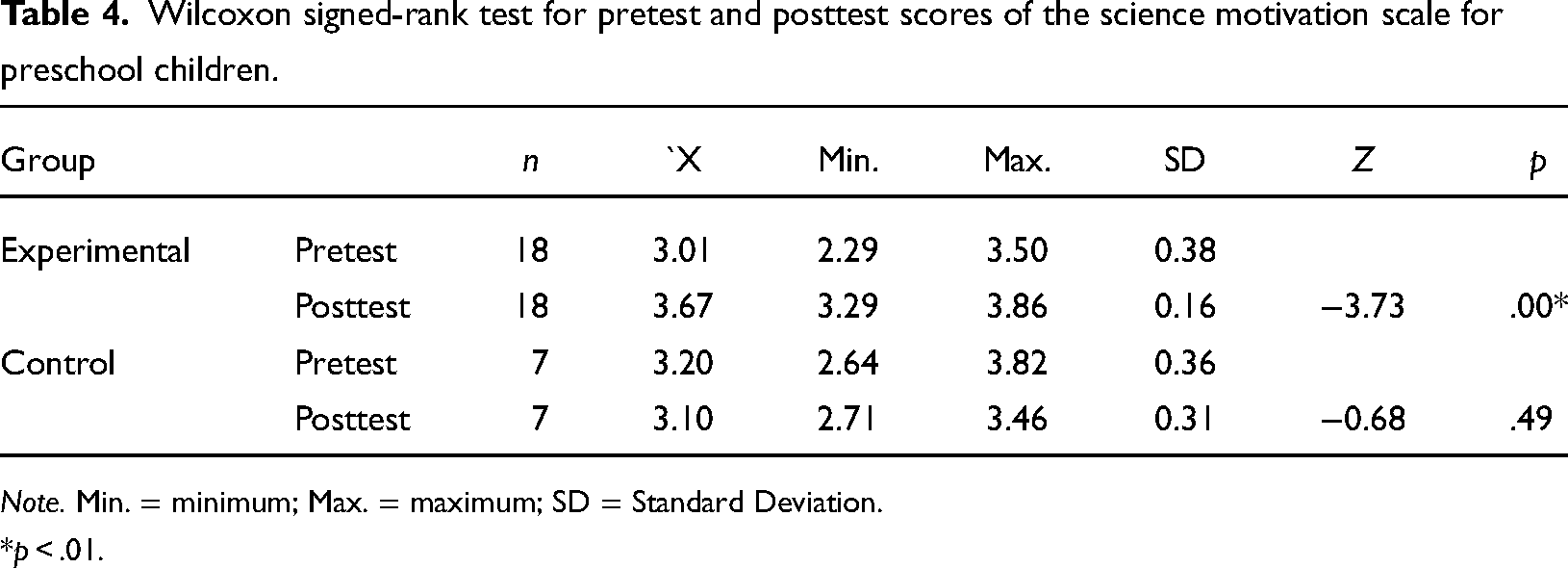
Wilcoxon signed-rank test was used to examine the change in the science motivation scores of the children in the experimental group during the pretest–posttest. The obtained results are presented in Table 4.
Wilcoxon signed-rank test for pretest and posttest scores of the science motivation scale for preschool children.
Note. Min. = minimum; Max. = maximum; SD = Standard Deviation.
*p < .01.
According to Table 4, it was determined that the difference between the mean scores of the children in the control group from the Science Motivation Scale for Preschool Children was not significant. The posttest mean scores of the children in the control group were lower than the pretest mean scores. In addition, it is seen in the table that the difference between the scores of the children in the classrooms in which experimental science activities were applied from the Science Motivation Scale for Preschool Children before and after the experiment was in favor of the posttest average score at the 0.01 significance level.
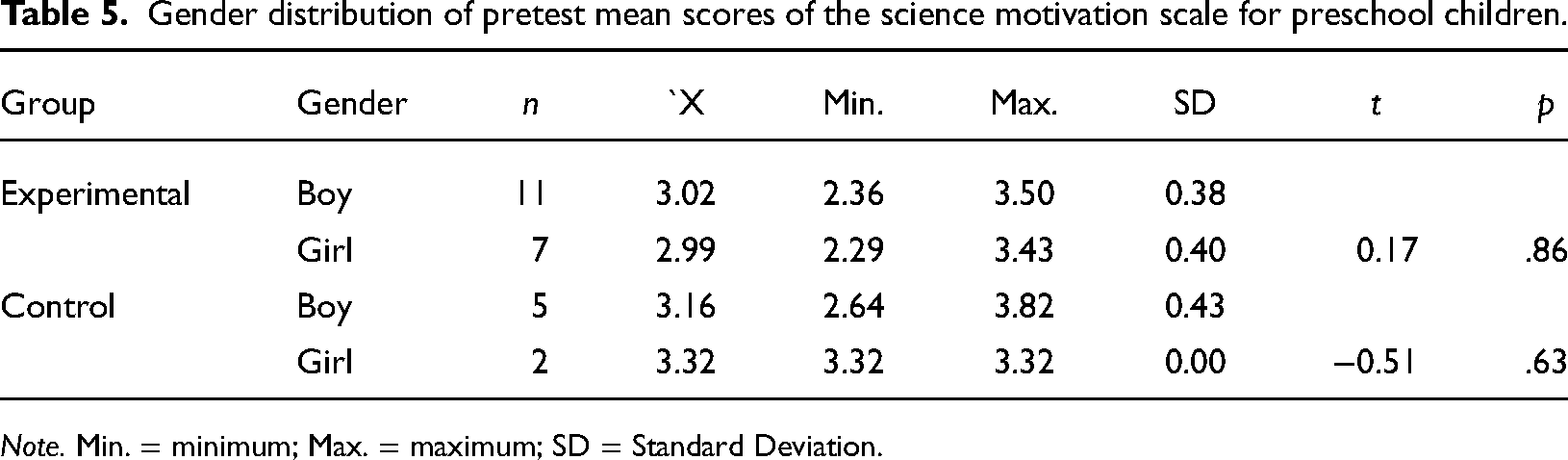
The results of the distribution of the science motivation pretest scores of the children in the experimental and control groups according to their gender are presented in Table 5.
Gender distribution of pretest mean scores of the science motivation scale for preschool children.
Note. Min. = minimum; Max. = maximum; SD = Standard Deviation.
Table 5 shows that according to the scores of the children in the Science Motivation Scale for Preschool Children, there is no gender difference between the pretest mean scores of the children in the experimental and control groups (p > .05).
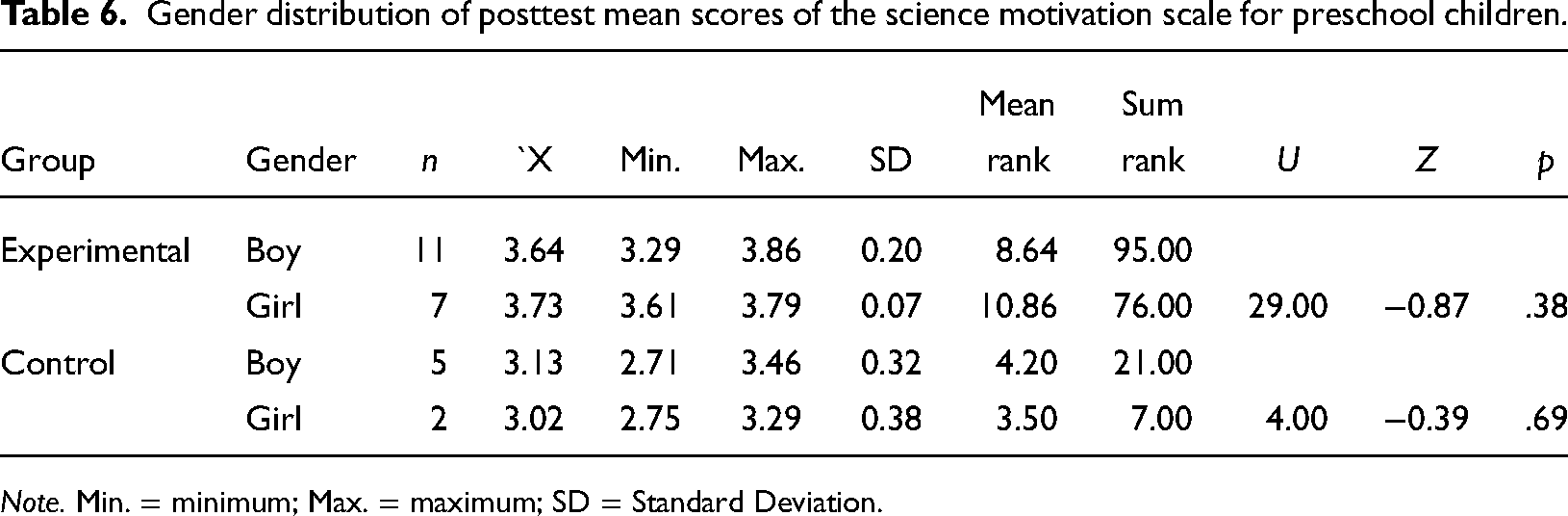
The results of the distribution of the science motivation posttest scores of the children in the experimental and control groups according to their gender are presented in Table 6.
Gender distribution of posttest mean scores of the science motivation scale for preschool children.
Note. Min. = minimum; Max. = maximum; SD = Standard Deviation.
Table 6 shows that according to the scores of the children in the Science Motivation Scale for Preschool Children, there is no gender difference between the posttest mean scores of the children in the experimental and control groups (p > .05).
Discussion and conclusion
This research basically reveals that it is possible to increase the science motivation of children in the preschool period and that science activities based on the hands-on activities can be effective in order to improve the science motivation of children. According to the results of the research, it was determined that the elements of self-confidence and enjoyment for science, which are the elements of science motivation, showed a significant increase in the experimental group in which science activities based on the hands-on activities were performed.
Studies on how science motivation can be improved (Ayvacı & Yurt, 2016; Eshach & Fried, 2005; Güler & Akman, 2006; Mantzicopoulos et al., 2008; Patrick et al., 2008, 2009; Samarapungavan et al., 2011), studies revealing the positive effects of hands-on experiences in early childhood (Çalışandemir & Bayhan, 2011; Ünal & Aral, 2014), and studies showing that hands-on activities affect attitudes toward science (Freedman, 1997; Koç & Böyük, 2012; Milner et al., 2011) support the findings of this study. In this study, it was also determined that science motivation did not differ according to gender. This result is consistent with some studies on the science motivation of preschool children (Alabay et al., 2020; Mantzicopoulos et al., 2008; Oppermann et al., 2018; Patrick et al., 2008, 2009). For example, in a study by Patrick et al. (2009) that included 162 preschool children, some of the children participated in the Scientific Literacy Project for 5 weeks; some participated for 10 weeks. An increase was observed in the science motivation of all boys and girls participating in the project, and there was no gender difference in this increase. Children who participated in this project for 10 weeks reported more proficiency than those who participated for 5 weeks (Patrick et al., 2009). Similarly, in this study, hands-on science activities applied for 5 weeks caused significant increases in children's science motivation. Accordingly, in order to develop children's perceptions and attitudes toward science and to increase their motivation for science, it is effective to carry out programs and activities in which children actively participate, intertwine with science, and gain various experiences related to science. Therefore, it can be understood that, hands-on activities that arouse children's interest, take into account scientific reasoning and scientific process skills, apply open-ended experiments and hypothesis experiments instead of closed-ended experiments, lead to active participation, gain experiences through discovery, and interact with science-related subjects more frequently, have a positive effect on science motivation.
According to the findings obtained from this study, a statistically insignificant decrease was observed in the posttest scores of the children in the control group. Some of the reasons for this can be deprived of making science activities enjoyable (Parlakyıldız & Aydın, 2011), carrying out activities which develop positive attitudes toward science (Saçkes et al., 2011), giving sufficient place to science activities in the program (Ornstein, 2006), hands-on experiences (Çakmak Güleç, 2015). In addition, it is known that in the current program applied to the control group, applied activities were not used at all for 5 weeks, and this is thought to be one of the most likely reasons.
This research aimed to examine the effect of hands-on activities on science motivation of children aged 60–72 months and revealed that hands-on experiences were effective in improving their science motivation. In addition, it was observed that science motivation did not differ according to gender, and there was an increase in the science motivation of both girls and boys in the experimental group. Consequently, it is necessary to provide more opportunities to learn through hands-on science activities in order to increase the motivation of preschool children regarding science (Balat & Önkol, 2017; Çakmak Güleç, 2015; Ornstein, 2006). In this way, children would be able to develop positive attitudes toward science in the future (Dilek et al., 2020; Lamb et al., 2012). Considering the contribution of the hands-on activities to science motivation, children should be offered various opportunities related to science. When it is evaluated that teachers do not include science activities very often, they are usually done once a week and even when there are preschool teachers who include science activities once a month in their programs (Yıldız & Tükel, 2018), it is concluded that these opportunities are not offered to children sufficiently. It is argued that not having enough experience in science activities leads to the evolution of negative beliefs about science (Mantzicopoulos et al., 2008). Overall, it is important for preschool teachers to develop themselves in science activities based on hands-on experience, to create environments where children are more engaged with science, and to actively involve children in the science learning process through fun and exploration. It is obvious that children who have the opportunity to deal with science from an early age develop feelings of excitement and desire toward science (Güler & Akman, 2006). Thus, it is extremely important to create environments in which children can experiment and practice, both at home and in the school environment, during the early childhood period (Ünal & Aral, 2014). In addition, experiments in science activities will enable children to make concrete observations and understand concepts more clearly. As a matter of fact, it is known that children show a special interest in activities using real materials in science teaching, and it is recommended to use learning by hands-on practices in early childhood (Çakmak Güleç, 2015).
It is a fact that, research on how early childhood science practices are related to motivation to learn and understand scientific concepts and processes is insufficient (Patrick & Mantzipoulos, 2015). Nevertheless, in a longitudinal study conducted with children aged 4–7 years, it was determined that, if scientific activities would be implemented less frequently, there would be a decrease in children's interest in science (Alexander et al., 2012). In order to raise individuals who attach importance to science and actively participate in scientific activities, it is necessary to focus on methods and activities that positively affect children's science motivation as from early childhood. Being interested in science increases the possibility of taking advanced scientific courses later in life (Lamb et al., 2012). This means that increasing curiosity and relevance to science is effective and necessary in raising generations who are enthusiastic about scientific knowledge and research.
In early childhood, as long as children have miserable opportunities to learn science, they would be negatively influenced about beliefs and attitudes toward science (Mantzicopoulos et al., 2009, 2013). On the contrary, it is possible to develop positive attitudes toward science by using the hands-on activities more frequently (Ornstein, 2006). Children in the preschool period generally state that the activities including hands-on science experiences are one of their favorites (Doğan & Simsar, 2018). Additionally, it is observed that the preschool children establish connections between the existing information in their minds and the information they have just acquired through experiments (Bjorklund, 2022). Furthermore, increasing scientific experiences in early childhood and the realization of these experiences with active participation are accepted as important predictors of children's motivation (Saçkes et al., 2011). The hands-on activities in preschool science education keep children's curiosity and enthusiasm alive, and also help children to make actual their learning outcomes effectively (Bişkin & Güven, 2021). As a result of this, experiments should be made an integral part of learning experiences in the preschool period (Parlakyıldız & Aydın, 2011).
Hands-on activities are warp and woof of permanent, efficient, and productive learning in early childhood (Ünal & Aral, 2014). In fact, it is known that children's attention and observation skills develop significantly in activities based on hands-on experiences (Doğan & Ünüsan, 2015). In addition, this research has revealed the contribution of experiments to children's science motivation. In other words, this research demonstrated the power of the hands-on activities to increase science motivation in science activities in early childhood.
Recommendations
In line with the results obtained from the study, the effect of applied activities on science motivation in the preschool period can be examined with a larger sample. Because in this study, it was studied with a very limited sample. Therefore, seeing the change created by hands-on activities on the motivation of preschool children in large groups will make an important contribution to the field. However, we think that the science education achievements of these children in their later education levels can be followed. In the classrooms where a relatively long-term hands-on activity program will be implemented, it will be promising in terms of the science activities to be applied from the pre-school period and its motivational results to follow the children's progressive science motivation and its reflections on their academic achievement.
Limitations
In this study, due to the pandemic conditions, the school where the children in the sample continue their education could not be chosen randomly and the appropriate sampling method was used. As the number of children attending preschool decreased due to the COVID-19 pandemic, the number of children in the study sample was limited. In addition, it was not possible to balance the number of children in the experimental and control groups. The posttests were administered during the last week of the school year. The children then left the school. As a result, the maintenance test could not be applied and the sample was lost due to five children dropping out.
Footnotes
Contributorship
Melek Merve Yilmaz was responsible for conceptualization, design of research process, methodology, investigation, writing draft and original paper, and writing review and editing. Asli Bekirler was responsible for the methodology, data collection, data analysis, investigation, and drafting of the paper. Ayperi Dikici Sigirtmac was responsible for conceptualization, design of research process, and supervision.
Declaration of conflicting interests
The authors declared no potential conflicts of interest with respect to the research, authorship, and/or publication of this article.
Ethical statement
The research was approved by the Ministry of National Education of the Republic of Turkey and Çukurova University Institute of Social Sciences Scientific Research and Publcation Ethics Committee (IRB E-95704281), and participation in the study took into account the written consent of the parents and the voluntary participation of the children.
Funding
The authors received no financial support for the research, authorship, and/or publication of this article.
