




Abstract
Highlights
This commentary centers on one of the insightful articles in this Special Issue: “Curriculum Hybridization and Cultural Glocalization: A Scoping Review of International Research on Early Childhood Curriculum in China and Singapore,” authored by
Yang and Li (2022). The commented article provides insights and directions regarding early childhood curriculum policy and practice in China and Singapore. Aligning with
Yang and Li’s (2022) findings, this commentary further paints a new three-component framework (the foreground, the background, and the middle ground) for understanding and harmonizing the global–local dissonance in the early childhood curriculum landscape. Leveraging both hindsight and foresight, this commentary also provides insights for policy and practice to advance a harmonious early childhood curriculum landscape in China and Singapore as well as in other societies confronted with similar predicaments.
Keywords
Introduction
I am honored by the invitation from the Guest Editors (Dr. Weipeng Yang, Dr. Marek Tesar, and Prof. Hui Li) for the Special Issue on “Childhood, Curriculum, and Culture in Diverse Contexts” to comment on one of the included insightful articles. Given that one of my research programs focuses on early childhood curriculum, pedagogy, and policy in Eastern and Western cultures, I am delighted to construct a commentary around the article, “Curriculum Hybridization and Cultural Glocalization: A Scoping Review of International Research on Early Childhood Curriculum in China and Singapore,” authored by Weipeng Yang and Hui Li (two admirable experts and scholars of early childhood education in Chinese societies).
In their article, Yang and Li (2022) reviewed the theoretical and empirical literature related to the policy and practice of implementing imported progressive early childhood curriculum ideologies in China and Singapore. I interpret their review as revealing two key points: (1) the point of divergence and (2) the point of convergence. First, the cultural and ideological incongruence between the Contemporary Western context and the traditional Confucianism-inspired Chinese context appears to have contributed to a noticeable point of implementation divergence. Second, to resolve this divergence, “curriculum hybridization” and “cultural glocalization” are identified as critical points of implementation convergence. Yang and Li’s (2022) article contributes synthesized insights to the early childhood curriculum discourse, especially highlighting hybridization and glocalization as a viable yet complex solution to the inherent global–local conflicts in curriculum importation. In this commentary, I further offer a harmonious solution to this conflicting curriculum landscape by proposing a new conceptual framework to paint over. This framework consists of three integral elements: (1) the foreground (the Western-derived global ideologies), (2) the background (the local cultural and contextual realities), and (3) the middle ground (the harmonization of the foreground and the background). I first contextualize the tug of war between global and local cultures within the domain of response possibilities to global influences concerning early childhood policy and practice. I then introduce the new foreground-middle ground-background conceptual framework. Finally, drawing insights from both hindsight and foresight, I offer recommendations for policy and practice.
Responses to global influences: The domain of possibilities
Culture is generally defined as a set of common beliefs, values, and ideologies shared among members of a community (Hofstede, 1991; Spiro, 1994). Accordingly, a local culture may be referred to as a value and belief system embraced by members of a specific locality, while a global culture may be defined as the dominant system of ideologies shared by citizens or nations in this world. Notably, some local educational ideologies, such as those from the Western cultural context, may prevail over all others to form the global culture of education.
When a local culture encounters the global culture as in the case of importing global ideologies into local early childhood policy and practice, at least three ensuing consequences are plausible. One possibility is cultural consonance: If the values of the local culture are congruent with those of the global culture, a direct match is likely to occur. In this scenario, riding the global currents would likely be a breeze for this ideologically compatible local culture. A second possible outcome is partial cultural consonance: If some aspects of the local values are compatible with those of the global culture, implementation success can still be likely but will require some responsive accommodations. A third possibility is cultural dissonance: If the values of the local culture clash with those of the global culture, a tug of war between the two cultures is likely to occur and local struggles are likely to ensue.
In the case of the third possible outcome, two logical responses may be at play: (1) unyielding and (2) yielding. First, a society may decide not to conform to global ideologies to avoid any potential internal conflict and tension, but there is more at stake with this decision than what logic dictates. For instance, as global views generally signal progress and advancement, by dismissing global perspectives, a society may risk not achieving and maintaining competitiveness in the global sphere dictated by certain global standards. In this scenario, the unyielding response to global forces does not appear to be a viable, let alone sustainable, option for globally prosperous and reliant societies, such as China and Singapore. The second logical solution is to yield to global forces by adopting their standards, but this yielding is likely to conflict with local cultural and contextual circumstances. This scenario appears to reflect the situation of China and Singapore in its early childhood formal curriculum.
Due to cultural dissonance between the global and local forces, China and Singapore encounter inevitable implementation challenges (Yang & Li, 2022). Yet, there are also opportunities for these two societies to scrutinize and reflect on their own practices against global norms to identify their own inner strengths as well as specific areas needing policy and practice improvement. Yang and Li’s (2022) article represents a concerted effort to engage in such scrutiny and reflection. Along with those of other research studies (e.g., Chen et al., 2017; Chen & Li, under review; Yang & Li, 2018a, 2018b), Yang and Li’s (2022) findings also suggest that curriculum hybridization and cultural glocalization are a viable and sustainable bridge between yielding to global forces and attending to local cultural and contextual conditions.
The early childhood curriculum landscape as reflecting both global and local forces
Within the last two decades, the dynamic interaction between global and local forces has painted an intricate landscape of early childhood curriculum for China and Singapore. Just like a typical landscape painting, any attempt to paint this curriculum landscape should consider three coherent yet distinct elements: the foreground, the background, and the middle ground. Collectively, these three elements provide context, draw the main object to our focus, and complete the painting with coherence, cohesion, perspective, and insight. It is within this visual analogy that I comment on Yang and Li’s (2022) article. Figure 1 depicts the landscape of the three essential components (the foreground, the background, and the middle ground). It reflects Yang and Li’s (2022) findings and interpretations concerning the formal curriculum and the implemented curriculum in China and Singapore. Conceptually, just like in a landscape painting, there may be multiple layers embedded within each element, creating an ever more intricate piece of art. This new three-component conceptual landscape framework may also be employed to understand and reconcile the global–local dilemma inherent in other educational phenomena. Each element is discussed in turn in the following sections.
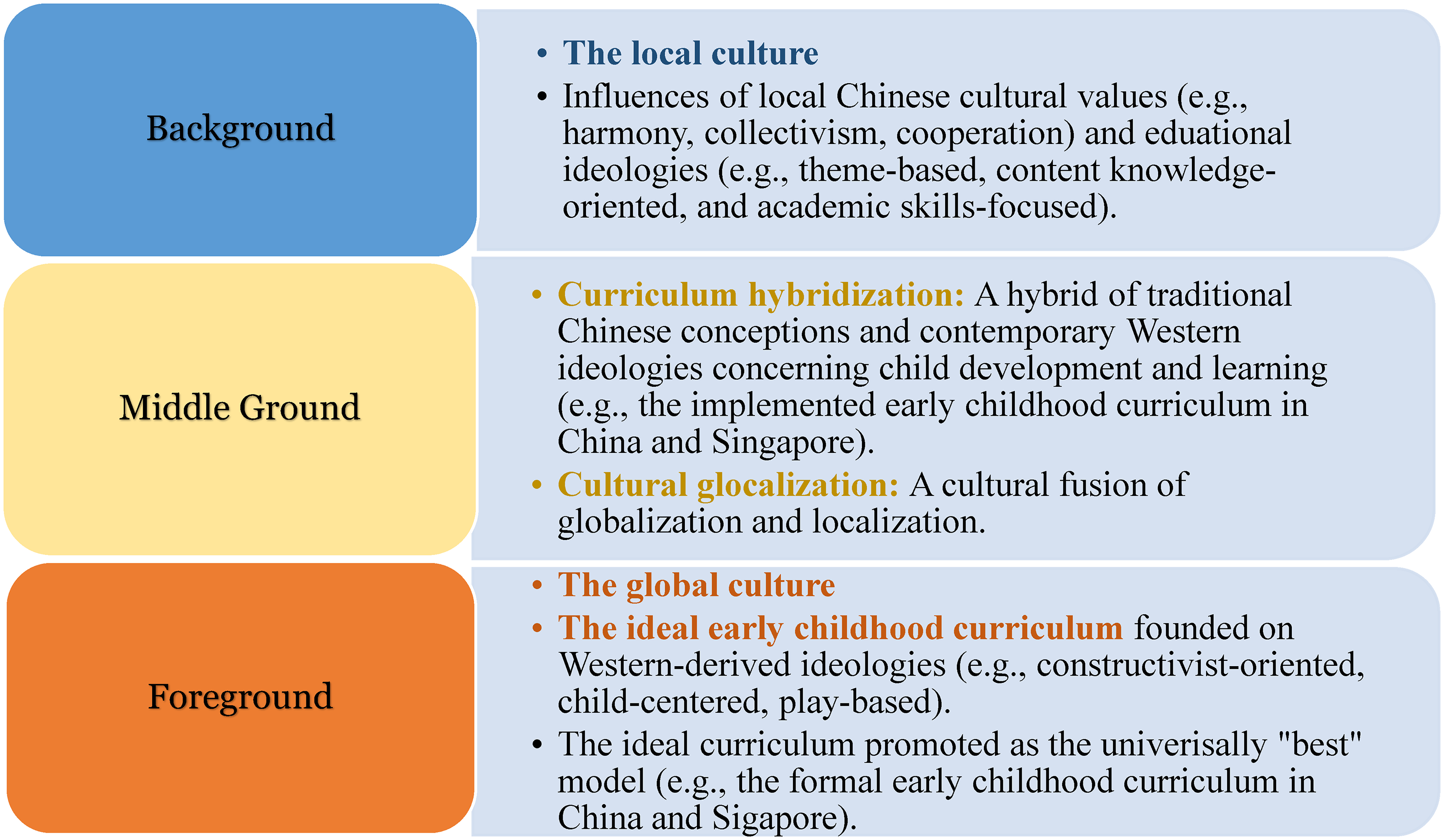
The foreground, background, and middle ground of the new curriculum landscape framework.
The foreground: Western ideologies
Just like in a landscape painting where the foreground is anchored as the focal point or object that is closest in view, contemporary Western ideologies are hailed as the dominant foreground in the global education landscape. Yang and Li’s (2022) scoping review of the literature within the last two decades tells a tale of how two societies (China and Singapore) sharing traditional Chinese values have similarly prioritized early childhood education reforms around the global culture of Western ideologies. At the heart of these ideologies is constructivism, a learning theory that views children as active constructors rather than passive recipients of knowledge (Piaget, 1973; Vygotsky, 1978). Grounded in these progressive, contemporary ideologies, a constructivist-oriented curriculum model (e.g., child-centered, play-based) has accordingly been painted as the foreground in the landscape of the early childhood formal curriculum in both China and Singapore.
The background: Chinese cultural and contextual realities
Just as the background provides the context and supports the foreground in a landscape painting to yield perspective and insight, it is important to situate China and Singapore in context. Over the recent decades, China and Singapore have, by their own merits, catapulted themselves into the ranks of international high academic achievers and prosperous economic powerhouses. Furthermore, China and Singapore are socially distinct yet converge culturally on the shared traditional Chinese culture rooted in Confucianism (Yang & Li, 2022). As reviewed by Yang and Li (2022), the literature generally characterizes the traditional curriculum in both China and Singapore as content knowledge-oriented and academic skills-focused, and the traditional pedagogy as correspondingly teacher-directed and whole-group instructed. This traditional curriculum contrasts starkly with the contemporary, constructivist-oriented curriculum that has been foregrounded fervently by early childhood reformers in both China and Singapore.
The foreground-background dissonance
As revealed by Yang and Li’s (2022) analysis, although well meaning, the formal curriculum, founded on globally espoused progressive Western ideologies, has been met with little implementation fidelity in both China and Singapore. This outcome is not surprising, considering that while it may be easy to institute a policy, it is rather challenging, if not insurmountable, for practitioners to translate into practice a top-down policy involving a paradigm shift in educational ideologies that are culturally bound (Chen et al., 2017). For one, the formal curriculum has been crafted around constructivism and child-centeredness, an orientation that exacts Western cultural ideals (e.g., individualism, autonomy) but is unfavorable to indigenous Chinese cultural values (e.g., collectivism, harmony, cooperation) (Chen et al., 2017; Chen & Li, under review). For another, the focus on content knowledge and academic skills in the traditional Chinese curriculum makes it particularly challenging for practitioners to make the paradigm shift from the traditional curriculum to the formal curriculum. These two related factors appear to be rooted in the fundamental problem of cultural dissonance, creating yet another problem: a policy–practice gap (Li et al., 2011). Furthermore, Yang and Li’s (2022) review also revealed that while the teachers in both China and Singapore espoused constructivist ideologies, their practices (e.g., teacher-directed, whole-class instruction) painted a contrasting picture. In turn, the implemented curriculum by the teachers tended to deviate from the formal curriculum, resulting in a theory/belief–practice gap (Li et al., 2011, 2012).
Both the policy–practice gap and the belief–practice gap suggest the existence of an inherent dissonance between the foreground and the background, leaving the current early childhood curriculum landscape rather disharmonious. This state of disharmony may be best elucidated by the classic Chinese philosophy, Tian Shi, Di Li, Ren He (天时, 地利, 人和), that Chen and Li (under review) proposed as a new theoretical framework for analyzing the implementability of imported Western-derived curriculum and pedagogy in Chinese cultural contexts (e.g., Hong Kong SAR). Tian Shi, Di Li, Ren He comprises three essential elements: “Tian Shi refers to literally heavenly timing (meaning the right time or favorable timing), Di Li earthly auspices (meaning the right place or favorable contextual circumstances), and Ren He the right people or favorable human conditions (e.g., human unity, human capital)” (Chen & Li, under review). According to Yang and Li’s (2022) analysis, the teachers in both China and Singapore appeared to encounter contextual constraints or unfavorable Di Li (e.g., rigidity in teacher autonomy and classroom environment and activities) and inadequate human capital or unfavorable Ren He (lacking professional capacity) to implement the formal curriculum in constructivist, child-centered manners as intended. Collectively, the unfavorable conditions of Di Li and Ren He, in turn, apparently rendered the Tian Shi (timing) inopportune for implementing Western ideologies in the formal curriculum in both China and Singapore. Without the blessings of Tian Shi, Di Li, Ren He, consequently, the top-down policy of the formal curriculum generally lacked implementation fidelity. Furthermore, the formal curriculum seemed to have reflected a phenomenon of superimposing the foreground on the background, making the curriculum landscape appear rather artificial, forceful, and discordant.
The middle ground: A vital yet complex solution to the foreground–background dissonance
Just as in a landscape painting, the middle ground is the natural space that connects the foreground and the background; in the curriculum realm, the middle ground appears to reconcile the foreground–background dissonance in the implementation of Western ideologies in China and Singapore. As Yang and Li’s (2022) review of the literature revealed, although encountering cultural, contextual, and professional challenges in simulating and emulating Western ideologies, teachers in China and Singapore were also met with opportunities for experimenting and innovating new ideas for solving the implementation problem. In the process, the teachers resorted to striking a balance between the global and the local demands to ease any potential tension by seemingly embracing curriculum hybridization (combining global ideologies and indigenous conceptions concerning child development and learning) and cultural glocalization (combining globalization and localization of cultural values) as a complex yet practical solution. Hence, this solution constitutes the middle ground that can potentially harmonize the conflicting forces between the global culture and the local culture.
The middle ground may also be considered optimal for addressing issues associated with Tian Shi, Di Li, Ren He in implementing imported ideologies because it bridges the foreground and the background, making its temporal, spatial, and human capacity dimensions favorable for curriculum hybridization and cultural glocalization to thrive. Furthermore, this middle ground also aligns with Li’s (2007) framework of the 3CAPs: culturally appropriate, contextually appropriate, and child-individually appropriate. Given the cultural and contextual realities presently existing in China and Singapore, just like the situation in Hong Kong SAR (Chen et al., 2017; Chen & Li, under review), the middle ground may well represent the educational innovation that these societies need and can realistically achieve at this moment in time (Tian Shi), place (Di Li), and by the currently prepared teachers (Ren He).
Hindsight and foresight: Insights for policy and practice
As we march into the future, for a country to remain competitive in the global world, early childhood educators and education policymakers in both China and Singapore have every reason to continue searching outwardly for the “best” global knowledge to incorporate into their local culture so that their practices can be locally strengthened and globally competitive. At the same time, it is also imperative that they reflect inwardly to identify their unique “best” practices as well as the middle ground between global and local forces on which they may anchor their policy. This outward–inward dual practice can be applied to all aspects of a society’s functioning within the global–local interactive dynamics.
On the basis of their literature review, Yang and Li (2022) concluded that the Western ideology-grounded formal curriculum, as promoted by education policymakers in both China and Singapore, has not been actualized in its implementation. In hindsight, it appears that both societies have not attained favorable Tian Shi, Di Li, Ren He (Chen & Li, under review), and the 3CAPs (Li, 2007) needed to successfully implement the formal curriculum, an outcome that has also pointed to the existence of a policy/theory–practice gap and theory/belief–practice gap. In further hindsight, two lessons are apparent: (1) adaptation rather than adoption would have been a better approach to the seemingly uncritical importation of curriculum ideologies and (2) a hybrid or glocalized curriculum would have been an instrumental middle ground between the formal curriculum and the implemented curriculum (Chen et al., 2017; Li et al., 2011; Yang & Li, 2018a, 2019).
Nevertheless, we can now leverage our hindsight to inform our foresight for improving the early childhood curriculum policy and practice in both China and Singapore as well as in other societies confronted with similar predicaments. Thus, I present the following four recommendations for policy and practical considerations:
Stakeholders’ voices matter. In hindsight, the top-down early childhood formal curriculum in both China and Singapore has imposed considerable challenges on local teachers who are responsible for implementing it (Yang & Li, 2022). Local educators and education authorities should now have the foresight to reflect on the implementation process and outcome as well as identify areas for improvement in policy and practice. This reflective process needs to involve all stakeholders (e.g., school leaders, teachers, parents) by encouraging them to share their feedback, concerns, and suggestions. For instance, having implemented the formal curriculum arduously, early childhood teachers are in the best position to provide input. Although granting stakeholders the opportunity to voice their views is a pivotal start, it is not sufficient by itself. It must be accompanied by education policymakers’ concerted efforts to consider the feedback from all participating stakeholders seriously in policy improvement. This consideration may potentially help narrow the policy–practice gap. Professional resources and support matter. In hindsight, it was clear that early childhood teachers in both China and Singapore needed proper support and resources to better translate theory into practice. Education authorities there should now have the foresight to invest in strengthening human capital by providing necessary resources, including professional development for teachers to acquire effective strategies for implementing a given curriculum. This investment may potentially help narrow the theory/belief–practice gap. The “best” curriculum model is relative. Agreeing with Yang and Li’s (2022) analysis, I also believe that in contrast to idealism and universalism advocating for an absolute, universal “best” model, an educational model is considered the best only when it is the most appropriate vis-à-vis local cultural and contextual conditions. Based on this logic, as local cultures are not all the same, there is no one single curriculum model that can be considered globally applicable and there may well be multiple culturally and contextually specific best models. Furthermore, from a pluralistic, postmodernist perspective, the best curriculum models are those that have attained Tian Shi, Di Li, Ren He (Chen & Li, under review) and the 3CAPs (Li, 2007) in their implementation. Considering these criteria, for the moment, the best early childhood curriculum that seems operable in both China and Singapore is a hybrid model that combines the best of the two worlds (the Chinese and Western ideologies) and is responsive to local cultural and contextual realities. In hindsight, this hybrid model was also demonstrated as the most fitting approach in Yang and Li’s (2022) review of the literature. Thus, early childhood education authorities and policymakers in both China and Singapore should now have the foresight to potentially consider a hybrid model in their curriculum development and refinment. The middle ground needs concreteness. The formal early childhood curriculum seems to attend mainly to the foreground at the expense of, rather than in consideration of, the background, leaving the curriculum landscape to appear rather unidimensional in perspective. We should now have the foresight to view that when the background is incorporated to provide context, it is easy to see that a middle ground is needed to connect the foreground and background, thereby enhancing the overall perceptual depth of an intricate landscape. Education policymakers supporting the middle ground should now have the foresight to delineate concretely and informatively what this middle ground is and how early childhood teachers may achieve it in practice to increase the likelihood of implementation success. However, the challenge lies in deciphering and discerning what global values to adopt or adapt and what local values to maintain or forsake. One potentially effective strategy is to identify and reflect on points of convergence and divergence between global ideologies and local philosophies to help guide refinement in local policy and practice. As discussed earlier in the Introduction section, I interpreted convergence and divergence as two key points revealed by Yang and Li’s (2022) scoping review of the literature.
Concluding remarks
Taken together, Yang and Li’s (2022) research review suggests that there is disharmony between the foreground and the background in the current early childhood curriculum in both China and Singapore. The solution before educators and education policymakers is to paint a different curriculum landscape that considers the middle ground as a necessary anchor of internal harmony between the foreground and the background. Just like all other elements in an aesthetic landscape painting, the middle ground may be composed of multiple layers, with each additional layer displaying further perceptual depth. A curriculum landscape that is complete with the three essentials (the foreground, the background, and the middle ground) appears to provide the beauty of a multidimensional perspective, offering layers of depth and insight for our appreciation and comprehension. In conclusion, to me, discovering and applying theoretical and empirical knowledge concerning curriculum implementation is science; “painting” this rather integral and intricate three-component curriculum landscape harmoniously to bring about new perspectives and clarity for policy and practice considerations is art; and we need both to advance the education field within the complex yet interactive global–local dynamics.
Footnotes
Declaration of conflicting interests
The author declared no potential conflicts of interest with respect to the research, authorship, and/or publication of this article.
Funding
The author received no financial support for the research, authorship, and/or publication of this article.