




Abstract
Purpose
This study discusses the development of higher engineering education and its future direction following the increased enrollment in higher education institutions in China.
Design/Approach/Methods
By compiling and analyzing corresponding policies and historical and statistical data, the large-scale expansion process and quality enhancement pathways of China's higher engineering education are summarized. Additionally, probable future development scenarios are identified based on the current situation.
Findings
Ever since the expansion of higher education enrollment in China, higher engineering education has experienced rapid expansion in scale and quality, leading China toward becoming a prolific global leader in this aspect. Through a series of national engineering educational reforms, such as “Engineering Program Accreditation,” “Outstanding Engineer Plan,” and “New Engineering Construction,” China has sought to improve the quality of engineering talent to “transition from a large state to a powerful state” in higher engineering education. Therefore, this development process can be considered a “golden age” of higher engineering education development in China. Going forward, China's higher engineering education should focus on continuous quality improvement, strengthen international exchanges and collaboration, and expand into new engineering fields.
Originality/Value
This study systematically analyzes the large-scale expansion and quality enhancement routes of China's higher engineering education. By enhancing the understanding of such education, this study can serve as a reference for domestic and foreign engineering education researchers.
Keywords
Originating from the Self-Strengthening Movement in the late Qing Dynasty, higher engineering education in China underwent a series of eventful explorative paths. The founding of the People's Republic of China (1949) provided fertile ground for the further development of higher engineering education. In the wake of widescale economic reform, known as China's reform and opening-up, such education blossomed. The expansion of higher education enrollment since the end of the 20th century has resulted in rapid growth of the scale of higher engineering education, as well as steady improvement in its quality over a relatively short period. Consequently, China is currently home to the largest higher engineering education pool in the world. In recent years, a series of major reform measures, such as the program accreditation system, “Outstanding Engineer Plan,” and the construction of new engineering disciplines, have been adopted to further improve students’ engineering competence. The two decades following the initial expansion of enrollment are considered the “golden age” of higher engineering education development in China, constituting a giant leap forward in a relatively short period.
Large-scale expansion
With China's rapid economic development and the acceleration of industrialization, the contradiction between the supply and demand of higher education has become increasingly prominent. Talent training for corresponding students has been slow to meet the needs of Chinese society. At the end of the 20th century, the Central Committee of the Communist Party of China (CPC) and the State Council decided to expand the scale of higher education enrollment. Consequently, higher engineering education, an important part of the higher education system, entered a historic stage of large-scale expansion. The scale of China's higher engineering education now ranks first in the world; it has trained tens of millions of engineering and scientific professionals, and an extensive number of industry leaders, supporting the construction of the largest manufacturing economy. Simultaneously, its higher engineering education contributes a large number of engineering and scientific teams to the world, providing a “Talent Highland” and key support for the global scientific and technological revolution and industrial transformation.
Expansion of enrollment in engineering programs across various degree levels
Issued in 1998, the Educational Revitalization Action Plan for the twenty-first Century was developed to realize the tasks and goals of the cross-century social modernization schemes determined by the 15th National Congress of the CPC, and ensure the strategy of invigorating China through science and education. This policy set a goal of a higher education gross enrollment rate of 15% for all school-age youth by 2010. Moreover, it noted the goal for a number of higher education institutions and key disciplines to enter or approach a world-class level (Ministry of Education of the People's Republic of China [MOE], 1998). Since 1999, higher education institutions have attempted to meet the requirements for large-scale expansion of enrollment.
As reported in Table 1, in the first year following the MOE's decree to expand enrollment, the total enrollment rate increased by 46.5%, with enrollment at each level expanding significantly, particularly in junior colleges. More specifically, in 1999, 386,458 students were enrolled in undergraduate programs in engineering (an increase of 38% from the previous year), 221,139 in junior colleges (an increase of 67%), 30,151 in graduate programs (an increase of 34%), and 8,567 in doctoral programs (an increase of 31%).
Enrollment of engineering students at all levels (1999–2021).
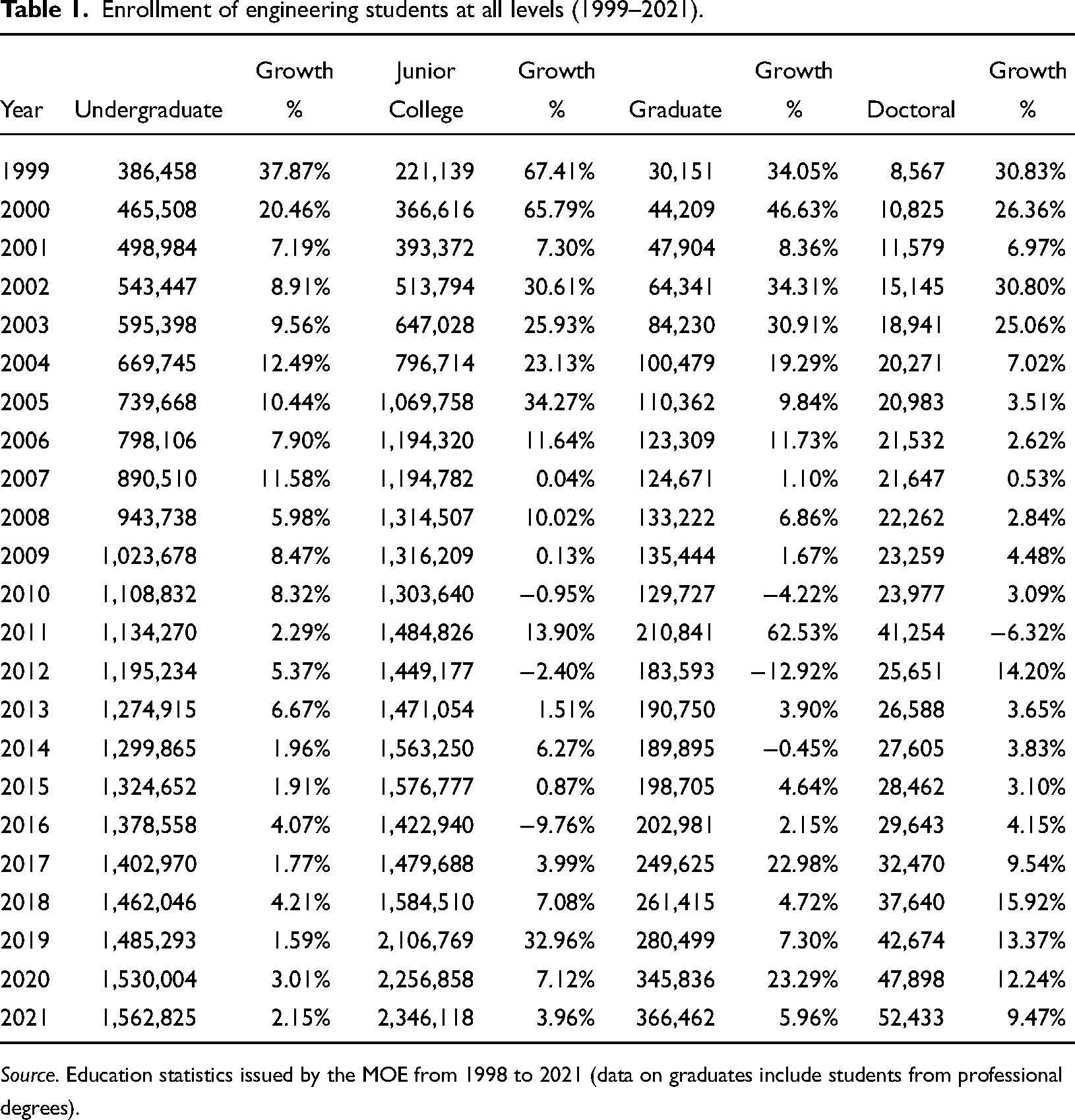
Source. Education statistics issued by the MOE from 1998 to 2021 (data on graduates include students from professional degrees).
From 1999 to 2006, undergraduate enrollment increased from 386,458 to 798,106, by a factor of approximately 2.1, with an average annual growth rate (AAGR) of approximately 14%. Meanwhile, enrollment in junior college increased from 221,139 to 1,194,320, by a factor of approximately 5.4, with an AAGR of ≈33%. Graduate enrollment increased from 71,847 to 341,970 (a factor of around 4.8, with an AAGR of ≈24%), while that of doctoral students increased from 19,915 to 55,955 (a factor of around 2.8, with an AAGR of ≈17%) (Table 1). As a result, the number of engineering students in China increased exponentially from 1999 to 2006. In particular, junior college enrollment approached 1.2 million in 2006, more than five times of that in 1999. Engineering thus expanded significantly between 1999 and 2006, laying the talent foundation necessary for China to become a prominent state in engineering education.
Higher education has placed greater emphasis on quality, focusing more on the development of programs since 2007. Consequently, the enrollment growth rate began to decline. Undergraduate enrollment increased from 890,510 in 2007 to 1,562,825 in 2021 (AAGR ≈4.9%), while junior college enrollment increased from 1,194,320 to 2,346,118 (AAGR ≈4.9%). Graduate enrollment increased from 124,671 to 366,462 (AAGR ≈8.8%), while that in doctoral programs increased from 21,647 to 52,433 (AAGR ≈6%). Although enrollment continued to expand during this period, the growth rate declined significantly, with the AAGR dropping below 9%.
Increased provision in engineering programs and high proportion of corresponding academic majors and disciplines
In terms of the distribution of engineering majors, the number of undergraduate programs grew rapidly across the country following the initiation of enrollment expansion. In this respect, the distribution of undergraduate programs presented a growing trend. Specifically, the number of colleges and institutions offering engineering programs increased more than 2.5 times, growing from 9,180 in 1999 to 23,472 in 2020. This indicates the growing nationwide popularity of higher engineering education, with increasing numbers of colleges, universities, and research institutes becoming involved in the training of engineering undergraduates. Currently, approximately 92% of higher education institutions in China offer engineering programs. After years of development, a solid foundation has been laid with a better ability of higher engineering education in China to meet society's demand for various levels and types of engineering and technical talent.
Academic majors and disciplines of engineering at the undergraduate, junior college, and graduate level account for more than a third of all programs offered by these respective institutions, making engineering a significant part of higher education overall. According to “The Catalog of Undergraduate Programs in Regular Institutions of Higher Education” (2020) and “List of New Majors Included in the ‘Catalog of Undergraduate Programs in Regular Institutions of Higher Education’” (2022), there are 92 undergraduate categories, 31 of which are related to engineering (33.69%) and 771 undergraduate majors, 260 of which are related to engineering (33.72%). Meanwhile, “The Catalog of Higher Vocational Education (Junior College) Programs in Regular Institutions of Higher Education Learning” (2015) identifies 19 junior college program categories, nine of which pertain to engineering (47.4%). The document also lists 762 junior college majors, 387 of which are related to engineering (50.8%). Finally, “The Discipline Catalog of Degree Awarding and Personnel Training” (2018) lists 13 major discipline categories comprising 111 first-level graduate programs, of which 39 are related to engineering (35.1%).
The emergence and rapid expansion of professional engineering degrees
Enrollment in graduate engineering programs has grown rapidly over the past two decades. In 1997, the Academic Degrees Committee of the State Council (ADCSC) reviewed and approved the “Proposal for the Provision of Master Programs in Engineering,” and the Master of Engineering (ME) was officially incorporated into graduate engineering education. The annual number of ME degrees awarded between 1999 and 2018 is illustrated in Figure 1. In 1999, 44 students across China were the first to receive an ME degree. By 2018, this number had grown to 135,462. In 2015, the number of graduates receiving an ME degree (129,478) outnumbered those receiving a Master of Science in Engineering (MSE) degree (113,378). By 2018, a total of 135,462 ME degrees had been granted, which was nearly 30,000 more than the number of MSE degrees. Over the past 20 years, the ME enrollment rate has expanded rapidly, and the degree now constitutes an important part of the engineering graduate program; this growth trend continues today. As a new degree program, the ME provides strong quantitative support for the large-scale expansion of engineering education at the graduate level.
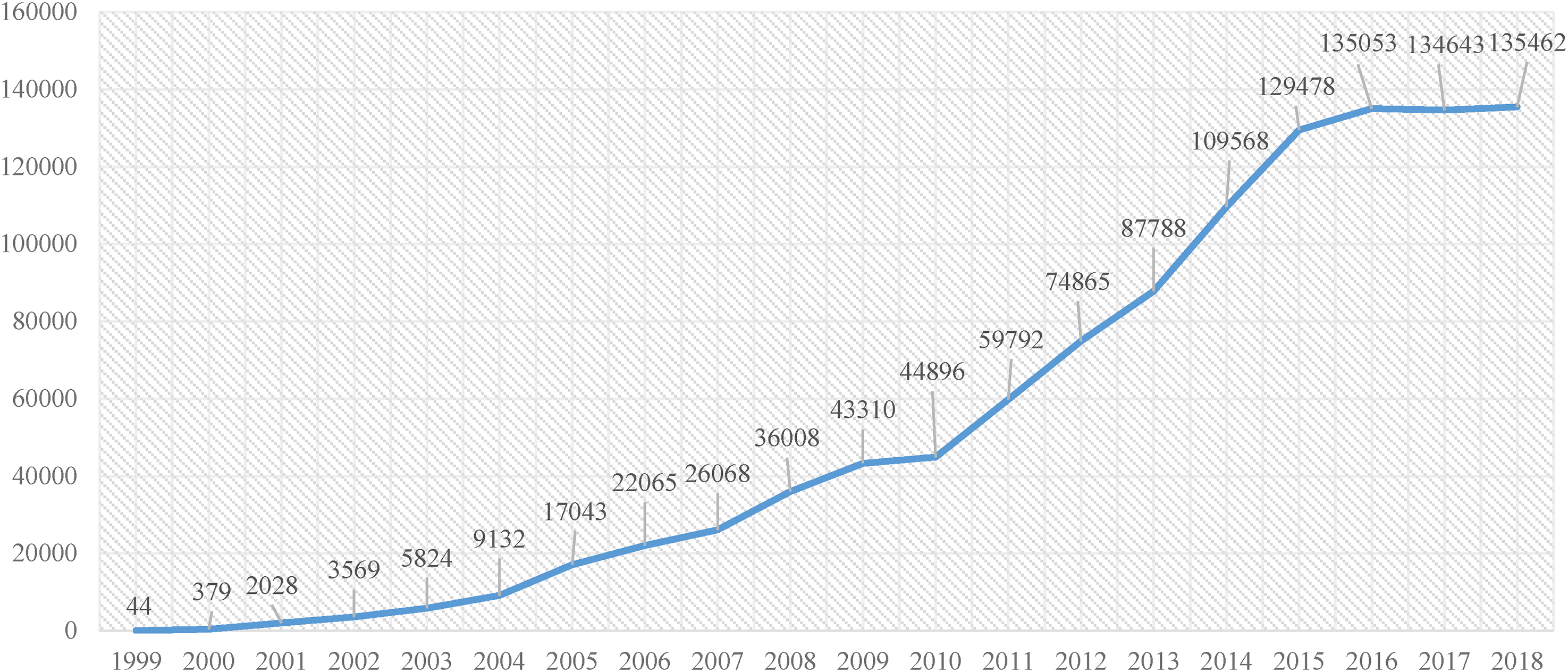
Number of ME degrees granted in China, 1999–2018.
Enrollment in the Doctor of Engineering (EngD) program has also expanded in recent years. In 2011, the ADCSC reviewed and approved the “Proposal for the Provision of Doctorate Programs in Engineering,” and the recruitment of EngD students began the following year. In 2011, 24 universities, including Tsinghua University, were authorized to confer EngD degrees, with an additional 16, including Beijing Jiaotong University, added to the list in 2018. At present, 40 universities have the authority to confer the degree (Academic Degrees Committee of the State Council, 2019). A total of 178 EngD students were recruited in 2012 and 2013, and 189 in 2014. By 2019, the number of professional doctoral students exceeded 10,000 (10,386), accounting for 9.9% of the total enrollment; engineering doctorates comprised a significant portion in this respect. As an emerging program, the enrollment of EngD students has increased rapidly over the past decade. They are an important new and strategic reserve force for the scientific research frontier and technological innovation, and are of particular significance for improving China's scientific and technological strength, comprehensive national strength, and global competitiveness (Lin & Shi, 2020). EngD programs have largely satisfied the demand for high-level engineering and technical talent, produced particularly capable high-end talent able to lead the construction of innovative national development policies, and enhanced the training system of engineering and technical talent in China. In the future, Doctors of Engineering will play a key role in the cultivation of engineering science and technology talent.
Improved academic structure in engineering
In terms of the internal structure, programs provided at the junior college, undergraduate, graduate, and doctoral levels have continued to improve since the initiation of the enrollment expansion policy. Such improvements are primarily reflected in the total enrollment rate for engineering programs, which reveals increased enrollment in junior colleges and graduate programs, and decreased enrollment in undergraduate programs. As a result, undergraduate programs are no longer the main source of engineering talent, and talent cultivation has shifted toward graduate and junior college programs.
However, despite these significant changes, traditional disciplinary categories remain dominant. The proportion of students in electrical and information sciences, mechanical engineering, and civil engineering account for the highest proportion of total students enrolled in engineering programs. Therefore, traditional engineering disciplines retain their absolute advantage. Among undergraduates, information-driven disciplines, such as electronic science and technology, optical engineering, information and communication engineering, computer science and technology, and control science and engineering, account for approximately one-third of total enrollment. Civil engineering, equipment manufacturing, transportation, and electrical and information sciences remain the dominant categories, accounting for 83%–90% of the total enrollment in engineering categories. Meanwhile, resources, environment, and safety; energy, power, and materials; water conservation and biochemical engineering; and light industry and textiles account for only 10%–17%.
The proportion of students enrolled in engineering programs at all levels has stabilized since the initial period of high growth. Higher engineering education programs account for one-third of the total undergraduate and graduate education programs, while a third of the students and graduates are from engineering programs (Wu, 2018). This has resulted in a pattern of engineering constituting approximately one-third of the total higher education system.
Increased international students in China
Economic globalization has further promoted the internationalization of China's higher education, with higher engineering education gradually achieving in-depth international integration. In the wake of the Washington Accord and “Belt and Road Initiative” (BRI), the quality of China's engineering and technological talent training has received international recognition. In this respect, the Chinese government has established a series of scholarships to encourage students and scholars from around the world to study and engage in research projects at Chinese institutions. Thus, a growing number of international students regard China as an important destination country for studying abroad. Indeed, enrollment in higher engineering education in China has become more popular among international students; the number of corresponding international students has increased steadily and the structure of student sources has been consistently optimized. There was a rapid increase in the number of undergraduate engineering students studying in China, from 608 in 1999 to 32,930 in 2020 (a 58-fold increase). Moreover, as illustrated in Figure 2, the number of foreign graduate students increased from 1,119 in 2005 to 22,115 in 2018 (a 20-fold increase).
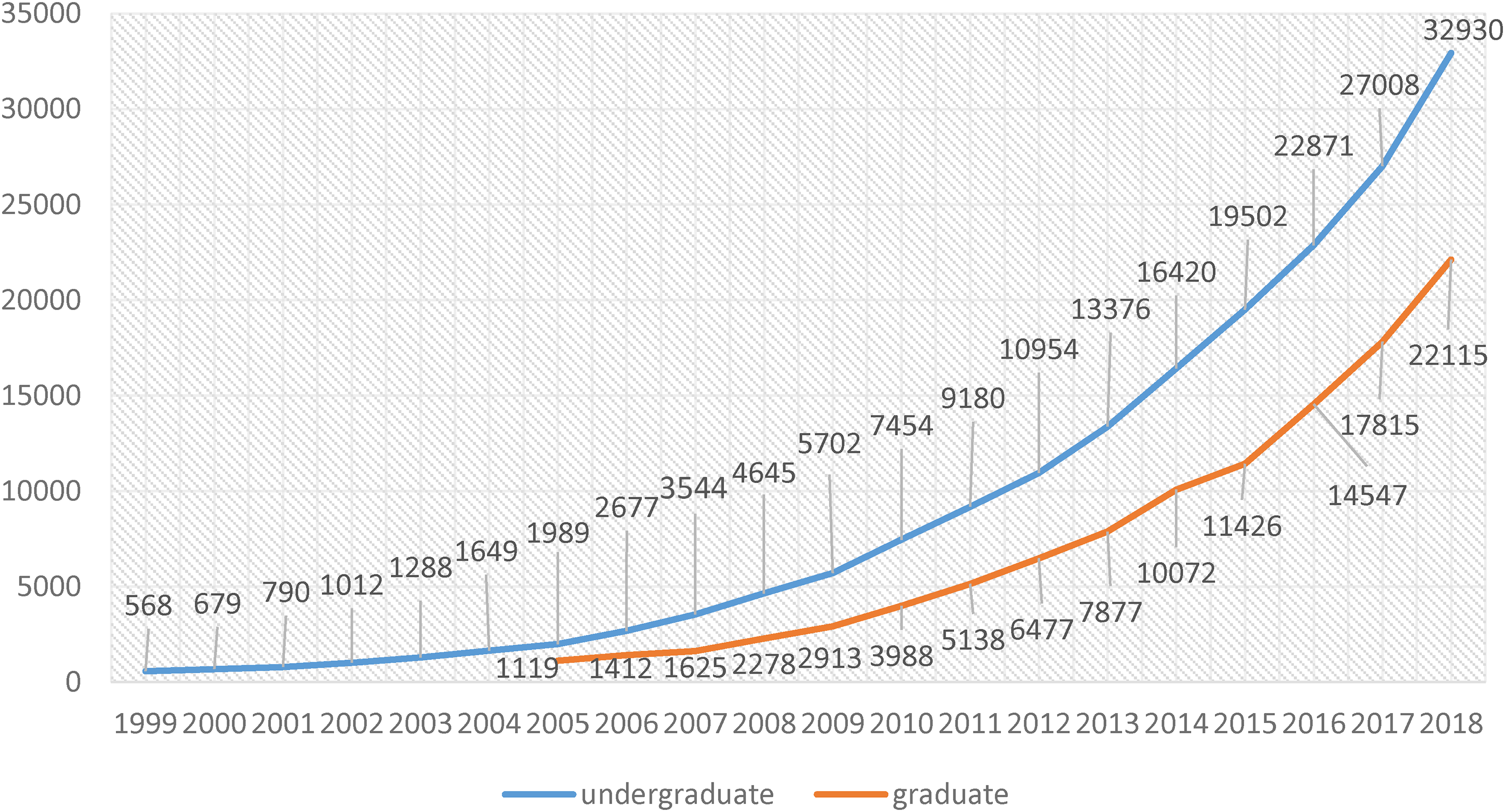
Number of international students enrolled in engineering in China (by year). Source. Data compiled by the author based on “Education for International Students in China in the 30 Years (1978–2008) following the Implementation of the Reform and Opening-up Policy” and the Concise Statistics on International Students Studying in China issued by the Department of International Cooperation and Exchanges of the MOE. Data pertaining to graduate students were available from 2005.
Quality enhancement pathways
A core task of higher engineering education in the new era is to cultivate a large base of high-quality engineering science and technology talent with strong innovation capabilities, the ability to adapt to China's economic and social development needs, and the capacity to help transform it from a large state to a leader in engineering education. In recent years, secondary and higher engineering education has undergone a series of reforms, including “Engineering Program Accreditation,” “Outstanding Engineer Education and Training Program,” and “Construction of New Engineering,” intended to improve the training quality of engineering science and technology talent in a holistic manner.
Preliminary establishment of the engineering accreditation system
Established in 2005, the National Engineer System Reform Coordination Group led the systematic reform of engineering and launched an engineering education accreditation initiative. After applying for provisional membership in June 2013, China officially joined the Washington Accord in 2016, becoming the eighteenth signatory member. By the end of 2020, 1,600 programs across 257 regular higher education institutions in China had passed the engineering education accreditation, including 22 programs in engineering (e.g., machinery and instruments) (Higher Education Evaluation Center, Ministry of Education of the People’s Republic of China, 2021). Joining the Washington Accord signaled that the quality of China's engineering education was internationally recognized, an important step in ensuring the global reach of its higher engineering education. Moreover, the accreditation system has evolved from superficially following procedures to fully incorporating the principles of accreditation, thereby guaranteeing the “substantial equivalence” of international accreditation (Li & Zhao, 2021).
Active promotion of new engineering disciplines
In response to a new round of technological advances and industry transformation, and to support a series of national strategies like service-innovation-driven development and “Made in China 2025,” the MOE launched a “new engineering” construction plan in 2017. This was intended to accelerate the design and construction of the new engineering disciplines and majors required for new industries to lead the holistic reform of higher engineering education. The plan successively implemented the “new engineering trilogy” of the “Fudan Consensus,” “Tianjin University Action,” and “Beijing Guidelines,” and launched new engineering research and practice projects exploring a new model for China's engineering programs in the Fourth Industrial Revolution.
Thereafter, groups of universities that excelled in engineering education as well as comprehensive and local university groups were established to actively promote the development of new engineering disciplines (Gu, 2017). To further promote China as an authoritative state in higher education, the government has spared no effort in exploring the construction of higher engineering education in the new era. More specifically, policies like the “Notice on Launching New Engineering Research and Practice Projects” and “Notice on Recommending New Engineering Research and Practice Projects” were issued with the aim of forming a Chinese model and experience to lead engineering education at the global level, as well as to support the building of a strong state in higher education. Moreover, the new engineering research and practice projects are important to promote the construction of new engineering. In 2018, the MOE announced the first batch of 612 new engineering research and practice projects and the second batch of 845 in 2022, bringing the total to 1,457. In addition to the state-level new engineering projects, the educational administrative departments in Shaanxi, Henan, and other places have also identified provincial-level new engineering research and practice projects, and provided financial support through various channels. New engineering research and practice projects are important measures to improve quality, promote fairness, and innovate talent training mechanisms. They have made a beneficial exploration of the interdisciplinary integration of higher engineering education, the renewal and transformation of traditional majors, and the collaborative education between industry and education.
To firmly promote the in-depth and extended development of new engineering disciplines and form innovative domains that lead to active breakthroughs, in July 2020, the MOE and the Ministry of Industry and Information Technology (MIIT) jointly issued the Guide to the Construction of Modern Industrial Colleges (for Trial Implementation). This policy is intended to cultivate high-quality, cross-disciplinary, and innovative talent able to adapt to and lead the development of modern industries and put their learned knowledge and skills into practice. It was also decided that a number of modern industry institutes should be co-constructed, managed, and shared between local governments, industry enterprises, and other higher education entities to ensure that these institutes possess distinctive characteristics and close ties to industry. Numerous higher education institutions have successively established such modern industry institutes. These schools have become an important starting point for local institutions to promote the construction of new engineering disciplines and cultivate high-quality engineering and technical talent (Huang & Yao, 2019). At the end of 2021, the MOE and MIIT announced the first 50 modern industry institutes, including the now renowned Tencent Cloud Intelligence Research Institute of Shenzhen University.
In addition to focusing on talent cultivation, these institutes place considerable focus on the exploration, research, and development of future technologies, closely combining these with talent cultivation. In 2021, the MOE announced the first 12 “future technology institutes/colleges,” which included Peking University, focusing on a number of areas related to national strategy, national security, the economy, and Chinese society, as well as developments related to people's lives, such as artificial intelligence (AI), quantum information, integrated circuits, life and health, brain science, energy and environment, and aerospace technology. These institutes are committed to building a training foundation for future technological leaders, thereby contributing to further enhancement and radical innovation of new engineering disciplines. The universities also promote new engineering disciplines by building distinctive demonstration institutes in the areas of software engineering, microelectronics, first-class network security, and energy storage technology.
New engineering disciplines and the transformation of traditional disciplines
To meet the societal and industry demands for new engineering disciplines, higher education institutions have successively launched a number of new programs in recent years. Between 2014 and 2021, 77 new undergraduate engineering programs were introduced, accounting for 34.07% of the total number of new undergraduate programs. These are offered by 1,983 higher education institutions. One such program is based on new and fledgling areas in Internet and industry intelligence like big data science and technology, AI, blockchain, and virtual reality. Several other programs are based on empowering traditional fields with digital and smart technologies, including smart construction, smart equipment for agriculture, smart mining projects, and big data policing technology. With the continuous development of such technology, the demand for engineering and technological talent in emerging industries has triggered substantial change. The establishment of such academic programs is intended to satisfy the demand for talent, while enhancing the growing capacity for higher engineering education in terms of serving major national strategies and the needs of emerging industries.
Traditional disciplines have also undergone continued enhancements to ensure adaptation to the corresponding industries, which is an important path for the construction of new engineering construction. With the assimilation of digital and smart technologies in traditional industries, engineering and technological talent who received training in traditional paradigms face growing difficulties. If traditional programs of engineering cannot keep up with the times in terms of teaching content, knowledge structure, training models, teaching staff, and teaching environment, or ensure continued transformation, they are unlikely to generate the engineering talent required by emerging industries. In this context, higher education institutions have begun exploring new practice and transformation methods to upgrade traditional disciplines. Facing both the primary needs at the national and regional levels and the new demand for future industry development of professional talent, higher education institutions have begun investigating new transformation and development directions for traditional disciplines. Thus, greater focus has been placed on informatization, digitization, and smart technology in the engineering industry chain. Moreover, cross-disciplinary programs in fields related to adjacent industries in the chain have been developed to inject engineering talent into new industries.
Education and training plan for outstanding engineers
To achieve national goals like the new industrialization and construction of national innovation, the MOE, along with relevant departments and industry associations, initiated the Education and Training Plan for Outstanding Engineers (Outstanding Engineer Plan) in relevant universities from 2010. In September 2018, the MOE, MIIT, and Chinese Academy of Engineering (CAE) issued Opinions on Accelerating the Construction and Development of New Engineering and Implementing the Education and Training Plan 2.0 for Excellent Engineers (Outstanding Engineer Plan 2.0) to explore and implement a new paradigm for engineering education, which triggered a nationwide “quality revolution” in engineering education. Three batches of higher education institutions (346 in total) covering 1,212 academic majors/disciplines have been included in the Outstanding Engineer Plan since its implementation. A total of 824 higher education institutions provide undergraduate programs, while 388 provide graduate programs.
The Outstanding Engineer Plan is a key measure in China's transformation from a large to powerful state in engineering education. This plan is intended to cultivate a substantial body of diverse and high-quality engineering and technical talent, which is a specialized pool of human resources possessing the required innovation capabilities to meet the needs of socioeconomic development and facilitate the strategic development of new industrialization in China, as well as the innovative potential of the corresponding talent at the national level. Thus, the plan serves to validate and guide higher education in terms of cultivating talent to meet social needs and comprehensively improving the quality of engineering education talent.
Commitment to teaching reforms
Under the guidance of the MOE, higher education institutions have implemented a series of fruitful teaching reforms. These included teaching reform activities in the field of engineering, including the Conceive-Design-Implement-Operate (CDIO) initiative, Project-Based Learning (PjBL), and Outcome-Based Curriculum (OBC), as well as general reforms intended to improve the quality of undergraduate teaching such as the “Double Ten Thousand Plan.” The education reform measures implemented in recent years have significantly improved the quality of engineering talent training.
The CDIO initiative was introduced in China in 2005. In 2008, the Department of Higher Education issued a document establishing the Task Group for the Research and Practice of the CDIO Approach in Engineering Education. In 2016, the MOE formed the CDIO Engineering Education Alliance on the basis of the original CDIO Engineering Education Reform Pilot Working Group, where 105 universities joined the alliance. The CDIO subsequently emerged as a key reform movement in higher engineering education in China. CDIO-based reforms and development have demonstrated that the CDIO noticeably improves the quality of talent training, promotes teaching reforms and research in engineering education, and stimulates other important reform projects in higher engineering education (Gu et al., 2017). Application of the CDIO framework has changed the perspectives underpinning China's engineering education, improving the educational quality of engineering and technological talent in pilot universities, advancing engineering education teaching reform and research, and promoting important higher engineering education reform projects, such as the Outstanding Engineer Plan and the Accreditation of Engineering Program.
PjBL became popular in China at the beginning of the 21st century. By focusing on professional frontier knowledge and multidisciplinary integration, PjBL effectively bridges science, technology, engineering, and mathematics (STEM) and humanities education through curriculum reforms. Engineering education scholars generally agree that PjBL is a participatory and comprehensive teaching method, wherein solving real problems is considered a driving factor for learning. Students are both participants and designers of activities, while teachers act as chief designers and process consultants. Learning outcomes involve either designing products or writing various forms of reports. PjBL aims to help students learn to apply knowledge, select methods and techniques, and propose, evaluate, and compare project solutions (Tian et al., 2021). Following the launch of the Outstanding Engineer Plan, PjBL has become the favored teaching method in engineering education, as it organizes and conducts teaching activities surrounding actual engineering projects, provides students with real engineering backgrounds and training, and helps them apply and integrate disciplinary knowledge while developing practical skills (Han et al., 2019).
Outcome-based education (OBE) is a learner-centered, learning-result-oriented educational philosophy that has had a significant influence on various nations and regions, including North America, Australia, and South Africa (Zhang et al., 2020). International engineering professional accreditation programs like the Accreditation Board for Engineering and Technology (ABET) and Washington Accord have also adopted such student-centered, result-oriented, and reverse-design concepts. After becoming a formal member of the Washington Accord in 2016, China's higher engineering education and teaching reform were deeply influenced by OBE. Indeed, OBE-guided higher education reforms are on the rise. Spearheaded by Tsinghua University and Shantou University, many higher education institutions have conducted OBE practices and explorative initiatives, thereby improving teaching quality and further enhancing China's higher engineering education.
Moreover, in undergraduate education, the implementation of a series of “quality revolution” actions have helped improve the quality of engineering education. In recent years, a government-backed strategy of reform, exploration, and practice of building first-class universities and revitalizing undergraduate education has been launched in China. Following the 18th National Congress of the CPC, a large number of higher education institutions successively implemented the strategy of “coordinated promotion of ‘double first-class’” and launched comprehensive and in-depth reform pertaining to this target, prompting other higher education institutions to adopt the target as a primary goal. The MOE issued several policies to support such measures and targets, including Opinions on Accelerating the Construction of High-Level Undergraduate Education and Comprehensively Improving Talent Cultivation Ability, Opinions on Deepening the Reform of Undergraduate Education and Teaching to Comprehensively Improve the Quality of Talent Training, and Notice on the Implementation of the “Double Ten Thousand Plan” to Construct First-Class Undergraduate Programs. Many educational reform activities like flipped classrooms and Massive Open Online Courses (MOOCs) have been promoted and applied nationwide. Although these policies and measures are aimed at higher education more generally, they specifically promote the quality of higher engineering education.
Acceleration of the internationalization of higher engineering education
The internationalization of engineering education in China has accelerated rapidly, and its international influence and discursive power have increased significantly. The construction of new engineering also emphasizes future-oriented international competitiveness, influencing engineering education to ensure the cultivation of engineering and technological talent with a global vision and competence (Lin, 2017). Cultivating internationally competitive talent in engineering science and technology is not only the primary path for the internationalization of China's higher engineering education, but also an inevitable requirement for the development of engineering in the new era. Internationalization is facilitated by enrolling foreign engineering students, recruiting foreign engineering teachers, hosting and participating in international engineering conferences, organizing non-degree exchanges of students and visiting scholars with foreign universities, co-running schools with international organizations, promoting international engineering program accreditation, establishing international industry-university-research cooperation, and issuing international journals.
In the past three years, the pandemic has hindered the flow of talent between countries and introduced many difficulties to international exchange and collaboration in engineering education. On the one hand, international academic exchanges based on personnel mobility cannot proceed normally. According to incomplete statistics of relevant universities in China, more than 90% of overseas academic exchange plans have not been completed as of 2020, more than 90% of overseas academic exchange funds for business have not been used, and international academic exchanges have to be transferred online. However, international engineering education has been greatly hindered by travel restrictions for international students who are unable to attend on-site teaching in foreign universities. Starting from 2023, with the weakening of the spread of COVID-19 worldwide, China gradually changed its public health policy. The pandemic has started to become a thing of the past; the international exchange and development of higher engineering education will be smoother and such education will certainly flourish in the future.
Future development priorities
In terms of scale, China's higher engineering education ranks first in the world. However, China remains lacking in terms of the actual reserve of high-level and innovative talent in engineering science and technology. The supply of corresponding talent has yet to meet the demands of the new scientific and technological revolution and subsequent industry transformations. For China to become a powerful country in terms of higher engineering education, significant focus should be placed on the quality of talent training.
Appropriate scale control and construction of a high-quality engineering education system
The key problem of the scale is the large number of undergraduate and junior colleges students, but a lack of masters, doctors, and excellent overseas students. China should continue expanding its graduate enrollment, especially doctoral students on the basis of ensuring appropriate overall scale. A reasonable hierarchical structure of higher education is conducive to economic development. China has a large base of engineering graduates, especially from junior college and bachelor programs, which meet the talent demands of a large manufacturing country. However, graduate-level trained engineering students only account for approximately 10% of all engineering students, with even fewer doctoral students (less than 1%). To transform China from a large manufacturing state into an intelligent one, it is necessary to expand the cultivation of high-level science among engineering graduates according to the needs of the external market.
As such, a steady increase in the enrollment of graduate students and a significant increase in the recruitment of engineering doctoral students are necessary. The 2020 National Graduate Education Conference proposed that the training of graduates should focus on talent specialized in a given profession, with knowledge and skills that can be applied immediately in practice (i.e., applicable talent). In September 2020, the MOE issued the Graduate Professional Degree Education Development Plan (2020–2025), proposing that, by 2025, the proportion of specialized graduate enrollment should be expanded to comprise approximately two-thirds of total graduate enrollment. As engineering talent requires outstanding hands-on capabilities, as well as the ability to directly confront market needs, corresponding disciplines should also focus on expanding the enrollment of graduate students.
The Fourth Industrial Revolution witnesses an unprecedented demand for applicable high-level talent in new industries. Accordingly, it is necessary to progressively expand the enrollment of engineering doctorates to adjust and optimize the hierarchical structure of higher engineering education, and adapt to industry transformation, advancement, and structural optimization. Professional graduate degrees are better able to provide talent with extensive professional knowledge, as well as prepare graduates that are “ready to work as soon as on board.” Expanding enrollment in engineering degree programs, especially doctorates, should thus be the main direction of China's engineering education.
This study suggests that the enrollment of foreign engineering students should be expanded, and admission standards need to be raised. International students have become an important section of higher education students in China. The enrollment of international students is paramount to promoting the internationalization of higher education, enhancing its international status, and conducting international exchanges and cooperation. Although the number of international students has increased in recent years, engineering students only account for approximately 20% of international enrollment. Contrary to the European and American industrial powers whose first language is English, China mainly attracts students from developing countries, where academic preparation, language competence, and adjustment to the Chinese learning environment is not sufficient. Therefore, China should work to increase the enrollment of international engineering students and explore new ways of recruiting high-quality international students in the post-pandemic era to improve the pool of international talent in quantity and quality.
Accelerating the establishment of programs targeting emerging professions and adjusting the distribution of academic disciplines and majors
Establishment, distribution, and educational orientation of academic majors should echo national strategic needs. Therefore, it is necessary to accelerate the development of emerging engineering majors alongside the active deployment of talent training in future strategic fields, which will ensure the influence and international competitiveness of the nation. Therefore, the MOE should instruct the education instruction committee of each corresponding domain to complete regular survey reports on the supply and demand of professional talent. Furthermore, higher education institutions should follow a guideline of “optimization, adjustment, advancement, and construction,” while continuing to optimize the structure of academic disciplines and majors to form dynamic adaptive mechanisms, thereby guaranteeing that new engineering majors meet national demand for corresponding talent.
Simultaneously, emphasis should be placed on reinforcing talent training in the ten key fields of manufacturing at the junior college and undergraduate levels. This should correspond to an increase in the number of higher education institutions providing new undergraduate programs (e.g., AI, smart manufacturing engineering, and robotics engineering) while expanding the scale of enrollment, as well as exploring and demonstrating the feasibility of new majors (e.g., the Industrial Internet) in accordance with national strategic needs and the holistic development of these domains. At the graduate level, higher education institutions can establish new subdisciplines based on the national and industry needs, and actively promote the construction of disciplines according to their own strengths and actual conditions. At present, training in disciplines and majors related to the important driving force of the “informatization era” rests on a small scale. The enrollment of information-related programs (such as electrical science and technology, optical engineering, information and communication engineering, computer science and technology, control science and engineering, and software engineering) should be expanded to 40% of total engineering graduate enrollments.
Construction of new engineering disciplines and elevation of training quality
In recent years, China has continued to deepen its reform and exploration of higher engineering education. The mission of “promoting new engineering” has had a resounding impact on the higher education community. However, several supporting policies have yet to be implemented, and expected goals yet to be achieved; the depth and breadth of new engineering domains are underwhelming. Therefore, additional breakthroughs are clearly required.
It is necessary to further promote interdisciplinary integration. In the 21st century, boundaries between disciplines are more blurred, and the society has entered a new era of cross-integration. In the field of engineering, promoting interdisciplinary research and improving the training of professionals in urgently needed disciplines have become major trends. Indeed, guidelines of the “Double First-Class Initiative” emphasize the need to focus on disciplines with characteristic advantages, incorporate other relevant disciplines, and integrate traditional discipline resources with interdisciplinary content. However, the process of cross-discipline engineering talent training faces several widespread issues, notably neglecting the endogenous needs of disciplines and simply assembling multiple disciplines. In this respect, both top-down (policy driving) and bottom-up (active response) forces should be incorporated, for researchers with different disciplinary backgrounds are not spread too thinly, and be able to focus on building innovative and interdisciplinary systems.
Similarly, it is necessary to deepen university–industry cooperation and the integration of production and education. Industrial upgrading and training of engineering talent are highly associated and mutually influential. In some cases, industry-level mastery of new technology and knowledge has extended beyond the scope of higher educational content. In addition to being an important concept in new engineering, another important starting point in improving the training quality of engineering talent involves the development of cooperative agreements between universities and enterprises, and the integration of production and education.
Despite a few joint-talent training programs organized by universities and enterprises in China, the government has been promoting new mechanisms that encourage the participation of enterprises in engineering education. However, the scarcity of professional internship opportunities suggests that students are less exposed to the real-life engineering activities of enterprises, and lack in-depth guidance from practicing engineers. Moreover, enterprises have little motivation to participate in talent training in higher education, and the quality of professional internships is concerning. Hence, it is necessary to rekindle the enthusiasm of enterprises and encourage them to work with universities and research institutes to establish industry research institutes, university courses, and manufacturing innovation centers. Moreover, establishing a national system that facilitates university-industry cooperation and develops high-level collaborative educational mechanisms that engage industries, universities, and research institutes is required.
At the government level, national policies could be established to solve the long-standing problem of educational authorities failing to adequately restrain enterprise influence, as well as standardize financial support for university–industry cooperation. The government should implement favorable policies like employment subsidies, tax reductions, and exemptions to stimulate enterprise engagement and participation in higher education. Coordinating stakeholders’ interests and enhancing enterprise participation through control measures and national policy should be a key direction for new engineering educational reforms.
Continuous exploration of teaching reforms
Over-emphasis on scientific research at the expense of teaching quality has been a persistent problem in Chinese higher education institutions. Educational and teaching reform initiatives in engineering are the cornerstone of the construction and development of new engineering. Rather than mere formalities, educational reform initiatives should be measured by driving real changes. The main body of educational and teaching reforms comprises educators themselves. Indeed, educators carry out the task of teaching, ensure the incorporation of reforms, and experience the outcome of reforms directly. Therefore, stimulating teachers’ enthusiasm and desire to engage with the reforms is important. Educational authorities and higher education institutions should pay more attention to the reforms at the micro-level while mobilizing teachers to reform their courses. Moreover, they should encourage comprehensive exploration and educational enhancement by improving teaching capabilities and innovating teaching methods and evaluation systems. More specifically, measures such as increasing the adoption of educational and teaching reform initiatives, adjusting the weights of reform-related indicators in the granting of teaching awards, and modifying curriculum evaluation standards can be adopted to improve the quality of engineering education.
Footnotes
1.
The data included in this study only cover full-time junior college as well as undergraduate and graduate students from regular higher education institutions; data do not cover part-time self-learning, distance-learning, and open university courses, or students that were enrolled through adult college entrance examinations.
2.
Data pertaining to the Junior College in engineering after 2011, were manually compiled by the author based on the main domain categories; therefore, the estimated figures may be slightly higher than they were in practice.
Declaration of conflicting interests
The author declared no potential conflicts of interest with respect to the research, authorship, and/or publication of this article.
Funding
The author disclosed receipt of the following financial support for the research, authorship, and/or publication of this article: Huazhong University of Science and Technology Double First-Class Funds for Humanities and Social Sciences (Think Tank and Social Services Project).
