




Abstract
Purpose
This study examines the impact of international academic mobility on knowledge exchange between China and the West, including its potential benefits and risks, specifically in the humanities and social sciences (HSS) fields.
Design/Approach/Methods
This study employed qualitative research methods; specifically, data were collected through interviews and analyzed using thematic analysis.
Findings
With increasing knowledge flows in global academia, Chinese HSS scholars are benefiting from international academic mobility. They engage in various activities, such as international visits, conferences, and research collaborations, and praise the role of mobility in building an understanding of Western culture and knowledge, including research dynamics, embodied and encultured knowledge, and location-specific textual materials. However, international mobility has inadvertently exacerbated global knowledge asymmetries, with some Chinese scholars uncritically adopting Western paradigms. Nonetheless, pioneering Chinese HSS scholars aim to promote a two-way knowledge exchange between China and the West by fostering cultural reflexivity and enhancing their global visibility.
Originality/Value
Chinese HSS scholars serve as an illuminating example in the context of global knowledge asymmetries dominated by the Anglo-American West. These findings have theoretical and practical implications for fostering equitable and inclusive knowledge exchange between Western and non-Western societies through international academic mobility.
Keywords
Introduction
Globalization has brought about a growing interconnectedness of social, cultural, economic, and political forces around the world (Giddens & Sutton, 2017); this has positioned scholars at the intersection of knowledge flows, creating an unprecedented situation. In an era of intense intellectual exchange, knowledge workers need to constantly learn from and understand others. However, the global dissemination of knowledge flows has remained uneven (Altbach, 1987; Li & Yang, 2020). The Western knowledge system, primarily regulated by Anglo-American institutions, has a clearly superior position in global knowledge production. Academic centers located in Western societies determine academic paradigms and control the majority of intellectual resources, whereas peripheries in non-Western societies can only follow the Western lead in global discourse (Altbach, 1987; Geerlings & Lundberg, 2018; Gosovic, 2000; Lo, 2011). Such regional asymmetry in the global knowledge system can be regarded as knowledge hierarchy or asymmetry (Alatas, 2003; Girvan, 2007; Langthaler et al., 2012).
Global knowledge asymmetries are reflected in international academic mobility, a buzzword in the context of higher education internationalization. International academic mobility is understood as “the cross-border movements of people and organisms (including students, especially postgraduate students, researchers and academics, and academic communities), coupled with materials (such as infrastructures, resources, equipment) and immaterialities (such as ideas, information, knowledge, skills, emotions, imaginations) in higher education contexts” (Shen et al., 2022, p. 1321). Non-Western scholars often encounter challenges in international mobility, such as language barriers, cultural differences, and unfamiliar research paradigms, which are generally shaped by the dominant Western academic system (Rumbley & de Wit, 2016). The situation has become more complicated owing to the pandemic and geopolitical strains, which have disrupted collaborations and exchanges between institutions and scholars from Anglo-American societies and other parts of the world (de Wit & Jones, 2022; Oleksiyenko et al., 2021). In a world that is becoming increasingly conservative rather than open-minded, the question regarding the extent to which new online forms of internationalization will be embraced or old practices will be revived remains uncertain (Huang et al., 2022).
The case of Chinese humanities and social sciences (HSS) scholars’ international mobility is worthy of attention. As a semi-periphery in the world knowledge system, China has substantially accepted Western academic patterns during globalization. This study understands that history and current reality, as well as Western and non-Western ideas, are now inseparably linked in today's non-Western societies, albeit in a disorganized manner (Yang, 2022). Although the use of “China/Chinese” and “West/Western” is theoretically somewhat problematic, these terms may be fruitfully employed as a pragmatic shorthand for ease of technical communication. In current reality, a clear knowledge asymmetry exists between China and the West, which can be traced back to the colonial period and the ongoing influence of academic neo-colonialism (Alatas, 2003; Geerlings & Lundberg, 2018).
Specifically, in modern Chinese history, although most HSS subjects in China have their traditional roots, they were archived by the modern (Western) knowledge system; meanwhile, science and technology subjects were entirely imported from the West (Xiong, 1983). Since China's reform and opening-up began in 1978, Chinese HSS academics (referring particularly to scholars from the Chinese mainland in this study) have been encouraged to engage in international academic mobility. Accordingly, there has been massive growth in the outflows of Chinese academics, faculty members, and students (Huang, 2003). Compared to science and technology, HSS subjects have stronger social and cultural foundations in the indigenous context (Yang, 2014), resulting in more tensions between local/global and traditional/modern epistemic practices for HSS academics in relation to international academic mobility. Therefore, the long-standing imbalance in knowledge flows between China and the West underscores the importance and urgency of promoting mutual understanding and equal exchange (Shen et al., 2023; Yang & Gao, 2020).
However, the existing literature has tended to focus on the influencing factors of international academic mobility and the effect that it has on career advancement and cultural adaptation of individual scholars (Sisco & Reinhard, 2007), as well as the direction of talent flows (Welch & Zhen, 2008). Thus, the impact of international mobility on knowledge exchange in the HSS field has been overlooked. To fill this gap, this study aims to answer the following research question: What are the impacts of international academic mobility on knowledge exchange between China and the West in the HSS field? Using qualitative research methods, it examines the experiences and perspectives of HSS scholars from the Chinese mainland in relation to the research question. The findings contribute to a more nuanced understanding of the benefits and challenges brought about by international academic mobility for Chinese HSS scholars; moreover, the study aims to explore strategies for addressing global knowledge asymmetries through more equitable knowledge exchange. The new insights from these findings can inform both policies and practices in this area.
Literature review
This review examined the effects of international academic mobility on knowledge exchange, with particular emphasis on the field of HSS and non-Western scholars. Notably, it incorporated the lens of global knowledge asymmetries. During the review, two noteworthy points emerged.
First, international academic mobility promotes knowledge transfer, including in HSS (Shen et al., 2022). It has significantly enhanced knowledge exchange between different societies. Kim (2010) noted that academics can transcend disciplinary identities through interactions with people in different international contexts; the length of a stay during international academic mobility plays an important role in promoting some types of knowledge. Building transnational networks through academic mobility, “in the forms of coauthoring, conducting joint research, co-organizing workshops, and also maintaining informal contact, are regarded as particular means for knowledge distribution and transformation” (Chen, 2017, p. 102).
HSS knowledge, whether explicit or tacit, can be shared and exchanged during researchers’ international mobility, with varying outcomes in terms of modes and durations (Coey, 2018). Among different HSS sub-disciplines, management, law, literature, education, and philosophy are considered more absorption-oriented (i.e., they tend to acquire knowledge from other disciplines in global knowledge transfer), while economics is more diffusion-oriented (Liu et al., 2018). Concrete, long-term, small-scale international cooperation with effective communication and mutual learning among scholars is seen as more feasible to implement and likely to improve the academic level than simply rushing to go abroad (Chen, 2016). For instance, collaboration with international sinologists in Chinese studies would be a highly beneficial path (Guo & Kern, 2021). In this manner, international academic mobility can provide numerous benefits to HSS scholars.
Nevertheless, the impact of international academic mobility in the field of HSS has received relatively limited academic research attention (Shen et al., 2022). While there is some research on the topic, it tends to be limited and fragmented, with only some studies offering a comprehensive and nuanced analysis of the relationship between international mobility and HSS knowledge exchange incorporating the perspectives and experiences of non-Western scholars.
Second, Chinese HSS scholars provide a valuable case study for analyzing the role of international academic mobility in knowledge exchange between China and the West. International academic mobility provides an opportunity for Chinese HSS scholars to interact with scholars from different cultural and academic backgrounds. This exposure broadens their outlooks, facilitating the development of a global perspective; further, it increases their cultural awareness and cross-cultural capacity and improves their international understanding (Chen, 2017; Jones, 2009). In this case, their understanding of their own field of study may be deepened. On the contrary, the trend of Chinese scholars traveling overseas to learn Western knowledge has resulted in this knowledge being considered the global standard by Chinese HSS academics, while traditional Chinese knowledge and local scholarship are often marginalized or excluded (Li & Yang, 2020; Yang, 2014). Most Western scholars are still grounded in ideas of Western universalism and have not yet reconsidered its epistemological hegemony or taken account of other forms of knowledge (Lin, 2012).
In recent years, there has been a growing recognition of the need to promote Chinese culture and knowledge to global audience through international academic mobility, both within and beyond Chinese academia. The “going global” of HSS academics and their research have been regarded as a key approach to improving China's discourse power and contributing to the multicultural world; accordingly, they have received growing research attention (Gao & Zheng, 2020; Xu, 2019). This view highlights China's potential for providing alternative perspectives on the development of the global knowledge system (Wu, 2019). Consequently, there is a growing emphasis on the importance of more equitable knowledge exchange, based on knowledge flows from the (semi) peripheries to the centers and the integration of different knowledge systems in the global scholarship (Marginson & Xu, 2023).
The growing use of alternative tools, such as online learning, has opened new possibilities for knowledge sharing (de Wit & Jones, 2022). Acknowledging the challenges associated with accessing international academic mobility, an increasing number of studies have focused on re-examining the concept and theory of internationalization at home and researching the role of AI learning in facilitating knowledge sharing (Guo & Guo, 2022; Su & Yang, 2023).
Despite these findings, the impact of Chinese HSS scholars’ international academic mobility on knowledge exchange between China and the West has received insufficient attention, particularly in the context of global knowledge asymmetries. To promote more equitable and inclusive knowledge exchange and integrate diverse knowledge systems into the global academic discourse, investigating the experiences and perspectives of Chinese HSS scholars regarding this impact is crucial; their unique insights and contributions can provide significant insights into this topic.
Method
Qualitative research, which can reveal and shed light on topics that are as yet little understood (Strauss & Corbin, 1990), is ideally suited to examine the impacts of international academic mobility on fostering HSS knowledge exchange between China and the West. As this study is exploratory in nature, it collected data from interviews and conducted thematic analysis to investigate the research topic.
In the process of data collection, to include the voices of Chinese HSS scholars in global academia, this study tried selecting the most appropriate participants based on extensive reading of various scholars’ published work on international academic mobility and knowledge exchange between China and the West. The disciplinary backgrounds of participants were carefully considered, as they directly influence the knowledge exchanged during international mobility. The incorporation of participants from diverse departments/schools allowed for the exploration of various disciplinary perspectives on knowledge exchange between China and the West. Chinese mainland HSS scholars born from the 1960s to the early 1980s were selected for the following reasons: First, they are often the most proactive and energetic knowledge producers owing to their academic experience, career requirements, and physical health. Second, they are more easily reached than older generations; that is, their contact information is more likely to be available, owing to the increasingly standardized requirements for in-service staff on official academic websites.
In total, 50 HSS academics were sent interview invitations through emails; 20 of these accepted (numbered as “P + number” in Table 1). Notably, there were no female participants. Four female scholars were invited, though they ultimately declined to participate. The possible reasons for this are reflected upon in the discussion section. Given the focus of the study, the gender of participants was not an overriding concern, and therefore the author did not consider the lack of female participants to be an excessive limitation. Ethical approval for this study was obtained from the Human Research Ethics Committee at The University of Hong Kong (approval number: EA210095).
Participants’ basic information.
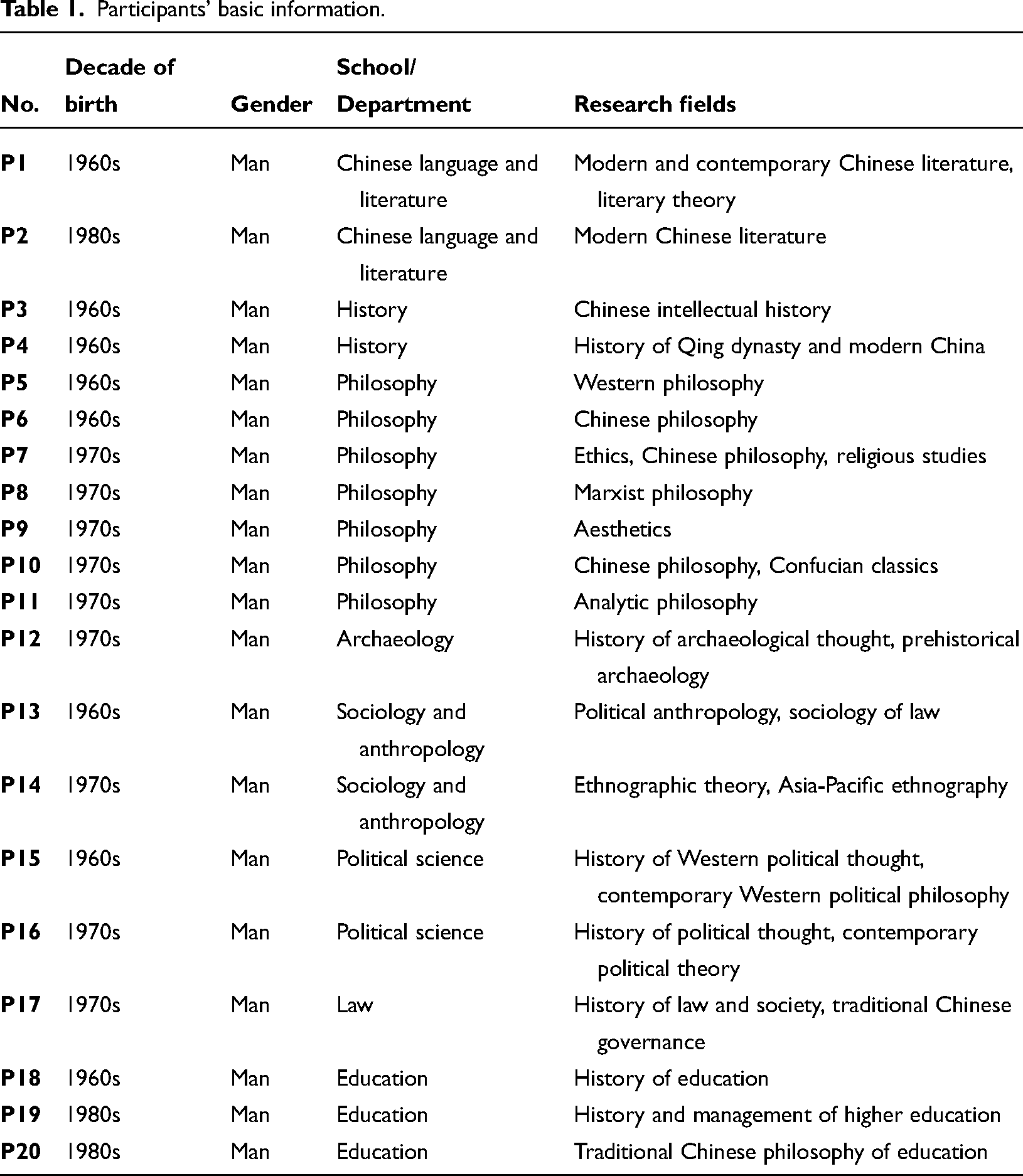
The interviews were conducted between December 2021 and July 2022. All participants provided informed consent prior to their inclusion in the study. Each interview lasted between one and two hours. The study utilized a semi-structured protocol for conducting interviews. The semi-structured interviews were organized around two key themes, as follows: (1) participants’ perceptions of international academic mobility and (2) strategies for addressing current global knowledge asymmetries through international academic mobility. Mandarin was the only language used throughout the interviews. The transcripts were also in Chinese. Only the evidence that needs to be used or quoted in this paper is translated into English.
Thematic analysis was employed to analyze the data. This involved identifying all relevant units of data pertaining to participants’ perceptions and experiences related to the impact of international academic mobility, coding them, and identifying the patterns and themes that emerged from the data. Accordingly, three main themes emerged, which are discussed in the results below.
Results
International academic mobility as a facilitator for approaching Western culture and knowledge
The participants acknowledged the significance of international academic mobility in their acquisition of Western culture and knowledge. They identified three types of international academic mobility activities as the most important channels in this regard. The first channel is international travel for study and research. Among the 20 participants, 15 explicitly mentioned their academic mobility as visiting scholars (over one year) and two participants mainly shared their experience of overseas doctoral study. The second channel is participation in international conferences, and the third channel is research collaboration. Their lively accounts demonstrated how these channels facilitated their learning of Western culture and knowledge in three ways.
First, all participants emphasized that international academic mobility could help researchers truly approach the dynamics of research in the West, including both academic traditions and the latest research trends. As P11 mentioned, while familiarizing oneself with research “through collecting international papers when academics are at home” is possible, this is less effective than “contacting the living being [the author] on the spot.”
Regarding academic traditions, international academic mobility allows Chinese scholars to immerse themselves in the Western academic tradition rather than reading about it from old literature. P3 pointed out: “Each country relies on its own academic tradition when dealing with certain issues. That is to say, it not only has an awareness of the persistence of problems but also has different theories and approaches that can be [used].” As a researcher with “mature ideas about academic research” and “a certain amount of personal experience,” P3 felt he greatly benefitted from research collaborations: “We can build on each other's strengths, share our experiences, and strengthen our ability to handle related issues.” He elaborated how his concern for “the development of modern knowledge and exchange between China and the West” was nourished by German academic traditions of conceptual history. Germany has “its own tradition of sinology, including some theoretical and methodological foundations for studying these issues,” such as “the research method of conceptual history” (P3). When he went to Germany in 2000, he saw that this approach to historical research “was already well understood by the [Western] researchers [he] was collaborating with” and had already been used to “do a lot of work.” P3 learned this approach based on his accumulated knowledge of history and progressed quickly. With the support of researchers such as P3, conceptual history has been more widely used in China in recent years.
Regarding recent developments in academic research, most participants emphasized approaching the latest theories and methods in the West through international academic mobility. Some participants indicated that Chinese research still needs to catch up with Western research in certain aspects, and they thought traveling abroad could provide first-hand insights into current trends in Western-led global academia. Accordingly, P11 argued: “Overseas experience is very helpful to expand our horizons and collect academic information.” When P2 was at home, he noticed Chinese scholars believed that “Japanese Sinologists favored documentary evidence and rigorous research over grand theories,” while “American Sinologists preferred a more strategic and ambitious approach which included exploring broader themes and making sweeping generalizations.” However, during his time as a visiting scholar in Japan, P2 observed that “there has been a decline of the traditional Japanese Sinology…Many [Japanese] scholars were catching up with Western theories.” P9 mentioned his study in the United States, where he learned “the latest, cutting-edge philosophical trends of our time.” He acquired Western theories through lectures at the City University of New York: “I met the most important traditional logical positivist philosopher Kripke … He gave a class. I also listened to many lectures by Chomsky … I was more exposed to ethics, cognitive theory, and affect theory.”
Attending international conferences in the West aids in conveniently enhancing scholars’ knowledge of research over a short period. P11 said: “If you are in the United States, you can drop by to attend the annual conference of the American Philosophical Association. Then you can learn a lot of new things, including what many academics are doing, which is very helpful.” Similarly, P18 commented: “Academic exchange can promote an explosion of ideas, especially for Ph.D. students, who should be encouraged to actively participate in international conferences.”
Second, most participants highlighted the importance of international mobility in activating and adding to their embodied and encultured knowledge about the West. They noted that international mobility could bring the experience of textual materials to life. P5 cited an old Chinese proverb about “reading ten thousand books and traveling ten thousand miles,” and argued that “ten thousand books alone are insufficient”: “I had read a lot of Western studies before arriving in Canada, but many conceptual ideas needed to be activated by experience when I first entered Western society.” Thus, it seems that Chinese HSS scholars may not lack textual knowledge about the West but rather the embodied and encultured knowledge about Western societies and lifestyles. P7 was a visiting scholar at a seminary where a variety of religions, including Catholicism, Judaism, and Protestantism, are researched. He was involved in many of their religious activities. Gradually, he discovered that religion played an extremely significant role in American culture: We had some major events that year … Once the church leaders talked about one issue, everyone cast their votes. I immediately discovered that Christianity is very important in American society. I remembered reading He Lin's saying “Science and democracy are the application of modern Western civilization, and Christianity is the essence of modern Western civilization.” I wondered at the time how he could consider a religion that we Chinese did not give much thought to as the essence of Western civilization, especially as the “essence” is more important than its practical “applications.” When I first arrived in American society, I became more conscious of this. Scholars, especially those with overseas experience, should not stay immersed in books, but go deeper into local societies … The more they experience, the better … including communicating with the people, experiencing their cultures, and obtaining embodied knowledge … Experiential knowledge is very profound. The primary significance of international conferences or overseas study visits is not academic exchange, because there are not many real exchanges. Rather, it is to understand the research dynamics of international scholars and observe overseas societies and lifestyles. It is more beneficial to travel a thousand miles than to read a thousand books, and empirical observation is paramount in academic research. The greater harvest is the understanding of the world, compared to the specific academic advancements, which are very common because you have to visit and have discussions. The root of some issues may be better understood through a more engaged approach [to international mobility].
International academic mobility as an amplifier of global knowledge asymmetries
Although the participants generally recognized the advantages of international academic mobility for their HSS research, they also pointed out its negative role in knowledge exchange between China and the West. Their remarks regarding accentuating global knowledge asymmetries were of three main types.
First, participants noted that the current global knowledge system is largely shaped by the Anglo-American West, which, in turn, shapes the direction of international academic mobility. As a scholar born in the early 1960s, P4 urged for deeper contemplation on this aspect of mobility: “The exchange and communication between China and the West is no longer a problem. For our generation, I think it was still very difficult to go abroad when we were [university students] in the 1980s … It is simply too easy to go abroad now.” Arguably, current scholars who go abroad with no difficulties may adopt Western academic practices without sufficient critical reflection. As described above, contemporary Chinese scholars often travel to the West to acquire knowledge. This, in turn, reflects the influence of academic institutions in the Anglo-American Western world, which have exerted control over research trends, including theories and methodologies.
Some valuable academic resources concerning China or materials originally owned by China are also now concentrated in the Anglo-American West, leading Chinese academics to make pilgrimages to consult them. P6 talked about the books he discovered in the Asian section of the Library of Congress in the United States: It has a section of Chinese books published in Chinese mainland before 1958, mainly in the Republican period or the early 20th century … In addition, there are about 4,000 volumes of ancient books in good condition, many of which are from the Ming and Qing dynasties.
Second, participants observed that many Chinese HSS academics tend to adopt an uncritical mindset and mimic Western paradigms, leading to the loss of their own subjectivity during international academic mobility. This situation was rooted in the long-standing self-perceived cultural inferiority of Chinese academics. P16 admitted: “We actually have had cultural inferiority for a long time. It was the case in the 1980s and 1990s when I was at school.” Thus, Chinese academics have been used to following the West without considering how Chinese knowledge might contribute to the rest of the world. P5 recalled that when he traveled abroad for the first time in 1998, he was invited to speak on culture by a club organized for retirees. He was “very impressed” when an old lady asked him a question at the end: “Hey! What can we Westerners learn from China?” Although he answered the question, he had never thought about it before. He remembered how the domestic cultural atmosphere was centered on “learning from the West,” which meant “opening up to the West and then trying to learn some Western science, technology, ideas, and culture.”
Although participants noted the rise of cultural confidence in and beyond China's academia, a tendency still exists among Chinese researchers to accept and emulate Western academic standards. P4 criticized the fact that Chinese scholars have followed this tendency to establish a global reputation in international academic mobility, including attending academic conferences and visiting prestigious colleges in the United States. He stated that “the biggest problem of Chinese scholars now is the desire to gain recognition from the other side.” He claimed that many Chinese scholars have been substantially and unknowingly influenced in this manner: A large number of international conferences nowadays [have such problems]. Do you think what you speak about is really what is inside your mind? What you want to say may be shaped by the other side. An international conference is a field where everybody needs to interact. The Western [discourse] is absolutely strong, and thus, you will definitely follow its approach if you attend the conference. Before the pandemic, there were a lot of exchanges, conferences, and so on, but now, there are fewer of them. However, I believe that this type of communication is unavoidable and that many issues will no longer be problems in the future.
Overall, some participants have recognized the potential risks associated with international academic mobility and have raised concerns regarding the resulting knowledge asymmetry between China and the West. However, the possibility of a more nuanced approach to international academic mobility also emerged from their critical reflections, as described in the following subsection.
International academic mobility as a means of promoting two-way knowledge exchange
Although participants recognized negative aspects associated with international academic mobility, they reached a consensus that it can foster reciprocal knowledge exchange between China and the West. They proposed two strategies for promoting two-way knowledge exchange based on their individual epistemic practices and expectations.
First and foremost, most participants stressed that international academic mobility can cultivate reflexivity, which promotes more profound and equal knowledge exchange. This requires engaging in critical reflection not only on the Western-dominated global knowledge system but also on one's own culture and knowledge. As previously mentioned, some of the participants recognized how global knowledge asymmetries are amplified by international mobility. In response, they tried leveraging this disadvantage and enhancing their understanding of China, including traditional Chinese knowledge. Accordingly, P17 asserted: “The more you learn about other countries, the more you can compare them to Chinese society.” Similarly, P13 argued that international academic mobility allows scholars to “increase their self-awareness and awareness of other cultures, stimulating new thoughts and ideas,” which he believed was “one of the most significant advantages of the modern era.” He explicated: When you go to a Western country and speak about your ideas, you cannot simply repeat Western ideas; however, your thinking, culture, and the subtle vocabulary in your expressions may impact the Western world; in turn, you can come back with the Western world's influence to look at the concepts in your own culture, and what you were not very sensitive to may become very important. This, I believe, is the process [of exchange]. [Fei] returned [from the United States] and wrote From the Soil: The Foundations of Chinese Society, a book entirely about China. Yet, it would have been impossible for someone who had only ever known China, where they were from, to write From the Soil in that manner. Why? Because he made a comparison after traveling round the world and then focused on the core characteristics of rural China, which he could see more distinctly and firmly, and which were no longer ambiguous.
Second, all participants acknowledged that international academic mobility increases the global visibility of Chinese scholars. This should be encouraged, as such visibility is increasingly important to more widely share Chinese culture and knowledge. Thus, participants encouraged Chinese HSS academics to engage in various international activities. P13 perceived such activities as a regular practice: “Developing scholarship will become more and more [based in] an international community. Our research is not only our personal business but may also become part of the process of international influence and development of the whole discipline.” The notion of “bringing Chinese knowledge to the West,” as proposed by P6, has become a widely recognized concept among a growing number of Chinese HSS scholars. P6 explained: “We bring [Chinese knowledge] into the Western discourse and the Western context. We provide the West with the resources of our Chinese tradition in response to some of their problems.”
In this case, participants encouraged Chinese HSS scholars to speak out more about Chinese knowledge at international conferences, through collaboration, and through other means in international activities. P19 argued: “You must publish, and you must speak at international conferences … you must allow others to see you, gradually increasing your visibility and influence, which I believe is critical.” Taking a wider view, the promotion of Chinese knowledge can be realized, fostering mutual understanding. This was demonstrated by P15's successful experience of research collaboration: I will make [a Western scholar] feel that the difference between him and me is quite similar to the difference between [Western scholars]. This difference between us is a difference between human beings, not between human beings and aliens, so I think we can understand each other … There are actually times when we might be able to bring them to understand more about themselves. In turn, they can bring us to learn more about ourselves.
Therefore, despite the disparities highlighted by the challenges arising from globalization, there are opportunities to effectively promote two-way knowledge exchange between China and the West. This illustrates the dynamic nature of global knowledge exchange and potential alternatives to current global knowledge flows.
Discussion and conclusion
This study provides an overview of the potential advantages and risks of international academic mobility for HSS knowledge exchange between China and the West. It also explores strategies for generating more equitable knowledge exchange in response to global knowledge asymmetries. Accordingly, it provides both theoretical and practical contributions, informing practice and policies in Chinese higher education and beyond.
Through this study, three contributions have emerged, which deserve further attention. First, this study expands the discussion on international academic mobility by incorporating the cultural politics surrounding global knowledge flows, with specific attention paid to the interactions between Chinese and Western knowledge. It reveals that while Chinese HSS scholars have a strong need and desire to learn from the Western-dominated international academic community, they can reflect critically on their growing reliance on Western frameworks. This echoes the long-standing trend, driven by historical circumstances, of non-Western scholars pursuing international mobility as a means of acquiring knowledge from the West. Importantly, even though the former imperial and colonial powers have receded, the Anglo-American West continues to exert influence and maintain control over global academic resources, including through the implementation of neo-colonial curricula (McGregor & Park, 2019). Until now, non-Western peripheral researchers have depended on their Western counterparts in the central zone for knowledge resources and recognition (Zheng & Wu, 2022). For example, China's (particularly elite) universities tend to regularly assess and improve their research and teaching institutional arrangements through comparisons with their international peer institutions (Zha et al., 2019). Such growing resemblance allows China's higher education to “nip at the heels of” global academic leaders (i.e., the West; Yang, 2022).
Second, the study highlights the role of international academic mobility in knowledge exchange by involving Chinese HSS scholars’ voices, thus providing new insights into interactions between Chinese and Western knowledge. It elucidates the significance of three forms of international mobility. The first (and most common) form comprises international visits for study and research. This helps Chinese HSS academics bring back the most recent knowledge, including theories and methodologies (Chen, 2017), facilitating knowledge flows to the home nation (Atta-Owusu, 2019). The second form is attending international conferences, which acts as a quick source of current research resources and ideas for those involved in global research communities (Lu, 2019). The third form is research collaboration, which is a fruitful conduit for bridging Chinese and Western knowledge (Atta-Owusu, 2019). It can increase contacts between academics, offer knowledge assimilation, and facilitate the co-construction of new knowledge (Horta & Shen, 2020; Ryan, 2011).
Additionally, the study emphasizes two crucially important aspects of international mobility for HSS scholars, an often-overlooked group in research examining global academic knowledge transfers. One is related to the physical resources required in HSS research, “such as libraries, archives, museum collections, archaeological digs, and so on [which] tend to be place-specific and relatively immobile” (Coey, 2018, p. 215). Accessing such intellectual resources during international mobility directly facilitates scholars’ knowledge production. The second important aspect is related to the embodied and encultured knowledge acquired from destination Western countries, which includes tacit location-specific knowledge (Baláž & Williams, 2004). In this case, international mobility can substantially facilitate Chinese HSS scholars in making introspective comparisons between Chinese and Western social and cultural issues (Chen, 2017). Therefore, non-Western HSS scholars may serve as a cultural bridge between disparate cultures (Lu, 2019).
Therefore, arguably, recent geopolitical tensions and the pandemic have greatly affected knowledge sharing in the evolving global landscape (de Wit & Jones, 2022; Oleksiyenko et al., 2021). The resulting forms of adaptation and innovation, such as virtual conferences and remote research projects, cannot fully replace the benefits of physical mobility for accessing intellectual resources and gaining embodied and encultured knowledge. Addressing the viewpoints of individual scholars, the study identified participants’ optimistic outlook on recovery from the pandemic, emphasizing the role of individual endeavors in international mobility to facilitate knowledge exchange between China and the West, as discussed in the following paragraph.
Third, this study sheds light on possible strategies for promoting bi-directional knowledge exchange by non-Western HSS scholars during their international mobility. The first strategy entails resisting unquestioning conformity to Western paradigms and instead engaging in self-reflection on one's own culture and knowledge system through comparisons with the Western counterpart. For instance, Chinese HSS scholars have already recognized that their embodied and encultured knowledge gained through international mobility can strengthen their research on the West and spur their reflections and research interests relating to Chinese studies (Shen et al., 2023). The second strategy is to enhance global dialogues by increasing the visibility of Chinese HSS scholars in international academia based on such awareness. For example, scholars have sought to participate more actively in international academia, including publishing in English-speaking journals (Xu, 2019) and promoting local knowledge (Marginson & Xu, 2023). They may also develop a more comprehensive, globally oriented discourse that incorporates indigenous wisdom (Ding, 2019; Liu, 2003). These strategies demonstrate how global knowledge exchange is constantly evolving, which can serve as a source of inspiration for academic practices in non-Western societies.
In addition to epistemic practice, the study also informs higher education policies. Policymakers can contribute to the creation of an inclusive and conducive environment for the international academic mobility of HSS scholars, ensuring that scholars have the necessary resources, support, and opportunities to engage in meaningful knowledge exchange (Huang et al., 2022). For example, Chinese policies should support the global mobility of HSS scholars, which can truly “introduce domestic knowledge, culture, higher education models, and norms to the world” (Wu, 2019, p. 81). Furthermore, policymakers can draw on the example set by Chinese scholars in promoting global collaborative strategies in non-Western societies; such an approach can avoid strengthening Western-centric perspectives and accentuating global knowledge imbalances (de Wit & Jones, 2022).
Despite these contributions, this study has some limitations, which suggest future research directions. The first limitation pertains to the diversity of the participants. The current sample reveals an unexpected concentration of participants with research interests in history, despite the initial intention to include scholars from various schools and departments. Moreover, there is a notable absence of some key HSS subjects, including economics. All this indicates a possible relation between scholars’ research interests and engagement in knowledge exchange between China and the West. Future research may include interviews with HSS scholars from disciplines that were not represented in this study. Another crucial issue is the absence of female participants. This result is directly linked to the lack of published works by female scholars on knowledge exchange between China and the West, which is the primary focus of our research. Although the findings may not be significantly affected by the exclusion of female academics, future research might specifically investigate how female participants perceive and engage in knowledge exchange between China and the West during international mobility.
The second limitation relates to the research topic, which concerns bridging Chinese and Western cultures and knowledge in response to global knowledge asymmetries. The aim was to promote mutual respect, understanding, and equal exchange between Chinese and Western culture and knowledge. However, this is a complex area and requires more explicit clarification. Chinese HSS scholars’ perceptions and experiences represent only one example among non-Western scholars. Thus, it is important to investigate additional cases from diverse non-Western societies to gain a more comprehensive understanding of this phenomenon. Future research could also explore variations in responses to global knowledge asymmetries and identify additional strategies to facilitate more equitable and inclusive knowledge exchange during international academic mobility.
Footnotes
Declaration of conflicting interests
The author declared no potential conflicts of interest with respect to the research, authorship, and/or publication of this article.
Ethical statement
Ethical approval for this study was obtained from the Human Research Ethics Committee at The University of Hong Kong (approval number: EA210095). All participants provided informed consent prior to their inclusion in the study.
Funding
The author received no financial support for the research, authorship, and/or publication of this article.
